Wednesday, June 04, 2025

“Antisemitism” The Making of Our Political Panic


 June 4, 2025
Facebook

Photo by Josh Hild

On May 15, 2025, Logan Rozos was the selected student speaker at NYU’s Gallatin School commencement. Briefly addressing the large crowd of faculty, students, their families and friends, Rozos offered brief remarks condemning “the current atrocities currently happening in Gaza” with U.S. financial, political, and military support. Nowhere in the short remarks were Israel or Jews mentioned. The remarks received prolonged applause from the students, followed by some jeers. Immediate social media accusations charged Rozos with “antisemitism” and “Jew hatred.” NYU, the country’s most expensive university, quickly condemned the remarks and withheld Rozos’s diploma as a consequence. A day later, at NYU’s Tisch School commencement, a group of faculty, in full regalia, stood on stage with white gags tied across their mouths, reminiscent of slavery’s muzzles. (Logan Rozos is Black and transgender.) To date, NYU has restrained from disciplining them, concerned perhaps about further inflaming tensions.

The social costs of spiraling inflation place overbearing burdens on the many while proving profitable for the small group well positioned to benefit from rising prices. The latter tend to be those controlling conditions of political economy, the former those lacking such power. Spiraling charges of antisemitism today raise related questions about the consequent social costs of the manufactured political panic in play: undermining the social standing and prospects of Israel’s critics, especially of those younger who have less institutional support or protection; intensification of uncertainty concerning what can be critically uttered and done; heightening of social conflict and the institutional costs from having to manage the impacts and fallout; and ultimately extending political control over institutions of higher education.

Accusations of rampant antisemitism on U.S. college campuses are fueling investigations by the Departments of Education and Justice. The Trump administration and Republican politicians have promoted the charges to assert greater control over prominent universities, private and public, regarding what can be taught as well as to limit critical political activity on campus. The NYU case illustrates larger dynamics in play.

Key to the Trumpian strategy has been to pit Jewish donors against administrations, faculty and student groups, and administrations, faculty, and students against each other. The aims are twofold. First, universities are being pressured into “deliberalizing” campus thinking, teaching, and culture. And second, Jewish supporters of higher education, traditionally more Democrat leaning, are being pitted against more progressive campus constituencies, further undermining the basis of anti-Republican strength. Inflating “antisemitism” has been key to these ends, encouraged by the current Israeli government and long fueled by Israel’s support groups and organizations in the U.S. and globally.

Central to this strategy is adoption of the International Holocaust Remembrance Alliance (IHRA 2016) formulation as the key determinant of what counts as antisemitic. The IHRA account has been adopted by 40 states, including the U.S. State Department, and a host of other institutions, among them universities like Harvard, as their basis for placating the Trump administration by opposing “antisemitism,” to the point of illegalizing it.  Congressional Republicans have been pushing the Antisemitism Awareness Act. This would require the Department of Education to deploy the IHRA definition in its attacks on higher education, effectively criminalizing most criticism of Israel. The Act expands antisemitism’s definition to include most anti-Zionist expression for the purposes of civil rights law. It thus seeks to curtail critical political speech. One exception Senate Republicans have introduced reveal the politics in play. The charge that Jews killed Jesus, long a Christian nationalist assertion, would not be considered antisemitic (despite IHRA explicitly formulating it as such). Republicans would protect the claim in the name of advancing First Amendment free speech rights. The outcry has been muted, at most. It seems that not all actual antisemitism is, well, “antisemitism.”

IHRA’s principal author, Kenneth Stern, director of the Center for the Study of Hate at Bard College, has repeatedly emphasized that the “working definition” was never intended as a state or legal principle. Rather, it was provided as a working account to be used especially by European researchers to monitor expressions of antisemitism across the many countries on the continent. Stern is clear: IHRA should not be used to prohibit or restrict non-contemptuous criticism of Israel, or of Zionism, notwithstanding his own disagreements with such criticism.

On its face, the definition IHRA offers appears largely uncontroversial, centering “hatred of Jews.” If one substituted “hatred of Muslims” or “Islam” it could easily serve as a comparable formulation of Islamophobia. But “hatred” reduces more complex considerations to affective criteria, sliding by discriminatory group stereotyping or material dimensions. Following the likes of Charles Murray and Dinesh D’Souza, Christopher Rufo has suggested that group crime rates justify not hiring or admitting Black applicants for some positions. And “positive discrimination” might privilege group members at the expense of non-members. Theodor Herzl, a key founding figure of Zionism, famously offered the Sultan of Turkey free accounting service (“financial regulation”) by Jews in exchange for Palestine as the site for “the Jewish state.” Herzl was trading on the time-worn stereotype that Jews are good money-managers, the world’s Shylock in less flattering terms. Donald Trump has reportedly mimicked the characterization: “Black guys counting my money! I hate it. The only kind of people I want counting my money are short guys that wear yarmulkes every day.” These sorts of gross characterizations reinforce the longstanding antisemitic stereotype of Jews controlling the local or global financial system.

Given antisemitism’s conceptual elasticity, then, it becomes understandable why Stern cautioned against adoption of IHRA as a formal legal account. The more fraught terrain across which both antisemitism and Islamophobia operate suggests turning to an actionable disposition rather than an affective consideration to ground plausibility to charges of antisemitism or Islamophobia. Both are expressive or active antagonisms towards and on the basis of uniquely picking out Jews and Muslims, or their institutions, respectively—for character traits, actions, social standings or roles attributed to the group as such. This would make the definition’s applicability far less nebulous and porous than the claimed basis on hatred. The Jerusalem Declaration on Antisemitism (JDA) offers a more fine-grained account than IHRA’s, one consistent with that I offer here. It parses out antagonisms as “discrimination, prejudice, hostility or violence” directed at “Jews as Jews (or  Jewish institutions as Jewish”). Antagonism is a disposition of antipathy, treating Jews (or Muslims in the case of Islamophobia) differently or for pejoratively different reasons than others.

The JDA offers a careful set of guidelines for what counts as antisemitism, most notably regarding criticism of Israel. Tellingly, its definition has received far less uptake, application, or discussion than the more elastic and easily weaponized IHRA formulation. It has been adopted, as far as I can tell, by no states. Like the IHRA definition, though, it explicitly rejects being codified into law.

The IHRA controversy, however, is made to turn less on its actual definition and more readily on the sorts of examples of antisemitism it offers as heuristics. Pretty much the entire public conversation around adopting the IHRA account slides by the formal definition, leaving it unmentioned. Instead, the examples are taken up as if inevitably instances of antisemitic expression no matter the circumstance and without exception. The examples effectively serve as definitional substitute.

A careful reading of the IHRA document, however, calls for a more nuanced, less definitive analysis of what “might” or “may” or “could” amount to antisemitic expression, depending on “overall context”  in specific circumstances.  Sloppy readings of provisional considerations of “overall context” nevertheless have opened IHRA applicability to an expansive range of instances, loosening parameters currently in play, while also rendering any specific determination prone to more or less robust contestation. The overwhelming effect has been accusation inflation and expression suppression. Mere accusation has foreclosed analysis, been made guilt-producing. Its political uptake has been designed to produce panic, by individuals and institutions.

The eighth example IHRA offers, arguably the key one, is especially telling here. What counts as antisemitism is “the targeting of the state of Israel, conceived as a Jewish collectivity” unless “criticism of Israel [is] similar to that leveled against any other country.” (Five of the eleven examples offered focus on statements about Israel.) The qualification is so central to IHRA that example 8 is repeated verbatim from the claim made in the preamble paragraph to the eleven examples IHRA offers. The conditional is invariably disregarded by those adopting IHRA’s account. The definition is effectively read as “classif[ying] most anti-Zionism as antisemitic.”

Consider this: Were a person—call them X– to say they hate Russia for the way it has treated Ukrainians few if any would so much as blink. But were X to say they hate Israel because of the way it has treated Palestinians, Israel’s supporters would quickly turn them into an antisemite, threatening their career if not life. What’s the difference exactly? The latter would certainly not be transgressing the letter and, for Stern, spirit of the IHRA definition. X would not be saying they hate Jews but criticizing the state of Israel in ways they might reasonably criticize another state, say Russia, as IHRA insists they must if not to qualify as antisemitic.

In response, Israel now declares itself not just a Jewish state but the state of all Jews. For a Jew to say it is not their state is not to declare themselves not Jewish, even if Netanyahu’s state seems to be gesturing to that declaration. It is to say Israel is not the state of this Jew, and a growing number of others like them in this regard. One might say something analogous of Russia, or Ukraine, of most all other states. Ethnicity is not reducible to state belonging. It is not that one would rather not be bound by its laws, culture, or politics. Netanyahu’s belligerent state is ready to radically narrow the range and diversity of Jewishness, effectively reducing official “Jewishness” to a minority of an already distinct global minority. This would make Jewish Israel far less secure and more vulnerable than advancing the longstanding Jewish tradition, traceable to the Torah, of embracing the stranger, and living justly with the neighbor.

A careful reading of this particular IHRA example, then, more generally implies that critics of Israel reasonably objecting to any state defining itself on reductively ethno-religious, -national, or -racial grounds would prima facie not qualify as antisemitic. A critic questioning the Israeli government’s self-characterization in law and policy as “theJewish state” materially and legally privileging Jews while restricting in materially discriminatory ways all who are not would not be questioning only Jewish self-determination or sovereignty. Grounding such criticism on a general theory that any such state ends up invariably precluding those not meeting the (usually shifting) criteria of ethno-religious belonging is not reductively anti-Jewish. States ethno-religiously self-defined (no matter the religion) almost inevitably turn repressive to sustain their ethno-purity. Once embracing secularity, they usually scale back some on state violence or restriction against those of different ethnic or religious background even as the state might retain vestiges of its historical culture usually referenced as its “national character.” The latter might take on pernicious implication at the hands of a nationalist government but, unlike ethno-religious ones, secular states do not invariably end up doing so.

+++

Those inflating political charges of antisemitism have overwhelmingly ignored, if not resisted, more fine-grained analysis of the kind suggested here. President Trump’s commitment to rooting out antisemitism from college campuses, and seeking to deport non-citizen campus critics of Israel, proceeds by reductively collapsing ethnicity with a political state. Stern is right. Most criticisms of Zionism should not be deemed antisemitic, as Israel’s supporters too often charge. Zionism, after all, is a political ideology. It is neither a necessary nor sufficient condition for Jewishness. Criticisms of Zionism are not necessarily antisemitic unless linking it perniciously to Jewishness. Those defending against political criticisms of Zionism most often dismissively reduce all anti-Zionism to antisemitism. This mere assertion, nevertheless, does not create the fact of it, nor a shield from the reach of justice.

Harvard’s reports on Antisemitism and on Islamophobia, both released April 29, 2025, reveal the numbers of Harvard Jewish and Muslim constituents expressing fear of antagonism towards them on campus. The data are telling. Well over 2,000 Harvard faculty, staff, and students responded to a survey. Almost half of Muslim (47 percent), 15 percent of Jewish, and 6 percent of Christian respondents felt physically unsafe on campus.  Nearly all Muslims (92 percent), 61 percent of Jews, and 51 percent of Christians registered anxiety about expressing their political views. And yet the overwhelming  focus–at Harvard, in media reports, by the Trump administration–has been on antisemitism.

Antisemitism no doubt exists on campuses. It tends to be generally reflective of the antisemitism at any point in the culture at large. It is perhaps unsurprising, then, that the reported numbers have spiked following Israel’s dramatically disproportionate, increasingly genocidal response to the murderous Hamas attacks of October 7. But reports of the robust spike in instances of campus antisemitism require careful disaggregation too. Antisemitic language has been used by some, perhaps especially a small number of students, critical of Israel’s actions in Gaza. Whether such expression is all a product of sustained antisemitic belief, thoughtless insensitivity, or caught up in the emotion of the moment remain open questions. It is not clear to what degree the spike in reports has been inflated by treating most any criticism of Israel’s actions in Gaza as antisemitic for making Israel-supporting Jewish students “uncomfortable” or “distressed.” It is also unclear to what degree Islamophobia and anti-Palestinian antagonisms have ramped up: the Harvard reports suggest they have to a significantly greater degree than antisemitism.

Anyone identifying with or expressing support for Israel in the wake of October 7 may well feel discomfort due to even reasonably articulated concerns about genocidal reactions by the Israeli state to the attacks. Jews, as some have pointed out, understandably feel especially sensitive about Israel being charged with genocide.  And relatedly, there is great resistance to admitting that Israel’s leaders could be driving one. That campus supporters of Israel tend to report a dramatic spike in antisemitism while Jewish critics of Israel do not suggests that the underlying sensitivities tend often to prompt the charge of antisemitism out of the discomfort.

Discomfort alone, however, doesn’t fit either the IHRA or JDA definitions. The tension between discomfort, sometimes produced by insensitive expression by young students, and students’ like Logan Rozos’s cutting critiques of genocidal destruction will not be resolved by pedagogical institutions turned punishment machines. The Genocide Convention characterizes genocide as intentionally eliminating or harming some (not necessarily all) members of a group by killing or removal. Copious evidence of this exists in Gaza. The notable Haaretz journalist, Gideon Levy, recently indicated that Netanyahu’s current undertaking is to “exterminate” all Palestinians in Gaza. Former Knesset member and now head of a far-right libertarian party, Zehut, Moshe Feiglin, recently declared that “Every child in Gaza is the enemy. . . not a single Gazan child will be left [in Gaza].” Those condemning Israel, both Jewish and not, have been antagonistically targeted by some stridently Israel-supporting faculty and non-campus observers, almost invariably with the prompting or support from Israel-supporting organizations. The latter hardly ever face campus disciplinary action when their accusations against named individuals or groups prove after vigorous campus administrative investigation, including by outside lawyers, to be fabricated at worst or exaggerated at least.

The contrasts in response to Islamophobia or anti-Palestinian and antisemitic antagonisms are telling. There are no accounts of pro-Israel students beaten up by off-campus thugs or police, being picked up by ICE and threatened with deportation without due process, as Palestinian-supporting students and faculty have been. There are very few cases of disciplinary action against Jewish defenders of Israel. Shai Davidai, Israeli faculty member in Columbia’s Business School, was briefly barred from campus in late 2024, whereas Columbia Law School’s Katherine Franke, a vocal critic of Israel, was forced into early retirement. There have been streams of disciplinary action against students, Palestinian or Jewish, critical of Israel’s ongoing massacre in Gaza, as there have been against those protesting Israel’s treatment of Palestinians well before Oct 7. Palestinian (and indeed Jewish) faculty critical of Israel regularly receive death threats.

Government spokespersons, American and Israeli, as well as mainstream media,  have instantaneously characterized as “antisemitic” Elias Rodriguez’s chilling murder of two Israeli embassy employees in Washington D.C. The same is true of the awful flame-throwing attacks by Mohamed Soliman on those holding a vigil calling for the release of the remaining hostages held by Hamas in Boulder this past Sunday. That there is no justification for such violence should not distract from the fact that, to date,  there is no evidence either was aimed at Jews as Jews. Both were directed at Israel for its war on Palestinians (and not just on Hamas), by attacking its employees or supporters.  In both cases the perpetrators shouted “Free Palestine,” adding no words at the scene or on social media about Jews.  The murders and attacks, each conducted by lone men and horrific as both events were, will also likely heighten not dissipate violence against Palestinians. In the ten days between the embassy murders and Boulder attacks, Israel killed well over six hundred Gazans, including many peacefully lining up at a food distribution site after two months of Israel’s preventing any aid reaching Gaza. These killings have received far less media coverage than the two U.S. events. Mainstream reports of the IDF bombings have almost completely maintained anonymity of those killed. No one should be subjected to violent assaults like these, whether conducted by loners or states.

+++

Targeting of Israel’s critics as antisemitic appear to ramp up exactly when Israel’s government makes public and carries out its violent plans in Gaza. Charges of “antisemitism” against critics now represent a textbook case of a politically- and media-inspired moral panic, as theorized in the 1970s by Stanley Cohen and Stuart Hall. Concerns about some incidents become blown up to include an entire population, all members of which then get targeted, further exacerbating the panic about the group. The initial concern, linked to a long historical animosity, becomes ramified into the stereotype. Much as racism historically manifested race, the political panic produces the targeted population, not the reverse.

The strident attacks on Israel’s critics are not happenstance. They are produced by well-funded organizations, some financially supported by Israeli state entities as well as by Jewish American billionaires. StandWithUs, Canary Mission, and Betar have all made it a central cause to use any means available to them to shut down criticism of Israel, including providing the Trump administration with names of Israel’s critics to deport.

“Discomfort” and “distress” are the sort of psychic sensibilities that IHRA’s centering of hate in defining antisemitism has tended to encourage. That these considerations are so subjective render inflationary antisemitism that much easier and politically effective. They silence most public and campus reference to the “hundred’s year war” on Palestinians. In classrooms and forums, accusation and political theatre have substituted for any need to provide arguments to support Israel’s actions. The recourse is mostly to claims of “existential threat.” Quick charges of “existential threat,” while perhaps understandable against the backdrop of mid-twentieth century history, cannot close down debate, let alone criticism.

Despite the accusations, Harvard University is hardly the hotbed of rampant antisemitism, “perpetuating an unsafe campus environment that is hostile to Jewish students, promotes pro-Hamas sympathies,” as Homeland Security Director Kristi Noem recently charged. That’s not to say there is no antisemitism at Harvard, nor that there is not more post October 8 than before it. Where Jewish organizations such as Hillel are the objects of Israel-critical protest, these would count as antisemitic only where the campus organization has no record of supporting, embracing, defending, or rationalizing Israel’s devastation of Gaza. Where there is no such record, targeting a Jewish organization or institution—Hillel or a synagogue, say—would be doing so because identified as Jewish. But where the institution’s membership or board as such has supported Israel’s actions in Gaza, criticism becomes legitimate public political expression. Criticizing the ADL for these attacks would not count as antisemitic unless criticisms included evident antisemitic stereotypes or self-evident presuppositions. Concretely, the Anti-Defamation League has attacked critics of Israel’s actions in Gaza. Harvard and other universities like Columbia have too readily ignored these distinctions in the interests of placating the Trump administration only to find out that whatever concessions the university makes never satisfy Trump’s political calculus.

Charges of antisemitism now serve as the dead end (excuse the metaphor) for acknowledging the kind of genocidal action taking place before us. Genocides thankfully have never completed themselves, despite the deadly suffering they produce. But as Jews and Germans today could surely both attest in their own ways, or South Africans for that matter, they leave indelible marks not just on victims and perpetrators but on generations of their offspring alike.

+++

Antisemitisms have seen some increase, as I’ve said. The increase in reports and charges is driven in part by concerns for Israel, the heartfelt covering for the politically cynical. Concerns about Jewish student wellbeing are amplified,  those for Palestinian or Muslim students relatedly under-emphasized, even ignored. In response to Harvard’s antisemitism report, a Trump administration spokesman declared that “Universities’ violation of federal law, due to their blatant reluctance to protect Jewish students and defend civil rights, is unbecoming of institutions seeking billions in taxpayer funds.” They were deafeningly silent in response to the Harvard report on Islamophobia.

Trump’s vocal stress on college antisemitism (spurred on by the likes of the Heritage Foundation’s Project Esther) was fueled initially by Elise Stefanik’s grilling of then Harvard President Claudine Gay in a December 2024 congressional hearing on college antisemitism and the outcry that followed Gay’s floundering. As he assumed power, Trump mobilized antisemitism as a wedge issue to assert increasing control over college constituencies long critical of both him and ultra-right nationalism. This embrace has helped to undermine confidence in university knowledge-making, as much in the natural as human sciences. This, in turn, was meant to politically elevate the claim to deific presidential authority, to fill the vacuity left in the wake of the skepticism.

“Antisemitism” has served politically for the second Trump administration much as the attack on Critical Race Theory did for Republicans from 2020-2022. Looking strong on confronting campus “antisemitism” has helped to cover up some of the administration’s dramatic erosion of civil rights much as the anti-CRT campaigns did in conservative states and the anti-DEI and anti-woke focus more nationally since. In her letter to Harvard purporting to end Harvard’s capacity to admit international students, Director Noem explicitly linked antisemitism to Harvard’s “employ[ing] racist ‘diversity, equity, and inclusion’ policies.” The politics of inflationary antisemitism serves, in short, as heavy artillery in conservativism’s war on woke.

The political roiling of campuses around matters of Israel and Palestine poses a larger question, however. Israel’s supporters, whether governments, institutions, or individuals, are at least implicitly supporting Palestinian removal in Gaza and, through annexation, in the West Bank too. Those more explicit in this commitment characterizePalestinians as “human animals,” to be eliminated by bombing, starvation, or “self-deportation.” Not a condemnatory word has been uttered by those supporting Israel’s crusade against Gaza of Feiglin’s call to “kill all Gazan babies”. Inflationary antisemitism is the rationalizing legitimation of this crusade.

The political panic around antisemitism, then, has exacerbated anxiety of its occurrence. And this heightened anxiety, in turn, tends to find it around every corner, in every critical statement concerning Israel’s actions, in every damnation of its excesses. The panic produces the “proof.”

The larger question, then, concerns the tough work in the face of all this not just of reconciliation but as a stepping-stone to addressing what now seems even more impossible: how to live together, across separation divides such as borders but especially also literally as next-door neighbors, as partners in governing and commerce, even as friends and lovers? What would it take to find or really reparatively make ways of living together side-by-side, on campuses and in classrooms as in cities and countrysides, engaging with each other rather than fenced off by ideological or actual walls? Inflationary antisemitism serves to wall out even thinking this possibility, let alone its realization.

The political panic of “antisemitism” is exemplified by the fact that anything critical of Israel can now be dismissed in its name. Four years ago Christopher Rufo torched Critical Race Theory as a communist plot initiated in the 1960s by four Jewish European philosophers. The charge was repeated ad nauseam by his prominent followers like Ted Cruz, Ron DeSantis, and Mark Levine despite abundant evidence of its complete historical fabrication. No one registered the slightest concern that the  claim represents as classic a trope of Nazi-like antisemitism as one might find.

The political instrumentalization of “antisemitism”—now screeched save when proving all too inconvenient—empties the charge of the necessary power when really needed as a timely weapon to face down deadly attacks on Jews and Palestinians. Frantz Fanon famously declared that when Jews are attacked, Blacks should pay attention as they would be next. We might now say that when Palestinians are attacked, most notably by Israel and its supporters, Jews especially should pay attention. “Antisemitism” today renders more powerless the defense against the much more dangerous antisemitism of the Christian nationalists when tomorrow they no longer find useful the currently convenient embrace of the Judeo- to Christian ascension.

These are the challenges of our times, as pressing today as ever in the wake of ideological elasticity and the production of panic. It requires a response from every one of us, and from the university we want in our world. It is the question, after all, of how ultimately we choose, individually and interactively, to inhabit our humanity.


Ahh, Little Red Barns Don’t Exist Anymore, Israel Was Never a Democracy, and Neither US the Shining City on the Hill


A new book by Will Potter, author of Green is the New Red ('11), and then newsfeeds just keep dinging me on my computer as I read his Little Red Barns: Hiding the Truth from Farm to Fable


I’ll be interviewing Will this Tuesday, for my radio show, Finding Fringe: Voices from the Edge, and it will air in July.

Here’s a blub — a promotional positive statement about the book:

“We are in a fight for our lives against a rising authoritarian tide, and this clear-eyed, compelling, clarion call of a book has a message everyone needs to hear. We will not save ourselves if we do not also fight for the lives of others–including non-human animals. No one is better positioned than Will Potter to connect the dots between fascism and factory farming, and he does so with energy, conviction, and incredible insight.”

— Astra Taylor, author of Democracy May Not Exist, but We’ll Miss It When It’s Gone

I’m digging the book he sent me. Stay TUNED.

Yes indeed, things have gotten really really worse, and the book thus far is about ag-gag, the history of those laws, and we go back farther than Upton Sinclair’s The Jungle, way back to “Old McDonald Had a Farm.” Even farther back to Matthew in that book about bearing witness, or Islam and the concept of being a martyr, witness, whistleblower.

Oh, I recall this bullshit interview/debate on Democracy Now with Will Potter and the schill goofy woman working for the lobby, man, and the manufactured balance, the false balance, the broken equivalency.

Thirteen Years ago: States Crack Down On Animal Rights Activists And Their Undercover Videos

My most recent radio interview about to hit the airways June 18, KYAQ.org, but DV and Paulokirk readers get the preview here: The right to community. And that is what the politicians and their thug dictators, the corporations, the polluters and the destroyers, want DESTROYED forever. The-Right-to/for/because of Community

CELDF - Community Rights Pioneers - Protecting Nature and ...

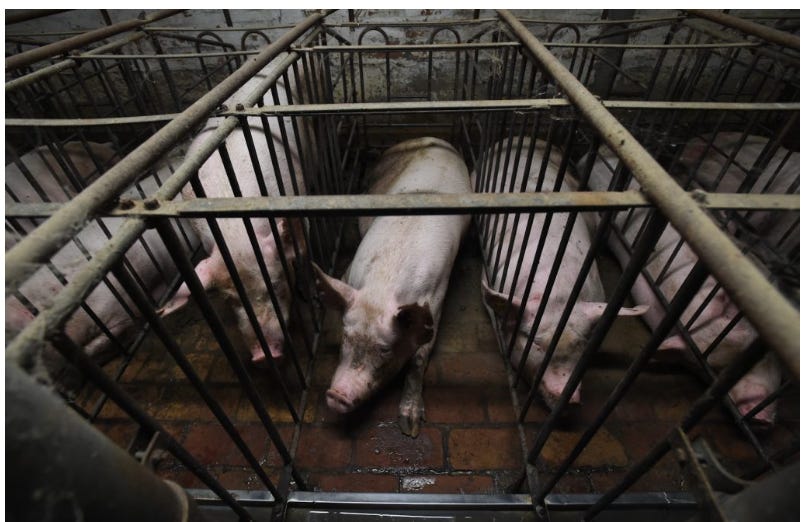
So, moving on before I get back to reading Will’s new book, the infamy of AmeriKKKa and the world, as we slaughter not just the billions of birds and bovine and swine, but our fellow human beings.

Bearing witness? Goddamn!

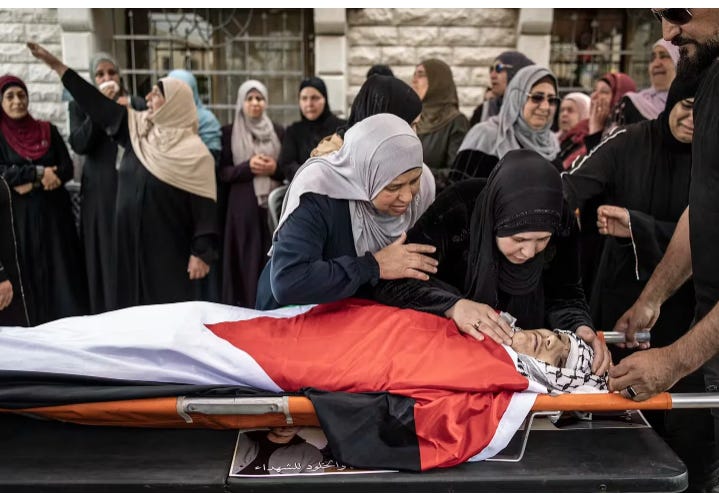
Child Gunned Down by the IDF, His Crime? Being Born Palestinian: Israel is annihilating Palestinian children. Amer Rabee was one of them

Amer had a name. He had a smile. He was loved. He was real. And now, he is gone. We owe him more than silence. We owe Gaza’s starving children more than silence.

*****

I talk about this EVERYDAY — how do we go on without YELLING at the top of our lungs everywhere all the goddamn time?

Progress

[Palestine Will Be Free]

Oh, what great progress! We have come so far

What glorious days I wake up to!
What mirth and joy the mornings conjure.
After starting my day with coffee and Wagyu steak,
I tap-dance to work and present my deck.

All fun and games with the friends at work,
As we discuss last night’s game we streamed.
“Oh, how he shot — and the one he missed —
They should build him a statue in the city’s midst.”

At noon, I got the letter with the bonus check —
My hard work is really stacking the deck!
That called for a celebration, so we went
To this exquisite bar a colleague had picked.

We did good business this year, my boss said,
As our machines were deployed across the East and the West.
We’re ramping up production — the demand is high.
I already smell the next check — oh, how I fly!

We wrapped up another busy day at work,
As we built more machines to send across the pond.
On the way home, I called my spouse,
And we went to her favourite: Roundhouse.

As we got home, on the TV they showed
One of our products being dropped by the shore.
Our President announced, “No holds will be barred,
In support of our friends who always want more.”

Smacking my lips, I looked up the scrip,
Giddy as a kid, I slept like a pig.
More work tomorrow, as we must ship more
Of our fearsome products to our friends by the shore.

Oh, what great progress! We have come so far.
With my MIT degree, I have become a star.
My machines hum low as they cross the sea,
Carving silence where children used to be.

*****

More of the monsters, the criminals, the continuing criminal enterprises of finance and predatory and disaster and penury and polluting capitalism:

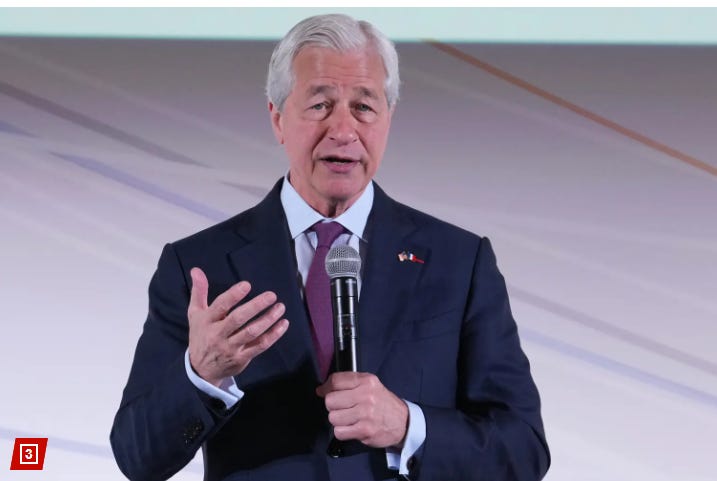
JPMorgan’s Jamie Dimon calls on US to stockpile bullets, rare earth instead of bitcoin!

Crime boss in a 5,000 dollar suit:

“We should be stockpiling bullets,” he continued.

“Like, you know, the military guys tell you that, you know, if there’s a war in the South China Sea, we have missiles for seven days. Okay, come on. I mean, we can’t say that with a straight face and think that’s okay. So we know what to do. We just got to now go about doing it. Get the people together, roll up our sleeves, you know, have the debates.”

And so the clown show is so on track to take the USA down the path of intellectual-spiritual-agency starvation. No one in the NBC piece is railing against the military and the fool Trump, no-sir-ee.

Army says Trump’s military parade could cause $16 million in damage to Washington streets

The repair costs are part of the estimated $45 million price tag for the upcoming parade.

Bone spurs Trump, man, what a complete Chief Fraud.

“We have the greatest missiles in the world. We have the greatest submarines in the world. We have the greatest army tanks in the world. We have the greatest weapons in the world. And we’re going to celebrate it,” Trump added.

The parade will be part of a massive celebration in downtown Washington that includes a number of events, historical displays and a demonstration by the Army’s famous parachute team, the Golden Knights.

The parade itself will include about 130 vehicles, including 28 M1A1 tanks, 28 Bradley Fighting Vehicles, 28 Stryker armored fighting vehicles and a number of vehicles towing artillery launchers. More than 50 helicopters will also participate in an “extensive flyover” in the nation’s capital.

The event will also bring more than 9,000 soldiers from around the country to Washington, about 7,000 of whom will march in the parade itself. The event will also include at least eight Army bands, and some troops will ride on the nearly three dozen horses and two mules expected to march as part of a historical section of the parade.

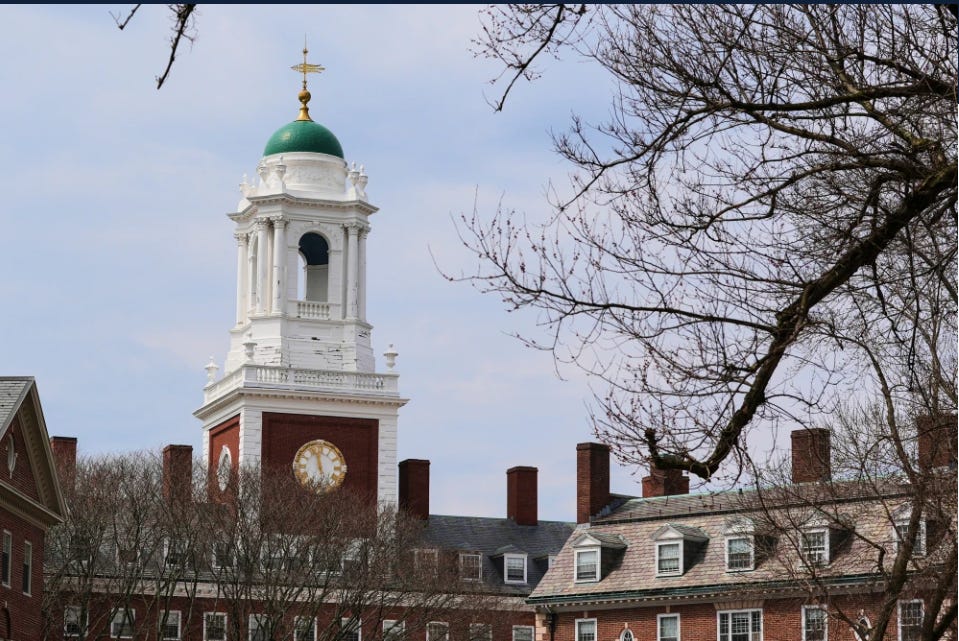
[Photo: Poison Ivy League school Harvard!]

And you thought colleges were places of sanity and caring? Forget about it.

As colleges halt affinity graduations, students of color plan their own cultural celebrations. Affinity graduations recognize the range “of challenges and obstacles” that students from minority backgrounds face as they work toward their degrees, said one professor.

Death spiral in almost 100 percent of American life:

The Harvard joins many other institutions across the country that have canceled affinity graduations after the federal cracked down on funding for colleges. Notre Dame canceled its Lavender Graduation for 50 LGBTQ students, with members of the university’s Alumni Rainbow Community and the Notre Dame Club of Greater Louisville stepping in to host an independent ceremony this month.

Wichita State University, the University of Louisville and the University of Kentucky also canceled some or all of their affinity ceremonies. The Hispanic Educators Association of Nevada said it canceled its event for Latino students because of a lack of financial support.

This is what education once again means to the perversions called US Secretary of Ed.

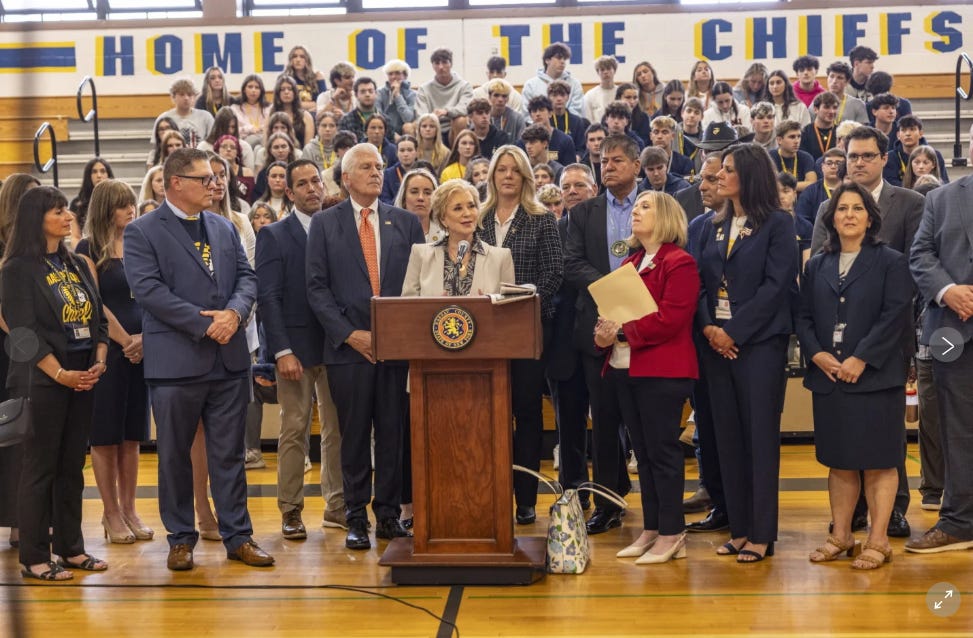
U.S. Secretary of Education Linda McMahon said her department will give the state ten days to sign an agreement rescinding its Native American mascot ban and apologizing to Native Americans for having discriminated against them and attempted to “erase” their history.

JP O’Hare, a spokesperson for the New York education department, dismissed McMahon’s visit as “political theater” and said the school district was doing a “grave disservice” to its students by refusing to consult with local tribes about their concerns.

“These representatives will tell them, as they have told us, that certain Native American names and images perpetuate negative stereotypes and are demonstrably harmful to children,” he said in a statement.

You feeling the dictator’s blues yet? President Trump has long called for escalating the U.S. drug war against Mexican cartels and wants tougher penalties for dealers selling fentanyl and other street drugs in American communities. “I am ready for it, the death penalty, if you deal drugs,” Trump said during a meeting with state governors in February, where he said dealers are too often treated with a “slap on the wrist.”

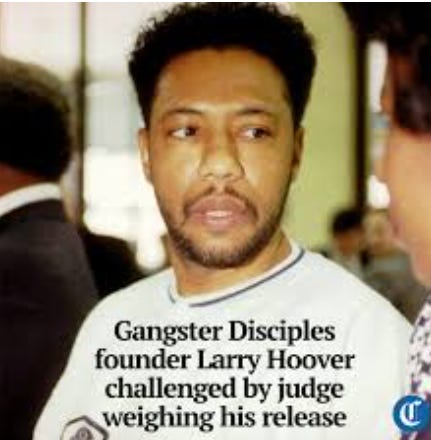
But despite his tough rhetoric, Trump has sparked controversy by pardoning a growing number of convicted drug dealers, including this week’s move to grant clemency to Larry Hoover, 74, who was serving multiple life sentences in federal prison for crimes linked to his role leading the Chicago-based Gangster Disciples.

“Larry Hoover was the head of perhaps the most pernicious, efficient drug operation in the United States,” Safer said. “They sold over $100 million of drugs a year in the city of Chicago alone. They were responsible for countless murders. They supported their drug territories with ruthless violence.”

*****

A LITTLE pushback?

What? Everything about Trump, man, is the most perverse, weird and dystopian and of course, Snake Oil Salesmanship and Three Card Monty and Chapter 11-13 full bore.

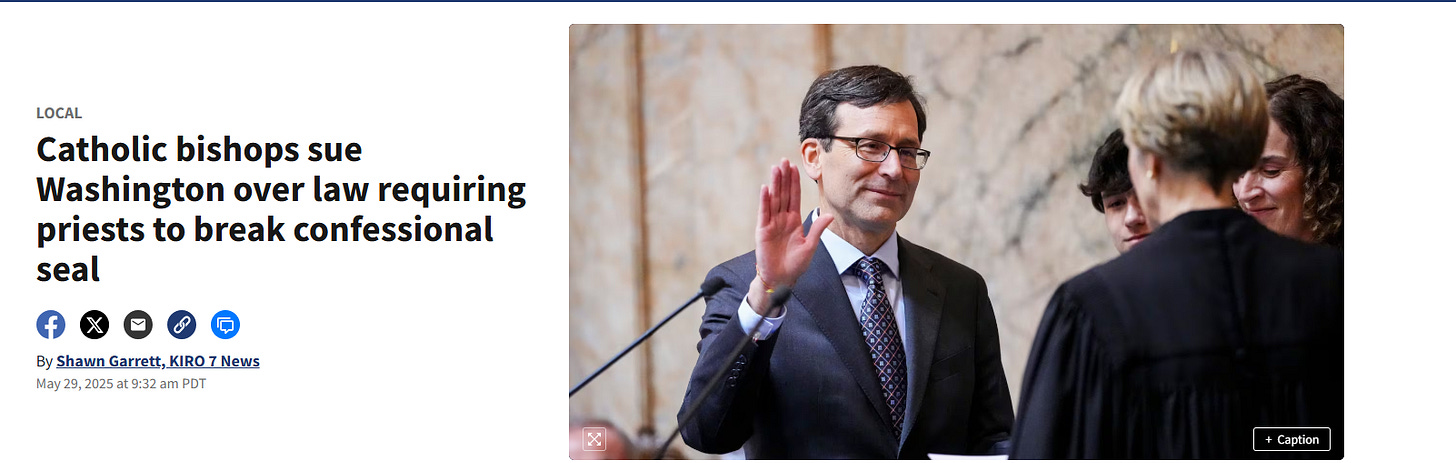
Not digging the Catholic Church, but can you imagine making rabbis tell the truth, the Fortune 300 or 5,000 go before a board of truth and reconciliation? Imagine if the Jewish State of Murdering Raping Maiming Polluting Poisoning Starving Occupied Palestine had to disclose that client-extortionist privilege? Patient-Doctor confidentiality? Doesn’t exist, and DOGE is coming after the food stampers and the disability pittance recipients while the millionaires, billionaires and trillionaires get to keep their dirty felonious secrets, well, secrets.

The sickness throughout the land, as Flag Day and Rapist in CHief’s B-Day and the Military Uniformed Mercenary Hired Guns Army have their anniversary, and we continue writing at Dissident Voice and elsewhere the crimes, man, the inhumanity, the absolute Orwellian and Phillip K. Dick nature of this dystopia.

*****

Some of us are tired of surviving

For many in Gaza, death isn’t always the worst outcome.

MOHAMMED R MHAWISH's avatar

Mohammed R Mhawish

May 31, 2025

What kind of world forces people to beg for death to feel peace?

I’ve survived so many times now I’ve lost count. I was pulled from the rubble with my son after our home was flattened, walked for hours carrying a bag of bread and the bones of what once was a life, fled neighborhoods, towns, and streets we once called home, only to find no home waiting on the other side, and every time I survived, something else died. Sometimes, it was a friend. Sometimes a cousin and sometimes a colleague. Some other times it was the sound of my son’s laughter and my own belief that living means something.

Survival is not a blessing.

I’ve come to learn that survival is just another word for staying inside the pain. People wake up every day in a different place than where they were yesterday and find it more crowded and more tired and more broken. Stepping over children sleeping on cardboard under trees is now a normal thing, and the days are all the same. So are the struggles of hunger and water and the bitter metallic taste. The same questions about where we should go next, what we will eat today, and who else we’ve lost.

A reporter captured the moment at midnight, as the sky lit up like day from illumination flares.

Watch the post on Instagram

A post shared by @anasjamal44

The caption reads: “We are dying. The Israeli bombing is relentless. Women and children are the victims. No safe places left. No food, no water. Famine is spreading rapidly.”

I’ve sat with people who don’t run anymore when leaflets fall from the sky, I remember talking to a woman in Khan Younis who told me she stayed in her home after the first warnings. Her name was Sameera and she was sixty-two. Her husband was too sick to walk and she couldn’t carry him. “If we leave, we die on the road. If we stay, we die here,” she said. “At least here I know the ground. I know which walls will fall on me.”

She didn’t say it with fear. There was simply no fear left.

Another man in Deir Al Balah was standing in the middle of a bombed street and sweeping glass and dirt into a pile. He’d lost two of his daughters, and when I asked him why he didn’t leave earlier, he said, “I didn’t want to spend the last moments of my life running.”

It’s neither courage nor resistance, only exhaustion, the kind that comes with an understanding that in Gaza there is no such thing as a safe place. We just run until our legs and souls give out. And even if we make it out alive, we still carry the weight of every person who didn’t.

In one video, a child sits on top of the rubble sobbing. His father is still trapped beneath the debris.]

Watch the video on X

People always say survival is the goal and we’re lucky to have made it. But there’s no such thing as luck about people dissolving slowly and dying in slow motion.

During my months reporting from there, I saw children who don’t speak anymore. I once saw a boy in Jabalia who used to love cartoons but now just sits and stares at the wall. When I tried to ask for his name, he covered his ears. His mother said he hasn’t spoken since the missile hit their home and took his sister.

When someone cries out of an injury, we know they’re still holding on. But when they just stare at the ceiling as they bleed, we know they’ve already left, even if their body hasn’t.

There is nothing noble about this kind of survival. There is no aftercare or healing.

A young Palestinian student, Shayma, describes what it’s like to be forcibly displaced amid the devastation and having nowhere to go. The camera pans across the flattened neighborhood where she is sheltering. aljazeeraenglish

We don’t want to die. But when some of us fantasize about death, it’s because we’re full of everything that hurts. Our moms whisper that they envy those who died peacefully and quickly. I myself used to shower in cold water at night just to feel something cold. My neighbor lost her baby to dehydration around the time my son and I were diagnosed with malnutrition in March 2024. She still carries his blanket in her bag.

And here my friends tell me to stay strong and safe. But I don’t want strength anymore. I don’t want to be the one who survived everything. I don’t want my son to grow up believing that pain is something you get used to or that losing everything and still breathing means you’re lucky.

We all have our tricks for trying to suffer a little less. Some stop talking about the people they lost because even saying a name is unbearable. Some lie to themselves and pretend their loved ones are still displaced just somewhere they can’t reach. Some stop eating because food feels like a betrayal when the person you used to share it with is gone.

I once believed that writing would help me make sense of it and that putting these stories down would somehow soften them. But even that doesn’t work anymore. I can’t keep writing about mass graves and call it documenting and narrating pain while still living inside it.

There is nothing poetic about this grief. It is ugly and it is heavy and it is repetitive. Sometimes I walk for hours just not to think and keep my body moving while my mind shuts down, or just to delay the next memory from arriving.

I still wake up sometimes believing we’re back home and feel like I’ll hear my mother’s voice and make coffee in our old kitchen.

The truth is, survival, when it’s endless and hollow and filled with nothing but hunger and mourning and fear… it begins to feel like a punishment.

We are alive in ways no one in this world would envy.

So when the people in Gaza no longer pray for safety, it’s because we’ve seen too much and lost too many.

Paul Haeder's been a teacher, social worker, newspaperman, environmental activist, and marginalized muckraker, union organizer. Paul's book, Reimagining Sanity: Voices Beyond the Echo Chamber (2016), looks at 10 years (now going on 17 years) of his writing at Dissident Voice. Read his musings at LA Progressive. Read (purchase) his short story collection, Wide Open Eyes: Surfacing from Vietnam now out, published by Cirque Journal. Here's his Amazon page with more published work AmazonRead other articles by Paul, or visit Paul's website.
France bears the brunt of Israel’s isolation ire

French President Emmanuel Macron’s push for a long-term political solution to the Gaza crisis and his advocacy of a Palestinian state has earned the wrath of Israel and its supporters. France-Israel relations have been bumpy at times, but the current vitriol underscores the Netanyahu administration’s panic over its depleting circle of backers on the international stage.


Issued on: 03/06/2025 - 
FRANCE24
By: Leela JACINTO

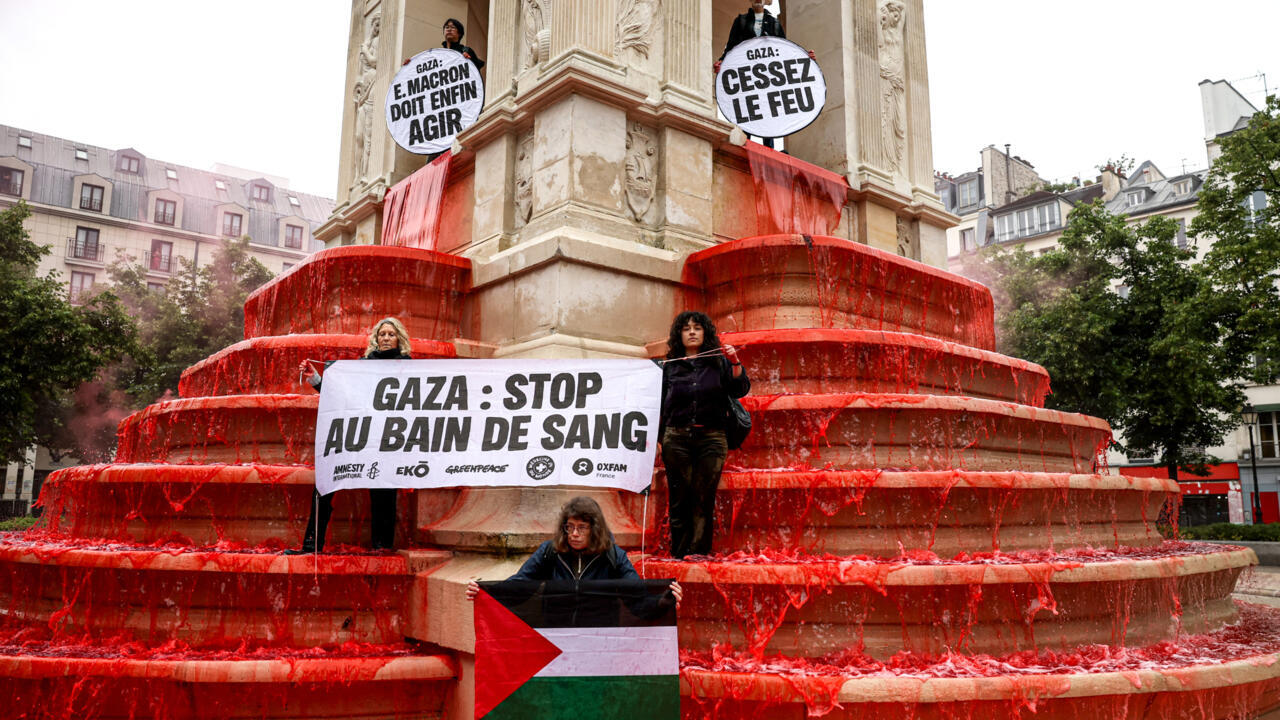
Protesters hold a Palestinian flag and placards reading '"Gaza: Emmanuel Macron must act" and "Gaza: Stop the bloodshed" in Paris, May 28, 2025. © Leo Vignal, AFP


The Franco-Israeli relationship was once a subject of obsessive scrutiny by the CIA as US intelligence scrambled to uncover proof that Tel Aviv was deceiving Washington as it built a nuclear bomb in secrecy – with more than a little help from the French.

CIA documents from the early 1960s that have since been declassified record speculation about the political backing in Paris for the suspicious nuclear cooperation between the French and Israeli militaries.

In a 1961 report, the CIA noted that the French ambassador to Israel “confirmed” that his military attaché in Israel “was much more intimately connected to the Israeli Army than is usual for an attaché”. The document concluded that, “It is unlikely that such cooperation would be possible without political support.”

France, at that time, was trying to recover diplomatically from the disastrous 1956 Suez crisis, which saw the British-French-Israeli invasion of Egypt until heavy pressure from Washington and Moscow prompted an embarrassing withdrawal.


With the Algerian independence war raging, the French government, under Charles de Gaulle, did not want to bear the onus of Arab hostility for arming Israel – publicly. But the high-level “cooling off” in French-Israeli relations “does not seem to have affected the close military ties cemented by cooperation in the Suez incident”, the CIA concluded.

That was more than 60 years and many Mideast wars ago. US suspicions about French-Israeli relations have now given way to outrage as President Emmanuel Macron pushes several Western countries to jointly recognise the state of Palestine. France is also co-hosting, along with Saudi Arabia, a June 17-20 UN summit to accelerate a two-state solution to the Israeli-Palestinian crisis.

The French diplomatic drive appears to have incensed the top US diplomat in Israel. In an interview with Fox News over the weekend, US Ambassador to Israel Mike Huckabee lashed out at Macron’s advocacy for a Palestinian state. "If France is really so determined to see a Palestinian state, I've got a suggestion for them – carve out a piece of the French Riviera and create a Palestinian state,” he said.

Meanwhile Israel, facing increasing international isolation over the humanitarian catastrophe in Gaza, has kept up a high-octane tirade against France over the past few weeks.

On Friday, shortly after Macron asserted that a recognition of a Palestinian state was "not only a moral duty, but a political necessity", Israel issued a blistering response. "President Macron’s Crusade Against the Jewish State Continues," said an Israeli foreign ministry statement posted on X. Countering yet another UN warning of a looming, Israeli-imposed enforced famine in Gaza, Israel maintained that the “facts do not interest Macron. There is no humanitarian blockade. That is a blatant lie."

French-Israeli relations have come a long way since the inception period of close political and military ties following the 1948 creation of Israel. Over the past seven decades, bilateral relations have careened from cooperation over shared strategic interests in the Arab world to periods of arms embargoes and warnings, followed by phases of rapprochement until they hit rocky ground again.

Along the way, French noises about recognising a Palestinian state have been invariably met with Israeli allegations of anti-Semitism and barbed reminders of the Vichy-era collaboration with the Nazis.

Tempers flare in church


The latest anti-French screed by Israel and its supporters have been met, for the most part, with a Gallic shrug in French Mideast circles.

“The reactions are not really surprising. They are pretty much in line with the hawkish rhetoric that has been emanating from the Israeli government. But they have taken it up a notch because they are sort of panicking, because they realise that Western public opinion is shifting very rapidly,” said Karim Emile Bitar, a lecturer in Middle East studies at SciencesPo, Paris.

“This is not something new. French relations with Israel have always been difficult. Almost every French president since Charles de Gaulle has been called anti-Semitic by the Israeli government. Almost everyone, except perhaps Sarkozy,” added Bitar, referring to former French president Nicolas Sarkozy. “But today, the Israelis are becoming almost insulting. Sometimes, it appears that there is a willingness to humiliate France.”

The slights have included diplomatic dust-ups, such as a brief detention of French embassy staff in November during a visit by French Foreign Minister Jean-Noël Barrot to a holy site in Jerusalem historically administered by France. When Israeli security forces entered the compound of the Church of the Pater Noster on the Mount of Olives and detained two French consulate gendarmes, Barrot had to cancel his church visit and France issued a summons to the Israeli ambassador in Paris.


French Foreign Minister Jean-Noël Barrot walks away after cancelling his scheduled visit to the Church of the Pater Noster in Jerusalem, November 7, 2024. 
© Menahem Kahana, AFP

It was not the first such incident at French-administered religious sites in a part of Jerusalem annexed by Israel in the 1967 war. In January 2020, Macron was forced to put his foot down during a visit to the Church of Sainte-Anne in the walled Old City, when Israeli security forces pushed their way into the site. “Everybody knows the rules,” Macron berated the security officials. “I don’t like what you did, in front of me. Go outside.”

In France, presidential explosions – in heavily French-accented English – in Jerusalem churches are viewed as emblematic of the long-standing yet testy ties between the two countries. They even inspire memes and musicians. In 1996, for instance, an exasperated Jacques Chirac told Israeli soldiers at Sainte-Anne: “What do you want? You want me to go back to my plane and come back to France?” Chirac’s lines are often repeated in France, including in song lyrics.


Moving G7 nations to recognise Palestinian statehood


But French patience with heavy-handed Israeli security personnel is wearing thin, particularly when it comes to defenceless Palestinians. As Gazans face starvation, death and dislocation, Israeli Defence Minister Israel Katz’s pledge that “no humanitarian aid will enter Gaza” or National Security Minister Itamar Ben-Gvir’s assertion that Gazans deserve “not even an ounce of food or aid” have been met with horror in France.

Israel’s refusal to address core issues of the Palestinian conflict and its verbal lashings of its allies for bringing it up are also exasperating diplomats in Paris.

Michel Duclos, a former French ambassador to Syria and a special adviser to the Paris-based Institut Montaigne, believes there are two elements behind the recent Israeli backlash. “First, it has been years and years now since the Israelis have taken a very hard stance against France. Second, they are very upset about the issue of the recognition of the state of Palestine. They consider, rightly so, that Macron is leading the move from the very last G7 countries that have not recognised the state of Palestine.”

While much of the Arab world, Africa, Asia and several eastern European countries recognised the state of Palestine in the 1980s, Western nations have held back, maintaining that Palestinians can only gain statehood as part of a negotiated peace with Israel.

But Israel’s latest military onslaught in Gaza, which has killed more than 54,000 Palestinians, has boosted European support for Palestinian statehood. Out of 193 UN member states, 147 recognise the state of Palestine, including Spain, Ireland, Norway and Slovenia, the latest European additions to join the ranks. The G7 countries – comprising Canada, France, Germany, Italy, Japan, the UK and the US – have held out, with the US using its veto at the UN Security Council last year to prevent a Palestinian bid to become a full UN member state.

In the lead-up to the June 17-20 UN summit, French foreign ministry statements have carefully noted that the “legitimate aspiration” for a Palestinian state must be accompanied by a comprehensive strategy that includes disarming Hamas, the release of hostages held by the militant group after the October 7, 2023 terrorist attack, a reform of the Palestinian Authority and a “day after” reconstruction plan for Gaza.

The Israeli response has focused on characterising the French initiative as a “reward to Hamas”, Duclos notes. “Maybe they believe that. I don't know, I can’t say. But if that’s the case, I think it's a mistake because you can argue that it's exactly the opposite. The way to deprive Hamas of legitimacy is to say that there should be a Palestinian state, of course – not in the hands of Hamas or in the hands of the extremists, but in the hands of a reformed Palestinian Authority.”

Back to ‘Gaullo-Mitterrandism’?


Since the October 7 Hamas attack, Macron has shifted his position with the deteriorating humanitarian situation on the ground in Gaza. It’s a move dictated by ethical, international as well as domestic concerns in France, home to Europe’s largest Muslim and Jewish communities, where the Israeli-Palestinian conflict is a lightning rod issue.

“Macron has been trying to use his traditional en même temps approach to foreign policy,” said Bitar, referring to the French term for “at the same time” – a phrase deployed for Macron’s frequent, seemingly contradictory positions. “Initially, he was very supportive of Israel after the October 7th massacres. But progressively, he started to change his rhetoric, and he became increasingly critical of Israel.”

While critics lampoon the centrist president’s en même temps proclivity, Macron’s shifts on the Mideast have been consistent with changing French positions on a longstanding crisis.

De Gaulle, France’s first post-war president, did the first presidential flip when he finally put the brakes on military ties with Israel and imposed an arms embargo after the 1967 Arab-Israeli war. He then launched what is called the politique arabe de la France, France's Arab policy, which brought Paris closer to the demands of the Palestinians and of other Arab countries.

The position continued under the presidency of Socialist leader François Mitterrand, sparking the concept of “Gaullo-Mitterrandism” in French foreign policy circles.

Gaullo-Mitterrandism placed France within the Western alliance as a sort of dissenting member – never fully aligned, unlike Britain – with US foreign policy. Mitterrand’s successor, Jacques Chirac, put Gaullo-Mitterrandism on centre stage in 2003, when France opposed the US invasion of Iraq, which was vociferously supported by Israel.

When Chirac’s successor Nicolas Sarkozy came to power in 2007, “things started to change”, explained Bitar. “In France, he was the first openly pro-Israel French president. And after Sarkozy, under François Hollande, France started to be perceived as just another Western country: it was no longer sending a discordant, dissident voice within the collective West,” he noted. “France ... lost its soft power in the Arab world because of this.”

After nearly two decades of French alliance with the US on Mideast policy, “Macron is trying to bring some balance, maintain solid relations with Israel, but criticising it whenever necessary. And in the past few months, he has been raising his tone,” Bitar said.

As US President Donald Trump’s hostility toward Europe and its institutions draws other Western capitals closer together, Macron has been spearheading talks with British Prime Minister Keir Starmer, Canada’s Mark Carney, Australia’s Anthony Albanese and other leaders ahead of the upcoming UN two-state solution summit.

Experts agree that a Western recognition of a Palestinian state, if it were to happen, is unlikely to change the situation on the ground in Gaza and the West Bank while Israel continues to enjoy Washington’s protection. They can’t seem to agree, however, on what to make of a slate of recent Trump administration moves in the region that are firmly opposed by Israel. These include reopening nuclear talks with Iran, lifting sanctions on Syria and meeting interim President Ahmed al-Sharaa, as well as announcing a truce with Yemen’s Houthis and directly dealing with Hamas for the release of a US hostage in Gaza.

While the latest Trump twists in the region are being closely followed in foreign policy circles, Duclos believes they are unlikely to impact geostrategic calculations in European capitals. “You can't base your policy on what Trump thinks today when you don't know what he's going to think tomorrow,” he said.

These geostrategic shifts may account for the tone of Israel’s vitriolic broadsides against Paris in recent months. “France is perceived as a European heavyweight because it's a former colonial power in the Middle East,” said Bitar. “France's diplomacy can have an important symbolic weight.”