Wednesday, June 04, 2025

U$


Law, Not Crime, Has Come from South of the Border


Not so much criminals as the foundations of the rule of law — that is what has infiltrated the United States from Latin America. That seems to be a major thread running through Greg Grandin’s wonderful new history of the hemisphere, America, América: A New History of the New World. It’s a book you can dive back into repeatedly, not to mention fantasize about someone compacting it into a short slideshow for the benefit of the President of the United States.

British settler colonists in North America had their preachers and writers, but those individuals had a tendency to pretend Native Americans were not real, did not exist, perhaps never had existed, or simply didn’t count for much on empty land, or didn’t count because they were to be pushed out or eliminated rather than lived with. Spain, in contrast, generated a tremendous raging debate between supporters and denouncers of its killing, robbery, theft, enslavement, and terrorizing of indigenous people. Spain broke new ground, according to Grandin, in producing criticism of its own atrocities as it conquered South America.

In very rough terms, this is similar to the contrast between U.S. media noncoverage of the genocide in Gaza and Israeli media’s inclusion of denunciations of the same. It’s one thing to live where you can’t escape drunk country musicians singing about being free, and perhaps something else to live where you can hear voices saying some of the things that most need saying. In both cases, the brutal atrocities go on, but in one, there are seeds of some future change planted.

Voices like those of Francisco de Vitoria and Bartolomé de Las Casas laid the foundations for modern international law, but did so very differently from Dutch and English writers. The Spanish tradition is at least as tied up in religion as the English, and has certainly needed to evolve during these past four or five hundred years. But Grandin identifies a basis for a future pluralistic society, even in the belief that populations were diverse yet all descended from Adam and Eve. One can also, I think, see in the tradition of public confessions something of a precursor of truth and reconciliation commissions. In Latin America, unlike the North, dying conquistadores in the sixteenth century commonly confessed their part in the Conquest and paid restitution. NB: They did not admit to having strayed from proper conquest behavior into illicit atrocities. Rather, they admitted to participation in a Conquest understood to have been wrong and evil in its totality.

Seen from a perspective that includes Latin America, Las Casas — who went beyond Erasmus, Moore, or anybody else — begins to look like the father of international legal standards applied equally to all of humanity, not to mention of self-determination and governance by the consent of the governed. He got there first. He drew the logical conclusions, such as the abolition of slavery. And he acted on those conclusions to as great an extent and for as long as perhaps any other person who has lived.

The world was not, even in the seventeenth century, strictly separated into different legal traditions. The English read Las Casas, but they often read him with an eye to understanding how evil the Spanish were, in contrast to the English, or to get ideas for how to be more evil toward the Irish themselves. Perhaps they could have read him more in order to do as Las Casas recommended, more in order to outgrow dehumanization and division. Defining certain people as not really people was a skill that increased in English culture as colonization and slavery expanded.

Hugo Grotius read Vitoria, but — like Aquinas before him and like all “just war” theory — Grotius was after excuses for wars. War might be regulated, but not banned. John Locke drew heavily on Spanish writers like Juan de Mariana and José de Acosta, but he reached his own conclusions, including that land could be taken from anyone not farming it. For a great many years, Spanish writers denounced war and slavery as parts of the Conquest, whereas Locke, Smith, Hume, et alia, at best wrote rules to regulate such evils as war and slavery, leaving us to this day with a culture that hardly murmurs about the crime of war but chatters endlessly about “possible war crimes” — almost always only mysteriously “possible,” never verified.

Francisco de Miranda (1750-1816) and Simón Bolívar (1783-1830) sought a confederacy of independent nations in Latin America. The United States served as a partial inspiration but was not of much actual help. Thomas Jefferson’s house, just down the road from mine, had numerous books by Las Casas and other Spanish writers in it, yet he flipped their views upside down, declaring that “white” nations had the right to control non-white peoples in lands they claimed and to deny access to other “white” nations. He called this “a kind of international law for America.” The United States has sought its own unique “international law” from that day to this.

The Doctrine of Discovery — the idea that a European nation can claim any land not yet claimed by other European nations, regardless of what people already live there — dates back to the fifteenth century and the Catholic church, but it was put into U.S. law in 1823, the same year as Monroe’s fateful “Doctrine” speech. It was put there by Monroe’s lifelong friend, U.S. Supreme Court Chief Justice John Marshall. The United States considered itself, perhaps alone outside of Europe, as possessing the same discovery privileges as European nations. Perhaps coincidentally, in December 2022, almost every nation on Earth signed an agreement to set aside 30% of the Earth’s land and sea for wildlife by the year 2030. The exceptions were only the United States and the Vatican, not the nations of Latin America.

While the U.S. had broken free of British rule and thereby rid itself of a mother country that was moving rapidly toward the abolition of slavery, movements for independence from Spain in South America generally sought freedom from slavery as well as from foreign empire. The U.S. tradition of slave-owners like Patrick Henry making speeches about being metaphorically enslaved was a northern hypocrisy where revolution was a rich man’s game. Moves for independence in the South were, to some extent, more of a popular revolt. They were, at the very least, not a revolt to maintain slavery or to expand empire, and not to combine numerous colonies into one, at least not immediately. Rather, Bolivarianism amounted to a push to create simultaneously several free and independent nations, some through violence and some without it. By the early nineteenth century, there were nine of them, newly independent, or 10 counting Haiti.

Latin America was not yet called Latin America and was not some sort of flawless paradise. Wealth extremes (greater than in the U.S. of that day, though not greater than the U.S. of this day) and all kinds of cruelty persisted. But, not only was slavery being abolished, but something else of great potential was being created. Numerous new nations jointly developed means of nonviolently and legally arbitrating boundary disputes, dealing with each other as equals and not enemies.

Bolivar proposed a Congress in Panama among sister nations that would

  • agree to mutual defense,
  • condemn Spain for the suffering it had caused in the New World (has the U.S. done that yet with regard to England?),
  • promote the independence of Cuba, Puerto Rico, the Canary Islands, and the Philippines (the U.S. was supporting Spanish rule over Cuba as more likely to lead to later U.S. rule over Cuba),
  • repudiate the doctrines of discovery and conquest,
  • abolish slavery,
  • recognize Haiti, and
  • legalize agreed-upon borders.

Here we see an early version of the League of Nations or the United Nations just beginning to come into being.

Slavery had already been ended — and without a horrific U.S.-style Civil War — in Chile, Bolivia, and parts of Mexico. Central America ended it in 1824. Colombia and Venezuela were ending it, but it persisted in Peru and Brazil.

In taking up such matters of domestic policy at an international gathering like the Panama Congress of 1826, something else — another grave evil in the world, one that afflicts the United States — was being prevented from ever being born in Latin America. This evil is the passionate aversion to anyone outside a nation having any say over what that nation does. When you read the Constitutions of various European nations today that describe transferring power to international institutions, you can just feel the veins bursting in the faces of outraged U.S. politicians. In 1826, vicious fury burst forth at the very idea that the United States would send anyone to a Congress in Panama to sit with potentially non-white people to decide anything about the sacred U.S. right to enslave human beings. In the words of Grandin, this “jolted the Age of Jackson into existence.” It hasn’t let up much since. The U.S. would later reject the League of Nations as one among equals and only join the United Nations over which it held a veto.

By 1844, Latin American statesmen had been working on theories and plans for international law for decades, and Juan Bautista Alberdi gave the name “American International Law” to a set of principles that included rejection of the doctrines of discovery and conquest, equality of nations despite their size, non-intervention, usi possidetis, and impartial arbitration. Alberdi also wrote a book in 1870, available online for free in English, titled The Crime of War. This is a book filled with hundreds of pages arguing almost the identical arguments that war abolitionists use today. It’s an outlawry book a half century before the movement to outlaw war. It’s a book making the case for neutrality (see page 262), perhaps a century before the power of neutrality was widely appreciated and 150 years before it disastrously ceased to be. Latin American nations continued to push such a vision on the United States for years.

At the Hague Peace Conference of 1907, 18 of the 44 nations represented were from Latin America, and it was there that Latin American ideas of multilateralism and sovereignty are thought to have really taken hold.

Woodrow Wilson (U.S. president, 1913-1921) may look in retrospect like mostly a talk and not much action, a promising savior who didn’t save us, a warrior to end war who gave us more war, a Barack Obama of his day. But early Wilson, before World War I, had some substance, and some of the talk was well worth hearing, and a lot of it came from south of the U.S. border. Wilson was outraged by and sought to reverse his predecessor’s interference in Mexico. He also apologized to Colombia for the U.S. role in removing Panama from it, and paid Colombia $25 million for the loss. Wilson was unable to resolve crises in Mexico but did not make the usual U.S. move of reaching for larger weapons. Instead, he accepted a proposal from Chile for Argentina, Brazil, and Chile to meet with the U.S. and Mexico and work out a solution. They met for two months on the Canadian side of Niagara Falls. The United States then joined Argentina, Brazil, Chile, Bolivia, Guatemala, Uruguay, Colombia, and Costa Rica in announcing a new joint policy toward Mexico. (Can you hear the Muricafirsters screaming in outrage?) When World War I got going, Latin American governments favored neutrality. The President of Mexico proposed a collective trade embargo on the belligerents. Wilson wasn’t wise enough to listen.

Imagine if McKinley had listened when Spain had proposed neutral arbitration to resolve U.S. war lies over the U.S.S. Maine in Havana harbor!

But Wilson did listen to Latin American advocates for international law, whose work increasingly influenced U.S. scholars. Wilson said that “Pan-Americanism” was what he wanted to model the world on, but only after the war.

When the war had ended and the League of Nations was being planned and negotiated, Wilson had in mind a vision straight out of South America, and he wanted to apply it to the Earth. He had three barriers to face, however, and could not overcome them. One was that he was generally lying in bed, sick.

The second was that he was a serious racist — as were others involved — or at least that he felt obliged to please racists back home. When Japan proposed that the covenant to create the League of Nations support “equality of nations and just treatment of their nationals,” the racists wouldn’t stand for it. As a result, some in Japan concluded that their best path forward was not the rule of law but the creation of an empire, or “an Asian Monroe Doctrine.” This was the same conference that viciously punished Germany, thereby laying the groundwork for the other “theater” of World War II as well, and the same conference at which Wilson refused to meet with Ho Chi Minh, just to pile on the future catastrophes being seeded.

The third problem was U.S. exceptionalism. The U.S. insisted on putting the Monroe Doctrine into the League of Nations, giving itself the power to violate the basic premise of the League at will. This was enough to poison the whole project, but not enough to win support for it in the U.S. Senate.

Latin American nations had pushed for a truly equitable League of Nations, and every last one of them joined it, such as it was. But when the League actively supported imperialism, Costa Rica, in 1925, was the first to leave it. Meanwhile, something was infiltrating Latin America from the north: weapons. The arms profiteers were pushing sales hard and encouraging conflicts to boost them. European debts to Latin America for crops and resources supplied during World War I were paid off in left-over weapons, which strikes me as the opposite of paying off a debt. And the United States was still plying its beloved Monroe Doctrine, but it was now joined by imitators in Japan, Italy, England, and Germany, all declaring their own Monroe Doctrines.

President Franklin Roosevelt improved U.S. treatment of Latin America and took Latin American ideas to lay plans for the United Nations. Grandin sadly and typically switches into war supporter mode when it comes to World War II. The fact that Roosevelt was lying when he claimed to have in his possession Nazi plans to take over South and Central America, is relegated by Grandin to a footnote that itself avoids quite telling the story. The U.S. exploitation of Latin America for World War II is recounted quite positively. And then comes the post-war planning. FDR told Stalin and Churchill that Latin America should be the model. FDR’s advisor Sumner Welles drafted plans for the United Nations based on his experiences in Latin America. At the meeting in San Francisco, Latin American delegations pushed for the UN to ban war and create a court of arbitration, among many other positive steps.

But Latin American nations also demanded something I see as far less helpful than Grandin seems to. They wanted to hold onto a regional alliance as a commitment to defend each other. While others rightly feared that this could break the world up into sections, the final UN Charter nonetheless put into Article 51 that nations could act “collectively.”

This became an excuse for institutions seemingly at odds with the very purpose of the UN Charter, most notably NATO. Grandin quotes John Foster Dulles and Winston Churchill praising Latin America for this, and he argues that without this “compromise,” the United Nations might not have been created. But without Latin America demanding something at odds with the basic project, no compromise would have been needed.

After World War II, the U.S. rebuilt Germany with the Marshall Plan. George Marshall took part in a meeting in Bogotá in 1948 at which the nations of Latin America essentially asked, “Where is our Marshall Plan?” Of course, there was none, but can you imagine if there had been, if nations of the whole globe had been aided instead of armed? The post-war U.S. government wanted little to do with laws, rules, morality, or cooperation. Coups, weapons, bases, and invasions would be the order of the day. Pretty much from that day to this, with the addition of demonization.

And yet Latin America goes on showing the way. More than anywhere else in the world, Latin America is a nuclear-free zone, supports the International Criminal Court, opposes the genocide in Gaza, and refuses to support either side of the war in Ukraine. Wearing North American blinders makes it hard even to recognize that as leadership. I hope that such recognition, and appreciation of past efforts too, sets in before it is too late.

David Swanson is an author, activist, journalist, and radio host. He is director of WorldBeyondWar.org and campaign coordinator for RootsAction.org. Swanson's books include War Is A Lie. He blogs at DavidSwanson.org and War Is a Crime.org. He hosts Talk Nation Radio. Follow him on Twitter: @davidcnswanson and FaceBookRead other articles by David.

Badenoch Blurts out the Truth: Britain is at the Heart of Gaza “Proxy War”

Tory leader says the quiet part out loud, admitting that both Israel and Ukraine are fighting for the West

If you have spent the past 20 months wondering why British leaders on both sides of the aisle have barely criticised Israel, even as it slaughtered and starved Gaza’s population of more than two million people, you finally got an answer last week.

Conservative Party leader Kemi Badenoch said the quiet part out loud. She told Sky: “Israel is fighting a proxy war [in Gaza] on behalf of the UK.”

According to Badenoch, the UK – and presumably in her assessment, other western powers – aren’t just supporting Israel against Hamas. They are willing that fight and helping to direct it. They view that fight as centrally important to their national interests.

This certainly accords with what we have witnessed over more than a year and a half. Both the current Labour government of Prime Minister Keir Starmer, and its Tory predecessor under Rishi Sunak, have been unwavering in their commitment to send British arms to Israel, while also shipping weapons from the United States and Germany to help with the slaughter.

Both governments used the Royal Air Force base Akrotiri in Cyprus to carry out surveillance flights to aid Israel with locating targets to hit in Gaza. Both allowed British citizens to travel to Israel to take part as soldiers in the Gaza genocide.

Neither government joined South Africa’s case at the International Court of Justice, which found more than a year ago that Israel’s actions could “plausibly” be considered a genocide.

And neither government proposed or tried to impose alongside other western states, as happened in other recent “wars”, a no-fly zone over Gaza to stop Israel’s murderous assault, or organised with others to break Israel’s blockade and get aid into the enclave.

In other words, both governments steadfastly maintained their material support for Israel, even if Starmer recently toned down rhetorical support after images of emaciated babies and young children in Gaza – reminiscent of images of Jewish children in Nazi death camps like Auschwitz – shocked the world.

Coded language

If Badenoch is right that the UK is waging a proxy war in Gaza, it means that both British governments are directly responsible for the huge death toll of Palestinian civilians – running into many tens of thousands, and possibly hundreds of thousands – from Israel’s saturation bombing.

It also makes it indisputable that the UK is complicit in the current mass starvation of more than two million people there, which is indeed what Badenoch went on to imply in the coded language of political debate.

In reference to Starmer’s recent, and very belated, criticism of Israel’s starvation of Gaza’s entire population, she observed: “What I want to see is Keir Starmer making sure that he is on the right side of British national interest.”

According to Badenoch, Starmer’s implied threat – so far entirely unrealised – to limit the UK’s active collusion in the genocidal starvation of the people of Gaza could harm Britain’s national interests. How exactly?

Her comments should have startled, or at least baffled, Sky interviewer Trevor Phillips. But they passed unremarked.

Badenoch’s “proxy war” statement was also largely ignored by the rest of the British establishment media. Rightwing publications did notice it, but it appeared they were only disturbed by her equating the West’s proxy war in Gaza with the West’s proxy war in Ukraine.

Or as the opposition leader put it: “Israel is fighting a proxy war on behalf of the UK just like Ukraine is on behalf of western Europe against Russia.”

A column in the Spectator, the Tory party’s house journal, criticised her use of “proxy war” to describe Ukraine, but appeared to take the Gaza proxy war reference as read. James Heale, the Spectator’s deputy political editor, wrote: “By inadvertently echoing Russia’s position on Ukraine, Badenoch has handed her opponents another stick with which to beat her.”

The Telegraph, another Tory-leaning newspaper, ran a similarly themed article headlined: “Kremlin seizes on Badenoch’s Ukraine ‘proxy war’ comments.”

Related wars

The lack of a response to her Gaza “proxy war” remark suggests that this sentiment actually informs much thinking in western foreign policy circles, even if she broke the taboo on articulating it publicly.

To reach an answer on why Gaza is viewed as a proxy war – one Britain continues to be deeply invested in, even at the cost of a genocide – one must also understand why Ukraine is seen in similar terms. The two “wars” are more related than they might appear.

Despite the consternation of the Spectator and Telegraph, Badenoch is not the first British leader to point out that the West is fighting a proxy war in Ukraine.

Back in February, one of her predecessors, Boris Johnson, observed of western involvement in the three-year war between Russia and Ukraine: “Let’s face it, we’re waging a proxy war. We’re waging a proxy war. But we’re not giving our proxies [Ukraine] the ability to do the job.”

If anyone should know the truth about Ukraine, it is Johnson. After all, he was prime minister when Moscow invaded its neighbour in February 2022.

He was soon dispatched by Washington to Kyiv, where he appears to have strong-armed President Volodymyr Zelensky into abandoning ceasefire talks that were well advanced and could have led to a resolution.

Offensive frontiers

There are good reasons why Johnson and Badenoch each understand Ukraine as a proxy war.

This weekend Keith Kellogg, Donald Trump’s envoy to Ukraine, echoed them. He told Fox News that Russian president Vladimir Putin was not wrong to see Ukraine as a proxy war, and that the West was acting as aggressor by supplying Kyiv with weapons.

For years, the West had expanded Nato’s offensive frontiers towards Russia, despite Moscow’s explicit warnings that this would cross a red line.

With the West threatening to bring Russia’s neighbour Ukraine into Nato’s military fold, there were only ever likely to be one of two Russian responses. Either Putin would blink first and find Russia boxed in militarily, with Nato missiles – potentially nuclear-tipped – on his doorstep, minutes from Moscow. Or he would react pre-emptively to stop Ukraine’s accession to Nato by invading.

The West believed it had nothing to lose either way. If Russia invaded, Nato would then have the pretext to use Ukraine as a theatre of war to bleed Moscow, both economically with sanctions and militarily by flooding the battlefield with western weapons.

As we now know, Moscow chose to react. And while it has indeed been bleeding heavily, Ukrainian forces and European economies have been haemorrhaging even faster and more heavily.

The problem isn’t so much a lack of weapons – the West has supplied lots of them – as the fact that Ukraine has run out of conscripts willing to be sent into the maw of war.

The West is not, of course, going to send its own soldiers. A proxy war means someone else, in this case Ukrainians, does the fighting – and dying – for you.

Three years on, the conditions for a ceasefire have dramatically changed too. Having spilled so much of its own people’s blood, Russia is much less ready to make compromises, not least over the eastern territories it has conquered and annexed.

We have reached this nadir in Ukraine – one so deep that even US President Donald Trump appears ready to bail out – precisely because Nato, via Johnson, pushed Ukraine to keep fighting an unwinnable war.

Full-spectrum dominance

Nonetheless, there was a geopolitical logic, however twisted, to the West’s actions in Ukraine. Bleeding Russia, a military and economic power, accords with the hawkish priorities of the neoconservative cabals that run western capitals nowadays, whichever party is in charge.

The neoconservatives valorise what used to be called the military-industrial complex. They believe that the West has a civilisational superiority to the rest of the world, and must use its superior arsenal to defeat, or at least contain, any state that refuses to submit.

This is a modern reimagining of the “barbarians at the gate”, or as neoconservatives like to frame it, “a clash of civilisations”. The fall of the West would amount, in their view, to a return to the Dark Ages. We are supposedly in a life-or-death struggle.

In the US, the imperial hub of what we call “the West”, this has justified a massive investment in war industries – or what is referred to as “defence”, because it is an easier sell to domestic publics tired of the endless austerity required to maintain military superiority.

Western capitals profess to act as “global police”, while the rest of the world sees the West more in terms of a sociopathic mafia don. However one frames it, the Pentagon is officially pursuing a doctrine known as US “global full-spectrum dominance”. You must submit – that is, let us control the world’s resources – or pay the price.

In practice, a “foreign policy” like this has necessarily divided the world in two: those in the Godfather’s camp, and those outside it.

If Russia could not be contained and defanged by turning Ukraine into a Nato forward base on Moscow’s doorstep, it had to be dragged by the West into a debilitating proxy war that would neutralise Russia’s ability to ally with China against US global hegemony.

Acts of violence

That is what Badenoch and Johnson meant by the proxy war in Ukraine. But how is Israel’s mass murder of Palestinian civilians through saturation bombing and engineered starvation similarly a proxy war – and one apparently benefitting the UK and the West, as Badenoch argues?

Interestingly, Badenoch offered two not entirely compatible reasons for Israel’s “war” on Gaza.

Initially, she told Sky: “Israel is fighting a war where they want to get 58 hostages who have not been returned. That is what all of this is about … What we need to make sure is that we’re on the side that is going to eradicate Hamas.”

But even “eradicating Hamas” is hard to square with British foreign policy objectives. After all, despite the UK’s designation of Hamas as a terrorist organisation, it has never attacked Britain, has said it has no such intention, and is unlikely to ever be in a position to do so.

Instead, it is far more likely that Israel’s destruction of Gaza, with visible western collusion, will inflame hotheads into random or misguided acts of violence that cannot be prepared for or stopped – acts of terror similar to the US gunman who recently shot dead two Israeli embassy staff in Washington DC.

That might be reason enough to conclude that the UK ought to distance itself from Israel’s actions as quickly as possible, rather than standing squarely behind Tel Aviv.

It was only when she was pushed by Phillips to explain her position that Badenoch switched trajectory. Apparently it wasn’t just about the hostages. She added: “Who funds Hamas? Iran, an enemy of this country.”

Cornered by her own logic, she then grasped tightly the West’s neoconservative comfort blanket and spoke of a “proxy war”.

‘Bracing’ truth?

Badenoch’s point was not lost on Stephen Pollard, the former editor of the Jewish Chronicle. In a column, he noted of the Sky interview: “Badenoch has a bracing attitude to the truth – she tells it as it is, even if it doesn’t make her popular.”

The “bracing” truth from Badenoch is that Israel is as central to the projection of western power into the oil-rich Middle East as it was more than a century ago, when Britain conceived of Palestine as a “national home for the Jewish people” in place of the native Palestinian population.

From Britain’s perspective, Israel’s war on Gaza, as Badenoch concedes, is not centrally about “eradicating Hamas” or “getting back the hostages” taken during the group’s attack on Israel on 7 October 2023.

Rather, it is about arming Israel to weaken those, like Iran and its regional allies, who refuse to submit to the West’s domination of the Middle East – or in the case of Palestinians, to their own dispossession and erasure.

In that way, arming Israel is seen as no different from arming Ukraine to weaken Russian influence in eastern Europe. It is about containing the West’s geostrategic rivals – or potential partners, were they not viewed exclusively through the prism of western “full-spectrum dominance” – as effectively as Israel has locked Palestinians into prisons and concentration camps in Gaza and the occupied West Bank.

This strategy is about averting any danger that one day Russia, China, Iran and others could unite effectively to oust the US and its allies from their heavily fortified hilltop. Alliances like BRICS are seen as a potential vehicle for such an assault on western dominance.

Whatever the rhetoric, western capitals are not chiefly concerned about military or “civilisational” threats. They do not fear being invaded or conquered by their “enemies”. In fact, their reckless behaviours in places like Ukraine make a cataclysmic nuclear confrontation more likely.

What drives western foreign policy is the craving to maintain global economic primacy. And terrorising other states with the West’s superior military might is seen as the only way to ensure such primacy.

There is nothing new about the West’s fears, nor are they partisan. Differences within western establishments are never over whether the West should assert “full-spectrum dominance” around the globe through client states such as Israel and Ukraine. Instead, factional splits emerge over which elements within those client states the West should be allying with the closest.

‘Rogue’ policy

The question of alliances has been particularly fraught in the case of Israel, where the far-right and religious extremist factions in the government have a near-Messianic view of their place and role in the Middle East.

Prime Minister Benjamin Netanyahu and many of those closest to him have been trying for decades to manoeuvre the US into launching an attack on Iran, not least to remove Israel’s main rival in the Middle East and guarantee its nuclear-armed regional primacy in perpetuity.

So far, Netanyahu has found no takers in the White House. But that hasn’t stopped him trying. He is widely reported to be deep in efforts to push Trump into joining an attack on Iran, in the midst of talks between Washington and Tehran.

Over many years, British hawks look like they have been playing their own role in these manoeuvres. In the recent past, at least two ambitious British government ministers on the right have been caught trying to cosy up to the most belligerent elements in the Israeli security establishment.

In 2017, Priti Patel was forced to resign as international development secretary after she was found to have held 12 secret meetings with senior Israeli officials, including Netanyahu, while supposedly on a family holiday. She had other off-the-books meetingswith Israeli officials in New York and London.

Six years earlier, then-Defence Secretary Liam Fox also had to step down after a series of shadowy meetings with Israeli officials. Fox’s ministry was also known to have drawn updetailed plans for British assistance in the event of a US military strike on Iran, including allowing the Americans to use Diego Garcia, a British territory in the Indian ocean.

Unnamed government officials told the Guardian at the time that Fox had been pursuing an “alternative” government policy. Former British diplomat Craig Murray was more direct: his sources within government suggested Fox had been conspiring with Israel in a “rogue” foreign policy towards Iran, against Britain’s stated aims.

Crime scene

The West’s behaviours are ideologically driven, not rational or moral. The compulsive, self-sabotaging nature of western support for Israel’s genocide in Gaza is no different – though far grosser – than the self-sabotaging nature of its actions in Ukraine.

The West has lost the battle against Russia, but refuses to learn or adapt. And it has spent whatever moral legitimacy it still had left in propping up an Israeli military occupier bent on starving millions of people to death, if they cannot be ethnically cleansed into Egypt first.

Netanyahu has not been the easy-to-sell, cuddly military mascot that Zelensky proved to be in Ukraine.

Support for Kyiv could at least be presented as taking the right side in a clash of civilisations with a barbarous Russia. Support for Israel simply exposes the West’s hypocrisy, its worship of power for its own sake, and its psychopathic instincts.

Support for Israel’s genocide has hollowed out the West’s claim to moral superiority for all but its most deluded devotees. Sadly, those still include most of the western political and media establishments, whose only rationale is to evangelise for the belief system over which they preside, claiming it to be the worthiest in history.

Some, like Starmer, are trying to moderate their rhetoric in a desperate attempt to protect the morally bankrupt system that has invested them with power.

Others, like Badenoch, are still so enthralled by the cult of a superior West that they are blind to how preposterous their rantings sound to anyone no longer rapt in devotion. Rather than distance herself from Israel’s atrocities, she is happy to place herself – and the UK – at the crime scene.

The scales have fallen from western publics’ eyes. Now is the time to hold our leaders fully to account.

  • First published at Middle East Eye.
Jonathan Cook, based in Nazareth, Israel is a winner of the Martha Gellhorn Special Prize for Journalism. His latest books are Israel and the Clash of Civilisations: Iraq, Iran and the Plan to Remake the Middle East (Pluto Press) and Disappearing Palestine: Israel's Experiments in Human Despair (Zed Books). Read other articles by Jonathan, or visit Jonathan's website.

Israeli Lies and Western Complicity: How Deceit Became a Weapon of War


 June 4, 2025

Image by Mohammed Ibrahim.

Throughout its long history of ethnic cleansing and occupation, Israel has remained consistent in its tactics: lie, deny, and distort the truth—often with the backing, or at least the indulgence, of Western powers. Lying has become an Israeli art form, refined over decades, practiced with impunity, and amplified by a complicit global media that not only tolerates but actively legitimizes these falsehoods.

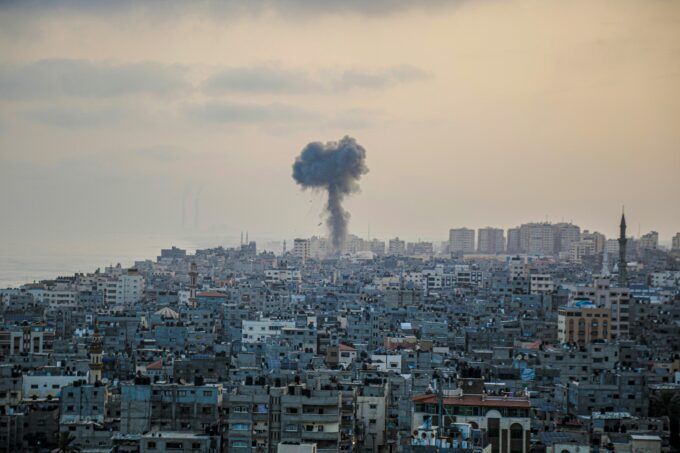
The latest massacre at the food distribution in Gaza offers yet another stark and sickening reminder of this pattern. At dawn on Sunday, June 1st, more than 30 Palestinians were murdered while waiting for food aid in Rafah. As usual, Israel swiftly denied responsibility, claiming its army was unaware of any shooting near the American-led distribution center. But eyewitnesses, survivors, humanitarian organizations, and hospitals told a contradictory story.

Israel’s denial was immediately echoed—and defended by American officials. The U.S. ambassador—better described as Israel’s emissary within the State Department—dismissed reports of the massacre as “fake news.” This grotesque inversion of truth is a familiar maneuver, reminiscent of the Flour Massacre on February 29, 2024, when Israeli forces opened fire on civilians collecting flour, killing 112 and injuring over 760.

Again, Israel denied responsibility, claiming the deaths resulted from “stampedes” and civilians being run over by aid trucks. Yet even after the United Nations and media outlets like Al Jazeera challenged the Israeli disinformation and presented video footage clearly showing Israeli forces firing on unarmed civilians, no accountability followed.

In Gaza, it is not just food aid sites have become death traps. Ambulances are targets. First responders, doctors, and even their children have become “legitimate” military objectives.

Last week, Israel targeted the home of Dr. Alaa al-Najjar, killing nine of her ten children—Yahya (12), Eve (9), Rival (5), Sadeen (3), Rakan (10), Ruslan (7), Jibran (8), Luqman (2), and Sedar, not yet one year old. Her husband, Dr. Hamdi al-Najjar, succumbed to his injuries days later. Their tenth child, 11-year-old Adma, sustained a critical head injury and is unlikely to survive due to Gaza’s medical blockade.

Israel’s standard, callous response followed, explaining that its aircraft had struck “a number of suspects” in Khan Younis.

In March, the Israeli army murdered eight medics, six civil defense workers, and a United Nations employee—then buried them in the sand. The military later blamed the “suspicious behavior” of an ambulance for the attack. When confronted with video evidence disproving the claim, the army reverted to its usual script: “a mistake,” “a wrong decision,” “disciplinary action taken.” Fifteen lives erased with a bureaucratic shrug.

When Israel murdered seven humanitarian workers from the World Central Kitchen in April 2024, the Biden administration initially expressed outrage. Twenty-four hours later, that outrage was mollified by Israeli firsters in Washington. White House spokesperson John Kirby reversed course, claiming there was no evidence of deliberate targeting—absolving Israel in the same breath that had condemned it. A mass killing became a footnote.

This is nothing new.

In October 2023, nearly 500 civilians were killed in a blast at the Al-Ahli Arab Hospital in Gaza. Israel immediately blamed a misfired Palestinian rocket. Just hours after landing in Tel Aviv, President Joe Biden publicly parroted the Israeli narrative—despite overwhelming eyewitness accounts, growing evidence, and skepticism from independent observers.

And then there is the case of Shireen Abu Akleh, the Palestinian-American journalist gunned down in 2022. Israel initially claimed she was killed by Palestinian crossfire and released a video that was quickly discredited. Yet Western media gave more airtime to Israeli claims than to eyewitness testimony. Months later, under the weight of irrefutable evidence, Israel admitted responsibility—calling it, once again, a “mistake.”

The soldier who murdered a “lesser” U.S. citizen, like other killers of journalists, never faced justice. In fact he was promoted to Captain and went on killing with impunity—until reports emerged of his death during a battle in Jenin.

Just like the murdered children of Gaza, truth itself has become another collateral damage in Israel’s war of disinformation. And those tasked with defending it—the media and democratic institutions—have too often served instead as marketers and conveyors of Israeli lies and propaganda.

The people of Gaza are not only being starved, bombed, and murdered. They are being erased from global consciousness by a wall of deception. And until the world begins to value Palestinian lives as much as it values Israeli (proven false) narratives, the Israeli theater of blood and deceit will continue.

Israel is not only getting away with war crimes—it’s getting away with lying about them. The impunity is not only military; it is moral, political, and informational. Israel has long mastered the art of the lie, dating back to the creation of political Zionism. The West, and its managed media, has normalized these falsehoods—just as it has normalized the starvation and siege of Gaza.

Israel lies with impunity because the world—especially the United States and much of the West—not only permits it, but promotes it. Western governments and media have built an echo chamber where Israeli narratives always take precedence—not due to credibility, but to avoid the reckoning that truth would demand. In choosing falsehood over fact, they evade moral accountability and sidestep the need to reconcile their professed values with the genocide they enable.

This is no longer just about Israeli lies. It’s about a global system complicit in sustaining Israel’s habitual lies and systematic deceit to cover up a starvation and a livestreamed genocide.

Jamal Kanj is the author of Children of Catastrophe: Journey from a Palestinian Refugee Camp to America, and other books. He writes frequently on Arab world issues for various national and international commentaries.