Wednesday, July 02, 2025


Backlash intensifies for Bob Vylan over Glastonbury controversy

Backlash intensifies with criminal investigation launched over ‘death to the IDF’ controversy
Copyright AP Photo

By David Mouriquand
Published on 

Following the controversial set played at Glastonbury festival by British artists Bob Vylan, the BBC is facing pressure from the UK government. The punk-rap duo has had their US visa revoked, amid support from fellow artists.

A criminal investigation has been launched into the Glastonbury performances of both Bob Vylan and Kneecap after the police reviewed video footage and audio of both sets, which took place on Saturday.  

UK culture secretary Lisa Nandy condemned the "appalling and unacceptable scenes" and said she had called BBC director-general Tim Davie after the broadcast of Bob Vylan's set.  

Nandy claimed there is "a problem of leadership" at the BBC, and has criticised the corporation over its decision not to pull the livestream after Bob Vylan’s frontman shouted “death, death to the IDF” (Israel Defence Forces).

Her comments follow a statement made by Prime Minister Keir Starmer, who said: "There is no excuse for this kind of appalling hate speech."  

Additionally, the Israeli Embassy to the UK said on social media that it was “deeply disturbed by the inflammatory and hateful rhetoric expressed on stage at the Glastonbury Festival," while the Campaign Against Antisemitism (CAA) said it will be formally complaining to the BBC over its "outrageous decision" to broadcast the performance.  

Bob Vylan at Glastonbury 2025
Bob Vylan at Glastonbury 2025AP Photo

Following the backlash to Bob Vylan’s performance at Glastonbury, the BBC said they should have pulled live coverage of the set. A spokesperson for the corporation said: “The team were dealing with a live situation, but with hindsight we should have pulled the stream during the performance. We regret this did not happen.”  

They continued: “The BBC respects freedom of expression but stands firmly against incitement to violence,” adding: “The antisemitic sentiments expressed by Bob Vylan were utterly unacceptable and have no place on our airwaves. In light of this weekend, we will look at our guidance around live events so we can be sure teams are clear on when it is acceptable to keep output on air.” 

The Avon and Somerset Police said in a statement: “This has been recorded as a public order incident at this time while our enquiries are at an early stage. The investigation will be evidence-led and will closely consider all appropriate legislation, including relating to hate crimes.” 

“There is absolutely no place in society for hate. Neighbourhood policing teams are speaking with people in their local communities and key stakeholders to make sure anyone who needs us knows that we are here for them.” 

Bob Vylan targeted

Bob Vylan during their Glastonbury set 2025
Bob Vylan during their Glastonbury set 2025AP Photo

The backlash has intensified for the British punk-rap duo, who have also been dropped by their agent following their incendiary performance ahead of Kneecap’s concert.  

United Talent Agency (UTA) has not acknowledged the alleged severing of ties, but Bob Vylan’s pages on their artists sites have been removed.  

Additionally, two days after their Glastonbury performance, US Deputy Secretary of State Christopher Landau took to social media to share that the State Department has “revoked the US visas for the members of the Bob Vylan band in light of their hateful tirade at Glastonbury, including leading the crowd in death chants. Foreigners who glorify violence and hatred are not welcome visitors to our country.”

The band had announced a US tour in October, during which they were due to open for Grandson.

Grandson has shared: “Censorship of art is a tactic of control. They blame artists and activists and not those who responsible for the conditions we rage against.  From the death spiral of corporate greed and climate change to the genocide of Palestinian lives, the music and the artists are not the problem, we are the symptom of a sick world.”

He added: “As a Jewish artist, I am deeply offended by the conflation of criticism against a military force known for their indiscriminate violence with antisemitism. The Israeli government has done more to exacerbate antisemitism this past 2 years than any statements by artists advocating for Palestinian freedom and solidarity. Bob Vylan are the one feature on my album and that feature will go on. If they have the opportunity to come to the United States, they will join us on the ‘Inertia’ tour as planned.”

Sharing a statement on Instagram after the Glastonbury set, Bobby Vylan said: "Teaching our children to speak up for the change they want and need is the only way that we make this world a better place.” 

He added: "As we grow older and our fire starts to possibly dim under the suffocation of adult life and all its responsibilities, it is incredibly important that we encourage and inspire future generations to pick up the torch that was passed to us." 

Artist support for Bob Vylan and Kneecap

Several artists have come out in support of Bob Vylan and Kneecap following the news that both bands were now formally under criminal investigation. 

Lambrini Girls wrote: “All good for bands to be political as long as it’s digestible and commidifiable. when it’s actually NEEDED and warranted and pushing against the true status quo – then time after time again, historically it’s proven that mass media and the government will villainise artists – look at Public Enemy, Nina Simone, Rage Against The Machine.” 

“Art creates emotional resonance in ways that speeches or articles sometimes can’t,” they continued. “It’s why oppressive regimes often target artists, musicians, and writers FIRST. Art is one of the most powerful tools we have for activism, they go hand in hand. Don’t be fooled into thinking it was anything other than protest. Fucking free Palestine.” 

Elsewhere, Amyl & The Sniffers defended both Kneecap and Bob Vylan: “Where do you think your anger should be directed? Are you uncomfortable hearing about genocide in Gaza? Take a beat and think about why musicians take plitical and social stances against injustices across the world. We have a platform that millions of others don’t, why expect everyone to be silent? Look at your politicians and government and how they respond to this. This conversation is once again distracted from the real issue of innocent Palestinians’ lives and family lines being obliterated. Have a think about who the real villains are in this story.” 

Fans at Glastonbury 2025
Fans at Glastonbury 2025AP Photo

The war in Gaza started after Hamas militants launched attacks in Israel on 7 October 2023, killing 1,200 people and taking up to 250 hostages. Israel has been carrying out a full-scale military campaign on occupied Gaza since.  

A UN report has found that Israel’s military actions are consistent with genocide, and at least 56,000 Palestinians have been killed, according to the Gaza Health Ministry.  

Israel has continually denied that their actions in Palestine can be equated to genocide and argued that it has not partaken in any war crimes.


 

Renault reports nearly €10 billion non-cash loss due to Nissan stake

The Renault Scenic model, elected "Car of the Year 2024," is seen at the 91st Geneva International Motor Show (GIMS) in Geneva, Switzerland 26 Feb., 2024.
Copyright Cyril Zingaro/KEYSTONE / Cyril Zingaro

By Doloresz Katanich
Published on 

The French carmaker said it would change the way it accounts for its stake in its long-term Japanese partner, based on Nissan’s share price.

Renault SA has changed the way it accounts for its stake in Japanese firm Nissan, leading to a non-cash loss of €9.5 billion, affecting its earnings in the first half of its 2025 fiscal year. 

The stake, previously accounted for using the equity method, will now be a financial asset, measured by the share price of Nissan, as of 30 June 2025.

“This approach aligns the value of the stake in Nissan in Renault Group's financial statements with the value of Nissan's share price,” Renault said in a statement. “The non-cash loss has no impact on the calculation of the dividend paid by Renault Group.”

The two carmakers have been cooperating for a little more than a quarter of a century, and the French brand owns nearly 36% of the ailing Japanese company.

Since the start of this year, the Japanese carmaker’s stocks have lost 28% of their value. Nissan also announced recently that it would shed 20,000 jobs worldwide after it reported a net loss of around €4bn for the fiscal year that ended in March 2025.

Renault Group, the owner of brands including Renault, Dacia, Alpine and Mobilize, successfully increased its sales against a broader market downturn in the first quarter of 2025, as carmakers across the globe face trade uncertainty triggered by US President Donald Trump’s tariff policy.

Renault’s future became even more uncertain after CEO Luca de Meo recently resigned to take over the leadership of luxury group Kering. 

In terms of the long-term alliance between Nissan and Renault, this partnership has come into question as reports have emerged that the two carmakers are looking for a way out of the strategic cooperation, which has bound them since 1999. 

Renault has, however, sent a strong message to investors saying: “The operational projects and collaboration resulting from the strategic cooperation between Renault Group and Nissan remain intact with a pragmatic and business-oriented approach.”


Poland trials a four-day working week: A step towards the future?

Office workers.
Copyright Canva.

By Berenika Sorokowska
Published on 

Poland will start its first-ever pilot of a shortened working week this July as the government seeks to meet social needs.

The idea of reducing working time is one that has received much attention. For several years now, this topic has regularly appeared in public debates, not only in Poland, but also in many other countries.

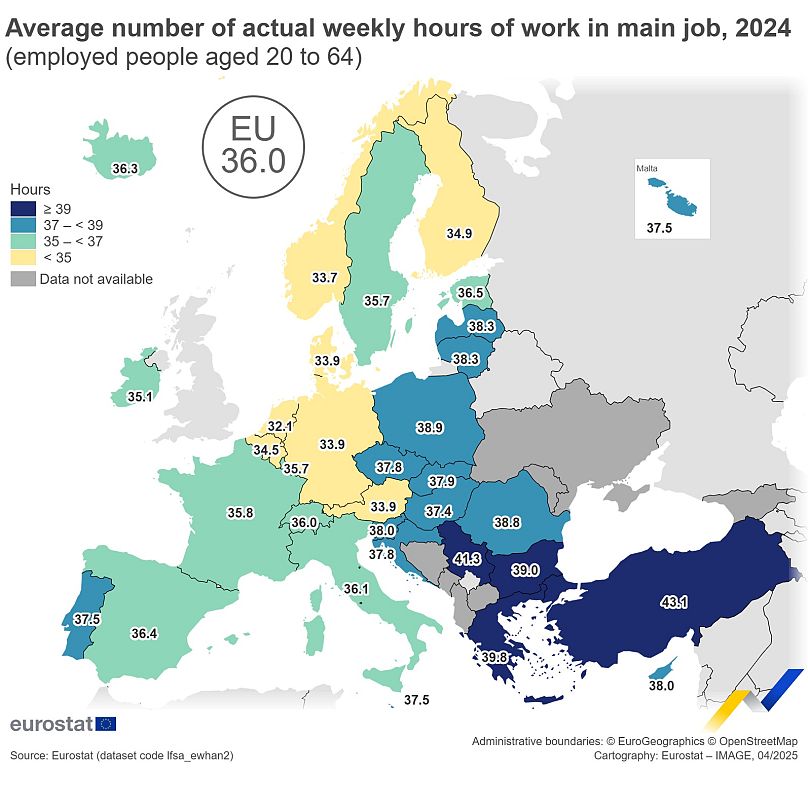
Employees are increasingly saying they are overburdened, lacking time for their private life, health, and family. Statistics from Poland reiterate this narrative; the country is one of the busiest nations in the European Union.

Working hours
Working hoursEurostat

At the same time, more and more countries are experimenting with "smarter work". In Iceland, Belgium, Spain and even Japan, various models of a shorter working week have already been tested or introduced. The results? Mostly positive: higher productivity, reduced sick leave, improved working atmospheres.

Four-day working week: Social expectations are clear

Today's labour market is vastly different from that seen a century ago, when the eight-hour working day was first introduced in Poland. Technology, automation and societal changes mean that many jobs can be done faster and more efficiently. Today, more than ever, it is not necessarily the time spent in the office that counts, but the quality of the work done.

Employers have diverse reactions

There is no single opinion among employers when it comes to the topic of the four-day working week. Large companies, especially in the creative and technology industries, are looking at the idea with interest. Some are already introducing flexible working hours or testing shorter weeks.

The situation is different in the SME sector, as small and medium-sized companies are usually more cautious. They fear that a shorter week could lead to cash flow problems, a drop in revenue or the need to hire additional staff.

This is why the government's financial support could be crucial for businesses trialling the new work model, protecting against the risk of serious losses.

The effect on the economy

Advocates of a shorter working week argue that less time spent at work doesn't have to lower productivity.

On the contrary, they argue that by organising work in a smarter way, the same — or even better — results can be achieved in less time.

Studies in other countries show an increase in efficiency, reduced resource use, fewer errors and increased team creativity.

Of course, there are also sceptics. Some economists warn that there could be an increase in companies' operating costs and, consequently, a decrease in competitiveness or a stifling of GDP growth.

To tackle these risks, the pilot project aims to rely on data rather than guesswork.

We are launching a pilot - employers all over Poland can now prepare to test the new work model. Up to PLN 1 million in funding for project implementation to be won!

Tried and tested examples from Poland

Some employers are already taking decisions to reduce working hours. Herbapol Poznań, as well as city halls in Włocławek, Ostrzeszów, Świebodzice or Leszno are just a few examples of institutions that have decided to take this step.

The conclusions? Employees are more engaged, less stressed and the quality of their work is higher.

Four days a week: A new working philosophy

Changing the working model is not only an organisational issue. It's also a mental shift — from a time-control approach to one that rewards efficiency, trust and a healthy work-life balance.

Although the pilot comes with risks, advocates of the model say it is an opportunity to ensure that professional success is not paid for by burnout.

The pilot in Poland could be the first step towards systemic change, which many are already waiting for.

1933


Will new EU animal welfare law curb illegal trade?


Copyright Euronews

By Isabel Marques da Silva
Published on 01/07/2025 - 


The EU has created its first law on the welfare of dogs and cats to be applied across the bloc, targeting illegal trade and harmful practices. A regulation that was long overdue, considering that 44% of EU households have a pet and it's a billion-dollar business.

The upcoming legislation sets minimum rules for the entire EU, such as mandatory microchipping and registration of dogs and cats born in or imported into the bloc.

Pet registration is already mandatory in 24 of the 27 EU Member States, but the systems are fragmented. A future common online data base should tackle the problem said Tilly Metz, an MEP from the Green group and shadow rapporteur for the regulation.

©
©Euronews

"It is now the responsibility of the European Commission to implement a system that works in all member states, so that we can guarantee interoperability and real traceability of the animal throughout Europe," Metz told Euronews.

The EU dog and cat trade is worth 1.3 billion euros annually. Around 60% of owners purchase them online, which has led to opacity regarding the origin of the animals, their health and whether they are vaccinated.

According to a study by the European Commission, the main countries of origin for the illegal animal trade are Romania and Hungary, both EU members, and the third countries Russia, Belarus, Serbia and Turkey.

"That's why we also want the animal to be registered as quickly as possible when it enters the European Union and we have been advocating that this should happen at the border," the MEP added.

©
©Euronews

End 'animal mills'

The European Parliament also defends a ban on the sale of dogs and cats in pet shops in an amended proposal to the law approved this month.

Inappropriate practices in the breeding of these pets are also being addressed, by imposing limits on the number of litters a female can have.

"The maximum is three litters in a two-year period, followed by a one-year break. This is because frequent pregnancies lead to malnutrition or weakening of the immune system," said Gerardo Fortuna, a Euronews reporter who has been covering the new law.

"It is one of the ways to curb the phenomenon of puppy mills, that has both support of the Council and Parliament," he added.

To avoid consanguinity, the crossbreeding between parents and children, grandparents and grandchildren, as well as between siblings and half-siblings will be prohibited.

Although cats and dogs make up 90% of Europeans' pets, the law could be soon enough extended to other companion animals, with the permitted species to be defined in a so-called "Positive List", an idea proposed by the European Parliament.

Watch the video here!


Journalist: Isabel Marques da Silva

Content production: Pilar Montero López

Video production: Zacharia Vigneron

Graphism: Loredana Dumitru

Editorial coordination: Ana Lázaro Bosch and Jeremy Fleming-Jones


Portugal hit by heatwave as rare 'tsunami' roll cloud phenomenon surprises beachgoers

A lot of heat and more: meteorological phenomena plague Portuguese territory
Copyright AP Photo

By Euronews Lisbon
Published on 

Mainland Portugal faces a heatwave with temperatures reaching 42°C. A rare roll cloud surprised sunbathers on beaches, while the risk of forest fires increases.

Mainland Portugal is currently facing a heatwave that has affected most of western Europe, with temperatures reaching 42 degrees Celsius in some regions on the Iberian Peninsula, as well as Greece and France.

The heat produced a variety of unstable weather phenomena in Portugal, including freak rain showers, violent thunderstorms and hail. These phenomena were more intense in the country's interior.

'Tsunami' rolling cloud hits Portuguese beaches

On Sunday, hundreds of sunbathers were surprised by a dense tsunami-like cloud coming out of the ocean and heading towards the beach.

The phenomenon, called a roll cloud, hit several beaches along the Portuguese coast in the afternoon.

The images were widely shared on social media.

Roll clouds are a rare meteorological phenomenon, formed from the interaction of air masses of contrasting temperatures and sea breezes.

These clouds are tube-shaped and move horizontally. Despite the clear resemblance to a giant wave, thankfully, they have nothing to do with tsunamis.

As the clouds approached, strong winds appeared, taking bathers by surprise.

As temperatures continue to rise throughout the week, concerns about major forest fires are intensifying.

The National Civil Protection Authority has issued a warning to the population with preventative measures and other recommendations.

The communiqué states that the danger of rural fires is very high to maximum in the interior of the north and centre and in the Algarve.

Record-breaking sea temperatures in the Mediterranean spark fresh warnings from scientists

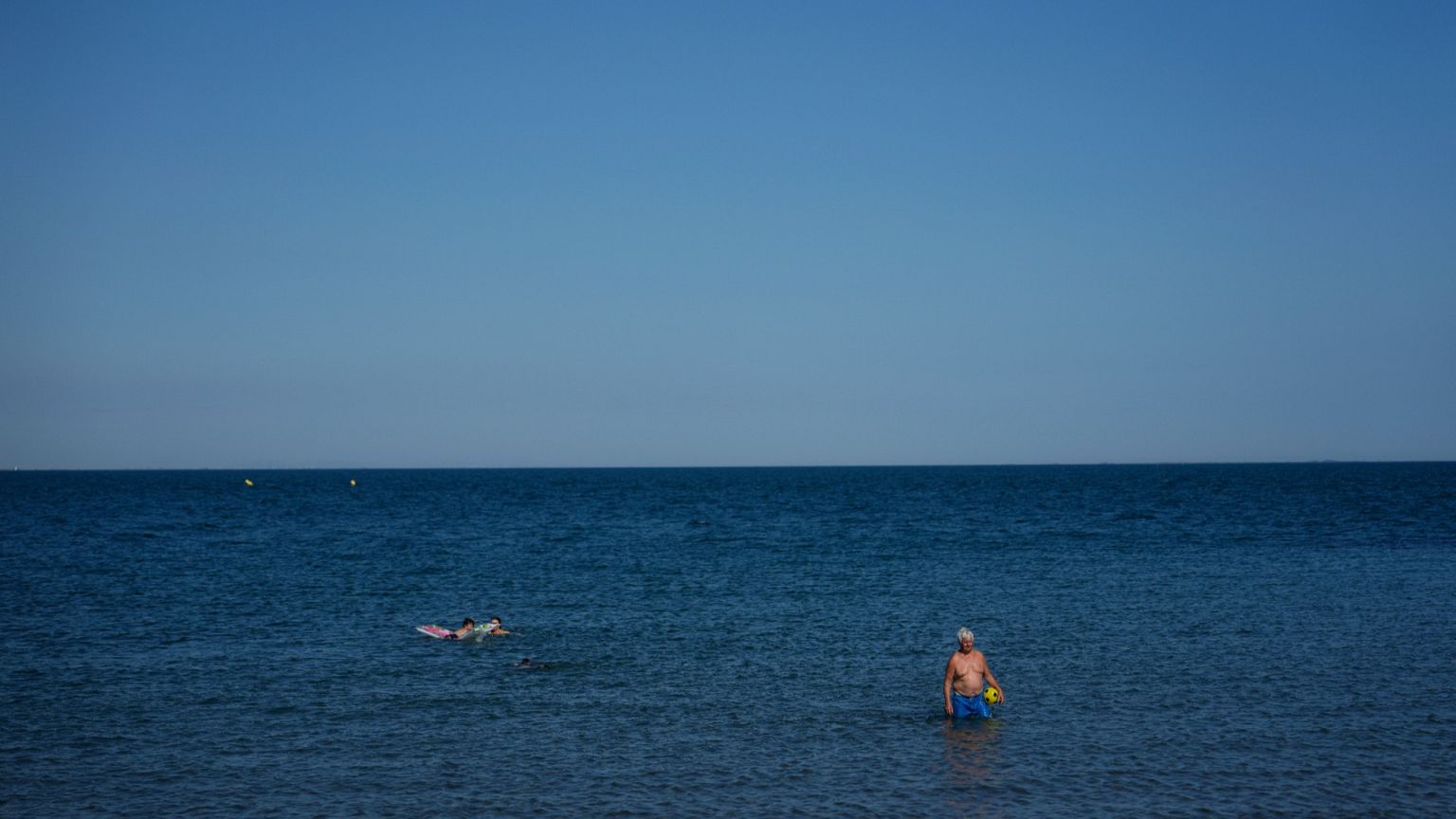
Beachgoers enjoy the sea during a heat wave Monday 30 June in Saintes-Maries-de-la-Mer, southern France.
Copyright AP Photo/Lewis Joly

By Rosie Frost
Published on 

Intense marine heat can have devastating consequences for ecosystems with its ripple effects also extending onto land.

Sea surface temperatures in the Mediterranean have reached their highest level ever recorded for June. 

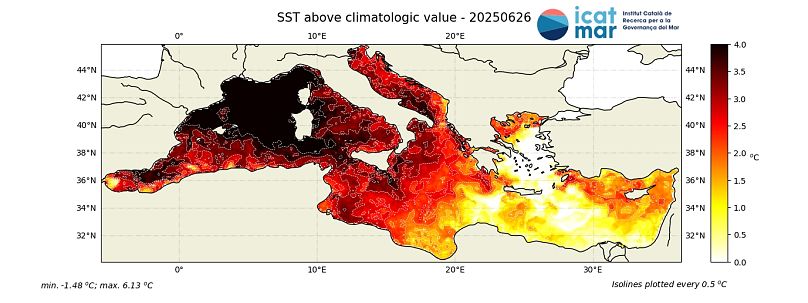
On 29 June, sea surface temperatures hit 26.01°C, according to data collected by Copernicus and analysed by Météo-France. Overall temperatures are currently 3°C higher than average, with spikes exceeding 4°C in some places around the French and Spanish coasts.

The most intense warming was observed in the western Mediterranean basin, including the Balearic Sea and the Tyrrhenian Sea. With the current weather conditions, scientists say temperatures are unlikely to drop anytime soon. 

The Mediterranean is considered one of the world’s most vulnerable ‘climate change hotspots’, warming much faster than the global average. Without action to curb climate change, experts warn that persistent marine heatwaves - prolonged periods of abnormally high ocean temperatures - could change the region beyond recognition. 

Marine heatwaves could devastate life in the Mediterranean Sea

A persistent and growing marine heatwave is gripping the region, with “severe” and “extreme” conditions emerging off southeastern Spain and northern Morocco. 

Marine scientists warn that the unfolding situation could bring devastating impacts for biodiversity, fisheries, aquaculture, and even weather patterns across southern Europe and North Africa.

“Marine heatwaves of this magnitude in the Mediterranean Sea have had major effects on marine life,” says Dr Kathryn Smith from the Marine Biological Association of the UK. 

“In the past, we have seen impacts like mass mortalities of invertebrate species, die-offs of seagrass beds and disease outbreaks in mussel farms. It's likely that we'll see similar impacts from this event.”

Sea surface temperature anomaly map from 26 June 2025.
Sea surface temperature anomaly map from 26 June 2025. ICATMAR

These events have already driven coral populations down by 90 per cent and pushed the noble fan mussel to the brink of extinction. 

Warmer waters hold less oxygen, leading to mass fish die-offs such as those seen in Tuscany in 2024. And, as fish dive deeper to escape the heat on the surface, they can’t be reached by seabirds, which then die off in their masses, too. 

The ripple effects of marine heatwaves extend onto land, too. Warm seas fuel extreme weather, as seen during Storm Daniel in 2023 which killed nearly 6,000 people. It was made 50 times more likely and 50 per cent more intense by high sea surface temperatures in the Mediterranean. 

Floods in Valencia in 2024, which claimed over 200 lives, have also been linked in part to high sea surface temperatures.

Marine heatwaves are becoming more intense and lasting longer

Marine heatwaves are now ten times more intense than in pre-industrial times and last three times as long. 

“Climate change is responsible for the global increase in the frequency, duration and intensity of marine heatwaves,” says Dr Alistair Hobday, research director for the Commonwealth Scientific and Industrial Research Organisation’s (CSIRO) Sustainable Marine Futures Programme.

The Mediterranean Sea has been steadily warming since the 1980s, with a sharp acceleration over the past decade. Over the last 40 years, it has gone from experiencing one marine heatwave per year in defined areas to an average of four per year, which cover almost the entire sea. Temperatures have been constantly above average for the past five years.

“The unfolding, wide-reaching heatwave in the western Mediterranean now demands close attention,” says Dr Karina von Schuckmann, a senior advisor at Mercator Ocean International. 

Scientists stress that only rapid global emission cuts can halt this trend. Without urgent action, this climate hotspot could be permanently transformed.

UK postal workers faced more than 2,000 dog attacks last year, Royal Mail reveals

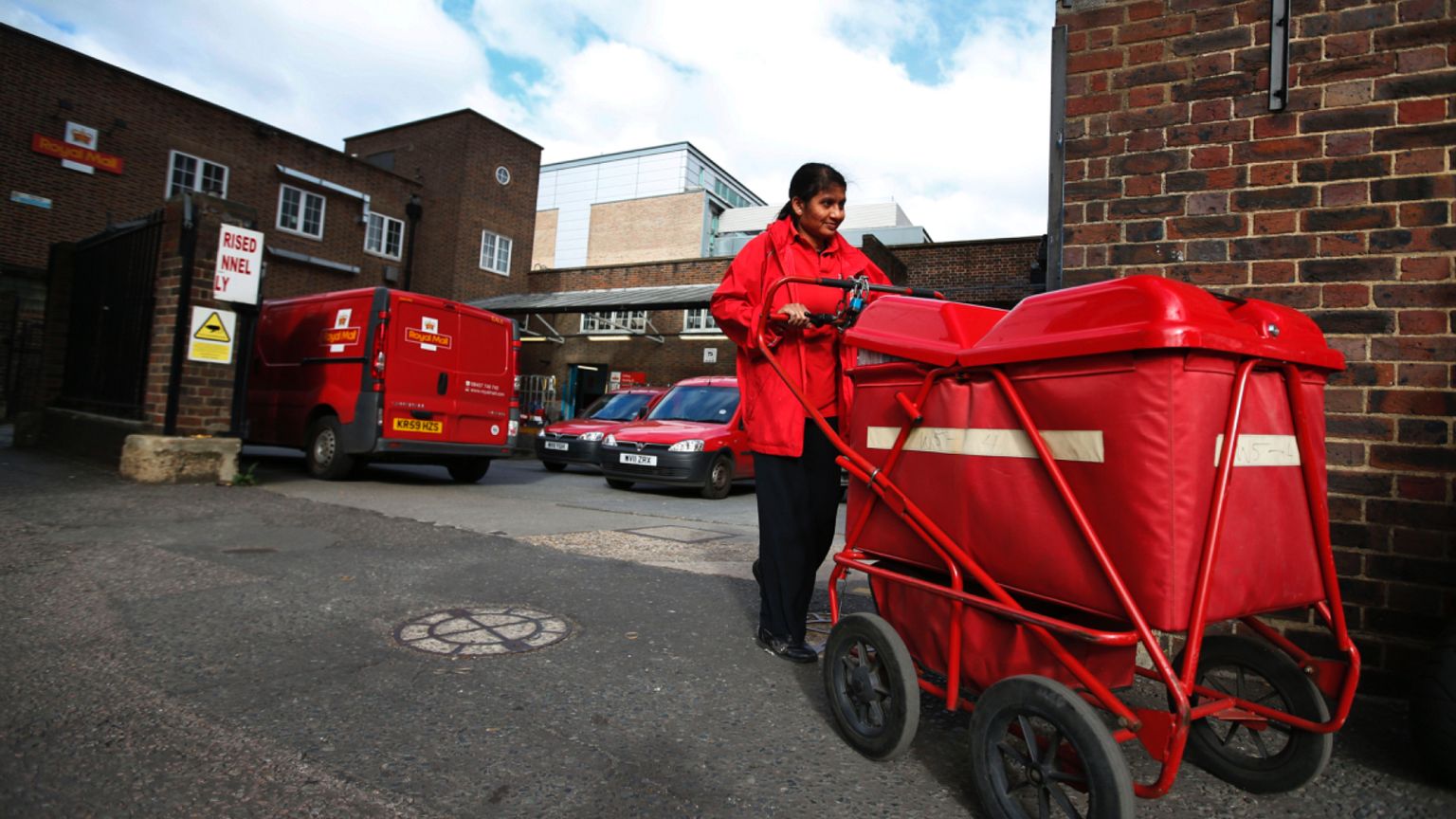
A Royal Mail post officer walks out of a Post Office depot in London, Thursday, Oct. 10, 2013.
Copyright AP Photo

By Estelle Nilsson-Julien
Published on 

Roughly 30,000 postal workers have been attacked by dogs in the last decade in Britain.

Postal workers working for Britain's Royal Mail have faced almost 2,200 dog attacks over the past year, marking a 2% annual increase in such incidents.

This equates to roughly 42 dog attacks targeting postal workers per week — with some causing permanent injuries and leading to disabilities, according to data released on Monday by Britain's main postal service.

Figures shared by the UK's Communication Workers Union also revealed that over a longer period — ranging from 2017 to 2024 — a third of all dog attacks across the UK targeted postal delivery workers.

Over the past decade, roughly 30,000 postal workers have been attacked by dogs.

'I could see the flesh on my leg hanging'


Ellenore King-Voisin has worked as a postwoman in Farnborough — a city in southeast England — for the past three years. But in June last year, what was meant to be a normal day at work turned out to be a traumatic experience.

"I was delivering mail to a property on my round that I had been to many times before," she told Royal Mail.

"The customers there were very proud of the two rescue dogs they had. I had seen the dogs before so was aware that one of them had an aggressive temperament."

On the day of the attack, the dogs' owner, who was working on his car parked at the front of the property, had left the front door open. However, when King-Voisin walked up the drive to deliver the man's post, things took a turn for the worse.

"I noticed the calmer of the two dogs at the door. She looked at me and I froze. The dog then went back inside and then both dogs returned to the door and at that point I realised I just didn't stand a chance", said King-Voisin.

"The dog jumped up at me and bit me three times just above the right knee. When I looked down, I could see the flesh on my leg hanging and the fat tissue that had literally burst open looked like little yellow marbles on the floor. I'd never seen anything like it before", added King-Voisin.

Eventually, King-Voisin managed to save herself.

"I knew that the dog would not stop attacking me if I didn’t do something, so I started screaming, and then the owner and his daughter came rushing out," she recalled. "I also startled the dog as she ran back into the house. I had to do my own First Aid as the man and his daughter were crying."

Do not let the dogs out

Despite the overall rise in attacks over the last year, a 10% decrease in attacks resulting in serious and significant injury to postal workers was recorded, with 74 significant incidents logged, compared to 82 in 2023-24.

But in a similar trend to previous years, nearly half of all dog attacks (46%) targeting postal workers took place at the front door, while more than a quarter (28%) took place in the garden, drive or yard.

Nearly a fifth of attacks (18%) happened through letterboxes and a total of 8% of attacks occurred in the street or road.

In a bid to protect its workforce, the UK's Post Office recommends the public print off and display on their property a postcard that warns postal workers that they own a dog.

It also asks them to wait while owners secure their dog before opening the door.

In 2020, a High Court ruling declared that stated dog owners (or those in care of a dog) could be prosecuted if their pets have free access to the letterbox and cause injury to any postal or delivery worker — whether the owner is at home or not.