Wednesday, July 16, 2025

 Israeli supreme court says rabbinate must offer tests to women

(RNS) — The ruling does not call for the strictly Orthodox rabbinate to ordain women as rabbis but opens up to women the body’s licensing exams that test in a variety of areas of Jewish law. 
Jewish Orthodox women attend an event celebrating the completion of the seven-and-a-half-year cycle of daily study of the Talmud, in Jerusalem, on Jan. 5, 2020. (AP Photo/Tsafrir Abayov)

(RNS) — Israel’s state rabbinate must open up its rabbinic expertise exams to women, Israel’s supreme court said on Monday (July 14) in a ruling hailed by advocates for pluralism and egalitarianism in the Jewish state’s religious institutions. 

“Discrimination between women and men regarding eligibility to take the Chief Rabbinate exams is unacceptable, just as discrimination between women and men regarding eligibility to enjoy any other service provided by a public authority in the State of Israel is unacceptable,” Justice Ofer Grosskopf wrote in the court’s decision. 

The ruling, however, does not call for the strictly Orthodox rabbinate to ordain women as rabbis, but it opens up to women the body’s licensing exams that test in a variety of areas of Jewish law. 

The rabbinate gives more than a dozen exams, on topics ranging from kosher slaughter to ritual purity to business and agricultural law, and requires a certain number to be completed to be eligible for the rabbinic positions it administers. For example, a neighborhood rabbi must pass six, while a city one must have passed 11. 

It also awards certificates based on the completion of exams that are treated as equivalent to university degrees and are associated with benefits and salary expectations. 

In 2018 Shas, the Sephardic Haredi party, which has exerted the most influence over the rabbinate in recent years, successfully lobbied to have the rabbinic exams be considered the equivalent of a bachelor’s degree for the public-sector jobs for which the Israeli government requires a higher education degree.
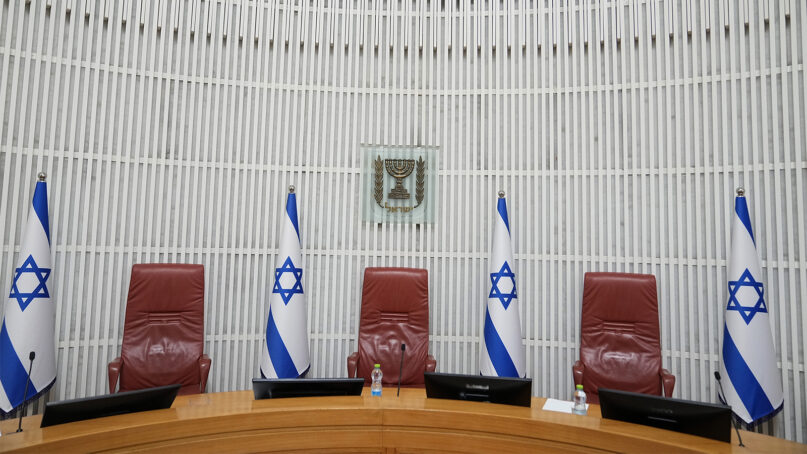
The justices’ bench in the Supreme Court of Israel in Jerusalem, Aug. 3, 2023. 

(AP Photo/Ohad Zwigenberg)

On that basis, three organizations — ITIM, which advocates for pluralism and openness in Israel’s religious institutions; the Rackman Center for the Advancement of the Status of Women; and the Kolech: Religious Women’s Forum — first brought the case before Israel’s courts seven years ago.

“Because Shas was giving so much economic benefit, that actually created a huge inequality,” Rabbi Seth Farber, the director of ITIM, told Religion News Service. “It’s not the (rabbinic ordination) that gives the economic benefits — no one would think that — it’s the exams that give the economic benefits, and because of that, women shouldn’t be left out of the exams.”

Farber explained that Israel requires a bachelor’s degree equivalent for nonrabbinic jobs such as community center director or to qualify for certain ranks in the police force, among others. 

In 2014, two rabbis were sentenced in Israel for a decades-long scheme in which they sold more than 1,000 rabbinic ordination diplomas to clients so they could qualify for roles that required an advanced degree. 

ITIM argued before the Supreme Court that if men could use their religious scholarship to fulfill the advanced degree requirements, there is no reason that women should not be able to either.

For centuries, the study of Talmud and even the Torah in its original biblical Hebrew had been reserved for men in Orthodox Jewish culture. If women received a religious education, it was often more informal — and in translation, through texts such as the Tsena U’rena, a Yiddish translation of the Bible that became known colloquially as the “Women’s Bible.”

Over the last century, however, that’s seen significant change, and in the last several decades an explosion of religious institutions has emerged to give female scholars an education on par with or even beyond that which is available to men. 
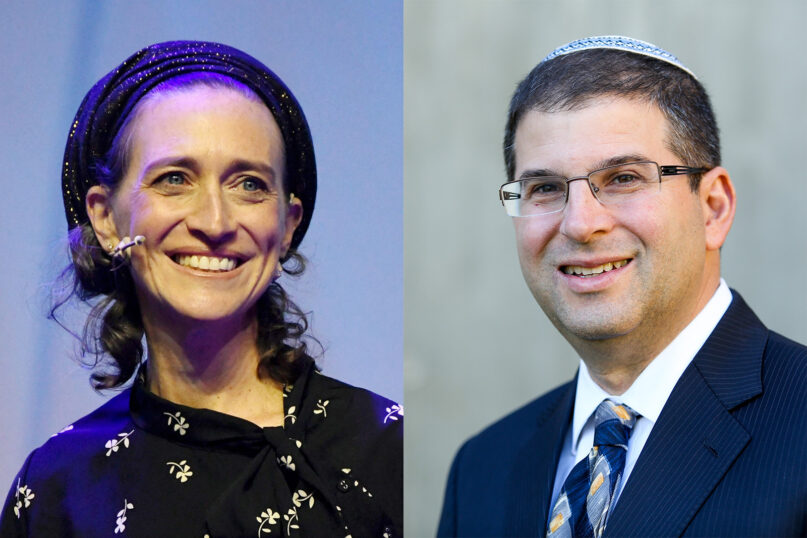
Michelle Cohen Farber, left, and Seth Farber. (Courtesy photos)

Farber’s wife, Michelle Cohen Farber, one of the women religious scholars who petitioned the court over the issue, is the founder of Hadran, which encourages Talmud study among Orthodox women. Cohen Farber led a Siyum, a traditional ceremony celebrating the completion of a seven-year cycle of Talmud study, for 10,000 women in 2019.

While some have advocated for women to be ordained fully as rabbis — something non-Orthodox Judaism has accepted for decades — others have simply argued that their scholarship must be acknowledged. 

“Once again, women stand at the gates of this Court — women of faith, grounded in their way of life and deeply versed in the world of halakhah,” wrote Justice Daphne Barak-Erez said in the Supreme Court decision, referring to Jewish law. “Once again, they come asking for equal treatment in the field of religious services in the State of Israel.”

The ruling is the latest in a series of wins for women’s participation in the rabbinate championed by the Supreme Court. Last year, the court ruled that women must be given representation on the council that chooses Israel’s chief rabbis, specifically citing their religious scholarship.
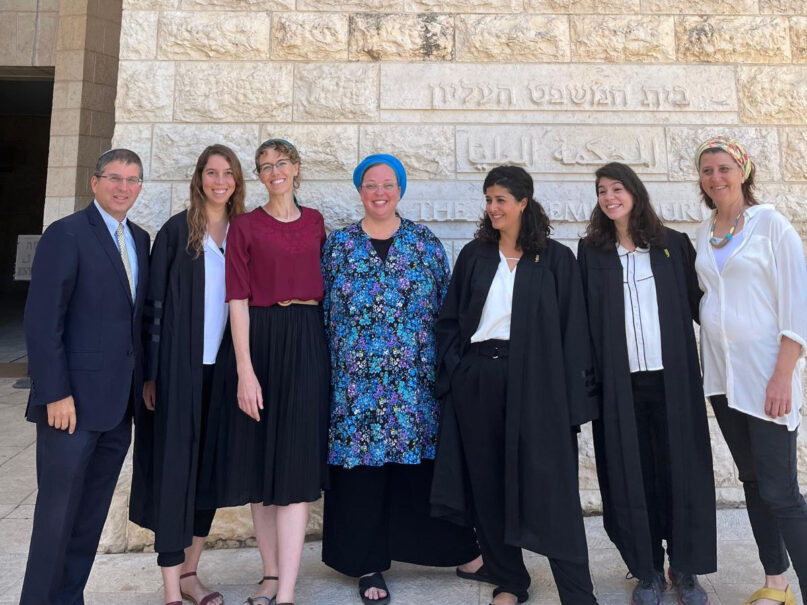


Rabbi Seth Farber, left, with some of the plaintiffs at the 

Supreme Court of Israel in Jerusalem. (Photo courtesy Seth Farber)

Israel’s rabbinate has sweeping powers over all things that intersect with Jewish ritual or law in the Jewish state, including marriage, divorce, conversion and even some aspects of immigration. It has become deeply unpopular to much of the Israeli public in recent years, even to Jews who identify as religious. Many view it as representative only of the most religious sector known as Haredim, and out of touch with the larger Orthodox Jewish population in Israel. 

A 2016 Pew study found that Haredim represented only 9% of Israel while other Orthodox Jews, such as Modern Orthodox, made up 13%. 

Over the seven years that the case has been contested, the rabbinate strongly opposed the idea, with former Sephardic Chief Rabbi Yitzhak Yosef stating that he would rather get rid of the exams altogether before opening them up to women. 

Farber noted that a subsequent offer from former Religious Affairs Minister Matan Kahana would have established a parallel system for women. But after immediately being told that the tests would be less rigorous than those offered to men, ITIM rejected the idea. 

“We were opposed to separate but equal, because we didn’t think that really worked,” Farber said. 

He is hopeful that with the current ruling, regardless of titles, there will be a framework to acknowledge women leaders’ experience and scholarship, just as there is for male ones. 

“We’ve seeded something that will yield its fruit in many, many years,” Farber said. “Next year … if they’ll allow women, you’ll certainly have tens of women apply. But ultimately, the hope is it will change the way people study, because there’ll be new vistas that are that are open to women.

“I can imagine a school saying, ‘We want a woman to be our religious leader, but the minimum requirement is you pass the rabbinate in exams,’” he added. “Ultimately, the community will decide how seriously these things are taken, but my sense is that this will create new institutional opportunities.”


 Opinion

Holding Israel accountable isn’t antisemitic — harming Jews is
(RNS) — When anger about Israeli government policy spills over into harassment or violence directed at Jews in the U.S. or any other country, that’s antisemitism.
People gather to light candles in a makeshift memorial during a vigil May 22, 2025, outside the White House in Washington to honor Yaron Lischinsky and Sarah Milgrim, who were killed as they left an event the night before at the Capital Jewish Museum in Washington. (AP Photo/Jose Luis Magana)

(RNS) — As the leader of an organization of rabbis and cantors, I hear from members nearly every day about synagogues vandalized, bomb threats called in during services, visible Jews harassed on the street and hateful comments online and off. 

In the last few months, we’ve witnessed several violent antisemitic incidents, some of which have turned deadly. On June 30, 82-year-old Karen Diamond died of wounds sustained in the firebombing of a June 1 walk for Israeli hostages in Boulder, Colorado. In May, a gunman fatally shot Yaron Lischinsky and Sarah Milgrim outside of the Capital Jewish Museum in D.C. On Passover night, there was an arson attack on Pennsylvania Gov. Josh Shapiro’s home in Harrisburg. 

Some have denied these violent attacks constitute antisemitism because the perpetrators allegedly acted out of solidarity with Palestinians. In a recent New York Times column, for example, M. Gessen condemned the attacks but categorized them as “violence committed for political reasons,” not as antisemitism. Many have seized on the fact that Lischinsky and Milgrim worked for the Israeli Embassy, even though their killings did not take place there and there is no evidence that the perpetrator knew anything about their identities. On the flip side, some Jewish leaders have seized on the fact that two of the men shouted “Free Palestine” in the course of their deadly attacks and declared this phrase itself to be antisemitic.


Both these conclusions are misguided. “Free Palestine,” when chanted at a rally to end the war, spray-painted on a sidewalk or written on a sign outside of the Israeli Embassy, is a political statement similar to “Free Tibet.” The phrase can encompass multiple visions of what a free Palestine might look like and multiple strategies for how to achieve it.

At the same time, few Americans would have trouble identifying a violent attack on a mosque or Muslim community event as a bias crime, regardless of the politics of the imam or the community. Nor did we see public arguments that the 2018 murder of 11 Jews in a Pittsburgh synagogue was political, not antisemitic, even though the attacker was motivated by anger at the community’s support for refugees. Likewise, we should have no trouble identifying the recent violent attacks on Jewish community events and spaces as antisemitic. 


Passersby pause for a moment at a makeshift memorial for victims of an attack outside of the Boulder County, Colo., courthouse as a light rain falls June 3, 2025, in Boulder, Colo. (AP Photo/David Zalubowski)

Not all opposition to Israel or Israeli policy is antisemitic. As a member of the United Nations, Israel has the same obligations to international law as any other country. Like every other country, it can and should be held accountable for violations of this law. All people of conscience should be horrified by Israel’s actions in Gaza, which have already killed tens of thousands of Palestinians, including thousands of children, provoked widespread starvation and disease, and displaced nearly the entire population. 

Americans can and should protest this war. Nor is it antisemitic to advocate for changes in U.S. policy toward Israel, including calling for an end to arms sales, or to boycott the country. I personally do not support such a boycott, but protected free speech includes speech with which one disagrees.


But when anger about Israeli government policy spills over into harassment or violence directed at Jews in the United States or any other country, that’s antisemitism. While I reject all political violence, violence aimed at an Israeli political figure or at an Israeli government office would be political, whereas violence aimed at a synagogue, a Jewish institution or Jews is antisemitic.


Claims that violence is directed only at “Zionists” or “Zionist Jews” do nothing to make such incidents less antisemitic. Some on the left have demanded that Jews and Jewish institutions disassociate from Zionism or Israel to avoid shunning and worse. This stance misunderstands the very nature of many Jews and Jewish communities. Judaism is not simply a faith, but a people with a history, a set of ritual and cultural practices, a sacred language and multiple vernaculars, and a homeland.

Today, the vast majority of Jews and Jewish institutions in the world maintain a strong connection with Israel for multiple reasons, including because nearly half the world’s Jewish population lives in Israel and because history has tragically taught that few other countries have provided safety for Jews in the long term. This kind of Zionism does not mean a rejection of criticism of Israel. Indeed, hundreds of thousands of Israelis have been in the streets since 2022, furiously protesting their anti-democratic government and now demanding a hostage deal and ceasefire.

There are, of course, Jews who identify as anti-Zionist, which may connote support for a secular democratic state over a Jewish one, a commitment to organizing their own Jewish lives around the places they live, or any number of other positions. These Jews can have legitimate and thoughtful reasons for their political stance and are just as Jewish as any other Jew. At the same time, they risk being tokenized and used as shields against accusations of antisemitism by others who argue their views make them “the good Jews,” and thereby are willing to see “the bad Jews” subjected to intimidation and violence based on their perceived politics.

Charred tables and dishes are visible inside the Pennsylvania governor’s official residence after a man was arrested in an alleged arson that forced Gov. Josh Shapiro, his family and guests to flee in the middle of the night on the Jewish holiday of Passover, April 13, 2025, in Harrisburg, Pa. (AP Photo/Marc Levy)

Since Jews have a collective identity as a people, not merely as adherents to a spiritual tradition, most Jews understand themselves to have a responsibility for k’lal yisrael, or the global Jewish people. These bonds of care and concern extend to Israeli Jews. As Jews worldwide have relearned since Oct. 7, 2023, pidyon shevuim — the ransoming of captives — is a religious obligation of the highest level. Traditional Jewish prayer books even include a centuries-old prayer for hostages because Jews have tragically so often had the need for it. People of goodwill need to take seriously the fact that the vast majority of Jews do see their concern for Israel and Israelis — including the hostages taken by Hamas — as an expression of Judaism and Jewish identity. Jews in Boulder walked for hostages as an expression of their Judaism.

Some progressives may hesitate to identify actions motivated by anti-Israel sentiment as antisemitic because they fear fueling the misuse of antisemitism by the Trump administration, which has cynically used antisemitism as a pretext to dismantle democratic institutions and subvert the rule of law by detaining foreign students and stripping funding from universities. It’s also true that many major Jewish leaders and institutions, as well as the Israeli government, have muddied the waters by declaring nearly every criticism of Israel and nearly every expression of solidarity with Palestinians antisemitic — from protests of Israeli policy and lawmakers, to calls for an end to arms sales, to the display of Palestinian flags, kaffiyehs and even watermelons. 


It’s crucial for those who love and care about Israel to reject the misuse of antisemitism that aims to quash criticism of Israeli government policy or to suppress free speech. And it’s crucial for pro-Palestine activists to make clear distinctions in their rhetoric and actions to demonstrate that the targets of their protest are Israeli and American policies and decision-makers — not ordinary Jews showing solidarity with other Jews across the ocean.

Progressive movements have made important progress in conveying that when a person, law or institution acts in a way that harms a group of people, the intent of the actor is a limited and often irrelevant tool for assessing the oppression. We also have to look at the impact.


When Elon Musk raises a Nazi salute, his supporters may insist he is simply fascinated with Roman history. But most progressives have no trouble asserting that it’s unnecessary to discern his intent, as the impact is clearly to normalize rhetoric and actions that terrorize Jews and make Jews unsafe.

Yet when actions that kill and maim Jews have some connection to Israel and Palestine, too many pro-Palestine progressives contort themselves to argue that we cannot truly know if the perpetrators had antisemitic intent. Those arguments fall apart when we prioritize impact. When Jews, Jewish events or Jewish sites are attacked — regardless of whether the perpetrator is motivated by anger at Israel, anti-immigrant sentiment or religiously based antisemitism — the impact is the same: Jews are terrorized.

Criticism or public protest of Israel, or any other country, is an essential tool in upholding human rights, especially in a moment when a never-ending war is causing needless death, starvation and displacement in Gaza. But when criticism expresses itself as violence toward Jews and Jewish institutions – including Jews who care about Israel and Israelis – that’s antisemitism.

(Rabbi Jill Jacobs is CEO of T’ruah: The Rabbinic Call for Human Rights. The views expressed in this commentary do not necessarily reflect those of Religion News Service.)