Thursday, October 02, 2025

Hollywood performers union slam debut of AI-generated 'actress' Tilly Norwood

The debut of an AI-generated “actress” named Tilly Norwood drew sharp condemnation on Tuesday from the SAG-AFTRA actors union, which warned against replacing human performers with “synthetics.” Producers touted interest from studio executives after unveiling Norwood at a Zurich film industry conference.


Issued on: 01/10/2025 
By: FRANCE 24

The iconic Hollywood Sign is pictured in Los Angeles, California, September 17, 2024
 © Mario Anzuoni, Reuters


The recent debut of an AI-generated "actress" dubbed Tilly Norwood, and its producer's boasts of interest from studio executives, sparked a backlash on Tuesday from the SAG-AFTRA actors union, condemning the replacement of human performers with "synthetics."

The Hollywood buzz around Tilly Norwood, introduced on Saturday at a film industry conference in Zurich, and the union's scathing reaction to it reflected the dread many in the creative community feel about the intersection of artificial intelligence and show business.

The official Tilly Norwood launch consisted of a 20-second appearance of the photo-real character - a twenty-something fictional ingénue bearing no particular resemblance to any real celebrity - in a brief video parody about making an AI-generated television show.

Dutch actor-producer Eline Van der Velden, whose London-based AI production studio Particle 6 created Tilly Norwood, said during her presentation at the Zurich Summit the project was starting to turn heads.


After months of facing boardroom skepticism, talent agents were starting to tell her: "'We need to do something with you guys,'" Hollywood trade paper Variety quoted Van der Velden as saying. She said an announcement of a first-of-its-kind talent agency deal was a few months away, Variety reported.

Read more  French films tackle AI, nuclear science and the 'it' couple of 1960s cinema

Concerns about Hollywood actors and writers being exploited, and even supplanted, by AI-generated scripts and performers was a major issue SAG-AFTRA's most recent round of contract talks with studios and streaming services.

Computer-generated imagery is nothing new to the film and television industry, and AI-enhanced software has more recently emerged in various effects such as "de-aging" technology allowing actors to portray younger versions of themselves.

The ability to convincingly replicate a feature-length human film performance with AI stand-ins is still seen as far off.


'VERY REAL EMOTIONS'

Nevertheless, the prospect of talent agents suddenly showing interest in AI-created figures stirred a swift denunciation from SAG-AFTRA, representing 160,000 actors, announcers, recording artists, stunt performers and other talent.

"Creativity is, and should remain, human-centered," the union said in a statement. "The union is opposed to the replacement of human performers by synthetics."

The parody video, which first appeared in July, actually comprises 16 AI-generated characters in all. But Tilly Norwood - a winsome figure with shoulder-length brown hair, brown eyes, a British accent and her own social media profile - was the star.

A separate Facebook post attributed to the character exclaims: "I may be AI generated, but I'm feeling very real emotions right now. I am so excited for what's coming next!" SAG-AFTRA officials were not amused.

"To be clear, 'Tilly Norwood' is not an actor," the union said in its statement. "It's a character generated by a computer program that was trained on the work of countless professional performers - without permission or compensation."


Van der Velden sought to assuage such concerns in an Instagram message, saying Tilly Norwood "is not a replacement for a human being, but a creative work - a piece of art. Like many forms of art before her, she sparks conversation, and that in itself shows the power of creativity."

Van der Velden was more provocative in an interview in July with the publication Broadcast International, which quoted her as saying: "We want Tilly to be the next Scarlett Johansson or Natalie Portman, that's the aim of what we're doing."

Not everyone is convinced Tilly Norwood packs such potential. Yves Berquist, director of AI in media at the University of Southern California's Entertainment Technology Center, called the hoopla "nonsense."

"There is a lot of very understandable nervousness and fear out there about talent being replaced," he said. But judging from his own daily interactions with Hollywood executives, Berquist said there was zero interest from "serious people" in developing entirely synthetic characters.

"Scarlett Johansson has a fan base. Scarlett Johansson is a person," he said.

(FRANCE 24 with REUTERS)


Workers, civil servants in Greece hold 24-hour strike over labor bill

Unions argue proposed law weakens workers' rights

Melike Pala |01.10.2025 - TRT/AA


BRUSSELS

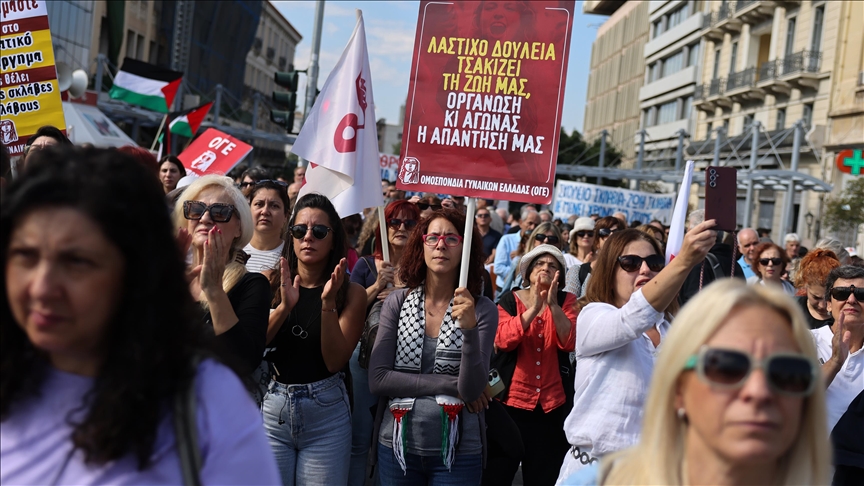
Workers and civil servants across Greece staged a 24-hour nationwide strike on Wednesday to protest a new labor bill, which unions say undermines workers' rights.

The strike, called by the General Confederation of Greek Workers (GSEE) and the Civil Servants' Confederation (ADEDY), brought thousands of people to the streets of Athens and other major cities, according to daily Kathimerini.

Protesters rallied against the government’s proposed measures to regulate working time, calling instead for shorter working hours and the full restoration of free collective bargaining.

"Working time is not a commodity - It is our life," read the main slogan of the rally in Athens, where demonstrators marched to Syntagma Square in front of the parliament.

Union leaders condemned the draft legislation, saying it prioritizes profits over human dignity and risks worsening job insecurity.

The strike disrupted public transport, schools, and other public services across the country.
Airport workers strike across South Korea

Around 2,000 staff at 15 airports walk out over working conditions, but flights continue with no major disruptions

Berk Kutay Gökmen |01.10.2025 - TRT/AA


ISTANBUL

Airport workers at 15 airports across South Korea, including the country’s main international hub Incheon, launched an indefinite strike Wednesday, local daily the Korea Herald reported.

The walkout comes just days before the Chuseok holiday in early October, when record passenger traffic is expected. About 2,000 employees — spanning sanitation, traffic control, fire safety, mechanical facility management and terminal operations — joined the action.

Workers are demanding a four-team, two-shift system to replace the current three-team, two-shift rotation, more staff hires and improved treatment for employees of airport subsidiaries.

While flights ran normally Wednesday, industry officials warned that a prolonged stoppage could cause major disruptions. At Incheon Airport alone, nearly 900 employees joined the strike. Authorities deployed 408 replacement staff to keep passenger check-in and flight operations running without major delays.

Officials cautioned that an extended strike might create serious bottlenecks, with 5.26 million passengers expected to pass through the nation’s 15 airports over the three-day Chuseok holiday.

Korea Airports Corp. and Incheon International Airport Corp. said they were working with partners and subsidiaries to minimize inconvenience for travelers.
Italian dockworkers block ships bound for Israel amid Gaza flotilla tensions

October 2, 2025 


Dockworkers and citizens at the garrison outside the Tuscan dock pose for a photo and rejoice at the news that Israeli ship Zim is preparing to leave the port of Livorno without unloading or loading after Italian dockworkers on strike, block the Darsena Toscana terminal during a protest in support of Gaza, Palestine and Global Sumud Flotilla on September 29, 2025 in Livorno, Italy.
 [Photo by Laura Lezza/Getty Images]


Dockworkers in several Italian ports are stepping up actions to block shipments to Israel as tensions mount over the approach of the “Sumud Flotilla” to Gaza.

Labour unions across Europe have pledged coordinated efforts to disrupt maritime trade with Israel if the flotilla comes under attack. In a meeting held in Genoa, union representatives said they had set up an alert system to monitor shipments and respond rapidly by halting the loading or unloading of vessels.

Italy has become the epicenter of the movement. Genoa was the first port to act, followed by Livorno, where union-led strikes have already disrupted operations. The container ship Zim Virginia was kept waiting for five days off the Tuscan coast after dockworkers refused to allow it to dock.

Another vessel, the Zim Iberia, is expected to arrive in Livorno on 3 October and is likely to encounter similar resistance, according to union organizers.

In Genoa, tensions escalated last week when about 2,000 protesters gathered at the port. The demonstration forced the Zim New Zealand to leave without loading any cargo after reports that several containers were suspected of being linked to Israeli shipments.

Union leaders said their campaign is aimed at putting pressure on Israel and demonstrating solidarity with Gaza. They warned that actions would intensify if the flotilla is obstructed.

Spain Summons Israeli Envoy Over Flotilla Arrests

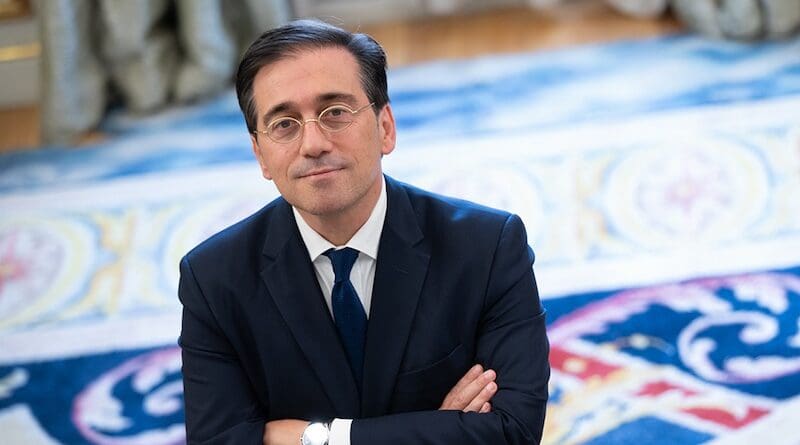
Spain's Foreign Minister José Manuel Albares. Photo Credit: Spanish Foreign Ministry

By 

By Inés Fernández-Pontes


(EurActiv) — Spanish Foreign Minister José Manuel Albares summoned Israel’s chargé d’affaires in Madrid on Thursday after the arrest of Spanish nationals aboard a Gaza-bound aid flotilla the previous night.

Speaking on national television, Albares demanded the “immediate release” of the the dozens of Spaniards detained by Israel.

“They posed no threat and had no intention of harassing anyone or carrying out any kind of illegal action. They should not be charged with anything at all,” he said.

Prime Minister Pedro Sánchez echoed the call upon arriving at the European Political Community summit meeting in Copenhagen on Tuesday. “Spain will guarantee diplomatic protection and the rights of its members,” he said, stressing that his government would “now consider any type of action” against Israel.

The episode comes amid escalating tensions between Madrid and Tel Aviv, after Spain imposed a full arms embargo on Israel in early September to “stop the genocide in Gaza.” Spain and Italy dispatched naval vessels last week to provide cover for the flotilla and assist in potential rescue operations.


Defence Minister Margarita Robles, however, warned that Spanish ships were barred from entering the Israeli-declared “exclusion zone” off Gaza, urging those on board to avoid “dangerous waters.”


Dutch pension fund sells Caterpillar shares over US firm's alleged arms supply to Israel

ABP divests $455.3B worth of Caterpillar shares on ethical grounds as American manufacturer’s construction machines, other equipment suspected of being used in Israel’s genocide against Palestinians

Bahattin Gonultas, Emir Yildirim |01.10.2025 - TRT/ AA


BERLIN

The Netherlands’ largest civic pension fund said it sold off its Caterpillar shares due to the alleged involvement of the American equipment manufacturer in supplying the Israeli army, according to a statement issued on Wednesday.

The fund, representing 3 million Dutch citizens, stated that it sold its Caterpillar shares on ethical grounds. ABP is also Europe’s largest and the world’s fifth-largest pension fund, with assets totaling €534 billion ($628.2 billion).

“Our investment approach must ensure good returns while being socially responsible,” the statement read, referring to its policy on investing in conflict zones like Gaza, where Israel has been committing genocide against Palestinians.

The fund said its investment portfolio changed due to the Israeli military attacks on Palestinians. ABP previously held around $455.3 billion worth of Caterpillar shares.

The Dutch fund's decision came after Norway's sovereign wealth fund, worth $2 trillion, divested its shares in Caterpillar and five Israeli banking groups on August 26 due to ethical reasons.

“There is no doubt that Caterpillar’s products are being used to commit extensive and systematic violations of international humanitarian law,” the Norwegian central bank said last month.

Before the sovereign fund, Norway’s largest pension fund KLP said on June 30 that it would not invest in US-based Oshkosh Corporation and German firm ThyssenKrupp. In 2021, the fund had also divested in some 16 companies based in Europe, Israel, and the US due to their links to illegal Israeli settlements in the West Bank.
Who profited off 7 October?


Jim DeBrosse 
25 September 2025

Short sellers made hay just a few days before the 7 October attack.
 Rafael Ben-Ari  Chameleons Eye

As Israel’s military invasion, indiscriminate slaughter and forced starvation in Gaza continue, questions as to how some 3,000 Hamas-led fighters were able to breach Israel’s security barriers on 7 October 2023 remain unanswered.

Israel’s government continues to reject an independent investigation, and evidence is mounting that the state’s top civilian and military leaders didn’t just miss the signs of an imminent assault, but may have purposely ignored them. The motive was to justify the ethnic cleansing of Gaza, the annexation of the West Bank and the creation of a larger Israel in occupied Palestine.

In addition, and surprisingly underreported, suspicious stock market activity just days before the October attack lends weight to the theory that someone somewhere knew something.

Earlier this month, a Haaretz investigation found that the top Israeli military leader for the Gaza area on 7 October had visited the site of the Supernova rave just an hour before the attack and took no precautions.

Lieutenant Colonel Haim Cohen, commander of the Northern Brigade in the Gaza Division, saw that only a handful of police officers were on duty at the crowded festival but told military investigators he had no information suggesting that he should have dispersed the crowd or beefed up security.

The Supernova rave, where 378 people were killed and 44 were taken hostage, was the deadliest single site on a day that saw 1,139 people killed in total and 240 people taken captive.

It is still unclear how many of the dead were killed by Palestinian fighters and how many were killed by Israel itself, due to its deadly Hannibal Directive.

Israeli Prime Minister Benjamin Netanyahu’s immediate response to the crisis has also come under scrutiny. His chief of staff and closest confidant, Tzachi Braverman, is accused of having altered Netanyahu’s phone logs to make them appear as if his first orders to his military on the morning of 7 October came earlier than they actually did.
The night before

The Israeli military had its strongest warnings the night before 7 October, however, but chose at the highest levels to ignore those warnings.

According to reports obtained by Ynet, Israel’s largest news website, a military intelligence unit had noted signs of impending rocket fire on Israel and “unusual activity of the Hamas aerial force” that should have set off alarm bells. Instead, the military “opted to avoid exposing sensitive intelligence sources rather than [taking measures for] preparedness.”

Really? The protection of a few agents was worth the risk of a major rocket attack on Israeli territory without warning civilians?

Ten days after those reports became public knowledge, Netanyahu’s office acknowledged that it had failed to pass on the memo detailing suspicious activity the night before 7 October, but was justified in not doing so because the alert was labeled “non-urgent.”

Israel’s leaders seem to have been better prepared to expel Palestinians in Gaza than thwart a possible assault. Just months after the October attack, they were already calling for the “voluntary migration” of Gaza’s 2.3 million residents while negotiating with several countries for their resettlement.

Such thoughts were swiftly rejected by Egypt, Jordan and a raft of other Arab nations, but Israel continues to eye other countries for the forced deportation of Palestinians in Gaza, including Indonesia, Ethiopia and Libya, with the help of the US administration under Donald Trump.

Even more mind-boggling is that Israeli officials had in their possession a year ahead of time a copy of the 40-page assault plan and watched as Hamas openly trained and prepared for the breakthrough, as the The New York Times reported in November 2023.

Topping off the suspicion that Israel’s top leaders willfully ignored the staggering number of warning signs, Netanyahu’s office has refused to countenance an inquiry into its own failings on 7 October while allowing an investigation into the military’s role and response. Netanyahu remains opposed to an independent state commission inquiry that would look at “the full picture” of political, civilian and military involvement.

If detailed plans and even public video recordings of Hamas training exercises weren’t enough, Israel’s fiscal sleuths also failed to notice another red flag – a sudden spike in trades in the days before 7 October, betting that the values of key Israeli stocks would soon plummet.

The most likely reason for the bet was that the investors knew war would soon break out and stress the Israeli economy.
Suspicious trading

The suspicious timing of the stock market activity was revealed in a 67-page study first reported in the US by CNN.

The authors of the study found that unidentified investors in Israel and the US had sold their stocks in key Israeli companies just days before the Hamas attack. In a practice known as “short selling,” the investors later repurchased their stocks at a much lower price, reaping millions of dollars in profit.

The study – titled “Trading on Terror?” – was written by former Securities and Exchange Commission head Robert Jackson Jr., now a professor at New York University, and Columbia law professor Joshua Mitts, an expert in monitoring short selling activity on stock markets.

“Our findings suggest that traders informed about the coming attacks profited from these tragic events,” the authors wrote, adding “days before the attack, traders appeared to anticipate the events to come.” The study found that on 2 October, “nearly 100 percent of the off-exchange trading volume in the [Israeli equity market] … consisted of short selling.”

Neither author of the report, or the university media relations offices at Colombia, replied to requests for interviews.

In CNN’s 4 December 2023 story, Jonathan Macey, a professor at Yale Law School, told the news channel the findings were “shocking.”

“The evidence that informed traders profited by anticipating the terrorist attack of October 7 is strong,” Macey said. “Regulators appear to lack the ability to discover the entities responsible for this trading, which is unfortunate.”

A story the same day in Haaretz speculated that it was Hamas-linked investors who had pulled their money, not Israelis or pro-Israelis, even though the authors of the paper said they couldn’t identify the investors.

If the short sellers did have connections to Hamas, however, it’s likely the Israelis would have known.

Since at least 2015, The New York Times reported, Israeli intelligence has been tracking the financing that supports Hamas and looking the other way. Critics believe the strategy of Israel’s leaders was that, by propping up Hamas’ leadership in Gaza against the Palestinian Authority’s limited control over parts of the occupied West Bank, the two factions would continue to divide the Palestinian people and head off a unified Palestinian state.
Who profited?

US regulators at the Securities and Exchange Commission and on Wall Street told CNN their policy is neither to confirm nor deny any investigation. That was 19 months ago.

Israeli regulators promised to investigate the unusual activity but, just a day later, said they found no proof of short-selling. Officials at the Tel Aviv Stock Exchange criticized the “Trading on Terror?” report as inaccurate and irresponsible and pointed out that a currency miscalculation by the authors inflated the potential short sale profits from about $9.5 million to just under $1 billion.

Regardless of the miscalculation, the authors of the report told Institutional Investor they stood by the gist of their report.

Yaniv Pagot, head of trading for the Tel Aviv exchange, told Reuters it was unlikely that investors linked to Hamas could have breached the exchange’s security regulations against “money laundering or something like that.”

Perhaps, then, the short sale was the work of Israeli or pro-Israeli investors who had been tipped off by Israel’s intelligence officials or political leaders. Or perhaps, too, Israeli officials who knew of the impending attack were themselves the short sellers.

Given that Israel has so far systematically eliminated five senior Hamas military leaders, 11 members of its political bureaus and attempted to assassinate more in a military strike on US ally Qatar just this month, finding out who profited from 7 October would seem to be a high priority for Israel’s leaders.

Or – judging by the Israeli government’s reluctance to investigate its own role – maybe not.

Jim DeBrosse, Ph.D., a veteran reporter and a retired assistant professor of journalism, is the author of See No Evil: The JFK Assassination and the US Media.
BOYCOTT CAT

Israeli bulldozers in West Bank carve up hopes for Palestinian state

Excavators expand an Israeli bypass road connecting Israeli settlers in the Israeli-occupied West Bank with Jerusalem, near Ramallah in the West Bank on Sept. 29, 2025. (Reuters)


https://arab.news/mw86e

Reuters
October 02, 202507:00


Israel builds bypass roads, isolating Palestinian villages

New roads seen as land grab, expanding occupation


NEAR RAMALLAH, West Bank: As US President Donald Trump announced a plan this week to end the Gaza war and suggested a possible path to a Palestinian state, Ashraf Samara in the Israeli-occupied West Bank watched bulldozers around his village help bury his hopes for statehood.

Surrounded by armed security guards, the Israeli machinery shoved aside earth to create new routes for Jewish settlements, carving up the land around Samara’s village of Beit Ur Al-Fauqa and creating new barriers to movement for Palestinians.

“This is to prevent the residents from reaching and using this land,” said Samara, a member of his village council.

He said the move would “trap the villages and the residential communities” by confining them exclusively to the areas they live in.

With each new road that makes movement for Jewish settlers easier, Palestinians in the West Bank who are usually barred from using the routes face fresh hurdles in reaching nearby towns, workplaces or agricultural land.

More nations recognize Palestinian state as settlements expand

While several major European countries, including Britain and France, in September joined an expanding list of nations recognizing a Palestinian state, Israeli settlements on the West Bank have been expanding at an increasingly rapid pace under Prime Minister Netanyahu’s government as the Gaza war has raged.

Palestinians and most nations regard settlements as illegal under international law. Israel disputes this.

Hagit Ofran, a member of the Israeli activist group Peace Now, said new roads being bulldozed around Beit Ur Al-Fauqa and beyond were a bid by Israel to control more Palestinian land.

“They are doing it in order to set facts on the ground. As much as they have the power, they will spend the money,” she said, adding that Israel had allocated seven billion shekels ($2.11 billion) to build roads in the West Bank since the October 2023 Hamas attacks that sparked Israel’s war in Gaza.

Israeli settlements, which have grown in size and number since Israel captured the West Bank in the 1967 war, stretch deep into the territory, backed by a system of roads and other infrastructure under Israeli control.

Israeli rights group B’Tselem, in a 2004 report, described this network of roads and bypasses to settlements built over several decades as “Israel’s Discriminatory Road Regime.” The group said some roads aimed to place a physical barrier to stifle Palestinian urban development.

Netanyahu’s office and the Israeli military did not immediately respond to requests for comment. The Yesha Council, a body that represents West Bank settlers, also did not immediately reply to a request for comment.

Before Trump’s Gaza plan was announced, Netanyahu declared: “There will never be a Palestinian state,” speaking as he approved a project last month to expand construction between the West Bank settlement of Maale Adumim and Jerusalem.

His finance minister, Bezalel Smotrich, said of the same project that it would “bury” the idea of a Palestinian state.

Trump’s Gaza plan to end the war, which Netanyahu approved, outlines a potential pathway to Palestinian statehood, but the conditions it lays down to achieve that mean such an outcome is far from guaranteed, analysts say.

“What the government is now doing is setting the infrastructure for the million settlers that they want to attract to the West Bank,” Ofran said. “Without roads, they cannot do it. If you have a road, eventually, almost naturally, the settlers will come.”


OPINION 

 E1 project as a gateway to annexation: A decisive test for international law

E1 project is no longer a hypothetical plan but an unfolding measure. This reality constitutes a decisive test for the international community’s seriousness in upholding international law and the 2-state solution

Mutaz M. Qafisheh and Mazen Zaro |01.10.2025 - TRT/ AA 


Israel is advancing its E1 plan to render it impossible for Palestine to form a state and to exclude East Jerusalem as its capital. This puts legality at odds with reality: Binding norms are systematically undermined while international resolutions remain unenforced


Mutaz M. Qafisheh is a professor of international law and diplomacy at Hebron University, Palestine, and Mazen Zaro is an independent international law researcher.

ISTANBUL

This Sept. 11, Israeli Prime Minister Benjamin Netanyahu signed the official approval for a settlement expansion plan in the E1 area, located between East Jerusalem and the settlement of 1Ma’ale Adumim1 in the central West Bank in occupied Palestine. The plan includes the construction of approximately 3,400 housing units. Israel considers this move the de facto beginning of its virtual annexation of the entire West Bank, after the project has been frozen for years due to international pressure. Netanyahu declared that “there will be no Palestinian state,” giving the project a declarative character in which settlements become a political tool to sever the possibility of Palestinian statehood rather than mere residential construction.

Then on Sept. 12, the UN General Assembly overwhelmingly adopted (142-10, with 12 abstentions) the New York Declaration that calls for concrete, time-bound, and irreversible steps toward establishing an independent Palestinian state. The resolution emphasizes the illegality of settlements and the urgent need to end the occupation as part of a two-state solution. Such a vote represents a growing recognition of Palestine's legitimacy while the expansion of settlements poses existential threats to this trajectory.


Strategic danger of the E1 project

The E1 project is not simply a plan to build houses for Israeli illegal settlers. It is part of a broader strategy to entrench Israeli control over Jerusalem. The plan isolates East Jerusalem from its Palestinian surroundings and cuts off the northern West Bank from its south, rendering any future Palestinian entity into fragmented cantons lacking the elements of an integral and viable state.

According to international law, the project constitutes an explicit breach of the principles of territorial integrity and the right to self-determination, both enshrined in the UN Charter and reaffirmed by Security Council Resolution 2334 (2016), which states clearly that “no Israeli settlement in the Palestinian territory occupied since 1967 has legal validity.” Israel’s attempt to impose permanent territorial facts by force can only be viewed as an illicit act of aggression that contravenes the principle of the inadmissibility of acquiring territory through force. That runs counter to the July 19, 2024 International Court of Justice verdict that instructed Israel to terminate its illegal occupation.


Growing international recognition of Palestine

Recently, waves of official recognition of Palestine have grown steadily, including from major states such as the UK and France. The New York Declaration represents the culmination of this process, with nearly three-quarters of UN member states supporting Palestine's statehood.

This growing recognition provides Palestine with stronger legal and diplomatic legitimacy, enhancing its standing in international institutions such as the UN, the International Court of Justice, the International Criminal Court, and specialized agencies. The more states recognize Palestine, the harder it becomes for Israel to ignore Palestinian rights. Yet recognition alone is insufficient if the material foundations of statehood (contiguous territory, natural resources, freedom of movement, and East Jerusalem as a capital) remain undermined by occupation and settlement policies.


Paradox of statehood recognition and settlement expansion

Here lies the central paradox: Whereas the international community reaffirms support for a two-state solution through declarations and statements, Israel is advancing its E1 plan to render it virtually impossible for Palestine to form an effective state and to exclude East Jerusalem as its capital. This puts legality at odds with reality: Binding norms are systematically undermined while international resolutions remain unenforced. The continued expansion of settlements amounts to a grave breach of international law and undermines the credibility of diplomatic initiatives.

This contradiction must be reconciled through a combination of measures. International accountability needs to be accelerated by precisely sanctioning the construction of settlements by the International Criminal Court. States should combine recognition with action through transforming the statehood ideal into tangible backing to Palestine’s territorial integrity. Diplomatic, military, and economic pressure should be intensified, by not only adopting symbolic stands like labeling settlement products and visa bans on far-right Israeli Cabinet ministers, but also imposing a full boycott on Israel as a state, a complete arm and aviation embargo as well as full economic sanctions, and preventing the travel of all Israeli officials, including ambassadors and diplomatic staff. Lastly, states should strengthen Palestinian institutions, the resilience of local communities, and mobilize global civil society to rescue the statehood project.

The E1 project is no longer a hypothetical plan but an unfolding measure. This reality constitutes a decisive test for the international community’s seriousness in upholding international law and the two-state solution. The New York Declaration may be significant, but without concrete judicial, diplomatic, economic, and even military measures, it will merely replicate the previous symbolic moves. Palestinian control over the E1 should be rescued before it becomes a gateway for annexation.

*Opinions expressed in this article are the authors' own and do not necessarily reflect Anadolu's editorial policy.

Israeli Defense Minister says half a million Palestinians in Gaza City will be considered ‘terrorists’ if they don’t evacuate

With at least half a million people still left in Gaza City, Israeli Defense Minister Israel Katz issued a "final warning" for residents to evacuate, saying those who remain will soon be regarded as “terrorists or terrorist supporters.”
 October 1, 2025 
MONDOWEISS

Palestinians arrive from Gaza City at Nuseirat refugee camp in central Gaza, following an Israeli announcement of the closure of the coastal al-Rashid road for anyone going back north. (Photo: Omar Ashtawy /APA Images)

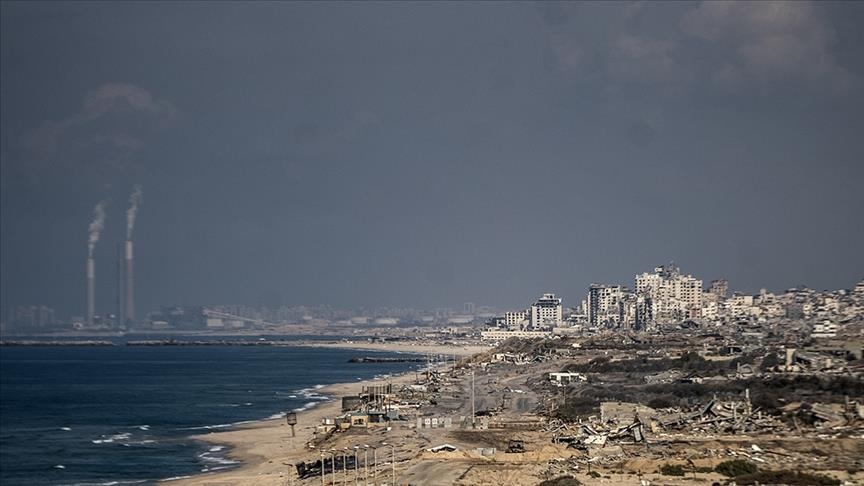
The Israeli army just announced that it won’t allow Palestinians in central and southern Gaza to travel north to Gaza City. Movement will only be allowed to leave the city for the south, the Israeli army said in a statement. Israeli Defense Minister Israel Katz also said that this was the Palestinians’ “last warning” to leave Gaza City, adding that anyone who remains will be considered “terrorists or terrorist supporters.”

An estimated 500,000 Palestinians remain in Gaza City, who are now officially cut off from any provisions coming from the south, including food, water, fuel, and medicine. To the north, Gaza City is completely sealed off from northern Gaza, including the cities of Jabalia, Beit Lahia, and Beit Hanoun, where the Israeli army is operating and has emptied of most of its inhabitants.

The announcement comes two days after the Trump administration announced its new plan for the end of the war on Gaza, amid an intensification of Israel’s campaign in Gaza City ahead of its planned occupation in the coming days or hours. According to the Israeli army, some 700,000 Palestinians have left, leaving at least 500,000 Palestinians still within the city. As of last Monday, September 29, half a million Palestinians remain trapped there, occupying a space of less than 8 square kilometers, UNRWA spokesperson Adnan Abu Hasna said.

The slow pace of evacuations from the city for the central and southern parts of the Strip had forced the Israeli army to delay sending in the third of its three military divisions (the 36th division), finally pushing it into Gaza last week.

Israel’s Channel 12 quoted military sources saying that the occupation would take up to three months, according to a report airing on September 16. The Israeli channel had reported earlier in August of disagreements between the Israeli army and the Israeli cabinet on the timing of the scheduled invasion. The cabinet insists on a faster operation, while the army prefers to conduct operations at a slower pace.

According to the Israeli daily Maariv, the Israeli army is avoiding combat with Palestinian resistance fighters, concentrating on air and artillery strikes to increase pressure on residents before sending in ground troops. Yet armored Israeli vehicles have still reached several areas, including the vital Jalaa street and the vicinity of the al-Shifa Hospital.

Despite the slow advance of ground forces, aerial and artillery bombardment has been relentless, sowing overwhelming destruction. Already, the iconic Shuja’iyya district in eastern Gaza City has been completely flattened, 90% of the Tuffah district has been destroyed, and 300 buildings have been demolished in Gaza’s largest neighborhood, Zeitoun.

In addition to entire residential blocks, Israeli strikes have targeted universities, where thousands of displaced Palestinians have taken shelter.
Remote-controlled ‘robots’ rigged to explode

One of the most devastating aspects of the ongoing Israeli campaign has been the phenomenon of what locals call the use of remote-controlled “robots” rigged with explosives and sent into dense built-up areas to be detonated, causing widespread destruction.

The deadly weapon is essentially an outdated Israeli armored personnel carrier (APC), which is retrofitted with large amounts of explosives and sent into neighborhoods. According to a report by Israeli army radio reporter Doron Kadosh, aired on September 21, each of these explosions equals the explosive force of two heavy air missiles.

The report pointed out that each APC explosion sends fragments across 500 square meters, turning the sky red for several seconds and pulverizing anything — including bodies — in its perimeter. The report confirmed that the Israeli army has been using these weapons “at an industrial scale,” detonating dozens of APCs in Gaza City every day, especially at night.

Meanwhile, Nibal Farsakh, spokesperson for the Palestinian Red Crescent Society (PRCS), told Al-Araby TV on Wednesday that the only two hospitals still operating in Gaza City are the al-Ahli Arab Hospital and the al-Quds Hospital, which is also owned by PRCS. Both hospitals are running without essential medical supplies, and access to al-Quds Hospital has been cut off by Israeli forces for the past nine days, Farsakh said, adding that the hospital can only treat the patients already inside it.

Farsakh said that the hospital is using its last stock of oxygen canisters, which are about to run out at any moment, warning that today’s blockade on the only way into the city puts thousands of patients at risk. Farsakh noted that as large numbers of wounded individuals have continued to require treatment, most essential medicines and medical supplies have run out.

If Gaza City falls

Amid the offensive, Palestinians are practically trapped in the city. Moving south is only possible through vehicles that charge up to 8,000 shekels per trip (about $2,420), with long delays due to the high volume of requests. For thousands of families, the only alternative is to flee on foot, which is impossible for the elderly, the sick, and the wounded. Many of them have already fled Israeli strikes numerous times.

Although most Palestinians from north Gaza have already fled the cities of Jabalia and Beit Lahia, which have been completely destroyed, most of them moved a short distance south to Gaza City.

The majority of them had fled during the Israeli operation between October and December of 2024, dubbed “the Generals’ Plan.” The majority of these displaced Palestinians returned to the destroyed north during the ceasefire between January and March of this year. After Israel broke the ceasefire, most Palestinians remained in the north, exhausted by the displacement they had already experienced since October 2023, especially after Israel bombed places to which they had fled in the south that the army designated as “safe zones.”

The Palestinians who have already fled Gaza City have concentrated in the central Gaza Strip, in and around the cities of Deir Al-Balah, Khan Younis, and the coastal Mawasi area. These areas have been crowded with tent encampments for almost two years.

A Palestinian displaced from Gaza City in Mawasi, who asked not to be named, told Mondoweiss that “there is no place left in Mawasi, not even for a needle.” He noted that “people are expanding the tent encampments into the areas in Khan Younis controlled by the Israeli army, which is putting their lives at risk.”

“They’ve been removing the rubble of other people’s homes with their bare hands for days, just to make some room for another tent,” he said.

Another Palestinian who remains in Gaza City told Mondoweiss that “we had a difficult and long discussion inside my family over moving out or not, and decided to split.”

“My mother and two sisters left to the south, and my father and I remained,” they said. “The moment we said goodbye was the most difficult of my entire life. I hugged my mother for several minutes, and we both wept, as neither of us knew if we were going to see each other again.”

Gaza City is the largest urban center in the Strip, and is 5,000 years old. It has been an economic and cultural hub for a millennia.

Now Palestinians fear that Israel plans on wiping it out entirely, the same way it did with Rafah, which has now been completely leveled. If Gaza City meets the same fate, it would be the end of the Gaza Strip as we know it.


Israel’s defence minister’s remarks signal escalation of war crimes in Gaza, says Hamas

October 2, 2025 


Smoke rises from ongoing strikes as Palestinians, carrying their belongings by vehicle or on their backs, continue to flee toward southern Gaza via al-Rashid Street after intensified Israeli attacks and ground operation amid forced evacuation orders in Gaza City, Gaza on September 26, 2025 [Hassan Jedi – Anadolu Agency]


The Palestinian resistance movement Hamas on Wednesday condemned recent statements by Israeli Defence Minister Yisrael Katz, saying his remarks pave the way for a further escalation of “war crimes” against civilians in Gaza City, Anadolu agency reported.

Katz had said that anyone refusing to leave Gaza City would be considered “combatants or supporters of terrorism.” Hamas argued that such rhetoric amounts to a green light for increased military operations against the civilian population.

In a statement, the movement said Katz’s comments “represent a blatant manifestation of arrogance and disregard for the international community and the principles of international and humanitarian law, and are a prelude to an escalation of the war crimes committed by his army against hundreds of thousands of innocent residents of the city, including women, children, and the elderly.”

Hamas accused Israeli forces of carrying out “ethnic cleansing and systematic forced displacement” in Gaza, citing the bombardment of homes, mass casualties, and ongoing military operations in Gaza City as well as central and southern areas of the Strip.

The group called on the international community, along with Arab and Islamic states, to take “immediate action” to halt what it described as “serious and unprecedented violations,” urging efforts to hold Israeli leaders accountable before international courts.

Earlier on Wednesday, Katz announced that the Israeli army had completed its control of the Netzarim axis, west of the Gaza Strip, effectively splitting Gaza between its northern and southern regions. “This will tighten the siege on Gaza City, and will force anyone leaving southward to pass through army checkpoints,” Katz said.

Opinion

Meloni’s Gaza challenge: The people vs. Netanyahu’s cronies

October 2, 2025 


Italian Prime Minister Giorgia Meloni attends informal meeting of European Union leaders at Christiansborg Palace in Copenhagen, Denmark on October 01, 2025.
 [Dursun Aydemir – Anadolu Agency]

by Dr Ramzy Baroud

What is happening in Italy regarding Gaza is unprecedented in the history of solidarity between the country and any other international cause anywhere. A popular uprising is underway, the consequences of which are likely to alter, not only Rome’s position on the Israeli genocide in the Strip, but the country’s own political structure altogether.

To understand why such a conclusion is a rational one, we must consider two important factors: the popular mobilisation throughout the country and the historical context of Italy’s political attitude towards Palestine and the Middle East.

When the Israeli genocide in Gaza started, the language and political posturing of the far-right government of Giorgia Meloni were more or less consistent with the political positions adopted by other European leaders.

In her visit to Israel on 21 October 2023, Meloni’s language was that of unconditional condemnation of Palestinians for the 7 October attack and equally unconditional support of Israel and its ‘right to defend itself’.

That position remained consistent throughout the war until a few months ago, when the Israeli genocide reached levels too extreme even for Meloni to ignore. This was expressed in the words of Italian Defence Minister Guido Crosetto, who stated, last August, that Israel “lost its sanity and humanity.”

Despite this, Italian weapons continued to flow into Israel. Even when Rome decided not to ship new weapons to Tel Aviv, old military contracts previously signed with the Italian arms giant Leonardo were still being honored, despite the fact that these weapons were used directly in the Israeli genocide in Gaza.

Not only did Meloni ‘honor’ the country’s commitment to Israel at the expense of hundreds of thousands of innocent Palestinians in Gaza, but also at the expense of Italy’s progressive constitution, which states that “Italy rejects war as an instrument of aggression against the freedom of other peoples”.

On the other side, Italian society, at least for a while, remained confused and apparently docile in the face of the Israeli crimes and the support of their government for the ongoing genocide.

Their apparent docility did not necessarily reflect the Italian people’s lack of interest in events outside of their borders. Instead, it was a reflection of three major political and historical factors that are worth noting:

One, Italian media has, as of late, been divided into two main groups: private media, owned largely by the family of the late Prime Minister Silvio Berlusconi – a far-right media mogul and close ally of Israeli Prime Minister Benjamin Netanyahu; and public media, beholden to the diktats of the government. Expectedly, both remained committed to the Israeli hasbara line that criminalised the Palestinians and absolved Israel.

READ: Sumud Flotilla accuses Italy of sabotaging Gaza aid mission instead of protecting it

Two, the lack of organisational platforms in Italy, which in the past have been positioned within the activities of popular-based unions. Historically, Italy’s powerful unions were directly linked to political parties that had substantial representation in the Italian parliament. Together, they have managed not only to pull political strings but even to influence policies, nationally and internationally.

Three, all of the above is related to the major repositioning of Italian politics between the post-WWII First Republic (1948-1992) and the Second Republic, from 1992 to the present. That major realignment was directly related to the collapse of the Soviet Union, the dismantling of Italy’s communist party – once the West’s most powerful and relevant communist party – and the rise of center-right politics.

The latter event not only forced a dramatic change in Italy’s domestic politics, but also its foreign policy’s attitude, thus moving away from the far more balanced position regarding the Israeli occupation of Palestine, for example, to the near embrace of Israel’s most far-right politicians in later years.

This embrace became most apparent during the years of Berlusconi, but even more accentuated in Matteo Salvini’s Lega party, known even among Italians for being the natural inheritor of Italy’s fascist legacy.

But things began changing, thanks to the extent of Israel’s criminality in Gaza, the rising global solidarity for Palestine and the elaborate grassroots mobilisation within Italy itself since the start of the genocide.

On 22 September, Italian dockworkers led a nationwide strike against the war on Gaza and arms shipments to Israel. The action drew on a long history of worker resistance to militarisation, especially in ports repeatedly used to transport weapons. Organised by grassroots unions and solidarity networks, the mobilisation underscored a broad refusal among workers to be complicit in government policies that sustain war and genocide.

Suddenly, Italian unions are back on the streets, not simply to negotiate better wages, but to reclaim their position as a vanguard of solidarity at home and abroad. The consequences of this event alone could usher in a major change in the political attitude of the Italian people.

As Meloni’s government refuses to recognise the state of Palestine, she positions herself in direct opposition to the aspirations of her own people, from all political and ideological backgrounds. This could cost her dearly in future elections.

Italy is now on the cusp of another historical moment, the outcome of which could either entrench the country further in the far-right camp or take it back to a position that is far more consistent with its radical history of anti-fascism, social mobilisation, and internationalist resistance.

Regardless of where the pendulum of history will swing, there is no denying that what is happening in Italy at the moment is no less than an actual political uprising, an Intifada.