Friday, October 03, 2025


LONG READ: Trade is the glue that holds Global Emerging Markets Institutions together

LONG READ: Trade is the glue that holds Global Emerging Markets Institutions together
The markets of the Global South dwarf those of the Global North and as they becme increasingly coordinated trade flows are changing fast, binding them closer together. / bne IntelliNews
By Ben Aris in Berlin October 3, 2025

The world order is changing. The emerging markets are coming of age and they are setting up a raft of largely non-Western Global Emerging Markets Institutions (GEMIs) to coordinate their lives.

An alphabet soup of organisations has emerged – BRICS+, G20 , the Shanghai Cooperation Organization (SCO), Eurasian Economic Union (EUU), ASEAN (Association of Southeast Asian Nations), the African Union, to name a few – but unlike their Developed Market (DM) peers, these organisations remain immature and are still in the process of working out what they want to achieve. In the meantime, what is holding them together is trade, dominated by China.

Made with Flourish

APPENDIX: Leading Global Emerging Markets Institutions (GEMIs

Since the advent of US President Donald Trump the world has gone through a profound change. A new economic paradigm has emerged based on the transactional multipolar world model that the US president has introduced, highlighted by his Liberation Day tariff scheme. Geography has reasserted itself in an increasingly fractured world. The old alliances, especially in the Global North, now count for nothing where the US seeks to maximise its profits, often at the expense of its traditional partners.

The big difference between the Global North and South is that the new markets are pragmatically focusing on economic and trade relations. Both Chinese President Xi Jinping and Russian President Vladimir Putin have adopted a strict policy of non-interference into domestic affairs (at least publicly), as they outlined in a joint 8,000 word essay last year. Given that many countries, notably the African Continent and India, still see the DMs as neo-colonialist powers, this stance appeals strongly to the new world. As bne IntelliNews reported, the Moscow consensus emerged early in Putin’s reign, which demands the citizens put the interests of the state ahead of their own, in sharp contrast to the Washington Consensus that has individual happiness and prosperity at its core. Human rights abuses and political repression are legion in Russia and China, but are off limits in mutual relations, whereas the DMs take it on themselves to criticise, sanction and even bomb any GEM country they deem to be acting beyond the pale. The point was most recently illustrated by Trump’s decision to impose 50% sanctions on both India for importing Russian oil and Brazil over the Bolsonaro case – both politically motivated decisions.

It has become a dog-eat-dog world and the GEMIs have adopted the obvious strategy: ignore the US and increase trade with each other. This process was already underway under the Biden administration with the emergence of a BRICS bloc, where trade has been flourishing, but Trump has rapidly accelerated the process. Political analysts argue that the US has made a huge geopolitical blunder by pushing the largest GEMs together – most notably Russia, China and India – which are not natural allies, but have been forced to increase cooperation in the face of an increasingly aggressive America.
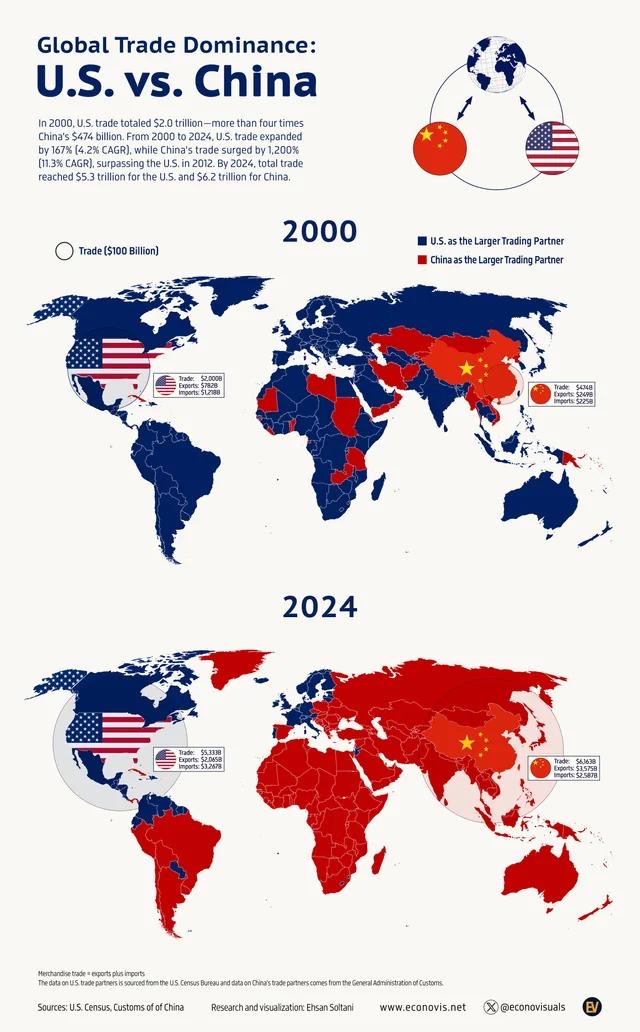
Biggest market in the world

Trade relations are suddenly in flux. Putin has taken the extreme step of breaking off relations with the West entirely and has become the most sanctioned country in the world as a result. He has made a big bet on the Global South Century so far successfully completely swapping trade with the West with booming economic relations with new GEM partners. Within the space of only four months, he managed to entirely reorient Russia’s oil exports from Europe to Asia after the twin oil sanctions came into effect at the end of 2022. And the effort to isolate Russia has largely failed; Putin was the guest of honour at the recent Shanghai Cooperation Organization (SCO) summit in China, surrounded by leaders from many of the biggest markets in the world, including China’s Xi, and India’s Prime Minister Narendra Modi.

The combined BRICS+ and SCO grouping now encompasses more than 5.26bn people—approximately 64% of the world’s population—and accounts for an estimated 55% of global GDP based on purchasing power parity (PPP), according to 2025 projections from the International Monetary Fund. Likewise, the recent tie up between the Gulf Cooperation Council (GCC) tied up with ASEAN (Association of Southeast Asian Nations) in May creates a market of over 2bn people, 30% of the world's GDP and, crucially, about 55% of world GDP growth in PPP terms. And there are dozens of these cooperative deals amongst the GEMs.


Selected GEMIs vs Developed Markets: GDP and population

Organisation

Share global GDP (PPP) %

Share global GDP (Nominal USD) %

GDP (PPP, USD trillions)

Nominal GDP (USD trillions)

Members’ population (millions)

Share of world population %

BRICS

37.5%

26.8%

79

32

3,950

49.3%

SCO

34.2%

22.1%

72

26

3,420

42.7%

BRI

42.0%

28.5%

88

34

5,340

66.7%

G20

85.0%

82.3%

179

97

4,950

61.8%

EAEU

4.0%

3.2%

8.4

3.8

185

2.3%

ASEAN

6.8%

5.1%

14

6.0

685

8.6%

MERCOSUR

2.9%

2.4%

6

2.8

295

3.7%

G7

29.8%

44.5%

63

53

775

9.7%

EU (27)

16.5%

15.8%

35

19

448

5.6%

NATO

33.1%

44.3%

70

52

981

12.3%

Sources: IMF World Economic Outlook (April 2025) for GDP (PPP and nominal); UN Population Division (2024 revision, mid-2025 estimates) for population. Global PPP GDP ~$210 trillion; nominal ~$118 trillion

Just the BRICS+ and SCO includes full members, observer states, dialogue partners, and potential future members, spanning over 30 countries across multiple regions. The bloc’s estimated GDP of $151 trillion in PPP terms dwarfs the US’ $30 trillion and the EU’s $18 trillion.

The G20 is even bigger, with a total GDP nominal value of $97 trillion and PPP adjusted value of $179 trillion. By comparison the G7 has a nominal GDP worth of $53 trillion and an adjusted value of $64 trillion.

The organisers of the SCO described it as a “global powerhouse” in oil, technology, trade, and de-dollarisation efforts. The overlapping BRICS+ and SCO memberships is a coordinated shift in geopolitical and economic influence away from traditional Western-led structures to the new world.

The BRICS+ grouping—comprising 10 full members and 10 partner countries, not counting another dozen candidate countries—includes Brazil, Russia, India, China, South Africa, Egypt, Ethiopia, Iran, the United Arab Emirates, and Indonesia, alongside partner states such as Belarus, Bolivia, Kazakhstan, Cuba, Malaysia, Nigeria, Thailand, Uganda, Uzbekistan, and Vietnam. In total, BRICS+ covers approximately 4.45bn people and contributes $76 trillion to global GDP, or 44% of the total, more than double the core group of five. And with Indonesia’s addition in January, the fourth most populous country in the world, the group will continue to grow.

The SCO, originally established as a regional security bloc, now includes 10 full members and 17 observers and dialogue partners. Its core membership includes China, Russia, India, Kazakhstan, Pakistan, Iran, Uzbekistan, Tajikistan, Kyrgyzstan, and Belarus. Observer states include Mongolia and Afghanistan, with dialogue partners ranging from Sri Lanka and Turkey to Qatar, Egypt, and Laos. The SCO grouping accounts for around 3.96bn people and $72 trillion in GDP, or 36% of global output.

Accounting for overlaps between the two blocs—such as China, Russia, India, and Iran—the consolidated total is at 5.26bn people and $95 trillion in GDP. With additional countries such as Turkey, Bahrain, or Mexico under consideration for future membership, the bloc’s demographic share could exceed 70% of the world’s population by 2030.

Chinese trade dominates

Home to the biggest economy in the world in PPP terms, Chinese trade dominates the group; it has become the biggest trade partner by far with all the countries in Asia, accounting for 80% of the total regional trade, but competing with ASEAN and Japan.

China is also is a major partner with many countries further afield: a top three trade partner for about 120 countries globally in 2025, including the EU ($786bn), US ($688bn), and Africa/Latin America (Brazil: $150bn).

Amongst the BRICS nations, China's 2024 exports were $1.2 trillion versus the total intra-BRICS bloc trade of $500bn, the dominant hub for commodities, tech, and infrastructure. In the SCO, China accounted for 60% of trade flows, largely driven by the Belt and Road Initiative (BRI) investments of over $1 trillion of commitments.

China’s trade dominance, particularly within the BRICS and SCO bloc, stands unrivalled. In 2025, China’s trade surplus is poised to swell to nearly $950bn, with exports of $3.4 trillion dwarfing the $2.5 trillion in imports. This imbalance has fuelled international friction and retaliatory tariffs from the US—ranging from 10% to 27%.

The US is grappling with a $400bn trade deficit with China, while the EU contends with a €200bn shortfall, a gap widening now from the surge in Chinese electric vehicle exports. Even in Asia, surpluses persist—$50bn with ASEAN, for instance—though local manufacturing is beginning to nibble at the edges.

The surpluses are rooted in an export-led growth model, but that has been giving way to a domestic consumption model for several years already. China mitigates tensions with partners by recycling surpluses into BRI geopolitical leverage that promotes their growth.

Several countries have gotten into trouble overextending themselves, borrowing from Beijing for large infrastructure projects. In 2017, Montenegro got into financial straits by overborrowing from China to build the Bar-Boljare motorway connecting Montenegro’s largest port, Bar on the Adriatic coast, to the Serbian border – a BRI project. But in recent years, many of China’s partners have become more cautious, trying to avoid falling into this sort of debt trap. Uzbekistan, for example, is investing heavily into building out its renewable energy sector. However, it has sought to diversify its partners and brought in investors Masdar from the UAE and ACWA from the Kingdom of Saudi Arabia (KSA) which are investing billions of dollars, to diversify away from Chinese help, raising BRI loans from Beijing only as a last resort.

China’s growing economic power and rising trade volumes are starting to impact the economies of the DMs, which is new. Sales of China’s BYD EVs in Europe overtook those of US firm Tesla for the first time ever in April.

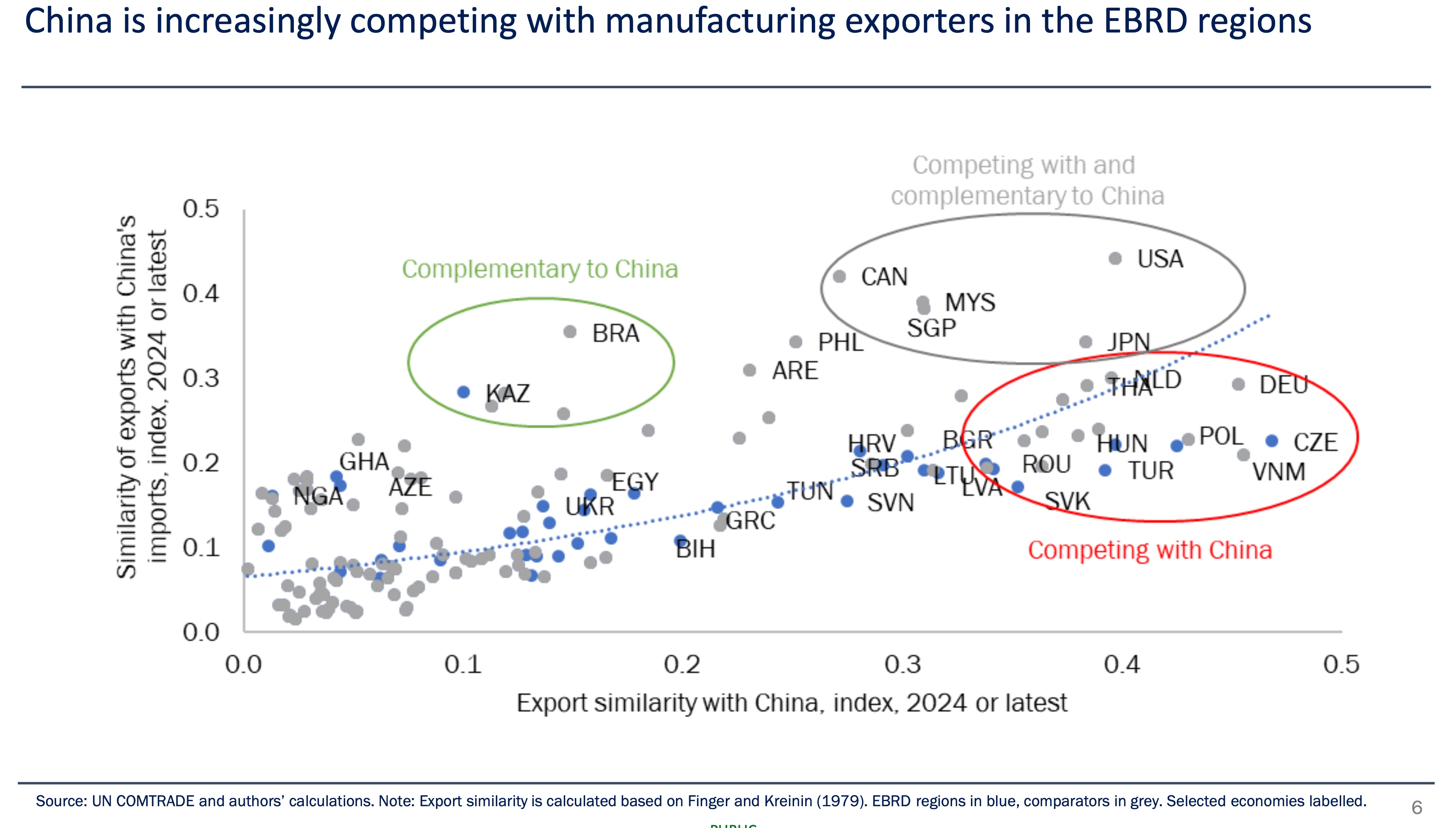
China’s growing dominance in global manufacturing exports is intensifying competitive pressures on Central and Eastern Europe (CEE) the European Bank for Reconstruction and Development’s (EBRD) warned, threatening its already moribund competitiveness, the Bank said in its latest Regional Economic Prospects report.

The global manufacturing profile and related trade is changing fast as China moves rapidly up the value-chain. China’s share of world manufacturing exports rose from less than 10% in 2000 to 25% in 2024, according to the World Bank, overtaking the combined exports of the US and Germany. Its export profile has also diversified rapidly, with strong growth in sectors such as EVs where it has become dominant and batteries—industries that are central to the export base of countries including Hungary and Poland. Notably, this year Sweden’s battery-maker Northvolt went bust, unable to compete with cheaper Chinese imports.

Thanks to China’s rapid advances in technology, developing nations are increasingly unable to compete with China, say analysts at Goldman Sachs. Those advances have already made European clean-tech start-ups “uninventable.” Eight venture capitalists flew to China in September to inspect Chinese factories and on their return stripped all European clean-tech investment projects out of their portfolios as they were no longer economically viable. “China is too far ahead. Europe will never be able to catch up,” one of the managers told Bloomberg.

French automaker Renault’s vice-president Jean-André Barbosa recently warned that Europe is no longer a net exporting Weltmeister if automotive exports are stripped out of the statistics during a conference in Brussels.

The Russian sanctions and the end of cheap energy imports has led to the deindustrialisation of Europe. Heavy industry has been decimated and the automotive sector is now in decline. Volkswagen narrowly avoided closing two German plants this year for the first time in its history, but only after it came to a compromise with the IG Metal union that will still see thousands of workers laid off. Porsche has abandoned its EV SUV, unable to compete with Chinese versions. A recent poll found a third of Germany's large businesses are either contemplating relocating to the emerging markets or have already started the process of moving.

Complimentary exports

While China’s progress is a problem for developed markets where they compete head-to-head, it has been a boon for many developing markets where Chinese trade is complimentary. The key is if these markets work in overlapping fields where mutual cooperation is beneficial, says the EBRD. In general, the GEMs benefit from cooperation with China, whereas the DMs are finding themselves in stiff and growing head-to-head competition.

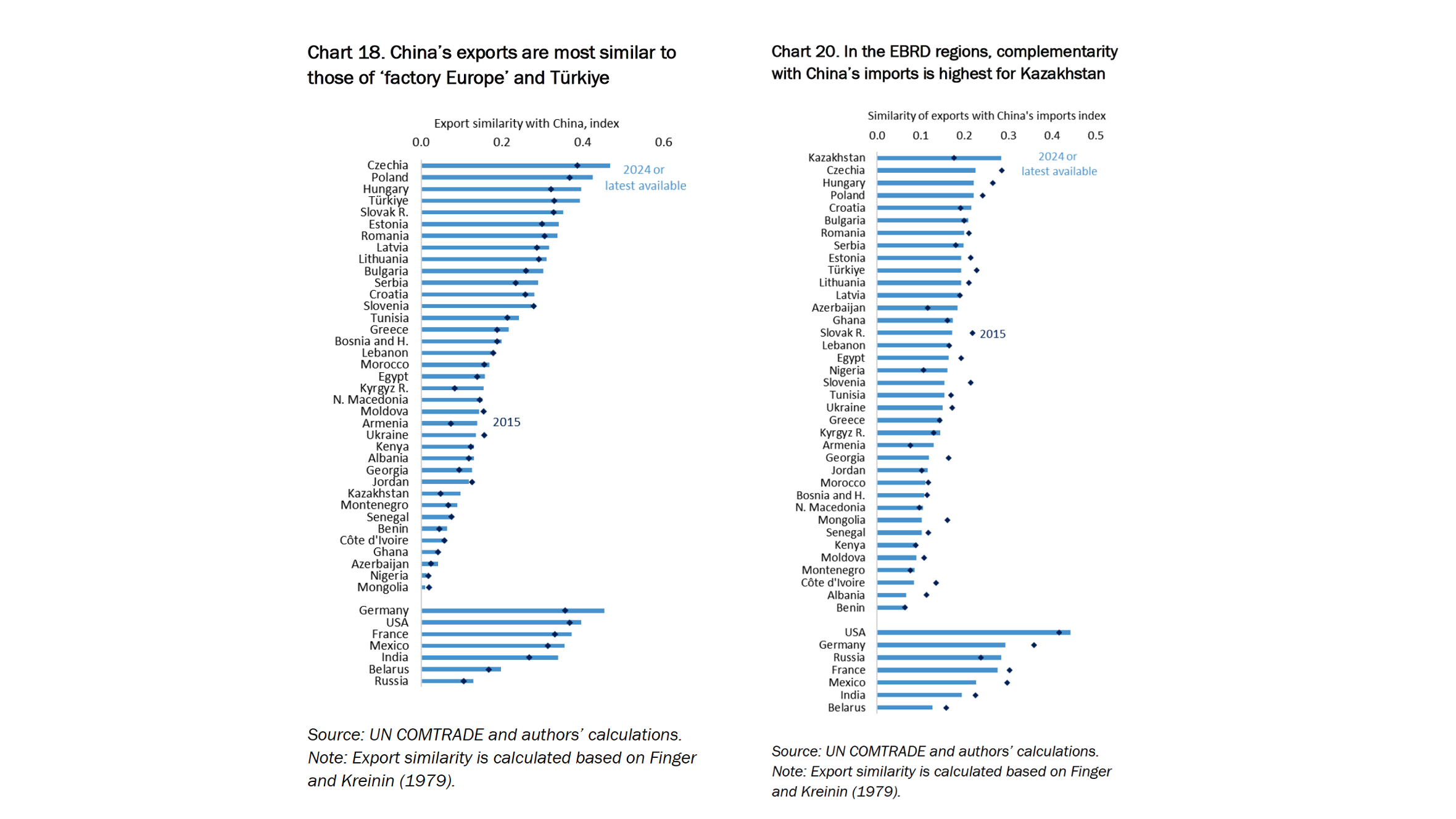
“China’s exports have become more ‘similar’ to those of advanced economies and other emerging markets since 2022, with particularly sharp increases observed for economies in the EBRD regions,” the report said.

Using an index of export similarity based on the Finger–Kreinin method -- an index from 0 (no overlap) to 1 (perfect overlap) – the Bank found that China’s export structure is now closest to that of emerging European economies, Kazakhstan and Turkey.

Complementarity with China’s imports vary across regions. The EBRD noted that complementarity is highest for higher-income economies and commodity exporters, including Kazakhstan, Brazil, Malaysia and the Philippines. “Complementarity for commodity exporters has also been rising, while it has been declining for manufacturing exporters,” the EBRD said.

For countries such as Czechia, Hungary, Poland, the Slovak Republic and Turkey, rising export similarity means they increasingly face China as a direct competitor in manufacturing markets. Germany, too, is exposed to this trend, given its high reliance on industrial exports.

The resource-based emerging economies benefit from growing Chinese demand for raw materials. Kazakhstan’s exports, dominated by commodities, are among the most complementary to China’s imports, the EBRD noted. Likewise, Russia and China are a synergy made in heaven.

The Bank added that several advanced economies—including the US, Canada, Japan and Singapore—simultaneously compete with China in export markets while enjoying strong complementarity with Chinese imports, as in addition to manufacturing, they have a large share of commodities in their production mix.
 

Russia’s special trade relations with China

The trade between Russia and China is a bit special. It has expanded dramatically as Beijing aids Putin's switch from east to west, growing from a modest $107bn in 2020 to an estimated $240bn in 2024, with projections for 2025 hovering around $250bn based on first-half figures of $115bn.

The change is not just due to economic necessity but a strategic pivot toward Beijing to get out from under the Western sanctions as part of the new “no limits” partnership. What began as a complementary partnership—Russia supplying raw materials in exchange for Chinese manufactured goods—has deepened into a near-exclusive lifeline. Trade volumes have surpassed pre-pandemic levels by over 120%.

Central to this boom is Russia's ramped-up energy exports, particularly oil, which now account for nearly 40% of bilateral trade. In 2020, oil shipments to China totalled around 1.6mn barrels per day; by 2024, that figure had climbed to over 2.3mn bpd, often at discounts of $10-20 per barrel below Brent benchmarks. That has earnt Beijing savings of up to $20bn annually.

Russia has also been a winner as food exports to China’s previously closed market, including wheat, soybeans, and meat, surged 150% to $5bn in 2024, filling gaps left by disrupted Ukrainian supplies, with China importing over 7mn tonnes of Russian grain in 2024 alone. The trade is also an important source of yuan earnings for yuanization of the Russian economy after it was forced to dump the dollar due to sanctions. The partners now settle their mutual trade almost exclusively in local currencies as part of their de-dollarisation efforts.

Russia is also increasingly leaning on Chinese equipment and technology to modernise, with machinery and electronics comprising 35% of inflows by 2024, up from 25% in 2020.  From Huawei telecom gear to Sany construction cranes, these purchases—totalling $80bn last year—used to largely come from Germany.

But an asymmetry in trade persists: Russia's trade surplus with China narrowed to $50bn in 2024 from $70bn in 2022, as Beijing extracts concessions on pricing and technology transfer. While the partnership has stabilised Russia's finances (trade now covers 60% of its current account deficit), it risks over-dependence, with experts warning of a "vassal economy" dynamic.

In contrast to its booming Sino-Russian trade, Russia's economic ties with the EU have contracted very sharply over the same period – an extreme example of how the changing relationship between the Global North and South are affecting trade.

Total EU-Russia bilateral trade turnover fell from a peak of €257.5bn in 2021 to €67.5bn in 2024, a decline of over 74%, according to Eurostat data. This reflects a 61% drop in EU exports to Russia (from €99bn in 2021 to €31.5bn in 2024) and an 89% plunge in EU imports from Russia (from €158.5bn to €36bn in 2024), driven by energy embargoes and restrictions on goods like machinery and chemicals.

The downward trend began pre-invasion following the 2014 annexation of Crimea, with 2020 turnover being hit by the coronavirus pandemic at approximately €200bn, but accelerated post-2022: €240bn in 2022, €150bn in 2023, and €67.5bn in 2024. By the second quarter of this year, the value hit a 20-year low, with EU imports from Russia at €1.9bn (down from 9.5% share in 2022) and exports rising slightly to €2.4bn, yielding a rare €0.5bn surplus for the EU.


Ethiopia contracts China’s GCL to build $2.5bn refinery in Somali region

Ethiopia contracts China’s GCL to build $2.5bn refinery in Somali region
/ bne IntelliNews
By bne IntelliNews October 2, 2025

China’s Golden Concord Group (GCL) has signed an agreement with Ethiopia to build a $2.5bn oil refinery in the country’s Somali region, as part of efforts to cut petroleum imports and drive industrialisation. The site will be co-developed by GCL and sovereign wealth fund Ethiopian Investment Holdings (EIH).

APA News reports that Prime Minister Abiy Ahmed officially launched the Gode project, laying the foundation stone for both the refinery and a new urea fertiliser project.

If realised, Gode would add to a wave of downstream investment across Africa in recent years. The facility is intended to process around 3.5mn tonnes of fuel annually, or about 70,000 barrels per day (bpd).

No commissioning date has been announced. But the first of two constructions phases should be completed within 24 months, according to Billene Seyoum, the prime minister’s spokeswoman, as quoted by Bloomberg. The facility will tap crude oil and condensate from the Hilala fields located in Ethiopia’s eastern Somali region, Abiy said in a post on X.

Oil and gas exploration in Ethiopia has been attempted for decades, with limited commercial success, owing to financing challenges, security concerns, and infrastructure gaps.

International companies including Tenneco, Petronas, and Chinese firms explored in the Ogaden Basin from the 1970s onward.

More recent efforts by Poly-GCL, a joint venture involving GCL, focused on developing the Calub and Hilala gas fields. The Gode Oil Refinery would be developed alongside upstream gas projects in those fields.

According to Addis Insight, Ethiopia’s Finance Minister Ahmed Shide and GCL’s chairman, Zhu Gongshan, have discussed fast-tracking refinery, metallurgy hubs, and oil & gas development.

The refinery project adds to a separate $2.5bn fertilizer plant that state-owned Ethiopian Investment Holdings is building together with Dangote Group, which will be fuelled by gas from Calub.

Nigeria’s $20bn Dangote refinery – the continent’s largest at 650,000 bpd – began operations in 2023 after years of delays and cost overruns.  Angola this year inaugurated the 30,000 bpd Cabinda refinery, the country’s first new plant in five decades.

WAIT, WHAT?!

Kazakhstan appoints AI board member to sovereign wealth fund, awards voting rights

Kazakhstan appoints AI board member to sovereign wealth fund, awards voting rights
The next board session at Samruk-Kazyna will be a special occasion as AI colleague SKAI plugs into the meeting. / gov.kz
By Nizom Khodjayev in Astana October 3, 2025

Kazakhstan’s sovereign wealth fund, Samruk-Kazyna, on October 2 unveiled an artificial intelligence-based member of its board of directors, complete with voting rights.

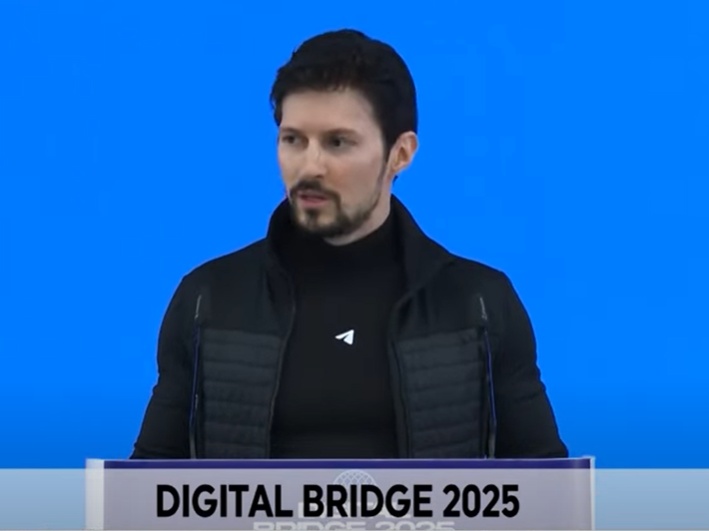
The Samruk-Kazyna Artificial Intelligence Neural Network, known as SKAI, was introduced to the country’s president, Kassym-Jomart Tokayev, on October 2 during the Digital Bridge 2025 international tech forum held in Astana. One of the guests, Telegram cross-platform founder Pavel Durov, used the event to announce the creation of a dedicated artificial intelligence (AI) laboratory in Kazakhstan.

SKAI will participate in the next Samruk-Kazyna board meeting under a testing regime. It is billed as marking a significant shift in corporate governance in which AI is embedded directly into board-level decision-making. Samruk-Kazyna, which has assets running to tens of billions of dollars, claims the system will raise both transparency and the quality of decision-making at the fund.

SKAI will analyse and synthesise a wide range of information, including internal and external regulations, as well as board records dating back to 2008. Data-backed AI insights will be presented to directors to inform strategic direction.

“Setting of an AI-based neural network in the Board of Directors is a quantum leap: technology and people are starting to make decisions together, and digitalisation goes beyond processes and becomes part of the management philosophy,”said Nurlan Zhakupov, chairman of the management board at Samruk-Kayna, a major shareholder in companies including KazMunayGas, Kazakhtelecom, Kazatomprom, Air Astana, Kazpost and Samruk-Energy.

SKAI has been built with an emphasis on sovereignty and security. It operates on the AlFarabium-2 supercomputer, which belongs to Kazakhtelecom, a company within the Samruk-Kazyna portfolio. No data that it processes will be transferred abroad.

The infrastructure is powered by NVIDIA H200 processors.

The system runs on Alem, a Kazakh-language large language model (LLM).

Tokayev said at Digital Bridge 2025 that Kazakhstan is seeking to transform itself into a fully digital state within three years.

Addressing political leaders, entrepreneurs and technology specialists from more than 100 countries, Tokayev called for AI to be developed responsibly and inclusively.

“Our task is to harness new technologies for the benefit of humanity, turning them into a key factor in progress and cooperation,” said Tokayev.

Kazakhstan lately established a Ministry of Artificial Intelligence and Digital Development. The creation of the Central Asian country’s first AI Council, and the passage of a dedicated law on AI have also been announced.

A forthcoming “Digital Code” will, said Tokayev, provide the legal framework for digital governance, education, healthcare and the economy.

Tokayev argued that digitalisation and the deployment of neural networks should underpin public administration in the years ahead. He highlighted SKAI as an example of Kazakhstan’s capacity for regional innovation.

The president, meanwhile, described as “historic” the decision to set up Kazakhstan’s first university dedicated to AI research. He also announced the launch of the Alem.ai International Centre for Artificial Intelligence, envisaged as a global hub for ethical AI and innovation, as well as plans for a second national supercomputer cluster to advance research and development.

“Alem.ai will become a place where artificial intelligence technologies are implemented as effectively and ethically as possible,” Tokayev said, emphasising that the ultimate goal was to safeguard human well-being.

Telegram AI lab

Telegram founder and CEO Pavel Durov addresses the forum.

The dedicated AI laboratory announced by Telegram’s Durov will be located in the Alem.ai building, Forklog reported. It will form part of the company’s wider collaboration with Kazakhstan’s supercomputing infrastructure.

“A year ago, we opened our first regional office in Kazakhstan and are very pleased with the results. I am delighted to announce that today we are launching a specialised artificial intelligence laboratory in the Alem.ai building,” Durov said.

Telegram has recently been developing technology at the intersection of blockchain and AI, added Durov, saying it was designed to allow more than one billion people to access AI services in a manner that is “confidential, transparent and efficient.” The initiative is expected to rely on Kazakhstan’s national high-performance computing resources.

“We hope that the Kazakh supercomputer cluster will become the first major provider of computing power for this network,” Durov noted. Telegram’s mini-applications will be the initial users of the new AI functions.

Tokayev met Durov during the forum to discuss cooperation in areas including education, AI and cybersecurity. 


US says USMCA talks with Mexico and Canada will "probably" be bilateral

WE CALL IT CUSMA


US says USMCA talks with Mexico and Canada will

US investors identify four aspects as the most relevant concerns about Mexico: lack of energy access; insecurity; corruption; and uncertainty about regulatory frameworks.
By bnl editorial staff October 2, 2025

Negotiations to review the free trade agreement between the United States, Mexico and Canada (USMCA), scheduled for 2026, will "probably" be bilateral, US Trade Representative Jamieson Greer said on September 30 at a New York Economic Club forum, El País reported.

Greer's words came just weeks after Canadian Prime Minister Mark Carney and Mexican President Claudia Sheinbaum met in Mexico City to agree on topics they will evaluate in the commercial agreement review.

The Carney-Sheinbaum meeting sought to avoid a repeat of the 2018 negotiation in which the United States established conditions separately with each country. Then, Washington began talks with Mexico and closed some agreements only with Mexican negotiators, later integrating Canadian requests, who protested and accused Mexico of "throwing them under a bus", in reference to the behind-their-backs agreements.

"Obviously, we are going to cooperate directly: the USMCA is the strength of the whole, of the three countries, and contributes to making North America competitive," Carney said upon leaving the meeting with Sheinbaum, referring to the possibility of designing strategies between Ottawa and Mexico City to face negotiations with Washington.

Greer's statements align with US President Donald Trump's position. The US leader has floated various times the possibility of making separate trade agreements with Mexico and Canada, and has even imposed tariffs in different proportions on goods not included in the USMCA. However, both Sheinbaum and Carney have made clear the agreement's value is maintaining the three countries as a competitive bloc for global trade.

Trump’s aggressive trade policy has placed both governments in a defensive position. But his announcement of tariffs on Mexican and Canadian goods, 25% in most cases and 50% on semi-finished metals, has been read less as an economic measure than as a negotiating tactic.

Following Greer's remarks, Mexican Economy Secretary Marcelo Ebrard said part of the USMCA negotiations have "a high bilateral content". "It is inevitable, and there are other contents that are trilateral, for example, the trilateral dispute resolution system," he said.

Greer also said the Office of the US Trade Representative is reviewing points where Mexico has not complied with the treaty, Reuters reported. According to the 2025 Investment Climate in Mexico report published this month by the same agency, the US government has detected non-compliance regarding intellectual property by the Latin American country.

"In 2024, no investigations or criminal proceedings for trademark counterfeiting and copyright piracy were reported, and Mexico's Attorney General's Office did not report intellectual property enforcement statistics for the last five years," the report noted.

Additionally, USTR information indicates that US investors identify four aspects as the most relevant concerns about Mexico: lack of energy access; insecurity; corruption; and uncertainty about regulatory frameworks. The report also notes US businesspeople have reservations about the controversial judicial reform undertaken in 2024, which renewed half of Mexico's judges through elections.

"The 2024 judicial reforms could further impact the legal landscape for foreign investors, by affecting the predictability and impartiality of judicial decisions, as well as reciprocity in dispute resolution," the document stated.

Thursday, October 02, 2025

Generation Z is stirring up rebellion across borders, from Morocco to Madagascar

Analysis


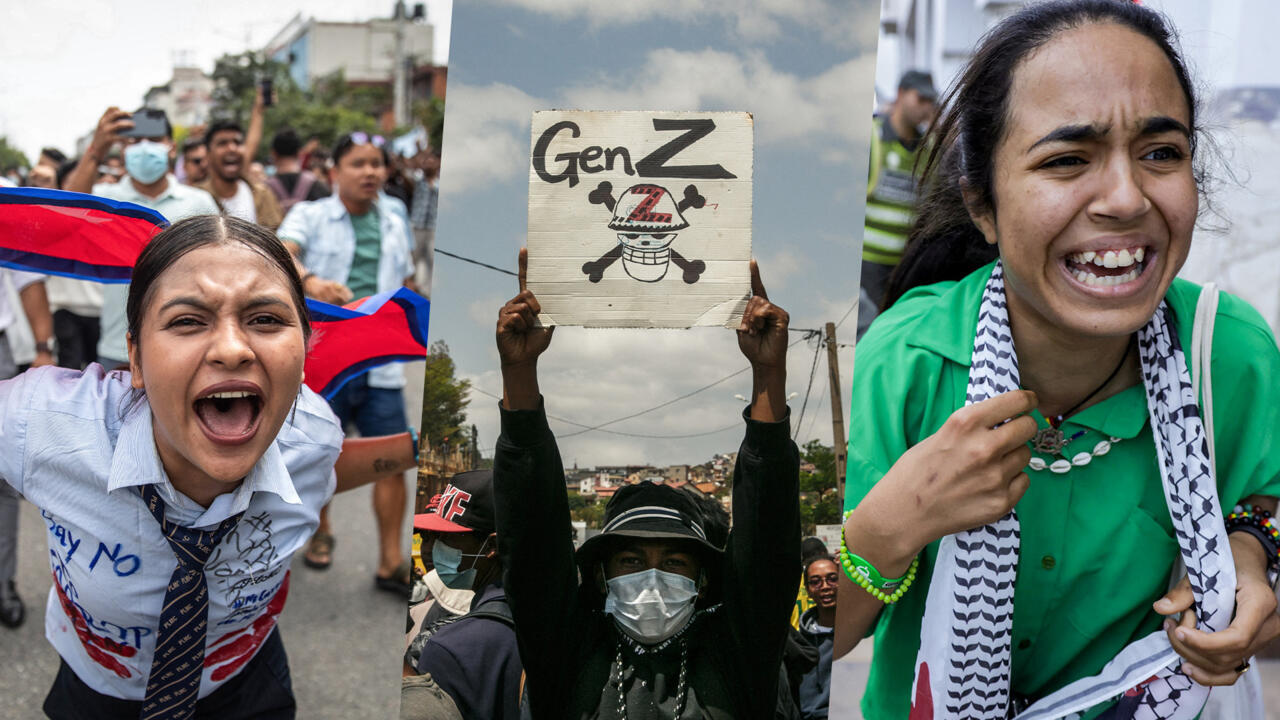
Gen Z, the first generation to have grown up in the internet age, has been at the forefront of anti-government protests in several countries of the Global South. Madagascar and Morocco are the latest countries to be hit by these youth-led movements, which use digital tools to communicate anger at corruption and underfunded social services.

Issued on: 02/10/2025 
FRANCE24
By: Grégoire SAUVAGE
Around the world, Gen Z is inventing new forms of mobilisation. 
© AFP / France 24 studio graphique
04:43


A persistent stereotype about Gen Z is that they are disengaged from and mistrustful of traditional politics, but judging by events over recent weeks, nothing could be further from the truth.

Media broadcasts have shown images of young people spearheading protests in the streets of Kathmandu, Nepal; Jakarta, Indonesia; Rabat, Morocco; and Antananarivo, Madagascar.

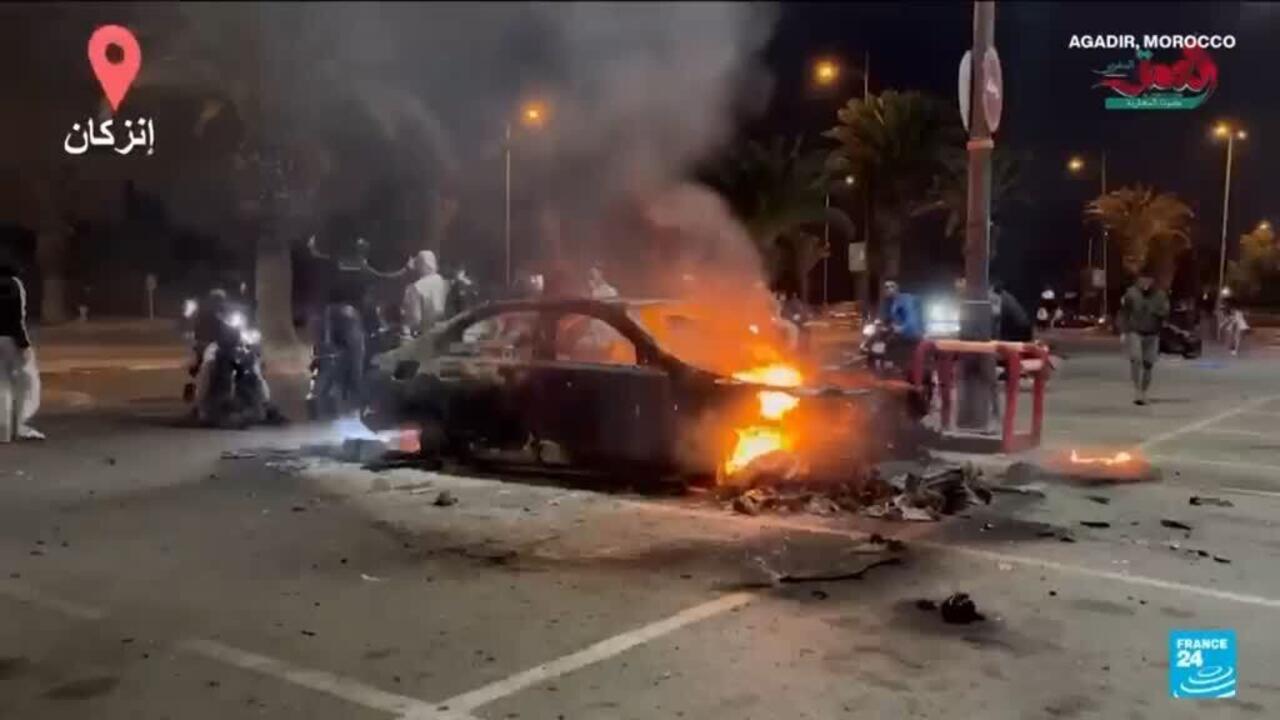
Three people were killed in anti-government protests across Morocco, the interior ministry said Thursday. The ministry said the three were shot and killed during an attempt to seize police weapons, though no witnesses could corroborate the report.

The protests have taken the North African nation by surprise and emerged as some of Morocco’s biggest in years. By midweek, they appeared to be spreading to new locations despite a lack of permits from authorities.

Madagascar’s protest movement began on social media under the banner “Gen Z Madagascar”, an informal group composed mainly of young people and students who claim to be “peaceful and civic-minded”. Although young people represent the overwhelming majority of the country's population – two-thirds were under 30 in 2023, according to UNICEF – Gen Z has never before taken such an active part in a political protest movement there.

"This movement is unprecedented, above all, because of its profoundly horizontal, spontaneous and decentralised nature. Unlike past mobilisations led or co-opted by political parties, unions or charismatic figures, this one arose from organic collective outrage, mainly in digital spaces, and took shape without a single leader," said Ketakandriana Rafitoson, professor of political science at the Université Catholique de Madagascar and vice chair of the NGO Transparency International.

“This gives it new symbolic power because it does not use the rationale of seizing power, but has an existential imperative: that of demanding a liveable future,” she said.
A common digital culture

Very much at home in the digital world, Gen Z has managed to mobilise a large part of the population in several countries using hashtags, AI-enhanced images, fast-paced videos – along with a healthy dose of sarcasm. After Madagascar’s President Andry Rajoelina sacked his government on Monday, he suggested he would select candidates for a new cabinet using LinkedIn – a proposal that was widely mocked by young internet users.


A Malagasy internet user's account mocks the president's proposal to use LinkedIn to hire government ministers. © Screengrab X


This social unrest, driven by tech savvy youngsters rebelling against inequality, can be seen as part of a broad movement that has already affected several Asian countries in recent months, including Nepal in early September, where the government was toppled in a matter of days. The Philippines, Indonesia, Bangladesh, Sri Lanka, and Kenya have all experienced similar protest movements.

In Morocco, thousands of young people active on the Discord messaging platform have been protesting since last week, mobilised by a movement that also claims to represent Gen Z.

Although unprecedented in terms of its organisation and methods of action, its demands are nevertheless in line with previous instances of social protest in the kingdom, according to Mehdi Alioua, a sociologist at Sciences Po Rabat-UIR.

“Ultimately, we see the same slogans calling for a more dignified life, better distribution of wealth, and above all, functional education and healthcare systems. These young people would like to respect the rules of a meritocracy, but they realise that the cards are stacked against them,” said Alioua.

In Madagascar, young people acknowledge the influence of Asian protesters thousands of miles away with whom they share many concerns, starting with the fight against inequality and corruption.

“The protests in Nepal were a key moment in the creation of the Gen Z Madagascar movement. Widely shared on social media, these protests in Asia played a major role in raising collective awareness in the country,” said a 26-year-old woman who did not want to named due to fears for her safety.


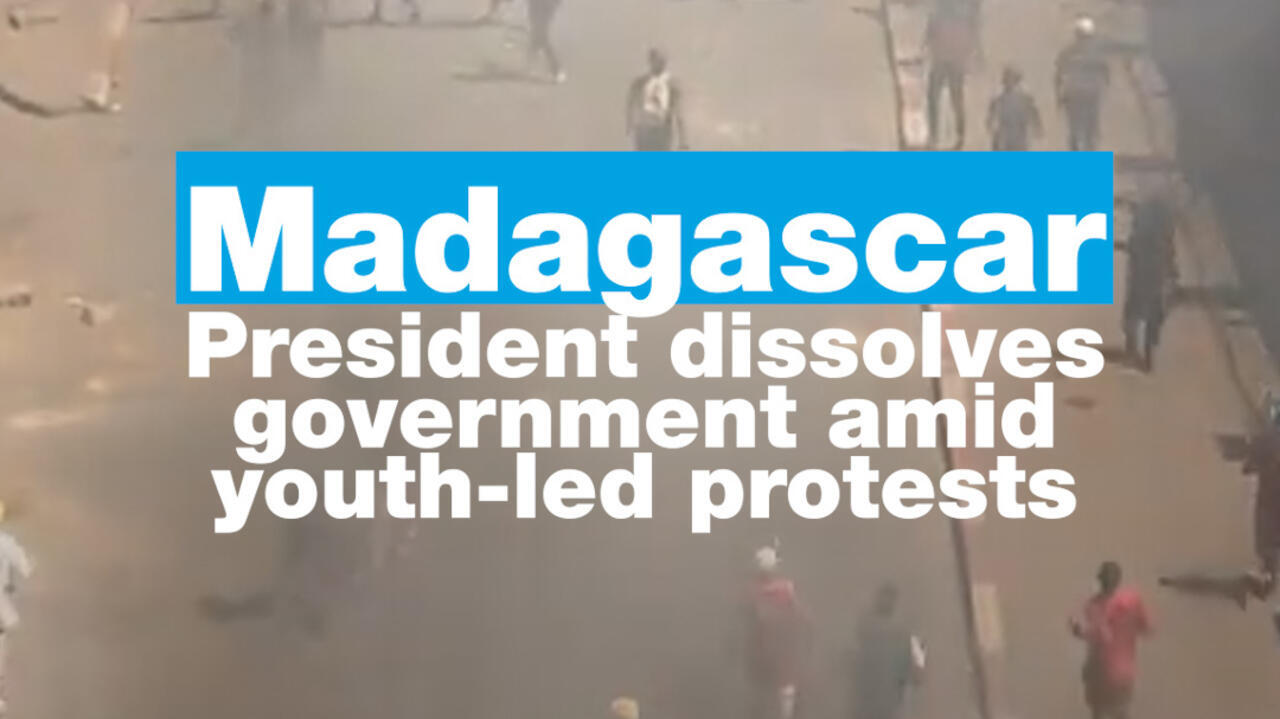
Madagascar: President dissolves government amid youth-led protests
EN Madagascar TikTok © France 24
00:44


“What happened in Nepal gave the people of Madagascar hope that it was possible to overthrow the system, that young people could take control of their own destiny, and that the country's situation was not inevitable. From then on, people began to speak out, and their voices came together under the Gen Z Madagascar movement,” she added.

A pirate flag from the Japanese manga series "One Piece" became a symbol of resistance for young people during protests in Indonesia and Nepal. In Madagascar, protesters are using a modified version of the flag where the skull-and-crossbones symbol sports traditional Malagasy headwear instead of a straw hat.


‘A turning point’

Protesters in Morocco and Madagascar are less focused than their counterparts in Asia on tracking the conspicuous consumption of “nepo kids” – children of the wealthy who flaunt their lavish lifestyles on the internet.

But in both Morocco and Madagascar, the anti-government movement is intent on exposing wealth inequalities between the ruling class and the average citizen.

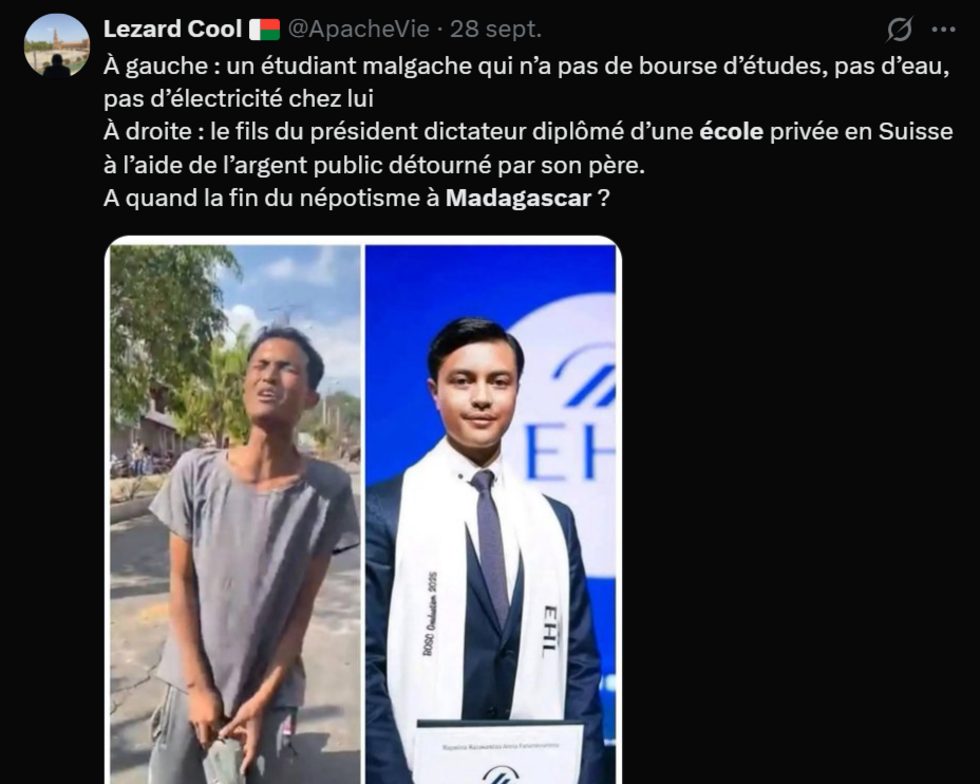
Among the most viewed pages on the Malagasy internet are images of the eldest member of the Rajoelina family, who graduated from a Swiss hotel school costing €150,000 per year, while two-thirds of Madagascar's population live on less than two dollars a day.

Screenshot of an X account denouncing the lifestyle of the son of Madagascar's president. ©Screengrab X

Wasteful public spending is a common theme motivating the young protesters. In Madagascar, the costly Antananarivo cable car – one of the government's key infrastructure projects, but which has been deemed completely unsuited to the needs of the population – has galvanised the youth.

In Morocco, protesters are focusing on the huge sums spent on renovating several football stadiums for the upcoming Africa Cup of Nations and the 2030 World Cup, funds that could have gone to public services such as education and healthcare.

“There is an interconnection among Gen Z, particularly in countries in the Global South, whose elders led the revolution for decolonisation. But today, there is a generational divide because these young people feel that the promises of an independent nation with functioning institutions have not been fully kept,” noted Alioua.

Morocco rocked by violent clashes as youths protest health, education system
© France 24
01:31


“The similarities between all these movements are striking, both in terms of their demands and their methods of action, with viral campaigns, simple and inclusive slogans, and a rejection of traditional hierarchies. In all these countries, young people are acting as a barometer of a deep crisis in the state,” says Rafitoson.

Creative, daring and versatile, these Gen Z movements remain vulnerable to fragmentation and political exploitation. Can they move from expressing their collective anger to developing a real strategy? And can they avoid being assimilated into traditional political parties?


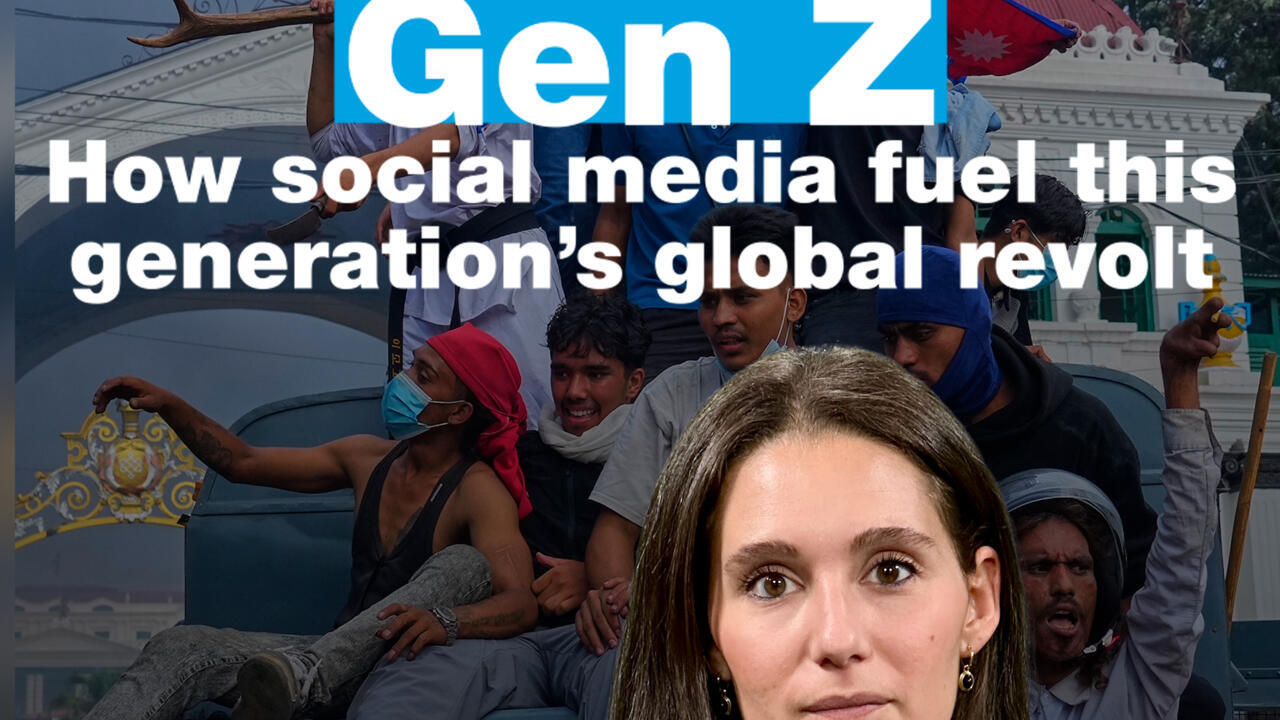
Gen Z: How social media fuel this generation's global revolt
EN Gen Z thumbnail © France 24
02:18


Despite these uncertainties, youth movements have already demonstrated their ability to bring about change by bringing down governments, although the social challenges remain daunting.

“Gen Z may not yet have a formalised political agenda. But it has already changed the terms of the debate with the idea that it is no longer a question of surviving in a failing system, but of radically transforming it,” said Rafitoson. "This is not a passing revolt, but a profound generational change that is under way. We may be living through a turning point today across the globe."

This article was adapted from the original in French by David Howley.
Mass protests and strikes grip Madagascar amid calls for president to resign


Anti-government protests continued across Madagascar on Wednesday as thousands demand President Andry Rajoelina step down. Demonstrators staged strikes and marches over misgovernance, water and power cuts, while authorities used tear gas in the capital and at-risk regions.


Issued on: 02/10/2025 
By: FRANCE 24
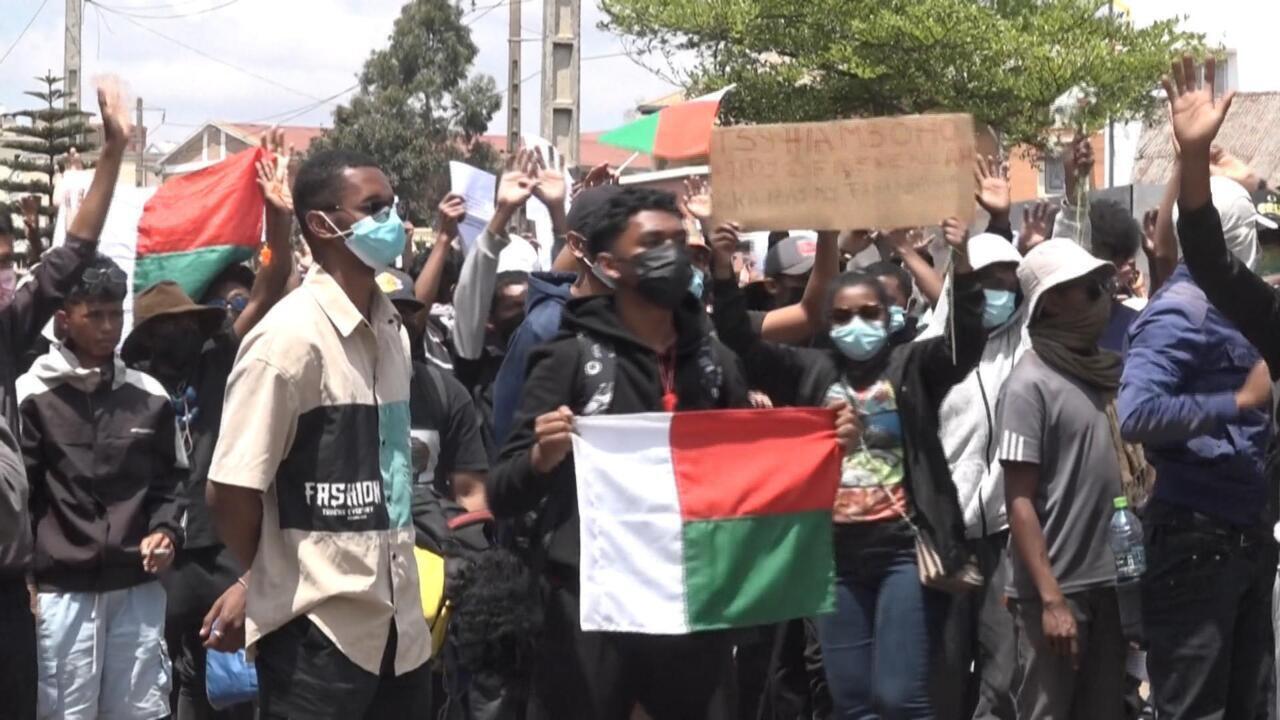
Protesters in Madagascar holding flags and carrying signs. © France 24

Anti-government protesters in Madagascar held fresh demonstrations on Wednesday and called for a general strike, seeking to force President Andry Rajoelina to step down after nearly a week of action by the youth-led movement.

Police fired tear gas at protesters in the centre of the capital, Antananarivo, where some 10,000 clashed with police on Tuesday, although life had mostly returned to normal in the rest of the city by later that afternoon, according to AFP journalists on the ground.

A crowd of several thousand marched in the northern city of Antsiranana, demanding the president's resignation, a local source told AFP, while several hundred gathered in Toliara, in the south.

Rajoelina on Wednesday evening organised a meeting at the presidential palace with foreign diplomats, spokesperson Lova Ranoromaro told AFP.

Ranoromaro added that the protesters had dispersed "without a clear leader emerging ... to allow for a structured exchange" of views.

Near-daily protests over misgovernance and water and power cuts began in Antananarivo last Thursday and spread to other cities across the Indian Ocean nation of almost 32 million people.

Despite Rajoelina having sacked his government on Monday in a bid to placate the unrest, anger has been intensified by a heavy crackdown on protesters.

At least 22 have died and more than a hundred have been injured in the unrest, according to the UN.

The government has rejected the tally as unverified and "based on rumours or misinformation".

"The dismissal of the government is not enough for us," a spokesperson for the "Gen Z" movement leading the protests told AFP on Tuesday, adding further demands are the president's resignation and "the cleaning up of the National Assembly".

Another anonymous demonstrator told AFP that "living conditions of the Malagasy people are deteriorating and getting worse every day".

Rajoelina "has been in power for 16 years, but nothing has changed" in a poverty-stricken society, he said.

Rajoelina, 51, first came to power in 2009 following a coup sparked by an uprising, which ousted former president Marc Ravalomanana.

After not contesting the 2013 election under international pressure, Rajoelina was voted back into office in 2018 and re-elected in 2023 in contested polls boycotted by the opposition.

Initially silent, the opposition endorsed the movement through a rare joint statement on Wednesday, with opposition leader Siteny Randrianasoloniaiko and former president Ravalomanana among the signatories.


NGOs in appeal against 'repression'


More than 200 local NGOs on Wednesday made a joint appeal for an "immediate end to all forms of repression" and for the "respect of the right to protest".

On social media, the Gen Z movement earlier called for the dissolution of the Senate, the Constitutional Court and the electoral commission as well as for businessman Mamy Ravatomanga, reportedly Rajoelina's main financial backer, to be put on trial.

"Trade unions from the public sector are called to join a general strike," the movement said, without giving a date for the proposed labour action.

The national water and electricity distribution company, JIRAMA, and the main labour inspectors' union had already announced they would go on strike.

Social media, meanwhile, highlighted images of a young boy with a facial injury, with Antananarivo's main hospital indicating that "the government has provided free treatment for the boy injured" during the protests. The hospital posted an image of the child, head bandaged, undergoing medical scans.

Political scientist and human rights activist Ketakandriana Rafitoson said the protests risked dragging on and intensifying if authorities rely on force to suppress dissent instead of prioritising accountability.

"That outcome risks political fragmentation, stronger nationalist rhetoric against perceived external interference, and possible economic fallout as investors and donors withdraw or condition support," the member of Transparency International Madagascar told AFP.

Pope 'saddened'


Pope Leo XIV on Wednesday said he was "saddened by the news coming from Madagascar" and called for "the promotion of justice and the common good".

Five of the main civil society organisations also called for Catholic Church-led talks to "prevent Madagascar from sinking into chaos or civil war".

Madagascar ranks among the world's poorest countries but is the leading producer of vanilla and has natural resources in farming, forestry, fishing and minerals.

(FRANCE 24 with AFP)