Sunday, December 14, 2025

Liberation Is Not Integration: On liberal Zionism, one-state fantasies, and what Palestinians actually want

The left's view of Palestine’s future often reduces to vague terms like “one-state solution” or “equal rights for all” but few address the tough questions they raise, especially: how can Palestinians live with those who carried out the Gaza genocide?
 December 8, 2025 
MONDOWEISS

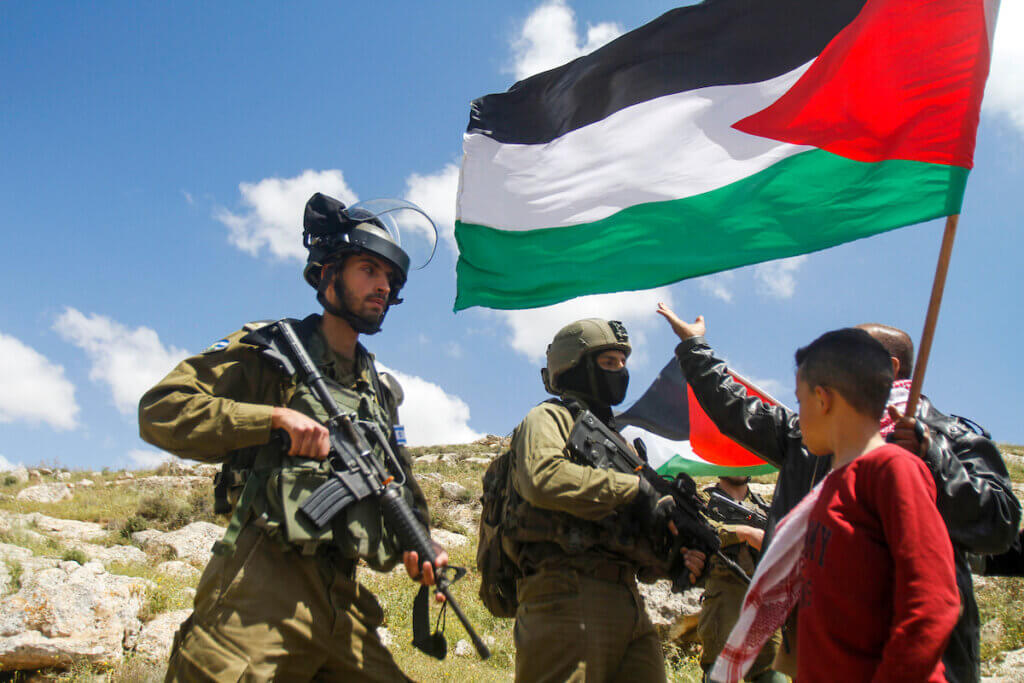
Palestinians block Israeli soldiers during a protest against the expansion of Jewish settlements, on April 28, 2023, in the West Bank village of Beit Dajan, east of Nablus. (Photo: Mohammed Nasser /APA Images)


A few weeks ago, on our walk back from the market in Bethlehem’s old city, my friend abruptly turned to me and declared that she could not imagine a one-state solution, because it would certainly mean the transformation of our beautiful city as we know it and the alteration of so many of the things we love about it.

Her comment and the discussion that followed, our voices rising in volume as we carried on down Star Street, stayed in my mind on the way home and over the weeks that have followed. The questions that arise from discussions of political solutions and decolonization are many, and since publishing some thoughts on decolonization two years ago, the practical questions remain, nagging to be answered — or at the very least, put to words and shared.

As my friend astutely noted, the common slogans representing what has seemingly become the international leftist vision for Palestine’s future can be boiled down to a few, vague catchphrases: “one-state solution,” “one democratic state,” “equal rights for all,” and the like. There is significant scholarly engagement with this concept as well — academic treatises on the need for a binational approach, Omar Barghouti’s emphasis on “equality” over separation, and the ever-present lamentations that the two-state solution is dead.

Still, there is no shortage of liberal organizing spaces in the West in which these fuzzy, imprecise calls for a one-state solution are bandied about without tackling the difficult questions that come with them. For example, who makes up the “all” in “equal rights for all”? What does it mean to be “equals” when one group of people has built their collection of rights and privileges by stripping them from others?

Furthermore, do settlers who have freshly arrived from the United Kingdom, Germany, Brazil, or the United States have the same rights as Palestinians who will return from languishing in Lebanon’s refugee camps for almost eighty years? Do Israelis have collective rights? Do Palestinians? Who controls the military? What is the economic arrangement of the state? Do Israelis have to return more than a hundred years of looted wealth, land, and resources, and if so, to whom? What will the process of unmaking their settler status look like?

For those of us who understand anti-Zionism as a necessary form of decolonization, the question of recent settlers — dual citizens who arrived from the United States, Australia, and Europe — is not ambiguous. Historical decolonial movements in Algeria, Zimbabwe, Kenya, and elsewhere recognized that dismantling settler-colonial structures required the return of settlers to their metropoles. This was not punitive but necessary, as it facilitated breaking the material and ideological infrastructure of colonialism, establishing legal precedents for indigenous sovereignty, and creating the political conditions for genuine self-determination. Allowing settlers to remain unchallenged preserves the very power asymmetries that decolonization seeks to dismantle. At the same time, for settlers arriving from settler colonies like Canada and the United States, is the just response to send them packing back to their more established settler-colonial points of origin?

This brings us to the question at the heart of my friend’s outburst: who wants to be made to live and share space with genocidaires?


This brings us to the question at the heart of my friend’s outburst: who wants to be made to live and share space with genocidaires?

In Bethlehem, this is not a theoretical question. Already having been separated from Jerusalem artificially, by the wall and checkpoints, villages and towns surrounding Bethlehem city are also set to be annexed by Israel, with a census of their residents reportedly beginning in the new year. In September, Zionist forces installed new barriers to separate Beit Sahour, immediately southeast of Bethlehem city, from Dar Salah and cities in the north of the West Bank by disrupting the primary road. Now, a settlement has been approved in Oush Ghrab, only a short distance from Bethlehem and Beit Sahour. As Bethlehem becomes more physically isolated from other Palestinian cities while its residents are also prevented from reaching the lands occupied since 1948 by Israel’s colonial permit regime, and settlements grow closer and closer to the city, the violence of liberal notions of “integration” is foreboding. Under Zionism, integration is not a peaceful affair. The presence of Jewish settlers in Palestine is inherently violent, and until now has been characterized by the continual elimination of Palestinians for the purposes of replacement.

The questionable desirability of living alongside settlers as “equals” is also amplified by the conversations happening about Palestinians and around Palestinians by self-described Jewish anti-Zionists, though often without much thought for Palestinians themselves. Just over a month ago, Jewish Currents published a podcast episode titled “Confronting the Anti-Zionist Right,” focusing on the expressed rejection of Zionism by white supremacist characters such as Nick Fuentes, Candace Owens, Tucker Carlson, and the like, and discusses the history and politics of the commentators’ antisemitism. There is very little in the way of discussion about what anti-Zionist values should be, though the host acknowledged that, “we are in a competition with the right for what kind of anti-Zionism we’re going to practice, what it’s going to look like, and what, at core, its values are.”

The podcast episode mimics a recent talk in Jerusalem by Peter Beinart, Jewish Currents’ editor-at-large. Beinart also gestured at the growing influence of characters like Carlson in the movement away from Zionism by some elements on the U.S. right, and laudably noted the long ties Jewish American institutions have made to white supremacy and its agents. However, Beinart and the podcasters frame these moves (both Carlson’s proclaimed anti-Zionism and the history of collaboration with white supremacists) as dangerous for Jewish people, and fail at what are arguably the more important endeavors beyond this: 1.) identifying the responsibility of Jewish institutions and individuals who do not wish to maintain ties to white supremacy and Zionism, and 2.) how any of this affects Palestinians, who have long been the victims of both white and Jewish supremacists.

Both Beinart and the podcast contributors evade essential questions underlying the reality of the Jewish institutional investment in Zionism: how do we begin to calculate the responsibility of, say, Jewish Federations in the harm they have done to Palestinians by funding Zionist projects? Can organizations that are materially committed to colonization and genocide be reformed? Not even three months ago, the Jewish Federations of North America collaborated with the Jewish Agency to leverage $130 million in loans to Israeli “reservists,” but only those who had served more than 200 days since October 7, 2023.

What do these investments in the ongoing violence against Palestinians mean for civic organizations and other “social justice” groups that receive money from these Jewish Federations? Do organizations bear some responsibility for the politics of their funders, whose contributions to their “social justice efforts” may serve as a form of philanthropy-washing, or a smokescreen to distract from a more significant and consistent support for the violence of maintaining this colony in Palestine?


One-state proposals that fail to address land return, settler removal, and the redistribution of power risk becoming the new “Oslo peace process” with different branding.

Most importantly, figures like Beinart and the Jewish Currents podcasters offer no framework for dismantling structural violence, no mechanisms to prevent the liberal modes of colonization embedded in one-state proposals, and no meaningful centering of Palestinian voices in determining Palestine’s future. In the case of the podcasters, by offering nothing new to consider, they have rendered anti-Zionism as a marketing technique, wholly divorced from theories of justice. Their visions remain abstract, untethered from the material realities of power — outside of where power intersects with antisemitism. Palestinians, meanwhile, need no theoretical education on the imperialism latent in arrangements that promise equality while preserving asymmetry — they have the lived experience of the Oslo Accords, which offered the language of peace and statehood while entrenching occupation, fragmenting territory, and outsourcing the policing of Palestinians to Palestinians themselves. One-state proposals that fail to address land return, settler removal, and the redistribution of power risk becoming the new “Oslo peace process” with different branding.

Data shows Palestinians fully understand that Zionism and imperialism can be repackaged within the one-state framework.

October 2025 polling from PCPSR reveals the complexity of Palestinian political preferences. While 53% oppose a two-state solution outright, when asked to choose among options, 47% still prefer two states based on 1967 borders — compared to just 12% favoring a single state with equality between Palestinians and Israelis. Opposition increases sharply (to 59%) when a two-state framework is tied to Arab normalization with Israel. Meanwhile, Palestinians show stronger enthusiasm for joining international organizations (73%), unarmed popular resistance (54%), and dissolving the Palestinian Authority (45%) than for abandoning two-state advocacy in favor of one-state organizing (27%).


For many Palestinians, a single state premised on “equality” with Israelis is not liberation but continued entanglement with a society that has perpetrated and largely supported their dispossession.

The apparent paradox — opposing two states while also not embracing integration — reflects deeper currents. For many Palestinians, a single state premised on “equality” with Israelis is not liberation but continued entanglement with a society that has perpetrated and largely supported their dispossession. Separation offers something integration cannot: sovereignty, self-determination, and distance from those who have participated in or were indifferent to ethnic cleansing. There is also justified skepticism that equality within a single polity is achievable given the power asymmetries, institutional racism, and demographic anxieties that define Israeli political culture. For Palestinians emerging from genocide, the desire may be less for coexistence than for safety, autonomy, and the space to rebuild without their survival dependent on Israeli consent.

My dear friend’s passionate comments on Star Street were not close-minded or lacking in political imagination — rather they were, as the data suggests, widely shared opinions. The international left’s embrace of “one democratic state” as the self-evident endpoint of Palestinian liberation often fails to account for what Palestinians themselves wish to preserve: not just rights in the abstract, but a way of life, a cultural fabric, cities and villages that remain theirs. Bethlehem under a single state would not simply gain Jewish residents; it would be subjected to the same forces of settlement, capital, and demographic engineering that have transformed every inch of land Israel has controlled. The slogans sound liberatory, but they can obscure a kind of erasure dressed in the language of equality. What my friend articulated — and what the polling reflects — is a desire not merely for political arrangement but for protection: of home, of identity, of the right to continue existing as Palestinians in Palestine, without that existence being contingent on integration with those who have sought to eliminate these things.

Lara Kilani
Lara Kilani is a Palestinian-American researcher based in Bethlehem, and member of the Good Shepherd Collective.
Opinion

Israel is recycling an old colonial plan in Gaza

Israeli Army Chief of Staff Eyal Zamir's statement that the “Yellow Line” dividing Gaza will be Israel's new border shows that Israel's Gaza policy is a continuation of its history of redrawing its borders through ethnic cleansing and land grabs.
 December 14, 2025 
MONDOWEISS

Displaced Palestinian families sheltering inside the UNRWA-run Malak School in Bani Suheila, east of Khan Younis, find themselves suddenly located within the newly designated “yellow line” after the Israeli army repositioned the yellow concrete blocks used to demarcate the so-called “temporary withdrawal line” inside Gaza, December 9, 2025. (Photo: Tariq Mohammad/APA Images)

When Israeli army Chief of Staff Eyal Zamir said that the “Yellow Line” cutting Gaza in half will be Israel’s new border, he was enshrining a decades-old Israeli policy toward Gaza.

Today, it boils down to a simple logic: divide the Gaza Strip into two areas separated by the Yellow Line — one remains under Israeli control, with residential blocks constructed for Palestinians to move into after security vetting (without being allowed to leave), and the other is placed under international control, where no reconstruction takes place and only minimal aid would be allowed through.

For now, Israel is willing to settle for this endgame in Gaza, and is actively pushing to expand what it might mean for the continued residence of Palestinians in the Strip. Although Zamir’s statement contradicts the officially stated aim of U.S. President Trump’s plan for Gaza — which outlines a full Israeli withdrawal at the end of the second phase of the ceasefire — the fact that such a vision was articulated by Israel’s highest military figure means it is a reflection of the heart of Israel’s security doctrine and its historic posture toward approaching the “Gaza question.”
Your donation will be MATCHED!


A map of the “Yellow Line” created by the Euro-Med Monitor. (Map: Euro-Med Monitor)

This vision was made clear since before the ceasefire, when Israeli Defense Minister Israel Katz said back in July that Palestinians in Gaza would be “concentrated” in a “humanitarian city” built over the ruins of Rafah, a plan that was universally condemned by rights groups as a thinly-veiled bid to build a “concentration camp.” More recently, a similar vision emerged in November, when reconstruction plans were reported to be underway on the Israeli side of the Yellow Line, where U.S. officials reportedly said a “new Gaza” would be built. The area falling under Israeli control makes up about 53% of Gaza, although Israel has been expanding the Yellow Line deeper into Gazan territory over the last few weeks.

The fear is that this would facilitate the expulsion of Gazans to other countries via so-called “voluntary emigration,” especially given that this was an explicitly articulated Israeli plan before the ceasefire went into effect; Katz had even created a special bureau tasked with facilitating the “transfer” of Palestinians out of Gaza as the war raged on, which was supposedly meant to work in tandem with the southern Rafah concentration camp Israel had planned on building.

The current plans to create a “new Gaza” under Israeli control bear an ominous resemblance to previous ethnic cleansing schemes.

The current plans to create a “new Gaza” under Israeli control bear an ominous resemblance to these previous ethnic cleansing schemes. Jared Kushner and JD Vance alluded to as much when they said that the “Hamas-controlled” area of Gaza would not receive any aid. This means that Palestinians in Gaza would be forced to leave the heart of the Strip and move to the Israeli-controlled eastern edge — after security vetting — where they would be under the surveillance of Israeli forces in a so-called “green zone.” U.S. officials reportedly said that Palestinians who travel to this area would not be allowed to leave it.

But this vision is not the product of the latest war on Gaza. This strip of land, created by the Nakba of 1948 as a concentration of hundreds of thousands of Palestinian refugees, has presented itself as perhaps the greatest challenge to Israel’s colonial project over the past 77 years.

The plans to ‘thin out’ Gaza’s population

Gaza’s high population density, its dominant refugee composition, and the continuation of chronically miserable living conditions in the Strip have made Gaza a constant site of resistance. This has also made it a target of continuous Israeli plans aimed at decreasing its population and placing it under its military control. Trump’s “peace” plan, recently enshrined at the UN Security Council, only embraces this colonial legacy.

It was in Gaza that Palestinians first declared a short-lived national government in 1948, and it was in Gaza that the first signs of Palestinian resistance to Israel in the wake of the Nakba began, taking off in the early 1950s and leading to repeated Israeli invasions of the Strip.

In 1953, Israel made a plan to relocate tens of thousands of Palestinians into the Egyptian Sinai desert. The plan, which was sponsored by France and the UK, was exposed by Egypt in 1955, sparking a wave of protests in Gaza rejecting the plan. The following year, Israel invaded the Strip as part of a joint French-British-Israeli war against Egypt — known as the Tripartite aggression of 1956 — that came in response to Gamal Abdel Nasser’s nationalization of the Suez Canal. Israeli forces killed some 500 Palestinians in Rafah and Khan Younis during the invasion and bombed Gaza City before withdrawing.

Later, in 1971, Israel made another plan to expel thousands of Palestinians from Gaza into the Sinai desert, with the purpose of “thinning out” its population, according to declassified British archival documents. The plan was known to both the U.S. and the UK, but it didn’t succeed.

When the genocide in Gaza began two years ago, Israel’s declared plan for the Strip — to ethnically cleanse the population into the Sinai — was pulled directly from this history. It was revealed as early as December 2023 when Israeli newspaper Israel Hayom reported that Prime Minister Netanyahu had directed Minister of Strategic Planning Ron Dermer to explore plans to “thin out” the Gaza population. In addition to pushing Palestinians into the Sinai, the Israeli report said that “the Sea is also open to Gazans,” meaning that Israel could open a “sea crossing” to precipitate Palestinians’ “mass escape to European and African countries.”

This Israeli vision would later receive brief public U.S. backing when Trump announced in February 2025 that the U.S. plan for Gaza will see the displacement of Gaza’s population and the building of a “riviera” in their place. In September, the Trump “Riviera” plan’s details to forcibly resettle Gazans were leaked to the Washington Post, which detailed how Gazans would be offered a $5,000 “relocation package.” Although the current Trump “peace” plan that brought about the ceasefire in October 2025 is phrased differently, its intentionally vague wording has left the door open for Israel to push through plans that it has been drawing for Gaza over decades.

The logic of demographic engineering

Although population transfer has been at the center of Israel’s dilemma with Gaza, today’s Israeli designs over the Strip also contain a demographic component that draws upon a history of Israeli colonial planning.

Land control as a way of “demographic engineering” has been a cornerstone of this policy since Israel occupied the West Bank, Gaza, and East Jerusalem in 1967. Israel expanded the de facto municipal limits of Jerusalem three times — first in 1967, officially expanding the limits of the city by 70.4 square kilometers; then in 2005, when Israel’s planning committee for Jerusalem approved the Jerusalem 2000-2020 “Master Plan ,” which increased Jerusalem’s Israeli municipal limits by 40%; and most recently in 2002, when Israel began to build the separation wall around Jerusalem, which isolated entire Palestinian communities from the city while keeping parts of it under Israeli law, including the Shu’fat refugee camp, Kufr Aqab, Samiramis, Anata, and Qalandia. This cut off some 100,000 Palestinians from Jerusalem.

Today, another Jerusalem “master plan” has been adopted, meant to create a “Greater Jerusalem” area that would be annexed by Israel while effectively cutting the West Bank in two. Israeli Finance Minister Bezalel Smotrich said that it would effectively “bury” a Palestinian state. Known as the E-1 settlement plan, the project is meant to expand the limits of the Maale Adumim settlement east of Jerusalem. Netanyahu recently approved the plan at a ceremonial event in Maale Adumim last September.

Together, these policies would change the demographic composition of Jerusalem by adding roughly the same number of Israelis to its limits as the number of Palestinians to be excluded from it — a continuation of Israel’s policy of demographic engineering through land grabs. The E-1 plan would also see the forcible ethnic cleansing of thousands of Palestinians in Khan al-Ahmar, Jabal al-Baba, and other Palestinian communities residing in the area slated for annexation, even further thinning out the Palestinian population falling under Israel’s expanding territorial-administrative borders.

The division of Gaza along the Yellow Line carries echoes of this same approach to demographic engineering, coupled with the redrawing of territorial boundaries. The area east of the line is where the smallest number of Palestinians are present — a flattened wasteland that remains virtually empty and would only absorb a limited number of Palestinians once the “green zone” is built there. Eyal Zamir’s statement that it would be included within Israel’s new borders confirms that the current plans for Gaza are an extension of Israel’s demographic logic, which would see Palestinians concentrated in highly controlled blocks that are continuously surveilled and controlled by the Israeli army. The Palestinians corralled in these parts of Gaza will remain at the mercy of the Israeli military, with no guarantees that they would not be eventually expelled from Gaza entirely.

Trump’s 20-point plan was light on details and lacked a clear roadmap for implementation, while the core issues that had been the subject of negotiations over the preceding two years remained unaddressed. Yet for Arab and Islamic mediators, as well as for Palestinians, it guaranteed the end of the genocidal war, even though daily killings have not ceased.

The problem is that the intentionally vague wording of the entire plan left enough room for Israel to implement the same strategy that it has formulated for resolving the “Gaza dilemma” on and off for decades. What is unfolding now in the Gaza Strip combines old doctrines of redrawing borders, population transfer, demographic engineering, and land grab.

Destruction of Evidence: The Struggle to Count the Dead in Gaza

In our latest visual, we highlight how the conditions of genocide make it difficult to accurately document the death toll and other aspects of the ongoing Israeli genocide against Palestinians in Gaza. This visual was inspired by various efforts by public health experts to estimate or project the possible death toll in Gaza, prompting important discussions about the limitations of data during an ongoing genocide. While we cannot yet be certain of the true cost of this genocide in terms of Palestinian lives, we can be certain that widely cited figures are a significant underestimate.

Since the International Court of Justice ordered Israel in January 2024 to prevent destruction and ensure the preservation of evidence related to allegations of genocide, Israel has instead continued to act with impunity. Israeli forces have escalated attacks, even during the so-called ceasefire, demolished large areas of the Gaza Strip, continued to bar international journalists from entering Gaza while assassinating Palestinian journalists, and refused to cooperate with international fact-finding missions. The bodies of thousands of Palestinians, both recently killed and long buried beneath debris, remain unrecovered.

Visualizing Palestine is the intersection of communication, social sciences, technology, design and urban studies for social justice. Visualizing Palestine uses creative visuals to describe a factual rights-based narrative of Palestine/Israel. Read other articles by Visualizing Palestine, or visit Visualizing Palestine's website.

Tell Barclays to stop bankrolling Israel’s atrocities – PSC petition

Featured image: A local demonstration against Barclays support for Israel’s assault on Gaza. Photo credit: Palestine Solidarity Campaign/X
“Barclays has become a toxic brand, with people of conscience across Britain wanting nothing to do with the bank.”

The Palestine Solidarity Campaign (PSC) has launched a new petition calling for a boycott of Barclays until it stops investing in companies that supply Israel with weapons, such as Elbit Systems. You can read the text of the petition below.

We, the undersigned, demand that Barclays immediately end all financial ties to companies arming Israel and cease acting as a ‘primary dealer’ of Israeli government bonds. Until these actions are undertaken, we will boycott all Barclays products and services.

Israel’s genocide in Gaza has killed over 70,000 Palestinians and injured hundreds of thousands. Israel continues to bomb the Gaza Strip and conduct daily military incursions in the occupied West Bank, despite the so-called ceasefire. Israel has also continued its military attacks in Lebanon. 

These horrific attacks and unprecedented numbers of civilian casualties are made possible by arms companies and the banks that provide services to them.

Barclays has directly helped Israel raise money to fund the cost of its genocide in Gaza by acting as a ‘primary dealer’ for its government bonds. Barclays also provides over £8 billion in investments and loans to companies supplying Israel with weapons and military technology used in its genocide in Gaza and occupation of the West Bank.

This includes Elbit Systems, which is central to producing Israel’s arsenal of weaponry. Recent reports show that Israel used cluster munitions manufactured by Elbit Systems in its attacks on Lebanon. Cluster munitions indiscriminately disperse multiple bombs over a wide area, causing high casualties and suffering. For this reason, the UK is a state party to a treaty banning their production, stockpiling and use.

By continuing to invest in Elbit Systems, Barclays is in violation of its own internal policy, which states it will not provide financing to “companies known to trade in, or manufacture cluster munitions”.

Barclays is under a legal obligation to end all financial ties that aid or assist grave violations of international law. Yet, it refuses to do so – continuing to bankroll Israel’s atrocities. For this reason, Barclays has become a toxic brand, with people of conscience across Britain wanting nothing to do with the bank.


Written from within the genocide


Mike Phipps reviews Witness to the Hellfire of Genocide, by Wasim Said, published by 1804 Books.

In the poem that constitutes the Introduction to this powerful account of life in Gaza, Wasim Said explains that he began writing when the January 2025 ceasefire broke out, but “the moment I picked up the pen— The war returned.”

He says: “I write it so I can hang these words around your neck—

to make you bear the responsibility of my perspective,

the responsibility of knowing,

the responsibility of being a witness.”

young man in his early twenties, Said began his chronicle as the genocide took place around him. His motivation: that what happened – and might happen to him – should not be erased.

On the evening of October 7th, Said’s family gathered on the ground floor of their building, “all thirty-six of us, my grandfather and everyone bearing his name. We sat in complete silence with the burning questions in our minds: Where can we go?” At that moment, Israeli planes bombed their neighbour’s house. The family set off, the children in two cars, the rest on foot.

They spent the night at al-Shifa Hospital. Next day he and his uncle set to work, carrying corpses from ambulances to the morgue. Most bodies could not be identified.

Two days later, they headed south in three vehicles. That night, they slept on the floor of a school, which quickly filled with displaced people. Their five-by-ten-metre classroom soon housed fifty-two people. When the school filled up, new arrivals took to the playground in ‘tents’ – loose home-made shelters that did not even keep out the rain. Sanitation quickly became a major concern.

“After the first month of the aggression, hunger became their most dangerous weapon. I had never imagined that a day would come when bread would be a treasure. I never thought that I would see the elderly splitting a small piece of bread among them, or children crying, not because they had lost a toy, but because starvation was tormenting them.”

In Deir al-Balah alone there were nearly a million people, but the town had only three bakeries. Within less than a month, one of them was flattened. “The lines were endless… I would leave at dawn, walk an hour to the bakery, then walk another half an hour to join the back of the queue. I stood there for long hours, until nightfall… At the bakery gate, there was no ‘queue’, just a battlefield.”

Said also describes the armed gangs who, with the support of the occupation, stole food from distribution trucks to sell on the black market, opening fire against any opposition.

An uncle recalls two tanks coming in, followed by food distribution trucks. The trucks unloaded their cargo of flour sacks and the tanks retreated. As people moved towards the flour, Israeli snipers opened fire. “The field was full of body parts.”

To avoid being used for Israeli target practice, other people the author spoke to ate animal feed and weeds.

Obtaining food and fuel to cook it was increasingly a life-threatening task. The author recalls his optimism during the ten-day ceasefire, which would quickly be dashed as the bombing resumed. But the emergence of communal soup kitchens became a lifeline and a symbol of collective resilience.

Said recounts almost random acts of destruction, senseless massacres – a tank deliberately crushing men who had been ordered by the Israelis to run and could not run fast enough, snipers killing children.

What comes through this memoir most strongly is a sense of anger and injustice – but also of unity, generosity and compassion amid the ceaseless bombardment. “If global action is not taken, we will be wiped out,” says Said. “We shall become a story, a fairy tale, a memory on the margins of history.”

At the time of writing, Wasid Said is still in Gaza. Another so-called ceasefire is in place. By mid-November, Israel had violated it 282 times and destroyed more than 1,500 homes. But the existence of this ceasefire pretence has given Germany the necessary cover to resume its arms exports to Israel, and France has reauthorised Israeli companies to exhibit at arms fairs. Meanwhile, Israel’s bombing of Lebanon intensifies.

Mike Phipps’ book Don’t Stop Thinking About Tomorrow: The Labour Party after Jeremy Corbyn (OR Books, 2022) can be ordered here.

Sacrificing democracy to save Israel


DECEMBER 14, 2025

Mike Phipps reviews America’s Middle East: The Ruination of a Region,  by Marc Lynch, published by Hurst.

US foreign policy in the region became a lot clearer to Marc Lynch once he realised that “America doesn’t seem willing to accept that people in the Middle East are actually human beings.” Moreover, “this refusal to recognize the humanity of those under US domination resembles the core pathology that enabled European colonialism, the slave trade, the Holocaust and most of the great evils of world history.”

His book starts with an account of Israel’s deliberate targeting of hospitals, schools, refugee shelters, journalists, aid workers and civilian housing after the Hamas attack on October 7th 2023, followed by its expansion of the conflict into other countries in the region. Despite the massive student protest movement that swept across the US, the Biden administration refused to use its leverage over Israel to push for an end to the war. Instead it threatened sanctions against organisations like the International Criminal Court that pursued accountability. But Biden’s indifference to Palestinian death and destruction was not exceptional – just the latest example of long-standing US policy in the region that  dates back to the Cold War.

The expectation that Palestinians will somehow welcome the replacements that the US has chosen to govern them – particularly Tony Blair! – is reminiscent of the failed Iraq policy: years of Western sanctions which killed up to half a million children, followed by bombardment and invasion accompanied by the absurd belief that the occupiers would be welcomed as ‘liberators’.

US Middle East policy has for decades been based on the assumption that backing and arming friendly autocratic regimes is the best way to secure order. This is why the many US democracy programs in the region could never be allowed to produce democracy, which might challenge that autocratic rule.

Under American primacy, the Middle East has become one of the most militarised regions in the world. No wonder that for the overwhelming majority of Arab people polled across the region, the US, which views itself as the provider of security in the Middle East, is seen as the biggest threat to their security. Washington of course not only dismisses this outlook – it minimises its own responsibility for events in the region, preferring narratives about ancient sectarian conflicts.

Lynch’s survey takes us through the 1980s and 1990s, exploring the potential of the Palestinian Intifada of these years. “Perhaps because it represented a peak moment of Palestinian agency and centred nonviolence resistance rather than war, it has been oddly erased, or at least neglected, by most accounts of the region’s evolution.” American pundits, suggests Lynch, still ask “where is the Palestinian Gandhi?” decades after the nonviolent kind of mass mobilisation he championed was brutally suppressed by Israel.

In reality, the author argues, the US has not only given up on even the semblance of a Middle East peace process in the last quarter of a century: it has effectively abandoned any commitment to international law as far as Israel is concerned. “Why should countries rally to the side of the United States in defence of Ukraine,” asks Lynch, “if the US makes clear that it has no objection in principle to war crimes or the conquest of territory by force?”

US policy towards the Palestinians was echoed in the pursuit of Clinton-era sanctions against, and Bush Jr’s violent invasion of, Iraq: both displayed a contemptuous lack of concern for the human cost of their actions and indifference to Arab lives. Today, it is standard for US policymakers to claim that the ‘threat’ from Iraq was exaggerated, and so forth, while overlooking the real reasons for the invasion – both plunder and the need for a “performative war”. As right wing pundit Jonah Goldberg put it, “Every ten years or so, the United States needs to pick up some crappy little country and throw it against the wall, just to show the world we mean business.”

If judged by its rhetoric, the Obama administration might appear to break with this long-established approach. But the US’s continued refusal to recognise a Palestinian state under Obama’s leadership underlines its refusal to treat Palestinians as equals under international law. Again, despite the rhetoric, continuity in Middle East policy was the dominant feature of the first Trump administration as well.

Biden too, despite huge differences on other areas of policy, opted to build on Trump’s approach in the Middle East, focusing on a security-oriented priority of normalising Saudi-Israel relations – all while ignoring the plight of the Palestinians. When the Hamas attack of October 2023 took place, it was in a context not only of no meaningful negotiations towards a solution for twenty years, but also of escalating Israeli violence against Palestinians in which US policymakers expressed little interest.

Similarly, the US placed no serious constraints on the genocide unleashed by Israel after October 7th – in fact they armed and supported it. Lynch says: “Biden’s stubborn refusal to call for an end to the killing presented a dilemma even to Israeli leaders, who understood well that Israel’s wars generally only end when America imposes a ceasefire.” Instead the Biden administration allowed Israel to escalate the conflict by opening several new fronts beyond its borders.

Lynch provides an excellent analysis. Perhaps his book’s biggest weakness is its hopeful belief that US policy can break from its militarist and racist mindset towards the Arab world. The fundamental continuity he highlights in policy between presidents as strikingly different as Clinton and Bush, Obama and Trump suggests this optimism may be misplaced.

Maybe a defeat for, rather than a modification of, US policy in the region is more likely. As he predicts, “Its efforts to sustain the old Middle East will involve ever greater direct application of military force  and repressive power, the clearest signal of dwindling legitimacy and the failure of hegemony.” And that repression is now intensifying against campus protests against the genocide at home.

Lynch led a task force in 2023 and 2024 documenting the breadth of institutional assault on scholars and students who spoke out on Gaza. Over three-quarters of 500 scholars surveyed felt the need to self-censor when speaking in a professional capacity about the conflict; the overwhelming majority said the current period was the most difficult in their academic career. The policy of sacrificing democracy to save Israel, so long practised in the Middle East, is now ripping through the US itself.

Mike Phipps’ book Don’t Stop Thinking About Tomorrow: The Labour Party after Jeremy Corbyn (OR Books, 2022) can be ordered here.

 The Inevitable Logic of the Zionist State


The Inevitable Logic of the Zionist State

There is huge effort by the establishment to reduce the crimes of genocide to the actions of a few rotten apples around Netanyahu, but as Nicky Coules argues, the reality is that it is an outworking of the logic of Zionism itself.

December 11, 2025

The Israeli genocide in Palestine has an inevitability to it that comes from the nature of the political Zionist project itself. Political Zionism is, in turn, an outcome of European antisemitism. To see this, we need to look at history. Antisemitism has been around for millennia. In antiquity Jews and later Christians were persecuted because at that time multiple gods were revered and Jews and Christians worshiping a single deity were considered disloyal. In the Middle Ages Christians regarded Jews as alien because they repudiated Christ and his church.

In Europe down to the early 20th century Jews were segregated into ghettos. This and other constraints created a cohesion among them that might otherwise not have been. They were prohibited from owning property, so they engaged in trade, banking and moneylending. This othered them while also engendering envy. With the emergence of nationalism in Europe in the nineteenth century Jews began to be viewed as ethnically homogenous rather than the religious community that they are. Into this stepped the founder of Zionism, Theodor Herzl, who made a case for the establishment of a Jewish state in a pamphlet published in 1896. Political Zionism was born based on the belief that antisemitism always was and always would be.

The Jewish National Fund was established in 1901. This operated much like the Catholic charity, Trócaire. Older readers may recall Trócaire collection boxes in Catholic households.  Similarly, the blue JNF tin boxes could be found in Jewish households throughout the world. Following the Balfour Declaration of 1917 and the granting of the British mandate, the funds collected were used to buy land in Palestine often from absentee Arab landlords. The hapless and often bewildered Palestinian tenants were evicted and replaced by Jewish immigrants. This was the seed of apartheid Israel.


Colonialist racism

The first substantial influx of settlers comprised Ashkenazi Jews from Europe. As Rob Ferguson notes, it was their secular Labour Zionism, a variant  of social democracy that laid the basis of the state. Like all colonisers the Ashkenazi saw themselves as a superior people on a mission. They would bring a higher civilisation to a ‘backward’ land populated by ‘ignorant and lazy’ Arabs. To get a flavour of this, recall the attitude of the colonisers from across the Irish Sea towards the native Irish. We too were supposedly backward, ignorant and lazy.

As the numbers of Ashkenazi immigrants declined, Mizrahi and Sephardic Jews were encouraged to settle in Israel. These people came from North Africa and the Middle East. With their similarity in appearance to Arabs they were looked down upon and discriminated against by the Ashkenazi. But what they all had in common was a bitter hostility towards Palestinians. The coming of Netanyahu to power, alongside the two fascists Smotrich and Ben-Gvir, is in large part the working out of the political tensions in Israel arising from its inter-Jewish discriminations and further shaped by Palestinian resistance as well as hostile countries in the region.

Even when more ‘liberal’ governments held sway Palestinians were personae non gratae. One such ‘liberal’ was Golda Meir, prime minister from 1969 to 1973, who infamously said: “There was no such thing as Palestinians….It was not as though there was a Palestinian people in Palestine considering itself as a Palestinian people and we came here and threw them out and took their country from them. They did not exist.” So much for the Palestinian homeland or identity.

The current genocide is not an aberration, therefore. It is a fundamental feature of the Zionist project. It is the continuity of a necessary compulsion to extinguish all Palestinian resistance. The Nakba of 1948 was not one single event: it  is always ongoing.


Two state: corralling resistance

The reality of Palestinian resistance in the form of the PLO gave the lie to the idea that there is no Palestinian nation. Apologists for Zionism choose not to see this. They – and the Irish government would happily join them at the first opportunity – would have us believe that were a more amenable regime to be elected in Israel a Palestinian state could come into being. It wouldn’t.

When the PLO was defeated, the Oslo Accords were designed as a way to corral resistance, holding out the chimera of a possible future two-state solution while creating the Palestinian Authority to police its own people. Divide and rule was the Israeli watchword. Repression continued with routine attacks by the Israeli military coming to be referred to by its army general staff as “mowing the lawn”. Israel’s hope for uninterrupted control of historic Palestine ran up against continued Palestinian resistance, especially during the mass uprisings of the first and second intifadas.

More land grabbing and repression was Israel’s answer as it searched for the knockdown blow that would finally and permanently extinguish resistance. While Palestinians are continuously fighting back, on a daily basis, the period before Hamas struck on October 7 was comparatively quieter. The subsequent genocide is a logical conclusion of a Zionist project that can’t comprehend that Palestinians will always resist.


International barbarity

Let us now turn to the bigger picture. The US and its allies have a strategic interest in sponsoring the Israeli project. The Zionist state acts as their agent in the Middle East keeping it in a state of tension and instability. Israel is hailed as the only democracy in the Middle East when it is no more democratic than was apartheid South Africa. Naturally, Israel sought to dress itself up in a cloak of respectability and the whole thing was going wonderfully. The despots running the adjacent Arab states were on the point of exchanging ambassadors with the Zionist state. Now all that is sprung into the air. Israel is a pariah, and the never-ending war has reached new levels of barbarity.

While Israel is undoubtedly an apartheid state there is an important difference to be noted between the Zionist state and the apartheid South Africa state. In the case of the latter the native population was vital to its economy. This gave the non-white South African workers a powerful lever. Such is not the case with Israel, which has built a national system based on the exclusion of Palestinians. Therefore, it will have to be external forces – the working classes across the neighbouring Arab states and the global Palestine movement –  along with Palestinian resistance that will extinguish the Zionist state.

Hundreds rally in Stockholm to protest Israel’s ceasefire violations in Gaza

Organized by several NGOs at Odenplan Square, demonstrators voiced anger over the targeting of civilians despite the truce. Participants carried banners reading "Stop the genocide in Gaza," "Schools and hospitals are being bombed," and "End the food shortage."


December 13, 2025


Hundreds of people gathered in Sweden’s capital Stockholm on Saturday to protest Israel’s continued attacks on Gaza despite a ceasefire agreement, Anadolu reports.

The demonstration was held at Odenplan Square following calls by several civil society organizations.

Protesters said Israel has violated the ceasefire that came into force on Oct. 10 by continuing airstrikes targeting civilians in Gaza.

Carrying banners reading “Children are being killed in Gaza,” “Schools and hospitals are being bombed,” “Stop the genocide in Gaza,” and “End food shortages,” the demonstrators demanded an end to Israel’s attacks and called on the Swedish government to halt arms sales to Israel.

Speaking to Anadolu, Swedish activist Joakim Orthen said the protests are organized every Saturday to draw attention to the situation in Gaza and the West Bank and to urge the international community to take action.

“We are here because the war is not over yet. Despite a peace agreement that should be implemented, civilians are still being killed,” Orthen said.

He stressed that the international community must intervene to ensure the ceasefire is enforced.

Orthen also underlined that Palestinians should enjoy the same human rights as people living in Europe do, calling for Israel to be stopped and for the rights of the Palestinian people to be protected in the same way as those in Western countries.

Separately, a protest was held at Utrecht University in the Netherlands, with demonstrators saying it will continue until the university cuts all ties with Israel, NOS broadcaster reported on Saturday.

Utrecht University said in a statement that damage was reported overnight at three of its buildings, with about 40 windows smashed.

The Israeli army has repeatedly violated the ceasefire, killing at least 386 Palestinians and injuring 1,018 others since the deal took effect on Oct. 10.

Israel has killed more than 70,300 people, mostly women and children, and injured over 171,000 in attacks in Gaza since October 2023, which have continued despite the truce.