Tuesday, January 20, 2026


Climate risks to insurance and reinsurance of global supply chains


– a new report from Stockholm Environment Institute 


Stockholm Environment Institute


Global supply chains are increasingly exposed to climate-related disruptions, redrawing the boundaries of what can be insured and how risk is distributed across the global economy. In recent years insured catastrophe losses have grown by roughly 5–7% per year in real terms. As insurers retreat from high-risk geographies and sectors, the burden of loss increasingly shifts to public budgets, enterprises, and households.

Disruption of international supply chains are a major systemic risk for Europe and countries beyond – alongside food insecurity, energy instability and financial stress. The 2021 floods in Germany and Belgium paralysed logistics and manufacturing across Europe and droughts in southern Europe in 2022 cut harvests and strained water supplies.

“Climate shocks are now driving supply-chain shocks, cascading through interconnected networks rather than remaining isolated disasters. As local weather extremes ripple through interdependent systems, they can quickly become global shortages and delays that threaten economic security,” says Dr. Mikael A. Mikaelsson, Policy Fellow at Stockholm Environment Institute (SEI).

Insurance and reinsurance, the financial mechanisms normally absorbing these shocks, are being tested by the growing complexity, frequency, and severity of climate hazards. The report Insurance and reinsurance under climate stress: managing systemic risk in global supply chains draws on interviews with leading experts from several of Europe’s top (re)insurance actors to examine how these sectors are responding to climate change challenges and the emerging limits of traditional risk-transfer models.

Without substantial changes to business models, regulation, and public-private coordination, there is a risk the sector will undermine stability by amplifying systemic climate stress, the report says.

“Climate risk is becoming systemic faster than insurance systems can adapt – and when losses can no longer be diversified, insurance stops working as designed,” says Mikael A. Mikaelsson.

Key findings

  • The physical and financial foundations of insurability are eroding. As hazards increase in number and intensity, assets concentrate in exposed regions and correlated losses across portfolios are undermining the principle of diversification on which (re)insurance depends, accelerating market withdrawals and widening protection gaps.
  • While innovative solutions, such as parametric products, Contingent Business Interruption (CBI) cover and resilience-linked assessments, offer valuable tools, they are limited in scope and reliability.
  • The scope of insurance coverage remains narrowly focused on assets and direct damages, excluding slow-onset, indirect and social dimensions of climate risk. Climate-related risks to human health and productivity among supply-chain workers are particularly under-recognized.
  • Structural and technical limits – including reliance on historical data, incomplete climate-adjusted modelling, and fragmented risk metrics – undermine insurers’ ability to anticipate systemic exposure. There is a need for harmonized standards and forward-looking, probabilistic models.
  • Short-term underwriting cycles and annual repricing prevent insurance from supporting long-term adaptation, since the focus on immediate solvency and profitability conflicts with the multi-decadal nature of climate risk.
  • Risks to labour in supply chains are effectively invisible to current life and health insurance systems, particularly in physically exposed roles such as agriculture, construction, and logistics. Workers in such roles often fall outside formal insurance systems, and even when insured, climate-related illness, productivity loss, or mental health impacts are rarely recognized or compensated.

“Insurance alone cannot manage systemic climate risk. Without stronger adaptation, better data, and coordinated public–private governance, risk transfer will increasingly fail where resilience is needed most,” says Mikael A. Mikaelsson.

About the report

The report is based on a literature review and expert consultations with senior climate risk specialists across the European (re)insurance ecosystem. Based on the findings, three recommendations are directed at policymakers and regulators, the (re)insurance sector, and businesses whose operations depend on insurable and resilient supply chains.

For further information, contact:

In Stockholm, Sweden

Mikael Allan Mikaelsson, Policy Fellow, SEI, mikael.mikaelsson@sei.org, +46 73 050 1818

Ulrika Lamberth, Senior Press Officer, SEI, ulrika.lamberth@sei.org, + 46 73 801 7053

In Seattle, US

Lynsi Burton, Communications Officer, SEI US, lynsi.burton@sei.org, +1 360 485 3041

Stockholm Environment Institute is an international non-profit research institute that tackles climate, environment and sustainable development challenges. We empower partners to meet these challenges through cutting-edge research, knowledge, tools and capacity building. Through SEI’s HQ and seven centres around the world, we engage with policy, practice and development action for a sustainable, prosperous future for all. www.sei.org @SEIresearch

Global warming and CO2 emissions 56 million years ago resulted in massive forest fires and soil erosion


Royal Netherlands Institute for Sea Research


56 million years ago, the Earth was already warm. ‘As a result, there was a lot of vegetation, even at high latitudes. That means that a lot of carbon was stored in, for example, vast coniferous forests.’ Biologist Mei Nelissen is conducting PhD research at NIOZ and Utrecht University. She analysed pollen and spores in clearly layered sediment that her supervisors had drilled from the seabed in the Norwegian Sea in 2021. This revealed unique information in great detail – even per season – about what happened when the Earth warmed by five degrees in a short period of time those 56 million years ago.

Layers in drill cores

Nelissen: 'We could see that within a maximum of three hundred years from the start of the explosive increase in CO2, the conifer-dominated vegetation disappeared at the studied site and many ferns appeared. The ecosystems on land were disrupted for thousands of years; an increase in charcoal indicates that there were more forest fires. An increase in clay minerals in the sea sediment also indicates that entire sections of land washed into the sea due to erosion.' Thanks to the exceptionally well-defined layers in the sediment – even per season! – researchers were able to demonstrate for the first time how quickly trees and plants respond to disruption.

More was already known about the major impact on the sea, says Nelissen. ‘In drill cores from the deep sea, for example, we see that there is suddenly no more calcium carbonate, because the seawater rapidly acidified due to all the CO2 it absorbed. This made the water too acidic for organisms to form calcium carbonate skeletons or shells.’

Even faster warming now than then

What was going on? The period around 56 million years ago is known as the PETM: Paleocene-Eocene Thermal Maximum. It was already warm and ‘suddenly’ it became even warmer. Nelissen: 'The cause is unknown; it is probably a combination of factors. Methane hydrates in the seabed became unstable due to the heat, which led to methane emissions. There was also a lot of volcanic activity during that period.' Nowadays, climate change is mainly due to the burning of fossil fuels. ‘Today, CO2 emissions are about two to ten times faster than in the PETM, but the rate at which CO2 concentrations in the atmosphere increased at that time is closest to the increase caused by human emissions. In geological terms, such a rate is unprecedented.’

The disruption amplified the warming

It is important to know what consequences the disruption of the carbon cycle and warming had at that time, because we can deduce what lies ahead if the rapid warming of today continues, the researchers write. We are already seeing more forest fires, but we also expect more extreme weather with more intense rainfall, flooding and drought. Nelissen: 'We must take this seriously. Our results are consistent with findings from other researchers in other areas. We now know that terrestrial ecosystems can respond quickly and dramatically to climate change. The carbon released into the atmosphere by the terrestrial disturbances, including fires and soil erosion,can further exacerbate global warming.'

Milestone in the research

Nelissen's supervisors Joost Frieling (University of Oxford and Ghent University) and Henk Brinkhuis (NIOZ and Utrecht University) went on a sea expedition with the International Ocean Discovery Program in 2021 to take sediment samples.

The drill cores turned out to be particularly clearly ‘laminated’: they showed very distinct layers, even per season. When they found the microfossils of the algae Apectodinium augustum, they happily posed for a photo together. Nelissen: ‘That's when my PhD position came about. This microfossil was proof that this beautifully preserved sediment comes from the PETM period, the period that researchers are keen to learn more about.’

[Article]

Widespread terrestrial ecosystem disruption at the onset of the Paleocene-Eocene Thermal MaximumPNAS, Mei Nelissen, Debra A. Willard, Han van Konijnenburg-van Cittert, Gabriel J. Bowen, Teuntje Hollaar, Appy Sluijs, Joost Frieling, Henk Brinkhuis

Journal

Method of Research

Subject of Research

Article Title

Article Publication Date


A two-week leap in breeding: Antarctic penguins’ striking climate adaptation


University of Oxford
Gentoo colony at Neko Harbour 

image: 

Gentoo colony at Neko Harbour (ES: Puerto Neko). An egg is visible at one of the nests. Credit Ignacio Juarez Martinez

view more 

Credit: Ignacio Juarez Martinez


More images available via the link in the notes section


A decade-long study led by Penguin Watch1, at the University of Oxford and Oxford Brookes University, has uncovered a record shift in the breeding season of Antarctic penguins, likely in response to climate change. These changes threaten to disrupt penguins’ access to food and increase interspecies competition. The results have been published today (20 January - World Penguin Awareness Day) in the Journal of Animal Ecology.

Lead author Dr Ignacio Juarez Martínez (University of Oxford/Oxford Brookes University) said: “Our results indicate that there will likely be ‘winners and losers of climate change’ for these penguin species. Specifically, the increasingly subpolar conditions of the Antarctic Peninsula likely favour generalists like Gentoos at the expense of polar specialists like the krill-specialist Chinstraps and the ice-specialist Adélies. Penguins play a key role in Antarctic food chains, and losing penguin diversity increases the risk of broad ecosystem collapse.’

The researchers examined changes in the timing of penguin breeding between 2012 and 2022, specifically their “settlement” at the colony, the first date at which penguins continuously occupied a nesting zone. The three species of penguins studied were the Adélie (Pygoscelis adeliae), Chinstrap (P. antarcticus) and Gentoo (P. papua), with colony sizes ranging from a dozen to up to hundreds of thousands of nests. They used evidence from 77 time-lapse cameras overlooking 37 colonies in Antarctica and some sub-Antarctic islands, which ensures conclusions are relevant to species as a whole and not just specific populations.

The results demonstrated that the timing of the breeding season for all three species advanced at record rates. Gentoo penguins showed the greatest change, with an average advance of 13 days per decade (up to 24 days in some colonies). This represents the fastest change in phenology recorded in any bird – and possibly any vertebrate – to date. Adélie and Chinstrap penguins also advanced their breeding by an average of 10 days.

Senior author Professor Tom Hart (Oxford Brookes University and founder of Penguin Watch) said: “Ecologists are good at counting populations to show trends, but often the early warnings of decline can be found in the behavioural change of animals, which can be very hard to monitor. The idea of this whole monitoring network is to put something in place that does both; monitoring populations and their behavioural responses to threats. This study proves the benefits of monitoring animals at a landscape level.”

These record shifts are happening in relation to changes in the environment including sea-ice, productivity and temperature. Each monitoring camera was equipped with a thermometer, enabling researchers to also track the temperature changes at colonies. The data revealed that colony locations are warming up four times faster (0.3ºC/year) than the Antarctic average (0.07ºC/year), making them one of the fastest-warming habitats on Earth.

Though statistical models suggest that temperature appears to be one of the dominant drivers of the observed shifts in breeding season, it remains unclear whether the changes reflect an adaptive response or not, risking a potential mismatch with other ecological factors such as prey availability. Even in the best-case scenario, it is unclear how much more elasticity these species will be capable of displaying if temperatures keep rising at the current rate.

Co-author Dr Fiona Jones (University of Oxford) added: “As penguins are considered 'a bellwether of climate change', the results of this study have implications for species across the planet. Further monitoring is needed to understand whether this record advance in the breeding seasons of these penguin species is impacting their breeding success.”

This research was also made possible thanks to international collaborators in the UK (University of Oxford, Oxford Brookes University, British Antarctic Survey), US (Stony Brook University, NOAA) and Argentina (CADIC-CONICET). The researchers would also like to thank the John Ellerman Foundation, Save our Seas Foundation, Quark Expeditions and the UK Government's Darwin Plus funding scheme for their support.

Notes to editors:

For media enquiries and interview requests, contact Ignacio Juarez at ijuarez.research@gmail.com and Tom Hart at t.hart@brookes.ac.uk

The study ‘Record phenological responses to climate change in three sympatric penguin species’ will be published in Journal of Animal Ecology at 05:01 AM (GMT), Tuesday 20 January, 2026 at doi.org/10.1111/1365-2656.70201. To view a copy of the study before this under embargo, contact ijuarez.research@gmail.com

Images available to use in articles can be found here Outreach Images IJM. These are for editorial purposes relating to the press release ONLY and MUST be credited. They MUST NOT be sold on to third parties.

About the University of Oxford

Oxford University has been placed number 1 in the Times Higher Education World University Rankings for the tenth year running, and ​number 3 in the QS World Rankings 2024. At the heart of this success are the twin-pillars of our ground-breaking research and innovation and our distinctive educational offer. Oxford is world-famous for research and teaching excellence and home to some of the most talented people from across the globe. Our work helps the lives of millions, solving real-world problems through a huge network of partnerships and collaborations. The breadth and interdisciplinary nature of our research alongside our personalised approach to teaching sparks imaginative and inventive insights and solutions. Through its research commercialisation arm, Oxford University Innovation, Oxford is the highest university patent filer in the UK and is ranked first in the UK for university spinouts, having created more than 300 new companies since 1988. Over a third of these companies have been created in the past five years. The university is a catalyst for prosperity in Oxfordshire and the United Kingdom, contributing around £16.9 billion to the UK economy in 2021/22, and supports more than 90,400 full time jobs.

About Oxford Brookes University
www.brookes.ac.uk

Oxford Brookes is one of the UK's leading modern universities, and is amongst the world’s top universities in 23 subject areas. Oxford Brookes prides itself as a diverse and inclusive university with students and staff from over 170 countries and it enjoys an international reputation for teaching excellence as well as strong links with business, industry and the public sector.

1. Penguin Watch project
https://www.polarsentinels.org/projects/penguin-watch

Penguin Watch is the largest penguin monitoring project in the Southern Ocean. Initiated at the University of Oxford in 2009 and currently hosted at Oxford Brookes University, it focuses on disentangling the confounded threats faced by penguins by harnessing time-lapse cameras to monitor penguin colonies year-round.

Monday, January 19, 2026

UK

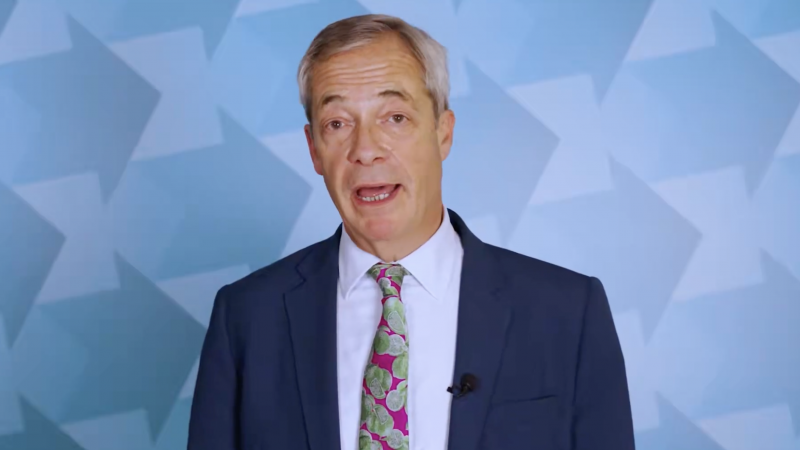
Sheer hypocrisy: After years of railing against Davos, Nigel Farage heads to Davos

Yesterday
Left Foot Forward

Farage is expected to attend the World Economic Forum at Davos for the first time, as he tries to portray himself as a statesman and increase his standing on the world stage.


Nigel Farage has made a career out of bashing what he sees as ‘global elites’ and ‘globalists’, and yet this year the self-proclaimed anti-establishment figurehead will himself be attending Davos.

Farage is expected to attend the World Economic Forum at Davos for the first time, as he tries to portray himself as a statesman and increase his standing on the world stage.

According to Reform’s Deputy Leader Richard Tice, Farage is hoping to meet US President Donald Trump so that he can express his worries over the US threatening tariffs against the UK and other European nations as part of efforts to annex Greenland.

Tice told the BBC: “Let’s hope they have an opportunity to have some words; both will have very busy schedules for sure, but in a sense that’s where real friendship can come in, to say: ‘Look, we understand what you’re trying to achieve; this is the wrong way to go about it.”

The Guardian reports that Farage has in the past taken particular aim at the World Economic Forum ‘epitomising what he sees as the elite capture of politics by a class intent on obliterating nation states in the name of “globalism”.

It adds: “Farage’s rhetoric on such subjects has in the past prompted criticism from groups including the Board of Deputies of British Jews, who said his discussion of supposed plots by bankers to create a global government at times veered into territory associated with antisemitic conspiracy theories.”

Basit Mahmood is editor of Left Foot Forward


Putin's envoy to crash Davos amid Trump-Zelenskyy deal talks


Copyright AP Photo
Published on 19/01/2026 - EURONEWS

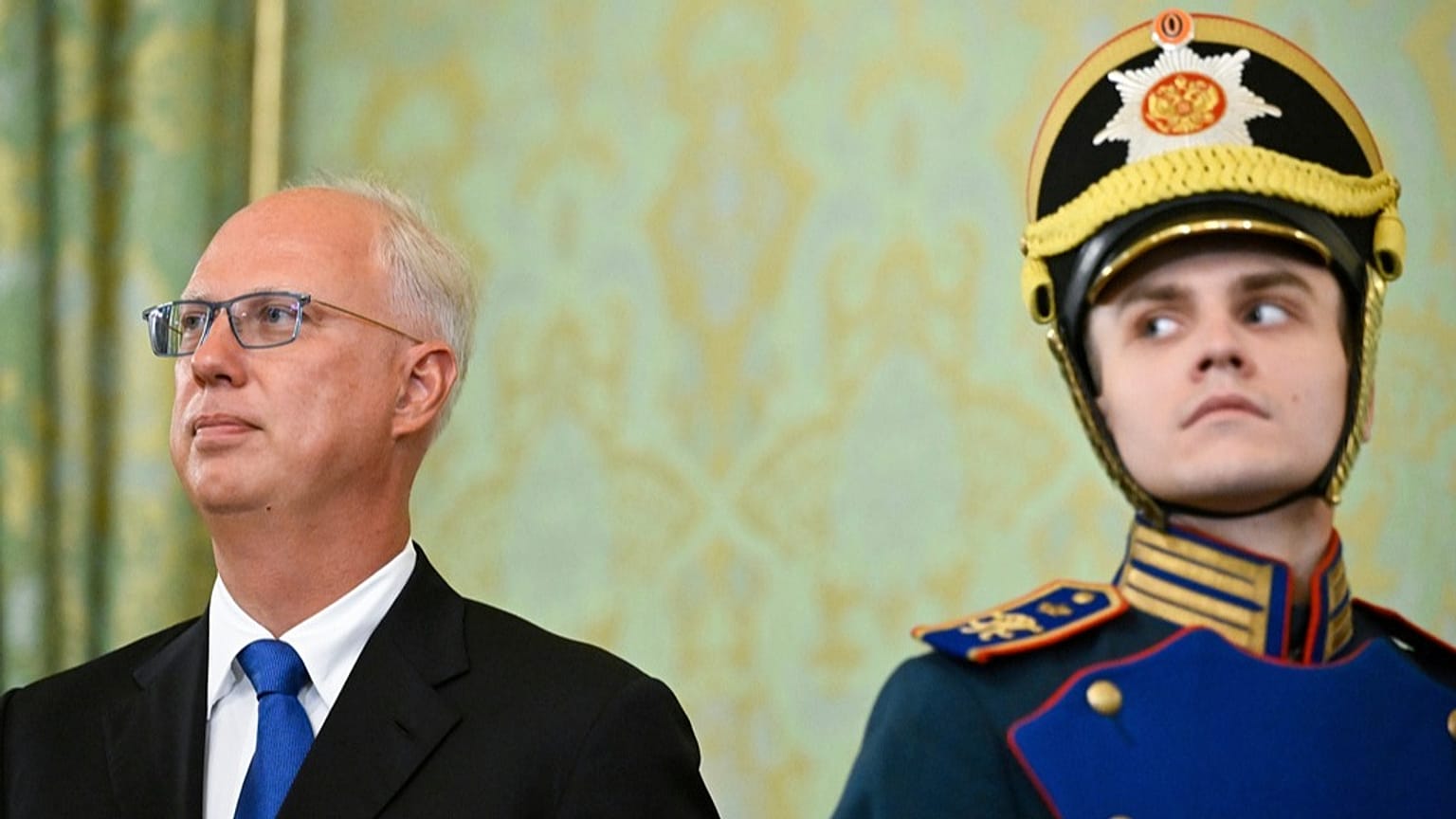
The Kremlin's top negotiator and Putin's confidant Kirill Dmitriev is to meet Trump team at Davos this week, casting doubt on the anticipated US-Ukraine agreement.


As the world’s political and business elites descend on Davos to try and provide answers to the world’s most burning issues under the slogan “The Spirit of Dialogue,” one envoy set to crash the summit might bring that lofty goal into question.

After the first rumours emerged around lunchtime, sources confirmed that Vladimir Putin’s special envoy Kirill Dmitriev will be in Davos to meet members of the delegation led by US President Donald Trump.

Trump is set to make a much-anticipated appearance at the Swiss Alps resort town on Wednesday to hold a special speech at the summit.

Ukrainian President Volodymyr Zelenskyy, who will also appear in person at Davos, is expected to meet with Trump while there to sign new security guarantees for a potential ceasefire deal with Russia, intended to deter the Kremlin from further acts of aggression against Ukraine.

Moscow’s sudden announcement that Dmitriev is or will shortly be on his way has now brought that into question, and Putin’s man’s presence could signal an attempt by the Kremlin to derail that agreement by showing up first.

Dmitriev’s trip is even more surprising given that the WEF froze its formal ties with Russian entities and persons in March 2022 and has not invited Russian officials or businesses to the annual Davos meetings since.


The announcement, however, fits into Moscow’s approach to US-led talks to end Russia’s ongoing all-out war in Ukraine, which is now a month away from its four-year mark.

While Trump has become increasingly eager to have Moscow and Kyiv reach a deal, Russia has continued to push for its maximalist demands while blaming Ukraine for stalled progress.

Last month, the Kremlin accused Kyiv of launching a swarm of drones against Putin’s residence in Krasnodar without providing concrete evidence.

Ukraine dismissed the accusations as “lies,” while the US said – after some deliberation and a personal call from Putin to Trump to complain of the barrage on his dacha – that there was no proof of the attack.

Meanwhile, as CEO of the Russian Direct Investment Fund (RDIF) and part of Putin’s trusted inner circle, Dmitriev has played a key role in trying to sway Washington to see things from Moscow’s perspective.


An ever-present face in US-Russia talks

Kyiv-born and US-educated, Dmitriev has been a key figure in the Kremlin's outreach to Washington and the point of contact with Trump's envoy and main negotiator Steve Witkoff.

He also participated in the Trump-Putin summit in Alaska in August.

According to media reports, Dmitriev was the mastermind behind a 28-point plan to put an end to Russia’s invasion of Ukraine, which was largely seen as Kyiv’s capitulation.

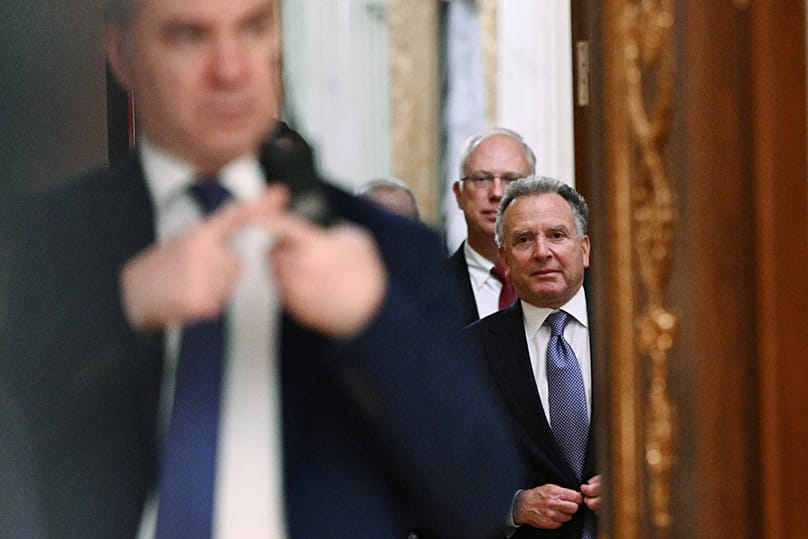
 US special envoy Steve Witkoff and Russia's top negotiator Kirill Dmitriev arrive to attend the talks with Vladimir Putin at the Kremlin, 2 December 2025 AP Photo

The reports suggested Washington representatives had been talking secretly to the Russians about a renewed effort to bring the invasion to an end, which involved Ukraine ceding land it still controls to Russia.

When the 28-point plan was leaked to the media, Witkoff commented on the story on X, "He must have got this from K..." seemingly in error instead of sending a private message. "K" likely stands for Kirill Dmitriev.

The document's content, specifically its language, raised further doubts about its origin, with reports claiming it may have been written in Russian and later translated into English.

Euronews reviewed the leaked plan in both languages and found that the wording and syntax of specific phrases, while common in Russian, do not directly translate into English, suggesting that at least some parts may have been translated from Russian using automatic translation tools.

Witkoff has repeatedly said Washington's goal was to “narrow the issues, bring the parties together, and stop the killing."

"That’s the game plan. And that’s what we’re all there to do," he said in an interview in March 2025.


TRUMPIAN EVIL EYED EAGLE
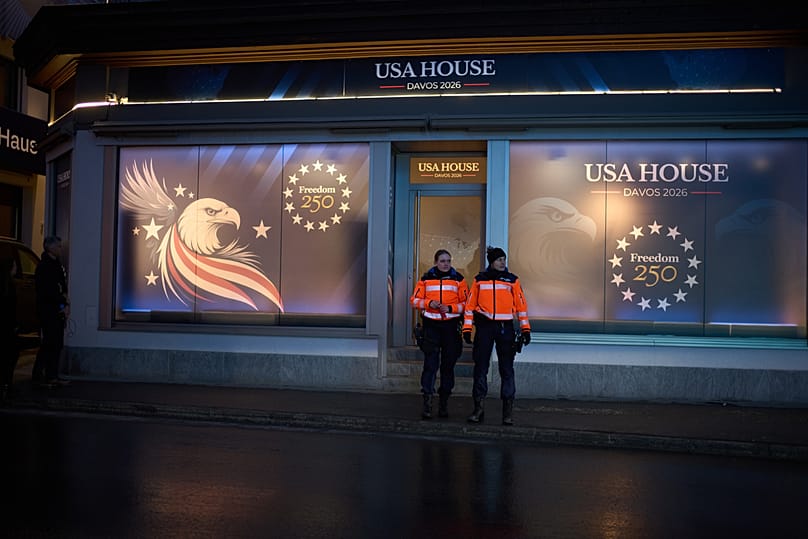
Police officers guard in front of a branch office of the USA House at the eve of the start of the Annual Meeting of the World Economy Forum in Davos, 18 January 2026 AP Photo

Witkoff is expected in Davos this week as part of Trump’s massive entourage – set to be the biggest US delegation in the summit’s history – with top officials such as US Secretary of State Marco Rubio and real estate investor and Trump’s son-in-law Jared Kushner also on the list of attendees.

While the White House said no bilateral meetings have been scheduled, the presence of Witkoff and Kushner — seen as key to any negotiations with Moscow and Kyiv — is what tipped off insiders that a deal between Trump and Zelenskyy will be signed in Davos.

In Davos, Dmitriev will reportedly meet with both Witkoff and Kushner.
'Tectonic shift' against 'ideological tyranny'

Dmitriev is no stranger to the WEF, having been named a Young Global Leader in 2010.

Speaking to CNBC at Davos in 2019 – during Trump’s first term as president – Dmitriev slammed American sanctions against Russia, calling them “wrong, because they really undermine US long term.”

“It is really undermining its own long-term fundamentals … things that held the world together, such as dollar, fair trade practices, and fairness,” he said.

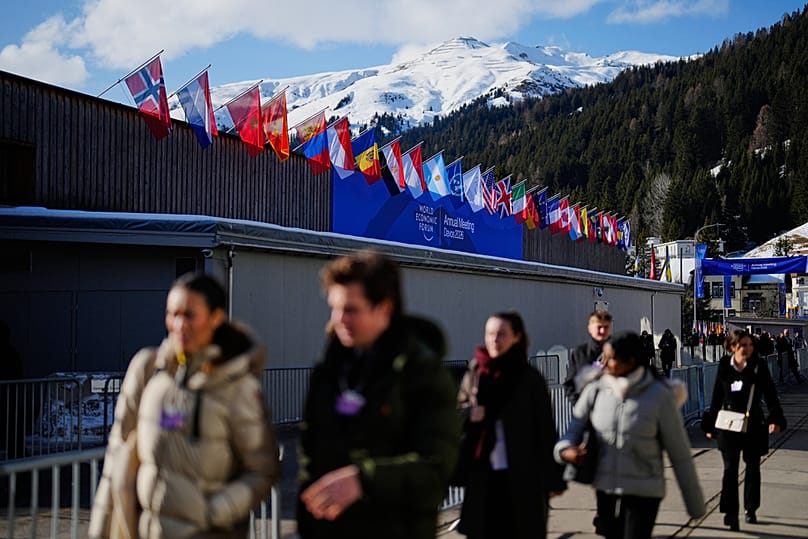
People walk at the Promenade in front of the Congress Center where the Annual Meeting of the World Economy Forum take place in Davos, 19 January 2026 AP Photo

Washington and Brussels imposed sanctions against Russia after a series of malign moves by the Kremlin, including the initial invasion of Ukraine and the annexation of Crimea, the novichok nerve agent poisoning of ex-intelligence officer Sergei Skripal and his daughter in Salisbury, and Moscow’s meddling in the 2016 US presidential election.

While the EU never imposed sanctions on Dmitriev or his fund, he has been subject to US sanctions after the US Treasury Department designated him a “close associate of Putin” following Russia’s full-scale invasion of Ukraine.

Ever since Trump returned to office for his second term, Dmitriev has been waxing lyrical about the US president, stating in a post on X in December 2025 that "the truth is that World War III was, is, and will be prevented thanks to President Trump and his team.”

Earlier last year, Dmitriev said Trump was presiding over a “tectonic shift” meant to dismantle “ideological tyranny” plaguing the West.

Putin’s top envoy also had the US sanctions temporarily lifted in April 2025, allowing him to enter the country as the first Russian official since Moscow’s all-out war to visit Washington, where he met Witkoff.

Moscow excited over Greenland discord

Meanwhile, one of the main causes of anxiety in Europe over Trump’s Wednesday speech at Davos hinges on what the US president will say as he continues to raise the stakes in his bid to take control of Greenland.

The increasingly tense exchange between Europe and the US has slowly grown into a feud that Russian officials openly welcomed – Dmitriev included.

Dmitriev has openly supported Trump’s plans and mocked the European leaders, specifically targeting German Finance Minister Lars Klingbeil, sarcastically dubbing him “Rambo”.

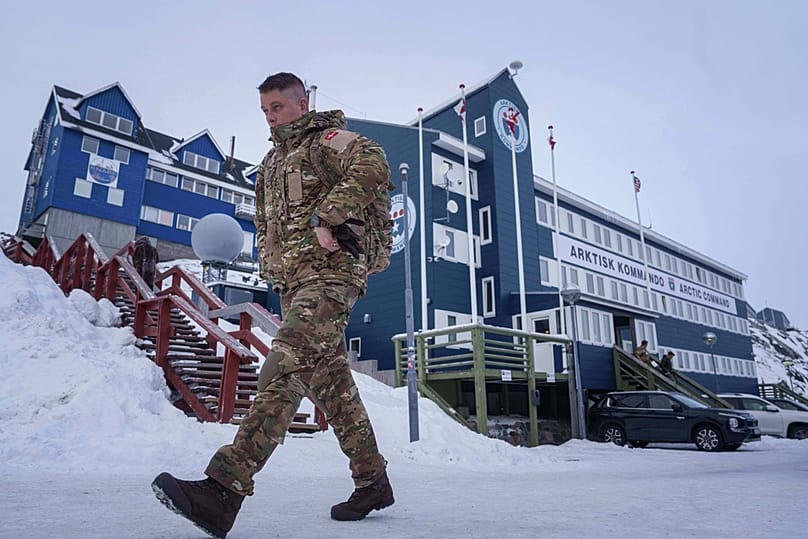
A Danish serviceman walks in front of Joint Arctic Command center in Nuuk, 16 January 2026 AP Photo

He also suggested that further friction over the Arctic island, which is part of the Kingdom of Denmark, would be favourable for Moscow.

“Europe will cave in, US will get Greenland, transatlantic unity may be somewhat restored,” Dmitriev said.

Last Friday, Moscow called Trump’s plans over Greenland “extraordinary,” adding that “it would continue monitoring the situation”.

“The situation is unusual, I would even say extraordinary from the standpoint of international law,” Kremlin spokesman Dmitry Peskov said, amid Russia’s full-scale invasion of Ukraine approaching four-years mark in February.