‘Are Readers Meant to Take This Seriously?’: Economist Refutes Latest Attack on Wealth Tax by Bezos’ Washington Post
“Local hospitals and emergency rooms could shut their doors forever because billionaires insist on paying less than the rest of us,” said Emmanuel Saez, the French economist who designed California’s wealth tax proposal.
“Local hospitals and emergency rooms could shut their doors forever because billionaires insist on paying less than the rest of us,” said Emmanuel Saez, the French economist who designed California’s wealth tax proposal.
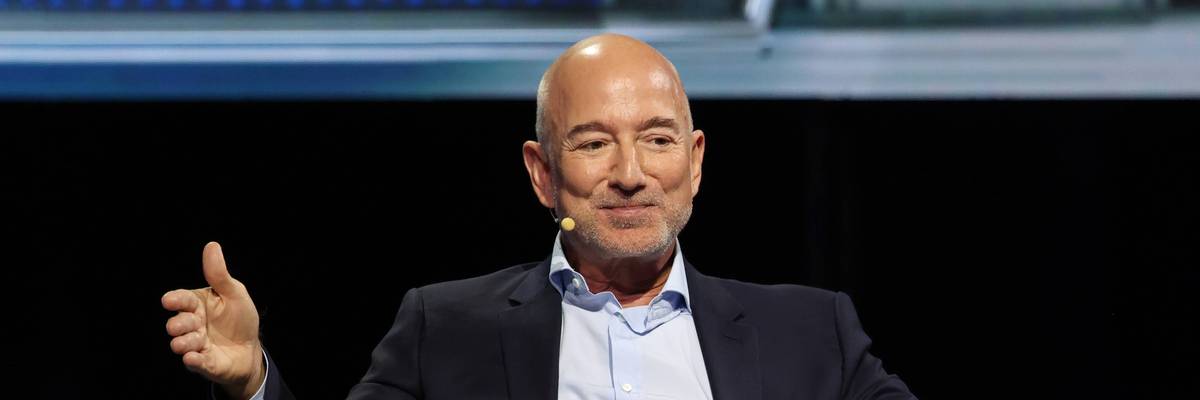
Jeff Bezos, founder and executive chairman of Amazon, speaks onstage during day 2 of the America Business Forum at Kaseya Center on November 6, 2025, in Miami.
(Photo by Alexander Tamargo/Getty Images for America Business Forum)
Stephen Prager
May 07, 2026
COMMON DREAMS
The architect of California’s wealth tax proposal called out The Washington Post and its multibillionaire owner, Amazon founder Jeff Bezos, on Thursday for peddling what he said is “misinformation” to readers.
Emmanuel Saez, a French economist and professor at the University of California, Berkeley, who was tapped by California’s largest union to design the tax proposal, singled out an opinion piece by the Washington Post editorial board from earlier this week that argues the proposal would backfire and cost California billions of dollars in tax revenue each year.
Saez said the article contains glaring falsehoods and omits key information about the proposal, which aims to create a one-time tax of 5% on the total assets of California’s roughly 200 billionaire residents in order to recoup about $100 billion in revenue for healthcare, food assistance, and education stripped from the state by last year’s Republican federal budget legislation, which will hand $1 trillion in tax breaks to the wealthiest 1% of Americans over the next 10 years.
The piece, published on Monday with the headline “California already losing with billionaire tax referendum,” argues that even if California voters don’t ultimately approve the measure, “the specter of such a wealth tax has already cost the state more in lost future revenue from income taxes than it would raise” due to an exodus of wealthy people from the state—an oft-used but weakly substantiated talking point by opponents of the measure.
The Post cited a paper by Jared Walczak, a visiting fellow at the California Tax Foundation, which it said demonstrates that billionaire flight “will cost California’s state government somewhere between $3.5 billion and $4.5 billion every year in other tax collections, and up to $19 billion in lost [gross domestic product].”
But Saez argued that his study makes a “basic mistake” by “modeling a mobility response of billionaires to a permanent annual and recurrent 5% wealth tax.” In reality, though, the tax would be imposed only once and would apply to any billionaires who resided in the state after January 1, 2026, which has already passed, so it no longer creates an incentive to move.
Saez argued that in any case, “Walczak’s estimation of the California income tax paid by billionaires who have threatened to leave is also wildly exaggerated.”
Walczak’s figure for lost tax revenue, he said, hinges on the idea that the three richest men who’ve threatened to leave the state, Google co-founders Sergey Brin and Larry Page, and Meta CEO Mark Zuckerberg, pay $1.7 billion in California income taxes each year.
“If only they paid so much!” Saez quipped.
“In reality, using Securities and Exchange Commission data on stock sales, stock donations, dividends, and executive compensation, we can directly estimate that they paid only [$269 million] in California income tax in 2025, 6.3 times less than Walczak’s assumption,” he said, citing a paper he co-wrote in March responding to a similar argument by a conservative think tank.
He cited tax data showing that the tech tycoons—who own a combined $810 billion according to Forbes—only collectively paid about [$22 million] per year on average between 2019-25, with Brin and Page paying no taxes on their wealth from stock in Google’s parent company Alphabet during three of those years because they didn’t sell stock, get dividends, or receive executive compensation. This is despite 90% of their wealth coming from those holdings.
“The one-time wealth tax finally makes them contribute in proportion to their enormous wealth gains,” Saez said.
The Post also claimed that the Service Employees International Union (SEIU) United Healthcare Workers West, the union leading the charge in support of the referendum, is “pretend[ing] that the tax is needed to save California’s health system from ‘collapse’” and is instead dishonestly using that framing to covertly pursue the “redistribution of wealth.”
But Saez said that the federal cuts of roughly $20 billion annually are already having devastating effects on Californians that could be alleviated with more tax revenue.
As a result of the cuts, “more than 400 California hospitals have already laid off more than 3,400 healthcare workers as of mid-March, with a second wave of layoffs expected as funding cuts tied to recent federal policy changes are phased in over the next several years,” he said. “Statewide, projections show the cuts could result in the loss of up to 145,000 healthcare jobs, impacting hospitals, clinics, and home care providers alike.”
Eighty-three more hospitals in California may be at risk of closing due to the federal funding cuts, according to a recent nationwide analysis by Public Citizen. But Saez said the billionaire’s tax would go a long way toward closing the gap.
“Right now, California’s billionaires pay much lower tax rates than what working families pay out of every paycheck,” Saez said.
Despite claims otherwise by the Post editorial board—which last month ran another piece arguing that due to progressive taxation, “the rich already pay more than their fair share”—according to the Institute on Taxation and Economic Policy, at all levels of government from 2018-20, billionaires paid just 24% of their total income in taxes, while the US-wide average was 30%. This disparity arises largely due to loopholes that allow the rich to avoid taxes on business and investment gains that are not sold.
“Local hospitals and emergency rooms could shut their doors forever because billionaires insist on paying less than the rest of us,” Saez said.
Debru Carthan, the executive vice president of SEIU-United Healthcare Workers West, said it was not surprising that the Post “completely ignores that the billionaire tax would keep hospitals from closing and healthcare costs from skyrocketing for millions of Californians” because it is “a crisis that comes as a direct result of the tax breaks handed out to Jeff Bezos and his buddies.”
Since the return of Donald Trump to the presidency, the Amazon founder has taken a much heavier hand over the content of his flagship paper, including its opinion section, which he last year mandated to exclusively publish pieces on economics that promote “personal liberties and free markets,” leading to the resignation of opinion editor David Shipley.
But Saez marveled at how blatant Bezos’ thumb on the scale has appeared in his paper’s coverage of California’s billionaire wealth tax and similar proposals, which it has denounced on several other occasions.
“Are readers meant to take this seriously?” Saez asked. “'Board of billionaire-owned paper comes out against tax on billionaires’? Everyone knows this board makes political decisions at the behest of Jeff Bezos, but this one is the most transparent of them all.”
A billionaire just accidentally delivered the most compelling argument for a wealth tax
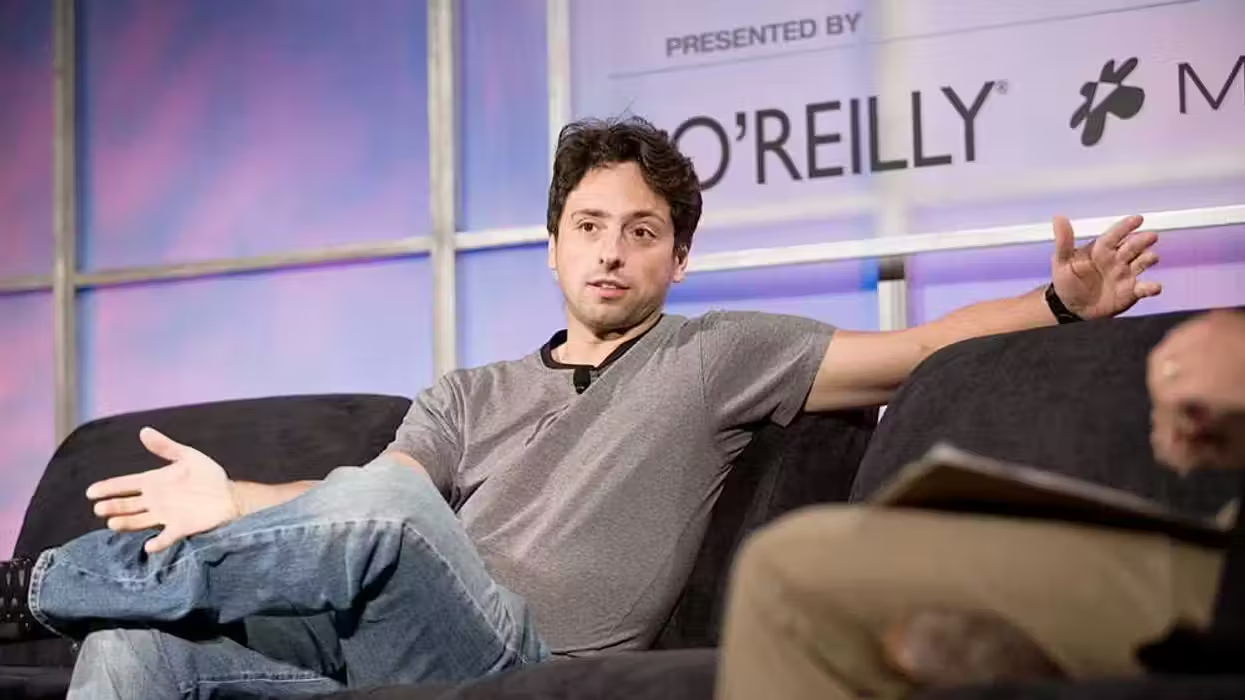
By James Duncan Davidson/O'Reilly Media, Inc. - BY 2.0,
May 06, 2026
ALTERNET
Google co-founder Sergey Brin, one of the three or four wealthiest people in the world, with a net worth hovering around $260 billion to $277 billion, is devoting some of his wealth to fighting California’s wealth tax on billionaires.
So far, he’s spent $57 million trying to defeat the measure.
Brin’s actions — along with Elon Musk’s $250 million “investment” in getting Trump reelected in 2024 — should be Exhibits A and B in why America needs a wealth tax.
First, let’s stipulate that there is nothing inherently wrong about being a billionaire, a multibillionaire, or even, as Musk is likely to become, a trillionaire.
Wealth isn’t a “zero-sum” game in which these vast accumulations at the top depend on the rest of us losing an equal amount. In fact, the super-wealthy may help the rest of us do somewhat better than we were doing before.
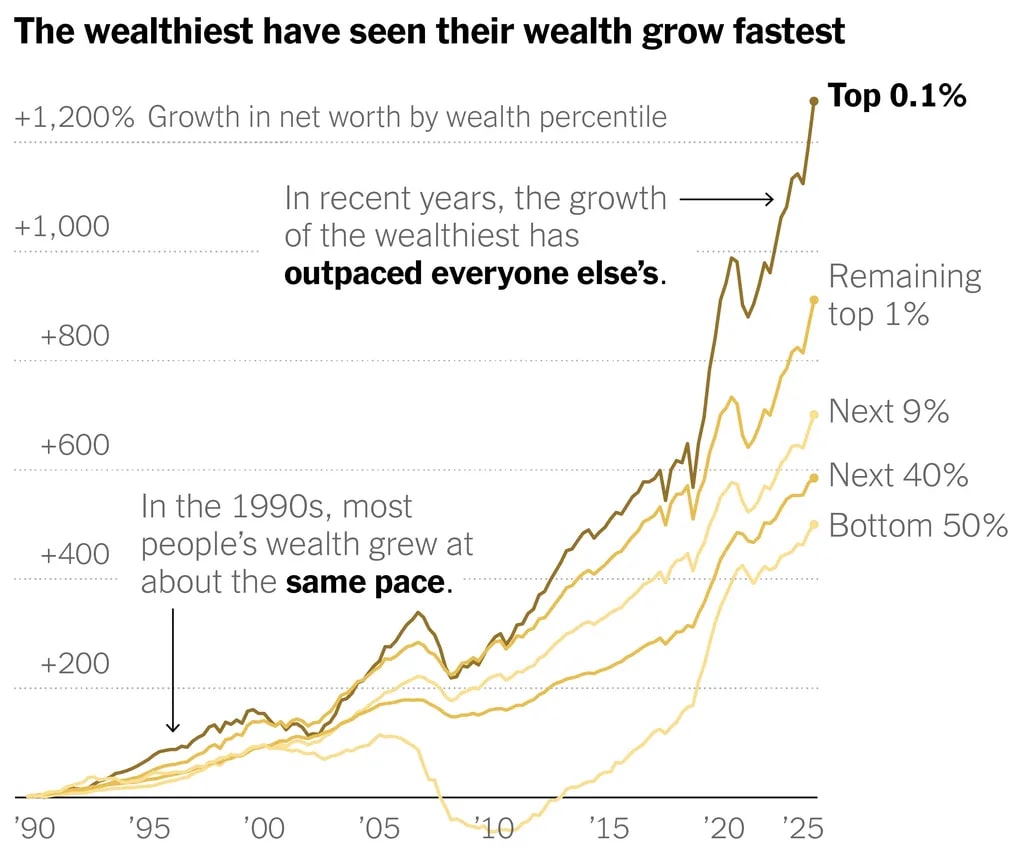
Even though the wealth of the top 0.1 percent has soared in recent years, the bottom 50 percent are doing somewhat better than before. (See chart here.)
But wait.
The problem is that political power is a zero-sum game. The more political power is concentrated in a few hands, the less political power in everyone else’s hands.
It’s almost impossible to separate wealth from power, because the wealthy turn their fortunes into campaign contributions to politicians who will change laws to their liking and stop laws they’d detest — such as higher taxes on the super-wealthy. The wealthy also finance public relations campaigns and think-tanks to persuade the public of the wisdom of their positions.
Billionaire spending on presidential elections has soared even faster than billionaire wealth. And if you believe they’re donating because they want people with great integrity and excellent character to be elected president, consider that most billionaire political spending in 2024 went to Trump.
They’re donating because they want to protect and enlarge their fortunes and don’t want politicians elected who support higher taxes on them.
Nor do they want politicians elected who support stricter anti-monopoly legislation or who would make it easier to form labor unions or stop climate change (all of which might reduce the profits of, say, Google).
Take Sergey Brin and his $57 million against California’s tax on billionaires — which, not incidentally, was proposed because California must now pay more for Medicaid for lower-income Californians, because Trump and his Republican lackeys enacted a giant federal tax cut whose benefits have gone mostly to the wealthy.
Brin has become a major Republican donor. Last May, he donated nearly half a million dollars to the Republican National Committee.
Why? Because the Republican Party is more dedicated to protecting and enlarging the wealth of the super-wealthy than is the Democratic Party.
By spending his fortune trying to stop California from taxing billionaires, Brin is illustrating why we need to tax billionaires. He’s making the argument for a billionaire wealth tax more clearly and articulately than anyone else possibly could.
Thank you, Serge.
Robert Reich is a professor of public policy at Berkeley and former secretary of labor. His writings can be found at https://robertreich.substack.com/.
Google co-founder Sergey Brin, one of the three or four wealthiest people in the world, with a net worth hovering around $260 billion to $277 billion, is devoting some of his wealth to fighting California’s wealth tax on billionaires.
So far, he’s spent $57 million trying to defeat the measure.
Brin’s actions — along with Elon Musk’s $250 million “investment” in getting Trump reelected in 2024 — should be Exhibits A and B in why America needs a wealth tax.
First, let’s stipulate that there is nothing inherently wrong about being a billionaire, a multibillionaire, or even, as Musk is likely to become, a trillionaire.
Wealth isn’t a “zero-sum” game in which these vast accumulations at the top depend on the rest of us losing an equal amount. In fact, the super-wealthy may help the rest of us do somewhat better than we were doing before.
Even though the wealth of the top 0.1 percent has soared in recent years, the bottom 50 percent are doing somewhat better than before. (See chart here.)
But wait.
The problem is that political power is a zero-sum game. The more political power is concentrated in a few hands, the less political power in everyone else’s hands.
It’s almost impossible to separate wealth from power, because the wealthy turn their fortunes into campaign contributions to politicians who will change laws to their liking and stop laws they’d detest — such as higher taxes on the super-wealthy. The wealthy also finance public relations campaigns and think-tanks to persuade the public of the wisdom of their positions.
Billionaire spending on presidential elections has soared even faster than billionaire wealth. And if you believe they’re donating because they want people with great integrity and excellent character to be elected president, consider that most billionaire political spending in 2024 went to Trump.
They’re donating because they want to protect and enlarge their fortunes and don’t want politicians elected who support higher taxes on them.
Nor do they want politicians elected who support stricter anti-monopoly legislation or who would make it easier to form labor unions or stop climate change (all of which might reduce the profits of, say, Google).
Take Sergey Brin and his $57 million against California’s tax on billionaires — which, not incidentally, was proposed because California must now pay more for Medicaid for lower-income Californians, because Trump and his Republican lackeys enacted a giant federal tax cut whose benefits have gone mostly to the wealthy.
Brin has become a major Republican donor. Last May, he donated nearly half a million dollars to the Republican National Committee.
Why? Because the Republican Party is more dedicated to protecting and enlarging the wealth of the super-wealthy than is the Democratic Party.
By spending his fortune trying to stop California from taxing billionaires, Brin is illustrating why we need to tax billionaires. He’s making the argument for a billionaire wealth tax more clearly and articulately than anyone else possibly could.
Thank you, Serge.
Robert Reich is a professor of public policy at Berkeley and former secretary of labor. His writings can be found at https://robertreich.substack.com/.


No comments:
Post a Comment