Sunday, February 15, 2026

Is a Mass Revolt Against Technocracy* Starting to Happen?

Will there be a popular uprising against AI and the vast AI-based robotic machinery that’s taking over both the means of production and the means of information?


Flames engulf an autonomous Waymo vehicle during an anti-ICE protest in downtown Los Angeles, California, on June 8, 2025.
(Photo by Benjamin Hanson / Middle East Images via AFP)

Tom Valovic
Feb 14, 2026
Common Dreams


Ted Gioia has a popular Substack called “The Honest Broker.” Although, as an author, his books tend to focus on music and popular culture, he writes eloquently about a wide range of topics and offers insightful commentary about the global forced march toward technocratic lifestyle and governance that we’re now immersed in. In one posting, “25 Propositions about the New Romanticism,” Gioia posits that there is a new movement afoot mimicking (or, better, reflecting) the Romantic Period of the 18th century. This movement coincided with the first industrial revolution and, as a counterweight to that trend, saw a great shift toward impulses to re-enchant the world via poetry, art, and music, and reconnecting to nature. Gioia writes:

More than two years ago, I predicted the rise of a New Romanticism—a movement to counter the intense rationalization and expanding technological control of society. Rationalist and algorithmic models were dominating every sphere of life at that midpoint in the Industrial Revolution—and people started resisting the forces of progress. Companies grew more powerful, promising productivity and prosperity. But Blake called them “dark Satanic mills” and Luddites started burning down factories—a drastic and futile step, almost the equivalent of throwing away your smartphone. Even as science and technology produced amazing results, dysfunctional behaviors sprang up everywhere. The pathbreaking literary works from the late 1700s reveal the dark side of the pervasive techno-optimism—Goethe’s novel about Werther’s suicide, the Marquis de Sade’s nasty stories, and all those gloomy Gothic novels. What happened to the Enlightenment? As the new century dawned, the creative class (as we would call it today) increasingly attacked rationalist currents that had somehow morphed into violent, intrusive forces in their lives—an 180° shift in the culture. For Blake and others, the name Newton became a term of abuse. Artists, especially poets and musicians, took the lead in this revolt. They celebrated human feeling and emotional attachments—embracing them as more trustworthy, more flexible, more desirable than technology, profits, and cold calculation.

He goes on to posit that we’re poised for a return to that modality and points out that the notion of a New Romanticism has spread “like a wildfire,” citing influencers such as Ross Barkan, Santiago Ramos, and Kate Alexandra. Gioia sees what he describes as cultural trends at the leading edge of this transformation citing popular TV series such as Pluribus and Yellowstone. But is this really happening or has Gioia just stumbled on a pocket of cultural resistance and pushback against technocracy that’s primarily a pocket of unified self-expression rather than something representing deep and substantive cultural and societal change?

The Technocratic Takeover: Alive and Well

Let’s be clear about what’s happening here: robots and AI are taking over our culture, our politics, our way of life, and our relationships to each other as social beings. They’re becoming the advance guard for a new and unprecedented technocratic form of governance—the apotheosis of Western scientific materialism. Further, these new forms of governance are being carried out by unelected Big Tech overlords operating behind the scenes and in the backrooms of a mediated society well out of public view.

The tech takeover is such a massive appropriation of our social, political, and cultural life—and indeed our own biological substrate—that stoic acceptance might not be the way to go this time around.

I certainly hope that Gioia is right about a major cultural rejection of technocracy. There are indeed hopeful signs. The fundamental human values that make societies work and cohere have gotten steadily shunted aside by the technocracy takeover of culture and education—essentially becoming a new value system. This behind-the-scenes power shift has been amplified and compounded by an over-emphasis in education on STEM, corporate modalities, neo-Darwinian utilitarianism, and the continuing erosion of the humanities that began decades ago. So yes, without a doubt, we need to get “back to the garden” and return to a wider and deeper set of the kind of core values that ultimately hold societies together. Without positive shared values, societies become rudderless and fall into a kind of benighted chaos. All we need to do is look around.

All of that said, in his Substack post, Gioia missed an important component of this transition—if indeed it is coming to pass (and we can only hope). Throwing off technocracy and emerging from our involuntary digital cages also means reconnecting with the natural world, a fundamental human relationship that’s now increasingly mediated by digital devices. The need for this reconnection, this existential about-face, was a key aspect of the romanticism of the 18th century. In literature, for example, the Romantic poets were rather obsessed with it as poet Robert Bly points out in his stellar book News of the Universe (I highly recommend it.) In allowing our daily life to be shifted into an increasingly claustrophobic and self-reinforcing digital cage, we have abandoned not only our connection to the natural world but also to each other. Connecting to nature also lets us tap into the mystery of the universe, which despite human folly remains nonetheless fully intact even if absurdly rationalized by scientific reductionism. Carl Sagan and Albert Einstein were both scientists who could appreciate this. We need more like them.


The Robot Wars: No Longer Sci-Fi


In the 80s and 90s, science fiction movies and literature commonly offered themes of “robot wars” where humans were pitted against the dominance of an ugly dystopian society. Will this be our future courtesy of Elon Musk and his cohorts? Or, alternatively, will there be a mass uprising against AI and the vast AI-based robotic machinery that’s taking over both the means of production and the means of information? We humans are known for our adaptability and stoicism in difficult situations such as world wars and major disasters. That stoicism and sense of “accepting what can’t be changed” seems to be part of our psychological and perhaps even biological makeup. But the tech takeover is such a massive appropriation of our social, political, and cultural life—and indeed our own biological substrate—that stoic acceptance might not be the way to go this time around.

In the next few years, it most certainly will have finally dawned on the mass of humanity, especially in advanced Western nations, that something is badly amiss. Many will realize at a visceral level that their everyday lives are trapped in a claustrophobia-inducing closed-circuit technocratic system and control grid that robs them of autonomy and freedom while purporting to do the opposite.

I totally agree that a new romanticism is a very necessary sea change at this strange time in human history but am perhaps a bit less optimistic that it will happen—at least over the next few years. The forces of technocracy seem too powerful at the moment to be countered because so many of the necessities of everyday life depend on our attachment to this digital realm. This includes paying bills, financial maintenance, government-related necessities such as getting a license renewed, and so much more. Further, technological dependency keeps getting ratcheted up by the self-appointed masters of the universe represented by Big Tech’s unchallenged and ever-growing power. That said, I sincerely hope I’m wrong about this and Gioia is right. Time will tell.


Our work is licensed under Creative Commons (CC BY-NC-ND 3.0). Feel free to republish and share widely.


Tom Valovic
Tom Valovic is a writer, editor, futurist, and the author of Digital Mythologies (Rutgers University Press), a series of essays that explored emerging social and cultural issues raised by the advent of the Internet. He has served as a consultant to the former Congressional Office of Technology Assessment and was editor-in- chief of Telecommunications magazine for many years. Tom has written about the effects of technology on society for a variety of publications including Common Dreams, Counterpunch, The Technoskeptic, the Boston Globe, the San Francisco Examiner, Columbia University’s Media Studies Journal, and others. He can be reached at jazzbird@outlook.com.
Full Bio >


* WHAT TECHNOCRACY REALLY IS
As Amazon Ditches Flock, Protesters Call On It to Go Further and ‘Dump’ ICE

“Amazon knows that we know now that they are facilitating and profiting from the rise of a supercharged surveillance state that does not respect human rights or the rule of law, and it must end,” one participant said.


Protesters call on Amazon to stop providing web services to federal immigration agencies in Seattle, Washington on February 13, 2025.
(Photo by Evan Sutton)

Olivia Rosane
Feb 13, 2026
COMMON DREAMS

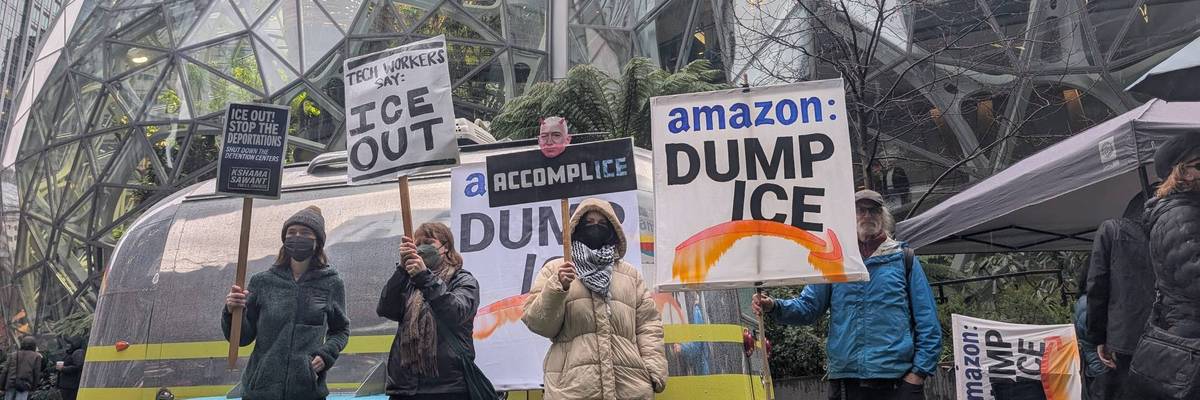
As backlash against Big Tech’s complicity with President Donald Trump’s authoritarian agenda grows, 200 to 250 people gathered on a rainy Seattle afternoon outside Amazon’s headquarters on Friday to demand that the company “dump” its support for Immigration and Customs Enforcement and Customs and Border Protection, which they illustrated by dumping ice onto the grass.

The protest came one day after Amazon-owned Ring announced it would cut ties with law-enforcement tech company Flock Safety, a move that followed public backlash after a Super Bowl ad showcased a “Search Party” feature that activates a network of Ring cameras and uses artificial intelligence for neighborhood surveillance. Ending the partnership with Flock had originally been one of the Seattle protesters’ three demands.

“Our third demand has already been met—which shows that these companies are waking up to how appalled regular people are about the dystopia they’re creating for us,” organizer Emily Johnston said in a statement.

Johnston said the backlash, as well as nationwide protests against Target’s complicity with ICE and an open letter from Google employees calling on that company to disclose and divest from its dealings with ICE and CBP, meant “it’s clear that we have momentum.”

“We want them to see that partnering with Palantir was a mistake and hosting ICE and CBP on Amazon Web Services was a mistake.”

“No one wants surveillance and state violence except those who are profiting from it—and Amazon’s thriving depends on both its workers and customers,” Johnston continued. “We have leverage, and we’re going to use it.”

The protesters on Friday called on Amazon to go further by stopping to host ICE and CBP on Amazon Web Services and ending its partnership with Palantir that also facilitates deportations and surveillance.

“Corporations for years have not only been complicit, but active beneficiaries of the tax money needlessly spent to tear apart immigrant families and communities,” Guadalupe of participating group La Resistencia said in a statement. “Tech plays a bigger role today more than ever in empowering ICE surveillance and its apparatuses of control.”

Eliza Pan, the co-founder of Amazon Employees for Climate Justice (AECJ), told the crowd that Ring dropping the Flock contract was “a big victory for every single person here.”

“We’re adding to that pressure by being here together,” she said. “Amazon knew about this rally, and knows that this is the first of many if they do not end these other partnerships. Amazon knows that we know now that they are facilitating and profiting from the rise of a supercharged surveillance state that does not respect human rights or the rule of law, and it must end.”

The Ring ad featured at the Super Bowl did not mention Flock and showed the Search Party feature being used to find lost dogs, yet viewers and advocates could easily imagine the technology being used in more invasive ways.

“The addition of AI-driven biometric identification is the latest entry in the company’s history of profiting off of public safety worries and disregard for individual privacy, one that turbocharges the extreme dangers of allowing this to carry on,” Beryl Lipton of the Electronic Frontier Foundation said in response to the ad. “People need to reject this kind of disingenuous framing and recognize the potential end result: a scary overreach of the surveillance state designed to catch us all in its net.”

The widely negative response told Amazon that partnering with Flock “was a mistake,” protest organizer Evan Sutton told Common Dreams.

“We want them to see that partnering with Palantir was a mistake and hosting ICE and CBP on Amazon Web Services was a mistake,” he said.

The protest was organized by local tech worker, immigrant justice, and other activist groups including AECJ, No Tech for Apartheid, Defend Immigrants Alliance, La Resistencia, Troublemakers, Washington for All, Seattle Indivisible, Seattle DSA, 350 Seattle, and Southend Indivisible.

The protesters gathered for about an hour to listen to six speakers, including progressive Seattle City Councilmember Alexis Mercedes Rinck. They distributed a flyer to Amazon employees and other passersby with a QR-code link for employees to connect with AECJ.

The demonstration reflects a growing frustration with the Trump-Tech alliance, both nationally and locally.

“We are seeing the American technocrats just full body hug the Trump administration right now, and in the case of Amazon, it’s a company that was born in Seattle, that has made Seattle home, that benefits from all the wonderful things about Seattle and is completely betraying Seattle values by profiting off of the industrial deportation complex and cuddling up to the Trump administration,” Sutton told Common Dreams.

He pointed out that on the night of the day that a CBP agent murdered Alex Pretti, Amazon CEO Andy Jassy attended a private White House premiere for the Melenia movie.

“We have a duty to let these companies know that we won’t stand for it,” he said.
Earth Hurtling Toward ‘Hothouse Trajectory,’ Scientists Warn in Tipping Points Analysis

“Existing climate mitigation approaches, including scaling up renewable energy and protecting carbon-storing ecosystems, are critical to limit the increase in global temperatures,” said the lead author.


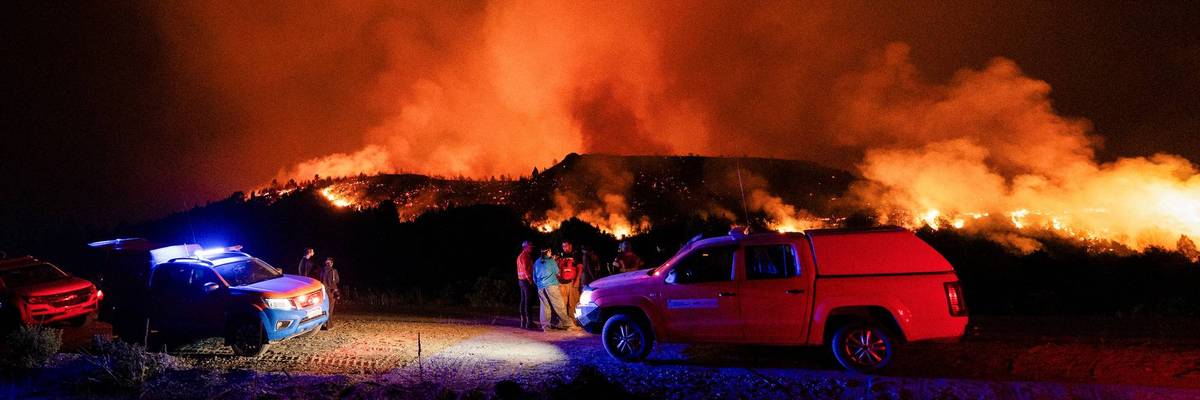
Volunteers and firefighters work to extinguish a forest fire burning in the Patagonian region of Chubut province, Argentina, on February 1, 2026.
(Photo by Gonzalo Keogan/AFP via Getty Images)

Jessica Corbett
Feb 12, 2026
COMMON DREAMS

In the lead-up to the Trump administration effectively destroying the US Environmental Protection Agency’s ability to combat the fossil fuel-driven climate emergency, an international team of scientists warned Wednesday that “Earth’s climate is now departing from the stable conditions that supported human civilization for millennia.”

Various institutions, including in the United States, have confirmed that 2025 was among the hottest years on record, and January continued that trend. Meanwhile, governments and polluting industries have repeatedly refused to impose policies that adequately heed experts’ calls for action.


Scientists Warn ‘Garbage’ Models Underestimate Risk of Economic Collapse From Climate Crisis


“In an effort to mitigate dangerous levels of warming, the Paris Agreement formalized the aim of limiting warming to 1.5°C above preindustrial levels, yet global temperatures have recently breached this limit for 12 consecutive months, coinciding with record-breaking heat, wildfires, floods, and other extremes,” the scientists noted Wednesday in the journal One Earth.

They wrote that “crossing critical temperature thresholds may trigger self-reinforcing feedbacks and tipping dynamics that amplify warming and destabilize distant Earth system components. Uncertain tipping thresholds make precaution essential, as crossing them could commit the planet to a hothouse trajectory with long-lasting and potentially irreversible consequences.”

A “hothouse trajectory,” they wrote, is “a pathway in which self-reinforcing feedbacks push the climate system past a point of no return, committing the planet to substantially higher long-term temperatures, even if emissions are later reduced.”

Sixteen major tipping elements have been identified, 10 of which could add to global temperature if triggered,” the experts detailed. “Tipping may already be underway or could occur soon for the Greenland and West Antarctic ice sheets, boreal permafrost, mountain glaciers, and parts of the Amazon rainforest.”

As an example, they pointed to ice melt in the Arctic, explaining that the resulting water “could perturb the Atlantic Meridional Overturning Circulation (AMOC), which is already showing signs of weakening. A weakened AMOC could alter global atmospheric circulation, shifting tropical rain belts and drying parts of the Amazon. This cascade of events could trigger large-scale Amazon forest dieback, with major consequences for the region’s carbon storage and biodiversity.”


The team of eight was led by William Ripple, who has previously emphasized alongside other experts that “we are on the brink of an irreversible climate disaster” and “fossil fuels—and the fossil fuel industry and its enablers—are driving a multitude of interlinked crises that jeopardize the breadth and stability of life on Earth.”

Ripple, distinguished professor of ecology at Oregon State University (OSU), said in a Wednesday statement that “after a million years of oscillating between ice ages separated by warmer periods, the Earth’s climate stabilized more than 11,000 years ago, enabling agriculture and complex societies.”

“We’re now moving away from that stability and could be entering a period of unprecedented climate change,” he stressed. “Existing climate mitigation approaches, including scaling up renewable energy and protecting carbon-storing ecosystems, are critical to limit the increase in global temperatures.”

Study co-author Christopher Wolf, a former OSU postdoctoral researcher who is now a scientist with Terrestrial Ecosystems Research Associates (TERA), noted that already, “climate model simulations suggest the recent 12-month breach indicates the long-term average temperature increase is at or near 1.5°C.”

“It’s likely that global temperatures are as warm as, or warmer than, at any point in the last 125,000 years and that climate change is advancing faster than many scientists predicted,” he said.

“Policymakers and the public remain largely unaware of the risks posed by what would effectively be a point-of-no-return transition,” Wolf added. “And while averting the hothouse trajectory won’t be easy, it’s much more achievable than trying to backtrack once we’re on it.”


The team’s warnings came in the wake of Big Oil-backed President Donald Trump claiming in a United Nations speech last year that climate change is “the greatest con job ever perpetrated on the world,” and ditching dozens of relevant organizations and treaties, including the Paris Agreement.

On Thursday, the Trump administration continued its war on the climate, revoking the “endangerment finding” that allowed the EPA to pass regulations fighting the global emergency—which was forcefully condemned by scientists and activists.

“In case there was any remaining doubt, the truth is very clear: Trump cares nothing for the health and well-being of our communities or our climate,” said Erin Doran, senior staff attorney at the advocacy group Food & Water Watch. “He is concerned only with making more money for the billionaire fossil fuel polluters that help to fund his dangerous political agenda.”

“The notion that the EPA shouldn’t regulate climate emissions is inconsistent with the law, the science, and the realities of the climate crisis,” Doran added. “EPA is charged with protecting human health and the environment, yet this rule does neither, benefiting only the fossil fuel industry at our expense. It’s absurd, and we’ll be fighting back.”
Courts Have Ruled That ICE Illegally Jailed People More Than 4,400 Times in Less Than Five Months

In some cases, the administration has kept immigrants locked up even after a judge has ordered their release, according to an investigation by Reuters.


Observers film US Immigration and Customs Enforcement (ICE) agents as they hold a perimeter after one of their vehicles got a flat tire on Penn Avenue on February 5, 2026 in Minneapolis, Minnesota.
(Photo by Stephen Maturen/Getty Images)


Stephen Prager
Feb 14, 2026
COMMON DREAMS

Judges across the country have ruled more than 4,400 times since the start of October that US Immigration and Customs Enforcement has illegally detained immigrants, according to a Reuters investigation published Saturday.

As President Donald Trump carries out his unprecedented “mass deportation” crusade, the number of people in ICE custody ballooned to 68,000 this month, up 75% from when he took office.


Midway through 2025, the administration had begun pushing for a daily quota of 3,000 arrests per day, with the goal of reaching 1 million per year. This has led to the targeting of mostly people with no criminal records rather than the “worst of the worst,” as the administration often claims.
Reuters’ reporting suggests chasing this number has also resulted in a staggering number of arrests that judges have later found to be illegal.

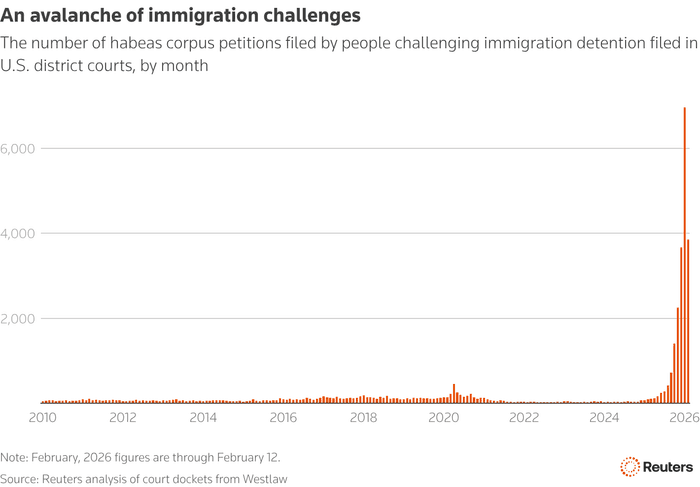
Since the beginning of Trump’s term, immigrants have filed more than 20,200 habeas corpus petitions, claiming they were held indefinitely without trial in violation of the Constitution.

In at least 4,421 cases, more than 400 federal judges have ruled that their detentions were illegal.

Last month, more than 6,000 habeas petitions were filed. Prior to the second Trump administration, no other month dating back to 2010 had seen even 500.


(Graphic by Reuters)


In part due to the sheer volume of legal challenges, the Trump administration has often failed to comply with court rulings, leaving people locked up even after judges ordered them to be released.

Reuters’ new report is the most comprehensive examination to date of the administration’s routine violation of the law with respect to immigration enforcement. But the extent to which federal immigration agencies have violated the law under Trump is hardly new information.

In a ruling last month, Chief Judge Patrick J. Schiltz of the US District Court in Minnesota—a conservative jurist appointed by former President George W. Bush—provided a list of nearly 100 court orders ICE had violated just that month while deployed as part of Trump’s Operation Metro Surge.

The report of ICE’s systemic violation of the law comes as the agency faces heightened scrutiny on Capitol Hill, with leaders of the agency called to testify and Democrats attempting to hold up funding in order to force reforms to ICE’s conduct, which resulted in a partial shutdown beginning Saturday.

Following the release of Reuters’ report, Rep. Ted Lieu (D-Calif.) directed a pointed question over social media to Kristi Noem, the secretary of the Department of Homeland Security, which oversees ICE.

“Why do your out-of-control agents keep violating federal law?” he said. “I look forward to seeing you testify under oath at the House Judiciary Committee in early March.”


‘Working-Class-Centered Politics’ Is Key to Defeating ‘Scourge of Authoritarianism’: AOC in Munich

“It is of the utmost urgency that we get our economic houses in order and deliver material gains for the working class.”


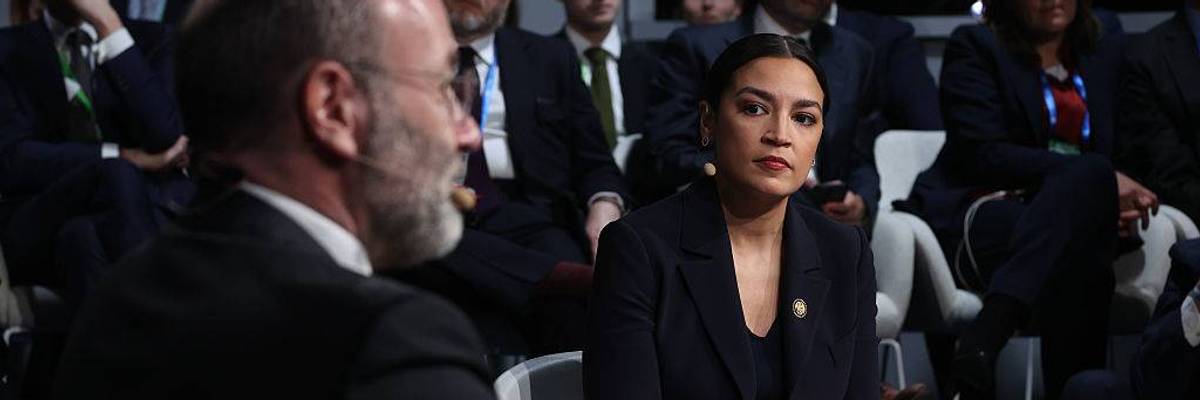
US Rep. Alexandria Ocasio-Cortez (D-NY) listens as President of the European People’s Party Manfred Weber speaks at a panel on populism at the 62nd Munich Security Conference on February 13, 2026 in Munich, Germany.
(Photo by Sean Gallup/Getty Images)


Brad Reed
Feb 13, 2026
COMMON DREAMS

US Rep. Alexandria Ocasio-Cortez on Friday made a pitch for a “working-class-centered politics” as the key to defeating the kind of authoritarian populism embodied by President Donald Trump.

Speaking at a panel at the Munich Security Conference in Germany, Ocasio-Cortez (D-NY) said that decades of government failures such as the North American Free Trade Agreement (NAFTA) and the 2003 Iraq War had opened the door for demagogues such as Trump among working-class voters.


House Progressives Unveil ‘Defund the Oligarchs, Fund the People’ Resolution

The only way to defeat this, she said, is to reorient progressive politics around social class.

“We have to have a working-class-centered politics if we are going to succeed,” she said, “and also if we are going to stave off the scourge of authoritarianism, which provide political siren calls to allure people into finding scapegoats to blame for rising economic inequality, both domestically and globally.”


Elsewhere during the panel, Ocasio-Cortez elaborated on the way economic inequality fuels the demand for authoritarian leaders.

“We’re seeing, in economy across economy around the world, including in the United States,” she said, “that extreme levels of income inequality lead to social instability and drives in a sense in authoritarianism, right-wing populism and very dangerous domestic internal politics. And that is a direct outcome of, not just income inequality, but the failure of democracies over decades to deliver, the failure to deliver higher wages, the failure to rein in corporations.”


The New York Democrat argued that the situation had grown so dire that many corporate CEOs now had more power and influence than democratically elected leaders.

“When massive corporations begin to consume the public sector and gobble up public spending, they start to call the shots,” she said. “And we’re starting to see this with some members of the billionaire class throwing their weight around in domestic and global politics.”

Given this situation, Ocasio-Cortez added, “it is of the utmost urgency that we get our economic houses in order and deliver material gains for the working class,” or else “we will fall into a more isolated world governed by authoritarians who also do not deliver for working people.”

AOC to Offer ‘Perspective Not Often Heard’ at Munich Security Conference

The progressive US congresswoman “is expected to decry the influence of billionaires and oligarchic interests at the expense of the working class,” according to one journalist.


Rep. Alexandria Ocasio-Cortez (D-NY) speaks at a rally at Texas State University in San Marcos, Texas on October 1, 2024.
(Photo by Sergio Flores for the Washington Post via Getty Images)

Brett Wilkins
Feb 12, 2026
COMMON DREAMS

Amid growing speculation that Congresswoman Alexandria Ocasio-Cortez could parlay her rising clout in the Democratic Party into a run for higher office, the New Yorker is set to speak Friday at a key annual international security summit in Germany.

Ocasio-Cortez (D-NY) will address the 62nd Munich Security Conference as one of numerous representatives of the Democratic Party. In addition to other members of Congress, California Gov. Gavin Newsom and Michigan Gov. Gretchen Whitmer, two names frequently floated as possible 2028 presidential candidates, are also speaking at the conference.


‘This Is a Dangerous, Dangerous Moment’: AOC Warns Trump, Noem Laying Groundwork for Insurrection Act

According to NBC News, the democratic socialist congresswoman is slated to speak on two panels—one concerning the “future of US foreign policy” and the other about the “rise of populism.”

Ocasio-Cortez is expected to offer a very different vision of US global leadership from that of President Donald Trump and Secretary of State Marco Rubio, the latter of whom will lead the American delegation in Munich.

“She is expected to decry the influence of billionaires and oligarchic interests at the expense of the working class,” Washington Post reporter John Hudson said Thursday on X.

Matt Duss, executive vice president at the Center for International Policy an an informal adviser to Ocasio-Cortez, told the Washington Post Thursday that the congresswoman “brings an understanding of the way that oligarchy and corruption are part of the problem in our foreign policy and have been for a long time.”

“This is an opportunity to hear from a progressive leader who represents a perspective not often heard at the Munich Security Conference,” he added.


In a separate interview with NBC News, Duss said of Ocasio-Cortez:
Trump has obviously turned the US into an antagonist of Europe. We’ve seen right-wing populism grow in Europe and around the world. Since her first days in Congress, she’s been sounding the alarm that people are hurting. Governments are failing. When people can’t find jobs or afford basic needs like housing and healthcare, they will turn to easy solutions like blaming immigrants, blaming LGBTQ people. This is driving right-wing populism.

Last year, another progressive US lawmaker, Sen. Bernie Sanders (I-Vt.), spoke at the Munich Security Conference, urging his audience to “stand tall against right-wing extremism” in a sharp rebuke of Vice President JD Vance’s admonition to European leaders to accommodate far-right parties like the neo-Nazi-rooted Alternative for Germany, or AfD.

Congressional Hispanic Caucus Chair Adriano Espaillat (D-NY) welcomed Ocasio-Cortez’s trip to Munich, telling NBC News: “I’ve always said that she is a national and an international voice. She’s young, articulate, clear-headed, represents not only the present but the future.”

“I predict someday she will become president of the United States,” Espaillat added. “I’ve called her ‘madam president’ before.”

Ocasio-Cortez has faced mounting speculation and calls to consider a future primary challenge to Senate Minority Leader Chuck Schumer (D-NY) or even a White House run.


For Trump and Rubio, Colonizing Cuba Is Not 

About Freedom—It’s About Their Own Egos

For Trump, regime change in Cuba will cement his legacy. For Rubio, it will mark the culmination of his childhood dream. In their equation, they win and Cuba—like Venezuela, Puerto Rico, Hawai’i, Guam, and so many nations before it—loses its independence and freedom.


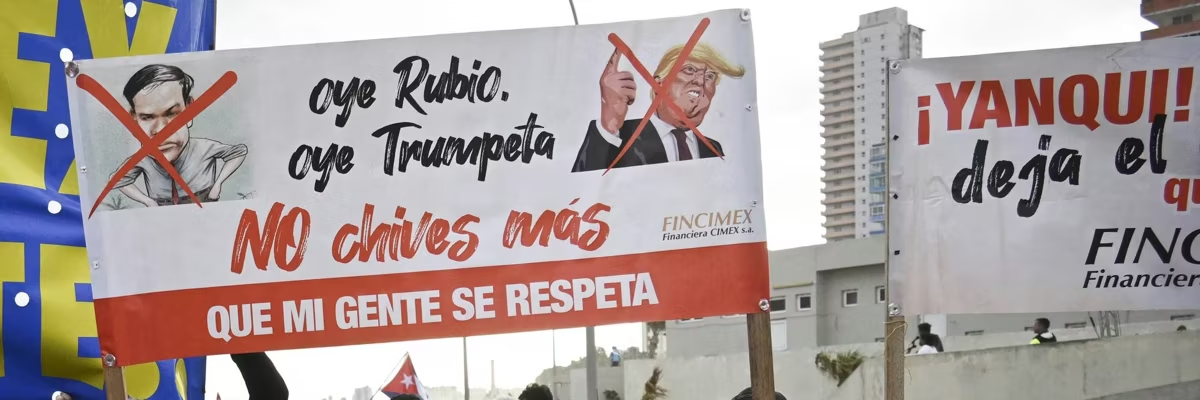
Cubans hold a banner against US President Donald Trump and Secretary of State Marco Rubio during an “Anti-Imperialist” protest in front of the US Embassy against the US incursion in Venezuela, where 32 Cuban soldiers lost their lives, in Havana on January 16, 2026.
(Photo by Yamil Lage / AFP via Getty Images)


Jordan Liz
Feb 14, 2026
Common Dreams

The Trump administration’s total blockade on oil imports to Cuba is jeopardizing the lives of millions across the island. It is resulting in severe blackouts that are disrupting food production, hospitals, schools, public transport, and tourism.

Despite this, the people of Cuba remain defiant. As Cuban President Miguel Díaz-Canel remarks: “The collapse lies in the imperial mindset, but not in the mindset of the Cubans. I know we are going to live through difficult times, but we will overcome them together with creative resilience.”

Cuba Is Not A Threat—Trump Is

President Donald Trump alleges that Cuba poses “an unusual and extraordinary threat” for two reasons. First, its relationship with “hostile countries” and “transnational terrorist groups,” including Russia, China, Iran, and Hamas. Second, Trump alleges that Cuba’s “communist ideas, policies, and practices” are a threat to the region and endanger the lives of its citizens.

Neither of these is the real reason, however. In January 2026, Trump praised Canada’s trade deal with China as “a good thing.” He told reporters, “If you can get a deal with China, you should do that.” While Trump did threaten retaliatory tariffs against Canada a few days later, his own administration has boasted about the “historic agreement” it reached with China on trade. Trump himself raves about his “extremely good” relationship with Chinese President Xi Jinping. He even invited Xi to join his Board of Peace.

For Trump, colonialism is not solely about exploitation and systematic theft—it is a means of reshaping the world in his self-obsessed image.

Likewise, Trump purports to have a good relationship with Russian President Vladimir Putin. Trump has described Putin as a “genius” and a “strong leader,” and their relationship as “very, very good.” He even praised Putin’s invasion of Ukraine. During a radio interview, Trump said: “Putin declares a big portion of the Ukraine—of Ukraine—Putin declares it as independent. Oh, that’s wonderful. He used the word ‘independent’ and ‘we’re gonna go out and we’re gonna go in and we’re gonna help keep peace.’ You gotta say that’s pretty savvy.” Despite his war crimes, Trump also invited Putin to be part of the Board of Peace.

Clearly, Trump has no issue forming close relationships with “hostile countries.”

Concerns about destabilizing the region or harms to the Cuban people are also false flags. The Trump administration has issued illegal military strikes on boats in the Caribbean Sea and Pacific Ocean that have killed at least 130 people; violated international law by invading Venezuela and kidnapping President Nicolás Maduro; threatened several nations in the region including ColombiaMexicoPanamaGreenlandCanada, as well as Cuba and Venezuela. Compared to Cuba, the Trump administration is, in orders of magnitude, a significantly greater threat to regional stability.

Moreover, Trump does not care whatsoever about the well-being of Cubans. If he did, he would not have undone President Barack Obama’s attempts at normalizing US-Cuba relations. If he cared, then his administration would not have paused a humanitarian program that allowed Cubans to enter the US and remain here legally for two years. Rather than protecting a group that has overwhelmingly supported him, the Trump administration is mass deporting Cubans back to the very country it is now economically asphyxiating.

This vile disregard, however, is not surprising—Trump does not care about global stability. He does not care about American citizens. And he especially does not care about the peoples of Asian, African, Caribbean, and Latin American countries.

No, Trump’s blatant act of global terrorism against Cuba is not about national security, communism, or saving lives. This act of deprived cruelty masquerading as foreign policy is about narcissism, private interest, and personal grievances.
Donald Trump: Where Narcissism Meets Colonialism

According to a US official, Trump believes that successfully ending the Castro era would cement his legacy by accomplishing what presidents since John F. Kennedy have failed to do. This is among his chief motivations.

Whether it’s adding his name to the Kennedy Center, building the “Arch de Trump,” or whining about the Nobel Peace Prize he thinks he deserves, Trump is obsessed with himself and his legacy. At Turning Point USA’s 2025 AmericaFest Conference, conservative commentator Jesse Watters recounts asking Trump about why his “big, beautiful ballroom” is so extravagant—“four times the size of the White House.” Watters told the audience, “[Trump] said, ‘Jesse, it’s a monument. I’m building a monument to myself—because no one else will.’”

For Trump, colonialism is not solely about exploitation and systematic theft—it is a means of reshaping the world in his self-obsessed image. In his mind, colonized lands are monuments to his greatness and ego; another property upon which he can stamp his name and expand his golden empire; further proof that only he can bring peace and order to the world.

Trump’s narcissism is why he labelled himself the “Acting President of Venezuela” after his administration kidnapped Maduro—a blatant violation of international law reduced to self-aggrandizement.

This is why he posted a video of an ethnically cleansed “Trump Gaza” filled with palm trees, luxury buildings, and, of course, a towering golden statue of himself. Mass displacement and genocide are simply steppingstones in his pursuit of more self-praise.

Cuba will be no different. He will torture Cuba in the hopes of forcing them to submit to his will and cement his legacy. To force them to “make a deal, before it is too late.” For Trump, all this cruelty is business as usual. As he puts it, “Sometimes, part of making a deal is denigrating your competition.”


Marco Rubio’s Childhood Fantasy


That said, Trump’s is not the only ego at play here. Reportedly, Secretary of State Marco Rubio is deliberately blocking negotiations between high-level officials from Havana and Washington. This, despite both Trump and Díaz-Canel insisting that they are open to talks.

Rubio has long since advocated for total regime change in Cuba. In his memoir American Son, Rubio writes about the profound impact his Castro-hating grandfather and President Ronald Reagan’s militant anti-communism had on his political beliefs. He writes that, as a child, “I boasted I would someday lead an army of exiles to overthrow Fidel Castro and become president of a free Cuba.” When applying to law school, his personal essay expressed his “intention to use [his] law degree one day to help construct a new legal and political system for a free Cuba.”

We were too late to stop Trump’s illegal invasion of Venezuela; but we can still save Cuba. From Argentina to Canada, we must unite.

Throughout his life, Rubio has expressed the same sentiment: For Cuba to be free, the Castro regime must end and be replaced with a new political system. For Rubio, Díaz-Canel is no different than Castro. As he sees it, “The dictatorship of Díaz-Canel follows the same tactics as the Castro regime, censoring and repressing members of the opposition.” As such, there can be no negotiations: “Every concession made to the [Díaz-Canel] regime is a betrayal of those who are fighting for freedom on the island.” Thus, Rubio opposed Obama’s attempts at normalizing relations with Cuba, warned against President Joe Biden recommitting to the “failed Obama Administration policy of rewarding Raúl Castro and Miguel Díaz-Canel,” and is now actively blocking negotiations between the two nations. For Rubio, there is only one way forward. The current regime must end, and the era of President Rubio must begin—an illicit inauguration that Trump has already endorsed.

Beyond his own twisted personal desires, many of Rubio’s constituents and backers are also anti-Castro and anti-communist. As journalists Ryan Grim, Noah Kulwin, and José Luis Granados Ceja with Drop Site News write, “If Trump successfully lands a deal with the Cuban government that Rubio would have to sign off on, Rubio would be left to either betray his life’s cause and that of his backers in Miami, or resign in protest.”

The stakes are much higher and far more personal for Rubio than Trump. But in the end, neither care about Cuba nor its people. For Trump, regime change in Cuba will cement his legacy. For Rubio, it will mark the culmination of his childhood dream. In their equation, they win and Cuba—like VenezuelaPuerto RicoHawai’iGuam, and so many nations before it—loses its independence and freedom.

America vs. Trump


Now is the time for nations across the Americas and the Caribbean to band together against Trump’s vile Donroe Doctrine. President Claudia Sheinbaum should be praised for her efforts to aid Cuba, but this is not a fight Mexico can win alone. Nor should it have to; this impacts all of us.

Let’s be clear: Regardless of current US relationships, no country is safe from Trump’s colonial aggression and narcissistic whims. Whether it’s betraying the Kurds in Syria or threatening NATO allies, Trump will do whatever it takes to satisfy his own ambitions. Trump’s allies in the region, like Dominican Republic President Luis Abinader and Argentine President Javier Milei, would do well to remember this.

We were too late to stop Trump’s illegal invasion of Venezuela; but we can still save Cuba. From Argentina to Canada, we must unite. We cannot allow ourselves to be at the mercy of Trump’s delusions of grandeur. We must act now to save Cuba.


Our work is licensed under Creative Commons (CC BY-NC-ND 3.0). Feel free to republish and share widely.


Jordan Liz
Jordan Liz is an Associate Professor of Philosophy at San José State University. He specializes in issues of race, immigration and the politics of belonging.
Full Bio >


In defence of Cuba against the neocolonial blockade and starvation imposed by Trump


By Ana Cristina Carvalhaes, Israel Dutra, João Machado & Manuel Rodríguez Banchs


Published date 14 February, 2026
First published at International Viewpoint.

The neo-fascist in the White House is attempting to bring the Caribbean island and its government to its knees, strangling it economically once and for all, killing its people with darkness and scarcity. 

But this is not “just” a war against Cuba and its revolutionary tradition. It is the continuation of the war against the sovereignty of all Latin American countries and Latino peoples within the United States. In particular, Lula da Silva, Gustave Petro, Yamandú Orsi and the foreign governments of social democracy must emphatically oppose this crime in all international forums and organizations.

Following the de facto “takeover” of Venezuela by the United States, with the kidnapping of Nicolas Maduro and Cilia Flores on January 3, the main target of the far-right strategists around Donald Trump is the Caribbean island, which has been the scene of resistance against two empires since the 19th century and the scene of the world’s last victorious anti-capitalist revolution, between 1959-61, led by the 26 July Movement (Fidel Castro’s movement) and the working masses of the sugar cane fields and factories.

From Washington and from a Caracas transformed — by force of arms and sanctions — into a kind of capital of a viceroyalty in the 21st century, the Yankee hawks have declared war on Cuba, a small country, isolated by nature and geopolitics, whose development has been limited by decades of US blockade and energy and food dependence on the outside world. (Many will say, as we do, combined with the mistakes of its own successive governments.)

The first step in the ongoing attack was to cut off the supply of Venezuelan oil, which since Hugo Chávez’s first government (1998) had guaranteed the functioning of Cuba’s economy. An order quickly carried out by Delcy Rodríguez. Cuba needs 100,000 barrels of oil a day and produces 40,000. The current phase of the attack involves intense pressure on Cuba’s last oil supplier, Mexico, to stop sending oil tankers, which Claudia Sheinbaum has so far refused to do.

At the same time, in a festival of media provocations typical of a genocidal showman, Trump calls on Cuban leader Miguel Díaz-Canel to “negotiate” nothing less than the end of the country’s sovereignty. He says that Cuba will surrender, thanks to the fact that he is starving Cubans, just as, with the support of Israel and its bombings, he starved the inhabitants of Gaza. (For now, there is no equivalence between one and the other, but the inhumane method is the same.) Everything indicates that the Yankee government expects one of two things: the capitulation of Havana or an internal popular rebellion.

At an international press conference on February 6, Díaz-Canel described the suffering of his people and denounced what is happening as an attempt at genocide. Unfortunately, although China and Russia, considered by many to be “alternative powers”, have issued formal statements criticising Washington, they have so far not contributed even a gallon of petrol to prevent the worst in Cuba. 

Rodríguez’s cut-off of oil supplies to Cuba should also give pause to those who continue to repeat the “mantra” that the Venezuelan government still has something to do with the “revolution”, when in reality it has become the administrator of the protectorate. As for Lula and the Workers Party (PT), it is regrettable that they do not order the wealthy Petrobras to break the energy blockade on Cuba, as the National Federation of Oil Workers (FNP) rightly demands.

Fascist revenge
Why is a weakened David such as little brave Cuba the object of so much hatred from the neo-fascist Goliath? Unlike what was correctly observed about Venezuela, that the immediate objective was to secure oil — to the point that imperialism discarded its long-time friend María Corina Machado and kept a Maduro-style regime without Maduro in power — in the Cuban case, the explanation is pure neo-fascist geopolitics, with an overdose of ideological and class revenge. Trump and his Secretary of State, Marco Rubio, a descendant of Cuban counterrevolutionaries, need to defeat the country that dared, in the past, to fight capitalism 150 kilometres from Miami, and which was a symbol and inspiration for generations of fighters for national sovereignty and, in the first decades after 1961, for social transformation.

Cuba was the only Latin American country in which the bourgeoisie was expropriated, more specifically with Castro’s proclamation of the socialist character of the revolution in 1961. It is worth remembering that in the early years of the Sandinista revolution in Nicaragua, at certain moments during the Chávez government (particularly after the defeat of the pro-US coup in 2002), and during the first government of Rafael Correa in Ecuador, local and international capitalists were displaced from power, and governments were temporarily formed without the bourgeoisie. In another stage of imperialism, they were also the target of imperial hatred — particularly Nicaragua, with the US-financed Contras. But the radicalism of the Cuban revolution was never completely imitated.

It is true that decades ago, decisively influenced by the then Soviet bureaucracy (from 1961 to 1991) and harassed by US economic persecution, the Cuban leadership abandoned the only path that would remove the country from its isolation and economic fragility: it worked hard to ensure that the mass struggles in Nicaragua and El Salvador between the 1970s and early 1990s, and in this century among the peoples of Venezuela and Bolivia, did not advance towards a course similar to its own, of direct confrontation with capitalism through the expropriation of bourgeois groups. In any case, the island continued, with great difficulty, as a sovereign country. And it is this autonomous nature that imperialism cannot tolerate.

The current situation in Cuba must be addressed as an unprecedented humanitarian crisis and a threat of a new military operation by Trump’s imperialism against another sovereign Latin American nation. These two elements are more than enough to warrant a strong and unified national and international campaign in defence of Cuba. At a time when the US government is facing growing internal opposition, mobilizations against ICE, and a feeling of solidarity with immigrants, particularly Latinos, it is necessary to prevent Trump from winning again, as in Venezuela.

Regardless of the balance sheet of the Cuban revolution, what is at stake is the sovereignty and independence of a historically oppressed Latin American country. It is urgently necessary to press for the resumption of oil supplies to Cuba and for food and medicine to be sent to the island. All those who support the idea of sovereignty, the principle of non-interference and the right of peoples to decide their own destiny must be called upon to speak out, take a stand and mobilize against the blockade!

• Trump and Rubio, hands off Cuba!

• For an immediate end to the energy and food blockade against the island! Lula, Petro, Orsini, mobilize with force. Notes of condemnation are not enough. Work for a front of governments opposed to the blockade and siege of Cuba.

• For a continental humanitarian campaign of solidarity with the Cuban people.

The authors are members of the Executive Bureau of the Fourth International.


Cuba cancels cigar festival amid economic crisis

By AFP
February 14, 2026


Cuba's cigar festival will not take place in 2026 - Copyright AFP/File ADALBERTO ROQUE

Cuba on Saturday announced the cancellation of its iconic cigar festival, amid a major energy crisis sparked by US pressure on the cash-strapped island.

In a message to participants seen by AFP, organizers said they were postponing the annual event, scheduled to take place from February 24-27, but did not give a new date.

The cigar festival typically raises millions of dollars from auction sales that are then funneled into the country’s health care system. Last year, it took in about $19.5 million.

International sales of Cuban cigars, the island nation’s most emblematic export, bring much needed income to its struggling economy, with Europe the main market for the luxury smokes.

The United States cut off oil deliveries to Cuba from Havana’s key ally Venezuela following the ouster of longtime president Nicolas Maduro in early January.

US President Donald Trump also signed an executive order allowing his country to impose tariffs on countries selling oil to Havana.

International airlines including Air Canada have halted Cuba flights due to a lack of fuel on the island, and several governments have urged citizens to reconsider travel there, warning they could be stranded.


UN Human Rights Chief Calls for End of Trump Oil Embargo on Cuba as Crisis Deepens

The demand came after a group of United Nations experts condemned the embargo as “a serious violation of international law and a grave threat to a democratic and equitable international order.


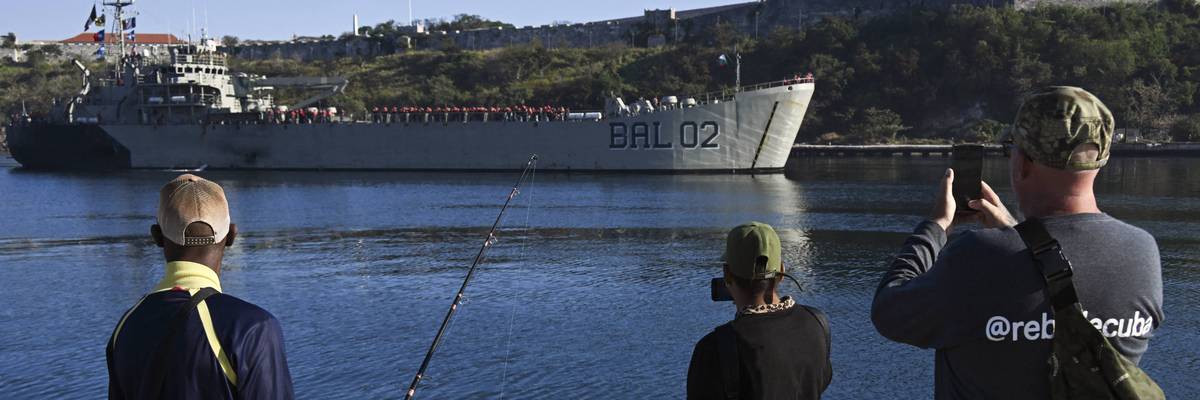
A Mexican Navy ship arrives at Havana Bay with humanitarian aid on February 12, 2026.
(Photo by Yamil Lage/AFP via Getty Images)


Jake Johnson
Feb 13, 2026
COMMON DREAMS

The United Nations’ human rights chief on Friday called on the Trump administration to lift its oil embargo against Cuba as the humanitarian crisis on the island deepens, with fuel shortages disrupting critical functions on the island and food and medicine shortages leaving families desperate for relief.

Marta Hurtado, a spokesperson for UN High Commissioner for Human Rights Volker Türk, said in a statement that “we are extremely worried about Cuba’s deepening socio-economic crisis—amid a decades-long financial and trade embargo, extreme weather events, and the recent US measures restricting oil shipments.”

Pushing for Regime Change, Trump Accused of ‘Asphyxiating’ Cuba With Fuel Embargo

‘War by Another Means’: Union Movement Condemns Trump Economic Siege of Cuba

“This is having an increasingly severe impact on the human rights of people in Cuba,” Hurtado said. “Given the dependence of health, food, and water systems on imported fossil fuels, the current oil scarcity has put the availability of essential services at risk nationwide. Intensive care units and emergency rooms are compromised, as are the production, delivery, and storage of vaccines, blood products, and other temperature-sensitive medications.”

The spokesperson noted that more than 80% of Cuba’s water-pumping equipment depends on electricity, which has been undermined by widespread power cuts stemming from fuel shortages.

“The fuel shortage has disrupted the rationing system and the regulated basic food basket, and has affected social protection networks—school feeding, maternity homes, and nursing homes—with the most vulnerable groups being disproportionately impacted,” said Hurtado. “Access to essential goods and services, including food, water, medicine, and adequate fuel and electricity, should always be safeguarded, as they are fundamental in modern societies to the right to life and the ability to enjoy many other rights.”

In the face of the growing humanitarian catastrophe, Turk “reiterates his call on all states to lift unilateral sectoral measures, given their broad and indiscriminate impact on the population,” Hurtado said.

“Policy goals cannot justify actions that in themselves violate human rights,” she added.

The US has been economically suffocating Cuba for decades, but the Trump administration intensified the assault last month by cutting the island off from its primary source of oil—Venezuela—and threatening to slap tariffs on countries that send fuel to the beleaguered Caribbean nation, which has long been in the crosshairs of Secretary of State Marco Rubio and other right-wing supporters of regime change.

“Cuba is ready to fall,” US President Donald Trump declared in early January after his administration kidnapped Venezuelan President Nicolás Maduro.

In a statement on Thursday, a group of UN human rights experts said that Trump’s January 29 executive order imposing a fuel blockade on Cuba represents “a serious violation of international law and a grave threat to a democratic and equitable international order.”

“It is an extreme form of unilateral economic coercion with extraterritorial effects, through which the United States seeks to exert coercion on the sovereign state of Cuba and compel other sovereign third States to alter their lawful commercial relations, under threat of punitive trade measures,” the experts said. “A democratic international order cannot be reconciled with practices whereby one State claims the authority to dictate the internal policies and economic relations of others through threats and coercion.”