
Image via Shutterstock.
March 06, 2026
ALTERNET
Veteran economics reporter Catherine Rampell warns of “Warflation” in the weeks ahead.
In a post to The Bulwark, Rampell predicted higher prices are on the horizon for “anything that needs to be transported anywhere.”
“The top crude oil expert at S&P Global Energy warned that the military conflict has the potential to become 'the largest oil supply disruption in history,'" she writes. "That’s because about a fifth of the world’s oil passes through the Strait of Hormuz, on Iran’s southern coast.”
Oil prices are already skyrocketing, a reversal of a previous bright spot in affordability.
“But since we bombed Iran, energy costs have risen sharply. To put things in perspective: oil prices are up about 20 percent so far just this week," Rampell adds.
The downstream effect on various pricing issues will soon follow.
“Downstream firms that require [liquefied natural gas] to operate are closing shop, too. For example, the Gulf region is responsible for nearly a tenth of the global aluminum supply," according to Rampell. "Already this week, multiple major aluminum smelters had to initiate shutdowns; one company says it may take up to a year to restart production.”
Adding to the cascade are methanol and other chemicals, including fertilizers used to grow food supplies. “American farmers are freaking out,” Rampell claims, and buttressed the point by talking to an analyst.
Consumers may see “higher prices for bread within six to 10 weeks, eggs within a few months and pork and broiler chicken within six months,” according to an estimate from food-system expert Raj Patel.
Those are the obvious targets. But on the horizon are other products that will soon feel the effect of chemical price hikes.
Rampell writes, “Then there are the gazillions of consumer goods that people may not realize use petrochemicals as inputs. Those include clothes, iPhones, candy, dentures, dishwashing liquid, footballs, shampoo, toothpaste, lipstick, plastic toys, trash bags, umbrellas, tires — you name it.”
Not everyone is sounding the inflation alarm.
Forbes reports LPL Financial analysts have noted, “Across more than two dozen events since World War II, the S&P 500 averaged a one-day decline of about 1 percent, analysts said, adding markets tend to “absorb shocks” quickly before stabilizing and recovering “within a matter of weeks.” The S&P 500 dropped 1.2 percent when Iran attacked Israel in April 2024 and took just over two weeks to recover the loss, whereas the index rose 1 percent after the U.S. and Israel last struck Iran in June 2025.”
The underlying state of the economy, such as the health of the job market, interest rates and inflation, “matters more than the event itself,” LDL writes.
CNBC notes, “most economists say the impact from higher oil prices is difficult to gauge and could ultimately prove temporary, as has often been the case with past Middle East conflicts.”
Moreover, with the U.S. producing a larger share of its own energy, the broader economic impact of oil price spikes is not what it once was.
“In today’s American economy, spikes in oil prices do not present the same significant downside risk to top-line economic growth or inflation as they did a half century ago,” said Joseph Brusuelas, chief economist at RSM. “The American economy is far less exposed to economic and inflation disruptions while its overall size has tripled.”
Rampell says Trump isn’t deliberately trying to raise prices, and acknowledges that presidents really don’t have a lot of tools to fight inflation.
“But between tariffs, mass deportations (and a resulting depletion in the agricultural workforce), politicizing the Federal Reserve, and bombing Iran, Trump seems intent on proving us wrong.”
Pro-Trump WSJ admits MAGA economy is 'lousy'
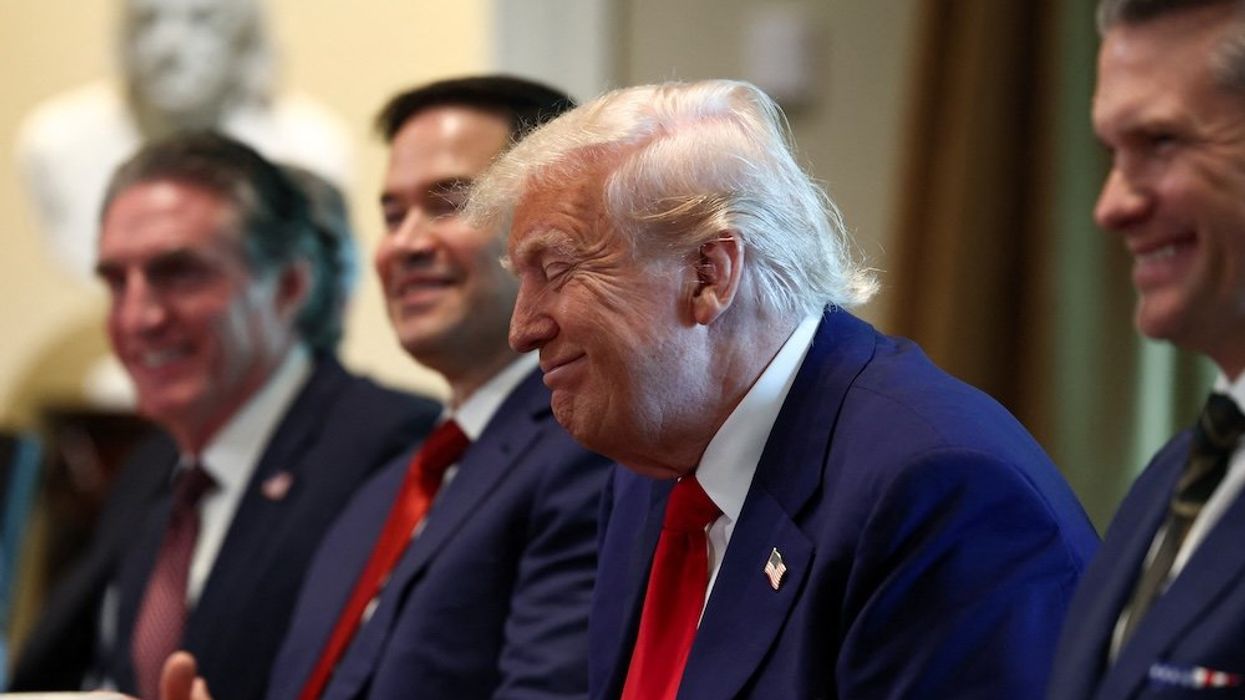
U.S. President Donald Trump reacts as he holds a cabinet meeting at the White House in Washington, D.C., U.S., April 30, 2025. REUTERS/Evelyn Hockstein
President Donald Trump’s economy is “lousy” and could be improved if he removes his tariffs, a newspaper that normally supports Trump wrote on Friday.
“There’s no denying the February report was lousy,” The Wall Street Journal Editorial Board wrote on Friday. “The U.S. shed 92,000 jobs and revised down gains for January and December by a combined 69,000. The question is what to make of the declines.”
After arguing that the jobs report is not related to Trump’s invasion of Iran, the Journal nevertheless predicted “a temporary price surge” in oil as the Iran regime tries to “cause enough political pain in the Gulf and the U.S. that Mr. Trump and Israel stop the bombing.” Yet they urged the public to not waver in backing the Iran war even as that happens.
“But that is all the more reason not to panic at a temporary price surge and press ahead to remove Iran’s missile and drone stockpiles and assembly lines and the regime’s brutal enforcers,” the Journal argued.
They then added, practically as an afterthought, “Oh, and if Mr. Trump wants a tax-cut boost for the economy while the war continues, he could call off his new 15% universal tariff. Consider it our contribution to easing everyone’s economic anxiety.”
Economist Catherine Rampell, speaking with the conservative publication The Bulwark, argued on Friday that Trump’s anti-immigrant policies are contributing to the ongoing economic malaise.
“So, we had been hearing for years from Trump and his allies that if you pulled immigrants out of the economy, then you would have a lot more job openings for native-born Americans, that immigrants were stealing all of the jobs that should have gone to, you know, red-blooded Americans,” Rampell said. “And therefore, if you just yanked them out of the labor force and out of the country, that would create an abundance of riches in terms of job opportunities for native-born Americans.”
She added, “Is it that we should have expected more job growth for native born Americans? Or is it … we should have expected less job growth overall? So, you know, they kind of want it both ways. And either way, they're just trying to cope with the fact that the numbers are not great… [Y]ou should never read too much into one month's report. Every economist will tell you that. But it's not just one month's report. We've seen, again, six months now under Trump's tenure in which we've had job losses.”
Also on Friday,University of Massachusetts Amherst Economics Professor Arin Dube warned that “the labor market is flashing red,” while University of Michigan Professor of Economics and frequent cable news guest Justin Wolfers said after the new jobs report that “the economic story just changed dramatically. Recession questions are back on the menu.”
In February the liberal-leaning think tank Center for American Progress argued Trump’s tariffs have cost the US more than 100,000 manufacturing jobs.
“Far from the manufacturing sector ‘roaring back’ as Trump promised, the United States has lost more than 100,000 manufacturing jobs over the past year,” Allison McManus and Dawn Le of the Center for American Progress wrote. “These actions have pushed the country’s closest trading partners to seek deals elsewhere, including with China: Canada, India, Japan, South Korea, and the European Union have all recently sought new agreements without the United States.”
They added, “Over time, each of these deals will result in markets that were once enjoyed by U.S. suppliers increasingly oriented away from them — and the rules of international engagement increasingly written by foreign governments.”
Conservative commentator Mona Charen from The Bulwark speculated last month that voters may also blame Trump’s tariffs for the poor economy.
“Voters are rarely able to connect policy to outcomes, but they have done so in the case of tariffs,” Mona Charen wrote. “Back in 2024, Americans were about equally divided on the question of trade, with some favoring higher tariffs and roughly similar numbers opting for lower tariffs. Experience has changed their views.”
U.S. President Donald Trump reacts as he holds a cabinet meeting at the White House in Washington, D.C., U.S., April 30, 2025. REUTERS/Evelyn Hockstein
March 06, 2026
ALTERNET
President Donald Trump’s economy is “lousy” and could be improved if he removes his tariffs, a newspaper that normally supports Trump wrote on Friday.
“There’s no denying the February report was lousy,” The Wall Street Journal Editorial Board wrote on Friday. “The U.S. shed 92,000 jobs and revised down gains for January and December by a combined 69,000. The question is what to make of the declines.”
After arguing that the jobs report is not related to Trump’s invasion of Iran, the Journal nevertheless predicted “a temporary price surge” in oil as the Iran regime tries to “cause enough political pain in the Gulf and the U.S. that Mr. Trump and Israel stop the bombing.” Yet they urged the public to not waver in backing the Iran war even as that happens.
“But that is all the more reason not to panic at a temporary price surge and press ahead to remove Iran’s missile and drone stockpiles and assembly lines and the regime’s brutal enforcers,” the Journal argued.
They then added, practically as an afterthought, “Oh, and if Mr. Trump wants a tax-cut boost for the economy while the war continues, he could call off his new 15% universal tariff. Consider it our contribution to easing everyone’s economic anxiety.”
Economist Catherine Rampell, speaking with the conservative publication The Bulwark, argued on Friday that Trump’s anti-immigrant policies are contributing to the ongoing economic malaise.
“So, we had been hearing for years from Trump and his allies that if you pulled immigrants out of the economy, then you would have a lot more job openings for native-born Americans, that immigrants were stealing all of the jobs that should have gone to, you know, red-blooded Americans,” Rampell said. “And therefore, if you just yanked them out of the labor force and out of the country, that would create an abundance of riches in terms of job opportunities for native-born Americans.”
She added, “Is it that we should have expected more job growth for native born Americans? Or is it … we should have expected less job growth overall? So, you know, they kind of want it both ways. And either way, they're just trying to cope with the fact that the numbers are not great… [Y]ou should never read too much into one month's report. Every economist will tell you that. But it's not just one month's report. We've seen, again, six months now under Trump's tenure in which we've had job losses.”
Also on Friday,University of Massachusetts Amherst Economics Professor Arin Dube warned that “the labor market is flashing red,” while University of Michigan Professor of Economics and frequent cable news guest Justin Wolfers said after the new jobs report that “the economic story just changed dramatically. Recession questions are back on the menu.”
In February the liberal-leaning think tank Center for American Progress argued Trump’s tariffs have cost the US more than 100,000 manufacturing jobs.
“Far from the manufacturing sector ‘roaring back’ as Trump promised, the United States has lost more than 100,000 manufacturing jobs over the past year,” Allison McManus and Dawn Le of the Center for American Progress wrote. “These actions have pushed the country’s closest trading partners to seek deals elsewhere, including with China: Canada, India, Japan, South Korea, and the European Union have all recently sought new agreements without the United States.”
They added, “Over time, each of these deals will result in markets that were once enjoyed by U.S. suppliers increasingly oriented away from them — and the rules of international engagement increasingly written by foreign governments.”
Conservative commentator Mona Charen from The Bulwark speculated last month that voters may also blame Trump’s tariffs for the poor economy.
“Voters are rarely able to connect policy to outcomes, but they have done so in the case of tariffs,” Mona Charen wrote. “Back in 2024, Americans were about equally divided on the question of trade, with some favoring higher tariffs and roughly similar numbers opting for lower tariffs. Experience has changed their views.”

No comments:
Post a Comment