Tuesday, April 07, 2026

California’s Battery Boom Is Rewriting Power Markets

  • Grid-scale batteries are rapidly moving from a niche role to replacing gas plants in peak demand, as seen in places like California where they now supply a large share of evening power.

  • Unlike traditional power plants, batteries can be deployed quickly, scaled easily, and respond instantly, making them a more flexible solution for balancing renewables.

  • Falling costs and improving technology are undermining the need for gas as backup, shifting power systems toward storage-driven flexibility rather than fossil fuels.

For years, one argument has dominated the debate around renewables: they are intermittent, and therefore require large-scale, dispatchable backup—usually in the form of gas-fired power plants. It is a compelling argument. It is also becoming increasingly outdated.

Because while much of the discussion still treats batteries as a marginal technology, real-world systems are starting to show something very different. Storage is not just filling small gaps. It is beginning to replace the role traditionally played by large, flexible fossil generation. And it is doing so faster than most forecasts expected.

California’s Live Experiment

The clearest example comes from California. On March 29, batteries on the CAISO grid delivered around 12.3 GW of power during the evening peak, covering roughly 43% of total demand. That is not a niche contribution. That is system-level impact.

To put that into perspective, this is equivalent to the output of roughly 15 to 20 combined-cycle gas plants, or several large hydroelectric facilities. More importantly, it is happening exactly when skeptics argue batteries cannot perform—during peak demand, after solar generation has dropped. And this is no longer a short-lived spike.

Batteries maintained more than 20% of grid demand for several hours during the evening ramp, effectively replacing what would traditionally have been one of the most gas-intensive periods of the day. This is precisely the window where gas plants have historically been considered indispensable. The system did not just cope. It adapted.

Built at Manufacturing Speed

What makes this even more significant is how quickly it happened. California’s battery capacity has grown from around 1.3 GW in 2020 to around 17 GW today. More than 90% of that capacity was deployed within the last five years. That is not megaproject speed. That is manufacturing speed.

And that distinction matters. Traditional dispatchable generation, whether gas or nuclear, takes years, often decades, to plan and build. Batteries, by contrast, can be deployed in months to a few years, scaled incrementally, and located exactly where flexibility is needed. This fundamentally changes how power systems can evolve.

Not Just California

California is not an isolated case. South Australia has been demonstrating similar dynamics for years. With high shares of wind and solar, supported by grid-scale batteries like the Hornsdale Power Reserve, the region has repeatedly shown that storage can provide frequency control, peak shaving, and reliability services once dominated by fossil generation.

Texas is now following a similar trajectory. Battery capacity on the ERCOT grid has expanded rapidly, playing an increasingly important role in managing peak demand and balancing variability from renewables.

China, meanwhile, is scaling battery storage alongside massive renewable deployment, integrating storage directly into solar and wind projects to stabilize output and reduce curtailment.

Different systems, different regulatory environments, same underlying trend. Batteries are moving from the margins to the core of grid operations.

The Old Assumption Is Breaking

The traditional argument against renewables rests on a simple premise: because wind and solar are variable, they require firm backup that can be turned on and off at will. Historically, that role has been filled by gas.

But what California and others are now showing is that flexibility does not have to come from combustion. It can come from storage. Batteries respond faster than gas plants. They can ramp instantly. They can absorb excess generation and release it exactly when needed. And when deployed at scale, they can reshape entire demand curves.

The evening peak, long seen as the Achilles’ heel of solar-heavy systems, is increasingly being managed without defaulting to gas.

Duration Is Expanding

A common counterargument is that batteries only work for short durations. That may have been true a few years ago. It is becoming less so. Four-hour battery systems are now standard in many markets. Longer-duration storage is being developed and deployed, with technologies ranging from advanced lithium-ion configurations to entirely new chemistries and storage concepts.

At the same time, system intelligence is improving. Smarter grid management, demand response, and hybrid systems combining solar, wind, and storage are extending the effective duration of flexibility far beyond what a single asset could provide. In practice, it is not just about how long a battery can discharge. It is about how the entire system is orchestrated.

Economics Are Moving in One Direction

Just as important as the technical shift is the economic one. Battery costs have fallen dramatically over the past decade, following a trajectory similar to solar. While there have been short-term fluctuations due to supply chain pressures, the long-term trend remains firmly downward.

This is critical because it reinforces the same dynamic seen with renewables: once built, batteries provide system services without ongoing fuel costs. That stands in stark contrast to gas plants, where operating costs remain tied to volatile fuel markets.

In a world of recurring geopolitical shocks, that difference is not theoretical. It is structural.

Rethinking the “Backup” Narrative

All of this points to a deeper shift in how power systems are evolving. The idea that renewables need fossil backup is being replaced by a more nuanced reality: renewables need flexibility, but that flexibility does not have to be fossil-based. It can be electric. It can be distributed. And increasingly, it can be deployed faster and at scale.

This does not mean gas disappears overnight. But it does mean its role as the default balancing mechanism is being steadily eroded

From Skepticism to System Reality

The skepticism around batteries is understandable. Power systems are complex, and reliability matters. But the evidence is increasingly clear. Batteries are no longer a supporting technology. They are becoming a central pillar of modern grids.

They are replacing peak generation. They are stabilizing frequency. They are enabling higher shares of renewables. And they are doing so at a pace that traditional infrastructure cannot match.

What makes this shift particularly striking is how quietly it is happening. There are no grand announcements declaring the end of gas as a balancing tool. There is no single moment where the system flips. Instead, there is a steady accumulation of capacity, capability, and confidence. A few gigawatts here. A few hours of coverage there. A peak shaved. A ramp managed. Until suddenly, the system looks very different.

A New Backbone

For decades, the backbone of power systems was defined by large, centralized plants that could be turned on and off as needed. That model is not disappearing overnight.

But it is being complemented, and increasingly challenged, by something more flexible, more modular, and faster to deploy. Batteries are not just supporting the grid. They are starting to become its new backbone.

And the faster that reality is recognized, the sooner the debate can move beyond outdated assumptions, and toward a system that is not only cleaner, but fundamentally more adaptable to the shocks of a volatile world.

By Leon Stille for Oilprice.com

Petrobras Shakes Up Leadership Amid Governance Transition


Brazil’s state-controlled oil major Petrobras has announced a set of leadership changes, reshaping both its board of directors and executive management as it navigates a critical governance transition.

The company confirmed that its board of directors has elected Marcelo Weick Pogliese as chairman, replacing the previous leadership on an interim basis until the next general shareholders’ meeting. The move follows earlier disclosures at the end of March and signals continued adjustments at the top of the company’s governance structure.

At the executive level, Petrobras approved the immediate departure of Claudio Romeo Schlosser from his role as Executive Director of Logistics, Commercialization, and Markets. He will be replaced by Angélica Laureano, whose appointment takes effect on April 7 and runs through April 2027 under a unified mandate.

In parallel, William França, currently Executive Director of Industrial Processes and Products, will temporarily assume additional responsibilities overseeing Energy Transition and Sustainability. This follows Laureano’s shift into her new role and underscores Petrobras’ ongoing effort to maintain continuity in its energy transition strategy during the leadership reshuffle.

The changes extend further into Petrobras’ governance pipeline. The Brazilian federal government, the company’s controlling shareholder, has nominated economist Guilherme Santos Mello to join the board, replacing Bruno Moretti. The government has also indicated that Mello should be considered for the role of board chairman, with a formal decision expected at the company’s annual general meeting scheduled for April 16.

Mello brings significant policy and financial expertise to the table. He currently serves as Secretary of Economic Policy at Brazil’s Ministry of Finance and holds leadership roles at key state institutions, including the Brazilian Development Bank (BNDES) and Pré-Sal Petróleo S.A. His academic background and government ties highlight the continued influence of Brasília over Petrobras’ strategic direction.

These developments come at a time when Petrobras is balancing shareholder returns with political expectations and long-term energy transition goals. The company has faced recurring shifts in leadership tied to changes in Brazil’s political landscape, often resulting in recalibrations of its investment strategy, fuel pricing policies, and capital allocation priorities.

The latest reshuffle suggests Petrobras is positioning itself ahead of its upcoming shareholder meeting, where broader strategic direction - including its role in Brazil’s energy transition and upstream investment focus - may come into sharper focus.

By Charles Kennedy for Oilprice.com

Oil Supply Shock Ripples Through Fertilizer, Plastics, and Tech


The worst supply shock in the history of the oil market is spilling over to critical supply chains, threatening shortages of medical supplies, fertilizers, semiconductors, and everyday consumer goods, including textiles, footwear, and cosmetics.

When the Strait of Hormuz is shut, it’s not only Asian refiners scrambling for crude oil to turn into fuels.

The naphtha, ammonia, urea, and helium supply that the Middle East would typically export via the most critical energy chokepoint is now trapped in the Persian Gulf. Petrochemicals producers in Asia, which are key exporters of plastics and other derivatives to the global markets, are cutting production and operations, declaring force majeure left and right. Without plastics, adhesives, lubricants, solvents, and even materials to make plastic caps and packaging for basic consumer goods, what began as an oil supply disruption is turning into a crisis along the supply chains of key industries, which will hit consumers with higher prices and/or shortages soon.


The most immediate disruption is seen in Asia. But Asia is a major exporter of all these goods and processed petroleum derivatives, which means shortages and higher prices are spilling over to other regions, too.

“Much like during COVID, the shock unfolds sequentially rather than simultaneously – a rolling supply disruption moving westward,” J.P. Morgan said in a note last week, as carried by CNN.

Asia’s petrochemicals industry is already feeling the crunch. Across Asia, shortages of naphtha and other key petrochemicals feedstocks due to the Iran war have already forced petrochemicals firms to curb output.

Asia’s petrochemicals sector is highly dependent on naphtha, liquefied petroleum gas (LPG), and methanol from the Persian Gulf, so the war in the Middle East is creating a major supply shock in Asia, which is the most vulnerable to supply disruptions from the Gulf region, trade credit insurance group Coface said last month.  

“With 60 to 70% of Asian naphtha passing through Hormuz, a prolonged disruption could redefine flows, costs and, perhaps, the very geography of the global petrochemical industry,” said Joe Douaihy, sector economist, Coface. 

Commodity intelligence firm ICIS noted in the second week of the war that “Asia’s petrochemical dominance sits atop a feedstock system that is dangerously concentrated. A single geopolitical shock can reverberate across an entire industrial continent.”

We are now in the sixth week of the war, the Strait of Hormuz is still de facto closed, and supply chains are reeling from the shock of slashed crude, naphtha, LNG, LPG, fertilizer, ammonia, urea, and helium supply.

Asia feels it first, but concerns and shortages spread to the West, too.

U.S. farmers plan to plant less corn, wheat, and rice acreage, as fertilizer prices have surged following the supply shock in the Middle East.

“The interruption of crop-nutrient supplies from the Gulf comes just as planting season begins in the Northern Hemisphere, threatening yields and harvests through the year and pushing food prices higher,” the International Monetary Fund (IMF) said last week.

Shortages of helium, of which Qatar produces a third of the global supply, are reverberating through the tech industry. Chip makers are scrambling for supply, with Qatar’s production sites hit by missiles and what’s already produced unable to leave the Strait of Hormuz. Helium is vital for the manufacturing of semiconductors and medical imaging devices.

Medical supplies are also threatened, and not only in Asia. The UK could face days until some supplies run out, the chief executive of NHS England, Sir Jim Mackey, told LBC radio last week.

The IMF last week warned that “The war is also reshaping supply chains for non-energy and critical inputs.”

The closure of the Strait of Hormuz, the mother of all disruptions, is affecting not only fuel supply and fuel prices globally. It has hit the processing and manufacturing of materials critical for food production, medicine, technology, and consumer goods, exposing the world’s dependence on petroleum derivatives for a normal everyday life.

By Tsvetana Paraskova for Oilprice.com

The Iran War Has Finally Exposed Japan’s Achilles Heel

  • Energy crises expose structural vulnerabilities: like Germany’s past reliance on Russian gas, Japan is now highly exposed due to heavy dependence on Middle Eastern oil via the Strait of Hormuz.

  • The disruption has hit Japan hard, triggering market declines, slower economic growth, rising energy costs, and forcing emergency measures like reserve releases and increased coal use.

  • Japan is scrambling to adapt by diversifying oil imports, investing in U.S./Alaskan supply, and accelerating renewables and nuclear power to reduce long-term dependence.

Global energy crises often act as severe stress tests that expose deep, structural fragilities in global supply chains that are erstwhile ignored. Such crises reveal weaknesses that extend far beyond fuel availability, causing systemic disruptions to industrial manufacturing, trade routes and food security. A good case in point is Germany, which effectively boxed itself into a corner with its decades-long energy policies. 

Before the 2022 Russian invasion of Ukraine, successive German governments pursued an energy policy that significantly increased the country's dependence on Russian oil and gas, primarily driven by economic considerations, cheap energy needs, and the belief in driving political change through economic cooperation. Germany’s Energiewende focused on a dual phase-out of nuclear and coal while rapidly expanding renewables. By 2021, Germany imported 55% of its natural gas from Russia, making it highly vulnerable to energy supply shocks.

And now Japan is facing a similar fate. For decades, the country’s strategy of deeply embedding itself in the Gulf's energy system in a bid to secure ample domestic supplies for the resource-poor nation worked like a charm, thanks to the region’s abundant and cheap fossil fuel resources. Prior to the conflict, Japan imported over 90% of its crude oil and about 11% of its LNG from the Middle East, with Saudi Arabia and UAE its top suppliers. Unfortunately, this meant that the vast majority of Japan’s crude supply imports passed through the Middle East. In fact, Japan was even more reliant on Middle Eastern energy commodities than Germany and Europe were on Russian gas before the war. The de facto closure of the Strait of Hormuz by Iran and its allies has effectively blocked the route for ~95% of Japan’s Middle Eastern oil, a five-alarm fire that has thrown its economy and financial markets into a tailspin. 

The Nikkei 225 has borne the brunt of the war, tumbling in double digits within the first few weeks of the conflict while business confidence in Japan's services sector has sunk to its lowest level since the pandemic. The IMF has projected that Japan’s economy will only expand by 0.8% in 2026, with a potential 3% contraction if the fuel crisis persists. Meanwhile, household electricity bills are projected to increase by ¥15,000 (USD $95) from April 2026 due to higher LNG import costs.

On the energy front, Japan has adopted several measures to cope with the ongoing crisis. The government began releasing oil from its national and private reserves on March 16, with plans to release up to 90 million barrels, or enough for roughly 45-50 days of domestic supply. That marks the largest release from the country’s strategic reserves. The government has also resumed state subsidies to stabilize gasoline prices and cap gasoline prices at ¥170 per litre after prices surged to a record-high of more than ¥190 per liter in mid-March. Further, Japan is reducing its immediate reliance on oil-fired power generation. The country has increased the utilization rate of coal-fired thermal power plants, securing coal supplies from Australia and Indonesia. The government has even given the greenlight for older, less efficient coal-fired equipment to operate for one year starting in April 2026.

Meanwhile, the Japanese government and private oil companies are frantically trying to secure alternative sources, including oil from outside the Middle East to bypass the Strait of Hormuz. Japan is reaching out to suppliers in Central Asia, South America and Canada while negotiations with Venezuela, a former supplier, are currently underway. Following high-level discussions with the U.S., Japan is exploring a joint effort to boost Alaskan oil production. Japan plans to invest in Alaskan oil infrastructure, including investing in loading facilities to facilitate the transport of Alaskan crude, as part of a broader $550 billion bilateral investment program between the two countries. Oil from Alaska takes about 12 days to reach Japan, compared to over 20 days from the Middle East.

Over the long-term, Tokyo is adopting several measures to lower dependence on the Middle East. First off, there is renewed pressure to accelerate the transition to renewable energy sources, including offshore wind and solar, in a bid to boost energy self-sufficiency. Last year, the government set an ambitious goal for renewable energy to reach up to 50% of the electricity mix by 2040. A major policy shift now allows for offshore wind development in Exclusive Economic Zones (EEZs), aiming to boost wind's share of electricity from 1% to 8% by 2040. At the same time, subsidies for large-scale, ground-mounted solar power are scheduled to be phased out from fiscal 2027 to encourage rooftop solar and address land-use concerns.

Finally, Tokyo is also focusing on boosting nuclear energy use, a complete 180 from its previous stance. Under the new 7th Strategic Energy Plan, Japan is shifting from reducing nuclear dependency to maximizing its use, including extending reactor lifespans beyond 40 years and developing next-generation reactors. In January, Tokyo Electric Power Company (TEPCO) restarted Unit 6 of the Kashiwazaki-Kariwa Nuclear Power Station, the world's largest nuclear plant, following a 15-year shutdown triggered by the 2011 Fukushima disaster. The restart of this single unit is expected to boost electricity supply to the Tokyo area by roughly 2% and displace significant liquefied natural gas (LNG) imports. Japan has now successfully restarted about half of its 33 operable reactors, with the government introducing new funding schemes to speed up the process.

By Alex Kimani for Oilprice.com


Southeast Asia’s energy squeeze

Southeast Asia’s energy squeeze
/ Chris LeBoutillier - UnsplashFacebook
By bno - Taipei Office April 7, 2026

The war in Iran has delivered a systemic shock to global energy markets, but few regions have felt the strain as acutely, or quite as quickly, as Southeast Asia. With the region being highly exposed to Middle Eastern supply routes and structurally dependent on imported hydrocarbons to supply power and fuel cars and trucks, Southeast Asia now finds itself grappling with a volatile mix of LNG shortages, oil supply disruptions and subsequent rising fuel prices. The result is a policy scramble across regional capitals that blends short-term crisis management with longer-term efforts at recalibration of energy policy.

At the heart of the disruption lies the effective closure of the Strait of Hormuz, through which roughly 20% of global oil and a significant share of the planet’s LNG flows – notwithstanding recent deals by a number of regional governments with the Iranian regime to permit limited numbers of vessels through the Strait.

For Asia, the dependency on the Strait is so pronounced that a full 84% of crude oil and 83% of LNG transiting the Strait in 2024 was bound for the region. The consequences of this chokepoint disruption have been immediate – and far reaching. Brent crude has surged to around $110 per barrel at times, well above the $70–85 range that prevailed through much of the past two years, and should Tehran refuse to abide by the conditions laid down in a Trump White House effort at peace talks by 8pm EDT on March 7, the $110 number could be left behind as prices rise again.

For Southeast Asia, thousands of miles east of the Strait, the shock is amplified by structural vulnerability. While countries such as Malaysia and Indonesia are themselves producers of LNG at least, and a limited amount of oil, the region as a whole has become increasingly import-dependent as domestic reserves decline and demand rises. This imbalance has translated into acute exposure to both price volatility and physical shortages.

Nowhere is this more evident than in the region’s LNG markets – just at a time Asia was moving closer to the once-widespread belief that LNG is the ideal transitional fuel as the world moves to a future goal of all-out renewables use.

Asian LNG prices have surged by around 85% since the onset of the conflict, at one stage exceeding even the peaks seen during the 2022 global energy crisis. In some cases, the increase has been even more dramatic with broader estimates suggesting that spot LNG prices in Asia have risen by more than 140% in places following disruptions to Qatari supply.

The knock-on effects are being felt across Southeast Asian economies. Governments from Thailand to the Philippines have introduced wide ranging conservation measures such as remote work policies, reduced operating hours and in some cases, fuel rationing. In the Philippines, oil reserves have fallen to roughly 45 days of supply according to local reports, while hundreds of petrol stations have shut amid tightening availability. Airlines across Asia have cut routes, and industrial users are curbing output as rising diesel and jet fuel costs cut into profits.

The surge in global oil benchmarks has already filtered into domestic fuel markets, pushing up the cost of gasoline and diesel in most countries across the region. In import-dependent economies, this has then translated into broader inflationary pressures, particularly in the transportation and food sectors with fertiliser costs which are linked to both natural gas and oil, also increasing. This in turn is threatening agricultural output in high population countries such as Vietnam and Indonesia.

Faced with these pressures, most Southeast Asian governments have adopted a three-pronged response of diversification coupled to substitution and intervention.

Diversification has been the most immediate lever, with Middle Eastern supplies constrained as Southeast Asian countries have en-masse turned to alternative sources, notably the Atlantic Basin. Imports of Brazilian fuel oil more than doubled to over 1mn tonnes in March which is helping to ease some shortages in trading and bunkering hubs such as Singapore and Malaysia. Indonesia too has sought to diversify crude imports, reaching out to Africa and the US.

Substitution, however, has been more controversial. In looking for readily available power sources as the warmer summer months approach, a number of Asian economies, including several in Southeast Asia, as well as those in Northeast and South Asia, have switched back to coal-fired generation to help offset LNG shortages. While effective in the short term, this shift risks undermining long-standing climate commitments. Crucially, it also reflects the limited flexibility of energy systems that have for so long been working to go green but still remain heavily dependent on imported fuels.

Intervention meanwhile, has taken the form of subsidies and price caps, with governments attempting to shield consumers from the full impact of rising gasoline and diesel prices. In some countries though, fiscal constraints are already seen as limiting the sustainability of such measures.

The scale of the disruption on global power supply, described by the International Energy Agency in recent days as the most severe energy problem in history, means that even aggressive policy responses can only partially offset the shock, however. As a result, industrial activity in the region and elsewhere around the world is already being curtailed. Financial markets have reacted sharply, with regional equities shedding billions in value and yo-yoing each time Donald Trump makes a speech or looks to be approaching a deal under which the fighting will cease and the Strait will reopen.

To this end, the broader economic implications are significant. Analysts have already estimated that the energy shock could shave up to 1.3% off growth in developing Asia.

Yet the crisis may also prove catalytic as the disruption has exposed the risks of over-reliance on a single geographic supply corridor and is likely to accelerate efforts to diversify energy sources regardless of when the war ends.

Investment in renewables will rise as regional power grids and domestic energy infrastructure investment gains momentum. But this all takes time.

For now, Southeast Asia remains in reactive mode. The combination of LNG and oil shortages coupled to rising gasoline and diesel prices is testing both economic resilience and policy flexibility everywhere. If and when Southeast Asia emerges more secure power-wise depends on how quickly it can shift the current power crisis into adaptation then longer-lasting change.


Sudan gold exports to UAE slump after diplomatic ties severed

Sudan. (Reference image by Retlaw Snellac Photography, Flickr).

Sudanese gold exports to the United Arab Emirates plunged last year, after the military-backed government ended relations with the Gulf state.

The North African nation sent about 8.2 metric tons of gold to the UAE in 2025, down from 22.2 tons the year before, according to data shared with Bloomberg by the Sudanese central bank. As a result, the proportion of Sudan’s total gold shipments that went to the UAE fell to 56% from 99% over the same period.

The bullion was exported elsewhere, including to Egypt, which received 4.9 tons worth $517 million in 2025 — a roughly 20-fold increase from the year before. Shipments to Oman doubled to 0.7 tons, valued at $77 million.

The figures show the frayed relations between Sudan’s army and the UAE, which was Sudan’s biggest trading partner when civil war erupted there in April 2023.

Sudanese authorities formally cut ties with the UAE last May, and have repeatedly accused Abu Dhabi of backing the Rapid Support Forces, the paramilitary group that’s battling the army for control of the country.

The UAE has consistently denied the allegations, saying it supports neither side. The Gulf state last month repeated its call for an immediate ceasefire and a political transition.

From August, there were indications some ships carrying Sudanese cargoes were having trouble entering the UAE – a development that affected some fuel cargoes from Sudan’s Red Sea ports.

System shock

Although some gold continued to flow to the UAE, events “sent shocks through the system in Sudan,” said Suliman Baldo, executive director of the Sudan Transparency and Policy Tracker, a Sudanese-run think tank that monitors economic developments. “That is the moment officials in Port Sudan began exploring alternative markets.”

Qatar also received more than twice as much Sudanese gold in 2025, amounting to 382 kilograms worth $41 million. Ethiopia — which previously imported none — got 294 kilograms worth $31 million, the data show.

Sudan officially shipped 14.7 tons last year, compared with 22.9 tons in 2024, although higher prices meant the total export incomes for the two years were similar.

The shipments to the UAE last year were worth $865 million, down from $1.5 billion in 2024.

Sudan’s state gold producer has said the official figures don’t account for massive illicit and unrecorded trade of gold, including by small-scale miners.

The RSF has also been accused by United Nations experts of using informal gold sales to fund its campaign — allegations it denies. The conflict in Sudan has claimed tens of thousands of lives and caused the world’s biggest humanitarian crisis.

(By Simon Marks and Mohammed Alamin)


‘Phytocapture’ from Kazakhstan Research Institute helps trap airborne dust near gold mine


Stock image by Serghei V.

China’s Zijin Mining, one of the world’s largest gold producers, plans to begin construction of a $500 million processing plant in Kazakhstan this year, following its 2025 acquisition of RG Gold, a Kazakh gold mining company, for $1.2 billion.

As part of its production expansion, RG Gold is implementing a comprehensive environmental protection program. As of November 2025, the company planted more than 100,000 Scots pine trees near its Raygorodok deposit in Kazakhstan to capture dust particles generated by open-pit mining operations.

The Sustainable Kazakhstan Research Institute (SKRI), an environmental think tank at Narxoz University in Almaty, has partnered with RG Gold to help deploy this innovative ‘phytocapture’ technology.

The initiative is based on a method of capturing fine airborne dust particles through vegetation. Developed by SKRI, the technology identifies the most suitable tree species and determines optimal planting distances to maximize dust-capture efficiency through advanced supercomputer modelling based on big data, including regional wind-rose patterns.

Narxoz University, backed by the Kazakh businessman and philanthropist Bulat Utemuratov through his investment group Verny Capital, has emerged as a regional leader in sustainability research, ranking as Kazakhstan’s top private university in the Times Higher Education Impact Rankings in 2022. Its research arm, the Sustainable Kazakhstan Research Institute (SKRI), has developed phytocapture technologies. Vegetative barriers using this technology have been planted at several gold mining operations in the country, including at RG Gold in 2024. After joining the Zijin Mining Group, the company continued this practice as part of its environmental initiatives.

For the current phase, Scots pine seedlings were selected to establish a vegetative barrier across more than 20 hectares, complemented by continuous grass cover to stabilize the soil and enhance the retention of airborne dust particles. The phytocapture approach developed by SKRI was recognized as a best practice under the UNECE Convention on the Transboundary Effects of Industrial Accidents.

Scientific precision and computer modelling have enabled the creation of a multilayered barrier system – not simply landscaping – using native plant species that reduces particulate-matter concentrations by more than 40%, according to Arman Markashov, general counsel of RG Gold. Together, RG Gold and SKRI have been implementing a carefully engineered environmental project aligned with ESG standards and sustainable development goals.

In line with the mine’s expansion plans, a protective forest belt has been established approximately 1.7 kilometres downwind of current operations.

“Once pollution sources move closer to the forest boundary, this plantation will be capable of capturing roughly one-third of dust emissions, transforming long-term land-restoration efforts into a powerful frontline environmental protection system for nearby communities,” said Brendan Duprey, director of SKRI.


Greenland to block ETM Kvanefjeld rare earth project


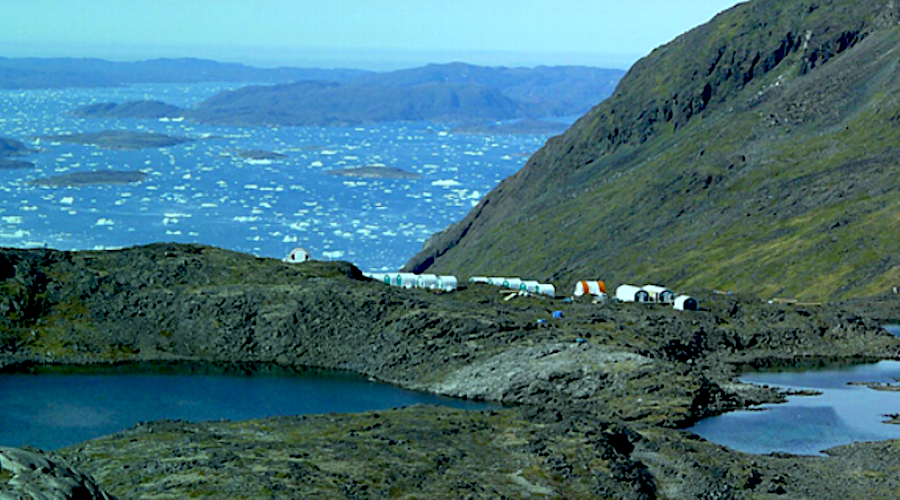
The Kvanefjeld rare earth project. (Image courtesy of Energy Transition Minerals.)

Energy Transition Minerals (ASX: ETM) said Tuesday that Greenland intends not to renew the exploration licence for its Kvanefjeld rare earths project.

The draft decision deals a fresh blow to one of the largest undeveloped critical minerals assets, which will consist of a mine, a concentrator and refinery.

It stems from the country’s 2021 Uranium Act, which effectively bans uranium prospecting, exploration and exploitation, and is the subject of ongoing legal proceedings challenging its application to Kvanefjeld.

ETM said similar licences have been renewed since the Act’s introduction, raising questions about regulatory consistency.

“This draft position appears inconsistent with the historical treatment of the project,” the company said in an emailed statement, noting Greenland had previously extended the licence even after the uranium legislation came into force and during active legal disputes.

ETM said the move risks sending a broader signal to investors at a sensitive time for Greenland, which sits at the centre of intensifying geopolitical competition over critical minerals supply. Western governments, including the US and Europe, are seeking to reduce reliance on China.

Mining is widely viewed as a pathway for Greenland to diversify its economy, so policy shifts that appear to change the rules may heighten concerns about regulatory stability and long-term commitment to the sector, ETM said.

The draft outcome also follows Greenland’s outreach to industry at January’s PDAC convention in Canada earlier this year, adding to questions about policy direction.

Shares of ETM fell 7.4% to A$0.050 in Sydney in the first session after a trading halt last week, giving the company a market value of about A$118.7 million. The broader S&P/ASX 200 rose 1.5%. Year-to-date, the stock has halved its value.

Spain support

The share price drop came despite ETM also securing foreign direct investment approval from the Spanish government for its proposed acquisition of the Penouta tin-tantalum mine.

The approval clears a key regulatory hurdle, confirms the investment meets national security requirements and endorses the company’s financial capacity and suitability to operate strategic assets in Spain, marking progress toward closing the deal.


Energy Transition Minerals faces likely licence renewal rejection for Greenland project


Greenland has informed Energy Transition Minerals of a potential rejection of its exploration licence renewal application for the Kvanefjeld rare earths project, the Australian miner said on Tuesday.

Shares of Energy Transition Minerals fell 5.6% to A$0.051 by 01:52 GMT as trading resumed after a halt on Thursday. The broader S&P/ASX 200 benchmark index was up 1.5%.

Kvanefjeld is a large-scale rare earths project with the potential to become a significant western world producer of critical minerals used in manufacture of consumer electronics.

Energy Transition Minerals said it had received a draft decision from the Greenland government indicating that the mineral resources ministry intended to recommend that the application be declined.

Greenland stated that the company’s exploration activities were “no longer considered to serve a purpose” and that a licence could not be granted under the current legislative framework, the company said in a statement.

The company noted the decision stemmed from a December 2021 law – the 2021 Uranium Act – that would effectively ban uranium prospecting, exploration and exploitation.

In 2023, Energy Transition Minerals filed a statement of claims with an arbitration tribunal in Copenhagen to decide on unit Greenland Minerals A/S’ legal right to be granted an exploitation licence for the project in relation to this law.

Greenland had previously granted licence renewals for the project, including during the course of active legal dispute and after the introduction of the 2021 Uranium Act, the company said, calling the draft position “inconsistent” with the historical treatment of the project.

(By Sherin Sunny; Editing by Sumana Nandy and Subhranshu Sahu)


Energy Transition Minerals Confronts Greenland Licence Rejection Risk


Energy Transition Minerals Ltd is facing a major regulatory setback after Greenland’s government signaled it intends to reject the renewal of the company’s exploration licence for the Kvanefjeld rare earth project, a move that could further complicate development of a strategically significant deposit.

The draft decision, issued by Greenland’s Ministry of Business, Mineral Resources, Energy, Justice and Gender Equality, argues that continued exploration no longer serves a purpose because an exploitation licence cannot be granted under the current legal framework. At the core of that framework is Greenland’s 2021 Uranium Act, which effectively prohibits uranium mining - a critical issue for Kvanefjeld, where uranium is present alongside rare earth elements.

ETM has pushed back strongly, emphasizing that the applicability of the Uranium Act remains under active legal challenge. The company argues that the government’s position represents a fundamental shift in regulatory treatment, particularly given that Kvanefjeld has previously received multiple licence renewals, including after the uranium legislation came into force.

The Greenlandic government has issued a draft recommendation to deny renewal of ETM’s Kvanefjeld exploration licence, citing the inability to secure a future mining permit under existing uranium-related legislation.

The company framed the draft decision as policy-driven rather than legally grounded, noting inconsistencies with past government actions. Notably, ETM pointed out that authorities had previously denied its request to suspend exploration expenditure obligations during ongoing legal proceedings - effectively requiring continued activity while now arguing that such exploration lacks purpose.

The dispute reflects broader tensions in Greenland over resource development, environmental concerns, and political sovereignty. The 2021 Uranium Act was introduced following elections that brought anti-uranium mining sentiment to the forefront, effectively halting progress on projects like Kvanefjeld despite their importance in global rare earth supply chains.

Kvanefjeld is widely regarded as one of the largest undeveloped rare earth deposits globally, with potential implications for supply diversification away from China. However, its association with uranium has made it politically contentious, placing it at the center of Greenland’s evolving mining policy.

ETM maintains that its rights as a long-standing licence holder are being undermined and has initiated legal proceedings to challenge the regulatory changes. Those proceedings remain unresolved and are likely to be pivotal in determining the project’s future.

The draft decision underscores rising geopolitical and regulatory risks in the critical minerals sector, particularly in jurisdictions balancing environmental, political, and economic priorities. For investors, the case highlights the vulnerability of long-cycle mining projects to policy shifts - even after years of exploration and capital investment.

ETM said it will formally respond to the draft decision and continue pursuing all legal avenues, signaling that the dispute is far from resolved.

By Charles Kennedy for Oilprice.com