Friday, April 10, 2026

DRAFT BARON BONESPURS

US ‘Automatic’ Draft Registration Begins in December


Amid war build-up, Selective Service System sends the White House its plan to identify and locate potential draftees

by  | Apr 10, 2026 |

On March 30th, the Selective Service System (SSS) sent the White House its proposed regulations for “automatic” [sic] draft registration for review and approval before they are made public. This is the first visible step in the transition from trying to get young men to sign themselves up for a military draft, to trying to sign them up “automatically” by aggregating data requisitioned from other Federal agencies.

This year-long process began with the enactment of the SSS proposal for “automatic” registration in December 2025. The new scheme is supposed to go into operation in December 2026.
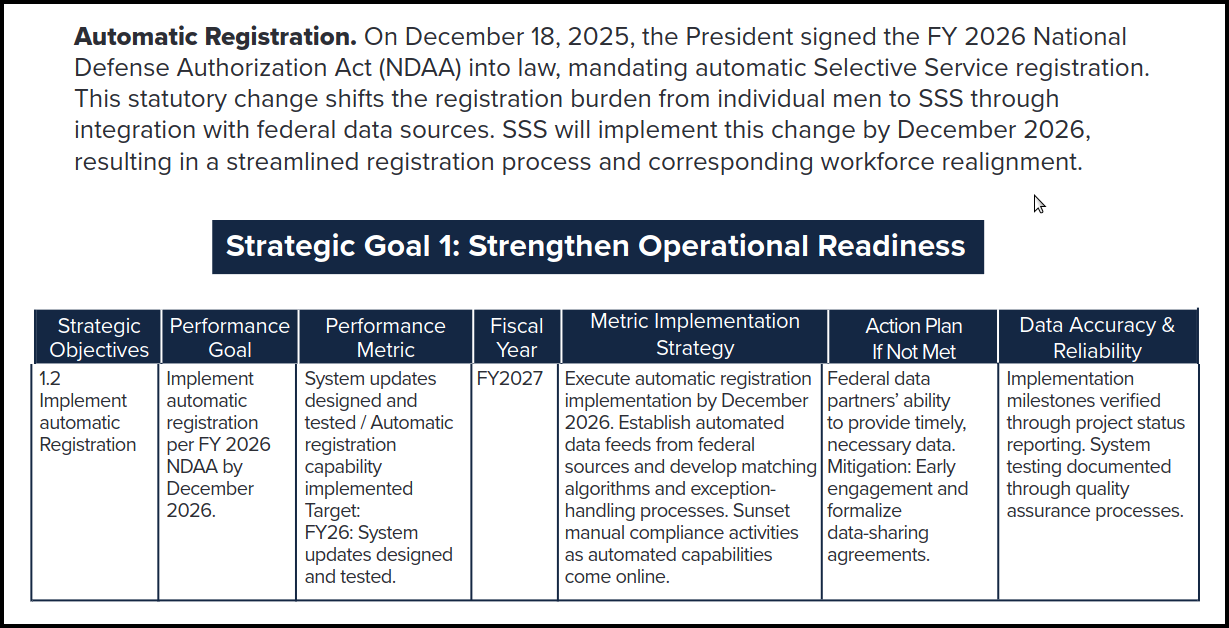
[Excerpt from Selective Service System FY 2026-2027 Annual Performance Plan]

The SSS has been keeping a low profile to avoid calling attention to its attempt to lay new groundwork for a draft in the middle of a major military escalation. The SSS hasn’t issued a press release in the four months since the enactment of the “automatic” registration law, has no details of its plans for “automatic” registration on its website, and has delayed responding to my FOIA request for those plans. This has led to hasty and credulous reports in the last few days by journalists who saw the notice of the proposed rules but hadn’t followed the legislation, didn’t know to expect this next step in the process, and weren’t aware of the widespread and increasingly organized opposition to this plan.

This isn’t a Trump 2.0 initiative. Documents released in response to one of my FOIA requests show that the legislative proposal for “automatic” draft registration was drafted during the Biden Administration by the former Trump 2016 Oregon state campaign director, Jacob Daniels. Still at the SSS today, Daniels is one of the Trump loyalists who got jobs at the SSS during Trump’s first administration. But both support and opposition to Selective Service has been and remains bipartisan.

Most of the latest news articles have said that all male U.S. citizens and residents “will be registered automatically” by the SS. What they should say is that the SSS will try to identify and locate all potential draftees. Whether that is possible, much less whether the SSS will succeed, is questionable.

In addition to the practical problems of determining who is subject to the draft (which is many cases depends on factors absent from existing Federal records) and their current postal mailing addresses (ditto), the switch to a new registration system requires jumping through many regulatory hoops. The eight months remaining before the new law takes effect aren’t much time to complete this process.

The law directing the SSS to try to register potential draftees “automatically” leaves most of the details to the SSS to establish through regulations. The SSS has completed the first step in this process by drafting proposed regulations and submitting them to the White House “Office of Information and Regulatory Affairs” (OIRA). OIRA has up to 90 days to review the proposed rules, approve them, or send them back to the agency for revision, but most OIRA reviews take significantly less time than this.

Once a proposed rule is approved by OIRA, the Administrative Procedure Act generally requires publication of the proposed regulations as a “Notice of Proposed Rulemaking” (NPRM) in the Federal Register, a window usually of at least 30 or 60 days for the public to submit comments on the proposal, and consideration of those comments by the agency before it publishes a final rule.

The NPRM for “automatic” draft registration could be published in a few weeks, or not for months.

The SSS is a tiny agency being given unprecedented authority to demand access to data from all other Federal agencies. The attempt to register potential draftees “automatically” will be a large, complex exercise in data collection, data sharing, and data matching between the SSS and other agencies.

Multiple elements of this process will require notice and comment and/or other approvals pursuant to the Privacy Act, Paperwork Reduction Act, and Computer Matching Act.

The SSS has a history of disregard for these requirements for notice, comment, and approval of its data collection, use, and sharing. If the SSS fails to promulgate the required notices or obtain the required approvals for “automatic” registration, those failings may provide a basis for lawsuits against the SSS.

The Privacy Act of 1974 requires each Federal agency to publish a notice in the Federal Register (with an opportunity for public comment) including specific information about each of system of records about U.S. citizens or residents. The notice must include the sources, recipients, and uses of the data. Maintaining such a system of records without first publishing a complete notice is a crime on the part of the responsible agency officials or employees. “Automatic” registration will require new sources of registration data from other agencies and therefore a revised Privacy Act notice.

Even before the start of “automatic” registration, the SSS gave DOGE access to the registration database in early 2025, and in late 2025 proposed sharing its registration data with more other agencies for immigration enforcement and other purposes.

Objections to that proposal were submitted by anti-militarist, civil liberties, and privacy organizations. It’s not clear whether those objections have been considered yet by the SSS.

The Paperwork Reduction Act requires an agency to publish first a 60-day notice and then a 30-day notice in the Federal Register and then get approval from the Office of Management and Budget (OMB) before collecting information from members of the public. The OMB approval number must be included on any form, Web site, or app through which information is collected.

The SSS has been collecting information for decades through its “Request for Status Information Letter” form, but has never requested or received approval from OMB for this form. The form does not display an OMB control number, making it flagrantly illegal.

The “automatic” registration law allows the SSS to demand information from a registrant if it is needed to complete their “automatic” registration. The new forms and/or Web pages to be used for this purpose will need to be published for comment and will then need OMB approval. Because of the two required notice-and-comment periods, this process takes at least three months.

The Computer Matching and Privacy Protection Act of 1988 requires advance notice in the Federal Register, a Privacy Impact Assessment, due-process procedures for individuals who are denied benefits on the basis of data matching, and an annual cost-benefit review and report to Congress for each data matching program by a Federal agency that is used to determine eligibility for, or compliance with, any Federal benefit program.

The SSS has argued that this law didn’t apply to any of its activities, at least prior to the attempt at “automatic” registration. None of the Computer Matching Act notices required annually for each daat matching program have been published by the SSS in the Federal Register since 2017.

New and expanded computer matching programs will be central to the attempt to register potential draftees “automatically”. These programs will be subject to the Computer Matching Act. It remains to be seen whether the SSS will continue to ignore this law even as it dramatically expands its computer matching programs.

Meanwhile, there’s still a chance for Congress to recognize its mistake and avert this impending fiasco by repealing the Military Selective Service Act (MSSA) before the attempt at “automatic” registration begins. The Selective Service Repeal Act could be reintroduced as a standalone bill, and/or proposed as an amendment to the NDAA for Fiscal Year 2027. The NDAA will probably be enacted by the “lame-duck” Congress in late 2026, after the elections but before new members of Congress are seated.

“Automatic” registration was enacted with no public awareness, hearings, debate, or budget review. It’s a bad idea, and it won’t work. The chances for repeal of the MSSA may depend on how soon and how widely “automatic” draft registration is recognized as not only bound to fail but a data grab for DOGE and an enabler of more aggressive war planning and policies.

The task of anti-draft awareness-bulding, mobilization, and action is increasingly urgent and important in the face of new military escalations. Repeal of the MSSA should be on the agenda of all anti-war organizations and a demand raised at all anti-war actions.

Edward Hasbrouck maintains the Resisters.info website and publishes the “Resistance News” newsletter. He was imprisoned in 1983-1984 for organizing resistance to draft registration.

REVANCHIST REACTIONARIES

Argentina lawmakers approve glacier law reform to boost mining

09.04.2026, dpa

Photo: Fede J. Ciarallo/dpa

Argentina's lower house of Congress on Thursday approved a controversial reform of the country's glacier protection law, easing environmental safeguards to allow new economic projects, particularly in mining.

Lawmakers voted 137 to 111 in favour of the measure after hours of debate, the newspaper La Nación reported. The upper house had passed the bill in February.

Under the reform, only glaciers and surrounding high-altitude areas deemed essential to water supply will remain under strict protection. Provincial authorities will play a central role in determining which areas qualify.

The government of right-wing libertarian President Javier Milei described the overhaul as "historic," saying it would restore "genuine environmental federalism" and enable a more pragmatic approach to resource use.

Officials argue the previous law discouraged investment and led to legal uncertainty. The reform is intended to unlock billions of dollars in projects, particularly in lithium extraction and mining.

Opponents say the changes weaken environmental protections and favour the mining industry. Several opposition lawmakers have said they plan to challenge the reform in court, arguing it may be unconstitutional.

Argentina has enforced comprehensive glacier protections since 2010, banning most industrial activity in and around roughly 17,000 glaciers, as there are considered critical water reserves.

The country's glaciers have been shrinking for years, largely due to climate change. Milei denies that Earth's rising temperatures are driven by human activity.

Inside Israel's expansionist ambitions


Djamilia Prange de Oliveira
DW
10/04/2026 


Israel has never officially defined its borders, but Israeli settlers and ministers are flirting with the biblical idea of extending them far beyond the current state. What's behind the concept of "Greater Israel"?


Daniela Weiss holds a laminated map of the Middle East with the title "The Promised Land" into the camera and says: "This is the promise of God to the patriarchs of the Jewish nation."

The map shows a Jewish state that encompasses parts of Jordan, Lebanon, Egypt, Iraq, Syria and Saudi Arabia – extending way beyond the 1949 armistice line, the so-called Green Line that defines Israel's territory according to international law.

"It's 3,000 kilometers (1,864 miles) – almost as big as the Sahara desert," Weiss adds.

Weiss – sometimes nicknamed "the godmother of the Israeli settler movement" – is referring to the idea of "Greater Israel", or in Hebrew "Eretz Israel HaShlema" – "Complete Israel." It's an expansionist concept popular among the Israeli far right that originates in the Bible.

Settler leader Daniela Weiss at a right-wing rally near the Gaza Strip in July 2025Image: Menahem Kahana/AFP

"For the proponents of the settlement policy like Bezalel Smotrich, the current finance minister, or Itamar Ben Gvir, the national security minister, it's not about making Israel greater than it actually should be," Gil Shohat, a historian and director of the Rosa Luxemburg Foundation in Tel Aviv, tells DW.

"It's about completing the job. This means that the claim to the whole of historical Palestine or 'Eretz Israel', as they frame it, is a divine promise," he adds.

Some Israelis interpret "Complete" or "Greater Israel" to include the territory Israel seized in 1967: The Occupied Palestinian Territories (OPT) — the West Bank, East Jerusalem and Gaza — as well as the Israeli-annexed Golan Heights in Syria and the Sinai Peninsula in Egypt that Israel returned decades ago. Others aim for the entire area promised in the Bible, stretching from the Egyptian Nile River to the Euphrates River, which flows through Turkey, Syria and Iraq.

Weiss' words are from a 2014 interview with Australian channel ABC News, but her ideas have only gained traction in Israeli politics since, as Israel continues its multi-front war across the Middle East.

'Greater Israel' in current politics

In March 2023, Israeli Finance Minister Bezalel Smotrich caused diplomatic turmoil when he spoke at a Paris memorial behind a podium featuring a "Greater Israel" map that included not only the territories Israel currently occupies but also Jordan.

A year later, he told the German-French channel ARTE that "the future of Jerusalem is to expand to Damascus," referring to the Syrian capital.

Israeli Finance Minister Smotrich holds a map of the settlement project known as E1 in the occupied West Bank in August 2025Image: Ohad Zwigenberg/AP Photo/picture alliance

In September 2024, when speaking about his plans for "the day after" the Israel-Hamas war in Gaza, Israeli Prime Minister Benjamin Netanyahu presented a map that fully annexed the West Bank.

In August 2025, he told the Israeli channel i24NEWS that he was "very much" connected to the vision of "Greater Israel," prompting Egypt and Jordan to demand clarifications from Israel.

And just a few months ago, in February 2026, the US Ambassador to Israel, Mike Huckabee, told American talkshow host Tucker Carlson that it would be "fine" if Israel took over the entire Middle East.

The origins of 'Greater Israel'


In the biblical story (Genesis 15:18-21), God promises Abraham and his descendants a territory from the Nile to the Euphrates River. This vision was later picked up by some Jewish religious and nationalist thinkers and became a foundational element of Zionist ideology.

Zionist thinkers including Theodor Herzl and Ze'ev Jabotinsky referenced these biblical boundaries in their writings. Herzl called the idea of the biblical homeland "excellent" in his diaries, and Jabotinsky echoed this vision in his song "The East Bank of the Jordan". Each verse ends with the line: "The Jordan has two banks – this one is ours, and so is the other."

The song later became the theme of Jabotinsky's Revisionist Zionist youth movement, "Betar." Benjamin Netanyahu's father, Benzion Netanyahu, was active in Jabotinsky's Revisionist Zionist movement and served briefly as a close aide to Jabotinsky before his death.

Historian Gil Shohat says that for figures of Israel's far right, "Greater Israel" is a divine promise
Image: Rosa Luxemburg Stiftung

Israel's first prime minister, David Ben-Gurion, also flirted with the idea of "Greater Israel" but ended up taking a more pragmatic approach. Before thinking about expansion, he tactically prioritized the establishment of a sovereign Jewish state. But he deliberately left Israel's borders undefined in the 1948 Declaration of the Establishment of the State of Israel, creating strategic ambiguity for future expansion.

In a 1937 speech, he said: "The acceptance of partition does not commit us to renounce Transjordan: one does not demand from anybody to give up his vision. We shall accept a state in the boundaries fixed today, but the boundaries of Zionist aspirations are the concern of the Jewish people and no external factor will be able to limit them."

Expansion is already reality

Israel expanded its borders beyond what was proposed in the UN Partition Plan in 1947. The plan allocated about 56% of former British Mandatory Palestine to a future Jewish state, but after the 1948 Arab-Israeli War, Israel controlled about 77%.

Since occupying East Jerusalem, the Gaza Strip and the West Bank in 1967, Israel effectively controls nearly all of former Mandatory Palestine, in addition to the Golan Heights.

The international community does not recognize these areas as part of sovereign Israeli territory. But most Israelis do, says Shohat: "It's been almost 60 years since Israel occupied these areas. Even in textbooks of more liberal schools in Tel Aviv, the map of Israel includes the West Bank and Gaza."

Today, more than 700,000 Jewish Israeli settlers live in the occupied West Bank and in East Jerusalem, according to the United Nations. Estimates for the Golan Heights range between 23,000 and 31,000 settlers, along with some 20,000 Druze who remained there when Israel seized the area.

The UN views all Israeli settlements beyond the Green Line as a violation of international law, and in an advisory opinion of 2024, the International Court of Justice found the occupation to be illegal.

After the territorial expansion following the 1967 war, the idea of "Greater Israel" gained momentum. Today, it remains influential among some far-right Israeli religious and nationalist groups, but is not a mainstream position in Israeli society, says Shohat.

"The occupation of historical Palestine — so basically Israel, the West Bank and Gaza — is normalized. I do not yet see the trend of normalizing permanent settlements in southern Lebanon, or even in parts of Syria. But this does not mean that the situation in these regions cannot develop into permanent settlement if there is no meaningful international and internal opposition to it."

But even though it is not a mainstream position in Israeli society, the idea of territorial expansion has long permeated key parts of the Israeli government. In March 2026, Finance Minister Smotrich called for the annexation of southern Lebanon.

In a 2024 conference hosted by Nahala, Weiss' settler organization, Finance Minister Smotrich, Security Minister Ben Gvir and settler leader Weiss lobbied for the "voluntary emigration" of Palestinians from Gaza.
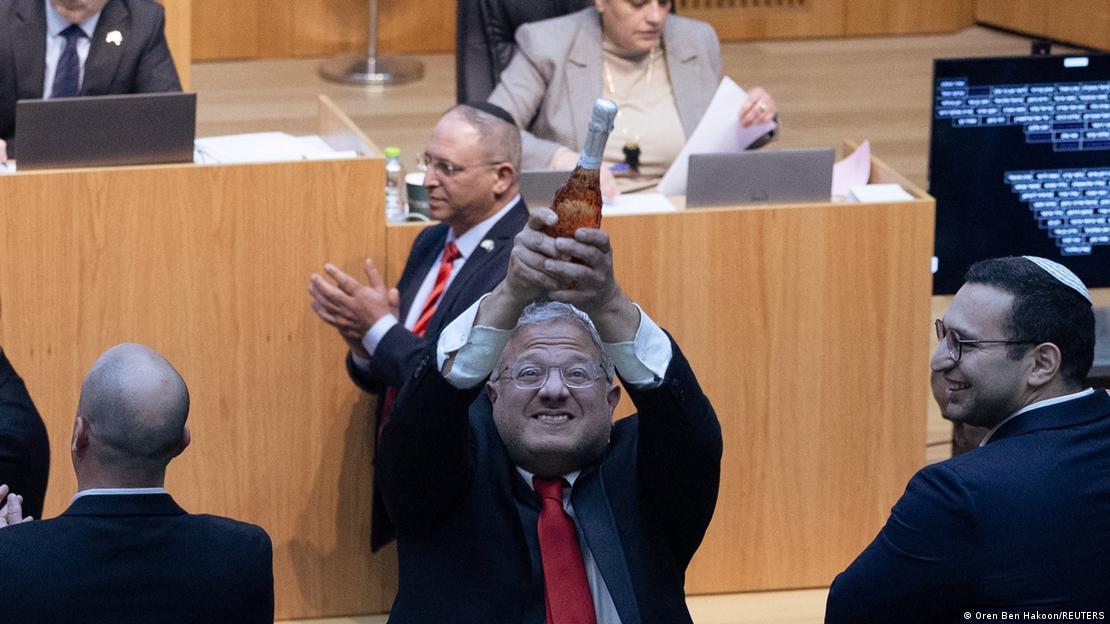
Itamar Ben Gvir celebrates Israel's new death penalty law for Palestinians on March 30, 2026 in the Knesset
Image: Oren Ben Hakoon/REUTERS

On stage, Ben Gvir said: "If we don't want another October 7, we need to go back home and control [Gaza]. We need to find a legal way to voluntarily emigrate [Palestinians] and impose death sentences on terrorists."

Two years later, Ben Gvir got a step closer to what he wanted. On March 30, the Knesset, Israel's parliament, approved a law imposing the death penalty on Palestinians convicted of fatal attacks.


Edited by: Kyra Levine and Sarah Hofmann

Djamilia Prange de Oliveira Reporter with a special focus on women's rights, culture, social policy and Brazil.

Recycling's next big thing — or big bluff?
DW
10/04/2026 


An advanced recycling process claims it can handle hard-to-recycle plastics, like packaging. But critics say it's not worth the effort.


Image: James Arthur Gekiere/BELGA/picture alliance

In a brightly-lit room in Houston, Texas, environmental activist Malachi Key is searching through a pile of trash. He picks up a used chicken salad box, which like the other waste in the heap is being sent off for recycling, and slips a tracking device inside.

In 2022, the city introduced a program that promised to give up to 90% all plastics, even those that are hard to recycle, a new lease on life. It's a significant claim, given that the US average is less than 10%.

But Key said the scheme, which is a partnership with plastic industry leaders like ExxonMobil, LyondellBasell and Cyclyx International, is "too good to be true." Hence the tracking.

This is not the first time he and his fellow activists with environment nonprofit Air Alliance Houston have played sleuth. In the past year and a half, they've counted 14 times when their plastic trash was in fact moved to a third-party storage site and simply left there.

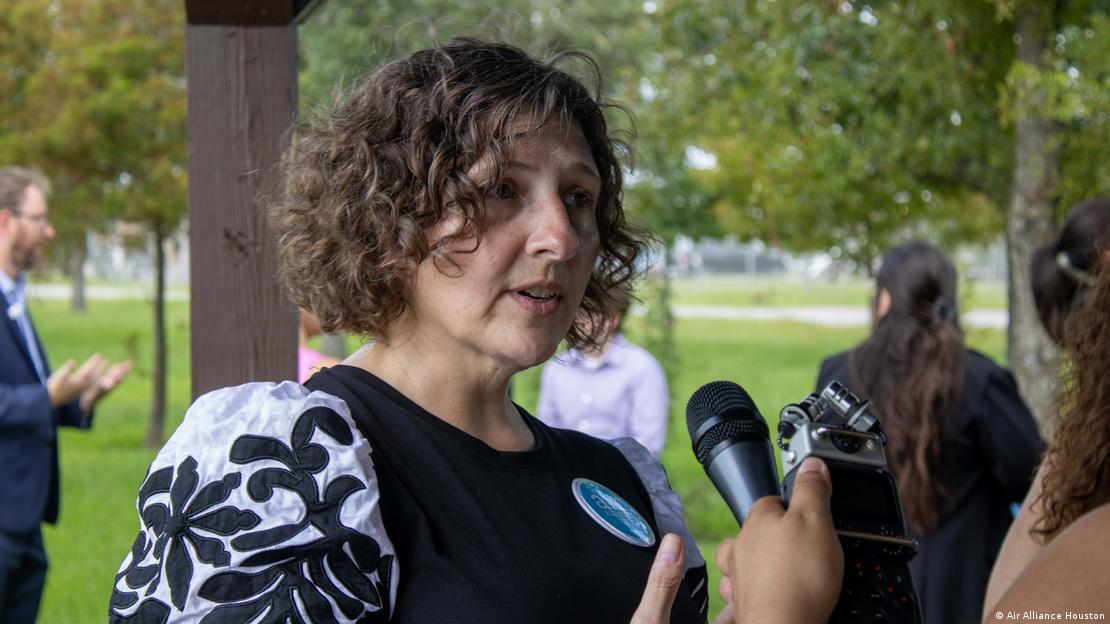
"The accumulated plastic was not actually being recycled," said Jen Hadayia, executive director of Air Alliance Houston. "Not in any way, shape or form in the way that the City of Houston had been saying."

Plastic production to double by 2050

The city's promised new program is an advanced process that can tackle unrecyclable single-use plastics, such as bread wrappers, juice pouches or yoghurt pots. Attracting millions of investment dollars from across the United States and Europe, the emerging industry says by using heat, enzymes or solvents, it can break stubborn plastics into smaller chemical compounds.

These are then turned back into their original chemical building blocks for use in making recycled plastics said to be indistinguishable from the virgin stuff — effectively meaning the material could be remade over and over again. Such is its apparent promise that the American Chemistry Council has heralded advanced recycling as "a breakthrough for reclaiming used plastics" which can "help lead to a circular economy."

Environmental, health risks with chemical recycling

Despite the advertised circularity, critics say the technology is not all it's cracked up to be.

Lee Bell, a technical adviser to the global nonprofit International Pollutants Elimination Network, points to the "something like 14,000 chemicals that are used as additives in plastics." He said more than a quarter are so hazardous they have to be stripped out and treated as waste, which is a flaw in the circular system.

"If they do manage to strip the polymers and monomers of these chemical additives and other contaminants, they generate enormous hazardous waste streams," he said.

That isn't the only issue. Veena Singla, a public health scientist affiliated with the University of California San Francisco, said the recycling facilities themselves can pose environmental and health risks.

"In the US, just three chemical recycling facilities generated more than 900 metric tons of hazardous waste in about three years," she said, adding that they are allowed to emit health-harming air pollutants linked to respiratory illness, cancer and disorders of the nervous system.

And despite the claim that the recycling industry is only creating new plastic for reuse, Singla said the plants are also making fuel to be burned. Which leaves less recycled material and a greater need to produce more virgin plastic.


The Houston Ship Channel serves as the hub for over 600 petrochemical plantsImage: David J. Phillip/AP Photo/picture alliance

Globally, we produce more than 400 million tons of new plastic every year, and that figure is expected to double or even triple by 2050. Ultimately, Lee said he thinks chemical recycling is largely "a propaganda exercise designed to divert attention away from increasing plastic production and plastic pollution that's occurring in the environment."

Chemical recycling struggles to get off the ground

The American Chemistry Council has said it believes the US could support 150 plants, which could result in $12.9 billion (€11.2 billion) of annual economic output.

But progress is slow. Bell said there were 11 operational facilities across America in 2023. Since then, four have shut down, either due to bankruptcy or the fact that they were not able to produce sufficient material to remain financially viable.

Of those currently still operating, just one is in the greater Houston area, which as a plastics production hub is home to hundreds of petrochemical companies. The facility is owned and operated by energy giant Exxon Mobil, which says it has already processed more than 68,000 metric tons of plastic waste into new products and fuels.

Still, Hadayia, of Air Alliance Houston, called it's a "false solution" for Houstians, who like the idea of companies coming up with a way to address some of their plastic waste.


Hayayia of Air Alliance Houston has called chemical recycling a 'false solution'
Image: Air Alliance Houston

But Exxon Mobil said activists clinging to a "narrow definition" of recycling is "propaganda" which "hurts the planet."

Plastic strategy a 'false solution,' say activists

It's still early days for the industry, but Bell sees a fundamental problem with the business model: it costs more to create new plastics from old, than to start fresh with raw materials — sourced from fossil fuels.

"You have to compete against virgin petrochemicals, plastics and when the price of oil is low, they cannot compete. It's simply not possible," he said.

Back in Houston, after a two-month wait, the activists could tell that the salad box containing the hidden tracker still hadn't been picked up. So it was no closer to being recycled.

The City of Houston declined to comment, saying it only collects from designated points across the city. At current count, there are just nine of them in a city of almost 2.5 million people.

While private companies involved in the recycling collaboration have previously said they are building a joint sorting center, for Hadayia, there is another solution.

"We didn't always rely on single-use plastic in the way we do now. We didn't always walk into a grocery store and all of our fruit was cut up for us and packaged in single use plastics," she said. "Bottom line, the true upstream solution to plastic waste is to reduce single-use plastic."

This article was based on an episode of Living Planet reported by investigative journalists Dan Ashby and Lucy Taylor.

This investigation was supported by a grant from the Investigative Journalism for Europe fund (IJ4EU). It was coordinated by Ludovica Jona, with reporting by Staffan Dahllof, Yann Philippin, Begona Ramirez, Lorenzo Sangermano and Stefano Valentino. Sound design was by Jarek Zaba.

Edited by: Tamsin Walker

Martin Kuebler Senior editor and reporter based in Brussels, with a focus on environmental issues

Germany's Daimler Truck feels the pinch in US with sharp sales drop

10.04.2026, DPA

Photo: Bernd Weißbrod/dpa

A weak US market and declining bus sales have led to a further drop in Daimler Truck's sales in the first quarter, resulting in a 9% decline compared with the same period last year, the company reported on Friday.

The German commercial vehicle manufacturer said it sold 68,849 trucks and buses worldwide between January and March.

The US subsidiary recorded the sharpest fall. Sales dropped 25% to 29,432 vehicles in the first quarter.

Daimler Truck said the market is weakening as freight companies hold back on new orders. It cited uncertainty linked in part to US tariffs, which make future freight volumes harder to forecast.

By contrast, sales of Mercedes-Benz Trucks rose 13% to 34,486 vehicles. The company did not provide an explanation for the increase.

Bus sales fell by 20% to 4,972 vehicles between January and March. Daimler Truck did not comment on the reasons for the decline.

The company plans to provide more detailed financial and operational figures when it publishes its quarterly results on May 6.

Profit under pressure

Daimler Truck has been facing weaker performance overall. Full-year profit fell 34% to €2 billion ($2.3 billion) in 2025, hit by weak demand in North America and tariff-related uncertainty.

Revenue declined 9% to around €49.5 billion, while sales fell 8% to 422,510 vehicles.

To improve competitiveness, the company launched a cost-cutting programme called "Cost Down Europe" last year.

It aims to reduce costs in Europe by more than €1 billion by 2030 and includes plans to cut around 5,000 jobs in Germany, with the Mercedes-Benz brand most affected.

Additional savings measures are also planned in North America.

Guinea-Bissau on edge after activist's killing

Antonio Cascais
DW
April 9, 2026

The death of activist Vigario Luis Balanta, found with signs of extreme violence, has triggered protests and accusations against Guinea-Bissau's military rulers, raising concerns over repression and media freedom.

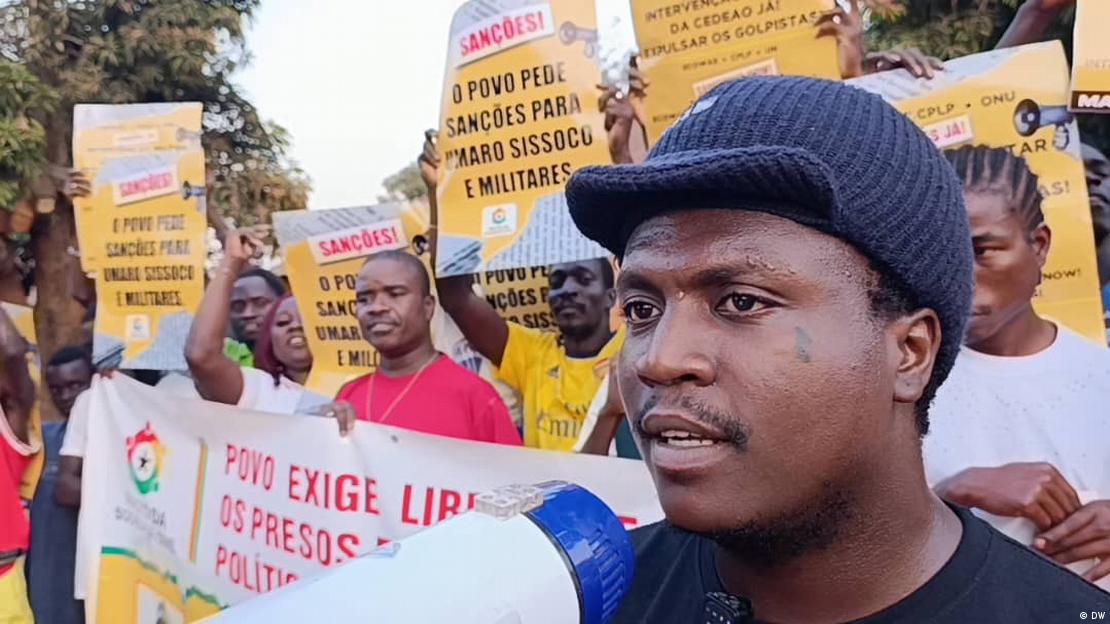
Several hundred people gathered in Bissau after Balanta's funeral
Image: DW


At the end of March, residents discovered a lifeless body in a remote, swampy area about 30 kilometers (19 miles) outside Bissau, the capital of Guinea-Bissau.

It was "covered in blood," "wounded all over with a bladed weapon" and there were "two bullet holes in the head," a witness told the AFP news agency.

The victim was Vigario Luis Balanta, a 35-year-old teacher and a prominent critic of Guinea-Bissau's military leadership that had seized power in a coup four months earlier, ousting outgoing President Umaro Sissoco Embalo.

Balanta was a leading figure in the civil society movement Po di Terra (Dust of the Earth) who, according to Radio France Internationale (RFI), had previously been reported missing before being released.

In late March, he was kidnapped in the Pilun district of Bissau. Two days later, his body was discovered. The United Nations called it a "brutal killing."


The body of the 35-year-old activist was found in the rice fields of Ndam Lero, just outside Bissau [FILE: November 2025]Image: DW

In Balanta's last public interview with DW in January, he remained defiant.

"We will keep going," he said. "We have to act strategically and mobilize the people."

He described Po di Terra as a movement rooted in love for the country and a determination to defend it.

"Despite the fear in the population, support is strong," Balanta told DW.

Accusations against military-linked forces


Civil society groups, including Po di Terra and the Bissau-Guinean League of Human Rights, have accused the transitional military regime — or forces aligned with it — of orchestrating Balanta's killing.

Seif Magango, spokesperson for the UN human rights office (OHCHR), said in a statement that Balanta's death "comes amid a progressive reduction of civic and democratic space, which has accelerated in Guinea-Bissau since the November 2025 coup."

"Members of the opposition and human rights defenders have been arbitrarily detained, assaulted, harassed and intimidated, demonstrations dispersed and radio stations suspended," Magango added.

Activist Sumaila Jalo described the killing as a warning to all who oppose the regime.

"We are afraid, but we will not be silent. The fight for justice continues," he told DW.

The military government condemned the killing, calling it a crime "under particularly violent circumstances" and pledging to investigate thoroughly, holding both the perpetrators and their potential backers accountable. The pledge has been met with skepticism from critics.

Funeral protest highlights growing public anger

Balanta's funeral in early April became a protest against the military rulers. Hundreds gathered at Antula Cemetery in Bissau, chanting: "We are all Vigario," "We want justice," and "Down with the dictatorship."

The Guinean diaspora also organized solidarity demonstrations, including in the Portuguese capital, Lisbon, calling for accountability.

Political tensions have risen after the government ordered private radio stations in Bissau to close, citing unpaid licensing fees of 5 million CFA francs (around $9,000). While broadcasts resumed after talks with Prime Minister Braima Camar, negotiations continue, leaving the state of press freedom uncertain.

At the same time, residents report severe fuel shortages, with long lines outside gas stations. The government denies there is a shortage.

The prime minister has publicly warned against "misinformation," and observers say some citizens reporting shortages have faced intimidation. Tensions in Bissau remain high.

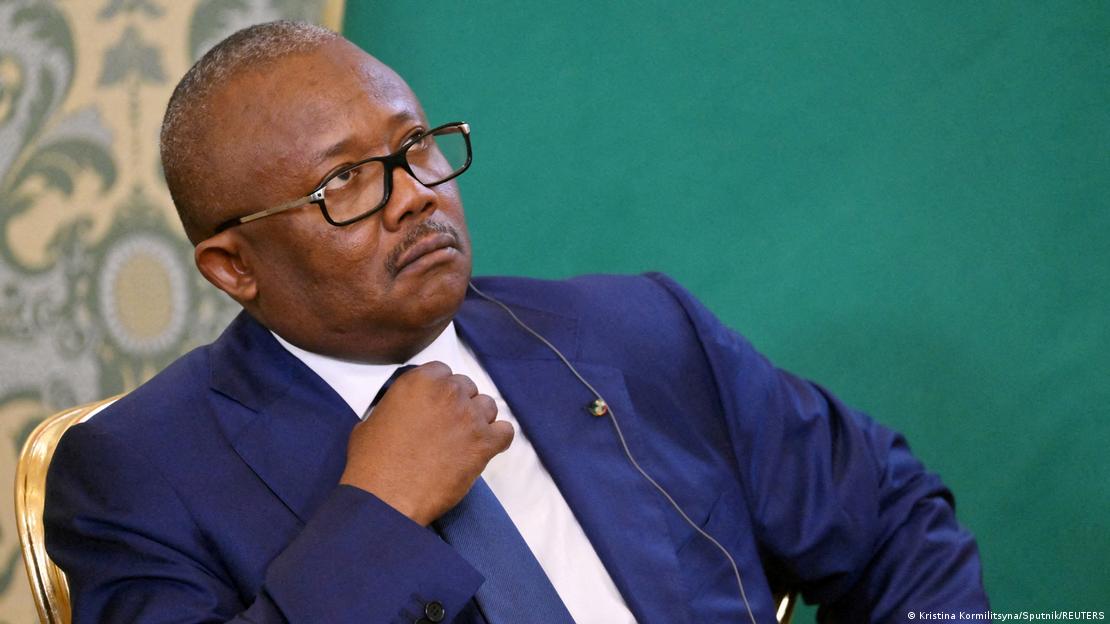
Critics accuse former Embalo of oppressing opposition figures, journalists and rights activists [FILE: February 26, 2025]Image: Kristina Kormilitsyna/Sputnik/REUTERS

The military under General Horta N'Tam, has announced plans to hold presidential and legislative elections in December and return to civilian rule.

Former President Embalo, whose current whereabouts are unknown, has been accused by opposition figures and observers of orchestrating the coup to avoid losing the election and stepping down.

Guinean economist and diplomat Carlos Lopes said several scenarios are possible, including that Embalo may have initiated the coup himself but now has less control over the junta than he intended.

Such dynamics are not unusual: "Revolutions often consume their own children — especially in Guinea-Bissau," Lopes said.


This article was originally published in German.


Antonio Cascais Award-winning documentary filmmaker and investigative journalist

Zambia: Is the US trading HIV treatment for resources?
DW
10/04/2026

The US is reportedly leveraging health aid to gain access to Zambia's critical minerals. Millions depend on US funding for HIV, tuberculosis and malaria treatment. Yet Zambia is hesitant to agree

Zambia is the second largest copper producer in Africa, and the US is seeking greater access to the country's mineral resources
Image: Damian Gillie/Construction Photography/Photosh/picture alliance

More than a million people in Zambia are living with HIV, one of several African countries where the United States' President's Emergency Plan for AIDS Relief (PEPFAR) program has been a cornerstone for the financing of life-saving medical treatment for more than two decades.

During this time, Zambia has made significant progress in battling the disease, with new HIV infections dropping from 63,000 to 30,000 between 2010 and 2025, according to the United Nations. But the southern African nation is reportedly reluctant to sign a new deal with the US, which ties this critical lifeline to demands for greater access to its critical minerals.

In late March, The New York Times reported it had obtained a memo prepared for Secretary of State Marco Rubio, which outlined how the US could withdraw health support "on a massive scale" to force Zambia and other countries to accept US terms.

From aid distribution to bilateral agreements


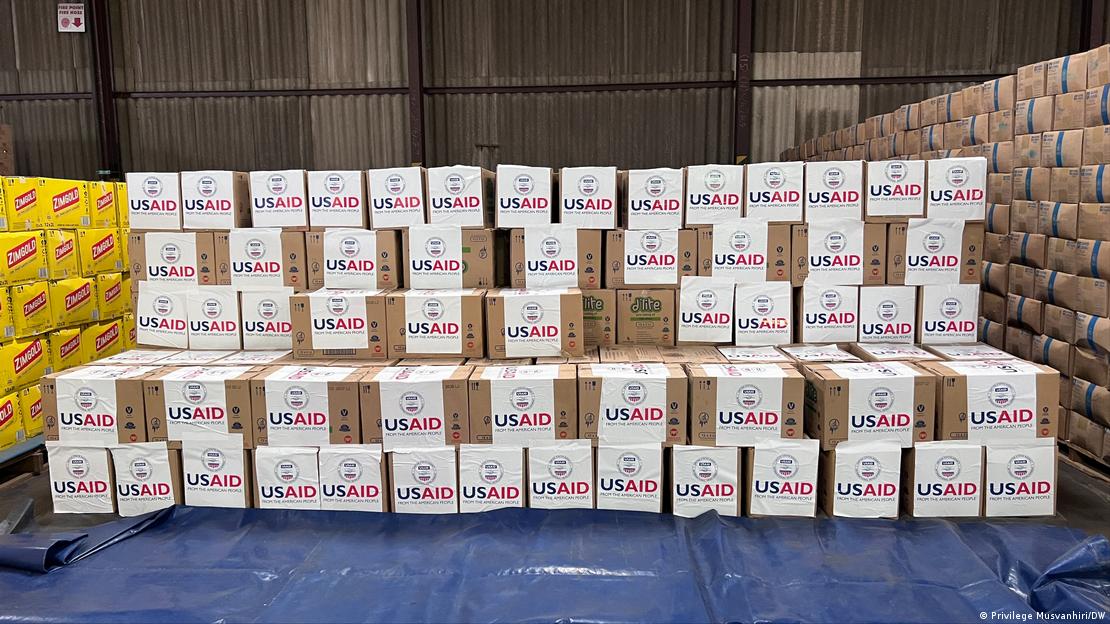
After dismantling USAID, the world's largest foreign aid agency, last year, the Trump administration has sought to replace decades of aid with new bilateral deals, called Memorandums of Understanding (MOUs), as part of the America First Global Health Strategy.

In a written statement to DW, the US State Department said it sought to partner "with select countries" to "transition from a foreign assistance paradigm to an investment and growth paradigm."

Details on many remain undisclosed, but the State Department said MOUs represented over $20.6 billion (€17.6 billion) in new health funding to fight HIV/AIDS, malaria, tuberculosis and other infectious diseases. Across Africa, 23 countries have so far signed bilateral deals with the US.

USAID officially shut down in July 2025, and its closure was felt significantly in Africa's health sector
Image: Privilege Musvanhiri/DW


But two countries are pushing back: Zimbabwe and Zambia.


"[The Trump administration is] fundamentally adopting a radically different approach to this than the US government has used in the past," said Conor Savoy, a visiting fellow at the Center for Global Development and formerly a foreign policy engagement lead at USAID.

US pressures African countries to accept health deals

Zimbabwe has walked away from negotiations, calling US demands on data and biological samples "lopsided" and an "intolerable infringement on sovereignty."

Kenya's government accepted a deal. However, activists with similar data privacy concerns have taken it to court.

For months, the US has been trying to reach a deal with Zambia. In February, its government said the American proposal did not align with the country's interests. The US is proposing $1 billion in health funding over five years, less than half of what Zambia received before Trump took office.

Zambia must also commit $340 million in new health spending, and the US has demanded biological and specimen data for 25 years. It has reportedly until May to sign or lose funding.


Zambia has already increased its own health contributions, including some HIV programs. However, scaling up health spending cannot happen overnight, according to Savoy.

"Their systems are simply not at a place where they can take on the entire challenge of health funding," he told DW.

Another reported demand from the US is access to Zambia's critical minerals. The country has significant reserves of nickel and cobalt, and is one of the world's largest copper producers.

Earlier this year, the Trump administration launched Project Vault, aiming to counter China's dominance in rare earth minerals. But reports of trading health aid for minerals is concerning to experts.

"We're playing with fire here ultimately and it could further erode confidence and credit and our credibility on the continent," said Savoy.


HealthGAP, a health advocacy organization working in Zambia, reported that activists are "demanding a rejection of deals conditioning funding access to mining."
Which countries have agreed to US mineral deals?

Many African nations have already signed MOUs with the US. "There are countries that want these types of investments, and they're going to be open to them," said Savoy.

It's difficult to confirm whether critical minerals have been a condition in other deals. For instance, the Democratic Republic of Congo has signed both a health agreement and a separate minerals deal with the US.

Some countries may welcome mineral agreements with the US.


"A lot of countries in the region have tried to look at diversifying away from China," Savoy said. But he argued health and economic deals with the US should be kept separate.

"This effort, especially in Zambia, could seriously undermine our credibility. At the end of the day we're doing essentially what the US government has accused the Chinese of doing for the past two decades in Africa."

Concerns increase for Zambian HIV patients

If a deal is not reached and the US does reduce its financial support on "a massive scale," the effects could be felt quickly.

Oxfam recently warned the deals are "effectively threatening the health and well-being of thousands by turning humanitarian assistance into a bargaining chip."

For 1.3 million Zambians that could mean losing daily life-saving HIV treatment, which had helped cut AIDS-related deaths in the country by over 70% in the last 15 years.

Zambia's health ministry was contacted for this article, but had not responded at the time of publishing.

Edited by: Cai Nebe

Amy Stockdale Author and multimedia journalist from Northern Ireland.