Thursday, April 16, 2026

What’s In Your Gasoline? Understanding U.S. Motor Gasoline Formulations – Analysis

April 16, 2026 

By EIA

Motor gasoline in the United States is a blend of hydrocarbons and chemicals, with specific formulas varying by region and season. To meet federal air quality standards, the U.S. Environmental Protection Agency (EPA) and state regulators require different formulations, depending on air quality and location, which affect performance, cost, and emissions. In addition, warmer summer months require a different gasoline formulation than cooler winter months. Key differences between formulations include octane rating, volatility—commonly measured as Reid vapor pressure (RVP)—and emissions. This year, the EPA will relax federal enforcement of summer RVP standards to help reduce gasoline prices.


What are the main types of gasoline formulations in the United States?


There are two main types of gasoline: Conventional gasoline is the standard gasoline blend used in areas of the United States that meet federal air-quality standards. Conventional blend gasoline meets basic federal limits on emissions and volatility. Most of the United States uses this formulation.
Reformulated gasoline (RFG) is required by the Clean Air Act in areas with high smog. RFG burns cleaner than conventional gasoline but is typically more expensive to produce. Approximately 25% of U.S. gasoline sales are RFG, according to the EPA.

Both types of gasoline are available in different octane ratings (regular, midgrade, premium) and are usually blended with ethanol. In addition to conventional and reformulated gasoline, refiners adjust gasoline blends for summer and winter.


Why do gasoline formulations change seasonally?

The EPA uses RVP to regulate gasoline volatility: the lower the RVP, the less volatile the gasoline and the less evaporative the emissions. To reduce smog-forming emissions, the EPA mandates that summer grade gasoline has a lower RVP (less volatility) to control evaporation, which would normally increase in warm weather. In cold weather, higher volatility helps engines start more easily.

How do RVP limits change across regions?

During the summer season, EPA limits gasoline in the continental United States to an RVP of no more than 9.0 pounds per square inch (psi). However, regulators apply stricter limits in areas with air quality issues, including:Gasoline with a RVP no higher than 7.8 psi in areas requiring federally mandated gasoline

RFG program gasoline with RVP no higher than 7.4 psi in federally designated areas
Gasoline made to specification for State Implementation Plans (SIP) that are more stringent than federal requirements

How does the RVP limit change through the year?

The summer season for retailers and wholesale purchasers runs from June 1 to September 15. For refiners and bulk terminals, it starts earlier, running from May 1 to September 15, to allow time for supplies of summer-grade gasoline to get from producers to retailers. Some areas require longer periods for summer-grade gasoline use to further control emissions. Although not mandated, switching back to winter-grade gasoline in the fall is common because of its lower production cost.

Why is gasoline with lower RVP more expensive?


Gasoline with lower RVP is more expensive to produce because it requires pricier components for blending. For example, butane, a low-cost octane booster, has high RVP that limits its use in summer or RFG blends. Instead, lower RVP gasoline uses more expensive components such as alkylate to maintain octane while reducing RVP, contributing to higher retail prices.

Do all states follow the same rules?

Not exactly. The EPA sets federal standards but allows states or regions to set stricter gasoline specifications. Arizona, for example, requires the use of Cleaner Burning Gasoline (CBG) in parts of the state. California has stricter requirements than the federal government.
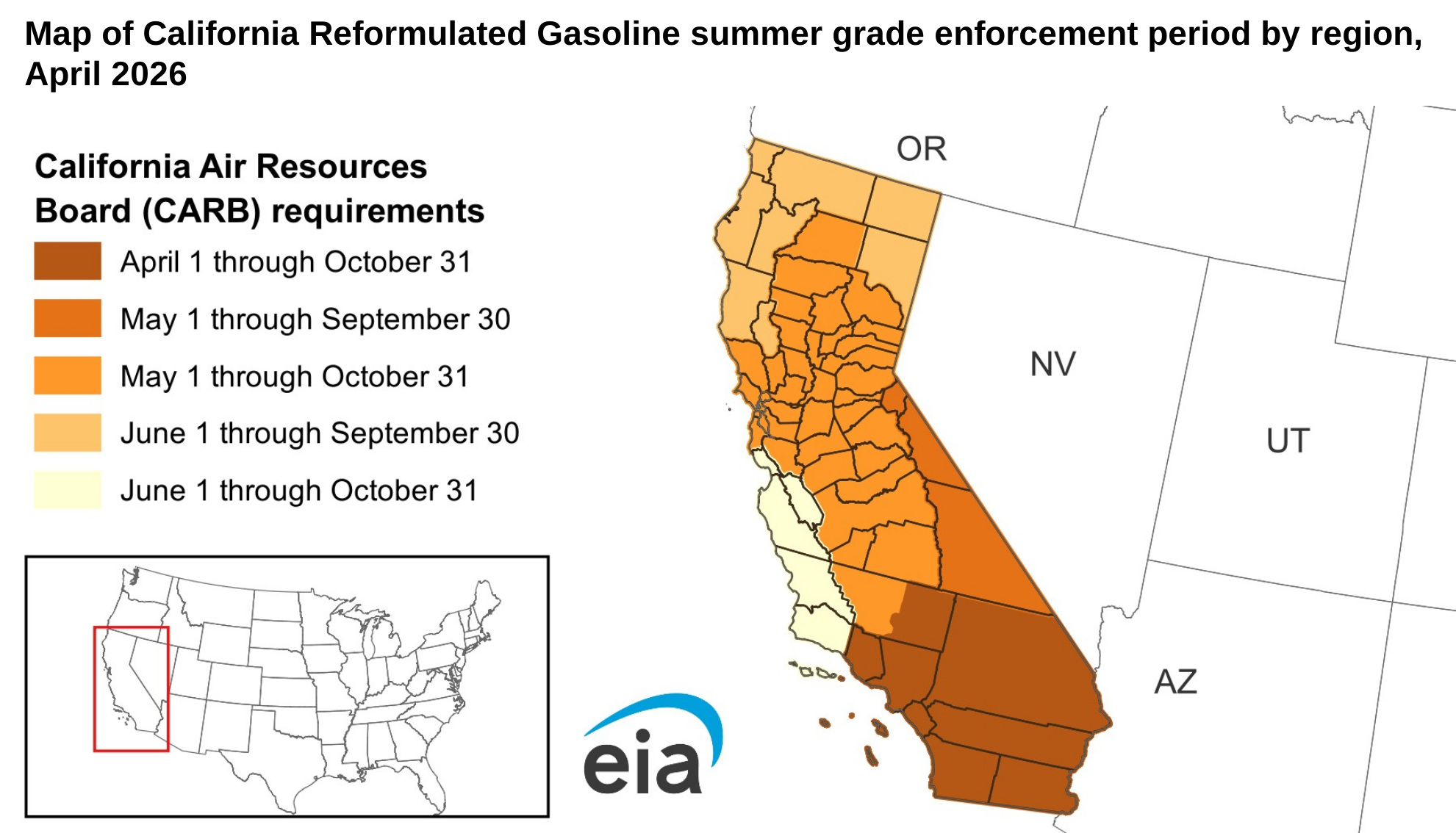
Data source: California Air Resources Board

The California Air Resources Board (CARB) requires gasoline RVP has no more than 7.0 psi during the summer season. In addition, CARB requires longer periods for summer-grade gasoline. These requirements contribute to consistently higher gasoline prices in California.


Principal contributor: Alex de Keyserling

Source: This article was published by the EIA

The U.S. Energy Information Administration (EIA) collects, analyzes, and disseminates independent and impartial energy information to promote sound policymaking, efficient markets, and public understanding of energy and its interaction with the economy and the environment.

Ocean Eddies Are Amplifying Climate Extremes In Coastal Seas


Ocean currents on Feb 11, 2018 from OSCAR v2.0, distributed by NASA JPL, generated by Earth and Space Research, and visualized by earth.nullschool.net.

By 

Lisa Beal, a professor of ocean sciences at the University of Miami Rosenstiel School of Marine, Atmospheric, and Earth Science, collaborated with South African researchers to study the Agulhas Current, a fast and narrow western boundary current flowing poleward along the southeast coast of Africa. Over a two-year period, they gathered high-resolution mooring data, recording hourly measurements of velocity, temperature, and salinity throughout the entire depth and width of the current.

The dataset launched more than a decade of research, with foundational work led at the Rosenstiel School and now advanced through sustained collaboration with Kathryn Gunn at the University of Southampton in the United Kingdom. Gunn and Beal use this dataset to show that increasing eddy activity is reshaping the Agulhas Current and intensifying adjacent coastal temperature extremes. Their findings, published in a new study in the journal Nature Climate Change, identify small frontal instabilities, about 10 kilometers across, along with larger, iconic meanders of the current, that transfer heat, salt, and nutrients between the open ocean and coastal environments.

“More eddy activity is accelerating surface warming in the Agulhas, while simultaneously enhancing hidden upwelling that cools deeper waters,” said Beal, the study’s senior author. “This combination—along with the onshore encroachment also driven by eddies—will create more extreme conditions in shelf seas in the future, potentially placing significant strain on coastal ecosystems.”

Both frontal eddies and meanders pump deep, cold, nutrient-rich water up onto the shelf, potentially enhancing productivity there, while farther offshore meanders trap heat and salt closer to the surface. The result is rapidly warming surface waters above cooler waters at depth.

Decades of satellite data have shown that surface waters in the Agulhas Current are warming at three or four times the global ocean average. At the same time, this new study shows that eddies have kept deeper waters comparatively cool. This layered structure helps explain how rapid surface warming—leading to increased rainfall in South Africa—has occurred alongside a reported decline in the current’s total heat transfer to higher latitudes.

These major changes are happening even as the overall strength (volume transport) of the Agulhas Current remains stable.

The implications extend far beyond southern Africa. The researchers suggest that intensifying eddies may provide a unifying explanation for observed changes in major ocean currents worldwide, including the Gulf Stream along the U.S. East Coast.

“Our findings suggest that eddies are fundamental in shaping how the ocean responds to climate change,” said Beal.

Streaming trap: Most musicians earn peanuts but can't afford opt-out

16.04.2026, DPA


Photo: Robert Michael/dpa

Musicians work hard to get streams from fans, yet their bank accounts remain empty. Spotify isn't profitable for most musicians, and yet hardly any artists can do without it, research shows.

Streaming has become essential for musicians worldwide, yet for most artists Spotify, Apple Music and the like don't pay the bills, a new international study found.

A survey by the UK’s Oxford Internet Institute and the Netherlands’ University of Groningen focused on musicians "who are neither rich nor famous and make up the vast majority of music artists around the world."

Researchers highlight what they call a "streaming paradox" - artists depend on platforms like Spotify for visibility, but earn little from them.

Last year, the researchers surveyed 1,198 musicians from Brazil, Chile, the Netherlands, Nigeria and South Korea. While 42% said they already work in music full-time, 53% hope to do so in the future.

The financial reality, however, is stark: 77% earned less than €10,000 annually from their music in the year prior to the study. Nearly a third (29%) made under €1,000, and 26% reported no income at all from their musical activities.

This "streaming paradox" is a global phenomenon, researchers found.

Little money, high dependence

Income from streaming varies widely - but is often minimal. A quarter of respondents said streaming accounts for just 0%-5% of their earnings. Only 8% reported that more than 75% of their income comes from streaming.

"Artists rely on digital platforms to be seen, to grow their audiences and to stay relevant. Our report shows that while streaming and social media contribute very little to artists' actual income, the work they require is changing what it means to be a musician," said Robert Prey, the study's author and professor of digital culture at the Oxford Internet Institute.

Despite this, 81% of those surveyed said streaming is "somewhat" or "extremely" important for their careers, "yet fewer than half say their situation has improved since streaming became dominant," the researchers said.

Furthermore, 83% are dissatisfied with the royalties they receive from streaming.

Frustration grows among artists

The issue is not confined to any one country. In Germany, artists have increasingly criticized the economics of streaming, despite the industry generating billions in revenue.

German rapper LGoony recently highlighted the problem in a video posted to social titled: "I can’t take it anymore."

He questioned how long he can continue releasing music under current conditions, saying that large corporations have "completely devalued" music.

For an artist to earn €1, "you'd have to listen to nothing but that artist's music for over 15 hours," the rapper calculated.

In South Korea, solo indie songwriter CHICKA dee told researchers: "The only way to survive as a musician is to get another job, which makes it harder to focus and create music."

EU top court sides with users of online gambling seeking restitution

16.04.2026, DPA


Photo: Arne Immanuel Bänsch/dpa


Users of online gambling services can sue the betting operator for reimbursement of their losses if online gambling is prohibited in their home country, the European Union's top court ruled on Thursday.

The decision is linked to the case of a German resident seeking restitution for losses playing virtual slot machines and other games online provided by two Maltese companies, even though online gambling was largely prohibited under German law at the time.

The European Court of Justice (ECJ) in Luxembourg ruled that EU law neither precludes national online gambling bans nor a civil action for restitution brought forward by a consumer.

The ECJ also clarified that a later reform of German online gambling legislation does not restrict the user's rights to claim restitution.

Despite the freedom to provide services across the bloc under EU law, member states can restrict this freedom for "consumer protection and the protection of social order," the court said.

Online gambling qualifies for such an exemption as it poses a particular risk to consumers "due to the permanence of access, the isolation and anonymity of the player, the absence of social control, the potentially unlimited frequency, and its attractiveness to young and vulnerable persons."

The court in Malta dealing with the claim for restitution had asked the ECJ for guidance in the case. The court has to take Thursday's ruling into account in taking a decision.

EXPLAINER


Spain launches programme to offer amnesty to 500,000 undocumented migrants


As countries on both sides of the Atlantic ramp up deportations of undocumented migrants, Spain’s left-wing government on Tuesday prepared to give legal status to hundreds of thousands of irregular workers. Prime Minister Pedro Sanchez has championed the amnesty as a way to not only give informal workers legal protections, but to also bring more money into a social security system increasingly under stress by the country's ageing population.


Issued on: 15/04/2026 
FRANCE24
By: Paul MILLAR

An immigrant worker from Mali works in a restaurant in San Sebastián on January 27, 2026. © Ander Gillenea, AFP


With a few scratches of a pen, Spain’s Socialist-led government on Tuesday prepared to grant legal status to roughly half a million people now living and working in the country without documentation.

Foreign nationals with clean criminal records who arrived before the end of 2025, and who can prove they’ve lived in Spain for at least five months, are now eligible for renewable one-year residence permits. People who applied for asylum in the country before December 31 will also be able to apply.

This extraordinary mass regularisation – the first in Spain in more than 20 years – was born from a citizen-backed proposal signed by some 700,000 people and supported by hundreds of civil society groups, including the Catholic Church.

While most immigrants in Spain have legal status, the country’s booming economy has also drawn hundreds of thousands of largely working-age people from across the world to work in the country’s underground economy. Undocumented migrants work on construction sites, on farms, in shops and restaurants or in people's homes, cooking and cleaning and caring for children.

Spain bets on migration to drive economic growth, bucking European trend

The bulk of these workers come from the country’s former colonial holdings across Latin America and North Africa such as Venezuela, Colombia, Ecuador and nearby Morocco.

And while footage of migrants scrambling over the barbed-wire fences surrounding Spain’s North African exclaves or lurching towards the Canary Islands in flimsy dinghies weigh heavily on the public imagination, the reality is usually less dramatic.

Most undocumented migrants are people who entered Spain legally, going on to overstay their visas and find cash-in-hand work in what has become known as the country’s “black economy”.

Bucking the trend

The decision sits in stark contrast to a hardening approach to irregular immigration that has flourished across Europe and the US in recent years as the far right gains ground.

Despite declining numbers of irregular arrivals, European Union states in December last year backed harsher migration measures that would allow rejected asylum seekers to be deported to offshore “return hubs” or countries with which they have no connection.

In France, last year’s figures show rising numbers of deportations paired with fewer cases of undocumented migrants being granted legal pathways to work.

Prime Minister Pedro Sanchez has maintained that – far from being a drain on the country’s social services as critics claim – migrants play a crucial role in keeping the country’s welfare state standing. Bringing half a million workers into the formal economy, he argues, will only strengthen the country’s social security system.

Migration Policy Institute Europe deputy director Jasmijn Slootjes said that Spain’s decision was partly in response to fears that the ageing native-born population won’t be capable of sustaining the kind of workforce the country needs to thrive.

“If you look at the demographic decline, the fertility rate in Spain is the lowest in Europe – so it's really, really low,” she said.

“There were a lot of skill shortages, labour shortages, and de facto a lot of irregular migrants are working, although in informal work. And through regularising you can, of course, get more tax payments, and you also get better matching [to] their skills – because people can actually work at their skill level. So it’s a very pragmatic approach.”

She said that the Sanchez government – which announced this decision as part of a deal struck with its erstwhile coalition partners, the leftist PODEMOS party – was championing migration as a fundamental driver of the country’s flourishing economy.

Official data released on Tuesday indicated that 52,500 of the 76,200 people who raised employment numbers in the final quarter of 2025 were born overseas, with that same quarter marking Spain's lowest unemployment rate in 18 years.

“That’s really something that's being mentioned time and again – this link to the economy, maintaining social welfare access and a healthy, competitive country. That is really a core argument in all of this, and the evidence is indeed pointing that way,” Slootjes said.

“I think one quote of [Sanchez's] is very clear in clarifying their approach – he says, ‘Spain needs to choose between being an open and prosperous country, or a closed-off and poor country’,” she said.

Migrant deaths at Melilla border post: Three years on, truth remains elusive
Billet retour © France 24
16:51


Since the last mass regularisation in 2005 – the sixth such amnesty since the fall of the Franco dictatorship – Spain has pursued a less dramatic approach to undocumented migrants, offering them a step-by-step pathway over several years towards gaining a legal right to live, work and eventually become a Spanish citizen.
'Sanchez hates the Spanish people'

Despite a turbulent 20 years of boom and bust as Spain weathered the 2008 global financial crisis and then the Covid-19 pandemic, the country has largely avoided the rising anti-immigration sentiment that has pushed far-right parties into prominence – and sometimes power – across Europe and beyond.

That changed in 2018 with the arrival of Vox on the political scene. Born out of a broader backlash to Catalan separatism, the far-right party won the third-most seats in parliament in 2019 on an increasingly anti-immigration platform.

Unsurprisingly, Vox party leader Santiago Abascal was incensed by the announcement.

“The tyrant Sanchez hates the Spanish people. He wants to replace them,” he posted on social media, adding that Sanchez wants to "accelerate the invasion”, echoing oft-repeated right-wing narratives.

Abascal instead called for “remigration” – another far-right rallying cry that champions the mass deportation of people born overseas, sometimes including naturalised citizens.


Alberto Nunez Feijoo, leader of the conservative People’s Party – which oversaw several of the amnesties in previous decades – has also criticised the decision, as the party struggles to head off rising support for the anti-immigration Vox.
Support for immigration remains 'largely stable'

Slootjes said that while Spain was not immune from the rising tide of nativist sentiment, levels of anti-immigration feeling had not reached the same heights as in other parts of Europe.

“Spain is also witnessing similar trends that we’ve been seeing in other countries in Europe and also across the Atlantic, of course, which is this increasing restrictive narrative around migration and a rise of support for the far right,” she said.

“This is really a moment where Vox is very vocal and really pushing this issue. So for those who are anti-migrant and agree with them, of course this can bolster their support."

Spanish think-tank Funcas in May last year found that local support for immigration was among the highest in Europe, with just 28 percent of respondents favouring restricted immigration in 2024. Those attitudes appeared to endure even as the country reeled from mass unemployment in the wake of the 2008 crash.

"Even during years when unemployment exceeded 25 percent, support for immigration remained largely stable," the report said.

And with more and more countries across Europe facing similar demands for workers, giving those people already practicing their livelihoods without legal protections a pathway out of precarity could well be a way forward, she noted.

“It's food for thought for policymakers across Europe and across the world, especially as this competition for talent and skill shortages, and ageing and demographic decline are plaguing our economies and societies, and it will all ramp up,” she said. “So it's going to be interesting to see how this may become more of a tool in the future, maybe if the tides are shifting and Spain is really testing it out and really creating this evidence to build future policies on how to do it – and how to do it well.”

😈 LOL ðŸ˜ˆ

Jesus punches Trump in face in AI video posted by Iran’s embassy in Tajikistan

Jesus punches Trump in face in AI video posted by Iran’s embassy in Tajikistan
Trump disappears into hell. / X/@IRANinTJFacebook
By bne IntelliNews April 15, 2026

Iran’s embassy in Tajikistan has posted an AI-generated video of Jesus punching Donald Trump in the face and throwing him into the fiery pit of hell.

The mocking clip, shared by the Dushanbe mission on April 14 as Trump continued to draw fire for posting an image of himself as a miracle-working Jesus, starts with a chilling voice saying, “Your reckoning has come”, and Trump shouting "No!!" Jesus then swoops towards the figure of Trump from behind and punches him, causing blood to splurt from his mouth and knocking him into the flames below. 

The AI image seen as depicting Trump as Jesus that angered many Christians, including many among the US president's base support (Credit: X/@IRANinTJ).

The video is one of several released by Iranian embassies trolling Trump and Israeli Prime Minister Benjamin Netanyahu.

Several embassies of Iran around the world have engaged in a heavy social media battle with the Trump administration amid the US-Israeli war with the Iranian regime, which included the February 28 killing of Iran’s supreme leader Ali Khamenei in missiles strikes that started the conflict.

AI-generated propaganda videos created by Iranian media company Explosive Media, showing American, Israeli and Iranian leaders as Lego minifigures, have won acclaim. They lampoon Trump and Israeli leader Benjamin Netanyahu, while glorifying Iran’s military capability.

The Trump administration, meanwhile, has used images from the video game series Grand Theft Auto and “SpongeBob SquarePants” to big up the successes of the US armed forces.

Trump’s post depicting him as a healing Jesus provoked a backlash among his conservative and Christian base. Many of his supporters have said the clip is blasphemous.

Trump responded in comments to reporters that he “thought it was me as a doctor.”

Vice President JD Vance, a Catholic, said the post was a joke that was removed from circulation because Trump “realised that a lot of people weren’t understanding his humour”.

Trump this week has also entered into a feud with Chicago-born Pope Leo XIV, who has been outspoken over the war on Iran.

Trump hit back by saying he was “not a big fan” of the pontiff, whom he said was “very liberal” and “WEAK on Crime, and terrible for Foreign Policy”.  

The clip depicting himself as Jesus Christ followed.


YouTube bans viral pro-Iran AI-generated LEGO videos trolling Trump


Issued on: 14/04/2026
04:27 min

As the "meme war" between the US and Iran continues via AI "slopaganda", an Iran-linked group named Explosive Media has been pumping out viral LEGO-style videos ridiculing the US war effort in Iran, and trolling US President Donald Trump. Many of these videos depict Trump as childish and fickle, accuse him of having started the war to distract from his ties to Jeffrey Epstein, and have gained an audience of hundreds of millions online.

Recently, after a LEGO-style video claimed "Iran won" last week, YouTube banned Explosive Media's channel, suspending it for violent content and "violating its spam, deceptive practices and scams policies".

This prompted a reaction from Tehran's foreign ministry, which accused YouTube of "suppressing the truth" and "shielding the US administration's false narrative from any competing voice". The rest of Explosive Media's other accounts on Meta platforms, X and TikTok appear unaffected for the moment.

Since the Middle East war, Iran has leaned into using artificial intelligence to push its narrative to a non-Iranian audience, often using American references and satire to flood the internet.

But who are the Explosive Media group? A representative for the group told the BBC the team consists of less than 10 people, and admitted the Iranian government is one of their clients, despite having previously claimed to be independent.

Vedika Bahl goes through Tehran's criticism of this new YouTube suspension, and what we know about the group behind these viral AI-generated propaganda clips in this episode of Truth or Fake.

BY: Vedika BAHL
VIDEO BY Vedika BAHL


Gaza aid flotilla sets sail from Barcelona in bid to break Israeli blockade

A flotilla of dozens of boats set sail for Gaza from Barcelona on Wednesday in a fresh bid to break an Israeli blockade and deliver aid supplies. Last year, another flotilla of about 50 boats was boarded by the Israeli navy, resulting in crew members, including Swedish activist Greta Thunberg, being arrested and expelled by Israel.


Issued on: 15/04/2026 
By:  FRANCE 24
Boats of a new flotilla bound for the Gaza Strip make a symbolic departure from Barcelona on April 12, 2026. 
© Josep Lago, AFP

A flotilla of some 40 boats set sail for Gaza from Barcelona on Wednesday in a fresh bid to break an Israeli blockade and deliver aid to the devastated territory, organisers said.

The Global Sumud Flotilla had initially been set to depart from the Mediterranean port on Sunday, but the mission was postponed due to adverse weather conditions.


The ships, mostly sailboats, set sail just after 11:30am (09:30GMT), organisers said in a statement.

Some 20 boats, which will join the maritime convoy, left the French port of Marseille on April 4, and more ships are set to depart from Syracuse in Sicily on April 24.

A week-long stopover is planned in southern Italy for "non-violence training".

Sumud, which means "resilience" in Arabic, is due to rally hundreds of pro-Palestinian activists from dozens of countries.

In late 2025, an initial flotilla of about 50 boats, composed of political figures and activists such as Sweden's Greta Thunberg, was boarded by the Israeli navy – illegally, according to the organisers and Amnesty International.

 Last Gaza flotilla boat intercepted by Israel, organisers say

The crew members were arrested and expelled by Israel.

The Gaza Strip, governed by Hamas, has been under an Israeli blockade since 2007. Israel and the Palestinian Islamist movement accuse each other of violating a ceasefire that came into effect on October 10, 2025, after two years of war.

(FRANCE 24 and AFP)
FREE ALL POLITICAL PRISONERS

Jailed Iranian Nobel laureate Narges Mohammadi in critical condition, supporters say

The health of jailed Iranian Nobel Peace Prize laureate Narges Mohammadi is critical after she suffered a heart attack last month, supporters said on Wednesday. Her family and lawyers, allowed a second prison visit, reported a sharp deterioration in her condition, with her physical state now described as critical, her foundation said.


Issued on: 15/04/2026 
FRANCE 24

An undated and unlocated photo of Nobel Prize laureate and Iranian human rights activist Narges Mohammadi © Foundation Narges Mohammadi

The health of jailed Iranian Nobel Peace Prize winner Narges Mohammadi is critical after she suffered a heart attack last month, supporters warned on Wednesday.

Her Iran-based family and legal team were on Saturday allowed a second in person visit with Mohammadi in her prison in northern Iran where "clear signs of a deterioration in her general condition were observed, and her physical state was described as critical", her foundation said in a statement.

The latest meeting came after an earlier visit in late March where it emerged that Mohammadi had suffered a heart attack earlier in the month.

The family reported after the latest visit that Mohammadi "has become extremely weak and has suffered significant weight loss", the statement quoted her Norway-based brother Hamidreza Mohammadi as saying.


He added that his sister was "being held in a cell with prisoners charged with murder and has been threatened with death by some of these inmates several times".


Mohammadi, who won the peace prize in 2023 in recognition of more than two decades of campaigning, was arrested on December 12 in the eastern city of Mashhad after speaking out against Iran's clerical authorities at a funeral ceremony.

In February, without prior warning, she was moved to a prison in the northern city of Zanjan and has only been allowed the most limited communication with her family, with concerns amplified by the US-Israel war against Iranwhich saw attacks on the city.

Mohammadi was arrested before protests erupted nationwide later in December 2025. The movement peaked in January, with authorities launching a crackdown that activists say killed thousands of people.

In February, she was handed a further six years in prison on charges of harming national security and a one-and-a-half-year prison sentence for propaganda against Iran's Islamic system. She also went on hunger strike for almost a week to protest her conditions of detention.

The foundation said in its statement the "continuation of this situation places Narges Mohammadi's life at immediate and irreparable risk".

(FRANCE 24 with AFP)