It’s possible that I shall make an ass of myself. But in that case one can always get out of it with a little dialectic. I have, of course, so worded my proposition as to be right either way (K.Marx, Letter to F.Engels on the Indian Mutiny)
Friday, April 17, 2026
Election experts expect Trump to confiscate voting equipment following midterm results
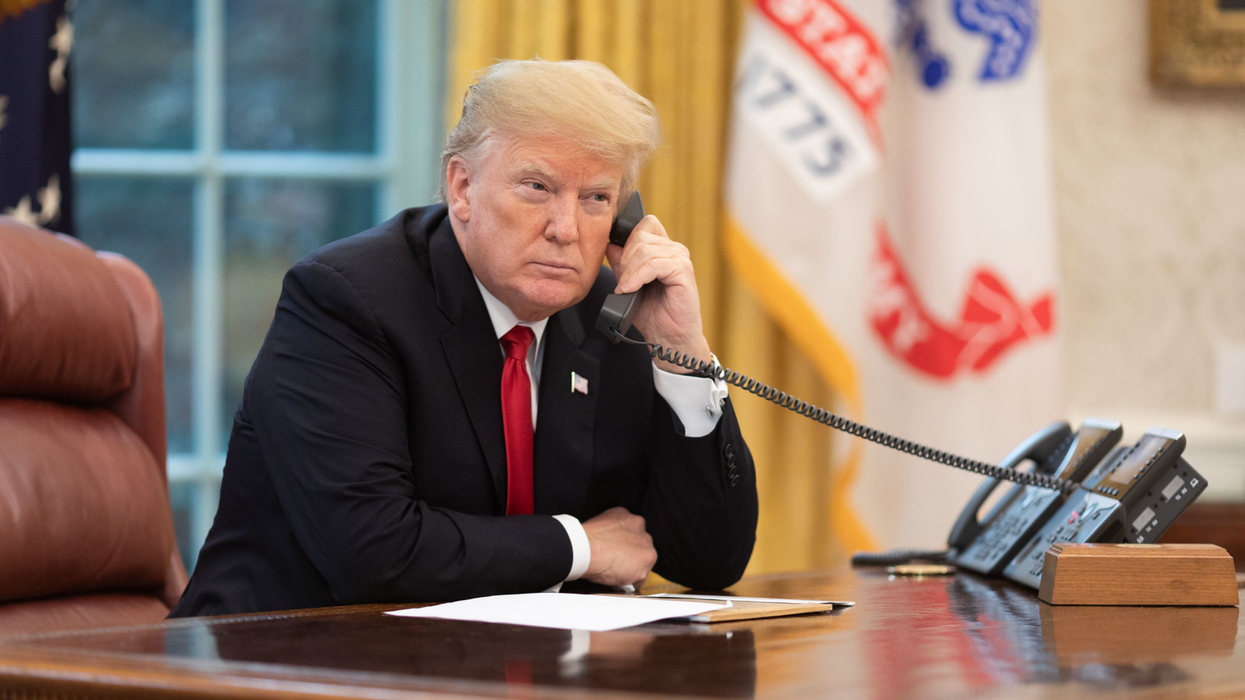
President Donald J. Trump speaks on the phone in the Oval Office Wednesday, Nov. 14, 2018, with Federal Emergency Management Agency Administrator Brock Long to receive the latest update on the devastating wildfires in California. (Official Whte House Photo by Joyce N. Boghosian)
There are always unanswered questions heading into any election. But usually those questions are more along the lines of “who’s going to win?” and less “will the federal government interfere with the election?”
This article was originally published by Votebeat, a nonprofit news organization covering local election administration and voting access.
But here in 2026, President Donald Trump’s broadsides against the legitimacy of U.S. elections and efforts to overhaul election laws have generated lots of uncertainty — and anxiety — about whether this will be a normal election year. Election officials and voters alike are left to wonder whether there will be new requirements for voters, physical interventions at the polls, or attempts to overturn results after the fact.
Despite seemingly endless speculation, no one knows for sure how likely any of these things is. But to get the most well-informed assessments, we turned to the people who spend the most time thinking about elections.
We asked 37 experts in the field of election administration — academics, lawyers, former election officials, etc. — to answer 26 questions about the likelihood of various scenarios coming to pass in the 2026 midterms.
Their answers reflect a general sense of cautious optimism about the most dire scenarios — such as an election getting overturned — and skepticism that the federal government will successfully change voting rules. But they also still believe the election will face serious challenges, including federal agents potentially showing up at polling places.
Election experts say new federal laws are unlikely, but split on state laws and court intervention
However, experts were skeptical that these measures would ever take effect. Thirty-four of our 37 respondents said it was unlikely that the federal government would successfully require new registrants to prove their citizenship for the midterms, and 32 said it was unlikely that the federal government would successfully require all voters to show an ID or restrict the use of no-excuse absentee or mail ballots. (They provided their answers before Trump issued his second executive order, which sought to regulate mail voting through the U.S. Postal Service.)
Likewise, virtually all respondents thought it was unlikely that the federal government would restrict the hours or locations of in-person voting or limit or eliminate the use of voting machines to tally ballots in the midterms.
However, experts were more open to the possibility that some of these policies could take effect in individual states. Although none thought it was likely that a significant number of states would limit or eliminate the use of voting machines, about a quarter of respondents thought it was at least somewhat likely that a significant number of states would restrict the use of no-excuse absentee or mail ballots in the midterms. About one-third thought it was at least somewhat likely that a significant number of states would strengthen their voter ID requirements or restrict the hours or locations of in-person voting.
Even more respondents, 15 of the 37, thought it was at least somewhat likely that a significant number of states would pass proof-of-citizenship requirements before the election — perhaps unsurprisingly, given that such laws were working their way through several state legislatures at the time. Those laws have since passed in Florida, Mississippi, South Dakota, and Utah, although Florida’s does not take effect until 2027 and Mississippi’s is limited in scope.
Overall, though, most experts didn’t expect states to significantly change their election laws this year. Derek Muller, an election law professor at the University of Notre Dame, pointed out that many states have part-time legislatures that won’t be in session between now and the election. “I expect new legislation in the months ahead that might affect the 2026 election to be negligible,” Muller said.
If there are going to be major election-law changes before the midterms, experts expect them to come from the third branch of government: the judiciary. Seventeen experts said it was at least somewhat likely that pre-election court rulings would significantly alter election rules shortly before the midterms, although 19 still said that was unlikely.
In follow-up interviews, those who thought this was likely said that they were keeping an eye both on currently pending cases — such as a U.S. Supreme Court case that could require all mail ballots to arrive by Election Day — and those that have not yet been filed. That said, a Supreme Court ruling earlier this year will probably encourage litigants to bring any cases challenging election rules well before the election, making last-minute rule changes less likely.
Experts expect federal agents to disrupt the 2026 election
For many election officials and voting advocates, the nightmare scenario for the 2026 midterms is if federal agents, such as U.S. Immigration and Customs Enforcement, attempt to disrupt voting or the counting of ballots. It’s already illegal for armed troops to visit voting locations, and the Trump administration has repeatedly said that it will not send ICE agents to polling places this year. However, new Secretary of Homeland Security Markwayne Mullin has declined to absolutely rule it out, and a majority of the experts we surveyed expected something like this to happen.
Twenty-seven of the 37 respondents said it was at least somewhat likely that the federal government would deploy some form of military or law enforcement at or near polling places in the midterms. A slight majority said it was likely that Trump would ask the National Guard or federal agents to seize voting equipment during the election, and over three-quarters said it was likely that Trump would ask them to seize voting equipment after the election. (It’s worth noting that respondents gave these answers just a few weeks after the FBI raided an election office in Fulton County, Georgia, and Trump said that he regretted not asking the National Guard to seize voting machines after the 2020 election.)
Multiple respondents told Votebeat that the seizure of voting equipment was more likely after the election because the election results will be known at that time. “Before the election, no one will know where seizing equipment or ballots could shift pivotal races,” said Christopher Mann, the research director at the Center for Election Innovation and Research. “After the election, a bad actor will have a better picture of where seizing voting equipment or ballots can shift the overall outcome.”
Twenty-eight experts said it was at least somewhat likely that there would be physical threats to voters or polling places in the midterms, including 11 who said it was very likely. (They were perhaps recalling 2024, when a string of bomb threats forced some polling places to close temporarily, though election officials were able to minimize disruptions to voting.) However, experts were divided on whether these threats would deter people from voting. Twenty-one experts said it was unlikely that a significant number of voters would decide not to vote because of threats or physical intimidation, while 16 said that was likely.
Notably, experts were not very confident about their predictions about armed intervention in the midterms. Some also pointed out that, even if it’s likely that Trump might order federal agents to interfere in the election, that doesn’t mean they will succeed. “Election officials, courts, and other state and local officials are going to stop any attempt to seize voting equipment or ballots,” Mann predicted.
And some experts emphasized that even if there are incidents at specific polling places, they expect the election overall to run smoothly. “I’m an optimist, which probably led to many of my answers,” admitted Jeff Greenburg, a retired election official in Pennsylvania and a senior adviser at the Committee of Seventy, a Philadelphia-based government watchdog group. But Greenburg said he doesn’t expect that physical threats to voting “will significantly impact elections nationwide. I have faith and trust in our election officials, as well as the rule of law, and believe in the end every vote cast will be counted.”
Losers may claim fraud, but it’s unlikely an election gets overturned
Election experts of all stripes are confident that U.S. elections are secure. All 37 respondents said it was unlikely that a significant number of ineligible voters would cast ballots in the midterms, including 35 who said it was not at all likely. Experts also unanimously said that it was unlikely that voter fraud would influence the outcome of a 2026 congressional race.
However, that isn’t expected to stop candidates from questioning the election results. Almost three-quarters of experts thought it was at least somewhat likely that a significant number of losing candidates would claim fraud influenced the outcome of the election. All 37 thought it was likely that at least one congressional or statewide election would be legally challenged, with 30 calling it very likely.
At the same time, though, most experts don’t expect those challenges to succeed. Thirty-one of the 37 respondents thought it was unlikely that any congressional or statewide elections would be successfully overturned. Nathaniel Rakich is Votebeat’s managing editor and is based in Washington, D.C. Contact Nathaniel at nrakich@votebeat.org.
Votebeat is a nonprofit news organization covering local election integrity and voting access. Sign up for their newsletters here.
'Let them eat lead': Alex Jones targets Trump with Marie Antoinette image
On Sunday, President Donald Trump shared an AI-generated image of himself as Jesus, prompting widespread outrage from many Christians. Then on Thursday morning, Defense Secretary Pete Hegseth delivered a press briefing in which he compared Trump to Jesus.
Later in the morning, in a post to X, far-right commentator Alex Jones shared his own AI-Trump comparison: Trump as Marie Antoinette.
“TRUMP ‘MARIE ANTOINETTE’ SAYS,” declared Jones, "’It's not possible for us to take care of daycare, Medicaid, Medicare, all these individual things... We have to take care of one thing: military protection. We have to guard the country,’ Trump said. He should have just said ‘let them eat lead, with a nice helping of hyper inflation.’”
While Jones has been a longtime ally of Trump, supporting him since the beginning of his first campaign in 2015, the relationship between the two has soured in recent months as the podcaster has become increasingly alarmed by the president’s behavior and his pro-war rather than “America First” policies.
In a follow-up post, Jones explained his reasoning behind comparing Trump to Antoinette.
“Trump's budget funnels $895B to Lockheed and Raytheon,” wrote Jones, “up 4.1%, while axing $800B from Medicaid, states bleed for Ukraine aid. Donors get cake; we get lead and hyperinflation. My point is Trump is changing his priority from domestic to foreign and telling us unlimited welfare for Israel is wonderful. Obviously the federal government needs to be cut, but you can’t slash entitlements in an election year and then spend trillions on wars at the same time. His behavior and statements literally look and sound like Marie Antoinette’s.”
Jones has previously criticized the president’s claim that the U.S. must prioritize war over domestic programs like Medicare and Medicaid, saying, “That’s always the big third rail situation that you know you don’t touch. That’s political suicide.”
In recent weeks, Jones has also questioned Trump’s mental and physical health, asserting Trump’s massively swollen ankles are a sign of “heart failure” and his behavior smacks of “dementia.”
“He does look sick,” said Jones. “And he does babble and sound like the brain’s not doing too hot.”
According to Jones, Trump’s actions have become too “erratic” to ignore, to the point where he has suggested invoking the 25th Amendment to remove the president from office.
“I think we’re dealing with the madness of King George III here,” said Jones. “We got a big, big problem.”
Pope Leo turns the tables on Trump — as he rallies Catholics against the president
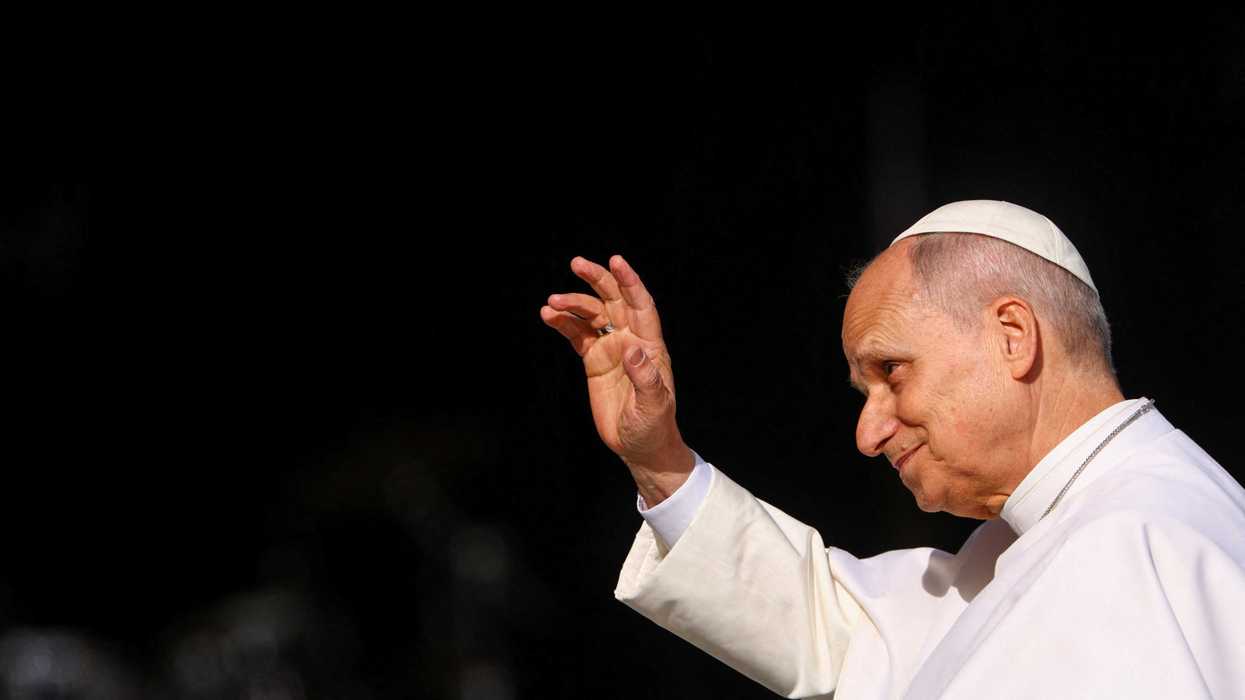
Pope Leo XIV arrives for a public Mass at the Stade Louis-II stadium, as part of a one-day trip, in Monaco, March 28, 2026. REUTERS/Manon Cruz
“I am not a politician; I speak of the Gospel.” Pope Leo XIV’s recent remarks, made during his apostolic journey to Africa, immediately suggest that his clash with Donald Trump operates on a different level to the US president’s usual political spats.
This is not the classic kind of confrontation that Trump has often had with foreign heads of state and government in the past, such as in recent months with the UK prime minister, Keir Starmer, whose refusal to fully back the US and Israel in their war against Iran attracted Trump’s ire. Rather, it is a clash rooted in fundamentally different moral and political visions: between a president who treats power in transactional terms and a pope who frames war, migration and human dignity as matters of moral principle.
When Cardinal Robert Prevost was named as Pope Leo in May 2025, Trump and his administration initially appeared to welcome the new pontiff warmly. In fact, in a post to his Truth Social platform the US president appeared to take credit for his election as pope, writing that Prevost “was only put there by the Church because he was an American, and they thought that would be the best way to deal with President Donald J. Trump”.
But the war in the Middle East launched by the US and Israel has made the differences between their positions clearer – further heightening tensions between them. On Palm Sunday, the week before Easter, it became clear that Leo had decided to take a firm line against the war in Iran, saying that Jesus “does not listen to the prayers of those who wage war, but rejects them, saying: ‘Even though you make many prayers, I will not listen: your hands are full of blood’”.
His Easter message was equally clear: “Let those who have weapons lay them down! Let those who have the power to unleash wars choose peace! Not a peace imposed by force, but through dialogue! Not with the desire to dominate others, but to encounter them.”
Day’s later the pope denounced the US president’s apparent threat to destroy the whole of the Iranian civilisation as “truly unacceptable” in comments which roundly criticised the war and called for a “return to dialogue, negotiations”.
Trump responded in harsh terms, describing the pope in a Truth Social post as “weak on crime” and “terrible for foreign policy”. He went on to say that he did not want a pope “who thinks it is OK for Iran to have nuclear weapons”, adding that “Leo should use common sense, stop doing the bidding of the radical left, and focus on being a great pope rather than a politician”.
Returning to Washington from Florida, Trump also told reporters: “I don’t think he’s doing a good job. I’m not a fan of Pope Leo.” The pope replied on Monday by saying that he was not afraid of the Trump administration and would continue to speak out against war.
Trump did not stop there. He went so far as to publish an image portraying himself as Jesus Christ, a move that appeared to go too far even for many of his conservative supporters. The reaction was strong enough to force him to delete the post and backtrack. This could hurt the US president
Trump has clashed with the Vatican before, but this confrontation unfolds in a very different setting. Pope Francis, the first Argentine pope and the first pontiff from the global south, was often openly critical of Trump, particularly on migration. In 2016, he famously suggested that a leader who thinks only of building walls rather than bridges is “not Christian”, crystallising the tension between them.
Pope Leo XiV calls for an end to war, March 29 2026.
The key difference was that Francis was also a divisive figure within sections of the American Catholic Church. He was frequently targeted by conservative Catholic commentators and church networks in the US, and in 2019 he remarked that “it’s an honour that the Americans attack me”.
Leo, by contrast, is the first US pope – and that changes the political equation. His voice is likely to carry different authority among Catholic voters, who are an important part of Trump’s electoral base.
In the last presidential election, 55% of Catholic voters supported Trump, including 62% of white Catholics. Senior Catholics also occupy prominent positions in his administration, including Vance and Trump’s secretary of state Marco Rubio.
That is why Leo’s criticism may prove more politically consequential. It does not come from an external moral voice alone, as was often the case with Francis, but from an American pontiff speaking into a church and an electorate that Trump cannot afford to ignore.
Early reactions suggest that many Catholic voices in the US have rallied behind Leo, making this not only a diplomatic clash, but a potentially significant domestic one too. (This could also really hurt J.D. Vance. As the likely contender to succeed Trump on the Repulican ticket, he is deeply invested in his Catholic faith and is about to publish a book devoted to his conversion.)
From an international perspective, the break with the pope has also had visible repercussions. Giorgia Meloni, the Italian prime minister, long regarded as Trump’s closest ally in Europe, went publicly in defence of Pope Leo, the bishop of Rome, drawing criticism from Trump himself, who defined the Italian prime minister’s behaviour as “unacceptable”.
To conclude, this is not a political confrontation like the many others the world has become used to with this US president. The stakes are higher at home and on the world stage. At home, it risks alienating many Catholic voters whose support will matter not only in the midterm elections but also in the next presidential race. Internationally, it may complicate Trump’s relationship with European conservative parties, many of which have long sought close association with the Vatican.
The pope, as the leader of a vast global community, cannot be treated as though he were just another political opponent.
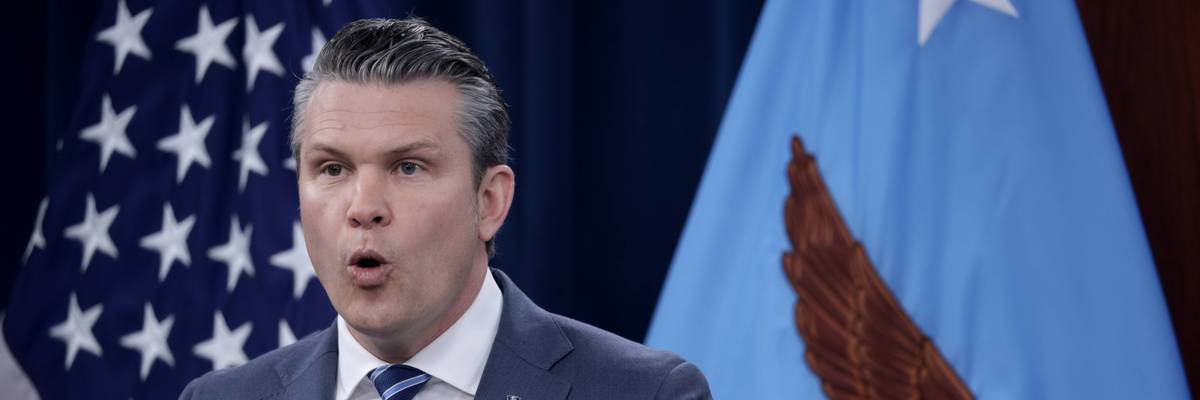
Citing Scripture, Hegseth Compares Trump to Jesus and Journalists Covering Unpopular Iran War to the Pharisees Hegseth has often used the Bible to sanctify violence against enemies he deems “ungodly.” So far, more than 1,700 civilians have been killed in his and Trump’s war in Iran. US Secretary of War Pete Hegseth speaks during a press briefing at the Pentagon on April 16, 2026, in Arlington, Virginia. Hegseth addressed the war between the United States and Israel against Iran as negotiations continue toward a longer-term agreement between the countries. (Photo by Alex Wong/Getty Images)
Days after President Donald Trump elicited backlash with an artificially generated image likening himself to Jesus Christ, Defense Secretary Pete Hegseth doubled down on the comparison, invoking scripture during a Pentagon press briefing.
Hegseth, an avowed Christian nationalist who has portrayed the war against Iran as part of a “crusade” against the Muslim world, has turned the Pentagon into a forum for proselytizing, with monthly prayer meetings featuring fundamentalist pastors.
And that posture has seeped into his regular briefings about the war, as it did on Thursday, when he likened reporters covering the war negatively to the “Pharisees,” who dismissed Jesus as a false prophet in the Bible.
“This past Sunday, I was sitting in church with my family, and our minister preached from the Book of Mark, the third chapter. And in the passage, Jesus entered a synagogue and healed a man with a withered hand,” Hegseth said.
“The Pharisees came to watch, and as the scripture reads, they came to see whether He, Jesus, would heal him on the Sabbath, so that they might accuse Him. You see, the Pharisees, the so-called elites of their time, were there to witness, to write everything down, to report. But their hearts were hardened,” he continued.
“Even though they witnessed a literal miracle, it didn’t matter. They were only there to explain away the goodness in pursuit of their agenda,” Hegseth continued. “I sat there in church, and I thought, ‘These press are just like these Pharisees.’ Not all of you, but the legacy, Trump-hating press.”
Trump’s portrayal of himself as a messiah over the weekend was met with so much outrage, including from many of his Christian supporters, that it is one of the few posts he has deleted from social media.
Other reporting from Axios on Thursday revealed that the controversial image was perhaps more deliberate than previously thought, having been discussed with one of his closest advisers, housing finance chief Bill Pulte, shortly before it was posted.
And Trump has since posted another image of himself being embraced by Jesus, accompanied by a caption stating that “God might be playing his Trump card.”
As for Hegseth’s comments on Thursday, there was little ambiguity in his description of Trump as a Christlike figure.
The defense secretary begged the press to “open their eyes” to the “historic goodness” of the war effort and referred to the operations by the US military to rescue downed bomber pilots in Iran as a “miracle.”
Hegseth has often used scripture to sanctify “overwhelming violence” against enemies he deems “ungodly.” During a Christian service at the Pentagon late last month, he said a prayer for the US military to deliver violence upon those “who deserve no mercy.”
“Behold now the wicked who rise against your justice and the peace of the righteous. Snap the rod of the oppressor, frustrate the wicked plans, and break the teeth of the ungodly. By the blast of your anger, let the evil perish,” Hegseth said. “Grant this task force clear and righteous targets for violence. Surround them as a shield, protect the innocent and blameless in their midst, make their arrows like those of a skilled warrior who returned not empty-handed. Let every round find its mark against the enemies of righteousness and our great nation.”
Whatever overtures have been made toward protecting “the innocent,” Hegseth’s holy war has resulted in more than 1,700 dead civilians in Iran, including more than 250 children, according to the most recent casualty report from the US-based Human Rights Activists News Agency (HRANA). More than 3 million people have been displaced from their homes, according to the United Nations Refugee Agency.
The war that Hegseth suggested the press should be covering positively has been broadly unpopular from the beginning, with 56% of respondents to a Marist poll in early March disapproving of military action.
Just 24% of Americans said in a Reuters/Ipsos poll this week that the war has been worth the costs and benefits, with a divide even among Trump’s core supporters. Twenty percent of Republicans said the war has not been worth it, and 24% were unsure.
Some MAGA voters say Trump assassination attempt was staged: 'The truth will come out'
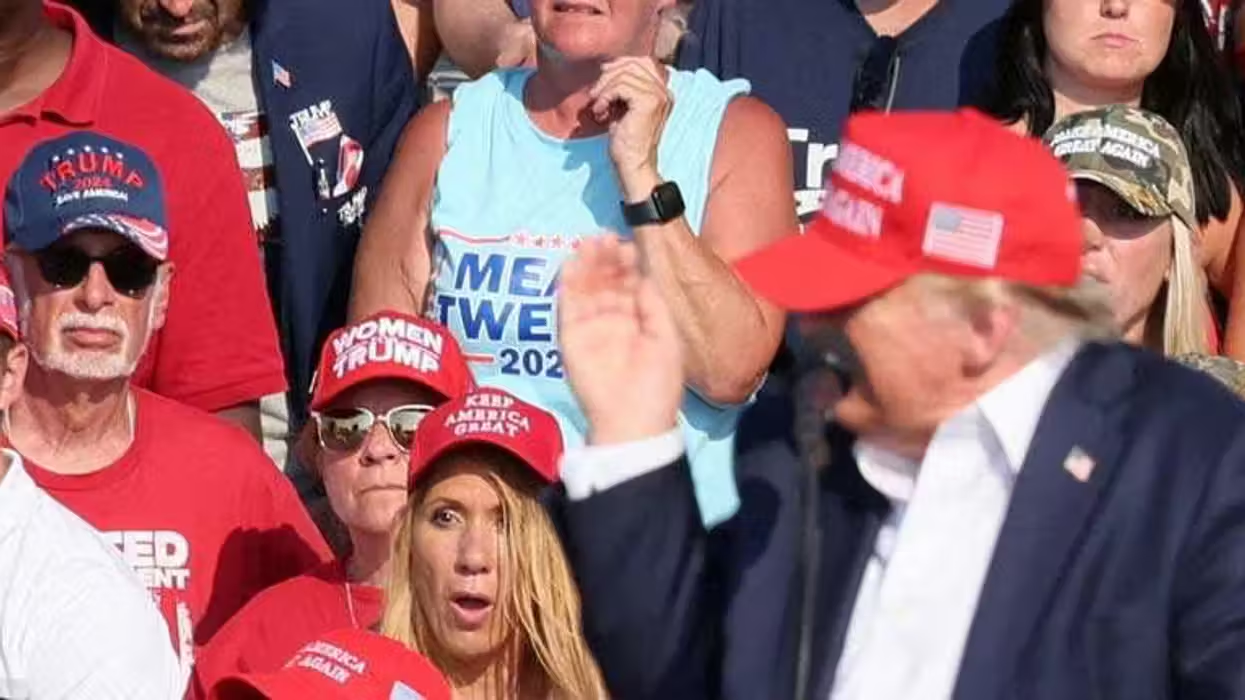
Trump had just begun his speech at the Pennsylvania rally when the sound of shots rang out and a bullet grazed his right ear. REUTERS/Brendan McDermid
The MAGA movement has long coalesced around conspiracy theories, and recently, many have begun floating a new hypothesis: that the 2024 assassination attempt on future President Donald Trump was staged, and that his administration is now covering it up.
On July 13, 2024, shots rang out during a Trump rally in Butler, Pennsylvania, clipping his ear and killing an attendee sitting behind him. The 20-year-old shooter was then killed by the Secret Service, and almost immediately, conspiracy theories began popping up across the internet. MAGA faithful, however, took it as a sign of Trump's divine protection — at least for the time being.
Over the past several months, however, Trump’s appeal has waned with a MAGA that has been disappointed by the president’s foreign military endeavors, economic failings, and bumbling release of the Epstein files. As a result, a growing number of disillusioned MAGA adherents are suggesting that the assassination attempt was faked.
"I think that maybe it was staged," said podcaster Tim Dillon, previously a Trump devotee, in early April. According to Dillon, the time has come for Trump to come out and say that, “Some people are going to be upset by this, but we staged the assassination attempt in Butler to show people how important it was to vote for me and how far I was willing to go for them.”
While such claims are growing louder, they aren’t new. In November, Tucker Carlson suggested that the FBI was involved in covering up the facts behind the shooting, posting that the “FBI lied” about the shooter's online habits. The following day, conservative pundit Emerald Robinson went even further, posting that the FBI “did it.”
Now, however, MAGA followers have begun loudly connecting Trump to the supposed plot, particularly after former US National Counterterrorism Center director Joe Kent resigned from his post and appeared on Carlon’s podcast, during which Kent claimed (without offering evidence) that the investigation into the shooting had been ended before it was concluded.
This prompted QAnon promoter MJ Truth to ask his 100,000 Telegram followers, “How does everyone feel about the narrative surrounding the Butler Assassination Attempt on Trump?” Nearly all replies asserted that the assassination was staged.
“The truth will come out 60+ years from now when we're all dead and nobody really cares anymore … just like JFK!!!!,” wrote one.
Then after Carlson suggested that the Israeli government had “clues” about the shooting, far-right provocateur Candace Owens picked up the conspiracy, claiming that Israeli-American political donor Miriam Adelson was actually behind the attempted assassination. Adelson, proffered Owens, had donated $100 million to Trump in exchange for his support of Israeli settlements in the West Bank, and when he reneged, she tried to have him killed.
Ali Alexander — a far-right activist who organized the Stop the Steal campaign after the 2020 presidential election — has a completely different theory: that Trump is the Antichrist.
“If Donald Trump didn’t receive a miracle, then it was deception or a dark sign,” Alexander wrote in a PDF he posted to his Telegram channel on Tuesday. “There is biblical prophecy in Revelation 13:3 apparently about the Antichrist being struck on the head.”
The passage he’s referencing reads, “I saw that one of its heads seemed to have been mortally wounded, but this mortal wound was healed. Fascinated, the whole world followed after the beast." Trump has, incidentally, received numerous accusations that he is the Antichrist in recent weeks, though for other reasons.
As WIRED notes, “The vast majority of people discussing conspiracy theories about the shooting today are Trump supporters or former Trump supporters.”
Trump's biggest fans want him to come clean about his 'staged' assassination attempt
FILE PHOTO: Republican presidential nominee and former U.S. president Donald Trump speaks during a rally at the site of the July assassination attempt against him, in Butler, Pennsylvania, U.S., October 5, 2024. REUTERS/Brian Snyder/File Photo
Even some of President Donald Trump's biggest fans are starting to believe his first assassination attempt was staged, and they want him to publicly admit it.
Conspiracy theories proliferated almost immediately after a 20-year-old gunman fired off shots that seemingly clipped Trump's ear and killed retired fire chief Corey Comperatore at a July 13, 2024, campaign rally in Butler, Pennsylvania, but now some of the president's own supporters have been casting doubts on the official account of the shooting, reported Wired.
"I think that maybe it was staged," conservative podcaster Tim Dillon told listeners, adding that Trump should admit it. “Some people are going to be upset by this, but we staged the assassination attempt in Butler to show people how important it was to vote for me and how far I was willing to go for them.”
Tucker Carlson has been floating the possibility for months that the FBI had lied about the shooter's online activity as part of a coverup, and conservative pundit Emerald Robinson has blamed the law enforcement agency for pulling off the shooting, but the baseless conspiracy theories gained new traction when former U.S. National Counterterrorism Center director Joe Kent told Carlson the assassination probe had been prematurely shut down.
“If you don't want to address that question, then you just go silent and say you can't ask that question,” Kent told Carlson last month. “Which then creates people who come out of nowhere and they start drawing their own conclusions.”
Kent provided no evidence to support his claims, but his suggestion that the investigation had not been completed has reinvigorated conspiracy theories about the shooting on the MAGA right, with prominent QAnon promoter MJ Truth asking his 100,000 followers: “How does everyone feel about the narrative surrounding the Butler Assassination Attempt on Trump?”
According to Wired's analysis, the vast majority of MJ Truth's followers – nearly all of them Trump supporters – agreed the event had been staged and that the truth would never be revealed.
“The truth will come out 60+ years from now when we're all dead and nobody really cares anymore … just like JFK!!!!,” one follower wrote.
The conspiracy theories have also ramped up as some right-wing influencers float the possibility that Trump is the antichrist due to criticism around the Iran war and his public statements and social media posts comparing himself to Jesus Christ.
“To be clear: if Donald Trump didn’t receive a miracle, then it was deception or a dark sign,” wrote "Stop the Steal" activist Ali Alexander in a five-page PDF posted to his Telegram channel. “There is biblical prophecy in Revelation 13:3 apparently about the Antichrist being struck on the head.”
That biblical passage reads: “I saw that one of its heads seemed to have been mortally wounded, but this mortal wound was healed. Fascinated, the whole world followed after the beast.”
Some elements of the right-wing conspiracy theories draw from antisemitic tropes, such as Carlson's questions about Israel's possible involvement in the assassination plot and MAGA influencer Candace Owens' claims that Israeli-American political donor Miriam Adelson was behind the assassination attempt.
"While the vast majority of people discussing conspiracy theories about the shooting today are Trump supporters or former Trump supporters, in the hours and days after the shooting," Wired noted, "it was left wing so-called Blue Anon accounts pushing the claims that the shooting was staged, suggesting it was all orchestrated by the Secret Service and that Trump had used blood gel packs in an attempt to draw sympathy and votes."
Anti-Monopoly Dems Say Proposed Airline Megamerger ‘Should Never See Light of Day’ The heads of the congressional Monopoly-Busters Caucus warned that a future administration could “break up” a merger of United and American Airlines if it is approved by Trump regulators.
United Airlines CEO Scott Kirby speaks to reporters outside the White House on October 30, 2025 in Washington, DC. (Photo by Kevin Dietsch/Getty Images)
The Democratic leaders of the congressional Monopoly-Busters Caucus said Wednesday that a recently floated megamerger of two of the largest airlines in the US—United and American—would be so awful for consumers that it shouldn’t even be considered, let alone approved by federal regulators.
“The rumored scheme to merge United and American should never see the light of day,” said Reps. Pramila Jayapal (D-Wash.), Chris Deluzio (D-Pa.), Pat Ryan (D-NY), and Angie Craig (D-Minn.). “This disaster of a merger would be illegal, consolidating more than a third of the US airline market, eliminating direct competitors on hundreds of routes across the country, and creating a near-monopoly on flights in many cities.”
The House Democrats went on to say that if a United-American merger is formally proposed and approved by President Donald Trump’s regulators, a future Democratic administration could break up the resulting airline behemoth.
“In a time when too many Americans just struggle to even go on vacation, much less afford their housing, childcare, and healthcare, these airline executives should not mistake the corruption of this administration as a green light to break the law,” the lawmakers said. “They should also remember that there is no statute of limitations on breaking up bad deals.”
“In case it is not crystal clear,” they added, “that is absolutely a threat to break up this merger should it ever happen.”
The lawmakers’ statement came a day after Bloomberg reported that United Airlines (UA) CEO Scott Kirby floated the idea of merging his company with American Airlines (AA) “directly” to Trump during a meeting in late February. Kirby also pitched the merger idea to other “senior government officials,” the outlet noted, without providing names.
“A combination would create the largest airline on the planet,” Bloomberg observed. “As a result, any merger between the two aviation giants would pose serious antitrust concerns and likely face significant backlash from consumers, politicians and rival US airlines.”
“That the United CEO raised the idea of a merger with American directly with Donald Trump suggests he thinks he might obtain direct approval from the president for a merger that would otherwise never be permitted.”
Contrary to claims of a “surging MAGA antitrust movement” in the early days of Trump’s second White House term, the president’s administration has proven friendly to corporate merger efforts, from Paramount-Skydance to UnitedHealth-Amedisys and more. Reuters reported Wednesday that “investment banking fees—earned from advising on mergers and acquisitions and underwriting deals—surged an average of 27% across six major US banks in the first quarter, with record dealmaking a key profit driver.”
William McGee, senior fellow for aviation and travel at the American Economic Liberties Project, said Wednesday that “thanks to the federal preemption clause in the 1978 Airline Deregulation Act, states have virtually no airline oversight.”
“So effectively the only sheriffs overseeing airlines are [the Department of Transportation] and [Department of Justice],” McGee observed. “Under Trump they’ve been derelict in policing competition.”
“To be clear: A UA-AA merger is absurd,” McGee added. “A monolith mega-mega-carrier operating 4 of every 10 domestic flights is so harmful that anyone favoring it doesn’t understand airlines. Or is a regulator eager to please a president who ‘loves to see big deals.’”
Robert Weissman, co-president of the consumer advocacy group Public Citizen, said in a statement Tuesday that “it would be easy to dismiss the prospect of such a merger passing antitrust scrutiny—except that the Trump Department of Justice seems content to bless dangerously high levels of corporate concentration, so long as administration cronies, allies, or flatterers are in charge of corporate goliath.”
“That the United CEO raised the idea of a merger with American directly with Donald Trump,” Weissman added, “suggests he thinks he might obtain direct approval from the president for a merger that would otherwise never be permitted.”
ICYMI
‘Decades in the Making’: Antitrust Advocates Celebrate as Jury Rules Against Live Nation-Ticketmaster Minnesota Attorney General Keith Ellison called the verdict “a win for everyone who thinks concert tickets are too damn expensive.”
The Ticketmaster logo is displayed on a smartphone screen in a photo illustration. (Photo by Jonathan Raa/NurPhoto via Getty Images)
Antitrust advocates celebrated on Wednesday after a jury found that Live Nation and is subsidiary Ticketmaster were illegal monopolies who for decades systematically overcharged customers for concert tickets.
As reported by The Associated Press, the verdict against Live Nation and Ticketmaster could cost the two entities “hundreds of millions of dollars, just for the $1.72 per ticket that the jury found Ticketmaster had overcharged consumers in 22 states,” and they could be forced to sell off some of the venues they own. RECOMMENDED...
The case against Live Nation, which was brought by 33 states and the District of Columbia, was initially led by the US Department of Justice. However, under President Donald Trump, the DOJ last month reached a last-minute settlement with the company that would not require it to be broken up.
The state attorneys general, however, vowed to see the case through and were rewarded with a big verdict in their favor.
New York Attorney General Letitia James celebrated the verdict, describing it as “a landmark victory to protect New Yorkers from harmful monopolies.”
Minnesota Attorney General Keith Ellisoncalled the verdict “a win for everyone who thinks concert tickets are too damn expensive,” and declared himself “proud to have brought this lawsuit.”
District of Columbia Attorney General Brian Schwalb noted Live Nation “has raked in billions in profits from an illegal monopoly that coerces venues, restricts artists, and exploits fans,” and called the verdict “a massive win in the fight for fairness for local venues, artists, and fans.”
Lina Khan, former chair of the Federal Trade Commission under President Joe Biden, hailed the verdict, but said it was just “a key first step towards ending Live Nation’s monopolistic control and securing real relief for those it harmed.”
Lee Hepner, senior legal counsel at the American Economic Liberties Project, said the verdict was “decades in the making,” and he cited iconic Seattle band Pearl Jam’s fight against Ticketmaster in the 1990s to illustrate just how long it’s taken to hold the company accountable.
“Pour one out for Pearl Jam, who testified before Congress in 1993 about Ticketmaster’s abuse of the live concert industry,” he commented.
The Roosevelt Institute took a shot at the Trump DOJ for bailing on the case, and noted the verdict against Live Nation “only happened because state AGs kept pushing after a federal settlement that let the companies off the hook.”
‘This Fight Is Nowhere Near Over,’ Privacy Advocates Warn After GOP Again Punts FISA Vote
“We won’t stop fighting for a self-evident truth: The government should not be able to bypass the courts to surveil Americans,” said one privacy campaigner.
US Speaker of the House Mike Johnson (R-La.) arrives for a caucus meeting in the US Capitol in Washington, DC on April 15, 2026. (Photo by Bill Clark/CQ-Roll Call, Inc. via Getty Images)
Jessica Corbett Apr 15, 2026 C0MMON DREAMS A controversial federal spying power is set to expire next week, but Republican leadership in the US House of Representatives again delayed a reauthorization vote on Wednesday amid persistent demands for reforms from across the political spectrum.
President Donald Trump is pushing for a “clean” 18-month extension of Section 702 of the Foreign Intelligence Surveillance Act (FISA), which allows for warrantless spying on the electronic communications of noncitizens located outside the United States.
House Speaker Mike Johnson (R-La.) “canceled a vote scheduled for Wednesday evening... amid a hard-liner rebellion, making it more likely the program could expire in five days—but said the House would try again Thursday,” Politico reported.
As for whether there would be the necessary votes on Thursday to adopt a rule to proceed to consideration of the bill, Johnson said: “I think we will... We’re working through some final details.”
Although GOP leaders are plowing ahead with their reauthorization effort, Demand Progress senior policy adviser Hajar Hammado still welcomed the delay, declaring that “this time, fearmongering was not enough to overcome a bipartisan movement fighting for the privacy rights of all Americans.”
“We rarely ever see the full force of the White House and the intelligence agencies fail to browbeat Congress into giving them what they want,” Hammado noted. “That this happened today is a testament to the tireless work of our movement, which has been successfully bringing Republicans, Democrats, and Independents together for a common cause.”
“Of course, this fight is nowhere near over,” she added. “Speaker Johnson can still force a vote any time with extremely short notice, but our coalition feels the wind at our backs, and we won’t stop fighting for a self-evident truth: The government should not be able to bypass the courts to surveil Americans.”
Hammado’s group has been a leader in the growing coalition calling for reforms—including for lawmakers to close the “data broker loophole” that intelligence and law enforcement agencies use to buy their way around the Fourth Amendment to the US Constitution, which is supposed to protect Americans against unreasonable searches and seizures.
It’s not just congressional Republicans under pressure. Demand Progress Action and Fight for the Future took aim at House Intelligence Committee Ranking Member Jim Himes (D-Conn.)—who has signaled that he will support renewal and vote against adding privacy protections—with a Sunday print advertisement in the Connecticut Post.
On Tuesday, Congressional Asian Pacific American Caucus Chair Grace Meng (D-NY), Congressional Hispanic Caucus Chair Adriano Espaillat (D-NY), and Congressional Progressive Caucus Chair Greg Casar (D-Texas) spearheaded a letter to Democratic and Republican leaders in both chambers arguing that “this authority ought to include meaningful Fourth Amendment protections for Americans in its renewal package.”
“The Trump administration has demonstrated an unparalleled appetite for collecting and exploiting Americans’ personal data,” the caucus leaders and members wrote. “The administration has built profiles on American citizens, demanded that artificial intelligence (AI) companies assist in mass domestic surveillance, and paid hundreds of millions of dollars to build a megadatabase of Americans’ personal data. Without independent guardrails on Section 702, this administration has repeatedly shown that it cannot be trusted to police its own use of this sweeping surveillance authority.”
Over 30 civil society organizations—including Demand Progress, Fight for the Future, Indivisible, Project On Government Oversight, RootsAction, and more—endorsed the congressional letter. POGO policy counsel Donald Bell commended the leadership of the caucuses “in seeking real guardrails and accountability that protect our constitutional rights,” while Hammado urged “all members of Congress to follow the lead” of the three groups.
Meanwhile, The American Prospect reported Monday that “the Congressional Black Caucus will quietly support an effort to reauthorize surveillance powers that were used to spy on Black Lives Matter activists in 2020,” which “comes after Rep. Gregory Meeks (D-NY), the powerful ranking member of the House Committee on Foreign Affairs, successfully lobbied CBC leadership to stand down on reforming the vast intelligence authority.”
After publication, Meeks told the outlet that “I support FISA reauthorization, but the only vote I’ve been whipping is my war powers resolution to end the war in Iran. Whip operations are traditionally conducted by the ranking member of the committee that has jurisdiction over the legislation being considered. Any claim that I’m whipping the CBC on FISA is false.”
In response to that reporting,Re Access Now, Fight for the Future, and STOP Spying NYC said in a joint statement that “if the heat of the glares aimed at Rep. Meeks right now could melt him, he’d be dripping like a snowman on the pavement in July. No one in Queens wants everybody in the federal government to have total access to the intimate details of their lives with the tap of a mouse.”
Highlighting the danger of continuing the spying power sans privacy protections as Trump’s Immigration and Customs Enforcement officers roam US streets, the groups said that “it is a total betrayal of the Fourth Amendment and the dignity of everyday people in this country to treat us all as if we are guilty until Big Brother Trump proves us innocent by watching our every move. And worse—it’s impossible to predict how these troves of records may be weaponized in the future against racial justice activists, trans and queer families, abortion patients and providers, anti-war activists, or anyone who acts out of step with MAGA.”
“It’s supposed to be the Foreign Intelligence Surveillance Act, not the Forever Indiscriminate Surveillance Act. Rep. Meeks’ colleagues are proposing real safeguards to protect people against this indiscriminate government surveillance,” the trio added. “He is not only failing his constituency, he is disrespecting them and putting them in danger. It’s not too late for Rep. Meeks to get on the right side of history.”
Human Rights Groups Demand Ireland Stop Letting Trump Use Airport for ‘Unlawful’ ICE Flights
“If Ireland is facilitating the monstrous ICE project, then we fear the government has lost its way. Rather than cower and capitulate, it must show courage, compassion, and principle,” said the head of Amnesty International Ireland.
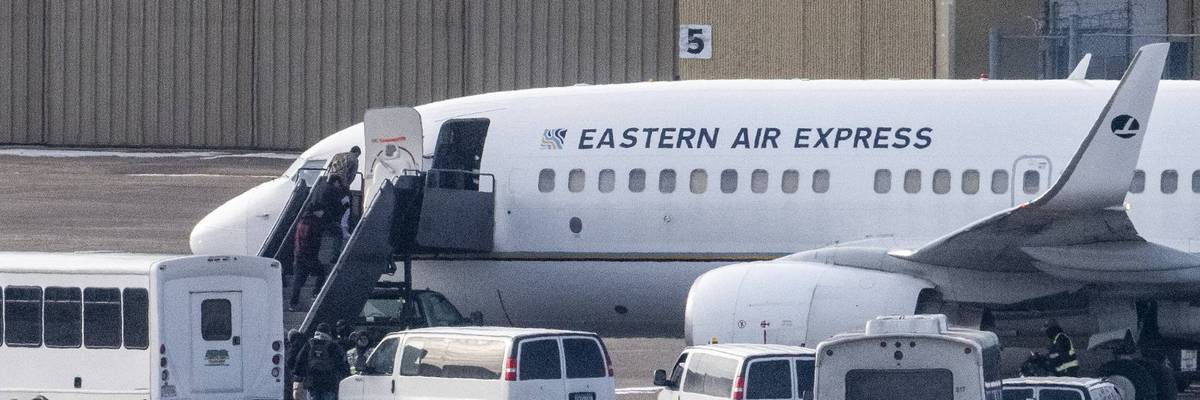
A group of detainees board an Eastern Air Express flight at Minneapolis-St Paul International Airport on January 11, 2026 in Minneapolis, Minnesota. At least five of these deportation flights have refueled at the Shannon Airport in Ireland. (Photo by Stephen Maturen/Getty Images)
A pair of human rights groups on Thursday called for the Irish government to stop letting the administration of US President Donald Trump use Shannon Airport as a refueling stop for Immigration and Customs Enforcement’s deportation flights.
In a joint letter to Ireland’s transport minister, Darragh O’Brien, and foreign affairs and trade minister, Helen McEntee, Amnesty International Ireland and Human Rights First urged the Irish government to stop cooperating with President Donald Trump’s efforts to deport migrants to third countries.
Using data from its ICE Flight Monitor, Human Rights First determined that Shannon Airport has been used to refuel deportation planes during at least five of these removal operations, which involved what the groups described as “transfers of individuals to countries... they have no ties to and where they have faced arbitrary and prolonged detention and other abuse.”
After one of the flights in May 2025, eight migrants from several countries, including Cuba, Mexico, Myanmar, Laos, Vietnam, and Sudan—some of whom had legally been resettled as refugees—were dropped in the East African nation of Djibouti. There, they were held in a shipping container at a US base for at least six weeks before being sent to war-torn South Sudan, where they were promptly detained by authorities. Six of them remain in detention today, with little ability to communicate with their lawyers.
Another group of five men from Cuba, Yemen, Vietnam, and Laos was taken to the southern African country of Eswatini in July. Four of them remain in state custody more than eight months later, despite the authorities giving no official reason for their ongoing detention.
Another flight stopped in Ireland on its way back from dumping eight Palestinian men, who were shackled for the entire journey, on the side of the road in the occupied West Bank. Some of the men had green cards in the United States, and several had wives and children from whom they had been forcibly separated, despite facing no accusations of having committed a crime. Two such flights have taken place.
In total, the groups found that at least 28 migrants had traveled through the Shannon Airport on their way to third countries.
About 300 migrants have been sent to third countries as part of the Trump administration’s “mass deportation” campaign, according to a February report by Democrats on the Senate Foreign Relations Committee.
The administration has spent more than $40 million, part of which has gone to countries willing to take in deportees, including Equatorial Guinea, Rwanda, El Salvador, Eswatini, and Palau, each of which has received multimillion-dollar lump sums.Most infamously, the administration last year secretly sent more than 280 young men, most without criminal records, to the Terrorism Confinement Center (CECOT), a megaprison in El Salvador, where they were subjected to torture and cut off from communication with their families and lawyers for more than four months before a judge ordered most of them released.
Amnesty and Human Rights First have described this practice as a form of “enforced disappearance” under international law.
“To carry out its mass deportation campaign, the Trump administration is flouting international law and cutting deals with dictators. It is also endangering lives, through its opaque web of third country agreements to send people against their will to countries where they have no connection”, said Uzra Zeya, the CEO of Human Rights First.
“Beyond their cruelty, these agreements reflect a transactional foreign policy driven by xenophobia, and they undermine due process and human rights globally,” she said. “Ireland should play no part in facilitating these unlawful removals, including to third countries notorious for rights abuses.”
Shannon Airport has become a target of protest over its use as a hub for American military planes, which many in Ireland see as an affront to the country’s long history of military neutrality. It has previously come under scrutiny for helping transport detainees renditioned for torture by the CIA during the post-9/11 global War on Terror.
Last week, a man was arrested for allegedly breaking into the facility and damaging a US military plane that was en route to a bilateral military exercise in Poland, according to The New York Times. Though no motive has been made public, the incident evoked other acts of vandalism by anti-war activists opposed to the US military presence.
“People across Ireland and the world look on in horror as the Trump administration continues implementing its vile, racist, and xenophobic executive orders that dehumanize and criminalize people who are, or are perceived to be, migrants and refugees. The administration has brazenly violated the right to due process by unlawfully removing people and subjecting some to enforced disappearance,” said Stephen Bowen, the executive director of Amnesty International Ireland.
Following a request last month for it to stop US deportation flights from using Shannon to refuel, Ireland’s Department of Transport contended that under the 1944 Chicago Convention on International Civil Aviation, US aircraft do not require permission to refuel at Shannon. Transport Minister O’Brien has said the US did not request authorization for the flights to land and that his department had no knowledge of them.
But Bowen says that even though states are not required to obtain permission to land, the convention still requires them to abide by international law, and that the Irish government ultimately has the power to decide how its sovereign airspace is used.
“The Department of Transport’s public responses are just not good enough,” he said. “There are depressing parallels with Ireland’s failure two decades ago to stop CIA-leased civil aircraft using Shannon as a stopover for rendition operations during the US ‘War on Terror’. Despite promises to ‘enforce the prohibition on the use of Irish airspace, airports, and related facilities for purposes not in line with the dictates of international law’, it appears that no concrete actions were ever taken.”
“The government’s timidity in its dealings with President Trump is already a cause for concern,” Bowen added. “If Ireland is facilitating the monstrous ICE project, then we fear the government has lost its way. Rather than cower and capitulate, it must show courage, compassion, and principle.”
Thomas' 'historically illiterate' speech gets history 'wildly inaccurate': scholar
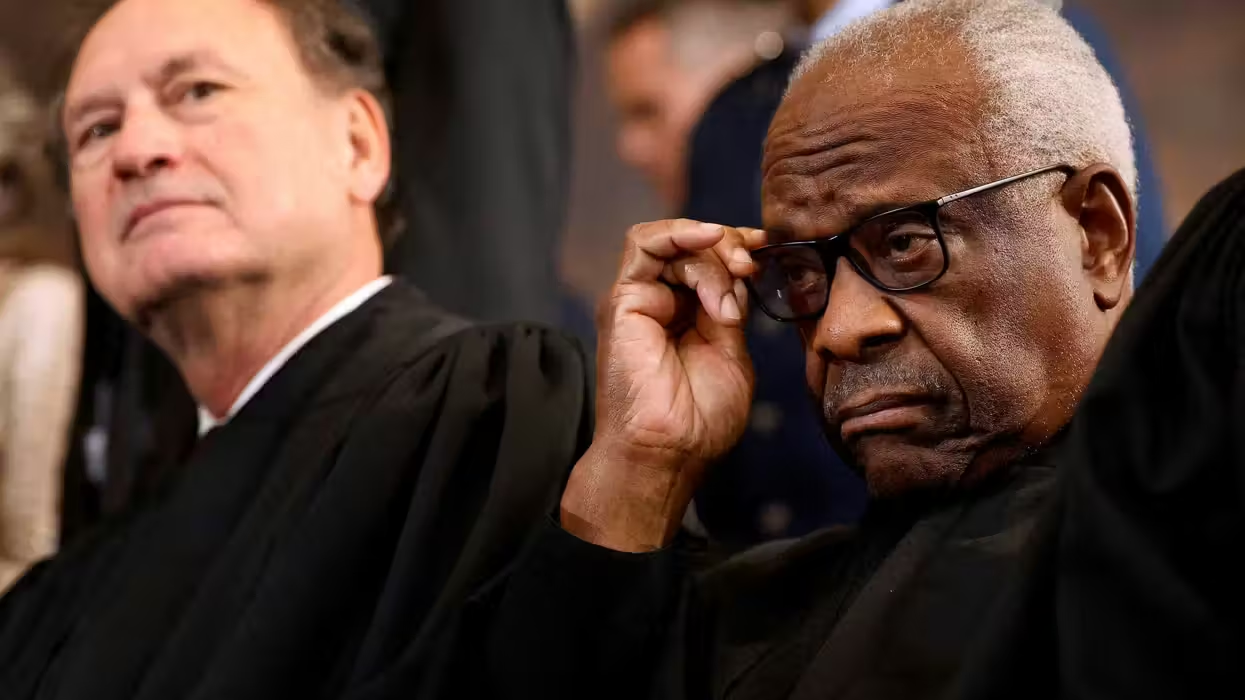
U.S. Supreme Court Justices Samuel Alito (left) and Clarence Thomas on January 20, 2025 in Washington, DC. Chip Somodevilla/Pool via REUTERS/File Photo
When U.S. Supreme Court Justice Thurgood Marshall announced his retirement in 1991 and President George H.W. Bush nominated Clarence Thomas, he wanted the seat to be held by another Black justice. Marshall was an historic figure: Appointed by President Lyndon B. Johnson in 1967, he was the first Black justice in the High Court's history.
But Thomas, now 77, was a major departure from Marshall in terms of judicial philosophy. While Marshall (who passed away in 1993) was decidedly liberal, Thomas is a far-right social conservative. And over the years, he had strong disagreements with not only the late liberal Justice Ruth Bader Ginsburg, but also, with retired libertarian/conservative Justice Anthony Kennedy.
Thomas looked back on U.S. history during a Wednesday night, April 15 speech at the University of Texas, Austin Law School, arguing that progressive politics are incompatible with the U.S. Declaration of Independence. But The New Republic's Matt Ford, in an article published on April 17, argues that Thomas got history wrong in multiple ways.
Thomas told attendees, "As we meet today, it is unclear whether these principles will endure. At the beginning of the 20th Century, a new set of first principles of government was introduced into the American mainstream. The proponents of this new set of first principles, most prominently among them the 28th president, Woodrow Wilson, called it progressivism. Since Wilson's presidency, progressivism has made many inroads in our system of government and our way of life. It has coexisted uneasily with the principles of the Declaration. Because it is opposed to those principles, it is not possible for the two to coexist forever."
But according to Ford, Thomas' take on U.S. history is wildly inaccurate.
"Thomas is correct that progressivism was introduced around the turn of the 20th Century, that Woodrow Wilson was the 28th president, and that Wilson was a progressive," Ford explains. "The historical accuracy ends there. Presenting Wilson as the inventor of progressivism is historically illiterate, akin to saying that Joseph Stalin invented communism or that Ronald Reagan invented conservatism. In reality, the progressive era emerged in the 1890s from the corruption and excesses of the Gilded Age."
Ford continues, "A broad range of activists, journalists, legislators, and judges challenged the societal ills that had emerged from the nation's rapid industrialization…. I'm sure that Wilson would have liked to claim credit for inventing the progressive movement, but he was one figure in a much larger social and political ecosystem. Republicans and Democrats alike both supported the movement and its reforms, and the first president to embrace it was actually Theodore Roosevelt."
Ford argues that for Thomas, it is "rhetorically advantageous to make" Wilson "the standard-bearer of progressivism" because he "was perhaps the most racist person to hold the presidency between Andrew Johnson and Donald Trump."
"It allows certain conservative intellectuals to adopt the guise of anti-racism while simultaneously opposing the civil rights laws passed decades after Wilson died," Ford notes. "I bring all of this up not to defend Wilson himself, but to point out the importance of getting history correct."
As Sotomayor Apologizes to Kavanaugh, Thomas Paints Progressives as Existential Threat
“Cowering liberals think this is a manners contest while conservatives are waging an ideological war,” said one observer.
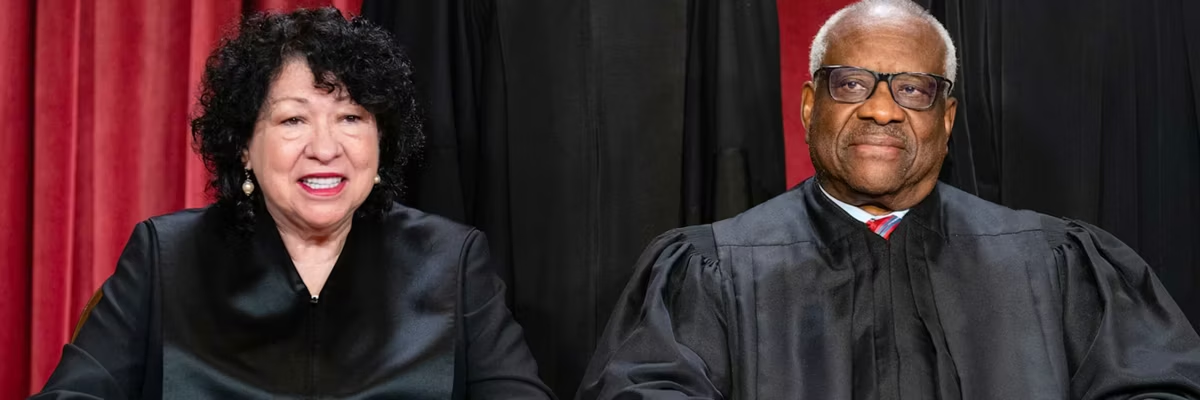
US Supreme Court Justices Sonia Sotomayor and Clarence Thomas pose for official photos on October 7, 2022 in Washington, DC. (Photo: Eric Lee/Bloomberg via Getty Images)
While one liberal US Supreme Court justice apologized Wednesday for mildly condescending remarks about a colleague, one of the high court’s most right-wing members compared progressives to the Nazi leader Adolf Hitler—a contrast that one prominent observer called “a perfect commentary on the asymmetry in politics” between liberals and the MAGA right.
“This is from a man whose parents were professionals,” Sotomayor told the audience, “and probably doesn’t really know any person who works by the hour.”
Meanwhile on Wednesday, Justice Clarence Thomas linked the progressive movement—which Americans have to thank for many of the rights they have today, from the five-day, 40-hour workweek, to food safety and environmental protection, to near-universal civil and voting rights—with some of the 20th century’s worst mass murderers.
“Progressivism seeks to replace the basic premises of the Declaration of Independence and hence our form of government,” Thomas told attendees of a University of Texas event commemorating the 250th anniversary of the document’s signing. “It holds that our rights and our dignities come not from God, but from government.”
Thomas called the declaration “one of the greatest anti-slavery documents in the history of the Western civilization,” even though its proclamation that “all men are created equal” did not apply to the 20% of the American population who were enslaved Blacks, and a condemnation of slavery was stricken from the draft due to objections from slave owners.
However, Thomas argued that the ideals in the Declaration of Independence have “fallen out of favor” among progressives.
“Progressivism was the first mainstream American political movement, with the possible exception of the pro-slavery reactionaries on the eve of the Civil War, to openly oppose the principles of the declaration” Thomas asserted. “Progressives strove to undo the declaration’s commitment to equality and natural rights, both of which they denied were self-evident.”
“It requires of the people a subservience and weakness incompatible with a constitution premised on the transcendent origin of our rights,” he continued, adding that it “led to the governments that caused the most awful century that the world has ever seen.”
“Stalin, Hitler, Mussolini, and Mao all were intertwined with the rise of progressivism, and all were opposed to the natural rights on which our declaration are based,” Thomas added, referring to Soviet leader Josef Stalin, the Nazi leader, and Chinese revolutionary Mao Zedong.
Balls and Strikes editor-in-chief Jay Willis responded to Thomas’ remarks on Bluesky, writing that it is “genuinely funny that Sonia Sotomayor issued a public apology today for her mild criticism of a conservative colleague on a specific, substantive issue, and then a few hours later Clarence Thomas picked up a mic and was like ALL LIBERALS ARE AMERICA-HATING COWARDS.”
“Clarence Thomas is a right-wing freak,” Willis added. “This is an indistinguishable from what unironic retvrn guys post on X about, like, women being allowed to have bank accounts. Anyone who tells you he is a profound thinker or a serious jurist or whatever is not to be trusted.”
Many right-wingers, meanwhile, applauded Thomas’ remarks, with Sen. Mike Lee (R-Utah)—who helped try to steal the 2020 election for President Donald Trump—posting on X that “progressivism *is* an existential threat to America.”
During his speech, Thomas also expressed his admiration for Harlan Crow, the Republican megadonor whose largesse to the justice and his wife Virginia—who was also involved in efforts to subvert the 2020 presidential election—has included undisclosed gifts like luxury vacations and private school tuition for a relative.
He also praised John Yoo, his former clerk and senior Justice Department lawyer who authored the infamous “torture memos” for the George W. Bush administration and publicly argued that the president has the power to order the massacre of an entire village of civilians or the crushing of a child’s testicles.
Thomas closed his speech with a call to action.
“Each of you will have opportunities to be courageous every day,” he said. “It may mean speaking up in class tomorrow when someone around you expects you to live by lies. It may mean confronting today’s fashionable bigotries, such as antisemitism. It may mean standing up for your religion when it is mocked and disparaged by a professor.”
“It may mean not budging on your principles when it will entail losing friends or being ostracized,” he continued. “It may mean running for your school board when you see that they are teaching your children to hate your values and our country. It may mean turning down a job offer that requires you to make moral or ethical compromises.”
This, from a justice on the nation’s highest court whose moral and ethical compromises in the form of “the number, value, and extravagance of the gifts” he took from a billionaire linked to a case before that same court has “no comparison in modern American history,” according to a Senate report.






.jpeg)