Report: The Race is On to Bring Unmanned Combatants to Life
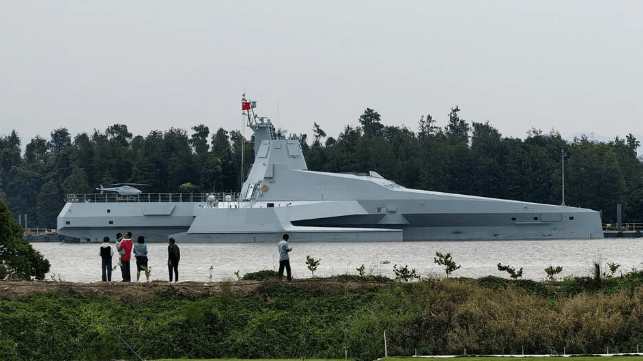
American defense tech consultancy Janus has just published a major review of autonomous naval systems in all global markets. After Ukraine's success with USVs in the Black Sea, interest in unmanned naval warfare is taking off - notably in the United States, with real backing from the U.S. Navy. But America is not alone in seeking an unmanned edge: China is moving towards development of "larger, more capable unmanned surface vessels" with long endurance and heavier payloads - "beyond anything the United States currently has deployed," the consultancy warns.
Janus points to the unveiling of CSSC's JARI-USV-A, or Orca, the world's largest (acknowledged) unmanned surface combatant. The trimaran vessel was revealed to the public at the Zhuhai Airshow in November 2024, and at a displacement of about 300-500 tonnes, it is about three times larger than the U.S. Navy's nearest equivalent, the Sea Hunter. The Orca is outfitted with VLS cells, torpedo tubes, an AESA radar, and a helideck for multipurpose operations. As a shallow-draft trimaran, it would be suitable for littoral operations in the Taiwan Strait, Janus says.
Looking ahead, China's abundant shipyard capacity positions it not just as a leader in modern warship and merchant ship production, but also as a tough competitor in scaled-up unmanned systems. "Chinese commercial shipyards produce more tonnage annually than the rest of the world combined. The structural advantage in production capacity that underlies every U.S. concern about naval competition does not disappear because the vessels are unmanned. It is, if anything, more relevant when the goal is to build dozens or hundreds of vessels rather than a handful of exquisite ones," Janus warns.
In the U.S., the unmanned-vessel space is crowded with competitors - a good thing for choice, but it is likely to lead to future consolidation, according to Janus. The big names in the startup world - Saronic, Anduril, Blue Water Robotics and others - are being joined by countless smaller companies, and by the defense primes as well. "The Navy will have a sustained number of orders once programs of record materialize, but not at the kind of scale that will keep a dozen companies in business simultaneously," predicts Janus.
The consultancy expects the Navy to begin moving swiftly into production orders under the newly-restructured MUSV "marketplace" concept (formerly MASC). The Navy now wants production-ready products, not development programs, and reliability at sea will be a primary focus, Janus says. This year should be one to watch for the future of the industry. "The structure of the award — how many companies receive contracts, whether it includes one or multiple hull variants, and how the OTA pathway shapes ongoing development will determine the industry landscape for years," the firm says.
Report: Three Injured in Fire Aboard USS Zumwalt
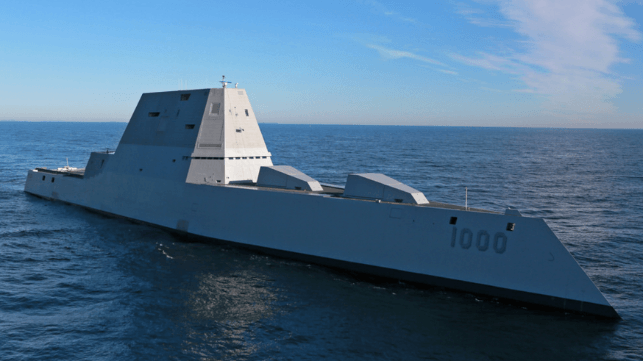
A fire aboard the first-in-class destroyer USS Zumwalt has injured three sailors, according to the U.S. Navy.
Zumwalt is currently at shipyard in Pascagoula, Mississippi to undergo modifications needed to launch the service's next-generation hypersonic missile. Launch tubes and equipment have replaced both of the Zumwalt's iconic deck guns, which were designed to deliver high velocity, high tech shore bombardment from a stealthy platform.
According to USNI and Naval Surface Forces, a fire was reported aboard Zumwalt at about 2145 hours on April 19. The crew managed to put it out, but three sailors were injured; two were treated at the scene, and the third was taken to the hospital. All are in stable condition.
An investigation into the circumstances of the blaze and the extent of the damage is under way.
The U.S. Navy's futuristic Zumwalt-class destroyers have had an uneven history in service, and have deployed only rarely. Their unique deck guns have never been used: After the number of vessels in the class was cut back from 32 to three due to budget concerns, the manufacturing cost per round for their special ammunition rose to an impractical $800,000-$1 million per shot. The production run of ammunition was canceled, and the guns are functionally unusable.
Aboard USS Zumwalt, the deck guns have now been replaced with four launch tubes for the Conventional Prompt Strike hypersonic missile system, each built to carry an all-up round pack with three missiles. This high-powered arsenal adds to Zumwalt's 80 existing VLS cells. The modification will cost up to $2 billion to complete for all three vessels in the series.


.jpg)