Canada Just Opened North America's First Battery-Grade Lithium Refinery
- Mangrove Lithium's Delta, BC facility is the first commercial electrochemical lithium refinery in North America, with capacity to produce 1,000 tonnes of battery-grade lithium a year.
- China still controls roughly half of the global lithium market, and the Canadian government is backing Mangrove as part of a broader critical minerals push under PM Mark Carney.
- A planned Eastern Canada expansion would scale output to support up to 500,000 EVs annually by refining lithium and processing spodumene sourced from Canadian mines.
China has been consolidating its control over global lithium supplies for years now. As the lithium-ion battery sector continues to grow at a massive pace, the extreme concentration of lithium supply chains gives China a major economic and geopolitical advantage. It also creates worrying vulnerabilities for the rest of the world that has come to rely on imports of the ‘white gold’ to keep their tech and energy sectors running.
Half of the global lithium market is controlled by China alone. “For over a decade, China has meticulously orchestrated a strategic ascent in the global electric vehicle (EV) batteries market, culminating in a dominance that now presents a formidable challenge to Western manufacturers,” the EE Times reported last year. This dominance functions as “almost a moat” around battery production in China, protecting the sector from any external competition.
Lithium-ion batteries have become omnipresent, powering everything from your smartwatch and your phone to electric vehicles and grid-scale energy storage. As oil and gas prices skyrocket against the backdrop of the Strait of Hormuz closure, the EV and energy sectors are poised for takeoff – making competition for lithium, and the resultant benefits for China, even more pronounced. But even before the current energy crisis breathed new life into the global clean energy transition, 2026 was already shaping up to be a ‘hot year for lithium.’
Incentive has never been higher for other nations around the world to step up their own lithium production and processing efforts. And this year, Canada may have made a major step toward breaking up China’s near-monopoly on lithium-ion battery production, thereby helping to relieve a “major choke point” in the EV supply chain. Mangrove Lithium, a lithium refining platform in Delta, British Columbia, just opened North America’s first-ever commercial-scale electrochemical lithium refining facility.
The venture capital-backed company says that it will be able to produce 1,000 tonnes of refined battery-grade lithium per year, or about enough to support 25,000 electric vehicles. The venture reportedly uses a cutting-edge electrochemical technology that allows for more economical, flexible, and sustainable lithium refining as compared to traditional methods.
“This is a landmark moment not just for Mangrove, but for Canada,” Dr. Saad Dara, CEO and Founder of Mangrove Lithium, was recently quoted by Interesting Engineering. “By commissioning the first commercial electrochemical lithium refinery in North America, we are proving that lithium can be refined domestically, sustainably, and competitively.”
The Delta plant is just the beginning for Mangrove, which has grand plans of creating an entire homeshored mine-to-cathode lithium supply chain. The company plans to develop a larger facility in Eastern Canada capable of producing enough material to support 500,000 EVs annually through the refining of lithium and the processing of spodumene, a raw source of lithium. These primary materials would also be sourced from Canadian mines.
Mangrove’s projects have the full support of the Canadian government, which sees these developments as critical to the country’s own energy security and independence goals. Canada’s national and energy security priorities have become heightened under the shadow of the Trump administration, and were a central platform for current Prime Minister Mark Carney.
“Canada is leveraging our critical mineral resources — including our lithium — to unlock supply chain security, job creation and clean energy innovation,” said Tim Hodgson, Canadian Minister of Energy and Natural Resources. “Mangrove Lithium’s new headquarters will house North America’s first commercial electrochemical lithium refining facility — exactly the type of cutting-edge, sovereign Canadian project we need. By supporting projects like these, our new government is advancing Canada’s low-carbon potential, creating new careers, strengthening our security and creating reliable Canadian jobs in an uncertain time.”
While domestic lithium production and extraction will be hugely beneficial for energy independence and resilience, it does come with some significant downsides. Lithium extraction tends to be extremely environmentally costly, posing major risks for local communities and water resources. Of course, homeshoring these processes instead of outsourcing them to poorer countries is not necessarily a bad thing – in fact, it’s ethically a far sounder approach. But questions remain about which communities will host these extraction sites, and under what protections.
By Haley Zaremba for Oilprice.com
Scientists at Rice pioneer faster, greener method to recycle lithium-ion batteries
image:
Simon M. King, a sophomore studying chemical and biomolecular engineering and first author of the study (Photo and video credit: Jorge Vidal/Rice University).
view moreCredit: Jorge Vidal/Rice University
As global demand for lithium-ion batteries continues to surge, a team of Rice University researchers has developed a faster, more energy-efficient way to recover critical minerals from spent batteries, potentially easing supply chain pressures and reducing environmental harm.
In a new study published in Small, researchers from Rice’s Department of Materials Science and Nanoengineering introduce a class of water-based solutions that can extract valuable metals from battery waste in minutes rather than hours. The work centers on aqueous solutions of “amino chlorides,” which mimic the performance of commonly studied green solvents like deep eutectics, while avoiding their key limitations.
“Traditional recycling methods often rely on harsh acids or slow, energy-intensive processes,” said the study’s first author, Simon M. King, a sophomore studying chemical and biomolecular engineering who completed this work as a summer research fellow at the Rice Advanced Materials Institute. “What we’ve shown is that you can achieve rapid, high-efficiency metal recovery using a much simpler, water-based system.”
King worked closely with corresponding authors Pulickel Ajayan, the Benjamin M. and Mary Greenwood Anderson Professor of Engineering, and Sohini Bhattacharyya, a research scientist in Ajayan’s lab.
Lithium-ion batteries power everything from smartphones to electric vehicles, but recycling them remains a major challenge. Only a small fraction of battery materials, including lithium, cobalt, nickel and manganese, are typically recovered during the recycling process, despite growing demand and limited global reserves.
Hydrometallurgical recycling, which dissolves metals into solution followed by their chemical precipitation, is considered one of the most scalable approaches. However, commonly used solvents can be toxic and proposed green alternatives (DESs) can be inefficient. To address this, the Rice team explored aqueous amino chloride salts as alternative “lixiviants,” or leaching agents. Among the candidates tested, a solution based on hydroxylammonium chloride (HACl) delivered standout performance.
“We were surprised by just how fast the reaction occurs, especially without the involvement of high temperatures,” King said. “Within the first minute, we’re already seeing the majority of the metal extraction take place.”
The HACl-based solution achieved roughly 65% extraction of key battery metals in just one minute at room temperature with efficiencies climbing above 75% for several metals under slightly longer processing times. And unlike many existing approaches, the process does not require high temperatures or long reaction times — two major drivers of cost and environmental impact.
“A big advantage of this system is that it works under relatively mild conditions,” Ajayan said. “That opens the door to more sustainable and scalable recycling technologies.”
The team found that replacing traditional organic solvents with water significantly reduced viscosity, allowing faster movement of molecules and improving reaction speed. This shift also simplifies waste handling and lowers environmental risk.
Through a combination of experiments and modeling, the researchers identified why the HACl solution performs so well: While acidity and chloride ions help dissolve metals, the key factor appears to be a built-in redox-active nitrogen center in HACl that actively participates in the reaction.
“While the rapid metal dissolution is very interesting, what is most exciting is that this highlights the generic chemical properties that are the major drivers for efficient leaching,” Bhattacharyya said. “That redox capability gives it a major advantage over other similar systems we tested.”
The study also shows that factors like solvent polarity or pH can be outweighed by the presence of reactive chemical groups and efficient mass transport to facilitate rapid leaching.
After extraction, the team demonstrated that the recovered metals could be reprocessed into new battery materials, completing the recycling loop. The findings point to a broader design strategy for next-generation recycling systems: combining low-toxicity solvents with targeted chemical functionality to maximize efficiency.
Journal
Small
Article Title
Beyond DESs: Aqueous Redox-Active Amino Chloride Salts for Efficient Hydrometallurgical Recycling of Lithium-Ion Batteries
Article Publication Date
24-Apr-2026
Lithium market to enter deficit until 2035, says Canaccord
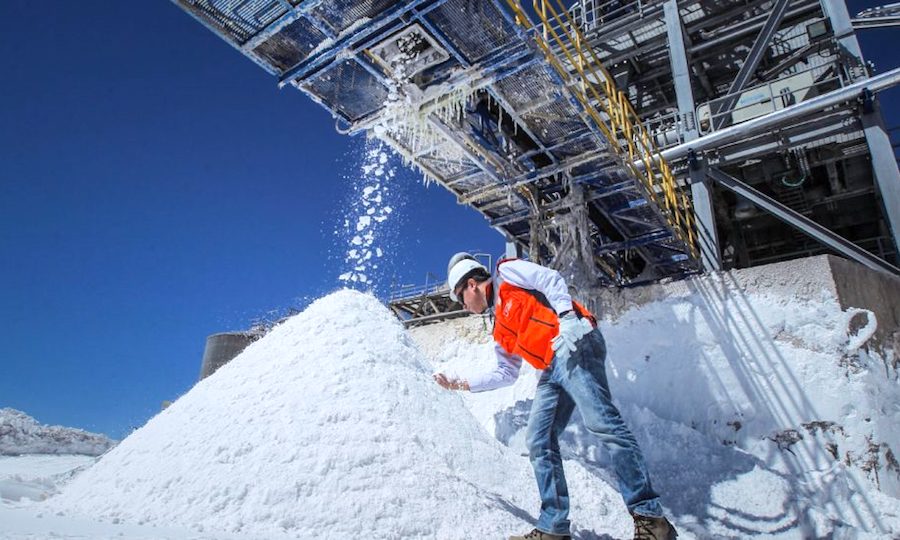
The global lithium market is set to enter a near-decade-long deficit as a lack of mine investment weighs on supply of the EV battery metal, according to Canaccord Genuity.

In a note published Wednesday, Canaccord analysts said they expect to see a “material market deficit” starting in 2026, given that tightening supply has more than offset the weakness in near-term demand.
This deficit, they added, could last until 2035. Even if rising lithium prices through 2027-28 could ignite a supply response, that would still fall short of their demand growth forecasts, the analysts said.
In recent months, lithium prices have shot up on persistent worries over supply, led by the suspension of a key mine in China, one of the world’s leading suppliers. Earlier this year, Zimbabwe, another top producer, introduced a ban on raw lithium exports, exacerbating the market conditions.
Canaccord’s outlook assumes no further disruptions in China and elsewhere, which could well extend the deficit beyond the projected period.
According to Canaccord analysts, the lithium market would require “significant” investment in new supply in the long term, even if there are no more supply risks and drastic changes to demand forecasts.

No comments:
Post a Comment