Report: Arctic Routes to Remain Peripheral, Especially for Boxships
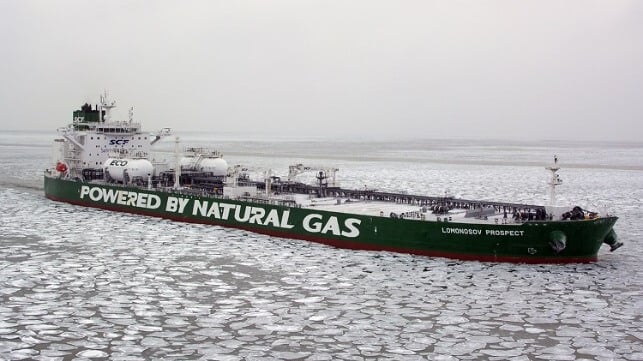
In the past few years, there has been a lot of hype about the growing ship traffic along the Arctic routes. But recent analysis shows that whle Arctic shipping has indeed surged, growth remains uneven. In a new report, credit insurance firm Coface said that the commercial impact of Arctic shipping routes is likely to remain marginal within the next five years. Nevertheless, Arctic routing offer significant benefits for certain commodity flows.
With climate change opening up navigation in the Arctic, the region is being seen as a viable alternative to the traditional routes. Add to the fact that critical chokepoints are also increasingly facing disruptions due to geopolitical tensions and drought. These factors combined have raised the transport viability of the Arctic. Arctic routes also offer reduced sailing distances - up to 40% less between East Asia and Northern Europe.
While the Arctic shipping outlook appears favorable, Coface’s analysis indicates that the region’s routes will primarily attract the transport of raw materials. Arctic routes will particularly offer significant cost savings to liquid bulk shipping (crude oil, diesel or LNG). Dry bulk is another segment that is likely to find Arctic shipping competitive, but only when ships can operate without icebreaker support.
On the other hand, the Arctic is expected to remain uncompetitive for container shipping, despite the shorter distances. Operational constraints, the limited size of vessels and the specific costs of Arctic navigation prevent it, at this stage, from competing with the economies of scale of traditional routes.
Overall, only about 3.5 percent of trade between East Asia, Northern Europe and North America is likely to use Arctic routes in the short term. Thus, the overall impact of Arctic shipping in the global trade is expected to be minimal. However, industries linked to cereals, energy, metals and timber will benefit from the Arctic routes.
In the short term, Coface sees the value of Arctic routes as more political than commercial. “Until container transport becomes economically viable on a large scale, the Arctic routes are unlikely to radically disrupt the major balances of global trade,” Coface added.
These findings are corroborated by a new publication by Norway’s research organization Fram Center (High North Research Center for Climate and Environment). The study analyzed shipping traffic in the High Arctic between 2013 and 2022. Largely, the focus was comparing traffic in High-Arctic Large Marine Ecosystems (LMEs), consisting of major seas in the Arctic.
Vessels in the Barents Sea accounted for 74 percent of the total distance sailed in the High-Arctic LMEs in 2022. Vessels sailed 4.5 million nautical miles (nm) in the year than 10 years before, making the growth in the Barents Sea the largest. In contrast, traffic in the Northern Canadian Archipelago increased by only 2,000 nm, making the region to have the lowest share.
Remarkably, sailed distance tripled in the Kara Sea, with the LME becoming number two in 2022 traffic with a 7.8 percent share, followed by Baffin Bay with 7.3 percent. The Kara Sea exceptional performance could be explained by the steady increase in traffic of cargo ships. The launch of the Yamal Peninsula LNG project has seen a rise of crude oil and gas tankers of a size and type that had never been present in the Arctic before.
In the Barents Sea, fishing vessels constitute the biggest share of the traffic. This also applies to Baffin Bay, but in this region, there is a significant increase in small containerships, which serve settlements in Greenland and northern Canada. Bulk carrier traffic is also on the rise, owing to expansion of iron-ore mining on Baffin Island.
HD Hyundai Finalizes Its First International Contract for an Icebreaker
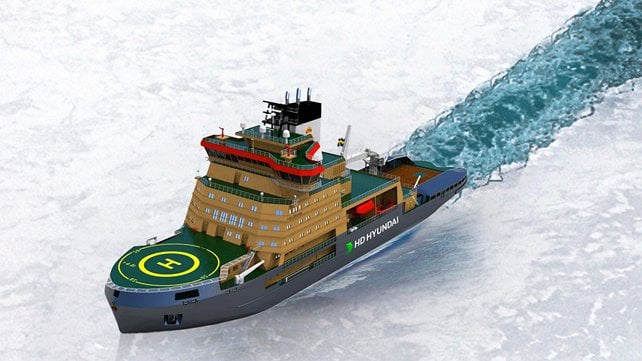
The Swedish Maritime Authority and HD Hyundai Heavy Industries completed the contract for the construction of a new icebreaker to support operations in the Baltic. The vessel, which is critical for modernizing Sweden’s fleet, also marks the entry of South Korea’s shipbuilders into this segment of the international market.
HD Hyundai reports the contract is valued at $348.9 million for one icebreaker due for delivery in 2029. The vessel, which will be 126 meters (413 feet) in length, will be approximately 15,000 tons displacement. It will be a Polar Class 4 (PC4) icebreaker, meaning it can handle continuous ice breaking at approximately 1 to 1.2 meters (approximately 3 to 4 feet) in thickness.
Sweden had launched the project in October 2017, with the Maritime Authority submitting preliminary studies and recommending that its fleet of five vessels should be replaced by 2030. It worked with the Finnish Transport Agency and Aker Arctic Technology in Helsinki to develop the design. They said the vessel would be able to maintain a 32-meter (105-foot) wide channel.
Plans called for the vessel to have the capability to be powered by methanol in the future. HD Hyundai reports it will utilize an electric propulsion system. The ship will be used to perform icebreaking as well as fleet operation support, towing operations, and ice management in the Baltic.
According to the Swedish Maritime Administration, its icebreakers are critical to keeping northern ports open, which otherwise could have to close for up to 130 days a year. It highlights the critical role of the maritime trade to the country’s economy while highlighting that five of its six vessels were built in the 1970s and 1980s. The age of the ships has become a challenge and requires additional maintenance to keep them in operation.
A tender was launched in 2025 with a total of four bids, one from Norway, two from Finland, and HD Hyundai from South Korea. In addition to price, which Sweden said was the most important factor, it also considered the delivery timetable and technological capabilities of the yard. In November 2025, HD Hyundai was selected as the winner of the tender.
The results of the tender, however, were challenged in the Swedish courts. The Administrative Court found in favor of the Maritime Administration, but that decision was appealed. The SMA reported on April 14 that the Court of Appeals had decided not to “grant leave,” meaning the lower court’s decision was final and cleared the way for the shipbuilding contract.
HD Hyundai is calling it a “breakthrough” and is in keeping with its plans to expand internationally for specialized vessels. The company is already citing the opportunities with the 2024 ICE Pact between the United States, Canada, and Finland, which projected a $9 billion investment to build 70 to 90 icebreakers over the next decade.
“We will expand into new export markets in the special-purpose vessel sector based on our technological prowess and business integration capabilities,” said HD Hyundai Heavy Industries President Joo Won-ho (Head of Warship and Medium-sized Vessel Business).
Last year, the EU announced it would provide more than $6 million for a program running between 2025 and 2029 to renovate and modernize Sweden’s state icebreakers. It is a joint project with Finland and Estonia to ensure the continued operations of the icebreakers. This winter, the Baltic saw some of its most challenging conditions, placing high demands on the icebreaker fleet as the ice expanded and slowed vessel movements.

No comments:
Post a Comment