Thursday, April 30, 2026

Why UAE's OPEC exit is a blow to Saudi Arabia

Nik Martin
DW
 30/04/2026

The United Arab Emirates is leaving OPEC to pump more oil on its own terms. The break strips Saudi Arabia of a key partner and adds to growing uncertainty over the cartel's future.


The UAE, then part of the Trucial States, joined the OPEC oil cartel in 1967
Image: Karim Sahib/AFP


Why has the UAE decided to quit OPEC now?

OPEC, the global cartel of oil-producing nations, operates a quota system that limits how much oil each member can produce.

For years, the United Arab Emirates (UAE) has clashed with Saudi Arabia, OPEC’s most powerful member, over these quotas. The UAE has invested heavily to expand its oil industry and grow its market share, but OPEC limits have repeatedly held it back.

Energy Minister Suhail Al Mazrouei told the New York Times on Tuesday: "The world needs more energy. The world needs more resources, and [the] UAE wanted to be unconstrained by any groups."

The UAE is now betting it can sell more oil once the Iran war and Strait of Hormuz crisis ends, both in the medium and the longer term. Analysts, meanwhile, see the move as a calculated step by a producer ready to act independently.

"Losing a member with 4.8 million barrels per day of capacity, and the ambition to produce more, takes a real tool out of the group's [OPEC] hands," said Jorge Leon, head of geopolitical analysis at research consultancy Rystad Energy.

"With demand nearing a peak, the calculation for producers with low-cost barrels is changing fast, and waiting your turn inside a quota system starts to look like leaving money on the table."

The UAE, which joined OPEC in 1967 through Abu Dhabi, will leave both OPEC and the wider OPEC+ alliance, which includes Russia, on May 1.

The UAE currently produces roughly 3.2 to 3.6 million barrels per day (bpd) under quotas but holds spare capacity of nearly 4.8 million bpd, Reuters news agency reported. Plans call for a hike in output toward 5 million bpd by next year.

How does the UAE's exit weaken OPEC and Saudi Arabia’s leadership?

The UAE's exit removes one of the few OPEC members with meaningful spare oil capacity, leaving Saudi Arabia unable to easily share the burden of output adjustments.

The Gulf Kingdom has traditionally managed oil prices by cutting its own production and enforcing discipline across the group. With the UAE gone, Saudi Arabia will have to rely much more on its own oil production cuts to stabilize prices.

This will make defending oil prices more expensive and less effective for Riyadh. It also weakens the Kingdom's ability to manage and discipline the wider OPEC group.

David Oxley, chief climate and commodities economist at the London-based Capital Economics research house, called the move "the thin end of the wedge," warning in an analysis its website that "the ties binding OPEC members together have loosened."

Saudi Arabia needs high oil prices — around $90 (€77) per barrel — to fund government spending and its ambitious Vision 2030, a set of huge infrastructure projects to cut the Kingdom's reliance on fossil fuels. These include a $500 billion futuristic city named NEOM.

Every extra barrel the country holds back means lost revenue, which hurts the country's ability to grow its economy.

The exit also exposes long‑standing tensions inside OPEC, especially the perception that Saudi Arabia dominates decision-making.

The move also comes at a time when OPEC's overall influence has been shrinking. The cartel once controlled more than half of global supply; today, it commands less than a third.

What does the UAE exit mean for global oil prices?


The UAE's departure is unlikely to cause major immediate swings in global oil prices, largely because the ongoing disruption in the Strait of Hormuz already dominates the market.

Much of the region's oil exports remain blocked and the UAE is redirecting about 1.8 million bpd to its Fujairah port on the Gulf of Oman coast via a pipeline that is running at maximum capacity. Any additional production the country plans to bring online cannot reach markets right away.

As a result, the announcement had little immediate effect on prices, with Brent crude largely unchanged on Tuesday.

"In the short term, I don't expect it [the exit] to have major impacts because what's happening in the Strait of Hormuz dominates the whole global oil picture in a way that renders this news from OPEC as kind of a minor thing," Jeff Colgan, an expert on OPEC at Brown University, told DW

Once the situation in the Hormuz situation normalizes, the UAE could add several hundred thousand extra barrels per day to the market. In the longer term, the exit points to modestly lower and more volatile oil prices.
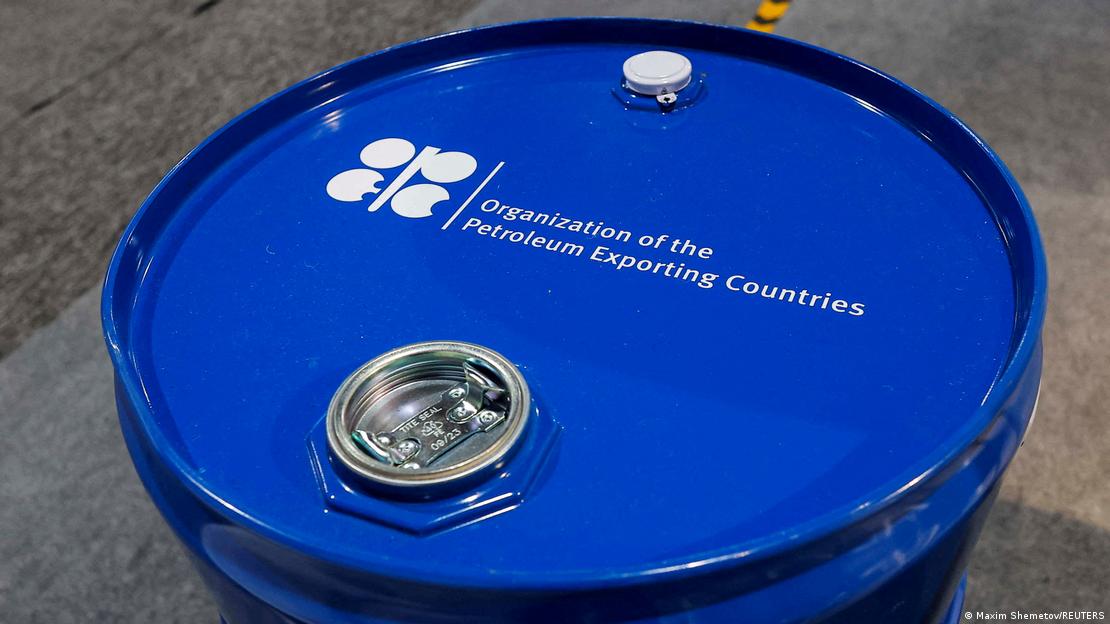
OPEC will have 11 remaining members after the UAE's exit
Image: Maxim Shemetov/REUTERS


Could the UAE prompt other producers to reconsider OPEC?

Some oil industry analysts say the UAE's exit adds to longer-running doubts about OPEC's future cohesion.

"It is possible that we could see the whole organization fall apart," Colgan told DW, adding that he believes Saudi Arabia will likely try to keep the group together as "the key anchor to the whole organization."

The UAE's exit does, however, highlight growing frustrations with OPEC's quota system and exposes rifts, especially with Riyadh.

OPEC has already been under strain from repeated quota breaches by members such as Iraq and Nigeria, and from Russia's inconsistent compliance within OPEC+. The UAE's departure adds to that sense of fragmentation.

In his analysis for Capital Economics, Oxley warned that, in the medium term, if other producers with spare capacity "see the UAE successfully gaining flexibility and market share" outside OPEC, "others may follow."

For now, most members lack the UAE's production capacity or economic diversification, so a mass exodus is unlikely.

The UAE is not the first OPEC member to leave. Qatar exited in 2019, while Angola, Ecuador, Gabon and Indonesia have also departed in recent years, often due to disagreements over quotas.

Edited by: Ashutosh Pandey
Mali: France urges citizens to leave amid Tuareg advance

DW with Reuters, AFP
29/04/2026 - 

With Tuareg-led rebels saying the ruling junta in Mali will fall "sooner or later" and demanding the withdrawal of Russian troops, the French Foreign Ministry has called on French nationals to leave the country.


Paris says the security situation in the former French colony remains 'volatile'
Image: AFP

France has urged its nationals in Mali to leave the country "as soon as possible" amid continuing attacks by Tuareg-led rebel forces who have claimed that the ruling junta will "fall sooner or later" and demanded that Russian forces also withdraw from "all of Mali."

The French Foreign Ministry said the security situation in the former French colony remains "volatile" following a coordinated assault by Tuareg-dominated separatists allied with the al-Qaeda-linked Jihadist Group for the Support of Islam and Muslims (JNIM).

In the largest attacks in Mali in nearly 15 years, the rebel alliance, the Azawad Liberation Front (FLA), has captured the strategic northern desert town of Kidal and killed Defense Minister Sadio Camara, seen as the mastermind behind the military government's pivot away from the West and towards Russia in recent years.

Mali: Russian Africa Corps admits losses

Russian troops from Moscow's Africa Corps, who have provided security for the junta, admitted they have "sustained losses" but provided no further details.

"Our objective is for Russia to withdraw permanently from Azawad and beyond," said FLA spokesman Mohamed Elmaouloud Ramadane, referring to the northern part of Mali in which the rebels would like to declare an independent state.

"We have no particular problem with Russia, nor with any other country," he said. "Our problem is with the regime that governs [in the capital] Bamako."

Nevertheless, he said the Russian troops were still viewed negatively for their role in "supporting people who committed serious crimes and massacres."

In Moscow, the Russian Defense Ministry confirmed that Africa Corps fighters had been forced to withdraw from Kidal, with Ramadane saying they had been escorted out of town.

"The Russians found themselves in danger; there was no way out," he said. "When they realized they could not hold out against our forces and our firepower, they requested this withdrawal."

Mali junta 'will fall sooner or later,' say rebels


Ramadane, who was set to meet French security and defense officials in Paris on Wednesday, claimed that FLA troops had won "all the confrontations we had with the Russians" who he said were no match for Tuaregs who are defending their homeland.

"Even if they are a powerful force, they will not be able to stand up to the Azawadians, the masters of the terrain," he said.

The ​leader of Mali's military government vowed on Tuesday to "neutralize" those responsible for the attacks, but Ramadane said that the FLA also intends to "liberate" the towns of Gao and Timbuktu along the River Niger.

"To achieve peace, to find stability in Azawad, in Mali and beyond in the Sahel, the first thing is to get rid of this junta," he said. "The regime will fall, sooner or later."

Edited by: Srinivas Mazumdaru


Matt Ford Reporter for DW News and Fact Check


ANTI IMPERIALIST UNITED FRONT 

Insurgent alliance strikes at heart of Mali’s junta, exposing limits of Russian protection


Mali’s ruling junta was reeling on Monday after coordinated attacks by separatists and al Qaeda-linked jihadists sparked two days of fierce fighting across the country. It was the most serious challenge to Mali's central government since a 2012 rebel offensive was pushed back by the intervention of French forces.


Issued on: 27/04/2026
By: Barbara GABEL/Benjamin DODMAN

Tuareg rebels of the Azawad Liberation Front (FLA) celebrate in Tidal after seizing control of the northern Malian city, on April 26, 2026. © Abdollah Ag Mohamed, AFP

Mali has been plunged into its worse security crisis in more than a decade after Tuareg separatists and al Qaeda-linked jihadist fighters joined forces to launch sweeping attacks on Saturday, delivering a huge setback for its ruling military junta and its Russian allies.

Insurgents struck the main army base outside the capital Bamako and killed General Sadio Camara, the country’s defence minister, further undermining the junta’s claim that it is restoring order to impoverished West African nation that has long battled Islamist militants and separatist rebellions. The violence also saw rebel forces drive Russian mercenaries out of the key northern city of Kidal.


© France 24
02:10


It was the most sweeping rebel offensive since 2012, when Tuareg separatists joined forces with Islamist groups and eventually seized control of two-thirds of the country. As fighters advanced on the capital, Mali’s government appealed to former colonial ruler France for reinforcements. After France helped oust the Islamists, the subsequent presence of French troops and a UN peacekeeping mission helped ensure a wary peace over most of the next decade.

A 2020 military coup in Mali saw relations with France deteriorate, and by 2022 France had withdrawn the last of its troops despite a jihadist resurgence.


But history now appears to be repeating itself, with many of the same players on the ground – alongside some new elements that further complicate Mali’s search for stability.
· Defence minister killed, key town captured

Several strategic towns and areas around Bamako were targeted in Saturday’s dawn offensive by Tuareg rebels of the Azawad Liberation Front (FLA) and the al Qaeda-linked jihadist Group for the Support of Islam and Muslims (JNIM).

Defence Minister Sadio Camara, seen as the military regime’s second-most-powerful figure and a key Moscow ally, was killed in an apparent suicide truck bombing on his residence in Kati, a garrison town near Bamako that serves as the junta’s headquarters.

JNIM fighters also struck near Bamako airport and in localities farther north, including Mopti, Sevare and Gao.

In another major blow to the junta, FLA rebels claimed “total” control of their historic northern bastion of Kidal, where they secured the withdrawal of junta-allied mercenaries from Russia’s Africa Corps, which has taken over from the Wagner paramilitary group in much of Africa.

General Assimi Goita, the military ruler who deposed Mali’s civilian government in a 2020 coup, has not been seen or spoken publicly since the start of hostilities.

“This is a dramatic setback for the Malian government and a new phase in the ongoing insurgency in the Sahel,” said Andrew Leibovich, a research fellow with the Clingendael Conflict Research Unit focusing on North Africa and the Sahel.

“The fact that they were able to assemble so many fighters, particularly in and around Bamako and Kati, without detection and without the government being able to stop them, indicates how tenuous the security situation is, even around the capital,” he added.
· JNIM and FLA: Who are the insurgent forces?

One of Africa's deadliest jihadist groups, JNIM formed in 2017 through the merger of five separate militant groups. It has been the main force behind a resurgence of jihadist attacks across several West African nations, including Mali’s neighbours Burkina Faso and Niger.

The group is believed to have around 6,000 fighters. Its leader is Iyad Ag Ghaly, the ethnic Tuareg head of the Ansar Dine Islamist group that took over the historic city of Timbuktu in northern Mali in 2012 and imposed sharia law there.

JNIM aims to establish Islamist governance across the Sahel. Its years-long insurgency broadened to economic warfare last year when it staged a fuel blockade that paralysed Bamako and large swaths of the country.

But experts have cast doubt on the group’s ability to govern.

“JNIM fighters don’t have the capacity to take and run a city like Bamako. What they are trying to do is to target major regime figures, destabilise the junta and perhaps spark an uprising,” said Ulf Laessing, head of the Sahel Program at the Konrad Adenauer Foundation.
© France 24
01:32

Mali has been grappling with ethnic Tuareg rebellions since shortly after it gained independence from France in 1960. The Azawad Liberation Front (FLA), officially formed in November 2024, is just their latest iteration.

Present across the Sahara region, nomadic Tuaregs are fighting for an independent homeland they call "Azawad". In 2012, it was the National Movement for the Liberation of Azawad (MNLA) that first swept through northern Mali until its campaign was hijacked by Islamist groups.

Mali struck a peace deal with Tuareg separatists in 2015, but the military junta withdrew from the agreement in 2024, leading to a resumption of hostilities.

In July 2024, Tuareg fighters attacked a convoy of Malian soldiers and Wagner fighters in the north, claiming to have killed 84 Russians and 47 Malian soldiers. Ukraine's military intelligence service then suggested it had helped the Tuareg rebels carry out the attack by providing intelligence, and Mali responded by cutting ties with Kyiv.
· ‘A shaky, ad hoc alliance’

Saturday’s coordinated attacks mark the first time since 2012 that jihadists and Tuareg separatists have cooperated on this scale, providing the most concrete evidence yet of a rapprochement negotiated more than a year ago, according to FRANCE 24’s expert in jihadist networks Wassim Nasr.

“We now have proof that there is genuine coordination across the country: all these attacks took place simultaneously,” Nasr explained.

“The aim was not to bring down Bamako, but to tie down the army in order to cut off the north and gain control of it,” he added. “There is a clear coordination to resume fighting against the Malian junta, but also against the Russians."

An FLA spokesperson confirmed the coordinated push on Sunday, stating that JNIM “is also committed to defending the people against the military regime in Bamako”.

However, analysts caution that the two groups have relatively little in common aside from a common enemy, suggesting theirs could be little more than an alliance of convenience.

“They both know they can’t really force regime change on their own – that's why they are teaming up the way they did in 2012,” said Laessing. “The jihadists eventually got rid of the Tuaregs back then, so this is a very shaky, ad hoc alliance, and not something that can run Mali.”

· Twin blows for the junta


Saturday’s brazen attacks on the heart of government, coupled with the fall of Kidal, constitute major setbacks for a military junta that seized power in 2020 on a promise to stabilise the country and assert the central government’s control throughout its territory.

Kidal had long served as a stronghold of the rebellion before being taken by junta forces and mercenaries from Russia’s Wagner. Its capture in late 2023 marked a significant symbolic victory for the junta and its allies in Moscow.

© France 24
08:14

The attacks on Kati and Bamako, and the killing of Defence Minister Camara, are “an even greater blow to the junta’s confidence”, said Paul Melly, Consulting Fellow on the Africa Programme at Chatham House.

“The fact that they could even launch a truck bomb at the house of the regime’s number two shows the fragility of the regime’s military hold. Even in Kati, basically the headquarters of the junta, they could not guarantee the security of their most senior figures,” he said.

“The reason the military junta took over from civilian authorities was because of the mounting insecurity in the region, under the promise that they would quell the violence. But the data shows that insecurity in Mali and across the Sahel region has only worsened,” added Folahanmi Aina, a lecturer at the School of Oriental and African Studies (SOAS) in London.

He pointed to early signs of a “legitimacy crisis” for the regime.

“While part of the population remains supportive of the junta, we’re beginning to see an erosion of trust in its ability to address the situation on the ground and guarantee the safety and security of the Malian people,” Aina said.


· Russia's African ambitions undermined


The fall of Kidal and the failure to thwart attacks on Bamako and Kati have also exposed the limits of Russian military power in West Africa.

Russia’s Africa Corps confirmed its withdrawal from Kidal on Monday, acknowledging that “the situation in the Republic of Mali remains difficult”. Moscow also lost a key ally with the killing of Defence Minister Camara, a key architect of the rapid shift in alliances that saw the junta expel French and UN forces and turn to Russia for military support.

“The attacks show that Russian mercenaries only have a limited capacity, in stark contrast to the situation before the coup, when Mali had a military partnership with France and there was a very large UN peacekeeping force of 13,000-14,000 soldiers, many of them West African, which helped to maintain a basic degree of security and stability,” said Chatham House’s Melly.


© France 24
01:47

“The French never really had a chance to pacify this vast country and the Russians even less so,” added Laessing. “In fact, they (the Russian mercenaries) made the conflict worse by being brutal and not distinguishing between civilians and combatants, which has made it easier for jihadists to recruit fighters.”

The regime’s political isolation – and that of allied juntas in Burkina Faso and Niger, which have also severed ties with France and left the ECOWAS group of West African states – has left them with few other options to confront the security emergency, he added.

“Mali, Niger and Burkina Faso are on a nationalist, anti-Western course and it is not clear who will want to engage with them,” Laessing explained. “I don’t think Europe or France will be willing or even welcome to put boots on the ground to help stabilise the situation, which is probably beyond a military solution anyway.”

Street battles and withdrawal of Russian mercenaries: Inside the 48-hour fall of Mali’s Kidal

The Azawad Liberation Front and the Group for the Support of Islam and Muslims (JNIM) launched an offensive against several Malian towns on April 25. In the north, the city of Kidal was recaptured following a three-year presence of Russian and Malian forces. Verified footage offers a window into these two days of tensions.


Issued on: 27/04/2026 - 
By:  The FRANCE 24 Observers / Guillaume MAURICE
FLA rebels seen parading through Kidal after capturing the city. © Observers

Two and a half years later, the flag of Azawad – the Tuareg name for the northern region of Mali claimed by separatists of the FLA (Azawad Liberation Front) – is once again flying over the city of Kidal.


In November 2023, the Malian army seized the city alongside Russian mercenaries from the Wagner Group, now rebranded as Africa Corps. On April 25, separatists raised their flag in the city’s central square, claiming to have regained control.

FLA fighters pose in Kidal’s main square after seizing control of the city on April 25. Location: 18°26'48.17"N 1°24'32.56"E Source: X / Wamaps_news / Guillaumem_MRC

The assault began at 6am. Six Malian cities found themselves under fire. In Kidal and Gao, the offensive was led by a coalition comprising the FLA and the al Qaeda-linked Jihadist Group for the Support of Islam and Muslims (JNIM).

A morning of heavy fighting on the outskirts of Kidal

An FLA commander told the FRANCE 24 Observers team that checkpoints at the city’s entrance fell within the first hour of fighting. The Tuareg rebel, originally from the area, said that the city fell to the coalition by early afternoon.

Around noon, a video shows vehicles belonging to the JNIM or the FLA circulating freely past a military camp north of Kidal. With a Starlink receiver mounted on the hood of their car, the armed men drove past the building without stopping.

An account supporting the FLA independence movement shared a video showing militants bypassing a military camp north of Kidal. Location: 18°27'27.73"N 1°24'4.54"E Source: Facebook / AlkassimAgAhouchel.1990

Within the city, fighting was concentrated around the police station, where Malian Armed Forces (FAMA) soldiers had taken up defensive positions. The building’s perimeter was breached at approximately 2pm.
Footage published on April 25 shows armed FLA militants parading a Kidal police car they have captured. Source: X / XNewsUncensored


Symbolic sites

Another symbolic victory was claimed as the Kidal governorate fell into the hands of separatists. This building served as the administrative headquarters for General El Hadj Ag Gamou, the governor of the region, following the Malian junta’s return in 2023. As the leader of the Imghad Tuareg Self-Defence Group and Allies (Gatia), Gamou has remained loyal to the junta.

By late afternoon, a pro-FLA account released a video showing independence forces hoisting their flag atop the building.


Footage shows FLA members raising the group’s flag atop the Kidal governorate. Location: 18°26'58.81"N 1°24'12.59"E source: X / Guillaumem_MRC

The FLA and JNIM also claim to have captured soldiers from the Malian army.
The former UN base south of Kidal: a strategic stronghold

Located on the southern outskirts of the city, the former camp of MINUSMA, the former UN mission in Mali, served as a strategic stronghold. While encircled and entrenched within the base, Russian Africa Corps mercenaries were reportedly targeted by drone strikes and mortar fire from the FLA.

To organise their evacuation, negotiations between the FLA and Russian forces reportedly began as early as April 25, according to the pro-independence source the Observers team spoke to. Russian troops were evacuated from the former UN base the following day, at approximately 4 or 5pm.
A comparison of satellite imagery captured on April 10 (left) and April 25 (right) reveals potential signs of fighting or fires. © Sentinel- 2 Copernicus


However, resistance from Africa Corps mercenaries also persisted on the fringes of Kidal until the evening of April 25. Our source within the FLA said the mercenaries and Malian troops, entrenched in a turret with precision rifles, were finally evacuated to the MINUSMA camp the following day.


Withdrawal of Russian mercenaries

At 5pm, the Tuareg commander claimed that the independence fighters had taken control of the camp’s exit points. He said the Russian mercenaries burned several installations and vehicles before pulling out.

Our team geolocated a video showing a convoy of vehicles from the Africa Corps mercenaries and the Malian army departing the MINUSMA base and heading north. However, it’s currently impossible to determine where the forces previously stationed in Kidal are repositioning.

This video was published on April 25 by a pro-FLA account. It shows the evacuation of vehicles from the Africa Corps and the FAMA. Location: 18°26'10.28"N 1°24'29.34"E source:X / BayeAg1 / Guillaumem_MRC

The retreating Russian column included heavy weaponry, such as several BM-21 Grad multiple-rocket launchers, and truck-towed artillery pieces.

The total number of casualties remained unknown after a day of intense fighting. While footage emerged on April 25 showing the bodies of Malian soldiers in Kidal, none of the combatant groups has disclosed their losses. Meanwhile, the Malian Armed Forces stated that “the hunt for armed terrorist groups continues in Kidal, Kati, and other locations across the country”.

This article has been translated from the original in French.


France investigates return of adult website linked to Pelicot mass-rape trial


French prosecutors are investigating the reopening of the adult website Coco, now renamed Cocoland, on which sex criminal Dominique Pelicot used a chatroom to find dozens of strangers to rape his sedated wife Gisèle Pelicot. The platform has also been linked to crimes including the sexual abuse of children and murder.


Issued on: 29/04/2026 
By: FRANCE 24

The logo for the website "Cocoland", formerly "Coco", displayed on a smartphone in Paris on April 28, 2026. © Simon Wolhlfahrt, AFP

France has launched a probe into the reappearance of a website that enabled sex criminal Dominique Pelicot to recruit dozens of strangers to rape his heavily sedated wife, prosecutors said on Tuesday.

Authorities say the French-language platform Coco has been linked to crimes, including the sexual abuse of children, rape and murder. The website, which was registered abroad, was shut down in June 2024.

"The Paris public prosecutor's office has opened an investigation into the website's reopening," it told AFP.

The website, now operating under the name Cocoland and featuring a coconut-themed backdrop, was accessible on Tuesday.

France's commissioner for children, Sarah el Hairy, raised the alarm in mid-April.

"The reopening of the Coco site is a real slap in the face to the promise of protection we've made," she told broadcaster RMC at the time.

Such websites "exploit every loophole, they seek out prey, and that prey is children"? she said.

READ MOREFrance probes online platform for possible 'paedophile content'

"We will track them down, we will hound them, we will give them no respite."

Prior to the platform's re-emergence, the investigation into the Coco platform was "well advanced", according to a source with knowledge of the matter.

Isaac Steidl, the founder and manager of the Coco website, was in January 2025 charged with complicity in drug trafficking, possession and distribution of child pornography, corruption of a minor via the internet, and criminal conspiracy. He denies the charges.

His lawyer Julien Zanatta said Steidl had "nothing to do" with the new website.

The platform has been at the centre of several criminal cases, including the high-profile Pelicot trial.

Pelicot was sentenced in 2024 to 20 years in prison for aggravated rape, after he recruited dozens of strangers to rape his then-wife Gisele after drugging her in their home between 2011 and 2020.

He spoke to potential attackers on the website's chatroom called "A son insu" (literally, "Without his/her knowledge").

Two French women's rights groups called Tuesday for the authorities to launch a broader probe into other, similar websites and platforms.

The appeal came after a report by US news network CNN in March on so-called "Rape Academy" platforms, where men around the world exchange tips on drugging and raping their partners while filming the scenes.

"Given recent cases such as that of Gisele Pelicot, it is highly likely that French users are participating (on such sites) and that victims in France are involved," the Women's Foundation and the group M'endors pas (Don't Put Me to Sleep) said in a joint statement.

The latter group was co-founded by Gisele Pelicot's daughter, Caroline Darian.

"These are not isolated episodes but organised crimes by fully fledged communities that encourage and structure such violence," the groups said.

(FRANCE 24 with AFP)
Abuse at French after-school programmes: Parents sound the alarm

Issued on: 29/04/2026 - 


Play (12:15 min) From the show

In Paris, parents are now dropping their children off at school in a climate of anxiety. For several months, reports of physical and sexual abuse involving nursery school children have been mounting. These cases are said to have taken place during after-school care and lunch breaks, when the children are supervised by non-teaching staff. In 2026 alone, 78 youth workers were suspended in Paris, 31 of them on suspicion of sexual abuse. Warning: viewers may find this report disturbing.

While much media attention has focused on the scandal in Parisian schools, the abuse is a nationwide issue. Amid a culture of silence, denial, inadequate training for employees and flawed recruitment practices, how can such serious failures be explained?

Parents' warnings ignored

In April 2026, several dozen parents gathered for a demonstration in front of Paris's City Hall. Shaken by reports of the physical and sexual abuse of children during lunchtimes and after-school care, they were calling for decisive action from their representatives. "What we'd like is to restore trust as soon as possible so we can all get back to normal," said Lyna, a concerned mother who decided to withdraw her children from the after-school programme.

Since this scandal came to light, Nathalie has been plagued by guilt. Her son, now eight years old, attended one of the dozens of schools involved. "At the time, he was having very violent outbursts. We couldn't understand why. He wasn't well. He was always saying, 'I hate them. I don't like it. I don't want to go to the after-school club.'" Like other parents, she had tried to raise the alarm. But her concerns fell on deaf ears.

Olivier knew nothing about the situation at the school when his children started there last September. Soon, his daughter began having serious trouble sleeping, and his son would regularly come home with bruises and scratches.

In January, Olivier and his wife recognised their children's school in video clips circulating from a report on violence in after-school care. When the children returned from school, they questioned them. The family's life was turned upside down. "They obviously told us about the violence and the shouting, but they also told us about the sexual abuse, the behaviour, the inappropriate touching," says Olivier, who is devastated.

Several months after coming forward, the two children are still suffering from severe psychological after-effects, typical of victims of abuse.

Children's accounts often doubted

That trauma has been revisited and triggered by the inefficiencies of the justice system: the children had to repeat their accounts several times due to a lack of appropriate procedures.

In France, doubt is still too often cast over children's accounts. "These opinions go against the scientific data. Numerous studies show that in less than 1 percent of cases, the child is lying," explains Luis Alvarez, a child psychiatrist.

Overwhelming accounts of violence in after-school care have been flooding into the founders of the 'Afterschool programmes in crisis' association. Created by Anne and Elisabeth, this collective put out a call for testimonies in 2021. "We received over 80 testimonies in 10 days. That's when we realised it was systemic," explains Elisabeth.
Inadequate training and flawed recruitment processes

The majority of accounts reveal physical and psychological abuse, often downplayed by the adults in charge of the children. The whistleblowers point to a deeply flawed system. Inadequate recruitment, unsuitable training, precarious working conditions and the absence of a clear national framework: these are the main issues that, in their view, explain the violations.

Given the scale of these revelations, the City of Paris has launched a €20 million action plan to better protect children in after-school care. Measures include improving reporting procedures, training staff and setting up support groups for children who have been victims of abuse.

Initiatives to raise awareness of consent are also emerging, in order to better equip children to deal with violence.

More broadly, this scandal highlights the urgent need to listen to children more carefully, to protect them and take their accounts seriously.


Yes, Trump's portrait will soon feature in some US passports

Issued on: 29/04/2026 

TRUTH OR FAKE © FRANCE 24


04:30 min From the show

Since returning to office, US President Donald Trump has plastered his name, likeness and signature across a series of US government buildings and documents. The US State Department has now announced that to mark the US's 250th birthday, it is unveiling a limited-edition "patriot passport" featuring Trump's portrait. The announcement has sparked criticism of "megalomania" and "vanity" from US lawmakers and average Americans alike.

These special edition passports are to be issued only in Washington, featuring Trump's portrait on the inside cover, surrounded by the text of the Declaration of Independence and the US flag, with his signature – rendered in gold – underneath.

There are few precedents worldwide – let alone in a democracy – of having the sitting leader's portrait in its citizens' passports.

Currently, US passports depict historical scenes such as the Moon landing, or famous American symbols like the Liberty Bell or Statue of Liberty. Trump would be the first sitting president to have his image inside Americans' travel documents.

The launch is expected to coincide with the 250th anniversary of American independence on July 4, and it's not clear whether Americans will be able to opt out of this special edition.


How have Americans reacted to these commemorative passports?

The announcement sparked heavy criticism from US lawmakers and average Americans alike. New York Senator Kirsten Gillibrand said Trump is "too busy trying to slap his face on everything to lower costs for working people or end his war in Iran."

California Representative Mike Levin blasted this as "not patriotism, it is vanity" and multiple lawmakers slammed the move as "megalomania".

California Governor Gavin Newsom – who often spars with Trump – went a step further in his criticism, with his press office sharing a parody California driving license featuring Newsom's own face, as well as an AI-generated passport design featuring Donald Trump and disgraced sex offender Jeffrey Epstein.

American citizens also slammed the move and compared Trump to a dictator, saying that not "even Castro, Peron, Mussolini or Hitler did such a thing" and pointing out that even North Korea's passport doesn't feature longtime leader Kim Jong Il.
Latest in Trump's efforts to plaster his portrait on institutions and documents

Since his return to office last January, banners of Trump already grace multiple government buildings in the capital, as well as the Kennedy Center and US Institute for Peace both being renamed to feature him. The US Treasury announced last month that his signature will soon appear on paper currency, with Trump-class battleships also announced.

Vedika Bahl goes through what we know about these new passports in Truth or Fake.


Powell to remain on Fed board after term ends, preventing Trump appointment

US Federal Reserve Chair Jerome Powell on Wednesday urged central bank independence as he nears the end of his term on May 15. He said he would remain a Fed governor, drawing criticism from President Donald Trump, who mocked the decision.


Issued on: 30/04/2026 -
By: FRANCE 24

© FRANCE 24

US Federal Reserve Chair Jerome Powell made a fervent appeal Wednesday for central bank independence, as he prepares to cap an eight-year term at its helm marked by insults and legal action under the Trump administration.

Powell's chairman term ends on May 15, and at his last policy press conference as chief, he announced that he would continue serving as a Fed governor for some time – even after vacating the top job.

The decision swiftly drew ire from President Donald Trump, who charged that he was only staying as he "can't get a job anywhere else".

At his press briefing, Powell gave a lengthy explanation of why central bank independence was key to the economy and the general public.

"We just work directly for the American people," he said.

"We don't think, oh, I want to do this because the president says it's a good idea, or because there's an election coming up and I want to speed up or slow down the economy," Powell added.

"This isn't bipartisan. This is nonpartisan," he said.

The briefing, where Powell appeared more relaxed than previous news conferences, concluded with some applause.

"You want people to make monetary policy and set interest rates to benefit the general public, and try to achieve economic goals, which are maximum employment and price stability, and focus only on that, and ignore political considerations – completely ignore them," he said.

The Fed has come under sharp pressure from Trump during Powell's term, sparking concerns that its cherished independence could be eroded.

Trump has called Powell a "numbskull" and "moron", lashing out at the Fed chief for not slashing interest rates more aggressively.

His Justice Department also launched an investigation into the Fed and Powell over renovation cost overruns at the central bank's headquarters.

But the department said last Friday that it would drop the probe for now.

Powell noted Wednesday that the Justice Department has provided assurances that it would not reopen the probe without a criminal referral from the Fed's inspector general.

He stressed the need to keep the Fed insulated from politics.

Otherwise, he added, "we'd have no credibility".

"Markets would lose faith in us and our ability to control inflation and have any respect would be gone," he said.

(FRANCE 24 with AFP)
TotalEnergies profits surge amid Iran war, sparking calls for windfall tax


TotalEnergies on Wednesday said its first quarter net profit rose 51 percent, boosted by a sharp spike in energy costs linked to the US-Israeli war on Iran. The announcement drew war-profiteering criticisms from climate groups and a call by France's opposition Socialist Party for a law on imposing a tax on crisis-related windfall profits.


Issued on: 29/04/2026 - 
By: FRANCE 24


TotalEnergies reported a Q1 profit surge of more than 50 percent. 
© Christophe Archambault, AFP (File


French oil and gas giant TotalEnergies said Wednesday net profit had risen 51 percent in the first quarter to $5.8 billion, boosted by higher oil prices linked to the war in the Middle East, drawing criticism from climate groups.

Growth in its oil and gas production in Brazil, Libya and Australia allowed the group to offset losses in the Gulf region, which is normally equivalent to 15 percent of its total oil and gas business, the company said in a statement.

It also highlighted its "ability to capitalise on rising prices".

The company's oil and gas production rose four percent in the quarter, with the amount of liquefied natural gas transported by sea gaining 12 percent.


TotalEnergies also said its trading arm had produced "a very strong performance".

In early April, the Financial Times reported that TotalEnergies had earned more than one billion dollars by buying almost all of the exportable oil cargoes in the Middle East, at a time when US-Israeli attacks on Iran had closed the key Strait of Hormuz and sent oil prices soaring.

"TotalEnergies' war profits highlight our persistent dependence on fossil fuels, whose soaring prices once again benefit shareholders at the expense of consumers," Antoine Bouhey, campaign coordinator at Reclaim Finance said in response.

Greenpeace France denounced a "cynical logic" while "households pay the high price at the pump".
New windfall profit tax proposed

Soaring gas prices have revived a political debate in Europe on taxing windfall profits made on high oil prices, an idea to which French Prime Minister Sébastien Lecornu said in early April that he had "no objection in principle".

On Wednesday, Lecornu called on TotalEnergies to commit to redistributing windfall profits "one way or another".

"Exceptional ⁠results raise the question of an exceptional, proportionate redistribution ... one option being through fiscal means. No doors are closed," Lecornu told senators on Wednesday after the opposition Socialist Party proposed a law imposing a minimum 20% tax on crisis-related windfall profits.

Last year Total paid no ​French tax, as its trading profits are booked mostly in Switzerland while its French refineries were loss-making.

It has voluntarily capped prices ‌at the pump at its French service stations since the crisis began.

The company said it was already doing so by limiting the increase in prices at the pump.

"That's how we redistribute our profits," TotalEnergies told AFP.

TotalEnergies also said it had partially restarted its Satorp refinery in eastern Saudi Arabia in mid-April, after it had shut the facility following air strikes in early April.

The group increased its dividend to 0.90 euros a share from 0.85 euros.

Shares in TotalEnergies were up 0.2 percent in late afternoon trading in Paris, where the bluechip CAC40 index was down 0.5 percent.

(FRANCE 24 with AFP)
Europe air quality improves but falls short of 2030 targets, European Environment Agency warns


Air quality in Europe is improving but further action is needed to meet the European Union’s 2030 targets, the European Environment Agency said on Thursday, noting pollution still exceeds limits at up to 20% of monitoring stations across 39 countries.


Issued on: 30/04/2026 - 
By: FRANCE 24


Paris on December 28, 2016, during a period of increased air pollution
 © Lionel Bonaventure, AFP


Air quality in Europe is improving but more effort is needed to reach the European Union's 2030 targets, the European Environment Agency (EEA) said in its annual report on Thursday.

"EU standards were mostly met in most regions across Europe for fine particulate matter (PM2.5) and for nitrogen dioxide (NO2)," the EEA said in a statement.

However, in up to 20 percent of monitoring stations, "air pollution is still above current EU air quality standards, especially for smaller particulate matter with a diameter of 10 microns (µm) or less (PM10), ground level ozone (O3) and benzo(a)pyrene (BaP)", it said.

The EEA report covers 39 European countries, comprising the 27 EU member states and 12 countries associated to the agency, including Switzerland, Norway and Turkey.


According to the EEA, EU member states will have to implement their roadmaps if they are to meet the 2030 air quality limits, set in 2024.

"For most pollutants the distance to the 2030 target is significant and will likely require additional measures," the report said, stressing the need for efforts on fine particulate matter.

It can be politically difficult to gain acceptance for such efforts, as illustrated by France's recent rollback of low-emission zones (LEZs) targeting polluting vehicles.

Moreover, the EU's 2030 targets still fall well short of the World Health Organisation's recommendations, updated in 2021.

The European agency also emphasised the lack of significant progress on ground-level ozone levels, which "have not decreased significantly", and which caused 63,000 premature deaths in the EU in 2023.

"Climate change is expected to worsen ozone pollution in Europe because of increased frequency and intensity of heat-related meteorological conditions that enhance ozone formation," the EEA said.

It warned that action at local and national levels "may not be sufficient", since ozone and its precursors can travel over long distances.

"Effective mitigation also depends on stronger European and international cooperation to tackle transboundary air pollution," the agency said.

(FRANCE 24 with AFP)
GEMOLOGY

New York's Mamdani calls on King Charles to 'return' Koh-i-Noor diamond taken from India


New York Mayor Zohran Mamdani on Wednesday called on King Charles III to "return" the Koh-i-Noor diamond, a 105.6 carat gem that was mined in India and is now the star of Britain's crown jewels. The diamond has been in British hands since 1849 but its ownership is contested with several countries laying claim.


Issued on: 30/04/2026 
By: FRANCE 24

King Charles III and Queen Camilla met with New York City Mayor Zohran Mamdani during a state visit. © Getty Images North America, pool via AFP

New York City Mayor Zohran Mamdani called for King Charles to "return" the prized Koh-i-Noor diamond, which the British Empire took from the Indian subcontinent in the 1800s, on the third day of the monarch's state visit on Wednesday.

Before greeting Charles and Queen Camilla at a 9/11 memorial event, Mamdani was asked what he would discuss with the king if he had the chance.

"If I was to speak to the king, separately from that, I would probably encourage him to return the Koh-i-Noor diamond," the leftist mayor said, adding that his focus would be honoring those killed in the terror attacks.

It's unclear whether Mamdani followed through and brought up the contentious subject with Charles when the two met.

The monarch was seen laughing with Mamdani and having a brief conversation after they shook hands.

Housed in the Tower of London, the massive 106 carat stone is the star of Britain's crown jewels, adorning the Crown of Queen Elizabeth the Queen Mother.

The Koh-i-noor, or "mountain of light," diamond, set in the Maltese Cross at the front of the crown made for Britain's late Queen Mother Elizabeth, is seen on her coffin on April 5, 2002. © Alastair Grant, AP

The ownership of the jewel has been contested over the centuries, passing through the hands of Mughal emperors, Iranian shahs and Sikh maharajas before the Kingdom of Punjab gave it to Queen Victoria in 1849 as part of a peace treaty.

India has repeatedly and unsuccessfully sought the return of the priceless jewel.

While there is little doubt it was mined in India, its history thereafter is a mixture of myth and fact, with several countries including Afghanistan, Iran and Pakistan also laying claim to the gem.


A politician from the anti-immigration Reform UK party was quick to slam the comments as an "insult to our King."

"This beautiful diamond is currently on display in the Tower of London," the party's home affairs spokesman Zia Yusuf said in an X post. "That is where it will stay."

(FRANCE 24 with AFP)


European rocket blasts off with Amazon internet satellites

Kourou (AFP) – Europe's most powerful rocket Ariane 6 launched on Thursday carrying a second batch of 32 satellites into space for Amazon's internet constellation, which is bidding to rival Elon Musk's giant Starlink.


Issued on: 30/04/2026 - FRANCE24

The rocket blasted off into overcast skies at 5.57 am local time (0857 GMT) from Europe's spaceport in Kourou, French Guiana, on the northeastern coast of South America, an AFP correspondent said.

It was the second Ariane 6 launch carrying 32 satellites for Amazon Leo, the internet constellation of the giant US company founded by US billionaire Jeff Bezos.

The launch also marked the second Ariane 6 mission using four boosters, its most powerful configuration.

The satellites are scheduled to separate an hour and 54 minutes after launch. They will be released into low-Earth orbit in small batches of twos and threes.

Amazon Leo plans to intially deploy 3,200 satellites into space that will form a network to provide internet back on Earth.

However after delays there are currently just 239 in orbit, including some launched by the rival SpaceX company of fellow billionaire Musk, according to data provided to AFP on Wednesday by Look Up, a French startup specialising in space surveillance.

In March, Musk's Starlink internet constellation crossed the symbolic threshold of 10,000 satellites -- and now has 10,162 in orbit, the startup added.

The French company Arianespace, which operates the rocket, will carry out a total of 18 launches for Amazon Leo, its main commercial customer.

Amazon Leo has become crucial for keeping Europe's relatively new Ariane 6 rocket competitive, because many European commercial customers have opted to rely on SpaceX for launches.

© 2026 AFP