It’s possible that I shall make an ass of myself. But in that case one can always get out of it with a little dialectic. I have, of course, so worded my proposition as to be right either way (K.Marx, Letter to F.Engels on the Indian Mutiny)
Thursday, April 30, 2026
US top court weighs ending Syrians, Haitians protections
Rana Taha
DW with AFP, Reuters
29/04/2026
The Trump administration is appealing lower court orders that blocked it from immediately ending temporary protected status for people from Haiti and Syria.
Syrians have been granted protective status in the US since 2012, when the civil war was raging [FILE: Nov 6, 2023
]Image: GUILLERMO ARIAS/AFP
The US Supreme Court on Wednesday leaned toward ruling in favor of moves by the Donald Trump administration to strip Haitians and Syrians living in the country of humanitarian protections.
While hearing arguments in the case, several of the court's conservative justices appeared sympathetic toward moves to strip over 350,000 Haitians and 6,100 Syrians of the Temporary Protected Status (TPS) designation. What to know about the TPS status for Syrians and Haitians
TPS gives migrants whose countries were struck by war, natural disaster or other catastrophes the right to live and work in the US as long as it is unsafe for them to return to their home countries.
Haitians earned the TPS designation after a major 2010 earthquake, whereas Syrians were added to the list in 2012 after their country descended into civil war.
The Trump administration has been trying to revoke the TPS designation of 13 of the 17 countries designated.
During his election campaign, Trump vowed to rescind TPS for Haitians, falsely claiming they were eating household dogs and cats in Ohio.
US Supreme court votes against second majoriy-Black district in Louisiana
Also on Wednesday, in a separate case related to voting rights, the Supreme Court sharply limited the use of race in drawing electoral districts, with the justices ruling in favor of a challenge to a map that creates a second majority-Black district in the southern state of Louisiana.
The court's ruling found that the map in question amounted to an unconstitutional racial gerrymander.
Writing for the majority, Justice Samuel Alito said that compliance with the Voting Rights Act (VRA) "could not justify" the use of race in this case, arguing that Section 2 of the act does not require states to draw districts primarily on racial lines.
"That map is an unconstitutional gerrymander, and its use would violate the plaintiffs' constitutional rights," he said, referring to the group of non-Black voters who brought the case.
Justice Elena Kagan, one of the three liberal-leaning justices at the top court, warned in a dissent that the decision would have sweeping consequences, saying it risked letting states "systematically dilute minority citizens' voting power" without legal redress.
It is unclear how much the ruling would impact the November midterms, with a primary election slated for May 16 in white-majority Louisiana, where Black people make up roughly a third of the population.
Black people and other minorities tend to support Democratic candidates.
Both the Republicans and Democrats are trying to redraw electoral maps, in ways that could potentially shift the balance of power in the currently Republican-dominated Congress.
Edited by: Srinivas Mazumdaru
GENERALISMO BONESPURS
Trump threatens US troop cuts in Germany
The US has more forces in Germany than anywhere else in Europe.
Donald Trump says the US is considering a "possible reduction" of its forces in Germany just days after German Chancellor Friedrich Merz said the US was being "humiliated" by Iran's leadership.
US President Donald Trump has said the United States will shortly decide whether to cut its forces in Germany, where it maintains a major military presence.
"The United States is studying and reviewing the possible reduction of Troops in Germany, with a determination to be made over the next short period of time," Trump posted on his Truth Social platform on Wednesday afternoon, Washington time.
The US has more forces in Germany than anywhere else in Europe.
As of December 2025, more than 36,000 active service members were stationed in Germany, according to the US Defense Manpower Data Center.
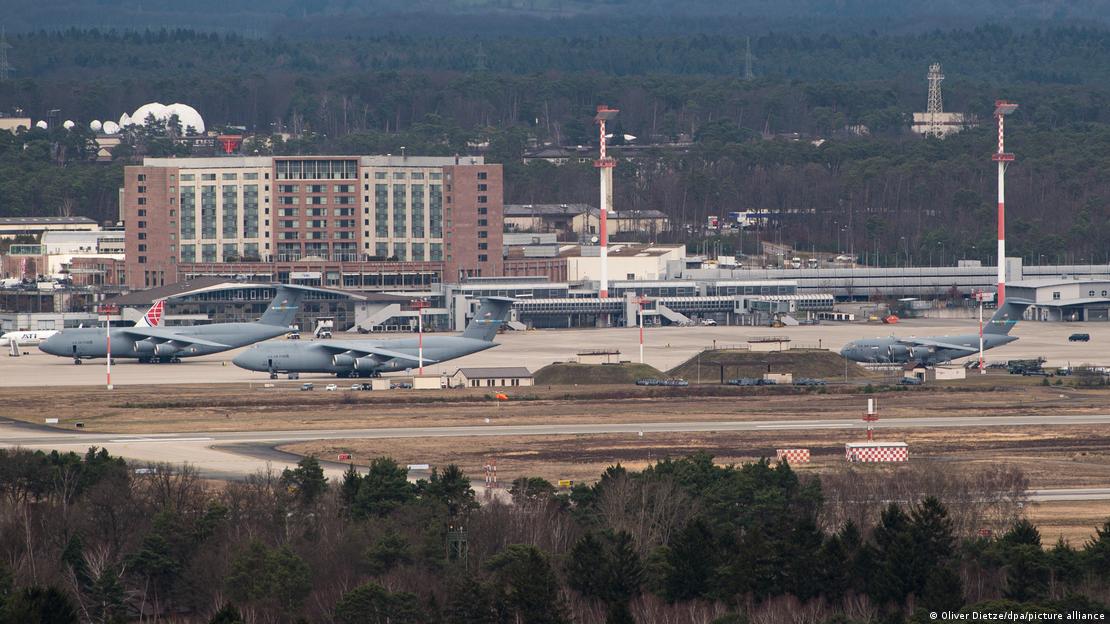
This includes personnel at Ramstein in southwestern Germany, regarded as the US's largest overseas air force base.
After Germany, which is home to five of the seven US garrisons in Europe, the United Kingdom and Italy have the biggest presence of US personnel on the continent.
The Ramstein base has also played a pivotal role in US operations in the Middle East
Image: Oliver Dietze/dpa/picture alliance
Why did Merz say Iran was 'humiliating' the US?
In the past months, news outlets have reported on rumors of possible US troop withdrawals from Germany.
On Monday, Merz said the "Iranians are obviously very skilled at negotiating, or rather, very skillful at not negotiating, letting the Americans travel to Islamabad and then leave again without any result.
"An entire nation is being humiliated by the Iranian leadership, especially by these so-called Revolutionary Guards. And so I hope that this ends as quickly as possible."
After Merz's comments, Trump hit back on his Truth Social platform to say that Merz "doesn't know what he's talking about!"
German Foreign Minister Johann Wadephul later clarified Merz's comments in an interview with DW.
"It was addressing the behavior of Iran," Wadephul told DW's Berlin bureau chief Max Hoffmann in New York City.
"They are, as I said, misunderstanding their position and overplaying their role, so this is what the chancellor said," Wadephul stressed.
Ecuador is pushing to increase its production of crude oil but faces a backlash from environmentalists and Indigenous groups.
Eduador is expanding its oil production in the Amazon
Image: Laurent Davoust/Zoonar/picture alliance
Ecuador has started fracking in the Amazon rainforest for the first time, state oil company Petroecuador said Wednesday.
The new hydraulic fracturing, or fracking, project is in the Amazonian province of Sucumbios on Ecuador's border with Colombia.
The fracking at a new well on Block 57 - Shushufindi Libertador represents "milestone " for oil production in the country, the Ministry of Environment and Energy said in a statement released on Wednesday.
The new well is in full production, producing more than 930 barrels a day, the ministry of said.
The project is being jointly conducted with a subsidiary of China's national petroleum corporation, CCDC.
What is fracking?
Fracking entails extracting natural gas and petroleum from subterranean bedrock.
It is criticized for using industrial quantities of water to break open rocks as well as causing chemical contamination and provoking micro-earthquakes. Ecuador pushing to ramp up oil production
Ecuador's crude oil production fell to around 466,000 barrels a day in January 2026, a 13% drop from the same period a decade earlier. Analysts point to aging infrastructure and years of underinvestment as part of the problem.
Oil revenues make up a significant amount of Ecuador's export earnings.
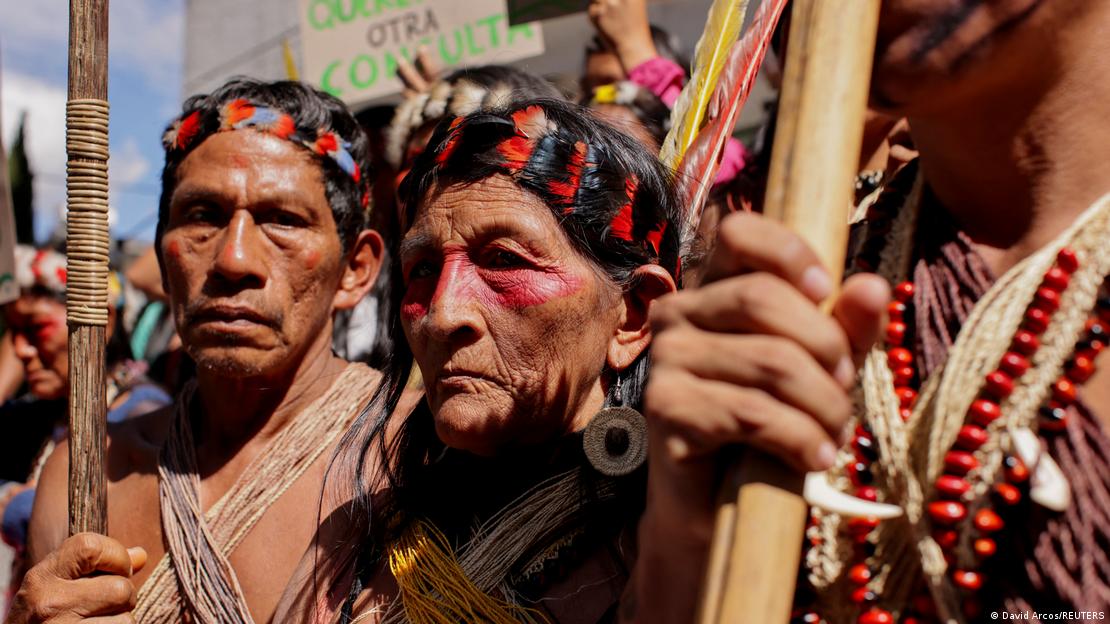
Government plans to expand oil exploration in Ecuador has led to Indigenous protest, like this one in 2025
Image: David Arcos/REUTERS
The government of President Daniel Noboa has promised more funds for oil exploration and infrastructure and to attract greater foreign oil investments.
At the same time, his government's push to expand oil exploration, particularly in the Amazon, has alarmed environmentalists and Indigenous leaders.
Edited by: Zac Crellin Kate Hairsine Reporter and senior editor
North Korea faces food shortages as drought threatens crops
The country's state-run news has said much of the country has been hit by an unusually severe drought. The largely isolated country, with a population of over 26 million, was already facing food shortages.
North Korea has long struggled with food shortages
Image: Jacky Chen/REUTERS
North Korea is rushing to shield its crops from a "severe" drought that has hit the country, its state news agency reported on Thursday.
The largely isolated country, with its lack of strong infrastructure, is particularly susceptible to the impacts of natural disasters.
North Koreans have long struggled with food insecurity due to extreme weather, worsened by sanctions, border closures, and limited farm inputs. What did North Korea say about its drought?
"An unusual drought has recently persisted across much of the country, a phenomenon rarely seen in previous years," Pyongyang's official Korean Central News Agency (KCNA) said.
"Workers across various regions are concentrating all efforts on protecting early-season crops from the drought," it added.
KCNA reported that North Korean cities and counties were carrying out "repairs to the gates of reservoirs and waterways," and implementing "technical measures" to boost drought resistance of wheat and barley.
In February, UN Special Rapporteur on human rights, Elizabeth Salmon, had said that food shortages were already a key concern. UN agencies say millions in North Korea are undernourished and vulnerable to disasters such as droughts and floods.
North Korea is ramping up efforts to prevent a prolonged drought from damaging crop production ahead of the rice planting season
Image: Yonhap/picture alliance
Crop-protection measures
In another report, KCNA said North Korean Premier Pak Thae Song went for on-site inspections at farms in South Pyongan and North Hwanghae provinces to check on the "countermeasures to minimize drought damage."
Pak called for farm workers to identify and efficiently use all water resources available. He emphasized that a successful harvest hinged on overcoming this year's drought, KCNA said.
South Korea was also hit by a drought last year, affecting the Gangneung province. It also recorded its hottest summer. Both the north and the south had their hottest Junes on record.
North Korea's frequent power shortages also meant people lacked access to air conditioning to cool themselves down.
Climate change, caused primarily by human emissions of CO2, has increased the frequency and intensity of extreme weather.
Edited by: Alex Berry Mahima Kapoor Digital journalist based in New Delhi
ROGUE CRIMINAL STATE
Israel stops Gaza-bound aid flotilla in international waters
Muna Turki
DW with AFP and Reuters
30/04/2026
More than 20 ships were intercepted in a mission aimed at challenging the blockade of the Gaza Strip. Israel dismissed those on board as "attention-seeking agitators."
Ships set off in recent weeks from Marseille in France, Barcelona in Spain and Syracuse in Italy
Image: Joan Mateu Parra/AP Photo/dpa/picture alliance
Isreal has intercepted more than twenty aid ships with 175 activists on board, Israel's Foreign Ministry said on Thursday. The ships were on their way to the Gaza Strip before being stopped in international waters near Greece.
What do we know about the Gaza flotilla interception?
Israeli military boats seized 15 ships near Crete, hundreds of miles from Gaza, according to the mission organizer, Global Sumud Flotilla.
"Our boats were approached by military speedboats, self-identified as Israeli, pointing lasers and semi-automatic assault weapons ordering participants to the front of the boats and to get on their hands and knees," the organization said in a post on X.
"This is piracy," the group said in the statement. "This is the unlawful seizure of human beings on the open sea near Crete, an assertion that Israel can operate with total impunity, far beyond its own borders, with no consequences," the group added.
Israel's UN envoy Danny Danon said the flotilla "was stopped before reaching our area," calling the flotilla members on board "attention-seeking agitators."
This spring flotilla mission included more than 50 boats, in what the organizers said was the largest coordinated civilian maritime action for the Palestinian territories to date. Why was the international flotilla heading to Gaza?
Last year, the Freedom Flotilla missions were the most ambitious and largest maritime attempts to reach Gaza. The crew members were arrested on the way and later expelled by Israel.
"The goods on these flotillas do not meet the needs of the Palestinians in Gaza, but they draw international attention to what is happening in Gaza," Nathan Brown, professor of political science and international affairs at George Washington University, told DW at the time.
Israel set up the naval blockade on Gaza in 2007 after Hamas took over as Gaza's governing body. Israel argues the blockade is necessary to prevent the Islamist militant group, which is categorized as a terror organization by the US, EU and many others, from importing arms.
In the view of many human rights organizations and NGOs, however, the blockade constitutes collective punishment, which is illegal under international law.
Gaza's already dire humanitarian situation has further deteriorated since the start ofIsreal-Hamas war, which was triggered by the Hamas-led terror attacks of October 7, 2023, against Israel. Despite a declared ceasefire on October 25, Israeli attacks have continued to kill hundreds of Palestinians in the enclave.
UN officials and others have said that as part of its ongoing military campaign, Israel is committing war crimes, including ethnic cleansing and deliberate starvation. Some have warned of genocide and famine.
More than 72,000 Palestinians, including at least 21,000 children, are reported to have been killed since October 2023, according to the Gaza Health Ministry.
Edited by: Alex Berry
'Israel destroyed houses, roads, even trees': People return to destruction in southern Lebanon
Many videos document the Israeli army’s destruction of houses and infrastructure in southern Lebanon, where it is creating a buffer zone along the border. Our Observers, many of whom wanted to return home after a ceasefire was announced, describe empty villages and razed homes.
Bulldozers ram the walls of a house in Naqoura, a Lebanese village on the border with Israel, in a video filmed on April 13, 2026. After just a few minutes, the home collapses in a cloud of dust.
This home belonged to a man named Bernard Farhat, who fled his hometown of Naqoura for Beirut as the Israeli army advanced. He watched the footage of his home collapsing on his phone, powerless to save it.
‘It took my parents ten years to build this house’
"It’s not the first time that we’ve lost a home. My family was displaced back in the 80s. I was born in Naqoura in 1987. For me, Naqoura isn’t just a village – it’s a refuge, it’s my entire childhood. It took my parents ten years to build that house, little by little, each week.
When I first saw the videos of homes destroyed, I thought to myself that it was perhaps linked to the Israeli army’s activities. And then one day, I saw my own home in one of these videos. On April 13, I received videos that showed three bulldozers demolishing it – two in front and another on the side, breaking it piece by piece. The area was already empty – everyone left. Only the Israeli army has been there since late March.
This home, it wasn’t just made of stones. It was also my memories, the place where I found refuge and certainly the last link that I had with my father, who died in 2019. But now, there is nothing left – just stones."
The Israeli army has been carrying out ground operations in southern Lebanon since early March 2026, as tensions continue to escalate with Lebanese militant group Hezbollah.
Officially, Israel says that it wants to create a barrier between Hezbollah fighters and its border and prevent them from re-establishing any military positions. However, Israel’s operations in the area have included the destruction of many civilian homes in several border towns. The army claims that it is targeting Hezbollah infrastructure, which they claim is often located within civilian zones.
In spite of the ceasefire, the Israeli army has continued to destroy dozens of civilian homes in the town of Bint Jbeil in southern Lebanon.
The Israeli army announced on April 19 that it was setting up what it called a "Yellow Line" in southern Lebanon, which they say demarcates a “security zone” meant to prevent any Hezbollah presence near the Israeli border.
Images posted online show explosions in buildings in Naqoura and the nearby villages of Bint Jbeil, Ainata and Rabb el-Thalathine – explosions taking place far from the zones of active combat.
Several videos show demolitions taking place in a number of southern villages, including Ainata, Jubbayn and Rab el-Thalathine.
‘Hezbollah fighters told us to go to leave them space’
After the ceasefire was announced on April 16, some people wanted to return to their homes. One of them was our Observer Samar, who is from the Tyr region.
"We left Beirut at 6am on April 18, 2026 and we only arrived in Tyr around 4pm because of the traffic jams. We crossed the Qasmiyeh bridge, which had been bombed. There was still an enormous hole that had been filled in. However, I didn’t recognise the south when I got there! I saw lots of portraits of Hezbollah fighters as well as Hezbollah and Iranian flags – there were even vendors selling them alongside the road. I didn’t see any Lebanese flags.
The south is nearly empty. There is no longer any normal life. There are very few services. You can only get electricity a few hours a day. The Hezbollah fighters told us to go, to leave them space. Some people left, others refused. I decided to stay, in spite of everything.”
The Israeli army has destroyed four different main bridges on the Litani River, which crosses southern Lebanon. The most recent is Qasmiyeh bridge, the bridge that our Observer had to take to return home.
‘A drone ordered us to turn around’
Abu Karim, a farmer from the border city of Houla in southern Lebanon, tried to return to his home just after the ceasefire was put in place.
"As soon as they announced the ceasefire, I wanted to return home. I love this land: I’m a farmer, my whole life is here. When the truce was called, they said that the roads were open and that the army had secured them. But in reality, the bridges had been destroyed. I crossed the damaged Qaquaiya bridge and there was no one there to organise the traffic. We had to take alternative roads and it took us hours.
My village, Houla, was more than 70 percent destroyed: homes burned, the burnt-out carcasses of cars and impassable roads. Even the agricultural land was ravaged. The destruction is indescribable. The farthest I got was to the villages of Shaqra and Majdal Selm. At that point, an Israeli drone spoke to us in Arabic, telling us that we needed to turn around or they would open fire. We didn’t have a choice, so we left. There’s no real ceasefire, it’s just on paper.
When I was in Shaqra, I saw Israeli equipment including bulldozers and tanks. They were destroying and burning down homes, roads and infrastructure. They even destroyed the trees about two kilometres from Houla. They are completely altering the terrain.
They speak of a ‘Yellow Line’, but that doesn’t exist for us. It’s our land. Today, there are entire villages that no one can access.
They can destroy homes and burn trees, but they can’t take our will away from us. We’ll come back. We’ll rebuild and replant. This land is ours.” ‘Destruction that goes beyond military objectives’
According to several sources, the area that the Israeli army wants to clear includes between 55 and 70 villages. Some of the villages are still partially inhabited, Lebanese sociologist Ahmed Baydoun says.
Baydoun says that the destruction that has been observed can’t be explained by just military objectives:
"The Israeli army says that they are destroying Hezbollah infrastructure but, in reality, we are seeing entire villages being destroyed including Bint Jbeil and Ainata. In some cases, the destruction is systematic. We’ve also seen that in some villages with majority Christian populations, the residents have remained.
No one knows how long the situation will last, but it’s worth asking if Israel wants this region to remain empty of residents or even de facto integrate it into Israel, like what happened with Syria’s Golan Heights. We feel as if the Israelis are applying the Gaza model - of having a buffer zone emptied of its population - to southern Lebanon."
Israeli sources reported that several hundred structures are thought to have been destroyed in this region.
The United Arab Emirates is leaving OPEC to pump more oil on its own terms. The break strips Saudi Arabia of a key partner and adds to growing uncertainty over the cartel's future.
The UAE, then part of the Trucial States, joined the OPEC oil cartel in 1967
Image: Karim Sahib/AFP
Why has the UAE decided to quit OPEC now?
OPEC, the global cartel of oil-producing nations, operates a quota system that limits how much oil each member can produce.
For years, the United Arab Emirates (UAE) has clashed with Saudi Arabia, OPEC’s most powerful member, over these quotas. The UAE has invested heavily to expand its oil industry and grow its market share, but OPEC limits have repeatedly held it back.
Energy Minister Suhail Al Mazrouei told the New York Times on Tuesday: "The world needs more energy. The world needs more resources, and [the] UAE wanted to be unconstrained by any groups."
The UAE is now betting it can sell more oil once the Iran war and Strait of Hormuz crisis ends, both in the medium and the longer term. Analysts, meanwhile, see the move as a calculated step by a producer ready to act independently.
"Losing a member with 4.8 million barrels per day of capacity, and the ambition to produce more, takes a real tool out of the group's [OPEC] hands," said Jorge Leon, head of geopolitical analysis at research consultancy Rystad Energy.
"With demand nearing a peak, the calculation for producers with low-cost barrels is changing fast, and waiting your turn inside a quota system starts to look like leaving money on the table."
The UAE, which joined OPEC in 1967 through Abu Dhabi, will leave both OPEC and the wider OPEC+ alliance, which includes Russia, on May 1.
The UAE currently produces roughly 3.2 to 3.6 million barrels per day (bpd) under quotas but holds spare capacity of nearly 4.8 million bpd, Reuters news agency reported. Plans call for a hike in output toward 5 million bpd by next year.
How does the UAE's exit weaken OPEC and Saudi Arabia’s leadership?
The UAE's exit removes one of the few OPEC members with meaningful spare oil capacity, leaving Saudi Arabia unable to easily share the burden of output adjustments.
The Gulf Kingdom has traditionally managed oil prices by cutting its own production and enforcing discipline across the group. With the UAE gone, Saudi Arabia will have to rely much more on its own oil production cuts to stabilize prices.
This will make defending oil prices more expensive and less effective for Riyadh. It also weakens the Kingdom's ability to manage and discipline the wider OPEC group.
David Oxley, chief climate and commodities economist at the London-based Capital Economics research house, called the move "the thin end of the wedge," warning in an analysis its website that "the ties binding OPEC members together have loosened."
Saudi Arabia needs high oil prices — around $90 (€77) per barrel — to fund government spending and its ambitious Vision 2030, a set of huge infrastructure projects to cut the Kingdom's reliance on fossil fuels. These include a $500 billion futuristic city named NEOM.
Every extra barrel the country holds back means lost revenue, which hurts the country's ability to grow its economy.
The exit also exposes long‑standing tensions inside OPEC, especially the perception that Saudi Arabia dominates decision-making.
The move also comes at a time when OPEC's overall influence has been shrinking. The cartel once controlled more than half of global supply; today, it commands less than a third. What does the UAE exit mean for global oil prices?
The UAE's departure is unlikely to cause major immediate swings in global oil prices, largely because the ongoing disruption in the Strait of Hormuz already dominates the market.
Much of the region's oil exports remain blocked and the UAE is redirecting about 1.8 million bpd to its Fujairah port on the Gulf of Oman coast via a pipeline that is running at maximum capacity. Any additional production the country plans to bring online cannot reach markets right away.
As a result, the announcement had little immediate effect on prices, with Brent crude largely unchanged on Tuesday.
"In the short term, I don't expect it [the exit] to have major impacts because what's happening in the Strait of Hormuz dominates the whole global oil picture in a way that renders this news from OPEC as kind of a minor thing," Jeff Colgan, an expert on OPEC at Brown University, told DW
Once the situation in the Hormuz situation normalizes, the UAE could add several hundred thousand extra barrels per day to the market. In the longer term, the exit points to modestly lower and more volatile oil prices.
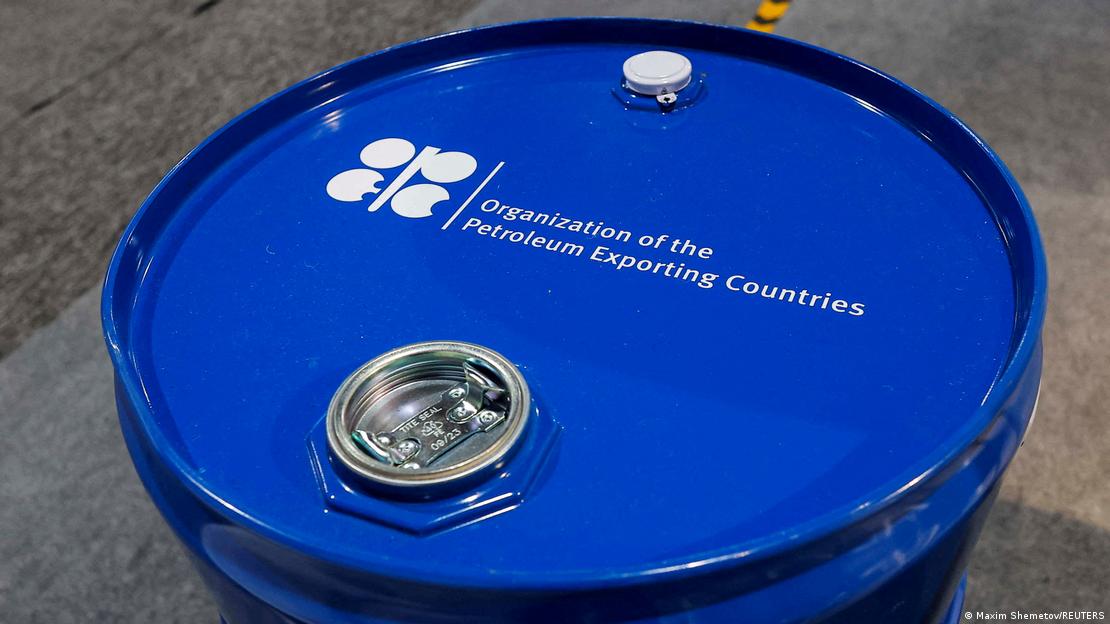
OPEC will have 11 remaining members after the UAE's exit
Image: Maxim Shemetov/REUTERS
Could the UAE prompt other producers to reconsider OPEC?
Some oil industry analysts say the UAE's exit adds to longer-running doubts about OPEC's future cohesion.
"It is possible that we could see the whole organization fall apart," Colgan told DW, adding that he believes Saudi Arabia will likely try to keep the group together as "the key anchor to the whole organization."
The UAE's exit does, however, highlight growing frustrations with OPEC's quota system and exposes rifts, especially with Riyadh.
OPEC has already been under strain from repeated quota breaches by members such as Iraq and Nigeria, and from Russia's inconsistent compliance within OPEC+. The UAE's departure adds to that sense of fragmentation.
In his analysis for Capital Economics, Oxley warned that, in the medium term, if other producers with spare capacity "see the UAE successfully gaining flexibility and market share" outside OPEC, "others may follow."
For now, most members lack the UAE's production capacity or economic diversification, so a mass exodus is unlikely.
The UAE is not the first OPEC member to leave. Qatar exited in 2019, while Angola, Ecuador, Gabon and Indonesia have also departed in recent years, often due to disagreements over quotas.
Edited by: Ashutosh Pandey
Mali: France urges citizens to leave amid Tuareg advance
With Tuareg-led rebels saying the ruling junta in Mali will fall "sooner or later" and demanding the withdrawal of Russian troops, the French Foreign Ministry has called on French nationals to leave the country.
Paris says the security situation in the former French colony remains 'volatile'
Image: AFP
France has urged its nationals in Mali to leave the country "as soon as possible" amid continuing attacks by Tuareg-led rebel forces who have claimed that the ruling junta will "fall sooner or later" and demanded that Russian forces also withdraw from "all of Mali."
The French Foreign Ministry said the security situation in the former French colony remains "volatile" following a coordinated assault by Tuareg-dominated separatists allied with the al-Qaeda-linked Jihadist Group for the Support of Islam and Muslims (JNIM).
In the largest attacks in Mali in nearly 15 years, the rebel alliance, the Azawad Liberation Front (FLA), has captured the strategic northern desert town of Kidal and killed Defense Minister Sadio Camara, seen as the mastermind behind the military government's pivot away from the West and towards Russia in recent years.
Mali: Russian Africa Corps admits losses
Russian troops from Moscow's Africa Corps, who have provided security for the junta, admitted they have "sustained losses" but provided no further details.
"Our objective is for Russia to withdraw permanently from Azawad and beyond," said FLA spokesman Mohamed Elmaouloud Ramadane, referring to the northern part of Mali in which the rebels would like to declare an independent state.
"We have no particular problem with Russia, nor with any other country," he said. "Our problem is with the regime that governs [in the capital] Bamako."
Nevertheless, he said the Russian troops were still viewed negatively for their role in "supporting people who committed serious crimes and massacres."
In Moscow, the Russian Defense Ministry confirmed that Africa Corps fighters had been forced to withdraw from Kidal, with Ramadane saying they had been escorted out of town.
"The Russians found themselves in danger; there was no way out," he said. "When they realized they could not hold out against our forces and our firepower, they requested this withdrawal." Mali junta 'will fall sooner or later,' say rebels
Ramadane, who was set to meet French security and defense officials in Paris on Wednesday, claimed that FLA troops had won "all the confrontations we had with the Russians" who he said were no match for Tuaregs who are defending their homeland.
"Even if they are a powerful force, they will not be able to stand up to the Azawadians, the masters of the terrain," he said.
The leader of Mali's military government vowed on Tuesday to "neutralize" those responsible for the attacks, but Ramadane said that the FLA also intends to "liberate" the towns of Gao and Timbuktu along the River Niger.
"To achieve peace, to find stability in Azawad, in Mali and beyond in the Sahel, the first thing is to get rid of this junta," he said. "The regime will fall, sooner or later." Edited by: Srinivas Mazumdaru
Insurgent alliance strikes at heart of Mali’s junta, exposing limits of Russian protection
Mali’s ruling junta was reeling on Monday after coordinated attacks by separatists and al Qaeda-linked jihadists sparked two days of fierce fighting across the country. It was the most serious challenge to Mali's central government since a 2012 rebel offensive was pushed back by the intervention of French forces.
Mali has been plunged into its worse security crisis in more than a decade after Tuareg separatists and al Qaeda-linked jihadist fighters joined forces to launch sweeping attacks on Saturday, delivering a huge setback for its ruling military junta and its Russian allies.
Insurgents struck the main army base outside the capital Bamako and killed General Sadio Camara, the country’s defence minister, further undermining the junta’s claim that it is restoring order to impoverished West African nation that has long battled Islamist militants and separatist rebellions. The violence also saw rebel forces drive Russian mercenaries out of the key northern city of Kidal.
It was the most sweeping rebel offensive since 2012, when Tuareg separatists joined forces with Islamist groups and eventually seized control of two-thirds of the country. As fighters advanced on the capital, Mali’s government appealed to former colonial ruler France for reinforcements. After France helped oust the Islamists, the subsequent presence of French troops and a UN peacekeeping mission helped ensure a wary peace over most of the next decade.
A 2020 military coup in Mali saw relations with France deteriorate, and by 2022 France had withdrawn the last of its troops despite a jihadist resurgence.
But history now appears to be repeating itself, with many of the same players on the ground – alongside some new elements that further complicate Mali’s search for stability. · Defence minister killed, key town captured
Several strategic towns and areas around Bamako were targeted in Saturday’s dawn offensive by Tuareg rebels of the Azawad Liberation Front (FLA) and the al Qaeda-linked jihadist Group for the Support of Islam and Muslims (JNIM).
Defence Minister Sadio Camara, seen as the military regime’s second-most-powerful figure and a key Moscow ally, was killed in an apparent suicide truck bombing on his residence in Kati, a garrison town near Bamako that serves as the junta’s headquarters.
JNIM fighters also struck near Bamako airport and in localities farther north, including Mopti, Sevare and Gao.
In another major blow to the junta, FLA rebels claimed “total” control of their historic northern bastion of Kidal, where they secured the withdrawal of junta-allied mercenaries from Russia’s Africa Corps, which has taken over from the Wagner paramilitary group in much of Africa.
General Assimi Goita, the military ruler who deposed Mali’s civilian government in a 2020 coup, has not been seen or spoken publicly since the start of hostilities.
“This is a dramatic setback for the Malian government and a new phase in the ongoing insurgency in the Sahel,” said Andrew Leibovich, a research fellow with the Clingendael Conflict Research Unit focusing on North Africa and the Sahel.
“The fact that they were able to assemble so many fighters, particularly in and around Bamako and Kati, without detection and without the government being able to stop them, indicates how tenuous the security situation is, even around the capital,” he added. · JNIM and FLA: Who are the insurgent forces?
One of Africa's deadliest jihadist groups, JNIM formed in 2017 through the merger of five separate militant groups. It has been the main force behind a resurgence of jihadist attacks across several West African nations, including Mali’s neighbours Burkina Faso and Niger.
The group is believed to have around 6,000 fighters. Its leader is Iyad Ag Ghaly, the ethnic Tuareg head of the Ansar Dine Islamist group that took over the historic city of Timbuktu in northern Mali in 2012 and imposed sharia law there.
JNIM aims to establish Islamist governance across the Sahel. Its years-long insurgency broadened to economic warfare last year when it staged a fuel blockade that paralysed Bamako and large swaths of the country.
But experts have cast doubt on the group’s ability to govern.
“JNIM fighters don’t have the capacity to take and run a city like Bamako. What they are trying to do is to target major regime figures, destabilise the junta and perhaps spark an uprising,” said Ulf Laessing, head of the Sahel Program at the Konrad Adenauer Foundation.
Mali has been grappling with ethnic Tuareg rebellions since shortly after it gained independence from France in 1960. The Azawad Liberation Front (FLA), officially formed in November 2024, is just their latest iteration.
Present across the Sahara region, nomadic Tuaregs are fighting for an independent homeland they call "Azawad". In 2012, it was the National Movement for the Liberation of Azawad (MNLA) that first swept through northern Mali until its campaign was hijacked by Islamist groups.
Mali struck a peace deal with Tuareg separatists in 2015, but the military junta withdrew from the agreement in 2024, leading to a resumption of hostilities.
In July 2024, Tuareg fighters attacked a convoy of Malian soldiers and Wagner fighters in the north, claiming to have killed 84 Russians and 47 Malian soldiers. Ukraine's military intelligence service then suggested it had helped the Tuareg rebels carry out the attack by providing intelligence, and Mali responded by cutting ties with Kyiv. · ‘A shaky, ad hoc alliance’
Saturday’s coordinated attacks mark the first time since 2012 that jihadists and Tuareg separatists have cooperated on this scale, providing the most concrete evidence yet of a rapprochement negotiated more than a year ago, according to FRANCE 24’s expert in jihadist networks Wassim Nasr.
“We now have proof that there is genuine coordination across the country: all these attacks took place simultaneously,” Nasr explained.
“The aim was not to bring down Bamako, but to tie down the army in order to cut off the north and gain control of it,” he added. “There is a clear coordination to resume fighting against the Malian junta, but also against the Russians."
An FLA spokesperson confirmed the coordinated push on Sunday, stating that JNIM “is also committed to defending the people against the military regime in Bamako”.
However, analysts caution that the two groups have relatively little in common aside from a common enemy, suggesting theirs could be little more than an alliance of convenience.
“They both know they can’t really force regime change on their own – that's why they are teaming up the way they did in 2012,” said Laessing. “The jihadists eventually got rid of the Tuaregs back then, so this is a very shaky, ad hoc alliance, and not something that can run Mali.”
· Twin blows for the junta
Saturday’s brazen attacks on the heart of government, coupled with the fall of Kidal, constitute major setbacks for a military junta that seized power in 2020 on a promise to stabilise the country and assert the central government’s control throughout its territory.
Kidal had long served as a stronghold of the rebellion before being taken by junta forces and mercenaries from Russia’s Wagner. Its capture in late 2023 marked a significant symbolic victory for the junta and its allies in Moscow.
The attacks on Kati and Bamako, and the killing of Defence Minister Camara, are “an even greater blow to the junta’s confidence”, said Paul Melly, Consulting Fellow on the Africa Programme at Chatham House.
“The fact that they could even launch a truck bomb at the house of the regime’s number two shows the fragility of the regime’s military hold. Even in Kati, basically the headquarters of the junta, they could not guarantee the security of their most senior figures,” he said.
“The reason the military junta took over from civilian authorities was because of the mounting insecurity in the region, under the promise that they would quell the violence. But the data shows that insecurity in Mali and across the Sahel region has only worsened,” added Folahanmi Aina, a lecturer at the School of Oriental and African Studies (SOAS) in London.
He pointed to early signs of a “legitimacy crisis” for the regime.
“While part of the population remains supportive of the junta, we’re beginning to see an erosion of trust in its ability to address the situation on the ground and guarantee the safety and security of the Malian people,” Aina said.
· Russia's African ambitions undermined
The fall of Kidal and the failure to thwart attacks on Bamako and Kati have also exposed the limits of Russian military power in West Africa.
Russia’s Africa Corps confirmed its withdrawal from Kidal on Monday, acknowledging that “the situation in the Republic of Mali remains difficult”. Moscow also lost a key ally with the killing of Defence Minister Camara, a key architect of the rapid shift in alliances that saw the junta expel French and UN forces and turn to Russia for military support.
“The attacks show that Russian mercenaries only have a limited capacity, in stark contrast to the situation before the coup, when Mali had a military partnership with France and there was a very large UN peacekeeping force of 13,000-14,000 soldiers, many of them West African, which helped to maintain a basic degree of security and stability,” said Chatham House’s Melly.
“The French never really had a chance to pacify this vast country and the Russians even less so,” added Laessing. “In fact, they (the Russian mercenaries) made the conflict worse by being brutal and not distinguishing between civilians and combatants, which has made it easier for jihadists to recruit fighters.”
The regime’s political isolation – and that of allied juntas in Burkina Faso and Niger, which have also severed ties with France and left the ECOWAS group of West African states – has left them with few other options to confront the security emergency, he added.
“Mali, Niger and Burkina Faso are on a nationalist, anti-Western course and it is not clear who will want to engage with them,” Laessing explained. “I don’t think Europe or France will be willing or even welcome to put boots on the ground to help stabilise the situation, which is probably beyond a military solution anyway.”
Street battles and withdrawal of Russian mercenaries: Inside the 48-hour fall of Mali’s Kidal The Azawad Liberation Front and the Group for the Support of Islam and Muslims (JNIM) launched an offensive against several Malian towns on April 25. In the north, the city of Kidal was recaptured following a three-year presence of Russian and Malian forces. Verified footage offers a window into these two days of tensions.
FLA fighters pose in Kidal’s main square after seizing control of the city on April 25. Location: 18°26'48.17"N 1°24'32.56"E Source: X / Wamaps_news / Guillaumem_MRC
The assault began at 6am. Six Malian cities found themselves under fire. In Kidal and Gao, the offensive was led by a coalition comprising the FLA and the al Qaeda-linked Jihadist Group for the Support of Islam and Muslims (JNIM).
A morning of heavy fighting on the outskirts of Kidal
An FLA commander told the FRANCE 24 Observers team that checkpoints at the city’s entrance fell within the first hour of fighting. The Tuareg rebel, originally from the area, said that the city fell to the coalition by early afternoon.
Around noon, a video shows vehicles belonging to the JNIM or the FLA circulating freely past a military camp north of Kidal. With a Starlink receiver mounted on the hood of their car, the armed men drove past the building without stopping.
An account supporting the FLA independence movement shared a video showing militants bypassing a military camp north of Kidal. Location: 18°27'27.73"N 1°24'4.54"E Source: Facebook / AlkassimAgAhouchel.1990
Within the city, fighting was concentrated around the police station, where Malian Armed Forces (FAMA) soldiers had taken up defensive positions. The building’s perimeter was breached at approximately 2pm.
Footage published on April 25 shows armed FLA militants parading a Kidal police car they have captured. Source: X / XNewsUncensored
Symbolic sites
Another symbolic victory was claimed as the Kidal governorate fell into the hands of separatists. This building served as the administrative headquarters for General El Hadj Ag Gamou, the governor of the region, following the Malian junta’s return in 2023. As the leader of the Imghad Tuareg Self-Defence Group and Allies (Gatia), Gamou has remained loyal to the junta.
By late afternoon, a pro-FLA account released a video showing independence forces hoisting their flag atop the building.
Footage shows FLA members raising the group’s flag atop the Kidal governorate. Location: 18°26'58.81"N 1°24'12.59"E source: X / Guillaumem_MRC
The FLA and JNIM also claim to have captured soldiers from the Malian army. The former UN base south of Kidal: a strategic stronghold
Located on the southern outskirts of the city, the former camp of MINUSMA, the former UN mission in Mali, served as a strategic stronghold. While encircled and entrenched within the base, Russian Africa Corps mercenaries were reportedly targeted by drone strikes and mortar fire from the FLA.
To organise their evacuation, negotiations between the FLA and Russian forces reportedly began as early as April 25, according to the pro-independence source the Observers team spoke to. Russian troops were evacuated from the former UN base the following day, at approximately 4 or 5pm.
However, resistance from Africa Corps mercenaries also persisted on the fringes of Kidal until the evening of April 25. Our source within the FLA said the mercenaries and Malian troops, entrenched in a turret with precision rifles, were finally evacuated to the MINUSMA camp the following day.
Withdrawal of Russian mercenaries
At 5pm, the Tuareg commander claimed that the independence fighters had taken control of the camp’s exit points. He said the Russian mercenaries burned several installations and vehicles before pulling out.
Our team geolocated a video showing a convoy of vehicles from the Africa Corps mercenaries and the Malian army departing the MINUSMA base and heading north. However, it’s currently impossible to determine where the forces previously stationed in Kidal are repositioning.
This video was published on April 25 by a pro-FLA account. It shows the evacuation of vehicles from the Africa Corps and the FAMA. Location: 18°26'10.28"N 1°24'29.34"E source:X / BayeAg1 / Guillaumem_MRC
The retreating Russian column included heavy weaponry, such as several BM-21 Grad multiple-rocket launchers, and truck-towed artillery pieces.
The total number of casualties remained unknown after a day of intense fighting. While footage emerged on April 25 showing the bodies of Malian soldiers in Kidal, none of the combatant groups has disclosed their losses. Meanwhile, the Malian Armed Forces stated that “the hunt for armed terrorist groups continues in Kidal, Kati, and other locations across the country”.
France investigates return of adult website linked to Pelicot mass-rape trial
French prosecutors are investigating the reopening of the adult website Coco, now renamed Cocoland, on which sex criminal Dominique Pelicot used a chatroom to find dozens of strangers to rape his sedated wife Gisèle Pelicot. The platform has also been linked to crimes including the sexual abuse of children and murder.
France has launched a probe into the reappearance of a website that enabled sex criminal Dominique Pelicot to recruit dozens of strangers to rape his heavily sedated wife, prosecutors said on Tuesday.
Authorities say the French-language platform Coco has been linked to crimes, including the sexual abuse of children, rape and murder. The website, which was registered abroad, was shut down in June 2024.
"The Paris public prosecutor's office has opened an investigation into the website's reopening," it told AFP.
The website, now operating under the name Cocoland and featuring a coconut-themed backdrop, was accessible on Tuesday.
France's commissioner for children, Sarah el Hairy, raised the alarm in mid-April.
"The reopening of the Coco site is a real slap in the face to the promise of protection we've made," she told broadcaster RMC at the time.
Such websites "exploit every loophole, they seek out prey, and that prey is children"? she said.
"We will track them down, we will hound them, we will give them no respite."
Prior to the platform's re-emergence, the investigation into the Coco platform was "well advanced", according to a source with knowledge of the matter.
Isaac Steidl, the founder and manager of the Coco website, was in January 2025 charged with complicity in drug trafficking, possession and distribution of child pornography, corruption of a minor via the internet, and criminal conspiracy. He denies the charges.
His lawyer Julien Zanatta said Steidl had "nothing to do" with the new website.
The platform has been at the centre of several criminal cases, including the high-profile Pelicot trial.
Pelicot was sentenced in 2024 to 20 years in prison for aggravated rape, after he recruited dozens of strangers to rape his then-wife Gisele after drugging her in their home between 2011 and 2020.
He spoke to potential attackers on the website's chatroom called "A son insu" (literally, "Without his/her knowledge").
Two French women's rights groups called Tuesday for the authorities to launch a broader probe into other, similar websites and platforms.
The appeal came after a report by US news network CNN in March on so-called "Rape Academy" platforms, where men around the world exchange tips on drugging and raping their partners while filming the scenes.
"Given recent cases such as that of Gisele Pelicot, it is highly likely that French users are participating (on such sites) and that victims in France are involved," the Women's Foundation and the group M'endors pas (Don't Put Me to Sleep) said in a joint statement.
The latter group was co-founded by Gisele Pelicot's daughter, Caroline Darian.
"These are not isolated episodes but organised crimes by fully fledged communities that encourage and structure such violence," the groups said.