Thursday, April 30, 2026

Whale 'Timmy' reaches Denmark in rescue effort — in pictures

DW with dpa, AP, Reuters
30/04/2026

A barge carrying a humpback whale stranded in Germany for weeks has reached Danish waters on its journey to the North Sea.

The young humpback whale is being towed to the North Sea in a rescue attempt
Image: Philip Dulian/dpa/picture alliance

A barge carrying 'Timmy', the humpback whale stranded in Germany since early March, is expected to reach the open ocean by Friday.

The tugboat pulling the water-filled barge entered Danish waters Wednesday afternoon.

It was located between the Danish islands of Samso and Sjaelland at 2 a.m. German time (0000 GMT) on Thursday, according to the Vessel Finder tracking website.
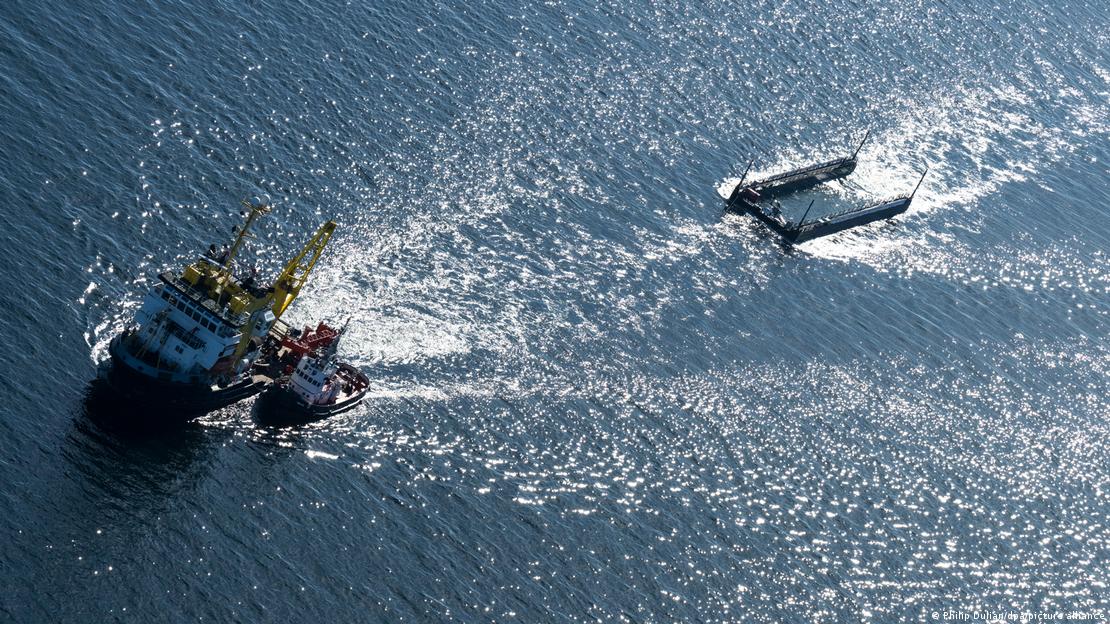

The tugboat and barge containing the humpback whale has crossed into Danish waters
Image: Philip Dulian/dpa/picture alliance

Environment minister for the German state of Mecklenburg-Western Pomerania, Till Backhaus, said that if everything went well, the whale would be in the North Sea by Friday.

"The very worst is already behind him now," Backhaus told Germany's Bild newspaper on Wednesday.

Backhaus said the animal was "doing well" and had made sounds during the night.
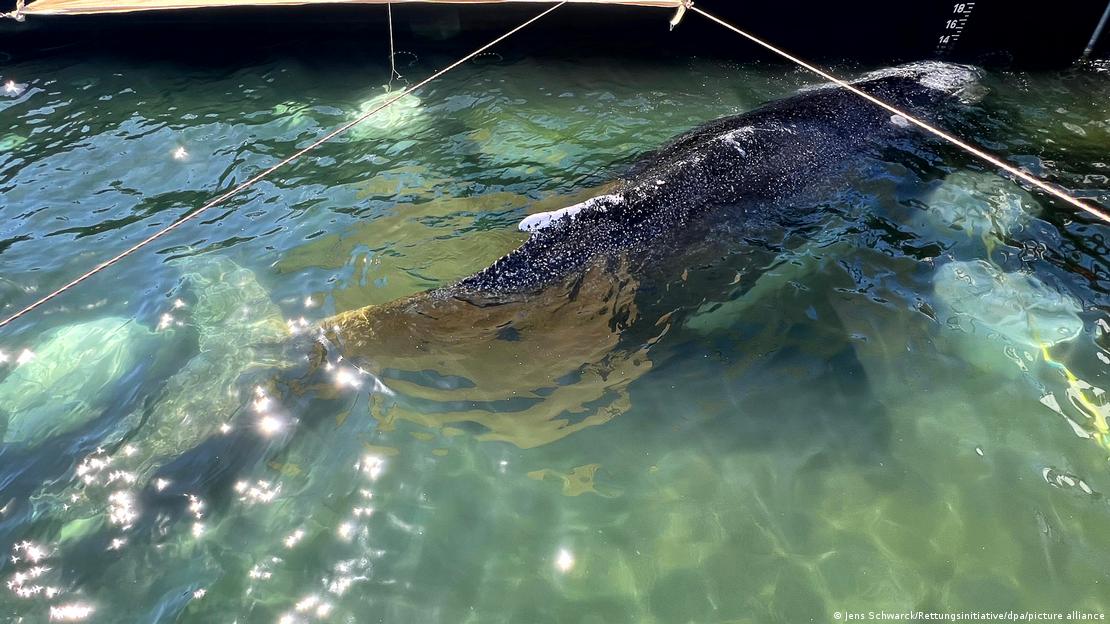

Rescuers managed to get Timmy onto the barge, has a water-filled hold and is usually used to carry other boats
Image: Jens Schwarck/Rettungsinitiative/dpa/picture alliance


Stranded whale Timmy was coaxed onto barge in complex rescue

The whale, nicknamed 'Timmy' by Germany media, was towed from the shallows of the island of German island of Poel to the barge through a specially dredged channel on Tuesday.

Rescuers then pulled the whale onto the specially converted freight barge using straps.
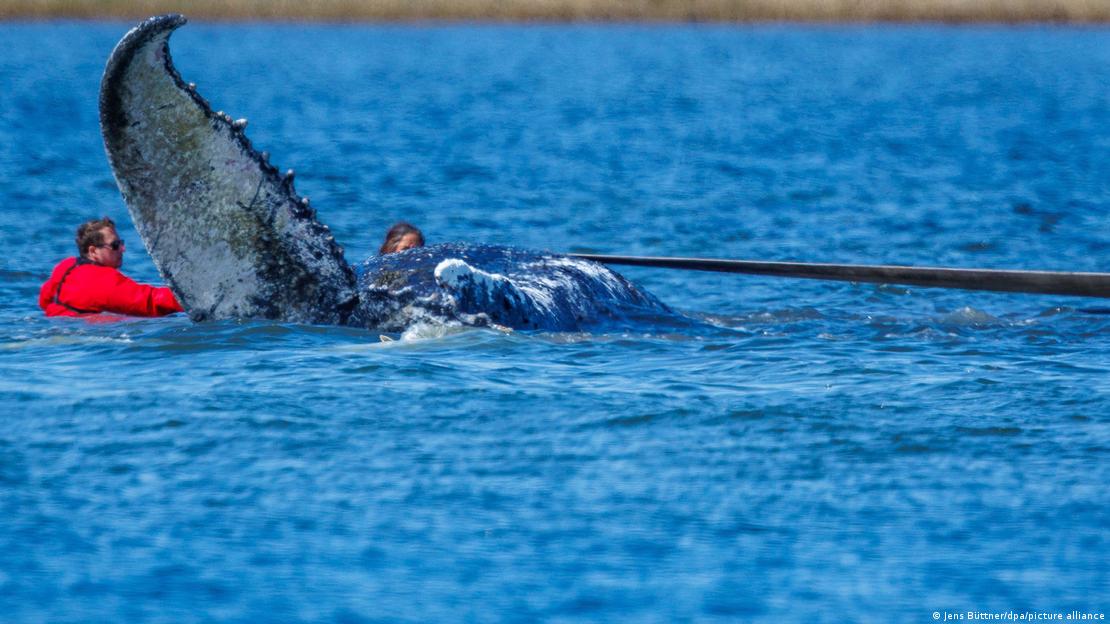
Rescuers guided Timmy from shallow waters through a specially dug channel
Image: Jens Büttner/dpa/picture alliance

"I'm truly relieved," Backhaus on Poel.

"I was even on the verge of jumping into the water to help him over the last few meters."
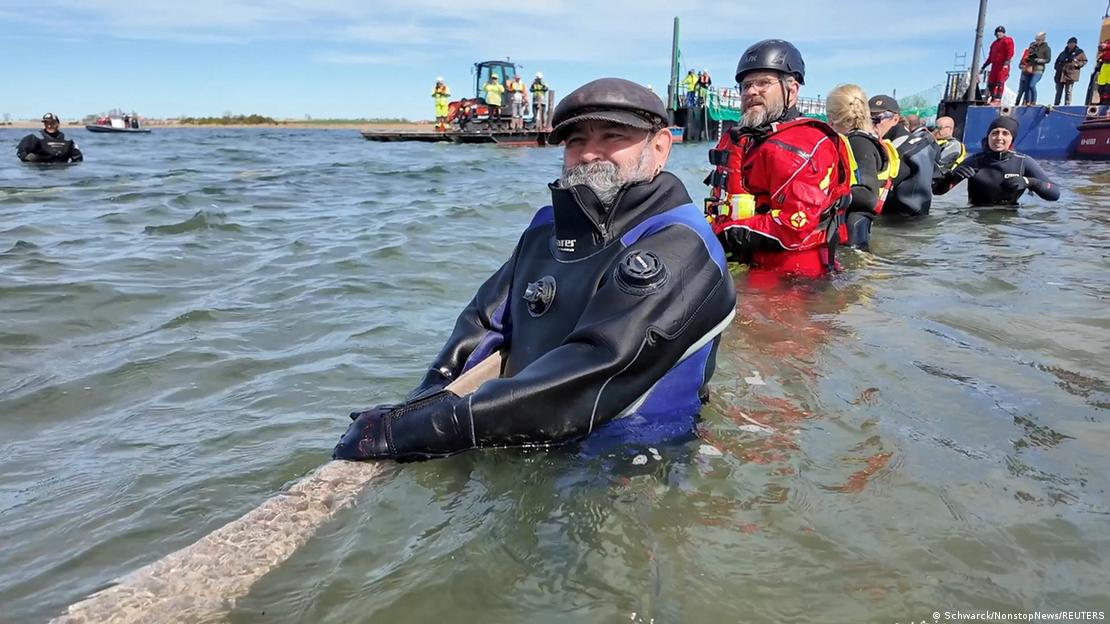
Rescuers pull Timmy the humpback (not visible) into the barge using straps
Image: Schwarck/NonstopNews/REUTERS

The young humpback was first spotted swimming near Germany's Baltic Coast on March 3, far from its natural habitat in the Atlantic Ocean.

Timmy's health deteriorated as the juvenile whale, thought to be between four and six years old, became repeatedly stranded in shallow waters.

The idea to coax the whale onto a barge and tow it to the North Sea was hatched after their initial attempt to save the whale with inflatable cushions and pontoons was unsuccessful.
Whale rescue attempt sparks heated debate

Some scientists warned that this latest attempt may be too much for the animal.
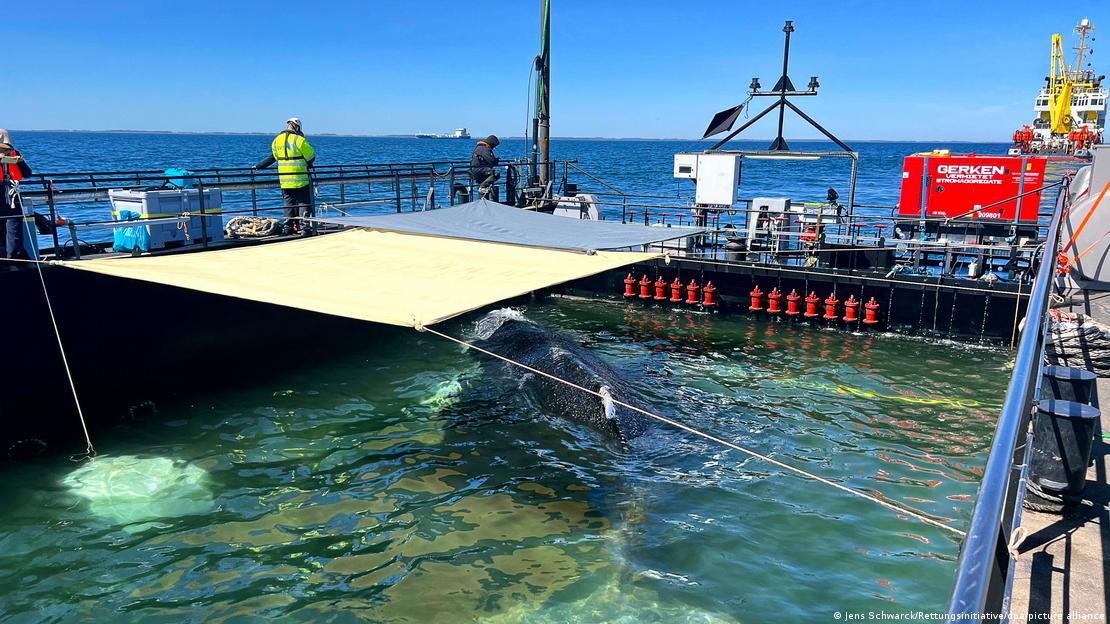
Some scientists have criticized this latest rescue attempt saying it will cause stress to the already sick whale
 Jens Schwarck/Rettungsinitiative/dpa/picture alliance

Thilo Maack, a marine biologist at Greenpeace, told the Associated Press earlier this month that efforts to save Timmy have caused the animal severe stress.

"I believe the whale will die very soon now," he said. "And I would also like to raise the question: What is actually so bad about that? Animals live, animals die. This animal is really, really very, very, very sick."
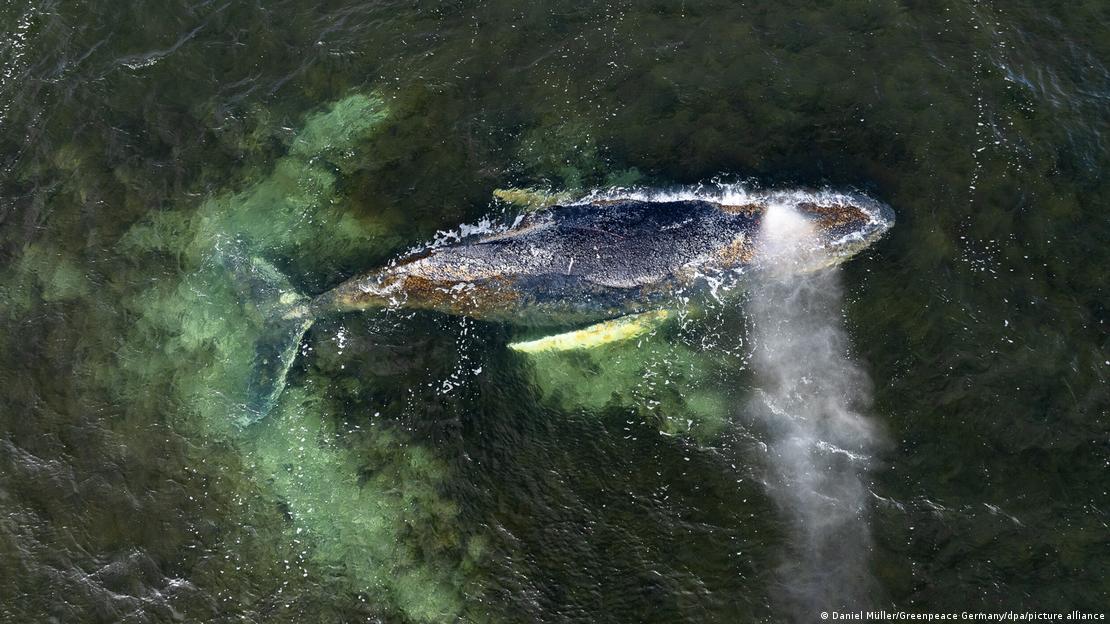
Whale specialists say Timmy the humpback's chance of survival are small
Image: Daniel Müller/Greenpeace Germany/dpa/picture alliance

The International Whaling Commission called the rescue "inadvisable."

It said the whale "appeared to be severely compromised" and "unlikely to survive."

The rescue initiative is being privately financed by two German multimillionaires.

Edited by: Zac Crellin
Kate Hairsine Reporter and senior editor

'Marine unicorns' aren't loving Arctic noise
DW
04/28/2026

Narwhals are fleeing Canada's far north. Researchers suspect a link to noise pollution from increasing ship traffic.

When the winter ice begins to melt, the speckled gray narwhals leave Baffin Bay and head toward the safe waters off Mittimatalik for the summer
Image: John E Marriott/All Canada Photos/picture alliance

For Alex Ootoowak, watching the speckled gray narwhals migrate in the icy waters of the Arctic during hunting season is a cherished childhood memory.

"It felt like a never-ending, looped-over scene of whales just constantly swimming past you all in the same direction, all migrating throughout the day, sometimes more than a day," said Ootoowak, who lives in Mittimatalik, also known as Pond Inlet, in Canada's far north. "You're always taught to be extra, extra quiet and careful […] because they're so sensitive."

The world's 80,000-plus narwhals mainly live in northeastern Canada and Greenland. For Ootoowak and others in Canada's Inuit communities, narwhal meat has been key to their survival for at least 1,000 years. It's an important source of protein, iron and vitamin C, and hunting is regulated by the government.


"This is our means of staying healthy and connected to the land and our culture," Ootoowak told DW. "It's not something we do just to kill and take animals for sport."
Narwhal numbers dwindling

But Ootoowak hasn't seen a migration like those of childhood for a long time. Over the last 20 years, hunters have noticed that the whales have become skinnier and harder to catch. By 2021, there were only about 2,000 left in the area — a 90% drop from more than 20,000 in the early 2000s.
Narwhal whale blubber and skin, sometimes eaten raw, is an important part of Inuit culture
Image: Yvette Cardozo/Visually/picture alliance

It's not clear why the whales are disappearing, and what's driving them away. Researchers suspect climate change may be playing a role, with the Arctic region warming four times faster than the rest of the planet.

"A whole host of things are changing — not just the ice, the water temperature, species, all the way from the bottom of the food chain all the way up," said Kristin Westdal, a marine mammal expert with Canadian marine conservation network Oceans North.

But she said the effects of climate change are gradual, and the drop in the whale population came over a relatively short time period. "And the only thing that changed that quickly in that habitat was the volume of ships coming through."

In 2015, a local mine run by a company called Baffinland opened a port nearby. Within two years, roughly 4 million tons of iron ore were shipped through the waters off Mittimatalik — and noise pollution increased dramatically.

Noise pollution may be driving whales away


Concerned about what the new noise was doing to the narwhals, Ootoowak and Westdal set up two listening stations in Milne Inlet, to the west of Mittimatalik. Within a couple of years, they were able to expand their acoustic monitoring program by collaborating with acoustics experts at the Scripps Institution of Oceanography, based in San Diego.

By lowering special microphones called hydrophones through holes in the ice and 800 meters (nearly half a mile) down into the water, they've listened to the Arctic seascape 24/7 — marine life like barking seals and clicking narwhals foraging for food, but also rumbling engines from growing ship traffic. And they've found that these ship noises may be behind the drop in narwhal numbers.
The long tusk of the male narwhal, roughly 2 meters (6 feet) in length, is often mistaken for a horn
Image: Visually/picture alliance

The monitoring team published a study in 2025 which found that "narwhals appear to either move away or stop vocalizing" when vessels came within 12 to 24 miles (20 to 40 kilometers). And the whales were responding to noises below the threshold of 120 decibels — like a loud thunderclap, or a roaring chainsaw — which is considered the disturbance threshold for midsized whales like the narwhal.

Hunters, too, have noticed that narwhals begin behaving differently when a ship is nearby.

"As soon as the ship starts their engines, they move away or stop feeding, stop doing their deep dives where they're feeding on fish at the bottom of the ocean," said Ootoowak. Whales, he said, have learned to avoid the heavily traveled shipping channel when boats are in the area.

Are narwhals heading to Greenland?

Ootoowak said it wasn't clear where the whales were going, but he has a theory. On a visit to northern Greenland in 2024, to the east across Baffin Bay — where narwhals usually spend the summer months — he spoke with local hunters who told him of whales that had started showing up in their waters, right around the time shipping increased off Mittimatalik.


"They said narwhals that were appearing were 'foreign' because they were longer and skinnier and behaved very different to their narwhal," said Ootoowak. The hunters, he added, said the whales were easier prey and tasted different, too.

Outi Tervo, a senior scientist at the Greenland Institute of Natural Resources, has also been researching narwhals and noise pollution. She has observed that noises from shipping and oil and gas exploration can cause narwhals to stop foraging for food, which lines up with Ootoowak's observation of seeing skinnier narwhals.

Tervo said she hasn't seen any evidence that the whales have relocated from Canada to Greenland, but said an increase in unfamiliar sounds could be pushing them to migrate.


For narwhals, who rely on echolocation to communicate and hunt, she said the ability to hear is what the ability to see is to humans. So just as bright headlights or a flashlight to the eyes would temporarily blind us humans, sounds that interfere with narwhal echolocation profoundly disrupt their activity and push them to be "ready to escape," she said.

Tervo said habitats for narwhals are limited, and they've adapted to life in the Arctic. "They can't swim to the Caribbean and spend the winter there," she pointed out. "So I do think that it's very important to take the needs of the animals into consideration and try to make some safe havens for them."

Noise a growing concern as Arctic opens up


The good news, however, is that the sound monitoring project spearheaded by Ootoowak and Westdal has raised awareness about noise pollution in Canada's Arctic.

The local mining company, Baffinland, has lowered its shipping speed to 9 knots and is using fixed routes. It's also agreed to stricter rules for when icebreakers can be deployed. Cruise ships have also been quick to get on board, agreeing to speed limits and no-go zones.
As ice retreats in the Arctic, the region is seeing increased maritime traffic
Image: Adrian Wyld/AP Photo/picture alliance

"I would say it's generally positive," said Ootoowak, pointing out that the 2025 hunt was the first time in a decade that people were happy with what they caught during the fall migration. "It's going to take some time working with industry, working with government to get these things moved forward into policy."

Westdal said stronger oversight, cooperation with local communities and much more data would be key to keeping noise pollution under control, especially as companies eye the increasingly ice-free waters of the Northwest Passage for international shipping.

"We are seeing a slow and steady increase of people showing interest and trying to get through there, whether it be cruise ships, pleasure vessels or the occasional commercial vessel," she said. "And I think that having policies and regulations in place in the Arctic is going to be really important in getting ahead of what's coming."

This article was based on an episode of Living Planet produced by Kathleen Schuster.

Edited by: Sarah Steffen
Martin Kuebler Senior editor and reporter based in Brussels, with a focus on environmental issues
Why Ghana walked away from a US health deal

DW
29/04/2026

Talks between Ghana and the US over a bilateral healthcare deal have stalled, after Accra voiced concerns regarding sensitive data sharing. Several African countries have pushed back on the deals, while some have signed.

Concerns over the sharing of sensitive health data have reportedly led Ghanaian officials to abandon a health deal worth millions of dollars proposed by the United States .

As part of the Trump Administration's "America First" strategy, which has shifted focus onto bilateral deals rather than multilateral aid, the new US model aims to transition funding responsibility for health commodities and services to Ghana.

This means Accra would have to increase its own investment in health systems. Previously, this was largely supported by US-contracted NGOs. However, since Trump's dismantling of USAID in 2025, there is far less development funding available.


However, a source told DW that Ghana would not sign a multi-year deal, reportedly worth around US$109 million (€93 million), because Ghana would have to waive key aspects of its health sovereignty. This includes sharing control over its health care decisions, data, and resources with US authorities.

Is the US-Ghana health deal dead?


For Ghana, this would violate domestic law, including the Data Protection Act and the Public Health Act. The deal also requires Ghana to bypass parliamentary ratification, a constitutional requirement for bilateral agreements.

A government source, who spoke anonymously to the AFP, said the deal is "dead" after US negotiators allegedly became "hostile" and piled "pressure" on Ghana, which pushed back on the demand for personal data. Additionally, the funds offered to Ghana are considerably less than those in similar proposed deals with Kenya and Nigeria, which were offered $2.5 billion and US$2.1 billion, respectively.

Ghana's government has yet to release an official statement on the deal, but Ghanaians who spoke to DW said they were concerned about the US demands for data sharing. "Sharing the health data of individuals is very critical," a young professional said, adding that it shouldn't be allowed.

"Health data is a personal document. What actually is making them ask for health data?"

Another man said he disagreed with sharing that information with other countries "because it might go against us."

Some African nations reject US health deals

The US has pursued a similar strategy in other African countries. According to the US State Department, at least 32 such deals worth about $20.6 billion have been signed under the America First Global Health Strategy with nations including Nigeria, Kenya, Rwanda, Uganda, Lesotho and eSwatini.

Some countries are treating the US strategy with suspicion. In February, Zimbabwe rejected a similar proposal, saying the terms threatened its autonomy, while a deal with Zambia has not moved forward after Washington demanded access to mineral rights and data.

German Development Minister, Reem Alabali Radovan, who attended the World Health Summit in Nairobi, Kenya, said it was important for Germany to show it was a reliable partner
Image: Eva Krafczyk/dpa/picture alliance

Meanwhile, Kenya,which this week hosted the World Health Summit in Nairobi, initially agreed to such a bilateral proposal in December 2025. However, the the country's courts suspended the deal over concerns around personal data.

German minister seeks to reassure Kenya


Germany's Development Minister, Reem Alabali Radovan, was in Nairobi to reassure the East African nation of Germany's continued commitment to Kenya. She described Germany's relationship to Kenya, which has the biggest economy in East Africa, as "strong."

"We see a lot of potential when it comes to German investment, especially when it comes to health care and also Kenya as a strategic partner for us when it comes to multilateralism," Radovan told DW.

In contrast to the United States, Germany has continued to promote multilateral initiatives and institutions such as the World Health Organization , despite also cutting aid.

"The cuts from the US government, especially in the global health sector, are very painful," Radovan said. "We can see them looking at multilateral funds like Gavi and the Global Fund, which are combating malaria, HIV, and tuberculosis, and we cannot fill the gap alone."

She said Germany intends to place a strong focus on global health, vowing that Berlin would not pull out of it. "It's important to show our partners in the regions that we are a reliable partner, especially when it comes to African countries," she added.

Sella Oneko in Nairobi and Eric Egbeta in Accra contributed to this article

Edited by: Chrispin Mwakideu

Cai Nebe Producer, podcaster and editor for DW Africa
US top court weighs ending Syrians, Haitians protections


Rana Taha
DW with AFP, Reuters
29/04/2026


The Trump administration is appealing lower court orders that blocked it from immediately ending temporary protected status for people from Haiti and Syria.

Syrians have been granted protective status in the US since 2012, when the civil war was raging [FILE: Nov 6, 2023
]Image: GUILLERMO ARIAS/AFP

The US Supreme Court on Wednesday leaned toward ruling in favor of moves by the Donald Trump administration to strip Haitians and Syrians living in the country of humanitarian protections.

While hearing arguments in the case, several of the court's conservative justices appeared sympathetic toward moves to strip over 350,000 Haitians and 6,100 Syrians of the Temporary Protected Status (TPS) designation.
What to know about the TPS status for Syrians and Haitians

TPS gives migrants whose countries were struck by war, natural disaster or other catastrophes the right to live and work in the US as long as it is unsafe for them to return to their home countries.

The State Department currently advises against all travel to either Haiti or Syria, with a level 4 travel advisory, the highest level, for both countries.

Haitians earned the TPS designation after a major 2010 earthquake, whereas Syrians were added to the list in 2012 after their country descended into civil war.

The Trump administration has been trying to revoke the TPS designation of 13 of the 17 countries designated.

During his election campaign, Trump vowed to rescind TPS for Haitians, falsely claiming they were eating household dogs and cats in Ohio.

US Supreme court votes against second majoriy-Black district in Louisiana

Also on Wednesday, in a separate case related to voting rights, the Supreme Court sharply limited the use of race in drawing electoral districts, with the justices ruling in favor of a challenge to a map that creates a second majority-Black district in the southern state of Louisiana.

The decision could alter congressional maps nationwide in favor of the Republicans ahead of the November midterm elections.

The court's ruling found that the map in question amounted to an unconstitutional racial gerrymander.

Writing for the majority, Justice Samuel Alito said that compliance with the Voting Rights Act (VRA) "could not justify" the use of race in this case, arguing that Section 2 of the act does not require states to draw districts primarily on racial lines.

"That map is an unconstitutional gerrymander, and its use would violate the plaintiffs' constitutional rights," he said, referring to the group of non-Black voters who brought the case.

Justice Elena Kagan, one of the three liberal-leaning justices at the top court, warned in a dissent that the decision would have sweeping consequences, saying it risked letting states "systematically dilute minority citizens' voting power" without legal redress.

It is unclear how much the ruling would impact the November midterms, with a primary election slated for May 16 in white-majority Louisiana, where Black people make up roughly a third of the population.

Black people and other minorities tend to support Democratic candidates.

Both the Republicans and Democrats are trying to redraw electoral maps, in ways that could potentially shift the balance of power in the currently Republican-dominated Congress.

Edited by: Srinivas Mazumdaru
GENERALISMO BONESPURS


Trump threatens US troop cuts in Germany

The US has more forces in Germany than anywhere else in Europe.
DW with AP, Reuters
30/04/2026


Donald Trump says the US is considering a "possible reduction" of its forces in Germany just days after German Chancellor Friedrich Merz said the US was being "humiliated" by Iran's leadership.

US President Donald Trump has said the United States will shortly decide whether to cut its forces in Germany, where it maintains a major military presence.

"The United States is studying and reviewing the possible reduction of Troops in Germany, with a determination to be made over the next short period of time," Trump posted on his Truth Social platform on Wednesday afternoon, Washington time.

The US has more forces in Germany than anywhere else in Europe.

As of December 2025, more than 36,000 active service members were stationed in Germany, according to the US Defense Manpower Data Center.

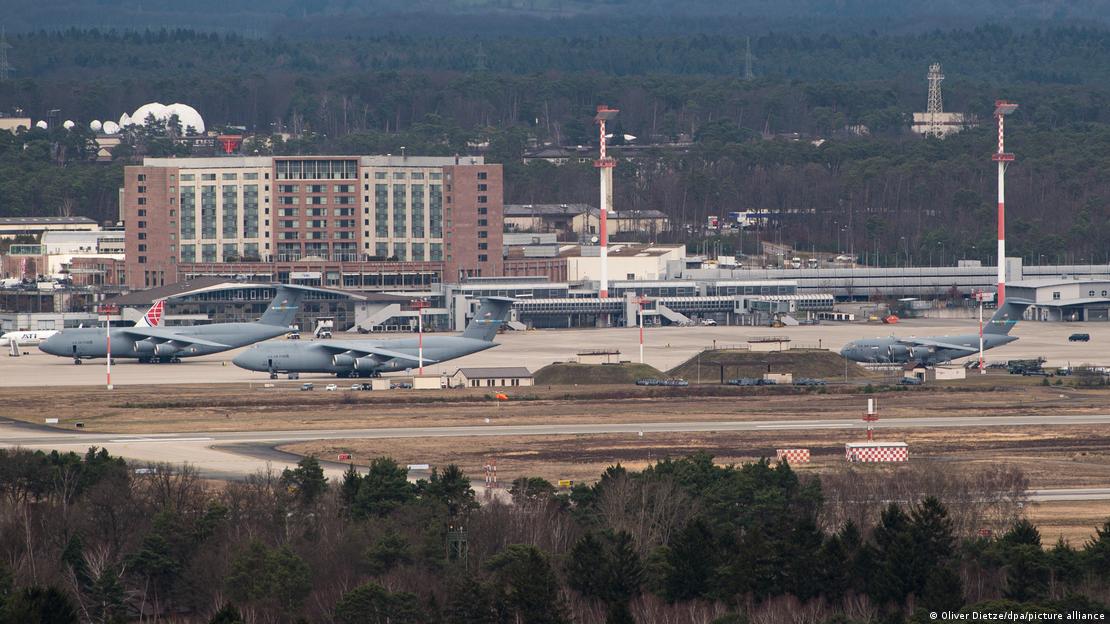
This includes personnel at Ramstein in southwestern Germany, regarded as the US's largest overseas air force base.

After Germany, which is home to five of the seven US garrisons in Europe, the United Kingdom and Italy have the biggest presence of US personnel on the continent.

The Ramstein base has also played a pivotal role in US operations in the Middle East
Image: Oliver Dietze/dpa/picture alliance


Why did Merz say Iran was 'humiliating' the US?


In the past months, news outlets have reported on rumors of possible US troop withdrawals from Germany.

However, Trump's Truth Social post comes just days after German Chancellor Friedrich Merz said that the US was being "humiliated" by Iran's leadership.

On Monday, Merz said the "Iranians are obviously very skilled at negotiating, or rather, very skillful at not negotiating, letting the Americans travel to Islamabad and then leave again without any result.

"An entire nation is being humiliated by the Iranian leadership, especially by these so-called Revolutionary Guards. And so I hope that this ends as quickly as possible."

After Merz's comments, Trump hit back on his Truth Social platform to say that Merz "doesn't know what he's talking about!"

German Foreign Minister Johann Wadephul later clarified Merz's comments in an interview with DW.

"It was addressing the behavior of Iran," Wadephul told DW's Berlin bureau chief Max Hoffmann in New York City.

"They are, as I said, misunderstanding their position and overplaying their role, so this is what the chancellor said," Wadephul stressed.

Edited by: Zac Crellin
Ecuador starts fracking in Amazon rainforest
DW with AFP, EFE
30/04/2026


Ecuador is pushing to increase its production of crude oil but faces a backlash from environmentalists and Indigenous groups.


Eduador is expanding its oil production in the Amazon
Image: Laurent Davoust/Zoonar/picture alliance


Ecuador has started fracking in the Amazon rainforest for the first time, state oil company Petroecuador said Wednesday.

The new hydraulic fracturing, or fracking, project is in the Amazonian province of Sucumbios on Ecuador's border with Colombia.

The fracking at a new well on Block 57 - Shushufindi Libertador represents "milestone " for oil production in the country, the Ministry of Environment and Energy said in a statement released on Wednesday.

The new well is in full production, producing more than 930 barrels a day, the ministry of said.

The project is being jointly conducted with a subsidiary of China's national petroleum corporation, CCDC.

What is fracking?


Fracking entails extracting natural gas and petroleum from subterranean bedrock.

It is criticized for using industrial quantities of water to break open rocks as well as causing chemical contamination and provoking micro-earthquakes.
Ecuador pushing to ramp up oil production

Ecuador's crude oil production fell to around 466,000 barrels a day in January 2026, a 13% drop from the same period a decade earlier. Analysts point to aging infrastructure and years of underinvestment as part of the problem.

Oil revenues make up a significant amount of Ecuador's export earnings.

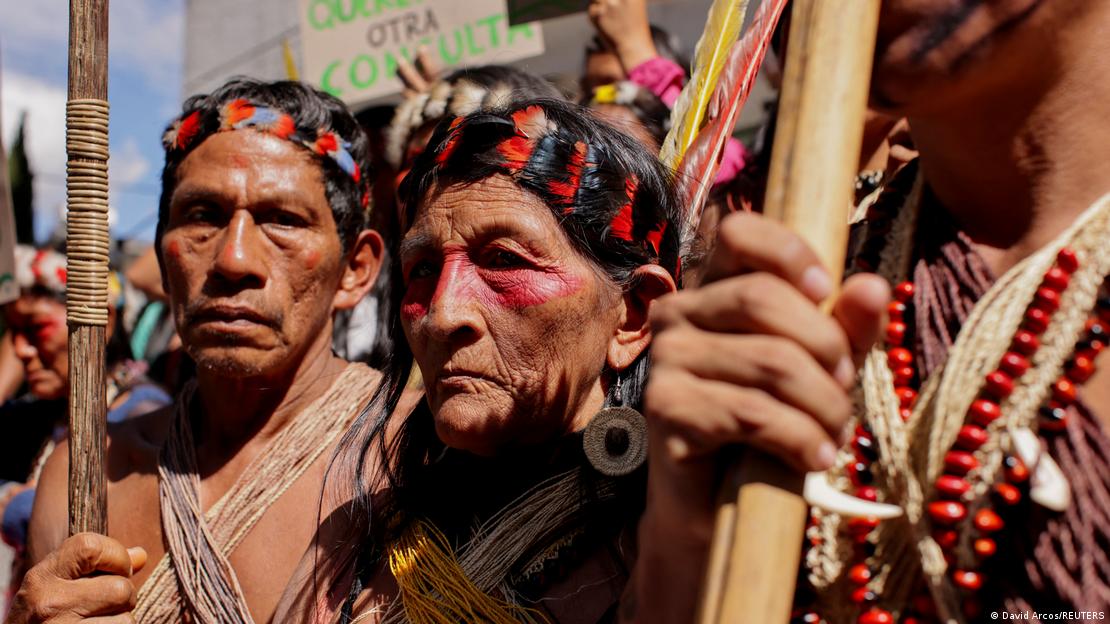
Government plans to expand oil exploration in Ecuador has led to Indigenous protest, like this one in 2025
Image: David Arcos/REUTERS

The government of President Daniel Noboa has promised more funds for oil exploration and infrastructure and to attract greater foreign oil investments.

At the same time, his government's push to expand oil exploration, particularly in the Amazon, has alarmed environmentalists and Indigenous leaders.

Edited by: Zac Crellin
Kate Hairsine Reporter and senior editor
North Korea faces food shortages as drought threatens crops
DW with AFP, Reuters
30/04/2026

The country's state-run news has said much of the country has been hit by an unusually severe drought. The largely isolated country, with a population of over 26 million, was already facing food shortages.


North Korea has long struggled with food shortages
Image: Jacky Chen/REUTERS

North Korea is rushing to shield its crops from a "severe" drought that has hit the country, its state news agency reported on Thursday.

The largely isolated country, with its lack of strong infrastructure, is particularly susceptible to the impacts of natural disasters.

North Koreans have long struggled with food insecurity due to extreme weather, worsened by sanctions, border closures, and limited farm inputs.
What did North Korea say about its drought?

"An unusual drought has recently persisted across much of the country, a phenomenon rarely seen in previous years," Pyongyang's official Korean Central News Agency (KCNA) said.

"Workers across various regions are concentrating all efforts on protecting early-season crops from the drought," it added.

KCNA reported that North Korean cities and counties were carrying out "repairs to the gates of reservoirs and waterways," and implementing "technical measures" to boost drought resistance of wheat and barley.

In February, UN Special Rapporteur on human rights, Elizabeth Salmon, had said that food shortages were already a key concern. UN agencies say millions in North Korea are undernourished and vulnerable to disasters such as droughts and floods.
North Korea is ramping up efforts to prevent a prolonged drought from damaging crop production ahead of the rice planting season
Image: Yonhap/picture alliance

Crop-protection measures

In another report, KCNA said North Korean Premier Pak Thae Song went for on-site inspections at farms in South Pyongan and North Hwanghae provinces to check on the "countermeasures to minimize drought damage."

Pak called for farm workers to identify and efficiently use all water resources available. He emphasized that a successful harvest hinged on overcoming this year's drought, KCNA said.

South Korea was also hit by a drought last year, affecting the Gangneung province. It also recorded its hottest summer. Both the north and the south had their hottest Junes on record.

North Korea's frequent power shortages also meant people lacked access to air conditioning to cool themselves down.

Climate change, caused primarily by human emissions of CO2, has increased the frequency and intensity of extreme weather.

Edited by: Alex Berry
Mahima Kapoor Digital journalist based in New Delhi
ROGUE CRIMINAL STATE
Israel stops Gaza-bound aid flotilla in international waters

Muna Turki 
DW with AFP and Reuters
30/04/2026

More than 20 ships were intercepted in a mission aimed at challenging the blockade of the Gaza Strip. Israel dismissed those on board as "attention-seeking agitators."


Ships set off in recent weeks from Marseille in France, Barcelona in Spain and Syracuse in Italy
Image: Joan Mateu Parra/AP Photo/dpa/picture alliance

Isreal has intercepted more than twenty aid ships with 175 activists on board, Israel's Foreign Ministry said on Thursday. The ships were on their way to the Gaza Strip before being stopped in international waters near Greece.

This flotilla mission carrying humanitarian aid to Palestinians in Gaza comes after a fleet of around 45 boasts was intercepted last year.

Palestinians and international aid bodies say supplies reaching the Gaza strip are not sufficient.

What do we know about the Gaza flotilla interception?

Israeli military boats seized 15 ships near Crete, hundreds of miles from Gaza, according to the mission organizer, Global Sumud Flotilla.

"Our boats were approached by military speedboats, self-identified as Israeli, pointing lasers and semi-automatic assault weapons ordering participants to the front of the boats and to get on their hands and knees," the organization said in a post on X.

"This is piracy," the group said in the statement. "This is the unlawful seizure of human beings on ‌the open sea near Crete, an assertion that Israel can operate with total impunity, far beyond its own borders, with no consequences," the group added.

Israel's UN envoy Danny Danon said the flotilla "was stopped before reaching our area," calling the flotilla members on board "attention-seeking agitators."

This spring flotilla mission included more than 50 boats, in what the organizers said was the largest coordinated civilian maritime action for the Palestinian territories to date.

Why was the international flotilla heading to Gaza?


Last year, the Freedom Flotilla missions were the most ambitious and largest maritime attempts to reach Gaza. The crew members were arrested on the way and later expelled by Israel.

"The goods on these flotillas do not meet the needs of the Palestinians in Gaza, but they draw international attention to what is happening in Gaza," Nathan Brown, professor of political science and international affairs at George Washington University, told DW at the time.

Israel set up the naval blockade on Gaza in 2007 after Hamas took over as Gaza's governing body. Israel argues the blockade is necessary to prevent the Islamist militant group, which is categorized as a terror organization by the US, EU and many others, from importing arms.

In the view of many human rights organizations and NGOs, however, the blockade constitutes collective punishment, which is illegal under international law.

Gaza's already dire humanitarian situation has further deteriorated since the start ofIsreal-Hamas war, which was triggered by the Hamas-led terror attacks of October 7, 2023, against Israel. Despite a declared ceasefire on October 25, Israeli attacks have continued to kill hundreds of Palestinians in the enclave.

UN officials and others have said that as part of its ongoing military campaign, Israel is committing war crimes, including ethnic cleansing and deliberate starvation. Some have warned of genocide and famine.

More than 72,000 Palestinians, including at least 21,000 children, are reported to have been killed since October 2023, according to the Gaza Health Ministry.


Edited by: Alex Berry
'Israel destroyed houses, roads, even trees': People return to destruction in southern Lebanon


Many videos document the Israeli army’s destruction of houses and infrastructure in southern Lebanon, where it is creating a buffer zone along the border. Our Observers, many of whom wanted to return home after a ceasefire was announced, describe empty villages and razed homes.


Issued on: 28/04/2026 - FRANCE24

By:
The FRANCE 24 Observers
Djamel BELAYACHI/
Ahmed ALMASSALMAH

Israeli bulldozers can be seen demolishing Bernard Farhat’s house in Naqoura, a village in southern Lebanon, in this photo taken on April 13, 2026. His home is located within the military zone demarcated by the Israeli army’s so-called Yellow Line. © Observers

Bulldozers ram the walls of a house in Naqoura, a Lebanese village on the border with Israel, in a video filmed on April 13, 2026. After just a few minutes, the home collapses in a cloud of dust.

This home belonged to a man named Bernard Farhat, who fled his hometown of Naqoura for Beirut as the Israeli army advanced. He watched the footage of his home collapsing on his phone, powerless to save it.

‘It took my parents ten years to build this house’

"It’s not the first time that we’ve lost a home. My family was displaced back in the 80s. I was born in Naqoura in 1987. For me, Naqoura isn’t just a village – it’s a refuge, it’s my entire childhood. It took my parents ten years to build that house, little by little, each week.

When I first saw the videos of homes destroyed, I thought to myself that it was perhaps linked to the Israeli army’s activities. And then one day, I saw my own home in one of these videos. On April 13, I received videos that showed three bulldozers demolishing it – two in front and another on the side, breaking it piece by piece. The area was already empty – everyone left. Only the Israeli army has been there since late March.

This home, it wasn’t just made of stones. It was also my memories, the place where I found refuge and certainly the last link that I had with my father, who died in 2019. But now, there is nothing left – just stones."

The Israeli army has been carrying out ground operations in southern Lebanon since early March 2026, as tensions continue to escalate with Lebanese militant group Hezbollah.

Officially, Israel says that it wants to create a barrier between Hezbollah fighters and its border and prevent them from re-establishing any military positions. However, Israel’s operations in the area have included the destruction of many civilian homes in several border towns. The army claims that it is targeting Hezbollah infrastructure, which they claim is often located within civilian zones.


In spite of the ceasefire, the Israeli army has continued to destroy dozens of civilian homes in the town of Bint Jbeil in southern Lebanon.

The Israeli army announced on April 19 that it was setting up what it called a "Yellow Line" in southern Lebanon, which they say demarcates a “security zone” meant to prevent any Hezbollah presence near the Israeli border.

Images posted online show explosions in buildings in Naqoura and the nearby villages of Bint Jbeil, Ainata and Rabb el-Thalathine – explosions taking place far from the zones of active combat.

In fact, even residential buildings located right next to the headquarters of the United Nations Interim Force in Lebanon (UNIFIL) in Naqoura were destroyed in recent weeks. UN surveillance cameras captured images of several seaside homes being destroyed on April 4, sending debris flying into the deserted streets.


Several videos show demolitions taking place in a number of southern villages, including Ainata, Jubbayn and Rab el-Thalathine.


‘Hezbollah fighters told us to go to leave them space’


After the ceasefire was announced on April 16, some people wanted to return to their homes. One of them was our Observer Samar, who is from the Tyr region.

"We left Beirut at 6am on April 18, 2026 and we only arrived in Tyr around 4pm because of the traffic jams. We crossed the Qasmiyeh bridge, which had been bombed. There was still an enormous hole that had been filled in. However, I didn’t recognise the south when I got there! I saw lots of portraits of Hezbollah fighters as well as Hezbollah and Iranian flags – there were even vendors selling them alongside the road. I didn’t see any Lebanese flags.

The south is nearly empty. There is no longer any normal life. There are very few services. You can only get electricity a few hours a day. The Hezbollah fighters told us to go, to leave them space. Some people left, others refused. I decided to stay, in spite of everything.”

The Israeli army has destroyed four different main bridges on the Litani River, which crosses southern Lebanon. The most recent is Qasmiyeh bridge, the bridge that our Observer had to take to return home.


‘A drone ordered us to turn around’


Abu Karim, a farmer from the border city of Houla in southern Lebanon, tried to return to his home just after the ceasefire was put in place.

"As soon as they announced the ceasefire, I wanted to return home. I love this land: I’m a farmer, my whole life is here. When the truce was called, they said that the roads were open and that the army had secured them. But in reality, the bridges had been destroyed. I crossed the damaged Qaquaiya bridge and there was no one there to organise the traffic. We had to take alternative roads and it took us hours.

My village, Houla, was more than 70 percent destroyed: homes burned, the burnt-out carcasses of cars and impassable roads. Even the agricultural land was ravaged. The destruction is indescribable. The farthest I got was to the villages of Shaqra and Majdal Selm. At that point, an Israeli drone spoke to us in Arabic, telling us that we needed to turn around or they would open fire. We didn’t have a choice, so we left. There’s no real ceasefire, it’s just on paper.

When I was in Shaqra, I saw Israeli equipment including bulldozers and tanks. They were destroying and burning down homes, roads and infrastructure. They even destroyed the trees about two kilometres from Houla. They are completely altering the terrain.

They speak of a ‘Yellow Line’, but that doesn’t exist for us. It’s our land. Today, there are entire villages that no one can access.

They can destroy homes and burn trees, but they can’t take our will away from us. We’ll come back. We’ll rebuild and replant. This land is ours.”
‘Destruction that goes beyond military objectives’

According to several sources, the area that the Israeli army wants to clear includes between 55 and 70 villages. Some of the villages are still partially inhabited, Lebanese sociologist Ahmed Baydoun says.

This is a map of the military zone established by the Israeli army in southern Lebanon on April 19, 2026. © FMM graphics studio


Baydoun says that the destruction that has been observed can’t be explained by just military objectives:

"The Israeli army says that they are destroying Hezbollah infrastructure but, in reality, we are seeing entire villages being destroyed including Bint Jbeil and Ainata. In some cases, the destruction is systematic. We’ve also seen that in some villages with majority Christian populations, the residents have remained.

No one knows how long the situation will last, but it’s worth asking if Israel wants this region to remain empty of residents or even de facto integrate it into Israel, like what happened with Syria’s Golan Heights. We feel as if the Israelis are applying the Gaza model - of having a buffer zone emptied of its population - to southern Lebanon."

Israeli sources reported that several hundred structures are thought to have been destroyed in this region.

This article has been translated from the original in French by Brenna Daldorph.
Why UAE's OPEC exit is a blow to Saudi Arabia

Nik Martin
DW
 30/04/2026

The United Arab Emirates is leaving OPEC to pump more oil on its own terms. The break strips Saudi Arabia of a key partner and adds to growing uncertainty over the cartel's future.


The UAE, then part of the Trucial States, joined the OPEC oil cartel in 1967
Image: Karim Sahib/AFP


Why has the UAE decided to quit OPEC now?

OPEC, the global cartel of oil-producing nations, operates a quota system that limits how much oil each member can produce.

For years, the United Arab Emirates (UAE) has clashed with Saudi Arabia, OPEC’s most powerful member, over these quotas. The UAE has invested heavily to expand its oil industry and grow its market share, but OPEC limits have repeatedly held it back.

Energy Minister Suhail Al Mazrouei told the New York Times on Tuesday: "The world needs more energy. The world needs more resources, and [the] UAE wanted to be unconstrained by any groups."

The UAE is now betting it can sell more oil once the Iran war and Strait of Hormuz crisis ends, both in the medium and the longer term. Analysts, meanwhile, see the move as a calculated step by a producer ready to act independently.

"Losing a member with 4.8 million barrels per day of capacity, and the ambition to produce more, takes a real tool out of the group's [OPEC] hands," said Jorge Leon, head of geopolitical analysis at research consultancy Rystad Energy.

"With demand nearing a peak, the calculation for producers with low-cost barrels is changing fast, and waiting your turn inside a quota system starts to look like leaving money on the table."

The UAE, which joined OPEC in 1967 through Abu Dhabi, will leave both OPEC and the wider OPEC+ alliance, which includes Russia, on May 1.

The UAE currently produces roughly 3.2 to 3.6 million barrels per day (bpd) under quotas but holds spare capacity of nearly 4.8 million bpd, Reuters news agency reported. Plans call for a hike in output toward 5 million bpd by next year.

How does the UAE's exit weaken OPEC and Saudi Arabia’s leadership?

The UAE's exit removes one of the few OPEC members with meaningful spare oil capacity, leaving Saudi Arabia unable to easily share the burden of output adjustments.

The Gulf Kingdom has traditionally managed oil prices by cutting its own production and enforcing discipline across the group. With the UAE gone, Saudi Arabia will have to rely much more on its own oil production cuts to stabilize prices.

This will make defending oil prices more expensive and less effective for Riyadh. It also weakens the Kingdom's ability to manage and discipline the wider OPEC group.

David Oxley, chief climate and commodities economist at the London-based Capital Economics research house, called the move "the thin end of the wedge," warning in an analysis its website that "the ties binding OPEC members together have loosened."

Saudi Arabia needs high oil prices — around $90 (€77) per barrel — to fund government spending and its ambitious Vision 2030, a set of huge infrastructure projects to cut the Kingdom's reliance on fossil fuels. These include a $500 billion futuristic city named NEOM.

Every extra barrel the country holds back means lost revenue, which hurts the country's ability to grow its economy.

The exit also exposes long‑standing tensions inside OPEC, especially the perception that Saudi Arabia dominates decision-making.

The move also comes at a time when OPEC's overall influence has been shrinking. The cartel once controlled more than half of global supply; today, it commands less than a third.

What does the UAE exit mean for global oil prices?


The UAE's departure is unlikely to cause major immediate swings in global oil prices, largely because the ongoing disruption in the Strait of Hormuz already dominates the market.

Much of the region's oil exports remain blocked and the UAE is redirecting about 1.8 million bpd to its Fujairah port on the Gulf of Oman coast via a pipeline that is running at maximum capacity. Any additional production the country plans to bring online cannot reach markets right away.

As a result, the announcement had little immediate effect on prices, with Brent crude largely unchanged on Tuesday.

"In the short term, I don't expect it [the exit] to have major impacts because what's happening in the Strait of Hormuz dominates the whole global oil picture in a way that renders this news from OPEC as kind of a minor thing," Jeff Colgan, an expert on OPEC at Brown University, told DW

Once the situation in the Hormuz situation normalizes, the UAE could add several hundred thousand extra barrels per day to the market. In the longer term, the exit points to modestly lower and more volatile oil prices.

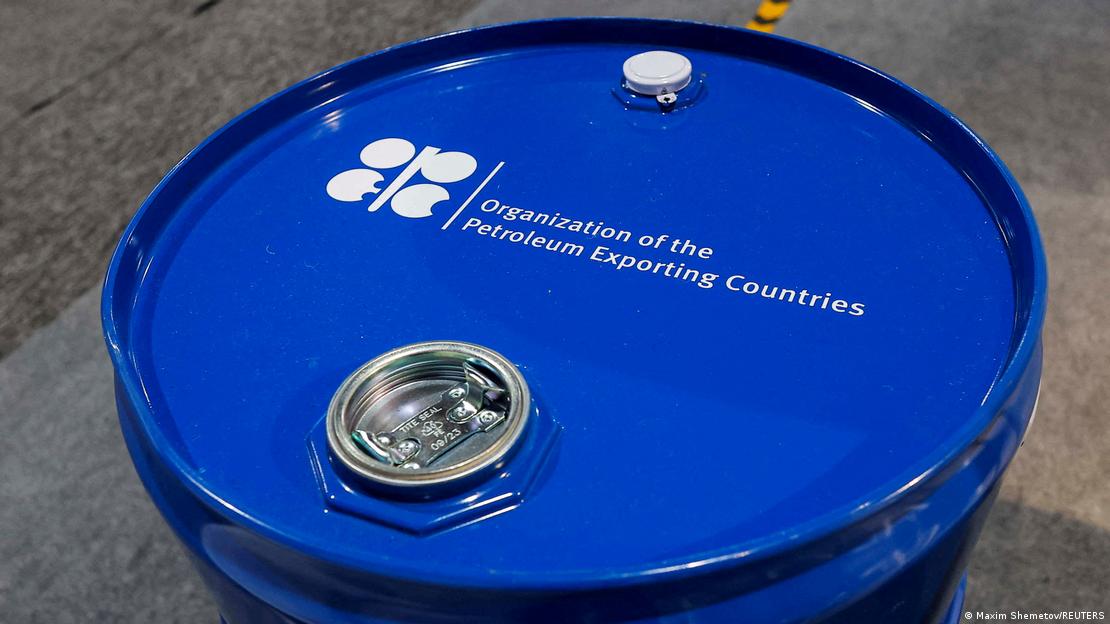
OPEC will have 11 remaining members after the UAE's exit
Image: Maxim Shemetov/REUTERS


Could the UAE prompt other producers to reconsider OPEC?

Some oil industry analysts say the UAE's exit adds to longer-running doubts about OPEC's future cohesion.

"It is possible that we could see the whole organization fall apart," Colgan told DW, adding that he believes Saudi Arabia will likely try to keep the group together as "the key anchor to the whole organization."

The UAE's exit does, however, highlight growing frustrations with OPEC's quota system and exposes rifts, especially with Riyadh.

OPEC has already been under strain from repeated quota breaches by members such as Iraq and Nigeria, and from Russia's inconsistent compliance within OPEC+. The UAE's departure adds to that sense of fragmentation.

In his analysis for Capital Economics, Oxley warned that, in the medium term, if other producers with spare capacity "see the UAE successfully gaining flexibility and market share" outside OPEC, "others may follow."

For now, most members lack the UAE's production capacity or economic diversification, so a mass exodus is unlikely.

The UAE is not the first OPEC member to leave. Qatar exited in 2019, while Angola, Ecuador, Gabon and Indonesia have also departed in recent years, often due to disagreements over quotas.

Edited by: Ashutosh Pandey