It’s possible that I shall make an ass of myself. But in that case one can always get out of it with a little dialectic. I have, of course, so worded my proposition as to be right either way (K.Marx, Letter to F.Engels on the Indian Mutiny)
Wednesday, May 06, 2026
The Digital Markets Act
How is the DMA reshaping Big Tech's grip on the internet?
Two years in, Europe's landmark law has changed how Big Tech operates and given users more freedom and choice, but the battle is far from over. Watch the video!
The European Commission has released its first formal review of the Digital Markets Act, a law aimed at regulating Big Tech's dominance in Europe's digital economy. The verdict: progress, with caveats.
Since the DMA was enacted in March 2024, users have noticed changes. iPhones support third-party app stores. New Android and iOS devices prompt users to select their preferred browser or search engine. The numbers show impact: Firefox daily users in Germany rose to 99 percent, while Brave and Opera saw EU download surges of 250 percent.
Enforcement has bite. In April 2025, Apple was fined €500 million for blocking developers from directing users to cheaper options. Meta was fined €200 million for its "consent or pay" model, which Brussels ruled was not a valid choice. Both are appealing.
Yet the review flags serious concerns: investigations are taking twice as long as their 12-month target, and gatekeepers are using legal delays to slow compliance. Bigger questions loom, too: should AI tools and cloud platforms be subject to the same rules?
The Digital Markets Act marks only the start of an ongoing contest. While significant changes are underway, consistent enforcement and tackling new challenges are crucial for lasting impact.
Holocaust denial is creeping into Dutch classrooms via social media, survey shows
Teachers who responded to a survey in the Netherlands say their students confront them with Holocaust-related disinformation they likely picked up on social media.
Teachers in schools across the Netherlands are struggling with a surge of disinformation relating to the Holocaust that they believe students are seeing on social media, according to a new survey.
Over 190 teachers from secondary schools in the Netherlands responded to a poll from NOS Stories, a branch of the Dutch public broadcaster.
The students “no longer know what is real and what is fake because of AI and TikTok,” history teacher Maarten Post told NOS.
Post said he preferred students who reach out to him and ask about the issue rather than drawing their own conclusions based on online disinformation.
“I am very happy that they come to me with those questions … then you can explain it and start a conversation.”
In one example, Post said students showed him a TikTok video that claimed the World War II Nazi German government killed 271,000 Jews, a significantly misconstrued and minimised figure.
The United States Holocaust Memorial Museum (USHMM) estimates that six million Jews were killed during the Holocaust across Europe — approximately two-thirds of the entire prewar European Jewish population of around nine million.
Relate
Euronews Next reached out to Tiktok for comment but did not receive an immediate reply.
One third of the teachers surveyed said that their student’s knowledge is “substandard,” and four out of ten teachers believe their students downplay the severity of the Holocaust.
This is not just an issue in the Netherlands.
In January, German Holocaust memorial institutions wrote an open letter to social media platforms, demanding to stop the spread of fake images aimed at distorting Holocaust history and memorialisation.
The Auschwitz Memorial Museum also said that AI was being used to generate fake images of Holocaust victims, in a “profound act of disrespect”.
Last year, Elon Musk’s AI platform Grok made various misleading or false statements about the Holocaust after a system update, leading to an investigation by French prosecutors.
Children are drawing moustaches on their faces to fool online age checks - and it's working
A new report reveals that children across the UK are outwitting online safety measures with fake birthdays, borrowed IDs, and some surprisingly creative facial hair.
A third of children say they have bypassed online age checks in the past two months - some by drawing fake moustaches on their faces to trick facial recognition software.
The report from Internet Matters titled The Online Safety Act: Are Children Safer Online? surveyed 1,270 children aged 9-16 and their parents across the United Kingdom to see whether the country's landmark online safety legislation is delivering any meaningful protection for children.
One mother told researchers she caught her son using an eyebrow pencil to draw a moustache on his face to pass a platform's facial age estimation check. It worked. He was verified as 15. He was 12.
What did the report find out?
The study discovered that 46% of children believe age checks are easy to bypass, while only 17% say they are difficult.
Among the infiltration methods children described were entering a fake birthdate, using someone else's identification, submitting videos of other people's faces, and using video game characters to fool facial recognition tools.
Related
"I've seen clips of people online where they'll get clips of video game characters like turning their head and use it for age verification," one 11-year-old girl told researchers.
Older children were more confident about circumventing checks, with 52% of those aged 13 and over saying age verification is easy to beat, compared with 41%of those aged 12 and under.
The most common reasons children gave for bypassing age checks were to access a social media platform they were not old enough to use (34%), to join an online game or gaming community (30%), and to use a messaging app (29%).
The report also found that just over a quarter of parents - 26% - have allowed their child to bypass age checks, with 17% actively helping them do so. Parents said they did this when they felt confident the content was appropriate for their child.
"I have helped my son get around them. It was to play a game, and I knew the game, and I was happy and confident that I was fine with him playing it," said one mother of a 13-year-old.
Is the Online Safety Act actually working?
The UK's Online Safety Act came into force in July 2025, which required social media platforms, gaming sites and other services to implement age-appropriate safety measures.
There are signs the legislation is having some effect. Around 68% of both parents and children report noticing new safety measures on the platforms children use, including improved reporting tools, content warnings, and restrictions on features such as livestreaming.
However, nearly half of children (49%) said they had experienced harm online in the past month, including seeing violent content (12%), content promoting unrealistic body types (11%), and racist, homophobic or sexist content (10%) - all of which should be prohibited under the Act's Children's Safety Codes.
Children in focus groups also described seeing videos of the assassination of right-wing political activist Charlie Kirk on their social media feeds. "I saw it on Snapchat. I broke down into tears and then told my mum immediately," said one 14-year-old girl.
The report recommends that children's safety be built into online platforms from the outset rather than added in response to harm, that access be determined by the level of risk a platform presents, and that access "should be tailored to their stage of development, rather than a one-size-fits-all approach".
It also stresses the role parents play in child safety and that they should be provided with "guidance on how to set up parental controls, through to clear, accessible explanations of how algorithms work and influence what children see online".
Everything you need to know about the Meta trial that could reshape social media
The landmark trial is entering its second phase, following an earlier jury verdict that already found Meta liable and imposed hundreds of millions of dollars in penalties.
A landmark trial in New Mexico is entering a decisive second phase that could fundamentally change how social media platforms operate worldwide.
State prosecutors are asking a judge to force Mark Zuckerberg's Meta, the parent company of Instagram, Facebook and WhatsApp, to overhaul key parts of its platforms - including the algorithms that decide what users see - over claims they harm children's mental health and enable exploitation.
The case follows a major jury verdict that already found the company liable and imposed $375 million (roughly €320 million) in penalties.
It also comes amid growing international scrutiny. Last week, the European Commission said around 10-12% of children under 13 are using Instagram and Facebook, raising concerns that Meta’s age checks are ineffective.
Here’s what you need to know about the trial.
What is the trial about?
New Mexico prosecutors are taking Meta to court over claims its platforms pose a public safety risk to children. They argue that features on their apps, such as Instagram, have contributed to a mental health crisis among young people and enabled harmful content, including child sexual exploitation.
Opening statements mark the second phase of the trial, which will determine whether the platforms amount to a "public nuisance" under state law.
What has already been decided?
In thefirst phase of the trial, which took place in March, a jury ruled against Meta and ordered $375 million (roughly €320 million) in civil penalties.
Jurors determined in their decision that Meta engaged in "unconscionable" trade practices that unfairly took advantage of the vulnerabilities and the inexperience of children.
The jurors also found there were thousands of violations of the state's Unfair Practices Act, a New Mexico law that protects consumers against unfair business practices.
Relate
A Meta spokesperson told the Associated Press that the company disagrees with the verdict and will appeal.
“We work hard to keep people safe on our platforms and are clear about the challenges of identifying and removing bad actors or harmful content,” the spokesperson said.
"We will continue to defend ourselves vigorously, and we remain confident in our record of protecting teens online.”
What changes are prosecutors demanding now?
Prosecutors want sweeping changes to how Meta’s platforms work. These include redesigning algorithms so they no longer prioritise constant engagement, as well as limiting addictive features like infinite scroll and push notifications.
They are also calling for stronger age verification, default privacy protections for children, and requiring child accounts to be linked to a parent or guardian.
The state is also seeking the appointment of a court-supervised child safety monitor.
Could social media algorithms be affected?
Yes - one of the biggest potential outcomes is a redesign of the systems that recommend content to users.
Prosecutors argue these algorithms currently prioritise engagement over safety, encouraging compulsive use.
What is Meta’s response?
Meta has said it will appeal the earlier verdict and strongly opposes the proposed changes.
The company argues the demands are unrealistic and could force it to "disregard the realities of the internet".
Meta is also invoking free speech protections. "The state’s proposed mandates infringe on parental rights and stifle free expression for all New Mexicans," the company said.
What happens next?
The trial is expected to last three weeks, with testimony from experts, investigators, and Meta executives.
A judge will then decide whether the company must implement the drastic changes requested by prosecutors.
Portugal arrests further 15 police officers in ongoing Lisbon rape and torture probe
According to the Portuguese press, the victims were mainly undocumented foreigners, homeless people or drug users.
A further 15 police officers suspected of torturing and abusing vulnerable people were arrested in Portugal on Tuesday, in a widening investigation into abuses of power in the Iberian country.
With the suspects taken into custody on Tuesday, a total of 24 police officers are now under investigation for alleged acts of "aggravated torture, rape, abuse of power and aggravated assault," according to a police statement.
Investigators carried out around 30 searches on Tuesday, including in two police stations in the Portuguese capital Lisbon where the abuses are believed to have taken place.
According to the Portuguese press, the victims were mainly undocumented foreigners, homeless people or drug users.
When questioned about the case on Monday, police director Luís Carrilho said: "We enforce a zero-tolerance policy toward cases of misconduct."
"Citizens can continue to have confidence in the police," he insisted.
A policeman on duty on the steps of the Portuguese parliament watches thousands of people protest for better salaries and work conditions in Lisbon, 24 January, 2024AP Photo
March arrests
In March, seven police officers were remanded in custody on charges including torture, rape, abuse of power and serious physical harm following alleged crimes at a Lisbon police station.
The Public Security Police (PSP) officers were arrested on 4 March in connection with alleged incidents at the Rato Police Station.
A court at the time justified pre-trial detention by citing the danger of continued criminal activity, serious disturbance to public order and the risk of evidence tampering.
According to Portuguese newspaper Correio da Manhã, the investigation was expected to involve around 70 officers from various police stations, including some with the rank of chief.
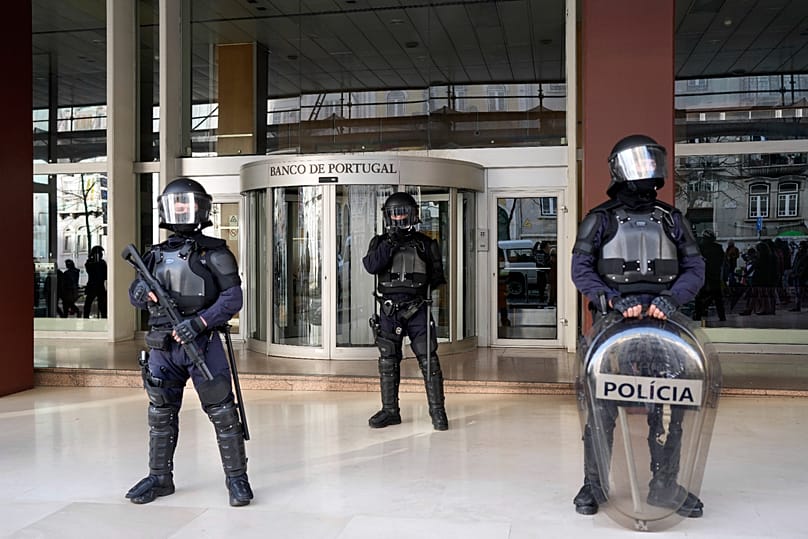
Police stand outside a building of the Bank of Portugal in Lisbon, 24 February, 2024 AP Photo
The PSP's Lisbon Metropolitan Command said it "strongly repudiates any behaviour that constitutes a flagrant violation of these principles," and stressed the institution itself reported the facts to the Public Prosecutor's Office.
Two other PSP officers were already in pre-trial detention on similar charges at the same police station at the time of the March arrests, authorities said.
They were arrested in July last year following raids on several Lisbon police stations for "possibly committing various crimes, including torture, offences against qualified physical integrity, embezzlement and forgery."
The officers were formally charged in January. According to the indictment, the officers chose victims from among the most vulnerable, mainly targeting drug addicts, homeless people and illegal immigrants.
Gender emissions gap: Rich white men’s jobs, diets and hobbies found to be ‘bad for the planet’
Men were also found to have “less concern with climate change” and be “less ambitious and less active in environmental politics”.
As humanity edges closer to irreversible climate damage, masculine behaviours have been called out for being “bad for the planet”.
A new paper by more than 20 scientists from 13 different countries has analysed existing research on climate change, global warming, and environmental collapse – and how they connect with what men do.
Published in Norma: International Journal for Masculinity Studies, the paper, titled ‘Men, masculinities and the planet at the end of (M)Anthropocene’, covers questions as diverse as climate denial in Canadian pipeline politics, environmental impacts of Chinese policies in the Pacific Ocean, pro-meat online influencers in Finland, and positive action by men activists in Africa, Latin America, the UK, and globally.
Is masculinity bad for the environment?
Researchers found that overall men tend to have a greater carbon footprint and greater environmental impact through consumption, especially when it comes to travel, transportation, tourism and meat eating.
Multiple studies have highlighted the gender gap in greenhouse gas emissions. For example, a 2025 study involving 15,000 people in France found that men emit 26 per cent more pollution than women from transport and food.
The team also warns that men tend to have “less concern with climate change”, are “less ambitious and less active in environmental politics”, and are less willing to change everyday practices to tackle the growing issue.
Relate
A study from last year published in the Journal of Environmental Psychology found that men with higher levels of "masculinity stress" (concerns about appearing feminine) express less worry about climate change and are more likely to exhibit pro-environmental behavioural avoidance, such as avoiding eco-friendly products to maintain a, often, traditional masculine image.
Men also tend to be more involved in owning, managing and controlling heavy, chemical, carbon-based, industrialised industries such as agriculture, along with other high environmental impact and extractive industries, and of course militarism, the paper states.
‘Negative impacts’ of men
“There is now plenty of research that shows clear negative impacts of some men’s behaviour on the environment and climate,” says Professor Jeff Hearn, the paper’s editor and a professor of Sociology at the University of Huddersfield.
“What is astonishing is how this aspect does not figure in most debates and policy in a more sustainable world.”
Researchers add that these “damaging patterns” apply especially to elite, white Eurowestern men opposed to low-income men in the global south.
The paper also acknowledges that some men are working “urgently and energetically” to change these tendencies.
Europe's ultra-rich club grew by 26% in five years — led by Germany
The number of people with at least $30 million (€25.7m) in wealth is growing across Europe. Germany has by far the most ultra-rich, and continues to add more.
Europe's ultra-rich club is growing fast. The number of people with at least $30 million (€25.7m) in wealth — known as ultra-high-net-worth individuals or UHNWIs — rose by 26% in Europe over the last five years. That means 37,428 new members joined this exclusive group between 2021 and 2026 according to Knight Frank's Wealth Report 2026.
So, which European countries have the most ultra-rich people? And where did their numbers grow the fastest?
More than 710,000 people worldwide hold at least $30 million (€25.7m) in net wealth. Almost a quarter of them, 25.8%, live in Europe. The continent's ultra-high-net-worth individual (UHNWI) population grew from 146,525 in 2021 to 183,953 in 2026 according to Knight Frank's Wealth Report 2026.
Germany has the most ultra-rich
Germany leads Europe with 38,215 UHNWIs. The UK ranks second with 27,876, followed by France with 21,528. No other European country crosses the 20,000 mark. Switzerland has 17,692 and Italy 15,433.
The figure drops sharply beyond the top five. Spain, one of Europe's largest economies, is home to 9,186 ultra-rich individuals. Sweden counts 6,845 and the Netherlands 5,077. Denmark (4,657), Turkey (4,208), Austria (4,188) and Poland (3,017) follow.
The number falls below 3,000 elsewhere. Norway has 2,460, Czechia 2,270, Ireland 2,196, Portugal 2,187 and Finland 1,317. All other European countries remain below 1,000.
Russia, which sits outside the EU, EU candidacy and EFTA, has 8,399 UHNWIs.
Germany saw the highest absolute rise between 2021 and 2026, adding 9,273 new members to the $30m+ wealth club. Switzerland (4,968), France (3,781) and the UK (3,005) also recorded significant increases.
New additions also ran into four digits in Italy (2,886), Spain (2,708), Turkey (2,034) and Poland (1,575).
Poland, Turkey and Romania saw the highest growth rates
Absolute numbers tell only part of the story. In percentage terms, the picture looks different. Poland's ultra-rich population more than doubled, rising 109%. Turkey (94%) and Romania (93%) came close to that level.
Greece, Czechia and Portugal each recorded growth of at least 50%.
UHNWIs rose 42% in Spain, 32% in Germany, 23% in Italy and 21% in France. The UK posted the lowest increase among the major economies at 12%, while Sweden had the lowest rise of all countries in this group at 8%.
The rate of increase tends to be higher where the base number of ultra-rich is comparatively smaller.
“Europe also features strongly, with Sweden, Romania and Greece all posting robust gains. The picture is one of wealth broadening geographically, even as it continues to concentrate in a handful of global powerhouses,” the report said.
Liam Bailey, global head of research at Knight Frank, said the world is witnessing one of the most significant shifts in global wealth distribution in modern history.
Ultra-rich spread their lives and wealth across borders
"The US remains the dominant engine, but we are also seeing rising strength from India and a cohort of fast-maturing economies that are now shaping the global landscape," he said.
The US leads the world in ultra-rich numbers by a wide margin, with 387,422 UHNWIs.
The report pointed out that rising tax and growing regulatory pressures are accelerating the global mobility of wealth. “UHNWIs are increasingly organising their lives across multiple
jurisdictions, with family offices actively managing tax, lifestyle and political risk,” it said.
Up to 20% of monitoring stations in Europe recorded air pollution levels above the current EU air quality standards.
The country of la Dolce Vita has a serious environmental problem: it has the highest local PM2.5 concentrations, according to the latest European Environment Agency (EEA) Air Quality Status repor
PM2.5 is a dangerous, fine dust that penetrates deep into the lungs and blood, and can be caused by road traffic, but also by refineries, cement plants, fossil fuels, and wildfires.
Between 2024 and 2025, the highest annual averages were observed in southern Italy, according to the EEA.
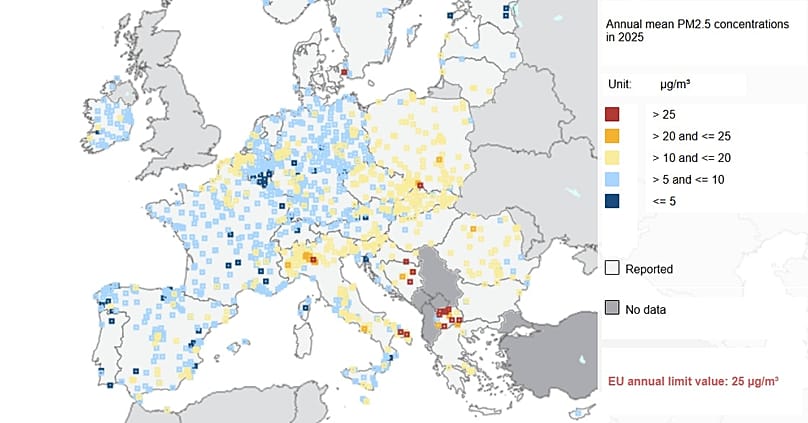
At 117 and 113 μg/m3 (micrograms per cubic metre), respectively, the towns of Ceglie Messapica and Torchiarolo had the worst results compared to the EU's annual limit of 25 μg/m3.
Why do these locations report such high PM2.5 rates?
"As we've seen in the past, those spikes are mainly caused by biomass burning during the winter — mostly from fireplaces," said Gianluigi De Gennaro, chemistry and environmental impact professor at Bari University.
"Pollution becomes more severe due to the atmosphere's reduced ability to disperse harmful particles in that area at that time of the year," he said, adding that this is due to a lower, denser planetary boundary layer, the lowest part of the Earth's atmosphere, extending up to around 3,000 metres.
Northern Italy — the country's main industrial area — presents another clearly concerning cluster, with a high density of locations where annual particulate matter levels hover close to the 25 μg/m3 threshold.
Averrage annual PM2.5 levels in 2025European Environment Agency - Air Quality Status, 2026
During the same 2024-25 period, in addition to Italy, regions in eight EU and non-EU countries exceeded the limit, namely Poland, Croatia, Bosnia and Herzegovina, Serbia, North Macedonia, Romania, Turkey, and even Denmark, at a site in Copenhagen, which recorded a striking 95 μg/m3.
Some of the highest concentrations of these "red dots" in Europe were found in Sarajevo and North Macedonia's industrial areas.
Where are the highest estimated mortality rates linked to PM2.5?
In fact, the Balkans and Eastern Europe are the regions with the highest estimated mortality rate per 100,000 people linked to long-term PM2.5 exposure, including Albania, Bulgaria, Greece and Romania.
Again, Italy (101) has much higher estimated mortality levels than similarly sized countries, such as Spain (41), France (34) and Germany (37), while the lowest rates all emerged in northern Europe: Iceland, Finland, Sweden, Estonia and Norway.
In general, however, more than nine in 10 Europeans are exposed to unsafe air pollution concentrations, according to stricter WHO standards, which puts its PM2.5 threshold at just 5 μg/m3.
Which other pollutants should you be aware of?
Unfortunately, PM2.5 isn't the only dangerous pollutant.
"Air quality continues to improve, but in up to 20% of monitoring stations in Europe, air pollution is still above the current EU air quality standards", according to the EEA.
The organisation also warns against PM10, another inhalable particulate matter, and ground-level ozone, which is formed by the interaction of sunlight with hydrocarbons and nitrogen oxides emitted by car tailpipes and smokestacks, and whose rate has more than doubled since 1900.
Benzo(a)pyrene (BaP) is another harmful substance arising from cigarette smoke, as well as charred food and fossil fuel exhaust.
How can you protect yourself from pollution?
According to experts, prevention starts with simple habits.
For example, De Gennaro recommends that people living in urban areas avoid airing out their homes during peak traffic hours, so only after 9:00 am. An air purifier can also partially help clean indoor air.
Experts at the EEA also told us to use only certified burning stoves, avoid burning fuels on winter days and avoid outdoor activities, like running, during the periods with the highest concentration of harmful substances in the air.
It's also useful to stay informed about pollution levels through apps providing real-time geolocalised data.