Wednesday, May 06, 2026


EU trade chief urges US to ‘swiftly’ restore 15% tariff arrangement

U.S. Trade Representative Jamieson Greer attends a joint media conference during the EU Trade Ministers meeting at the European Council building in Brussels, Nov. 24, 2025.
Copyright AP Photo

By Peggy Corlin
Published on 


EU Trade Commissioner Maroš Šefčovič met US Trade Representative Jamieson Greer ahead of what is expected to be a tense round of negotiations between EU countries and MEPs over the implementation of the EU-US trade deal, as Washington pushes the EU to rapidly eliminate tariffs on US goods.

EU Trade Commissioner Maroš Šefčovič on Tuesday urged the US to honour its side of the EU-US trade deal during a meeting in Paris with US Trade Representative Jamieson Greer.

Tensions have escalated in recent days over the implementation of the EU-US trade deal reached almost a year ago in Turnberry, Scotland, after US President Donald Trump threatened to impose 25% tariffs on EU cars, in breach of the agreement capping US tariffs on EU goods at 15%.

The agreement was further shaken in February after the White House introduced new tariffs following a US Supreme Court ruling declaring the 2025 tariffs illegal.

A European Commission spokesperson said Tuesday that during the 90-minute meeting with Greer, Šefčovič called for a “swift return” to the agreed Turnberry terms, meaning “a 15% all-inclusive tariff rate.”

The US currently imposes a 10% tariff on EU goods on top of duties already in place before Trump’s return to the White House in 2025, with rates varying across EU products. Combined duties can now reach as much as 30% on certain EU exports, such as cheese, exceeding the 15% cap established in the EU–US agreement.

During the meeting, Šefčovič also updated his counterpart on the EU's implementation of the agreement, the spokesperson said, “to clarify” where the EU “stands.”

Washington wants Brussels to accelerate the EU legislative process needed to implement the deal, including the bloc’s commitment to cut tariffs on US industrial goods to zero.

But negotiations between EU governments and members of the European Parliament remain tense.

MEPs want to add safeguards that would make EU tariff cuts conditional on the US implementing its side of the agreement. They are also pushing for a “sunset clause” that would terminate the deal in March 2028 unless renewed.

The European Parliament’s position is backed by France, while Germany and other member states want to preserve the original agreement struck in July 2025 by Trump and European Commission President Ursula von der Leyen.

A round of negotiation is scheduled for Wednesday evening.


'A deal is a deal': Von der Leyen hits back at Trump's latest tariff threat


By Jorge Liboreiro
Published on 

The European Union is "prepared for every scenario" if Donald Trump unilaterally hikes tariffs on EU-made cars, says Ursula von der Leyen.

Ursula von der Leyen has hit back at Donald Trump's latest tariff threat, stressing the United States is constrained by a limit that prevents it from increasing duties on its own.

The US president shocked Europeans last week when he suddenly threatened to raise tariffs on EU-made cars from 15% to 25%, alleging non-compliance.

"A deal is a deal, and we have a deal. And the essence of this deal is prosperity, common rules and reliability," von der Leyen said on Tuesday in Armenia.

"We want from this work (to achieve) mutual gain, cooperation and reliability. And we're prepared for every scenario," she added, hinting at potential retaliation.

The president of the European Commission, who oversees trade policy, said the bloc was "in the final stages" of implementing the pillar of the EU-US trade deal designed to eliminate tariffs on a wide range of American products.

The legislation is being negotiated in the European Parliament, where it has been previously delayed due to Trump's forceful attempt to seize Greenland from Denmark. MEPs have amended the original text to strengthen safeguards.

According to the joint statement published by Brussels and Washington last year, the US was meant to lower tariffs on EU-made cars upon the introduction of the legislation, rather than its final approval. At the same time, the US committed to an all-inclusive cap of 15% on EU goods, precluding the accumulation of additional duties.

"The alignment with the agreed ceiling is still outstanding," von der Leyen said, demanding respect for the "different democratic procedures".

Speaking by her side, António Costa, the president of the European Council, said the 27 member states "fully" supported the work of the Commission and its president.

Since Trump posted his threat on Friday, Brussels has been seeking "clarity" from Washington about the reasoning behind it while signalling its readiness to respond.

Maroš Šefčovič, the European Commissioner for Trade, is expected to meet with Jamieson Lee Greer, the US Trade Representative, later on Tuesday on the sidelines of a G7 gathering in Paris, France, to discuss the matter.

Trump's announcement has been linked to the comments recently made by German Chancellor Friedrich Merz, who said Iran had "humiliated" the US in the war. Germany is the largest carmaker in Europe and is heavily dependent on exports.

Merz has denied any connection between his remarks and the 25% tariff.


Inside Iran's 'mosquito fleet': Telegraph's Adrian Blomfield with a rare frontline glimpse of Hormuz

Issued on: 04/05/2026 - FRANCE24
Play (16:56 min)From the show

Gavin Lee welcomes Adrian Blomfield, senior foreign correspondent at The Telegraph. His reporting from the Strait of Hormuz offers a rare, intimate view beyond satellite imagery and policy abstraction. "One of the things you get a sense of when you're out on the water," he reflects, "is just how much more complicated the picture is." That complexity is not theoretical. It is kinetic, obscured by haze and shaped by "about 300 small speedboats… bouncing along the water" at high speeds, forming a dense and ambiguous maritime ecosystem where smugglers, civilians and military actors blur into a single, indistinguishable flow.

What emerges from Blomfield's account goes far beyond conflict and geopolitics. The same vessels that sustain an economy, "supporting coastal communities", also enable Iran's asymmetric leverage, allowing military assets to "hide in plain sight". In this environment, power is not asserted through overwhelming force but through persistence and opacity. As Blomfield puts it starkly: "Forget about weapons of mass destruction… Iran now has a weapon of mass disruption."

Perhaps most striking is the banality of the threat. Mining the Strait, a chokepoint of global energy flows, requires little sophistication, Blomfield explains. "You hide the mines… lift the tarpaulins, chuck the mines in." The implications, however, are profound. With "five to six thousand mines" potentially in play and no clear path to elimination, the crisis does not ever lead to a resolution. "There's no obvious easy solution," Blomfield concludes, sketching a future defined less by decisive conflict than by enduring instability.

His testimony ultimately reinforces a foundational truth of journalism on the front lines: proximity reshapes context, perspective and understanding. To "narrow the distance between you and the story" is not just a methodological choice. It is the only way to capture the layered realities that define modern conflict zones.


Can China Curb Trump’s Gambit In Hormuz? – OpEd


By 

China’s shock warning to the US President Donald Trump that his road to Beijing goes through the Strait of Hormuz has been an audacious move directly linking his planned visit to China on May 14-15 with the situation around Iran. 

It is more than coincidental that China’s whiplash in the form of a special press conference to mark the commencement of China’s presidency of the Security Council on May 1 at the UN by its special representative Ambassador Fu Cong came hot on the heels of Russian President Vladimir Putin telephoning Trump on April 28 to warn him that “if the United States and Israel resume military action, this would inevitably lead to extremely adverse consequences not only for Iran and its neighbours, but for the entire international community…  a ground operation on Iranian territory would be particularly unacceptable and dangerous.” 

Ambassador Fu, reading out a written statement, explicitly stated that the US blockade against Iran must be lifted and that the root cause of the crisis lies in the “unjust” attacks by the US and its allies on Iran. 

Ambassador Fu warned that if the Strait of Hormuz is still in crisis when Air Force One lands in Beijing, it will be on top of the agenda, despite the reality that China-US relationship goes far beyond the current crisis, as the continued closure of the world’s most vital chokepoint has become an unavoidable priority.  

As the world’s largest oil importer with 40 percent of its crude passing through the Strait, China views the restoration of navigation as an urgent matter of national and global interest. In Fu’s perspective, the responsibility for reopening the Strait lies with both sides. He called for a synchronised deescalation — Iran should lift its restrictions and the US should lift its retaliatory blockade. 

The ambassador expressed particular alarm over the current rhetoric from Washington suggesting that the ceasefire is only temporary and urged the international community to voice opposition to the resumption of kinetic operations. 

Fu’s choice of words linking the Hormuz crisis with Trump’s China visit is noteworthy: “I am sure if the Hormuz is still closed by the time President goes to China, this issue will be high on the agenda of the bilateral talks. And of course the bilateral relationship between China and the US goes far beyond the Strait of Hormuz. And I think it is in the interest of both countries, the two peoples and I should say the entire peoples of the world that China and the US maintain steady, sound and sustainable relations.” 

Interestingly, the Ambassador seized the opportunity to categorically deny any military collaboration between China and Iran during the war. “But we are very sympathetic towards what the Iranian people are enduring. An illegitimate war has been imposed on the people…” 

Make no mistake that China and Russia have signalled the emergence of an alternative narrative on the international stage — one that portrays the US as the destabilising force in the Persian Gulf. Between the two superpowers, China has taken a much stronger position linking the resolution of the Hormuz blockade with the Sino-American strategic discourses. 

Significantly, three days after Fu spoke in New York, Beijing took a decisive step against the US by ordering Chinese refineries across the country to defy the Trump administration’s sanctions on Iranian oil. Action speaks better than words. This is the first time a country has frontally poked the Trump administration in the eye, marking a new level of defiance that may be a precursor of the shape of things to come. (See my blog Beijing confronts US sanctions on refineries, Indian Punchline, May 4, 2026) 

That said, on closer examination, it would have weighed in Beijing’s calculus that China also has a profound and consequential relationship with the GCC states that is far more dynamic than what Iran is offering. Fu prudently took to the heights and refused to be judgemental about Iran’s entanglement with the petrodollar states of the Persian Gulf. 

On the other hand, it is a big thing in itself to warn a megalomaniacal politician like Trump to be publicly notified by Beijing that the invitation to him for a state visit comes with strings attached. Already, President Xi Jinping is reportedly balancing his invite to Trump with another one likewise to Putin in May itself. 

One can never be sure about the Chinese motivation to publicly set the tone for Trump’s arrival in Beijing 10 days from now. Fu Actually, embedded deep inside Ambassador Fu’s lengthy statement was a cryptic remark in parenthesis to the effect ‘if the visit (by Trump) takes place.’ Could it be that Beijing would have preferred Trump’s state visit to be deferred to a future date in calmer circumstances? 

The fact of the matter is that Trump has three options — a return to war but that is not only deeply unpopular internally and requires a redefinition of necessity as well as definite prospects of success; two, moving toward negotiation but Tehran seeks a fundamental change in the negotiation framework which would essentially require a retreat by Trump from his maximum pressure policy.

There is a third option indeed, which is to continue the present “siege warfare.” It is less costly but is gradually becoming a strategic trap where the decisive factor is resilience. This is where the shift in global pressure can be a critical factor.  The US stands isolated today as a permanent member of the Security Council.

Trump is highly sensitive about criticism. He hit back at Putin with a rare public rebuff apropos the latter’s offer to mediate by advising him to concentrate on the war in Ukraine. Fu, on the other hand, has written on a clean state, factoring in  the grim geo-strategic reality this is the last chance for the Trump-Netanyahu juggernaut to have another “go” at Iran’s destruction and disintegration.

The Islamic Revolutionary Guards Corps [IRGC] stated on,  Monday, “No commercial or tanker vessels have transited the Strait of Hormuz in the past several hours. US officials’ claims are baseless and outright false.” As Tehran sees it, Trump’s decision to launch the so-called Project Freedom in the Strait of Hormuz — ostensibly to “assist neutral vessels” and ensure their safe passage — is not just a security operation but a multi-layered political-military move, an effort to redefine the rules of the game in the Strait of Hormuz and to seize the initiative in one of the world’s most sensitive geopolitical points. 

The IRGC statement stressed that any US military presence in the Hormuz Strait will be met with military force, since this is  a blatant attempt to alter the status quo, continue the 40-day war, and effectively violate the ceasefire. 

There is no question that IRGC will bring to bear its deterrent capability to prevent the entrenchment of a US military presence near Iran’s maritime borders — as well as to send a message to markets and economic actors that safe transit through the Strait will remain contingent on engagement with Iran’s declared rules. 

This dialectic raises the level of risk for all parties. The signs of a dangerous drift toward “kinetic phase” are already appearing in the Strait Hormuz.


Trump renews feud with Pope Leo XIV days ahead of planned Marco Rubio visit to the Vatican

US President Donald Trump arrives for an event with small business leaders, Monday, May 4, 2026, in the East Room at the White House in Washington
Copyright AP Photo/Mark Schiefelbein

By Malek Fouda
Published on 

In an interview with US media outlets, Trump said Pope Leo XIV’s words are helping Iran and making the world “less safe”, slamming him for his stance which Trump perceives to mean indifference about Tehran acquiring nuclear weapons.

US President Donald Trump has renewed his criticisms of Pope Leo XIV, potentially complicating a relationship-mending visit that US Secretary of State Marco Rubio plans to make this week to the Vatican.

In an interview with conservative commentator Hugh Hewitt, Trump said the first American-born pontiff is helping Iran and also making the world less safe with his comments about the importance of not treating immigrants with disrespect.

“The pope would rather talk about the fact that it’s OK for Iran to have a nuclear weapon,” Trump said in the interview. “I don’t think that’s very good. I think he’s endangering a lot of Catholics and a lot of people.”

Pope Leo XIV talks to journalists as he leaves his residence in Castel Gandolfo, on the outskirts of Rome, to return to the Vatican, Tuesday, May 5, 2026
Pope Leo XIV talks to journalists as he leaves his residence in Castel Gandolfo, on the outskirts of Rome, to return to the Vatican, Tuesday, May 5, 2026 Gregorio Borgia/2026 Copyright The AP. All rights reserved.

The pope, however, has not said Iran should obtain nuclear weapons. He’s called for more peace talks, and criticised war with Iran generally and Trump’s specific threats of mass civilian strikes.

Leo XIV also has emphasised that he’s reflecting biblical and church teachings, not speaking as a political rival to Trump.

Leo responded to Trump's latest criticism by calling out the US president's misrepresentation of his views. Speaking to reporters on Tuesday, the pontiff said the Catholic Church “for years has spoken out against all nuclear weapons, so there is no doubt there.”

He also doubled down on his insistence that his call for peace and dialogue in the US-Israeli war in Iran is biblically inspired.

“The mission of the church is to preach the Gospel, to preach peace. If someone wants to criticise me for announcing the Gospel, let him do it with the truth,” he added.

US Secretary of State Marco Rubio speaks during a press briefing in the James Brady Press Briefing Room at the White House in Washington, Tuesday, May 5, 2026
US Secretary of State Marco Rubio speaks during a press briefing in the James Brady Press Briefing Room at the White House in Washington, Tuesday, May 5, 2026 Mark Schiefelbein/Copyright 2026 The AP. All rights reserved.

For his part, Rubio, a practicing Catholic, said Trump's recent criticisms were rooted in his opposition to Iran potentially obtaining a nuclear weapon, which he said could be used against millions of Catholics and other Christians. Rubio said the whole world should be opposed to that.

Tensions spill over into Italian politics

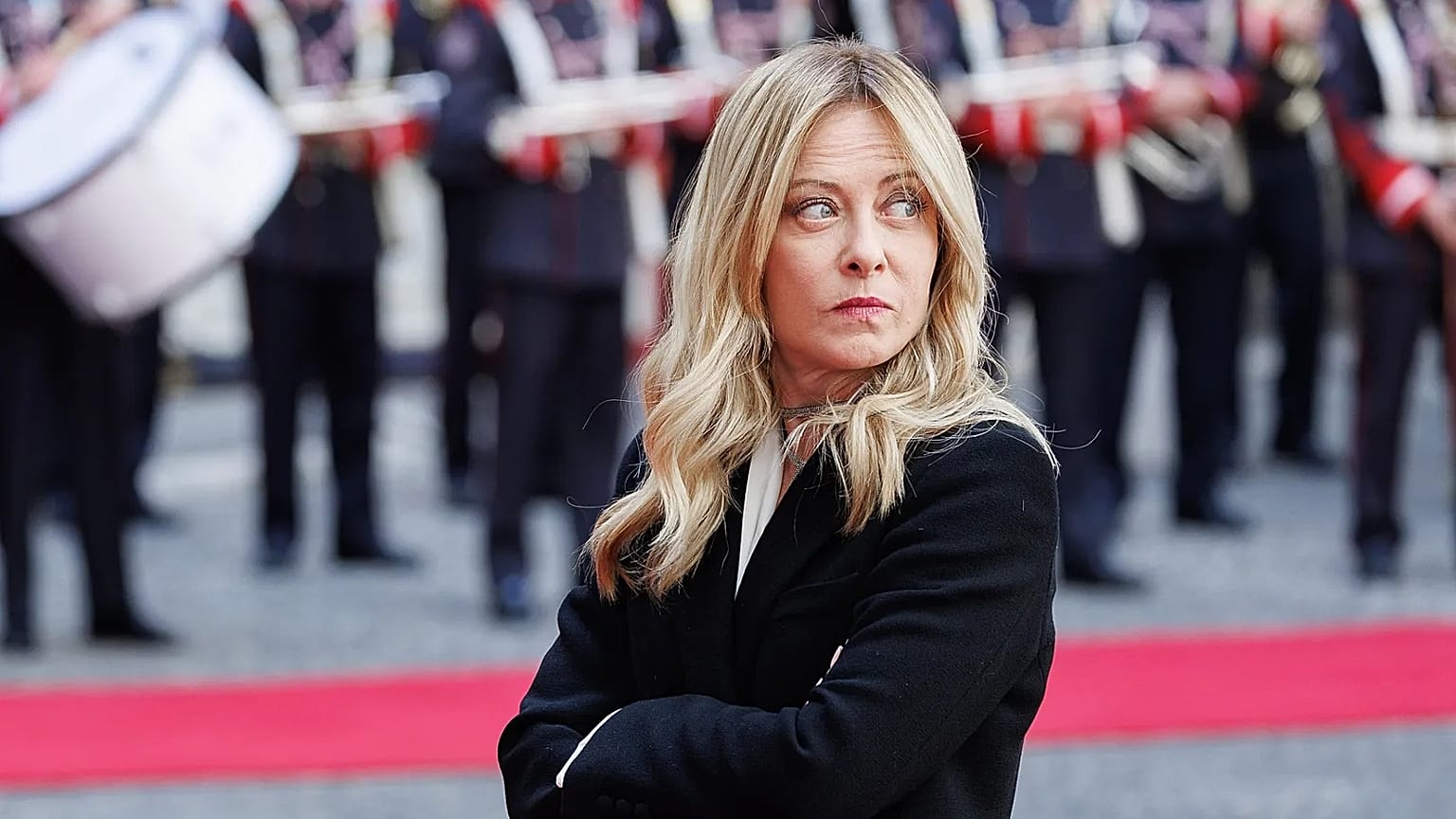
Italian Prime Minister Giorgia Meloni, a long-time Trump ally, has taken exception to Trump’s comments about the pope.

Trump in return criticised her as his ire against NATO allies expands over what he sees as a lack of support for his country’s war efforts, most recently with the Pentagon announcing plans to pull thousands of troops out of Germany in the coming months.

US President Donald Trump talks with small business owners in the Grand Foyer of the White House, Monday, May 4, 2026, in Washington
US President Donald Trump talks with small business owners in the Grand Foyer of the White House, Monday, May 4, 2026, in Washington Jacquelyn Martin/Copyright 2025 The AP. All rights reserved.

In response to Trump's latest comments criticising the pope, Italian Foreign Minister Antonio Tajani said in a social media post that they were “neither acceptable nor helpful to the cause of peace.”

“I reaffirm my support for every action and word of Pope Leo; his words are a testament to dialogue, the value of human life, and freedom. This is a vision shared by our government, which is committed through diplomacy to ensuring stability and peace in all areas where conflicts exist,” wrote Rome’s top diplomat.

Rubio, who after this trip will have visited Italy or the Vatican at least three times in the past year, is also expected to meet with Meloni and Tajani on Friday.

World Cup hotel boom may ‘fall short of expectations’, US industry association warns

NRG Stadium in Houston will host seven 2026 FIFA World Cup matches
Copyright AP Photo/Jon Shapley

By Michael Starling
Published on 

A new report by the American Hotel & Lodging Association says anticipated demand ‘has not translated into strong hotel bookings’ and that domestic travellers are ‘outpacing’ international visitors.

With less than 40 days to go until kick-off at the 2026 FIFA World Cup in North America, the build-up is being driven as much by questions over the event's potential tourism impact as by the nations and players who will take centre stage.

Set to be the biggest men’s World Cup in history, with a record 48 teams and 104 matches, this summer’s football extravaganza was billed as a major economic windfall for the host nations.

However, new data released by the American Hotel & Lodging Association (AHLA) suggests the outlook in the United States may be more complex than expected.

In its latest FIFA World Cup 2026 Hotel Outlook, the group warns that anticipated demand “has not translated into strong hotel bookings” and that domestic travellers are “outpacing” international visitors. FIFA room block cancellations, international travel barriers, and rising costs were identified by the AHLA as “key drivers of softened hotel demand”.

According to the report, based on surveys of hoteliers across 11 host cities, 80% of respondents say bookings are tracking below initial projections. While domestic travellers are still filling rooms at typical summer levels, the anticipated surge of international visitors has yet to materialise at scale.

That trend aligns with wider travel data reported earlier this month, which showed global interest in the tournament rising, but unevenly translating into confirmed trips. Analysts have pointed to a growing gap between search demand and actual arrivals, with structural barriers limiting conversion.

At the centre of the issue are visa constraints and geopolitical concerns. Between 65% and 70% of hoteliers surveyed by AHLA identified these factors as the primary impact on international demand. For a tournament that relies heavily on cross-border travel, particularly from Europe and Latin America, this presents a significant challenge.

“Hotels across host markets have spent years preparing for the World Cup, and while there is real excitement, the data points to a more nuanced outlook,” said Rosanna Maietta, President and CEO of AHLA.

Another key factor behind the softer outlook is what the report describes as an “artificial early demand signal” created by FIFA room block allocations. Hotels had initially reserved large volumes of inventory for official tournament use, inflating early expectations. However, roughly half of respondents now report significant room releases back into the market, forcing a recalibration of demand forecasts.

The impact is being felt unevenly across host cities.

In Kansas City, 85% to 90% of surveyed hotels report booking levels below expectations, with demand trailing even a standard summer without major events. Similarly weak signals are emerging in Boston, Philadelphia, San Francisco and Seattle, where many operators describe the World Cup as effectively a “non-event” so far.

In contrast, a smaller group of destinations are seeing tangible gains. Miami and Atlanta are outperforming expectations, buoyed by strong leisure appeal, better air connectivity and confirmed team base camps. These markets, AHLA notes, represent just 25% to 30% of respondents overall.

Major gateway cities such as New York City and Los Angeles sit somewhere in the middle. While bookings are softer than expected, they remain broadly in line with typical summer demand, suggesting the tournament is not yet delivering significant incremental uplift.

Meanwhile, Dallas and Houston report a similar pattern, with around 70% of hotels tracking below World Cup projections despite maintaining steady baseline occupancy.

Maietta believes there is still “meaningful opportunity ahead”, but to fully realise that potential, the US and FIFA must ensure a “welcoming and seamless experience for international travellers”.

She added: “That means avoiding unnecessary cost increases on visas and transportation to and from the games, and discouraging local jurisdictions from adding last-minute tax hikes that hurt the games and consumers.”

While the tourism picture is improving, benefits look uneven across North America. Analysis from Data Appeal and Mabrian, with PredictHQ, shows demand rising at different speeds, clustering in cities like Mexico City, Vancouver and Boston, with air connectivity key to conversions.

Spending may reach $4.3 billion, largely in hospitality, but Oxford Economics says wider gains will be “marginal and short-lived”. Economist Barbara Denham notes much demand will displace existing travel, with smaller cities gaining more than established hubs.


Europe is hungry for AI data centres — but its energy grid cannot feed them

FILE - Fans that are part of a cooling system are seen on the roof of a data center, 27 April 2026, in Hillsboro, Ore.
Copyright AP Photo

By Una Hajdari
Published on 

From decade-long grid queues to facilities running at half capacity, a new study exposes the energy crisis at the heart of Europe's push to boost its AI capabilities.

Every time you ask an artificial intelligence chatbot with a question, somewhere, possibly a continent away, a warehouse full of computers is working hard to answer it and a mind-numbing amount of energy is churned to give you a quick reply.

Data centres, the physical locations that house the supercomputers and associated components that underpin the dramatic increase in AI, are critical in our age of advanced data processing.

But their appetite for electricity is becoming a problem in its own right. These facilities are growing bigger, more numerous and dramatically more power-hungry, and the energy required to run them is scaling just as fast.

The United States currently dominates the global scene with roughly 5,400 facilities compared to around 3,400 across Europe, according to Cloudscene data, and Europe is desperate to close that gap.

The problem is that closing it comes at an enormous energy cost — and the continent's electricity grid is already struggling to cope with existing demand.

A major new study authored by Maria Nowicka at Interface, a European energy and digital policy think tank, highlights just how severe that tension has become.

They warn that without urgent reform, Europe's AI ambitions could end up as costly stranded assets, hoovering up power and public money while being ignored for better options elsewhere.

"Constructing multi-hundred-megawatt facilities that fail to use their contracted capacity effectively would be unsustainable not only economically but also from an energy- and climate-system perspective," the report said.

Electric mega-absorbers

A typical European household uses around 3,600 kilowatt-hours of electricity a year, or roughly 10 kilowatt-hours a day.

The data centre behind your AI assistant can burn through the daily equivalent of tens of thousands of those homes before breakfast.

"The power capacity of top AI clusters is increasing from around 13 MW in 2019 to an estimated 280–300 MW for xAI's Colossus in 2025 — comparable to the demand of roughly 250,000 European households," the report explained.

All this energy has to travel through something, and that something is already under serious strain.

Europe's electricity grid, the vast network of power lines, substations and transmission infrastructure that moves electricity from where it is generated to where it is needed, was not built with AI in mind.

When a single new facility demands hundreds of megawatts at once, it does not suffice to just plug it in. It strains and saps the entire system around it, potentially forcing costly upgrades and crowding out other users competing for the same capacity.

"ChatGPT-4 training reportedly consumed around 46 GWh in total energy — equivalent to a sustained 20 MW draw over three months, and enough to power the entire Brussels Capital Region for over four days," the report continued.

The most advanced models being built now are estimated to consume far more. The International Energy Agency projects that global data centre electricity use will "more than double by 2030, largely due to AI workloads".

Traditional server farms were built around modest, flexible power loads. AI clusters pack specialised chips running at near-maximum intensity for days or weeks at a stretch, behaving, as the report puts it, like "electro-intensive industrial plants connected to constrained grids".

"Grid connection capacity, connection lead times, local congestion, and most recently energy prices, have already become binding constraints, delaying or redirecting large deployments despite initial investment interest," according to Interface.

Will the grid keep up?

Nowhere is this more visible than in Europe's most sought-after data centre markets or what the industry calls the FLAP-D cities, or Frankfurt, London, Amsterdam, Paris and Dublin.

The queues for grid connections have grown so long that they have effectively become a ban on development.

"In the FLAP-D markets... new facilities wait on average 7 to 10 years for a grid connection, rising to 13 years in the most congested primary markets," the report explained.

Ireland has imposed a de facto moratorium on new data centres in Dublin until 2028, while the Netherlands and Frankfurt have effectively banned new connections until at least 2030.

The report noted that OpenAI has been "putting their UK and Norway investments on hold due to high electricity prices," a possible signal that even the world's best-capitalised AI companies are being stopped in their tracks by Europe's energy constraints.

What needs to change

Europe's electricity grid is already contending with the demands of electrifying transport and heating, the uneven rollout of renewables, and what the report calls the risks of "tight gas and power markets," further strained by Russia's invasion of Ukraine and ongoing conflict in the Middle East.

The report recommends that European facilities be integrated into national and EU grid planning from the outset, with siting decisions tied to renewable energy availability.

Piling on hundreds of megawatts of AI infrastructure risks making all of that harder and more expensive.

"The long-term value and acceptability of large AI compute clusters will depend on whether they are conceived, regulated and operated as critical energy infrastructure distinct from traditional data centres," the report concluded.


Meloni slams AI-generated images of herself, calling deepfakes a 'dangerous tool'

Italy's Premier Giorgia Meloni at the Palazzo Chigi in Rome, 16 April, 2026
Copyright https://x.com/GiorgiaMeloni


By Gabriele Barbati
Published on 

Doctored sexualised images of the prime minister have surfaced before, particularly last year on a pornographic website that included altered images of high-profile women.

Italian Prime Minister Giorgia Meloni has slammed fake images of herself generated by artificial intelligence, calling deepfakes a "dangerous tool" that can target and harm anyone.

The far-right leader posted one of the fake AI-generated photos on her social media accounts on Tuesday.

She said the pictures, showing her in scanty underclothes, had been circulating in recent days.

"In these days, several fake photos of me are circulating, generated with artificial intelligence and passed off as real by some zealous opponent," Meloni wrote in a post on X

Meloni also included a reply from a social media user who appeared to have been taken in by the photo, who wrote that the prime minister's appearance in such attire was "shameful and unworthy of the institutional role she holds."

"Check before you believe, and believe before you share. Because today it’s happening to me; tomorrow it could happen to anyone," she said.

Doctored sexualised images of the prime minister have surfaced before, particularly last year on a pornographic website that included altered images of high-profile women.

In response, the government passed a law that criminalised deepfakes that caused "unjust harm" to the person depicted.

In 2024, Meloni sued two men for €100,000 who produced fake videos of the premier which they then posted on a US pornographic website.

Female politicians around the world have increasingly become victims of such AI-generated deepfake pornography or sexualised images.

"Deepfakes are a dangerous tool, because they can deceive, manipulate and target anyone. I can defend myself. Many others cannot," Meloni said.