It’s possible that I shall make an ass of myself. But in that case one can always get out of it with a little dialectic. I have, of course, so worded my proposition as to be right either way (K.Marx, Letter to F.Engels on the Indian Mutiny)
Friday, May 08, 2026
Chart Shows How Trump 2.0 Is ‘Most Brazenly Self-Enriching’ Administration in US History
Buying Trump’s meme coin is like investing in “a pet rock, except you don’t even get a rock” out of the deal, said economist Steve Rattner.
A Donald Trump coin is pictured alongside Bitcoin and various other cryptocurrencies in this photo illustration in Brussels, Belgium, on August 5, 2025. (Photo by Jonathan Raa/NurPhoto via Getty Images)
Since returning to office a little more than a year ago, President Donald Trump has nearly tripled his net worth, driven in large part by investments in his family’s cryptocurrency ventures.
Appearing on MS NOW on Friday morning, economist Steve Rattner broke down how Trump’s net worth has exploded from $2.34 billion in 2024 to an estimated $6.5 billion in 2026.
“So where did the money come from? He had $4 billion, he and his family, of profits,” Rattner said. “$3 billion of it came from crypto, and I will tell you, there are so many transactions here, so many structures, that made my head hurt trying to understand it.”
In addition to the crypto ventures, Rattner pointed to Trump son-in-law Jared Kushner raising money from investors in the Middle East through his investment firm Affinity Partners; increased revenue that came from raising admission fees to his Mar-a-Lago resort; and money he’d obtained from lawsuits against assorted media companies.
Rattner then explained the finances of the Trump meme coin, which he described as investing in “a pet rock, except you don’t even get a rock” out of the deal.
“He sold them initially at $7, it went up to $45, not surprisingly it crashed,” Rattner said.
However, Rattner said that early investors in the cryptocurrency, whom he described as “whale wallets,” managed to profit handsomely from the venture by buying up large numbers of Trump coins and then selling them to retail investors, who were left holding the bag when the coin’s value fell precipitously shortly after its launch.
“Let me just emphasize, it’s not like [the retail investors] got anything,” he added. “All they got, in effect, was like a little note, a little email or something, saying, ‘Congratulations, you own 10 Trump meme coins.’ But there’s nothing they can do with it. They were buying nothing, they were buying air.”
The economist did note that Trump made $600 million in trading fees that investors paid to carry out transactions of the coin.
After his appearance on MS NOW, Rattner posted a photo on social media of a graph he made to document the rise in Trump’s wealth over the last two years.
“[Trump’s] administration,” Rattner commented, “is the most brazenly self-enriching in American history.”
Last year was the deadliest in ICE detention in about two decades, with more than 30 deaths reported in custody. So far this year, at least 18 more detainees had reportedly died in ICE custody. In an aerial view from a helicopter, detainees are seen at Krome Detention Center run by United States Immigration and Customs Enforcement on July 4, 2025 in Miami. (Photo by Alon Skuy/Getty Images)
The US Department of Homeland Security is officially closing its watchdog for immigrant detention abuse, even as reports of excessive force, deadly neglect, and other maltreatment by agency personnel soar under the Trump administration.
Citing an internal email, Huffpost’s Dave Jamieson reported Monday that DHS is shutting down its Office of the Immigration Detention Ombudsman (OIDO), which was established by an act of Congress and signed into law by President Donald Trump in 2020 as part the massive federal spending package known as the Consolidated Appropriations Act.
Jamieson added that the communication said that OIDO “is in the process of removing all its public signage and ending its inspection,” and that the agency’s website was down.
The email attributed OIDO’s closure to a lack of federal funding in the Homeland Security appropriations package that ended the recent 76-day shutdown affecting the agency.
Largely pushed through by congressional Democrats, OIDO was designed to be independent from both US Immigration and Customs Enforcement (ICE) and US Customs and Border Protection. The office was given the power to receive detainee complaints, investigate alleged abuse or misconduct, inspect detention facilities, and report systemic problems to DHS leaders and Congress.
OIDO emerged amid widespread abuse of detained migrants during the first Trump administration, including deaths in custody, family separation, overcrowding, and other mistreatment.
Since returning to office for a second term, Trump has overseen the dismantling of the agency, arguing that it hinders immigration enforcement. The administration’s effort to dilute OIDO’s power have triggered legal action arguing that, since it was created by Congress, the agency cannot be abolished without congressional consent.
DHS detainees—especially those ICE lockups—report abuses including inadequate or delayed medical care; physical attacks and excessive force; sexual abuse and harassment; solitary confinement misuse; overcrowded and unsanitary conditions; intimidation and retaliation following complaints; abuse of pregnant women and children; denial of access to lawyers; denial of family contact; and denial of food, water, hygiene, or medication.
Last year was the deadliest in ICE detention in about two decades, with more than 30 deaths reported in custody. So far this year, at least 18 more detainees had reportedly died in ICE custody.
OIDO isn’t the only DHS watchdog under attack by the Trump administration. The Office of Civil Rights and Civil Liberties (CRCL) and Office of Citizenship and Immigration Services Ombudsman have also been targeted.
One former CRCL employee who was placed on administrative leave due to funding cuts said in a recent court filing that the agency is unable to conduct “meaningful investigations” into alleged civil rights and civil liberties violations committed by its personnel. As an example, they noted the accusations of excessive force by the ICE agent who fatally shot Minneapolis resident Renee Good last year.
“In my experience, investigations into systemic issues like these required significant staff resources, which CRCL no longer has to devote to these important issues of civil rights and civil liberties,” the official told Federal News Network earlier this year. “Nor does CRCL have the resources to conduct multidisciplinary onsite investigations at detention facilities, the need for which is greater than it has ever been as both the number of detention facilities and number of people detained has skyrocketed.”
Report Details How Post-9/11 Legal Policies Laid Groundwork for Trump ‘Terrorizing Migrants’
A legal expert explores how the administration is “weaponizing the law... to effectuate a widespread harassment and mass deportation campaign that is more akin to ethnic cleansing than routine immigration enforcement.” US Immigration and Customs Enforcement agents detain a man outside of his home in Saint Paul, Minnesota on January 27, 2026. (Photo by Madison Thorn/Anadolu via Getty Images)
President Donald Trump’s taxpayer-funded mass deportation campaign has tormented communities across the country with militarized federal agents, killed immigrants and US citizens alike, abused demonstrators and detainees of all ages, and sparked fears of an expansive effort to strip citizenship from Americans.
The “Terrorizing Migrants” report released Tuesday by the Costs of War Project at Brown University’s Watson School of International and Public Affairs details how Trump’s xenophobic campaign reflects “specific law and policy options created and strengthened among all three branches of the US government, on a bipartisan basis, since 9/11.”
“These law and policy options place heightened unchecked discretionary authority within the administration, and are particularly ripe for abuse against noncitizen persons of color by immigration authorities, law enforcement agents, and other executive branch officials,” wrote Widener University Delaware Law School assistant professor Elizabeth Beavers, author of the report.
The publication focuses on five key post-9/11 precedents borrowed from the “War on Terror,” though it acknowledges that “the Trump administration is relying on laws and policies far beyond those described in this paper to effectuate its broader anti-immigrant agenda, and justifying much of it in national security language.”
The first of the five precedents is “conflation of immigration enforcement and counterterrorism.” The report recalls that after the 2001 terrorist attacks, the Federal Bureau of Investigation “orchestrated a mass investigation” that “exclusively targeted Arab, Muslim, and South Asian immigrants in a dragnet roundup, subjecting them to secretive detention at locations inside the US,” and holding many of them “for weeks or even months without any charges at all.”
Beavers also pointed to the George W. Bush administration’s launch of the National Security Entry and Exit Registration System, as well as the creation of the US Department of Homeland Security and the placement of Immigration and Customs Enforcement within DHS. ICE and Customs and Border Protection agents have been key to Trump’s campaign.
The Muslim ban from Trump’s first term “built upon the structures that came before it, but greatly expanded legal presumptions that people of particular races, religions, and nationalities carry inherent danger,” Beavers wrote. His second term policies have “extended this precedent to its logical conclusion by framing migration itself as terrorism. And nearly 25 years after its post-9/11 creation, ICE has been unleashed and empowered to roam American streets, snatching and disappearing people they perceive as unlawfully present, often based solely on race, and often without verifying their immigration status.”
The second precedent Beavers explored is “expanded and politicized ‘terrorist’ designation lists.” She noted Trump’s invasion of Venezuela and abduction of its president, Nicolás Maduro, as well as his boat-bombing spree allegedly targeting drug traffickers in international waters.
The expert also dove into “deporting people as ‘terrorists’ without proving actual violent conduct,” flagging Trump’s “reverse migration” pledge after an Afghan man allegedly shot two National Guard members in Washington, DC, along with the administration’s decision to “hold and review” asylum applications for people from “high-risk” countries.
That review, she warned, “could result in mass removal from the country of ‘terrorist’ noncitizens who involuntarily paid money to cartels at some point in their lives, whose family remittances have crossed hands with cartel-controlled actors, who have family members or other connections to a designated cartel but no involvement themselves, or who have unwillingly been pressed into service of a cartel at some point.”
The fourth precedent examined in the analysis is “indefinite detention, torture, and rendition of noncitizens.” Beavers began the section with the detention camp at US Naval Station Guantánamo Bay in Cuba, which she called “perhaps one of the most notorious features of the US government’s post-9/11 ‘War on Terror.’”
“It is both a place where every post-9/11 president has detained Muslim men in connection with the post-9/11 counterterrorism wars, but it is also a place where unauthorized migrants are sometimes held,” she wrote. “More than 700 migrants have been sent to and from Guantánamo in President Trump’s second term, detained there by ICE with support from the military.”
The expert also highlighted Trump’s deportation of hundreds of men to El Salvador’s infamous Terrorism Confinement Center (CECOT)—based on often dubious claims that they belonged to the gang Tren de Aragua, which the president designated as a terrorist organization—as well as the “practice of disappearing people into secretive immigration detention” within the United States, and reports indicating that “abusive treatment in those facilities may amount to unlawful torture.”
The final precedent Beavers explored is the “anti-democratic concentration of executive national security powers.” She wrote that “the second Trump administration has made prompt use of this latitude” from federal courts since 9/11.
“This has included: manipulating the ‘terrorist’ designation lists in novel ways to include drug cartels without needing court approval, which has expanded the scope of people who can be deported as ‘terrorists’; claiming a maximalist version of its immigration powers, daring courts to intervene; invoking the state secrets privilege to avoid accountability in cases challenging its deportation orders; and indefinitely detaining and torturing migrants,” Beavers continued. “They have taken each of these actions without fear they will be meaningfully held accountable in court.”
Based on her review, the professor concluded that “indisputably, administration officials are weaponizing the law in new and particularly indefensible ways to effectuate a widespread harassment and mass deportation campaign that is more akin to ethnic cleansing than routine immigration enforcement.”
“Neither Congress nor the courts have meaningfully checked presidents or held them accountable for their expansive and spurious claims of war authorities, national security powers, and counterterrorism mechanisms to justify harmful and discriminatory practices against noncitizens and especially against people of color,” she stressed. “In these and many other ways, US policymakers on a bipartisan basis built and sharpened the legal weapons that President Trump is now utilizing against immigrants.”
‘The Creep State Is Watching’: Guerilla Art Project Takes on Big Tech’s Power Grab
“These people and these companies need to continue to be exposed for all of the harm that they’re causing and the real power that they have over our government and those governed,” one organizer said.
Posters of Elon Musk and Bill Gates are seen in Seattle. (Photo via Creep State)
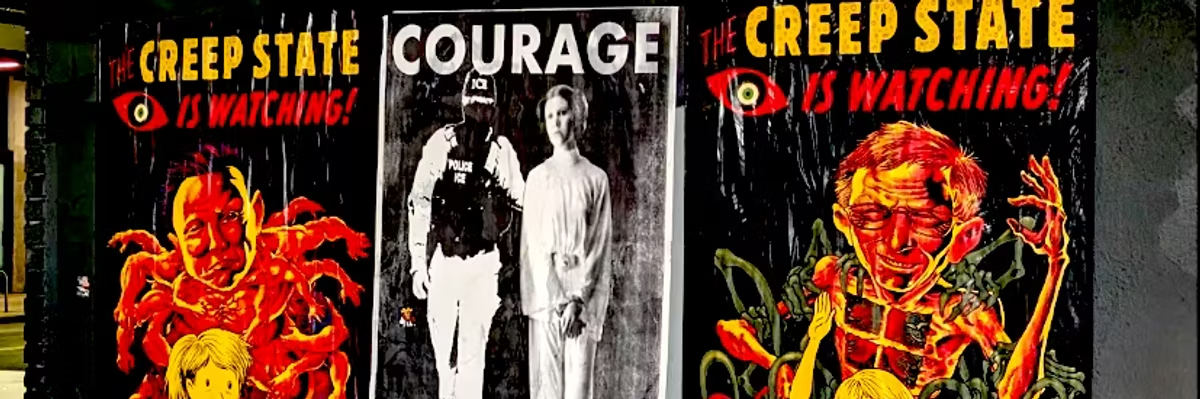
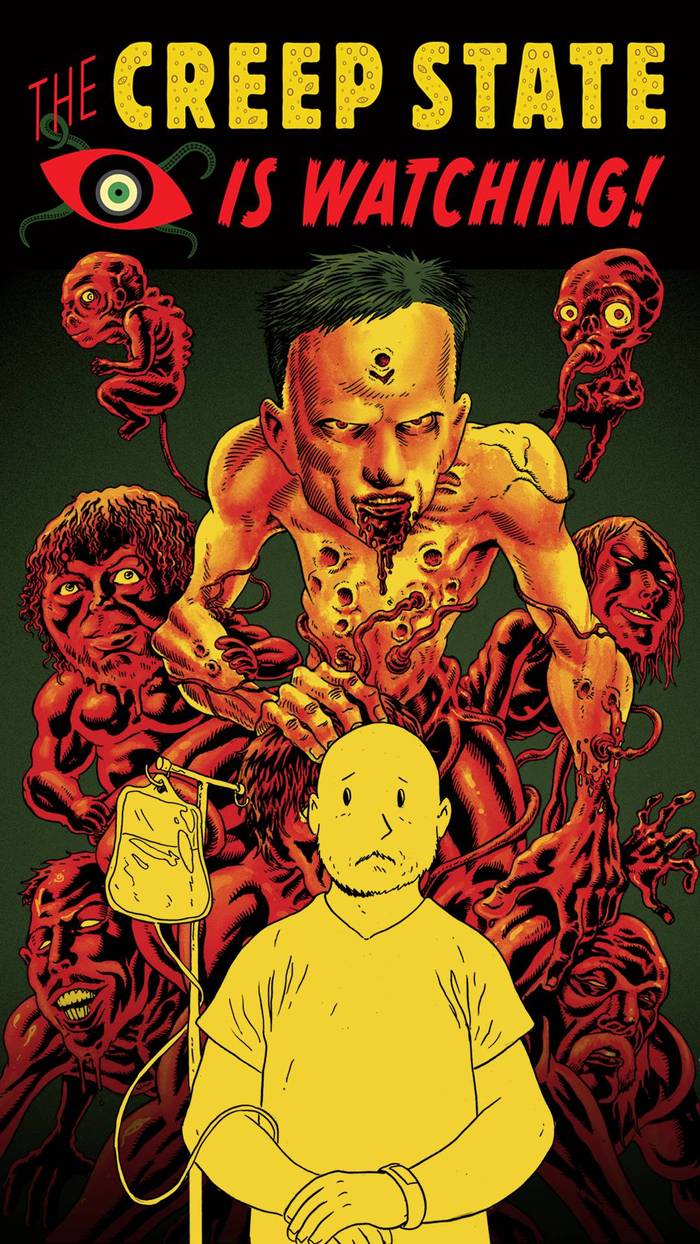
On their way to attend the Met Gala on Monday night, guests might have spotted a different image of Amazon founder Jeff Bezos than the one he tried to project by chairing the annual fundraiser: a poster featuring his bulbous head, looming over them out of the darkness, attached to a muscular spider-shaped body. Above it, a mysterious message: “The Creep State is watching.”
What does it mean?
The Creep State is an anonymous guerilla art and protest project that debuted in Austin, Texas during South by Southwest earlier this year. It is designed to draw people’s attention to the threat posed by Big Tech billionaires and their increasing influence over both the US government and the daily lives of everyone who interacts with their products.
“These individuals are a danger to all of us,” a DC-based organizer said.
What Is the Creep State?
The Creep State image of Jeff Bezos is shown. (Photo via Creep State)
The idea for the Creep State came from the desire to raise awareness about certain Silicon Valley oligarchs and their anti-democratic actions and aspirations. Participants in the project who spoke to Common Dreams asked to remain anonymous in keeping with the guerilla-style tactics of their effort.
“There’s what is really a very small group of men who control these algorithms, who control the software, the hardware, and.. they are trying to initially infiltrate our government and eventually replace our government,” a Seattle-based organizer explained. “They’ve all been pretty clear about, you know, some version of, you know, a company town run by a CEO king.”
The project’s designers wanted to convey that “these specific individuals have very nefarious and creepy goals, and they are personally creeps,”—hence, the “creep state” framing.
“Whatever you do, see, hear, touch, say, feel, believe, dream, the Creep State is watching.”
Currently, the project consists of a physical and digital element.
Volunteers wheatpaste posters of seven Silicon Valley kingpins—Jeff Bezos, Elon Musk, Mark Zuckerberg, Sam Altman, Peter Thiel, Bill Gates, and Marc Andreessen, drawn in cartoon style as B-movie monsters—in major US cities. To date, the images have been displayed in Austin, Seattle, DC, Palo Alto, the area around the Met Gala in New York, and Los Angeles, with more to come.
The posters include a QR code that leads to a website, including a video highlighting how these moguls’ companies and products are already monitoring people’s daily activities, from surveillance pricing to sleep tracking.
“Whatever you do, see, hear, touch, say, feel, believe, dream, the Creep State is watching,” the video declares, before concluding: “We’re fighting back.”
“These people and these companies need to continue to be exposed for all of the harm that they’re causing and the real power that they have over our government and those governed,” the DC-based organizer said.
‘People Versus the Machines
The Creep State image of Sam Altman is shown. (Photo via Creep State)
While there have been many different campaigns and critiques calling out Big Tech and the rise of AI in recent years, the creators of the Creep State took an artistic approach partly to grab people’s attention, to make something that “quite literally visually shocked people out of the normal way that they think about and talk about these guys,” as the Seattle-based organizer put it.
They added that they wanted a viewer’s first response upon seeing the art to be, “Woah!”
So far, it seems to be working.
When the art went up in Seattle ahead of the No Kings protest on March 28, “people walking by stopped and took pictures and were like, ‘Whoa, what is this about? Oh my God, is that Jeff Bezos? Whoa, is that Bill Gates?’” the Seattle organizer said.
A member of the team who put the posters up in DC on April 18 similarly recalled: “We had a young woman come up to us and ask us about the Creep State and said she was glad we were exposing these guys. She said she was from [Prince George’s] County in Maryland and was part of the movement to stop data centers there.”
“Fundamentally the question that we face is will we allow one or a few of these corporations to literally remake our society?”
The project’s designers see themselves as operating within a tradition of guerilla art against the powerful from Banksy, Favianna Rodriguez, and Shepard Fairey’s OBEY posters to student protests against Slobodan Milošević in Serbia in the 1990s and the FeesMustFall campaign in South Africa in the 2010s. However, the project—which made a point of working with actual human creators, including a screenwriter, comic book artist, and graphic designer—takes on extra resonance in an age in which AI slop clogs up social media feeds and threatens to put creative workers out of a job.
“This is very much a people versus the machines kind of thing,” the Seattle-based organizer said. “Are we going to be a society where human creativity and human inspiration and human thinking are valued, or are we going to be a world where.. we’re all plugged into a screen?”
Bipartisan Appeal
The Creep State image of Peter Thiel is shown. (Photo via Creep State)
As the project uses an artistic approach to hook people who might otherwise ignore its messaging, it also crafts that messaging in an attempt to appeal to people who might not always agree politically.
The name “Creep State” was chosen in part for its similarity to “deep state,” which is often used on the political right to describe hidden actors undemocratically controlling the federal government. Some of the headlines highlighted in the introductory video were also selected to appeal to right-leaning viewers. (“Prayer apps: is AI playing God?” one reads.)
“Our assessment here is that we may have, and we very much do have, some very deep disagreements in a variety of ways with the right wing. But there is a very real grassroots right-wing opposition to the Silicon Valley takeover of our economy and our democracy. And we want to make sure that this is a campaign that different types of folks can see themselves reflected in,” the Seattle-based organizer said.
“Once they’re burrowed in, it’s going to be very difficult to root them out.”
Indeed, the rise of AI and the hyperscale data centers it relies on seems to have, at least so far, bypassed the usual culture war divides. As communities across the country have mobilized against the data center buildout, “you’ve got DSA people linking arms with, you know, like ultra-MAGA folks,” the Seattle organizer added.
The numbers reflect this, with around 50% of both Republicans and Democrats now saying they are more concerned than excited about AI and 55% of the politicians opposing data centers, which are often located in red states, being Republicans.
The embrace of AI and its Silicon Valley pushers may be one wedge between President Donald Trump and some of his supporters, as 75% of 2024 Trump voters think that AI should be regulated while the president himself has thrown his weight behind a plan to prohibit states from regulating AI at all.
Indeed, even as the Creep State’s developers reach out to Trump voters, they are clear that the Trump administration itself has escalated the Big Tech takeover of the US government, upping the urgency of their project.
Even before Trump was elected a second time around, Silicon Valley enabled his rise. Bezos sunk The Washington Post’s endorsement of his rival Kamala Harris, while Musk donated more than a quarter billion to back Trump’s campaign. His Vice President JD Vance is a protege of Thiel, who has backed Trump since 2016.
Trump has repaid these Big Tech executives handsomely with access, money, and his deregulatory push. The DC-based organizer said they were partly inspired to get involved with the Creep State project after witnessing the havoc wreaked by Musk’s Department of Government Efficiency, which cut funding for essential grants and may lead to the deaths of over 14 million through the shuttering of the US Agency for International Development. At the same time, tech billionaires have increased their profits by contracting with the government, enablingdeportations via Immigration and Customs Enforcement and both surveillance and targeting via the Pentagon.
Yet the Seattle-based organizer said that some Trump supporters “are beginning to realize… that these guys don’t care about Trump. Trump is a vehicle for them. And, you know, once they’re burrowed in, it’s going to be very difficult to root them out.”
‘We’re Fighting Back’
The Creep State image of Mark Zuckerberg is shown. (Photo via Creep State)
Ultimately the goal of the Creep State project is to plug everyone who sees and responds to the art—whatever their politics—into the growing movement to push back against the Big Tech power grab.
“The more we can expose these actors, it can inspire people to… organize against them, demand… oversight and regulations over AI and the influence that these individuals have on their politics,” the DC-based organizer said.
People who scan the QR code can be funneled into future wheatpasting sessions (which are all volunteer efforts) or local fights related to tech policy. One hope the organizers have is that communities across the country who are fighting data center construction or Flock camera expansion could order posters from the site that would have their QR codes adjusted to direct viewers to the local struggle.
“If we can plug people into some of those fights with organizations and for them to get more deeply involved, we’d love to do that,” the DC organizer said.
The Seattle organizer concluded, “Fundamentally the question that we face is will we allow one or a few of these corporations to literally remake our society?”
They continued: “We’re all living through this polycrisis. The climate is collapsing, the economy is in tatters, we’re at war abroad. There’s something new and crazy every day, and it’s hard to break through to people. So the hope is that this art specifically, in this way of highlighting both the like political creepiness and the personal creepiness of these guys, can maybe shock some people who otherwise are just trying to get through their day into, ‘I need to do something.’”
A Four-Word Response for Those Upset With Jeff Bezos for Any Number of Reasons: ‘Tax the Damn Rich’
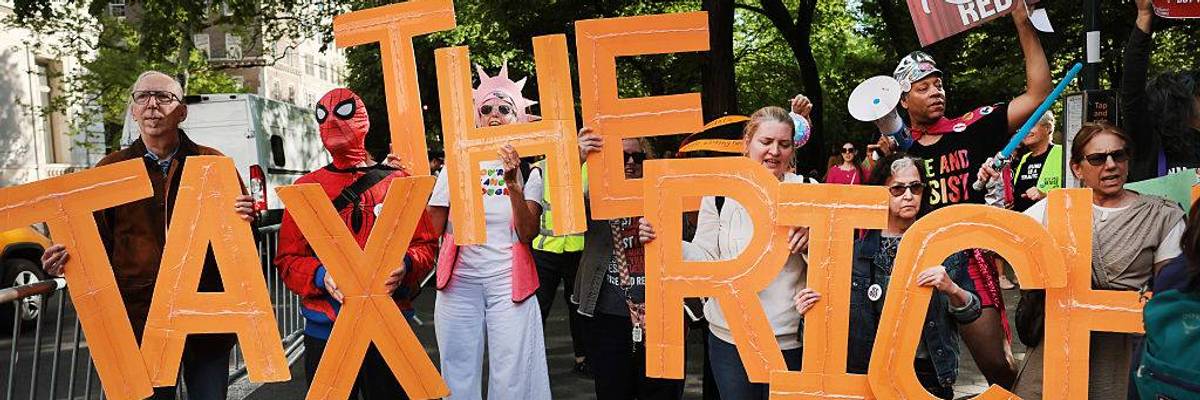
Sen. Bernie Sanders noted that the billionaire spent $10 million on the Met Gala, $120 million on a penthouse, and $500 million on a yacht while “planning to throw 600,000 Amazon workers out on the streets and replace them with robots.” Protesters gather blocks away from where the Met Gala is being held in Manhattan on May 4, 2026 in New York City. (Photo by Spencer Platt/Getty Images)
Amazon founder Jeff Bezos in recent weeks has come under fire for a wide variety of reasons, including his involvement with the 2026 Met Gala and his plans to build a robot workforce.
A Monday report from The Hollywood Reporter noted that Bezos, despite being a lead sponsor of this year’s Met Gala, did not make an appearance at the event’s red carpet as he had in past years.
Bezos’ sponsorship of the Gala has been hit with heavy criticism in recent weeks, as many activists slammed the New York Metropolitan Museum of Art for taking the tech mogul’s money despite his company’s labor practices and reported involvement in helping US Immigration and Customs Enforcement (ICE) operations.
According to The Hollywood Reporter, other critics “accused the billionaire of buying influence with the major event and speculation swirled that some stars may boycott the event due to his involvement.”
In addition to not appearing at the Met Gala red carpet, Bezos is reportedly trying to lower his profile by selling his $500 million luxury yacht.
The New York Post reported on Monday that Bezos has decided that the 417-foot vessel has become “too recognizable,” and is also a headache to maintain, costing an estimated $30 million per year to operate.
‘Worst Conceivable Representative’: Inequality Opponents Condemn Bezos Sponsorship of Met Gala
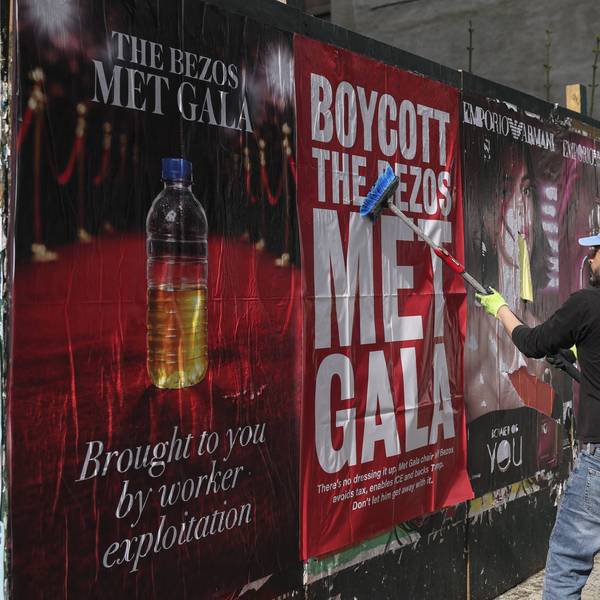
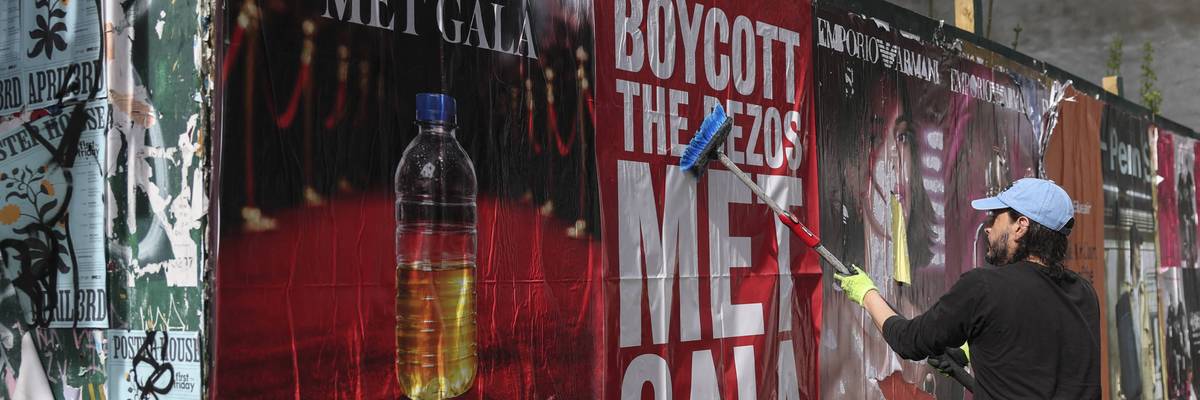
“It’s a thin line between celebrating glamor and artwashing extreme wealth,” said the Tax Justice Network. A person puts up “Boycott the Bezos Met Gala” posters in New York City on April 15, 2026. (Photo by Angela Weiss/AFP via Getty Images)
As celebrities prepared to attend the 2026 Met Gala at the Metropolitan Museum of Art in New York on Monday, a coalition of nearly three dozen civil society groups warned that with Amazon founder Jeff Bezos—currently the fourth-richest person on Earth—chairing the annual fundraiser, the gala risks “artwashing the harms of extreme wealth.”
Groups including Greenpeace International, Patriotic Millionaires, and War on Want signed a letter organized by the Tax the Superrich Alliance, calling on the museum and Vogue magazine, which hosts the event, not to honor Bezos and warning that the billionaire is using the two cultural institutions as tools “to launder his public image.”
The Metropolitan Museum of Art has a celebrated collection of art spanning centuries, many of it made “in defiance of power—work that exposed injustice, gave voice to the silenced, and held the powerful to account,” reads the letter.
But the tech mogul chosen to chair the gala “has made his loyalties clear” since President Donald Trump first took office in 2017 and during the Republican’s second term, said the groups, pointing to Bezos’ purchase of The Washington Post, the mass firing of hundreds of the newspaper’s reporters this year, and his remaking of the publication’s opinion section into one focusing on “free markets.”
He “gutted” the Post “while reportedly pouring $75 million into a film promoting Melania Trump,” reads the letter, referring to the Amazon-produced documentary film Melania.
“A 2% wealth tax on just three necklaces previously worn by celebrities to the Met Gala’s red carpet could fully fund New York City’s home energy assistance program, helping 1 million households heat and cool their homes.”
“He is not just a bystander to Trump’s administration,” wrote the organizations. “He is one of its enablers. This is not philanthropy. This effectively is influence bought and paid for by Bezos’ pocket change—and the Met Gala is his latest purchase.”
The groups added that in addition to aligning himself with the White House through his ownership of the Post, Bezos and Amazon—a government contractor where he is still the largest individual shareholder—is working with Trump to “make possible a concentration of power that not only threatens lives in the US but across the world as well.”
“While so many of these policies aren’t new, they have been exacerbated under Trump and with the help of people like Bezos—from families torn apart by ICE [US Immigration and Customs Enforcement] raids reportedly enabled by Amazon’s own technology, to a White House emboldened to threaten and carry out military action against sovereign nations without consequence—including to ‘destroy a whole civilization’ in Iran—with no accountability,” reads the letter.
The Tax Justice Network, one of the signatories, emphasized that just a fraction of the money that goes to the $100,000-per ticket Met Gala could alleviate the economic inequality that’s grown worse under the Trump administration.
“A 2% wealth tax on just three necklaces previously worn by celebrities to the Met Gala’s red carpet could fully fund New York City’s home energy assistance program, helping 1 million households heat and cool their homes,” said the Tax Justice Network, citing its analysis released Monday.
Bezos is among the billionaires who have contributed donations to Trump’s pet projects—a luxury ballroom and a 250-foot-tall arch in Washington, DC—while the president has tried to cut the home energy assistance program, said the group.
“There’s a thin line between celebrating glamorous fashion and artwashing extreme wealth, and that line gets bulldozed when your poster boy is an ICE-profiteering billionaire bankrolling Trump’s vanity projects and a top spender on anti-worker lobbying,” said Alex Cobham, chief executive at the Tax Justice Network.
In the first two hours of the Met Gala, Cobham added, “Bezos’s wealth will grow by the equivalent of 130,000 hours of a teacher’s labor... This extreme distortion throws economies out of whack. Our economies are supposed to let people earn the wealth they need to lead secure and comfortable lives, but most countries’ tax rules make it easier for the superrich to collect wealth than for the rest of us to earn it.”
“In Bezos’ case, it’s easy to see how that undertaxed collected wealth goes towards lobbying further against workers’ rights and pay, while his company Amazon remains one of the biggest recipients of US subsidies,” said Cobham.
According to the Tax Justice Network’s analysis, Bezos accumulated $3.8 million every house from 2023-25, when his total wealth grew by more than $100 billion.
“If Bezos were to continue to accumulate wealth at this rate,” said the group, “he would accumulate $7.6 million in the first two hours of the Met Gala event, which is the equivalent of 110 NYC Public Schools teachers’ starting salaries”—$68,902.
Those organizing the gala can and must “stop celebrating those destroying our countries and humanity itself,” reads the letter sent by the Tax the Superrich Alliance, by not honoring Bezos and backing the fair taxation of the wealthiest households and corporations.
“End the oligarchy,” reads the letter. “Tax the super rich. Now.”
New York City Mayor Zohran Mamdani, a proponent of taxing the rich to pay for crucial public programs and services, planned to skip the Met Gala in a break with tradition. Last month Mamdani announced plans for a tax on second homes valued at $5 million or more in New York City.
Celebrities who are reportedly planning to skip the event include Palestinian-American model Bella Hadid, who has spoken out against ICE and in favor of Palestinian rights, and actress Zendaya.
Sen. Bernie Sanders (I-Vt.) on Tuesday argued that Bezos’ lavish spending and his plan to build an army of robots to replace human workers was symbolic of American capitalism in 2026.
“The reality of American life today,” Sanders wrote in a social media post. “Jeff Bezos, worth $290 billion, spent: $10 million on the Met Gala, $120 million on a penthouse, $500 million on a yacht. Meanwhile, he’s planning to throw 600,000 Amazon workers out on the streets and replace them with robots. Unacceptable.”
Warren Gunnels, Sanders’ staff director, similarly made the case that Bezos’ spending spree was yet another argument for raising taxes on the wealthiest Americans.
“Jeff Bezos, who paid $10 million for the Met Gala,” Gunnels wrote, “got $62 billion richer since [President Donald] Trump was elected and spent $500 million on a yacht to sail to his $55 million wedding in Venice to give his wife a $5 million ring because his tax rate is less than 1%. Four words: Tax the damn rich.”
Labor unions, which have long clashed with Bezos over Amazon’s aggressive union-busting tactics, held their own rival “Ball Without Billionaires” on Monday evening to protest the Bezos-funded Met Gala.
As reported by Democracy Now!, the gala featured “Amazon, Whole Foods, Washington Post, Starbucks, and Uber workers” who “walked the runway in looks by immigrant designers.”
April Verrett, president of the Service Employees International Union, said the Ball Without Billionaires was “not just about fashion” but “about power” and “telling the truth that people who sew and care and drive and cook and clean and secure and those that create are the ones who make everything possible.”
Workers at the New York Metropolitan Museum of Art, who earlier this year voted to unionize, registered their own disapproval of this year’s Met Gala, posting a message on Instagram informing followers that “91% of hourly Met staff in our unit earn less than a living wage.”
‘Worst Conceivable Representative’: Inequality Opponents Condemn Bezos Sponsorship of Met Gala
“It’s a thin line between celebrating glamor and artwashing extreme wealth,” said the Tax Justice Network.
Thursday, May 07, 2026
Platner, El-Sayed Embrace Warning That They Are ‘Direct Threat to the US-Israel Relationship’
“I’m Abdul El-Sayed and I endorse this message,” said the US Senate candidate in Michigan.
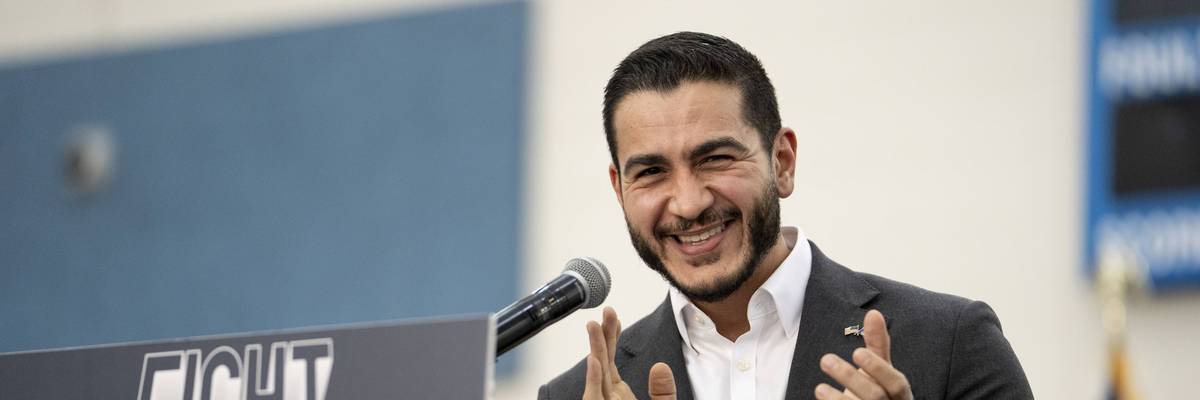
Abdul El-Sayed, candidate for US Senate in Michigan, speaks at a rally at Mumford High School on May 3, 2026 in Detroit. (Photo by Sarah Rice/Getty Images)
Two Democratic US Senate candidates in closely watched primary races found themselves in rare agreement with a powerful pro-Israel lobby group on Tuesday evening after it warned the two progressives posed “a direct threat to the US-Israel relationship.”
“I’m Abdul El-Sayed and I endorse this message,” said the physician and public health advocate running in a three-way race in Michigan, where he recently emphasized at a rally that the American Israel Public Affairs Committee (AIPAC)—the group that issued the warning to voters—has endangered Jewish Americans by promoting the idea that criticizing the Israeli government is antisemitic.
In Maine, combat veteran and oyster farmer Graham Platner, the presumed winner of the June 9 primary following Gov. Janet Mills’ decision to suspend her campaign, said he was also “proud to appear” in AIPAC’s fundraising email, “and many AIPAC fundraising emails to come.”
In its email to supporters, AIPAC said El-Sayed and Platner are the chosen candidates of a “coordinated, well-funded effort to punish anyone who stands with Israel”—one that’s being “driven by the far-left fringe of American politics.”
The group added that the movement is being “pushed” by Sen. Bernie Sanders (I-Vt.)—one of the nation’s most prominent Jewish political leaders and consistently ranked as the most popular member of the US Senate—and “amplified by voices like Hasan Piker,” a Twitch streamer and commentator who has campaigned with El-Sayed.
Piker’s involvement in El-Sayed’s campaign sparked a weekslong controversy, with the other two Michigan Democrats in the race, AIPAC-backed Rep. Haley Stevens and state Sen. Mallory McMorrow, accusing El-Sayed of associating with someone who’s promoted antisemitism and comparing Piker to white nationalist influencer Nick Fuentes. Both El-Sayed and Piker have condemned antisemitism, expressed vehement support for Palestinian rights, and denounced Israel’s US-backed attacks on the occupied Palestinian territories.
In its email, AIPAC doubled down on its claims that El-Sayed and Platner are part of an extremist movement that occupies the fringes of American public life, warning that they’ve embraced “extreme rhetoric, pushed false accusations of genocide, and openly support cutting off aid” to Israel.
But numerous polls in recent months have suggested that Israel’s actions since it began attacking Gaza in October 2023 with US military funding—killing more than 72,000 Palestinians, creating the largest child amputee population in the world, and imposing an intentional starvation policy—have resulted in plummeting approval ratings for the country and its right-wing government, without any help from Sanders, Platner, El-Sayed, or Piker.
Months into Israel’s war on Gaza, cracks in Israel’s popularity among US voters were already beginning to show. In May 2024, a poll by Data for Progress found that 56% of Democratic voters believed Israel was committing genocide in Gaza, and 54% said they supported suspending all US arms sales to Israel until it stopped blocking humanitarian aid.
Public disapproval has only grown more pronounced since then. A Gallup poll showed in February that for the first time, a larger share of Americans sympathized with the Palestinians than with Israel in the Middle East conflict. In March, a survey by Hart Research Associates and Public Opinion Strategies found that just 32% of US voters viewed Israel positively, down from 47% in 2023.
Just before the US helped broker a ceasefire between Israel and Hamas last October—a deal Israel has repeatedly violated, killing hundreds of Palestinians since it was reached—a Washington Post poll found that 61% of Jewish Americans believed Israel had committed war crimes in Gaza and 40% said Israel was guilty of genocide.
At a rally held by Platner and Sanders in September, the political newcomer garnered loud applause when he called for an end to US funding for the Israeli military.
On Tuesday, despite the mounting evidence to the contrary, AIPAC replied to El-Sayed’s “endorsement” of its attack by insisting that many voters want to vote for a candidate “who backs a partnership that delivers for Michigan—more jobs, a stronger auto industry, thriving agriculture, and better healthcare.”
The Medicare for All advocate retorted that he plans to be “a senator who keeps Michigan tax dollars in Michigan to fund schools, healthcare, and roads... in Michigan.”
Recent polls have shown a close race in the state. The most recent survey by the Glengariff Group found Stevens ahead of El-Sayed by just two points, with McMorrow behind six points. A poll by Emerson College, also taken in mid-April, found El-Sayed and McMorrow tied with 24% of the vote, despite the attacks on El-Sayed over his campaigning with Piker.
The Michigan primary is scheduled for August 4.
Billionaire Compares ‘Tax the Rich’ Calls to Hate Speech as Study Finds Barely Half of Americans Earn Living Wage
Vornado CEO Steven Roth was particularly upset by New York City Mayor Zohran Mamdani’s proposed tax on second homes in the city that are valued at $5 million or more.
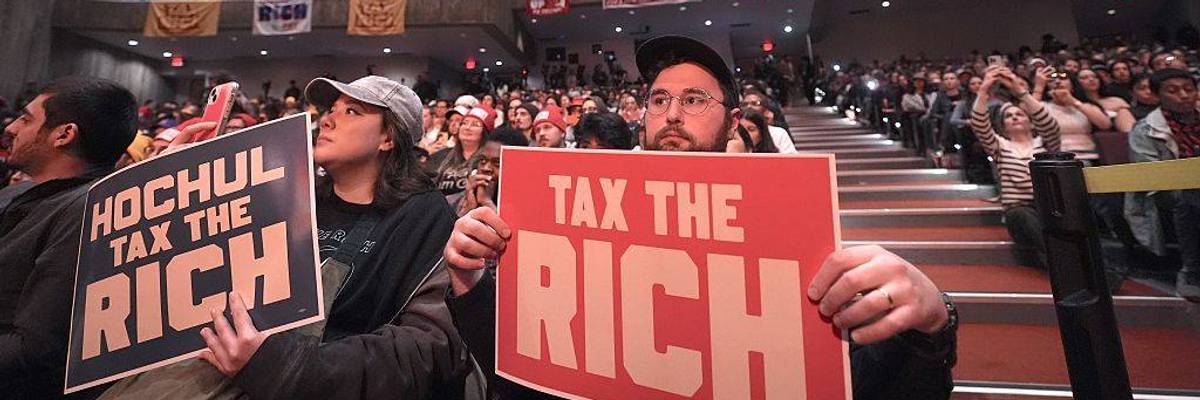
Sen. Bernie Sanders (I-V.) holds a ‘Tax the Rich’ rally at Lehman College in the Bronx, New York City, on March 29, 2026. (Photo by Selcuk Acar/Anadolu via Getty Images)
A real estate investment tycoon on Tuesday said that calls to raise taxes on the wealthiest Americans were akin to “racial slurs.”
As reported by The New York Times, Vornado Realty Trust CEO Steven Roth took time during his company’s latest earnings call to decry calls from politicians such as New York City Mayor Zohran Mamdani to fund public programs by taxing the rich.
“I must say that I consider the phrase ‘tax the rich’... when spit out with anger and contempt by politicians both here and across the country, to be just as hateful as some disgusting racial slurs,” said Roth.
Roth took aim at Mamdani for celebrating a proposed pied-à-terre tax on luxury properties worth more than $5 million whose owners have other primary homes, and was particularly upset that the mayor filmed a video announcing the tax outside a $238 million penthouse owned by Ken Griffin, the CEO of the hedge fund Citadel. He called the announcement “dangerous” and an “ugly, unnecessary video stunt.”
The Vornado CEO went on to say that America’s wealthiest individuals deserve the nation’s gratitude, not their scorn.
“The rich, whom the politicians are targeting... are the epitome of the American dream,” he said. “They are at the top of the great American economic pyramid for a reason. They should be praised and thanked.”
Roth’s remarks drew criticism from Douglas Farrar, former director of the Office of Public Affairs at the Federal Trade Commission under President Joe Biden.
“A billionaire real estate CEO compared being asked to pay taxes to a racial slur, then said the top 1% should be ‘praised and thanked,’” Farrar wrote in a social media post. “There was a time when the wealthy had the good sense to be quiet about it. Now they demand gratitude on earnings calls.”
Activist and healthcare advocate Melanie D’Arrigo noted that Roth build developments in the city after intentionally allowing properties to sit in a state of blight for years, which “gutted Black and brown neighborhoods in exchange for billions in tax breaks.”
Roth’s lamentations about the treatment of the wealthy in the US came as human resources and software services company Dayforce teamed with the Living Wage Institute to release a new study showing that the percentage of Americans earning a living wage has significantly declined over the last five years, from 55.8% in 2021 to 50.7% in 2025.
The report notes that “job growth has recently slowed, and millions of workers haven’t seen a meaningful improvement in their financial situation,” even as “the costs of housing, food, childcare, and other essentials are elevated, energy prices have spiked, and affordability continues to be a major issue for a significant share of the workforce.”
The data in the report all came from 2025, before President Donald Trump launched his illegal war with Iran that has sent gas prices soaring above $4.50 per gallon and is threatening to unleash a global food crisis.
US consumer sentiment as measured by the University of Michigan hit a record low last month, and the university found that the effects of the Iran war were the primary drivers of Americans’ economic pessimism.
Bessent confronted by airline exec over damage Trump is inflicting on industry: WSJ
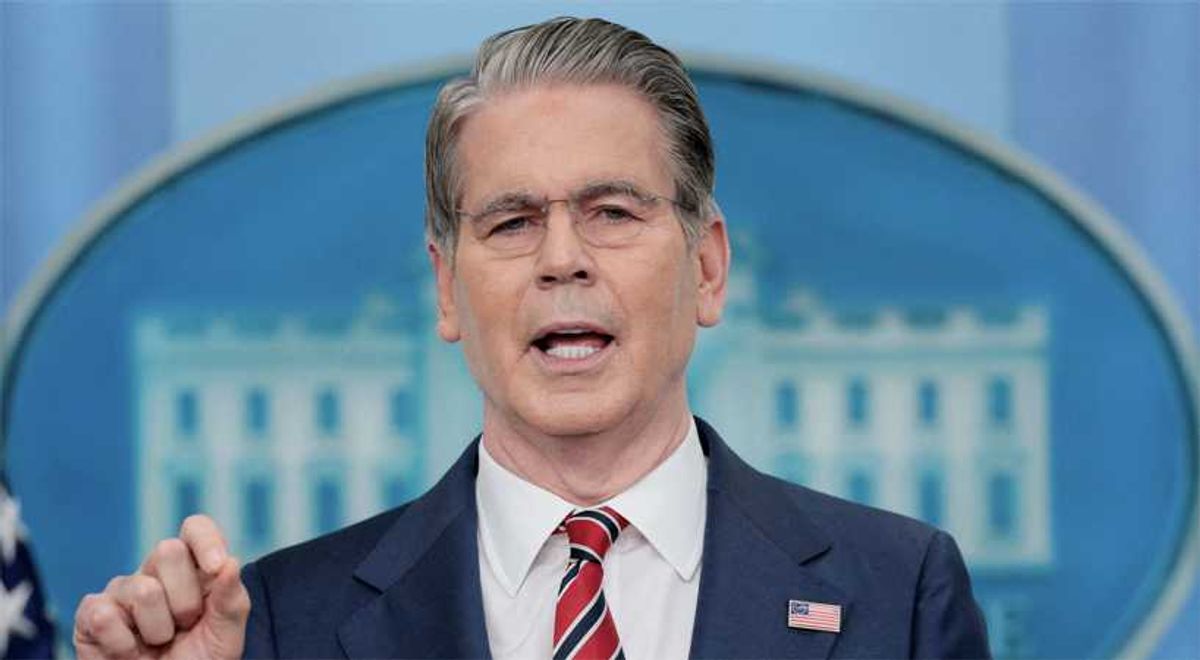
U.S. Treasury Secretary Scott Bessent speaks during a press briefing in the James S. Brady Press Briefing Room at the White House in Washington, D.C., U.S., April 15, 2026. REUTERS/Evan Vucci/File Photo
According to reporting from the Wall Street Journal, former New Hampshire Gov. Chris Sununu, now president of Airlines for America, delivered a stark warning to the Trump administration that jet-fuel costs have become unsustainable.
According to the Journal's Brian Schwartz and Alison Sider, Sununu "delivered a warning to Treasury Secretary Scott Bessent during a recent visit to Washington."
Sununu has spent weeks sounding the alarm to Trump administration officials about the economic fallout from elevated fuel prices, arguing that the war must end soon or conditions will deteriorate further. His message appears to be landing.
Privately, Trump's advisers are said to be growing concerned that Republicans will pay a significant political price for the rising fuel costs ahead of November's midterm elections. Many administration officials are now eager to end the conflict in hopes that prices will moderate before voters head to the polls, the Journal is reporting.
"They get it…and I think that's why they're trying to get through the war as fast as they can," Sununu told the Journal.
Since Trump's initial U.S.-Israeli attack on Iran in late February, Sununu has met in Washington with National Economic Council Director Kevin Hassett, representatives from the Transportation Department, and senior White House officials. A White House official confirmed that Hassett and Sununu have discussed the impact of increased fuel prices on the airline industry and how the sector can blunt the cost for consumers.
However, Sununu cautioned that recovery will be slow. Even after the Strait of Hormuz is fully reopened, ticket prices won't drop immediately. "You're looking at elevated ticket prices through the summer and fall because it takes a while for the prices to go down," Sununu warned.
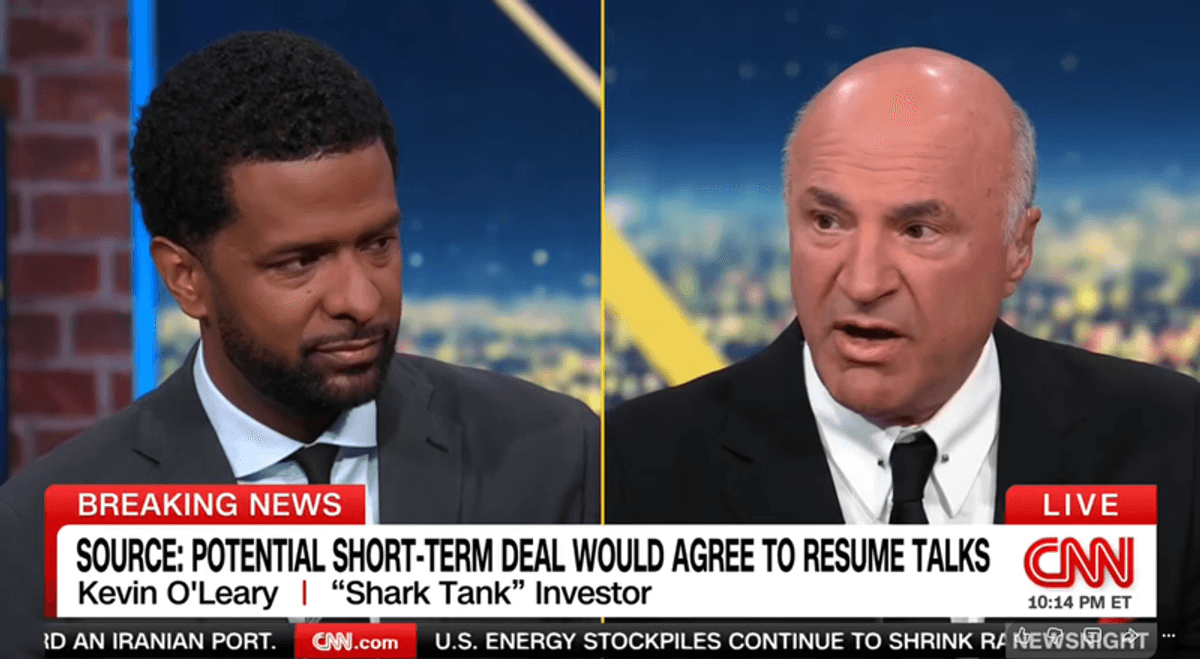
'You just said a bunch of nothing!' Kevin O'Leary sparks uproar on CNN over war costs
Canadian businessman and star of CNBC's "Shark Tank," Kevin O'Leary, sparked an uproar on CNN on Wednesday after he defended the costs of President Donald Trump's war in Iran.
O'Leary argued during a segment on CNN's "NewsNight" with host Abby Phillip that waging the war in Iran is worth the associated costs because it will allow American businesses to sell products in an emerging region, and that the Strait of Hormuz will be policed by another nation in the region. O'Leary added that the short-term rise in oil and fertilizer prices is just part of the deal for Americans.
"I guarantee you two things before this has worked out: the Strait will be open and probably policed by people around that region because it's in their best interest, and secondly, there are no friends in the world left for Iran," O'Leary said.
Bakari Sellers, a political analyst, sharply rebuked the "Shark Tank" star's comments.
"You just said a bunch of nothing!" Sellers said. "Explain to me, right now, somebody who lives in South Carolina, Nebraska, or Ohio, what is good right now for the American public going into a war where you do not understand that they're going to close the Strait of Hormuz. Explain to somebody watching right now where they're from."
"It's been 78 days ..." O'Leary began.
"So you don't have an answer?" Sellers shot back.
As Trump Drives Up Gas Prices and Trashes Economy, US Auto Debt Hits Record High
“Reckless actions on the economy and the expensive fallout from the war in Iran has made it harder for working families to purchase a car and has left millions more feeling major pocket pain at the pump,” one researcher said. Used cars are for sale in Inglewood, California on February 18, 2026. (Photo by Michael Yanow/NurPhoto via Getty Images)
As Americans on Wednesday continued to face the economic fallout of President Donald Trump’s war on Iran, a gallon of gasoline cost $4.536, the average transaction price for a new vehicle was $49,275, and a pair of progressive groups published a report detailing “how surging auto loan debt is hurting households.”
“The costs of purchasing and financing a car have been going up for years,” noted Protect Borrowers senior fellow Tara Mikkilineni, who co-authored the report, “When The Wheels Come Off,” with other experts from her organization and The Century Foundation.
“Unfortunately, the Trump administration’s reckless actions on the economy and the expensive fallout from the war in Iran has made it harder for working families to purchase a car and has left millions more feeling major pocket pain at the pump,” Mikkilineni said. “For millions of working families, a car is not a luxury, it is an essential economic lifeline. Working families deserve relief and they deserve to have a government that is watching out for them, not allowing lenders and auto dealers to rake in record profits at their expense.”
Mikkilineni’s team found that “in recent years, aggregate total auto debt has reached $1.68 trillion, a 37% jump since early 2018, and now comprises the largest volume of outstanding loan debt ever recorded. At the end of 2025, nearly 86 million Americans—roughly 28% of consumers—have outstanding auto loan or lease debt. Residents in states where driving is most necessary, such as Texas, Alaska, Louisiana, and Florida, are struggling with the highest levels of auto debt.”
“Borrowers carrying auto loans see significantly higher and faster credit card balance growth—regardless of income level—suggesting that auto debt cascades into broader financial pressure,” according to the report. Specifically, “between early 2018 and late 2025, credit card balances for middle-income borrowers with auto debt surged by 31%, while those without auto loans saw a notably lower growth of 17%. Borrowers with extended-length auto loans are carrying monthly balances on their credit cards that are 190% of (that is, nearly twice) their monthly income.”
“At the end of 2025, the average origination balance for an auto loan reached $33,519, an amount $10,000 higher than the average in 2018, due to massive increases in the price of even the most basic cars and a shortage of ‘affordable’ car models,” the publication explains. “Borrowers are also facing higher interest rates. Today, the average annual percentage rate (APR) for auto loans is nearly 10%, up from 7.5% in 2018.”
Financially vulnerable borrowers are being hit particularly hard by current conditions. The researchers found that for those with the most limited access to credit, “the average APR is up to 18.7%, which means a six-year loan on a $30,000 car will cost $20,000 in interest alone. Furthermore, Black, Hispanic, and American Indian and Alaska Native borrowers face higher interest rates than their white and Asian counterparts.”
Affordable vehicles are also harder to find these days. Sean Tucker, a managing editor at Kelley Blue Book, told CNBC that “in 2017, [automakers] built 36 models priced at $25,000 or under... Today? Four.”
Tucker said that a “record” share of new cars—over 43%—are now bought by households with incomes of at least $150,000. According to him, “Automakers are serving that market.”
Angela Hanks, another report co-author and chief of policy programs at The Century Foundation, stressed that “for the overwhelming majority of working families, a car is a necessity—yet purchasing a car has become a financial trap, eating up more of people’s paychecks than ever before.”
With so many US communities lacking quality public transit, some US families in need of a vehicle turn to loans with longer terms. The report points out that “for these borrowers, even after taking on these riskier products with additional lifetime costs, auto loan payments are still nearly 20% of their monthly income, meaning nearly $1 out of every $5 they earn will go toward car payments over the seven years of their loan.”
Hanks highlighted that “while families drown” from costly, extended-term loans, “the Trump administration is refunding big businesses for the tariffs that consumers paid, with interest.”
The Trump administration last month launched a portal designed to facilitate refunds for around $166 billion in tariffs that the US Supreme Courtstruck down as unconstitutional, but only businesses that directly paid the import taxes are eligible, even though companies largely passed on the cost hikes to consumers.
Meanwhile, the president responded to the high court’s decision by imposing temporary import taxes, and his administration is pursuing “plan B,” holding hearings required to impose tariffs under Section 301 of the Trade Act of 1974, a different legal authority than the one Trump used last year.
The new report concludes by calling on US policymakers to act: “Amidst the growing affordability crisis, Americans deserve urgent action to bring down costs and rein in profiteering from the dealers and lenders who have been allowed to get away with nickel-and-diming working families for far too long.”
Internet stumped over Trump official's bizarre boast
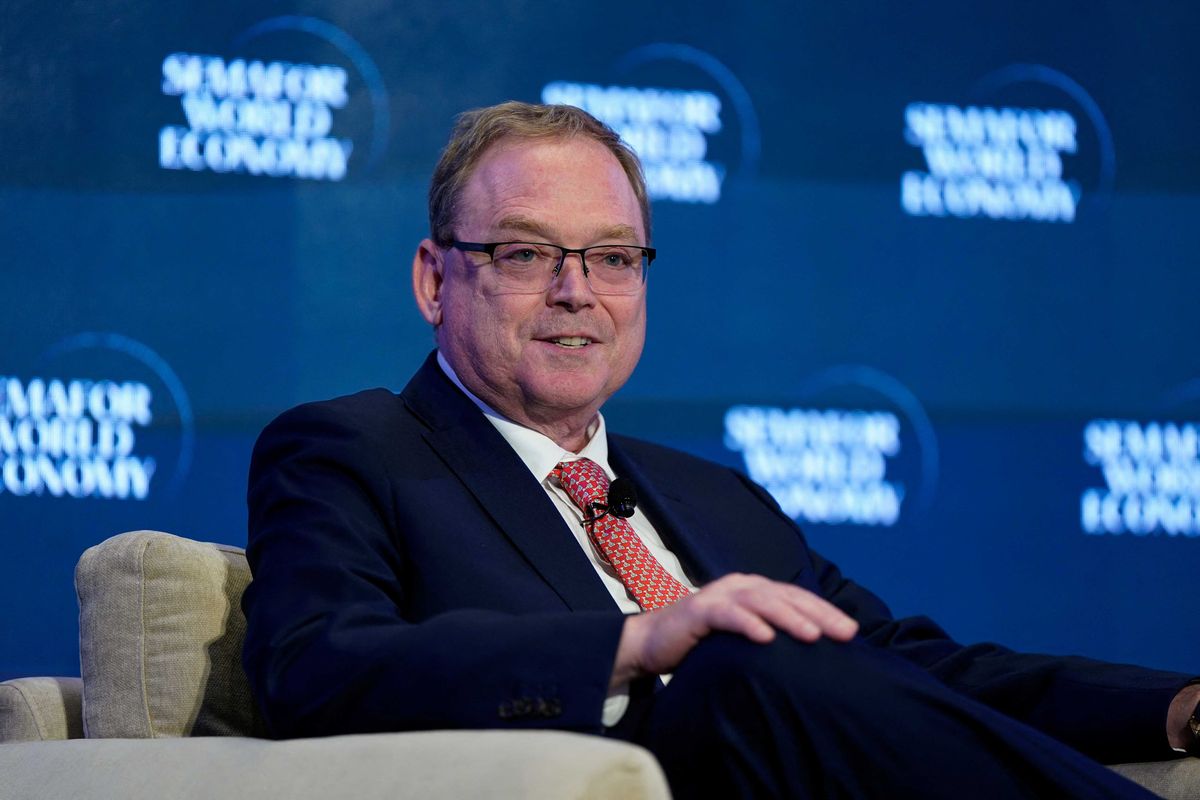
Kevin Hassett, director of the National Economic Council, participates in the Semafor World Economy conference in Washington, D.C., on April 14, 2026. REUTERS/Elizabeth Frantz
The internet was stunned by White House economic adviser Kevin Hassett's comments on Wednesday as he bragged about how credit card spending on higher-priced gasoline was "through the roof."
Hassett made the remarks in an interview with Fox Business on Wednesday morning where he discussed the ongoing Iran war, the continued closure of the Strait of Hormuz and the American economy.
Media experts and political voices were shocked by the comments.
"Is this supposed to be a brag?" Rep. Mark Pocan (D-WI) wrote on X.
"We must consider the possibility that Kevin Hassett is secretly working for the Democrats," Jon Favreau, co-founder of Crooked Media and co-host of Pod Save America, wrote on X.
"Trump’s chief economic advisor is bragging that people are surviving on credit cards right now," MeidasTouch editor-in-chief Ron Filipkowski wrote on X.
"?" New York Times White House correspondent Katie Rogers wrote on X.
"Make this guy the spokesperson for the entire Republican party," House Majority PAC, a Democratic Super PAC, wrote on X.
"Do they understand that this is not a good thing?" Nobel Prize nominee Andrew Gebo wrote on X.
Trump Economic Adviser Boasts That US Consumers Are ‘Spending More on Gasoline’ and ‘Everything Else’
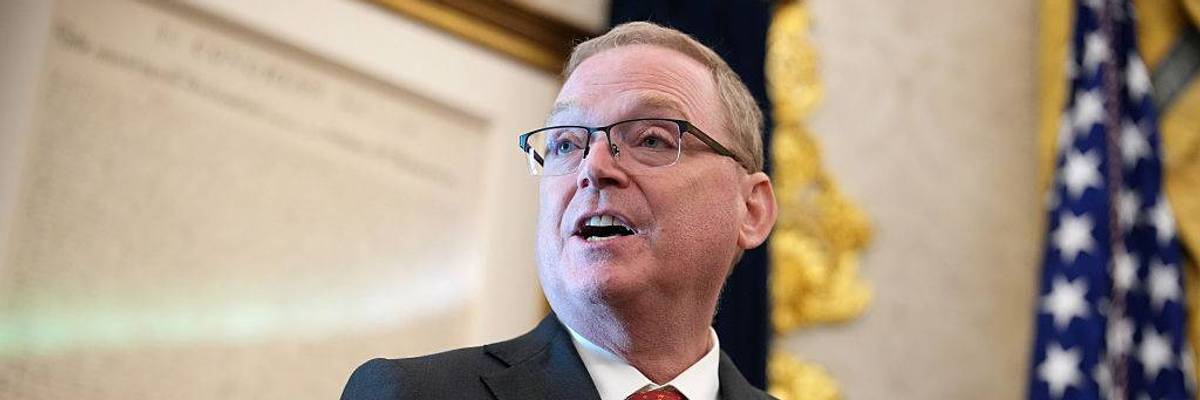
“Is this supposed to be a brag?” said Democratic US Rep. Mark Pocan. National Economic Council Director Kevin Hassett speaks in the Oval Office of the White House on April 30, 2026 in Washington, DC. (Photo by Andrew Harnik/Getty Images)
National Economic Council Director Kevin Hassett on Wednesday tried to put a rosy spin on President Donald Trump’s economy by highlighting the large credit card bills being racked up by US consumers.
During an interview on Fox Business, Hassett cited credit card spending as a purported sign of strength in the economy as a whole.
“I had the head of one of the Big Five banks in my office yesterday, going through credit card data,” he said. “Credit card spending is through the roof! They’re spending more on gasoline, but they’re spending more on everything else too.”
The price of oil has been surging since Trump launched an illegal war with Iran in late February, and on Wednesday the average price for a gallon of gasoline in the US topped $4.50, a high not seen since 2022 in the wake of Russia’s invasion of Ukraine.
As the Iran crisis persists, economists project that the price of energy will be reflected in increases in other consumer goods, most notably food.
Given this, many critics were astonished that Hassett decided to brag about consumer credit card spending as a way to reassure Americans concerned about the economy.
“Working-class Americans are maxing out their credit cards to pay for groceries and gas,” wrote House Minority Leader Hakeem Jeffries (D-NY). “The Trump Cartel thinks this is something to celebrate. Shameful.”
Hassett’s claims about credit card spending also earned a swift rebuke from Warren Gunnels, staff director for Sen. Bernie Sanders (I-Vt.).
“Americans are putting more stuff on credit cards because they don’t have enough money to pay for the skyrocketing cost of virtually everything,” Gunnels wrote. “Trump promised to put a 10% cap on credit card interest rates. Instead, the average credit card interest rate today is 22%. Obscene.”
Fred Wellman, a Democratic candidate for the US House of Representatives in Missouri, could not hide his disgust at Hassett’s performance.
“He’s smiling,” Wellman observed. “He’s celebrating that we are all maxing out our credit cards because they have torched the economy. He’s not smiling for working people. He’s happy for the corporations and billionaires. It’s good for them. We can all die poor. This is why I’m running for Congress.”
Rep. Mark Pocan (D-Wis.) expressed bewilderment at Hassett’s argument.
Jon Favreau, former speechwriter for President Barack Obama and current co-host of Pod Save America, found Hassett’s messaging so tone-deaf that “we must consider the possibility that Kevin Hassett is secretly working for the Democrats.”
The Democratic House Majority Political Action Committee had a response similar to Favreau’s, recommending that the GOP make Hassett “the spokesperson for the entire Republican Party.”

.jpg)




.jpeg)