It’s possible that I shall make an ass of myself. But in that case one can always get out of it with a little dialectic. I have, of course, so worded my proposition as to be right either way (K.Marx, Letter to F.Engels on the Indian Mutiny)
Friday, May 08, 2026
Leaked CIA Analysis Shows Trump and Hegseth ‘Lied Through Their Teeth’ About Iran War, Says Murphy White House officials “just straight up fabricated shit,” said the Democratic senator from Connecticut.
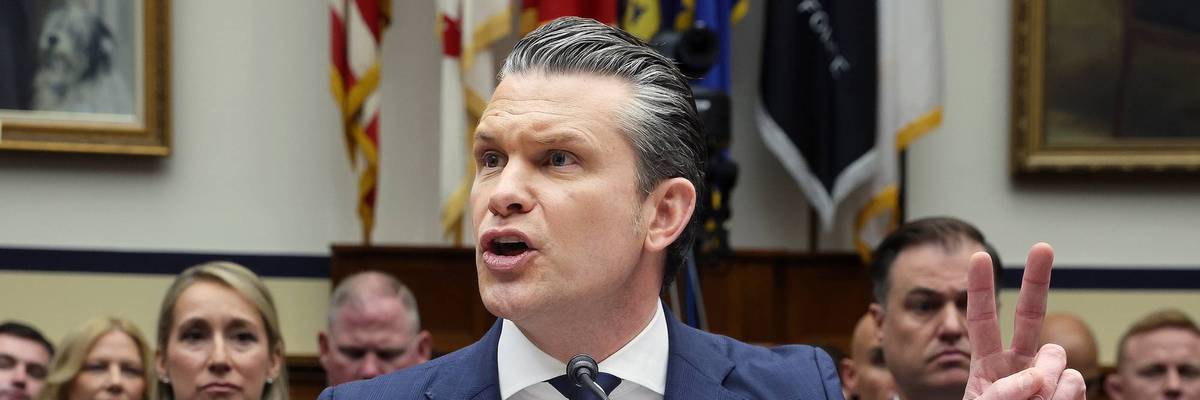
US Secretary of Defense Pete Hegseth testifies before the House Armed Services Committee on April 29, 2026 in Washington, DC. (Photo by Kevin Dietsch/Getty Images)
Just hours before the Trump administration conducted what it claimed were “self-defense strikes” against “Iranian military facilities,” The Washington Postreported Thursday that the Central Intelligence Agency concluded that “Iran can survive the US naval blockade for at least three to four months before facing more severe economic hardship.”
Citing four unnamed officials familiar with the analysis, the newspaper highlighted that “the CIA analysis might even be underestimating Iran’s economic resilience if Tehran is able to smuggle oil via overland routes.”
Militarily, “Iran retains about 75% of its prewar inventories of mobile launchers and about 70% of its prewar stockpiles of missiles,” the Post added. “There is evidence that the regime has been able to recover and reopen almost all of its underground storage facilities, repair some damaged missiles, and even assemble some new missiles that were nearly complete when the war began.”
Drop Site News’ Murtaza Hussain responded that if this assessment along with a previous one from the Center for Strategic and International Studies about “remaining US munitions and interceptor capacity are even approximately correct, it goes a long way to explaining why Trump seems so eager to end the war whereas the Iranians have either dug in or escalated their negotiating positions. The missile math of continuing the conflict would be much more favorable to the Iranians, especially if the war continued for a significant time.”
“Prior to the war, interceptor capacity compared to the size of the Iranian missile stockpile seemed like the most rationally incontrovertible reason to avoid fighting such a conflict, even for people who found it politically desirable,” he added. “This also might explain why the US and Israel pivoted towards the end to threatening countervalue strikes against civilian targets if attempts to destroy the underground missile cities by air were ineffective.”
The Post’s reporting came one month into a fragile ceasefire and starkly contrasts the recent framing of conditions in Iran from President Donald Trump and others in his administration, including Defense Secretary Pete Hesgeth.
Sen. Chris Murphy (D-Conn.) responded to the Post’s reporting by quoting Hegseth, who said in March that “never before has a modern, capable military, which Iran used to have, been so quickly destroyed and made combat ineffective.”
Murphy declared: “They lied through their teeth. Just straight up fabricated shit.”
Still, White House spokesperson Anna Kelly stuck to the administration’s framing in a Thursday statement to the Post.
“During Operation Epic Fury, Iran was crushed militarily,” Kelly said. “Now, they are being strangled economically by Operation Economic Fury and losing $500 million per day thanks to the United States military’s successful blockade of Iranian ports. The Iranian regime knows full well their current reality is not sustainable, and President Trump holds all the cards as negotiators work to make a deal.”
Meanwhile, some experts were unsurprised that the CIA privately delivered a “sober” assessment contradicting the administration’s public commentary on the conflict—which it now claims is no longer an active “war,” seemingly to dodge a key congressional deadline.
“Nice to know that a confidential CIA analysis is confirming what close observers of the Iranian economy have been saying publicly for weeks! Intelligent policymakers rely on intelligence. But Trump jeopardized diplomacy by instigating a blockade that was never going to work,” said Esfandyar Batmanghelidj, an adjunct professor at Johns Hopkins University’s School of Advanced International Studies in Europe and founder of the think tank Bourse & Bazaar Foundation.
Sharing the reporting on social media, Jennifer Kavanagh, a senior fellow and director of military analysis at the think tank Defense Priorities, wrote: “As I argued a week into the U.S. blockade, Iran can hold out for months without economic collapse. The costs for the US and the world are increasingly unsustainable, however.”
Earlier this week, Stephen Semler, a senior fellow at the Center for International Policy, estimated that the US government spent $71.8 billion on the Iran War during its first 60 days, an average of $1.2 billion daily. The International Monetary Fund warned last month that the conflict could cause a global recession.
Last Friday, Trump responded to the War Powers Act’s 60-day deadline by claiming to Congress that his war—which already violated US and international law—had been “terminated.” The White House said at the time that no fire had been exchanged since April 7, when a ceasefire deal was reached just hours after the president issued a genocidal threat against the Iranian people.
However, on Thursday evening, United States Central Command announced that Iran “launched multiple missiles, drones, and small boats” at American warships. CENTCOM added that it “eliminated inbound threats and targeted Iranian military facilities responsible for attacking US forces, including missile and drone launch sites; command and control locations; and intelligence, surveillance, and reconnaissance nodes.”
Expert Puts True Cost of Trump’s Iran War at $72 Billion—Nearly 3 Times Higher Than Pentagon Said
“The $25 billion war cost given by Pentagon Secretary Hegseth and acting Comptroller Hurst before Congress was a lie. It was a denial of the Iran war’s spiraling costs.”

Acting Pentagon Comptroller Jules Hurst and Pentagon Secretary Pete Hegseth testify during a Senate hearing on April 30, 2026. (Photo by Graeme Sloan/Getty Images)
The Pentagon’s official estimate of the direct financial cost of the US war on Iran is a nearly threefold undercount of the actual price tag of the war, according to an expert analysis published Wednesday.
Stephen Semler, a senior fellow at the Center for International Policy, produced the new cost estimate for the Popular Information newsletter. Accounting for armament use, troop deployments, and other factors, Semler estimated that the US government spent $71.8 billion on the Iran war over the course of 60 days—an average of $1.2 billion per day.
“Like the estimates from Pentagon leadership and unnamed officials, this figure refers only to direct war costs—near-term expenses for military operations, munitions, and the like—and not indirect costs, which include broader economic impacts, interest on the national debt, and longer-term expenses like veterans’ care,” explained Semler, who argued that the Pentagon’s $25 billion cost estimate suffers from “incomplete accounting of damaged or destroyed military assets, the exclusion of costs outside the department (including billions of dollars in State Department-funded military aid to Israel), and a flawed method for tracking munition expenditures.”
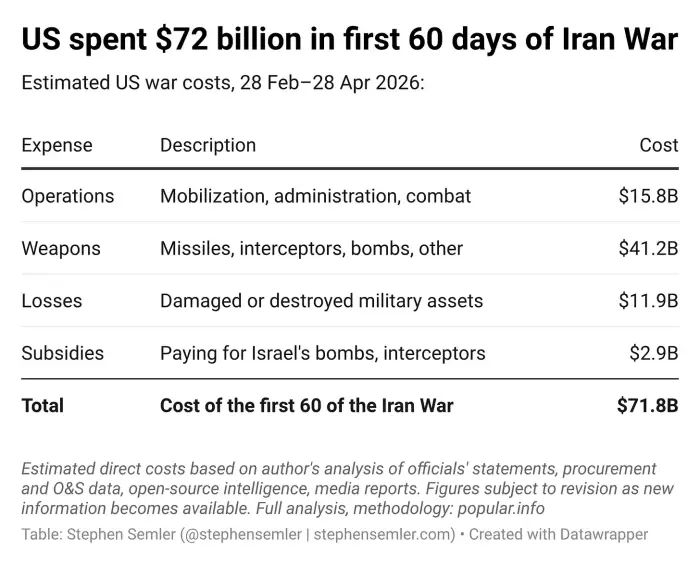
Semler, who detailed his methodology in a separate post, accused top Pentagon officials of attempting to deliberately mislead lawmakers and the American public about the true cost of the war, which is historically unpopular.
“The $25 billion war cost given by Pentagon Secretary [Pete] Hegseth and acting Comptroller [Jules] Hurst before Congress was a lie,” Semler wrote Wednesday. “It was a denial of the Iran war’s spiraling costs, one of several foreseen consequences of the Trump administration’s decision to go to war. The closing of the Strait of Hormuz is another predictable consequence.”
Semler’s analysis was released days after unnamed Trump administration officials told CBS News that they believe the actual US cost of the Iran war is roughly double the estimate offered under oath by Pentagon leaders.
“US officials familiar with internal assessments suggested the war’s price tag is closer to $50 billion so far,” CBS News reported. “Much of the gap is accounted for by munitions that have been used and need to be replaced. For instance, the Pentagon has lost 24 MQ-9 Reaper drones—sophisticated unmanned aircraft that can cost $30 million or more apiece—underscoring how quickly the financial toll has mounted. Taken together, the higher estimate reflects not only the tempo of operations but also the often unseen costs of attrition, as material lost in the field reshapes the ledger.”
In a Truth Social post early Wednesday, Trump said that if Iran doesn’t agree to US terms to end the war, “the bombing starts, and it will be, sadly, at a much higher level and intensity than it was before.”
Trump Rebuked for Bypassing Congress With $8.6 Billion Weapons Sale to Israel and Gulf Allies
“The vaults are open and the arms trade is thriving before the war and after it,” said one Nobel Peace Prize laureate.
As the US voting public continues to express its discontent over the disastrous war of choice against Iran that US President Donald Trump launched just over two months ago, fresh criticism followed after weekend reporting revealed the administration skirted congressional review to approve an $8.6 billion weapons deal with the United Arab Emirates and other allies in the Middle East.
Announced Friday night quietly by the US State Department, as the New York Timesreports, the “sales would entail the transfer of rockets to Israel, Qatar, and the United Arab Emirates and air-defense equipment to Qatar and Kuwait.”
According to the Times: Under the terms of the deal with Qatar, the Gulf country would pay more than $4 billion for American-made Patriot missile interceptors — global stockpiles of which have dwindled during the war with Iran.
Israel, the Emirates and Qatar would receive an Advanced Precision Kill Weapon System, which fires laser-guided rockets. Kuwait also purchased an advanced aerial defense system for about $2.5 billion.
Secretary of State Marco Rubio expedited the deals under an emergency provision allowing the “immediate sale” of the weapons, the State Department said, bypassing standard congressional review and prompting criticism from Democratic lawmakers. This is the third time the second Trump administration has invoked an emergency authorization during the Iran war to bypass Congress on arms sales.
“No comment,” said Mohamed ElBaradei, a Nobel Peace Prize winner and the former head of the International Atomic Energy Agency (IAEA), in an eye-rolling response to the news on social media.
After a commenter suggested that “America opened the door to war for [the countries taking part in the sale] so they would open their treasuries and the Israeli-American arms trade would boom after a slump,” ElBaradei seemed to agree.
“The vaults are open, and the arms trade is thriving before the war and after it,” he said.
Kenneth Roth, former executive director of Human Rights Watch and now a visiting professor at Princeton University, said: “Trump is bypassing Congress to fast-track arms sales to the United Arab Emirates, apparently without receiving any promise that the UAE would stop arming the genocidal Rapid Support Forces (RSF) in Sudan.”
The RSF has been accused of atrocities in the ongoing Sudanese civil war, and the backing it has received from the US, with the UAE as its closely allied proxy, has been the source of outrage and criticism.
Trump Agriculture Chief Claims ‘Golden Age’ Is Coming. US Farmers Say They’re ‘Barely, Barely Getting By’
“These rising costs are hitting us at the wrong time here,” said one farmer of the high prices of diesel and fertilizer.
Farmer Alan Montag loads soybeans into his planter on May 6, 2026 near West Bend, Iowa. (Photo by Scott Olson/Getty Images)
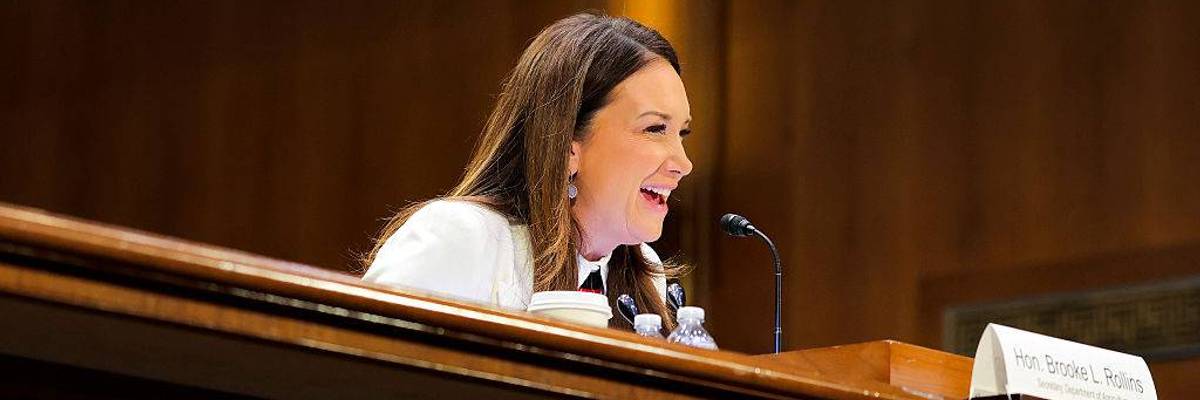
US Agriculture Secretary Brooke Rollins on Thursday claimed American farmers are heading toward a “golden age,” even as President Donald Trump’s policies are increasingly driving them into financial distress.
During an appearance on Fox Business, Rollins discussed Trump’s upcoming meeting with Chinese President Xi Jinping to talk trade between the two countries.
“For our farmers and our ranchers, for farm security, for food security, making sure our farmers can prosper as they move into what will hopefully be a golden age under this president, these trade deals are very important,” Rollins said. “But the president also understands that the over-reliance on a country like China has massive implications from a national security standpoint.”
American farmers took a big financial hit in 2025 after China cut off purchases of US soybeans in retaliation for Trump’s “Liberation Day” tariffs.
The problems facing US farmers have gotten even worse since Trump illegally launched a war with Iran in late February, as the prices of fertilizer and diesel soared after Iran shut down the Strait of Hormuz.
According to a Monday report from Wisconsin Public Radio, there is little immediate relief coming for US farmers even if Trump ends his war with Iran and the Strait of Hormuz immediately reopens.
Shawn Arita, associate director of the Agricultural Risk Policy Center, told WPR that price projections show fertilizer prices will likely remain high throughout the rest of the year.
In fact, even if the strait were to reopen soon, the center projects that fertilizer prices will remain 13% higher than they were before the war started through all of next year and into 2028.
“We have seen that even in the most optimistic scenario,” Arita explained, “we’re going to see elevated prices on the nitrogen as well as phosphate side that continues on through the fall and moving into 2027.”
Bill Knudson, agriculture economist at Michigan State University, told WPR that it will also take time to get shipping back to normal should the strait reopen soon because there are still an estimated 2,000 vessels stranded there that will take time to clear out.
“You’re not going to see a return to normal for several months, even if the Strait of Hormuz was opened relatively quickly,” Knudson explained, “because you’ve got to get all those ships out of there.”
The Guardian on Thursday published interviews with US farmers who explained how the combined hit of the president’s trade wars and the Iran war have hurt them financially.
New York-based farmer Blake Gendebien told The Guardian that “these rising costs are hitting us at the wrong time here,” as the price of offroad diesel has nearly doubled since last April.
“It’s a massive cost for farmers that are already barely, barely getting by,” Gendebien explained.
North Carolina-based cotton farmer Julius Tillery told The Guardian that he’s had to overhaul his planting process this year to minimize his use of diesel fuel.
“I’m very careful on my planting dates,” said Tillery, who also revealed he’s been eating more ramen noodles to save money. “I can’t afford to plant crops in bad climates, so the production window becomes smaller.”
‘4.3 Million Off SNAP and Counting!’ Trump Official Celebrates Mass Loss of Food Aid
“Kicking 4.3 million Americans off of SNAP is not a flex, it’s a failure,” said Democratic Rep. Shontel Brown. US Agriculture Secretary Brooke Rollins testifies during a Senate Appropriations Subcommittee hearing on April 22, 2026 in Washington, DC. (Photo by Heather Diehl/Getty Images)
US Secretary of Agriculture Brooke Rollins on Saturday openly celebrated millions of people losing their food assistance, which experts say is a direct result of the Republicans’ 2025 budget law that slashed funding to the Supplemental Nutrition Assistance Program by $186 billion over a decade.
In a social media post pointing to preliminary data from her department, Rollins boasted that there were now “4.3 million off SNAP and counting!”
“Under President Trump, Americans are getting back to work!” Rollins added. “Healthy employment numbers mean less reliance on government programs. Leaving benefits for those who truly need them. America is back in business!”
In reality, the unemployment rate is currently higher than when President Donald Trump took office in February 2025 and there has been almost no growth in net employment since the president announced his “Liberation Day” tariffs just over a year ago.
The Associated Press on Monday published a fact check of Rollins’ claims about SNAP, finding that Republicans’ cuts to the program were far more likely responsible for the historic drops in enrollment than any purported improvement in the economy.
Caitlin Caspi, an associate professor at the University of Connecticut who studies food insecurity, told the AP that current job creation numbers are nowhere near strong enough to explain the massive number of Americans losing access to SNAP.
“We’re not seeing a linear kind of drop-off,” Caspi said. “We are not seeing, if you look at the unemployment rates, things that might be an indicator that a strong economy was driving this change. We don’t see, for example, a pattern of decline in unemployment that would match the pattern of decline in SNAP participation.”
Caspi’s analysis was echoed by the Center on Budget and Policy Priorities (CBPP), which last week published an analysis finding that “economic conditions haven’t been improving as the number of people receiving SNAP has plummeted in recent months, representing the sharpest decline in decades.”
Instead, CBPP pointed the finger squarely at the GOP’s budget law as the biggest culprit behind the decline.
“The deep cuts to federal funding for SNAP are shifting significant new costs to states,” wrote CBPP, noting that the GOP law “also dramatically expands SNAP’s already harsh and ineffective provision taking away people’s benefits for not meeting the work requirement.”
Rollins’ claims about SNAP enrollment were also criticized by Rep. Shontel Brown (D-Ohio), who expressed disgust that the administration is bragging about kicking people off food assistance during a time when the price of groceries has continued to rise thanks in part to Trump’s own policies.
“Better economy where?” Brown wrote on social media in response to Rollins. “You mean the one where Americans paid $300 more on their groceries to compensate for Trump’s tariffs? Kicking 4.3 million Americans off of SNAP is not a flex, it’s a failure. That’s why I’ve authored legislation to reverse the Trump SNAP cuts.”
900 Health Facilities Shutting Down or at Risk of Collapse as Trump-GOP Cuts ‘Ripple Across the Country’
GOP STATES HIT HARDEST
“Providers are stretched thin, doing everything they can as resources disappear and the system buckles under the pressure of Republicans cutting more than $1 trillion from healthcare.”
A man has his blood pressure checked at a Remote Area Medical (RAM) mobile dental and medical clinic at Terre Haute South High School on August 02, 2025 in Terre Haute, Indiana. (Photo by Spencer Platt/Getty Images)
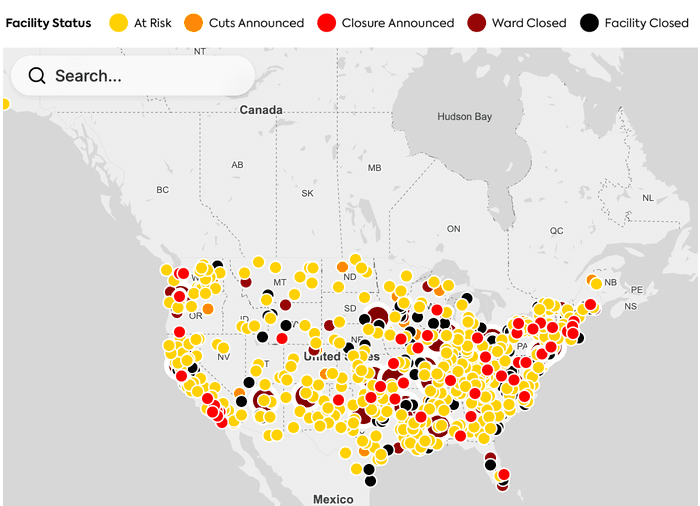
An advocacy group tracking the impacts of the unprecedented Medicaid cuts that congressional Republicans and President Donald Trump enacted last year said Monday that at least 900 hospitals, nursing homes, and other healthcare facilities are now shutting down or at risk of closure—a disaster for low-income Americans who lack easy access to care.
Protect Our Care’s Hospital Crisis Watch project has identified healthcare centers that have closed or are at risk of closing, cutting services, and shutting down wards as they grapple with the impacts of the GOP’s 2025 budget law, which included over $1 trillion in total healthcare cuts over the next decade. More than $900 billion of the cuts will come from Medicaid, which pays hospitals and other providers for services delivered to low-income patients.
“Hospital Crisis Watch has now reached 900 pins, 900 communities where access to care is evaporating as Republicans’ healthcare cuts ripple across the country,” said Brad Woodhouse, president of Protect Our Care. “Providers are stretched thin, doing everything they can as resources disappear and the system buckles under the pressure of Republicans cutting more than $1 trillion from health care to fund tax breaks for billionaires and big corporations.”
“Families are driving further for care, parents are scrambling to find services for their kids, and seniors are being left without the support they need,” Woodhouse continued. “Care is getting harder to access, in too many places, disappearing entirely, and communities are left to deal with the consequences.”
The impacts of the Trump-GOP Medicaid cuts have been felt in both urban and rural areas, despite Republicans’ inclusion of a $50 billion Rural Health Transformation Fund that supporters touted as a way to bolster at-risk healthcare facilities. Critics of the fund have warned from the start that it would not be nearly enough to offset the devastation caused by massive Medicaid cuts.(The Trump-GOP law includes an estimated $137 billion in cuts to Medicaid in rural areas.)
“In Nebraska and other states, rural hospitals are facing across-the-board cuts—and the rural health fund Congress created to offset the impact of Medicaid cuts on rural healthcare is falling short,” Adam Searing, an associate professor at the Georgetown University McCourt School of Public Policy’s Center for Children and Families, wrote in a blog post last week.
“What is quickly becoming clear, even at this early stage, is that as a result of the cuts enacted by Congress, healthcare is going to become much harder to access for many people,” wrote Searing. “Rural areas and small towns across the country will be particularly affected.”
The latest assessments of surging healthcare facility cuts and closures across the US came as Nebraska became the first state to implement the punitive work requirements that the 2025 Republican law imposes on some Medicaid recipients. Early estimates indicate that more than 20,000 Nebraskans could lose Medicaid coverage due to the stringent work requirements and the procedural hurdles the new mandates entail.
States must implement the new work requirements by the start of 2027.
“Everyone who is eligible for Medicaid will be at risk of having their health coverage taken away—whether or not the work requirement applies to them, and whether or not they prove their compliance or exemption status if it does—because the administrative burden of implementing the work requirement strains a state’s entire Medicaid system,” Farah Erzouki, a senior policy analyst at the Center on Budget and Policy Priorities, warned last week.
“Without sufficient time and guidance,” Erzouki added, “states will be unable to implement these requirements without harming many more eligible people and millions will lose coverage.”
‘Outrageous’: GOP Budget Includes $1 Billion in Taxpayer Funds for Trump Ballroom
“Using taxpayer dollars to toady to a wannabe-dictator is both pandering and pathetic,” said one critic.
US President Donald Trump holds a rendering of the White House South Terrace balustrade view as he speaks to reporters aboard Air Force One on March 29, 2026. (Photo by Mandel Ngan/AFP via Getty Images)
Even though President Donald Trump has long insisted that his proposed White House luxury ballroom would be funded by private donations, congressional Republicans unveiled legislation on Monday that would put US taxpayers on the hook for the project.
As reported by Punchbowl News, Sen. Chuck Grassley (R-Iowa) released a proposal for a budget reconciliation package that includes $30 billion more in funds for US Immigration and Customs Enforcement (ICE), $3.4 billion for Customs and Border Protection, and $2.5 billion for the Department of Homeland Security.
Tucked into the proposal is $1 billion for what is described as an “East Wing modernization project, including above-ground and below-ground security features.”
Given that Trump is planning to build his ballroom on the area of the White House’s East Wing that he demolished last year, this means that $1 billion in taxpayer money would be going to the president’s vanity project.
Democratic officials immediately pounced on news that their Republican counterparts are planning to funnel $1 billion to the ballroom project, noting that the budget plan comes as Americans are struggling with the surging costs of energy and food.
“Zero dollars to lower costs,” wrote Rep. Brendan Boyle (D-Pa.), ranking member of the House Budget Committee. “Zero dollars to protect your healthcare. A massive check for an out-of-control ICE, and $1 billion for Trump’s ballroom. This Republican budget bill is a disaster.”
Rep. Sean Casten (D-Ill.) responded to the GOP ballroom plan by declaring, “Oh hell no.”
“Spiking prices, SCOTUS attacking democracy, collapsing faith in the US government,” Casten added, “and the GOP is prioritizing sending more money to murderous ICE agents and Trump’s ballroom vanity project. This is offensive.”
Rep. Yassamin Ansari (D-Ariz.) contrasted the GOP finding money to fund the ballroom with its unwillingness to extend enhanced subsidies for Americans who buy health insurance through exchanges established by the Affordable Care Act.
“Add the ballroom to the laundry list of things Trump said someone else would pay for,” Ansari wrote. “Ultimately, of course, it’s always the American people footing the bill for his outrageous pet projects. A $1BN price tag while he rips away your healthcare. Sickening.”
Sen. Brian Schatz (D-Hawaii) welcomed the chance to have his Republican colleagues go on the record in favor of funding the ballroom.
“Just flagging that now everyone gets an up or down vote on the ballroom!” he wrote.
Elected Democrats weren’t the only ones to hammer the GOP for the proposal to fund Trump’s ballroom.
Lisa Gilbert, co-president of Public Citizen, called the GOP plan a “corrupt absurdity” that would make taxpayers shell out $1 billion for the president’s “grandiose, bombastic, vanity project.”
“Using taxpayer dollars to toady to a wannabe-dictator is both pandering and pathetic,” added Gilbert, who decried the plans for increased ICE funding as “abhorrent.”
Kristen Crowell, executive director of Families Over Billionaires, denounced the ballroom funding plan as “a glaring symbol of misplaced priorities and grift,” while also calling attention to other harmful aspects of the GOP’s budget proposal.
“At a time when families are struggling to afford housing, child care, and other basic necessities,” Crowell said, “the White House and Republicans in Congress are proposing to pour tens of billions of dollars into an already bloated and unaccountable deportation machine—while also carving out funding for the president’s own luxury projects.”
Chart Shows How Trump 2.0 Is ‘Most Brazenly Self-Enriching’ Administration in US History
Buying Trump’s meme coin is like investing in “a pet rock, except you don’t even get a rock” out of the deal, said economist Steve Rattner.
A Donald Trump coin is pictured alongside Bitcoin and various other cryptocurrencies in this photo illustration in Brussels, Belgium, on August 5, 2025. (Photo by Jonathan Raa/NurPhoto via Getty Images)
Since returning to office a little more than a year ago, President Donald Trump has nearly tripled his net worth, driven in large part by investments in his family’s cryptocurrency ventures.
Appearing on MS NOW on Friday morning, economist Steve Rattner broke down how Trump’s net worth has exploded from $2.34 billion in 2024 to an estimated $6.5 billion in 2026.
“So where did the money come from? He had $4 billion, he and his family, of profits,” Rattner said. “$3 billion of it came from crypto, and I will tell you, there are so many transactions here, so many structures, that made my head hurt trying to understand it.”
In addition to the crypto ventures, Rattner pointed to Trump son-in-law Jared Kushner raising money from investors in the Middle East through his investment firm Affinity Partners; increased revenue that came from raising admission fees to his Mar-a-Lago resort; and money he’d obtained from lawsuits against assorted media companies.
Rattner then explained the finances of the Trump meme coin, which he described as investing in “a pet rock, except you don’t even get a rock” out of the deal.
“He sold them initially at $7, it went up to $45, not surprisingly it crashed,” Rattner said.
However, Rattner said that early investors in the cryptocurrency, whom he described as “whale wallets,” managed to profit handsomely from the venture by buying up large numbers of Trump coins and then selling them to retail investors, who were left holding the bag when the coin’s value fell precipitously shortly after its launch.
“Let me just emphasize, it’s not like [the retail investors] got anything,” he added. “All they got, in effect, was like a little note, a little email or something, saying, ‘Congratulations, you own 10 Trump meme coins.’ But there’s nothing they can do with it. They were buying nothing, they were buying air.”
The economist did note that Trump made $600 million in trading fees that investors paid to carry out transactions of the coin.
After his appearance on MS NOW, Rattner posted a photo on social media of a graph he made to document the rise in Trump’s wealth over the last two years.
“[Trump’s] administration,” Rattner commented, “is the most brazenly self-enriching in American history.”
Last year was the deadliest in ICE detention in about two decades, with more than 30 deaths reported in custody. So far this year, at least 18 more detainees had reportedly died in ICE custody. In an aerial view from a helicopter, detainees are seen at Krome Detention Center run by United States Immigration and Customs Enforcement on July 4, 2025 in Miami. (Photo by Alon Skuy/Getty Images)
The US Department of Homeland Security is officially closing its watchdog for immigrant detention abuse, even as reports of excessive force, deadly neglect, and other maltreatment by agency personnel soar under the Trump administration.
Citing an internal email, Huffpost’s Dave Jamieson reported Monday that DHS is shutting down its Office of the Immigration Detention Ombudsman (OIDO), which was established by an act of Congress and signed into law by President Donald Trump in 2020 as part the massive federal spending package known as the Consolidated Appropriations Act.
Jamieson added that the communication said that OIDO “is in the process of removing all its public signage and ending its inspection,” and that the agency’s website was down.
The email attributed OIDO’s closure to a lack of federal funding in the Homeland Security appropriations package that ended the recent 76-day shutdown affecting the agency.
Largely pushed through by congressional Democrats, OIDO was designed to be independent from both US Immigration and Customs Enforcement (ICE) and US Customs and Border Protection. The office was given the power to receive detainee complaints, investigate alleged abuse or misconduct, inspect detention facilities, and report systemic problems to DHS leaders and Congress.
OIDO emerged amid widespread abuse of detained migrants during the first Trump administration, including deaths in custody, family separation, overcrowding, and other mistreatment.
Since returning to office for a second term, Trump has overseen the dismantling of the agency, arguing that it hinders immigration enforcement. The administration’s effort to dilute OIDO’s power have triggered legal action arguing that, since it was created by Congress, the agency cannot be abolished without congressional consent.
DHS detainees—especially those ICE lockups—report abuses including inadequate or delayed medical care; physical attacks and excessive force; sexual abuse and harassment; solitary confinement misuse; overcrowded and unsanitary conditions; intimidation and retaliation following complaints; abuse of pregnant women and children; denial of access to lawyers; denial of family contact; and denial of food, water, hygiene, or medication.
Last year was the deadliest in ICE detention in about two decades, with more than 30 deaths reported in custody. So far this year, at least 18 more detainees had reportedly died in ICE custody.
OIDO isn’t the only DHS watchdog under attack by the Trump administration. The Office of Civil Rights and Civil Liberties (CRCL) and Office of Citizenship and Immigration Services Ombudsman have also been targeted.
One former CRCL employee who was placed on administrative leave due to funding cuts said in a recent court filing that the agency is unable to conduct “meaningful investigations” into alleged civil rights and civil liberties violations committed by its personnel. As an example, they noted the accusations of excessive force by the ICE agent who fatally shot Minneapolis resident Renee Good last year.
“In my experience, investigations into systemic issues like these required significant staff resources, which CRCL no longer has to devote to these important issues of civil rights and civil liberties,” the official told Federal News Network earlier this year. “Nor does CRCL have the resources to conduct multidisciplinary onsite investigations at detention facilities, the need for which is greater than it has ever been as both the number of detention facilities and number of people detained has skyrocketed.”
Report Details How Post-9/11 Legal Policies Laid Groundwork for Trump ‘Terrorizing Migrants’
A legal expert explores how the administration is “weaponizing the law... to effectuate a widespread harassment and mass deportation campaign that is more akin to ethnic cleansing than routine immigration enforcement.” US Immigration and Customs Enforcement agents detain a man outside of his home in Saint Paul, Minnesota on January 27, 2026. (Photo by Madison Thorn/Anadolu via Getty Images)
President Donald Trump’s taxpayer-funded mass deportation campaign has tormented communities across the country with militarized federal agents, killed immigrants and US citizens alike, abused demonstrators and detainees of all ages, and sparked fears of an expansive effort to strip citizenship from Americans.
The “Terrorizing Migrants” report released Tuesday by the Costs of War Project at Brown University’s Watson School of International and Public Affairs details how Trump’s xenophobic campaign reflects “specific law and policy options created and strengthened among all three branches of the US government, on a bipartisan basis, since 9/11.”
“These law and policy options place heightened unchecked discretionary authority within the administration, and are particularly ripe for abuse against noncitizen persons of color by immigration authorities, law enforcement agents, and other executive branch officials,” wrote Widener University Delaware Law School assistant professor Elizabeth Beavers, author of the report.
The publication focuses on five key post-9/11 precedents borrowed from the “War on Terror,” though it acknowledges that “the Trump administration is relying on laws and policies far beyond those described in this paper to effectuate its broader anti-immigrant agenda, and justifying much of it in national security language.”
The first of the five precedents is “conflation of immigration enforcement and counterterrorism.” The report recalls that after the 2001 terrorist attacks, the Federal Bureau of Investigation “orchestrated a mass investigation” that “exclusively targeted Arab, Muslim, and South Asian immigrants in a dragnet roundup, subjecting them to secretive detention at locations inside the US,” and holding many of them “for weeks or even months without any charges at all.”
Beavers also pointed to the George W. Bush administration’s launch of the National Security Entry and Exit Registration System, as well as the creation of the US Department of Homeland Security and the placement of Immigration and Customs Enforcement within DHS. ICE and Customs and Border Protection agents have been key to Trump’s campaign.
The Muslim ban from Trump’s first term “built upon the structures that came before it, but greatly expanded legal presumptions that people of particular races, religions, and nationalities carry inherent danger,” Beavers wrote. His second term policies have “extended this precedent to its logical conclusion by framing migration itself as terrorism. And nearly 25 years after its post-9/11 creation, ICE has been unleashed and empowered to roam American streets, snatching and disappearing people they perceive as unlawfully present, often based solely on race, and often without verifying their immigration status.”
The second precedent Beavers explored is “expanded and politicized ‘terrorist’ designation lists.” She noted Trump’s invasion of Venezuela and abduction of its president, Nicolás Maduro, as well as his boat-bombing spree allegedly targeting drug traffickers in international waters.
The expert also dove into “deporting people as ‘terrorists’ without proving actual violent conduct,” flagging Trump’s “reverse migration” pledge after an Afghan man allegedly shot two National Guard members in Washington, DC, along with the administration’s decision to “hold and review” asylum applications for people from “high-risk” countries.
That review, she warned, “could result in mass removal from the country of ‘terrorist’ noncitizens who involuntarily paid money to cartels at some point in their lives, whose family remittances have crossed hands with cartel-controlled actors, who have family members or other connections to a designated cartel but no involvement themselves, or who have unwillingly been pressed into service of a cartel at some point.”
The fourth precedent examined in the analysis is “indefinite detention, torture, and rendition of noncitizens.” Beavers began the section with the detention camp at US Naval Station Guantánamo Bay in Cuba, which she called “perhaps one of the most notorious features of the US government’s post-9/11 ‘War on Terror.’”
“It is both a place where every post-9/11 president has detained Muslim men in connection with the post-9/11 counterterrorism wars, but it is also a place where unauthorized migrants are sometimes held,” she wrote. “More than 700 migrants have been sent to and from Guantánamo in President Trump’s second term, detained there by ICE with support from the military.”
The expert also highlighted Trump’s deportation of hundreds of men to El Salvador’s infamous Terrorism Confinement Center (CECOT)—based on often dubious claims that they belonged to the gang Tren de Aragua, which the president designated as a terrorist organization—as well as the “practice of disappearing people into secretive immigration detention” within the United States, and reports indicating that “abusive treatment in those facilities may amount to unlawful torture.”
The final precedent Beavers explored is the “anti-democratic concentration of executive national security powers.” She wrote that “the second Trump administration has made prompt use of this latitude” from federal courts since 9/11.
“This has included: manipulating the ‘terrorist’ designation lists in novel ways to include drug cartels without needing court approval, which has expanded the scope of people who can be deported as ‘terrorists’; claiming a maximalist version of its immigration powers, daring courts to intervene; invoking the state secrets privilege to avoid accountability in cases challenging its deportation orders; and indefinitely detaining and torturing migrants,” Beavers continued. “They have taken each of these actions without fear they will be meaningfully held accountable in court.”
Based on her review, the professor concluded that “indisputably, administration officials are weaponizing the law in new and particularly indefensible ways to effectuate a widespread harassment and mass deportation campaign that is more akin to ethnic cleansing than routine immigration enforcement.”
“Neither Congress nor the courts have meaningfully checked presidents or held them accountable for their expansive and spurious claims of war authorities, national security powers, and counterterrorism mechanisms to justify harmful and discriminatory practices against noncitizens and especially against people of color,” she stressed. “In these and many other ways, US policymakers on a bipartisan basis built and sharpened the legal weapons that President Trump is now utilizing against immigrants.”
‘Shame! Shame! Shame!’: Local Residents Furious After Shark Tank Billionaire’s Data Center Approved in Utah
The project, which residents were informed of just last week, is expected to more than double Utah’s electricity usage, hike its carbon footprint by 50%, and potentially drain more water from the depleted Great Salt Lake. Protesters react as the Box Elder County commission announces approval of a large data center on May 4, 2026 in Tremonton, Utah. (Photo by Natalie Behring/Getty Images)
County commissioners in Box Elder County, Utah, were deluged with chants of “Shame! Shame! Shame!” from a crowd of hundreds on Monday night as they voted unanimously to move forward with a sprawling “hyperscale” artificial intelligence data center project that many residents fear will cause energy prices to soar and imperil water access. The project, known by state officials as “Stratos,” was proposed by the celebrity venture capitalist Kevin O’Leary and has been rushed along by Utah’s Military Installation Development Authority, which recently approved a gigantic energy tax break for the program to help “lure” the billionaire “Shark Tank” investor.
The development, dubbed “Wonder Valley” after O’Leary’s “Mr. Wonderful” TV persona, would span more than 40,000 acres of northern Utah—more than two and a half times the size of Manhattan—and would consume more than twice the electricity currently used by the entire state if approved, according to Axios.
CBS 2 KUTV called it “the biggest thing in the region since the completion of the first transcontinental railroad.” And yet Utahns say they’ve been given little information about the plan and few opportunities to voice their concerns.
Residents were given short notice before Box Elder commissioners gathered at the county fairgrounds on Monday for a “special” meeting to vote on the project, but an estimated 500 still showed up to voice their displeasure.
They raised fears that they’d have to endure the same dramatic energy price spikes as other states with high concentrations of data centers. Residential utility costs have jumped 13-20% year over year in Virginia, Illinois, Ohio, and New Jersey, a trend attributed to the rollout of data centers in these states.
The developers of the Utah project have emphasized that it will be powered by an on-site natural gas plant, which they claim would limit the impact on utility bills.
However, that still leaves the massive environmental concern, especially since natural gas is almost entirely made of methane, one of the worst planet-heating pollutants.
Kevin Perry, a professor of atmospheric sciences at the University of Utah, has said that the estimated nine gigawatts of power the center would require, “would increase the carbon dioxide emissions for the state of Utah by more than 50%,” meaning “there’s a huge climate footprint associated with that proposal.”
Environmental advocates also warn that the facility will further drain water from the Great Salt Lake amid an already severe drought.
The Salt Lake Tribune has found that Utah’s dozens of other data centers consume wildly different amounts of water depending on the technology they use.
The developers of the Box Elder facility have claimed the project will use “zero water turbine” technology that allows it to recycle water, resulting in “net zero” consumption.
But Samantha Hawkins, the communications director for Grow the Flow Utah, a group dedicated to protecting the Great Salt Lake, said it’s impossible to know if the developers are telling the truth when they say their facility is designed to limit water usage.
“So far, there’s no publicly available hydrologic analysis or independent review to support those claims,” she said, “and there haven’t been any manufacturers, technologies, or contracts cited in relation to the ‘zero water turbine’ technology.”
Even if the centers limit water use, they still need to remain cool, which the Tribune said often requires more energy.
Many of the Utahns who showed up to protest Monday’s vote felt they were being kept in the dark about the facility’s potential harms and that the plans for the facility, which were not made public until last week, were being kept from them.
“I’m outraged,” said Colleen Flanagan, a resident of Sandy who spoke with Fox 13 Salt Lake. “I am absolutely angry that there was no studies done—it just came up out of the community. Nobody knew about it.”
Mitchell Tousley, who drove more than an hour from Draper to protest the decision, said, “A project of this scale just absolutely requires public input, and there really hasn’t been.”
Deals to build these facilities have often been made in secret, with contract details hidden from the public by nondisclosure agreements that stifle dissent until the project has already been approved. Despite this, these projects have often drawn fearsome backlash from the communities where they are planned. In some cases—like in Virginia late last month, where a 2,100-acre center was set to be built—it has led developers to pull out.
But the commissioners in Box Elder County, who said they’d reviewed more than 2,500 public comments on the proposal, appeared unmoved by the outpouring of public concern on Monday night. They said water and air quality issues were not factors in their vote and that the water rights were held by the private landowners.
As the crowd jeered, with chants of “cowards” and “people over profits,” Commissioner Boyd Bingham, a Republican, shouted them down.
“For hell’s sakes, grow up,” he yelled. “This is beyond a joke.” The commissioners then left the room and addressed the crowd via a virtual meeting.
In a video response to Monday night’s protest, O’Leary said: “I’m the only developer of data centers on Earth that graduated from environmental studies. I’m pretty aware of what these concerns are. They are around air, water use, heat, noise pollution. So sustainability is at the heart of what we do in terms of all these proposals.”
He claimed without evidence that 90% of the opponents of the data center project were “being bused in” from out of state. He also claimed that the facility would be powered in part by “solar, wind, and batteries,” when it is actually powered entirely by natural gas.
Opponents continue to characterize Stratos as a billionaire vanity project to loot Utah’s vast natural resources with little consideration for how it will affect residents.
Utah State University physics professor Robert Davies told Fox 13 that the Great Salt Lake “is occupied by amazing living systems” and that “projects like this go into environments like this and scrape the living systems right off the face of the Earth.”
He said, “This is a private enterprise that is coming in to extract from our natural wealth and pipe it out of the state… and leave us with a few crumbs.”