Friday, May 08, 2026

‘Cowardly’: University of Michigan Blasted After Apologizing for Commencement Speaker’s Praise of Pro-Palestine Students

“It should not be controversial to have one’s ‘heart opened to the inhumanity and injustice of Israel’s war in Gaza,’” said Professor Derek R. Peterson.


Students protest in support of Palestine during the University of Michigan’s Spring Commencement ceremony on May 4, 2024, at Michigan Stadium in Ann Arbor, Michigan.

(Photo by Nic Antaya/Getty Images)

Stephen Prager
May 04, 2026
COMMON DREAMS


The University of Michigan is facing criticism after it apologized and said it was launching a review into a professor’s commencement speech in which he praised the school’s pro-Palestine student movement for highlighting the “injustice and inhumanity” of Israel’s genocidal war in Gaza.

Since the early weeks of the war, which has so far resulted in the deaths of more than 72,000 Palestinians according to official estimates, Michigan’s campus has been the site of continued acts of civil disobedience from student activists that have been met with harsh disciplinary action by the school and aggressive crackdowns by state police.

During a commencement address on Saturday, Professor Derek R. Peterson—a University of Michigan historian and the outgoing chair of the Faculty Senate—acknowledged these students as part of a speech that commemorated the school’s long history of social activism, including the struggle led by suffragette Sarah Burger for the school to open its doors to women in the mid-1800s.


“The freedoms that we all enjoy were hard won. They weren’t handed to us by a generous and far-seeing administration,” Peterson said. “So the next time you sing ‘Hail to the Victors,’ our fight song, sing for Sarah Burger.”

“Sing for the thousands of other students who have dedicated themselves to the pursuit of social justice over the course of centuries,” he said.

He encouraged students to “sing for Moritz Levy, the first Jewish professor at the University of Michigan,” who helped turn it into “a safe haven from the antisemitism of East Coast universities” and for “the students of the Black Action Movement, whose members demanded a curriculum that would reflect the experience and identity of black people in this country.”

Then he said to “sing for the pro-Palestinian student activists, who have over these past two years opened our hearts to the injustice and inhumanity of Israel’s war in Gaza.”

A cheer erupted from the crowd. But Peterson said the comments caused “a furor on social media” from supporters of Israel, who called it a “political rant,” a shoutout to “terrorist sympathizers,” and “grounds for termination.”

Sarah Hubbard, a Republican who is currently serving as a regent at the university, wrote on social media that while she was not in attendance, she found Peterson’s remark “troubling and disappointing.” She added that there should be “meaningful consequences” for his statements that should “set the tone” for the conduct of other faculty.

Leo Terrell, the chair of the Department of Justice’s Task Force to Combat Antisemitism, which was created by President Donald Trump as part of an effort to crack down on pro-Palestinian speech on college campuses, said, “Shame on the University of Michigan,” and issued what appeared to be a threat for retaliation over social media: “We’ll see you soon. You can bet the house on it.”


Domenico Grasso, president of the University of Michigan, responded to the uproar on Saturday by issuing an apology for Peterson’s remark.

He called the comments “hurtful and insensitive to many members of our community” and said, “We regret the pain this has caused on a day devoted to celebration and accomplishment.”

Grasso accused Peterson of having “deviated” from the remarks he’d shared before the ceremony, and said his statements “were inappropriate and do not represent our institutional position” or “the diversity of views across our entire faculty.”

He added that Peterson’s remarks “were expected to be congratulatory, not a platform for personal or political expression” and said the school would “review and refine” future commencement programming to prevent speech that does not “align with the purpose of the occasion.” The university has removed Peterson’s commencement video from its public channels.

The University of Michigan has had sitting members of Congress and other political leaders serve as commencement speakers for decades.

President Lyndon B. Johnson famously used the ceremony in 1964 to introduce Americans to his “Great Society” agenda, which he said would demand an “end to poverty and racial injustice.” President George HW Bush used the forum to tout his foreign policy accomplishments and rail against “political correctness” on university campuses.

Just last year, Sen. Elissa Slotkin (D-Mich.) served as commencement speaker and warned that public discourse was being “defined by fear” under the second Trump administration in part because of activists being punished for their political beliefs and speech.

In a statement to CBS News Detroit, Peterson responded to the backlash and the university’s response.

“It should not be controversial to have one’s ‘heart opened to the inhumanity and injustice of Israel’s war in Gaza’, which is what I credited activists with doing,” he said. “Having an open heart to other people’s suffering is a fundamental human virtue. It is a quality that I hope we teach our students, whatever their political posture might be.”

Peterson said he was “mystified” by the response to his speech. “I have—like many of us here in Michigan—been convicted by the evidence of human suffering in Gaza; and I credit my awareness of that to pro-Palestinian activists... On a day meant to honor students for their accomplishments, I thought it important that we would honor the student activists who have, over the course of time, pushed the institution toward justice.”

“The idea that graduations should be apolitical is ridiculous,” Peterson added. “Michigan is not a finishing school for polite young men and women. Our students are not wilting flowers. They have just finished their degrees at the foremost public university in the country. They can handle controversy.”


Just as Peterson’s comments sparked a backlash, the university’s reaction to his speech has been met with familiar criticism that it is silencing political speech at the behest of Israel’s supporters.

“The entire ‘speak-no-criticism-of-Israel’ industry is erupting in outrage and demanding retribution for a history professor’s speech at the UMich graduation,” said Lara Friedman, the president of the Foundation for Middle East Peace, who added that those seeking to discipline Peterson were effectively making a “demand for a complete Israel-exception to free speech.”

Israel has been condemned for human rights violations in Gaza by United Nations experts and numerous nations around the world, while several human rights organizations, including Human Rights Watch, Amnesty International, and the Israeli organization B’Tselem, among many others, have used the term “genocide” to describe its campaign of destruction and displacement in Gaza.

Dean Baker, a senior economist at the Center for Economic Policy and Research, noted Grasso’s claim that Peterson’s statements ran counter to the school’s “institutional position.”

He said sardonically that it was “pretty neat to see a University of Michigan president say the school is opposed to human rights.”
‘Prepared to Fight’: Sanders Endorses NJ Medicare for All Advocate Dr. Adam Hamawy for Congress

“As a physician he understands firsthand that our current healthcare system is broken, that healthcare is a human right, and that we must pass Medicare for All.”


Dr. Adam Hamawy poses for a photo with two Palestinian children in the flattened Gaza Strip in this undated campaign photo.
(Photo by Hamawy for New Jersey)

Brett Wilkins
May 04, 2026
COMMON DREAMS

US Sen. Bernie Sanders over the weekend endorsed New Jersey surgeon Dr. Adam Hamawy for Congress, citing the Democratic candidate’s long record of saving lives in humanitarian disasters from 9/11 to Israel’s US-backed destruction of Gaza, as well as his support for Medicare for All and willingness to take on the billionaire class.

“Dr. Adam Hamawy has saved lives with great courage and honor—he did it as a 9/11 first responder, as a combat trauma surgeon in Iraq, as a volunteer in hospitals under bombardment in Gaza, and in emergency rooms in New Jersey,” Sanders (I-Vt.) said on social media.

“As a physician he understands firsthand that our current healthcare system is broken, that healthcare is a human right, and that we must pass Medicare for All,” the senator continued. “Dr. Hamawy is prepared to fight for real campaign finance reform to stop billionaires from buying elections, and will not waste billions of taxpayer dollars on endless and illegal wars.”


“Status quo politics is not working,” Sanders added. “We need bold leaders like Dr. Hamawy in Congress. I am proud to endorse him and look forward to working with him after he is elected.”

Hamawy said he was “excited” by Sanders’ endorsement.

“I am running to fund healthcare, not bombs, to abolish ICE, and to unrig our economy,” he said. “In Congress, I’ll fight right alongside Bernie to defeat fascism and deliver for working people.”

“As a doctor, I am proud to fight alongside him for Medicare for All,” Hamawy added. “As a veteran, I am grateful for his advocacy for our community and his leadership in fighting against endless wars. I am deeply honored to have earned his support.”

Hamawy, the son of immigrants from Egypt, is running for New Jersey’s 12th Congressional District seat, currently held by retiring Democratic Rep. Bonnie Watson Coleman. He grew up in Old Bridge Township and is a graduate of Rutgers University and what is now Rutgers New Jersey Medical School.

The 46-year-old physician joined the United States Army Medical Corps and served during the US invasion and occupation of Iraq as a combat trauma surgeon. Hamawy—whose highest rank was lieutenant colonel—became nationally known after saving the life of then-Army helicopter pilot and current US Sen. Tammy Duckworth (D-Ill.) after her helicopter was shot down in Iraq in 2004. Duckworth later credited him with preventing her from becoming a triple amputee.

After leaving the Army, Hamawy volunteered in emergency and war zones including after the 2010 Haiti earthquake, during the Syrian Civil War, and the ongoing Gaza genocide—when he joined an international medical mission and performed roughly 120 surgeries, many on children wounded in Israeli attacks.

Hamawy and the other doctors on the team became trapped inside Gaza after Israel closed the Rafah border crossing with Egypt. Duckworth urged then-US President Joe Biden to secure the doctors’ evacuation. According to reporting, Hamawy was one of three US doctors who refused to be evacuated from Gaza until non-American members of his medical team could also leave.

After returning stateside, Hamawy testified about conditions in Gaza, describing catastrophic shortages of medicine and other vital equipment and the high mortality rates among severely wounded civilians.


In addition to Sanders, Hamawy is endorsed by Duckworth, Reps. Ilhan Omar (D-Minn.) and Ro Khanna (D-Calif.), and progressive groups including Justice Democrats, Our Revolution, Veterans for Responsible Leadership, Council on American-Islamic Relations Action, and Track AIPAC.

While some pro-Palestine congressional incumbents and candidates including Reps. Jamaal Bowman (D-NY), Cori Bush (D-Mo.), and Kat Abughazaleh, a Palestinian American from Illinois, have been defeated amid a torrent of funding from groups like the American Israel Public Affairs Committee, others have won their races in recent elections, including Omar and Reps. Rashida Tlaib (D-Mich.), Summer Lee (D-Pa.), and Analilia Mejia (D-NJ), who was sworn into office last month.


‘An Embrace of Anti-Intellectualism’: Public School Bans on Nonfiction Books Doubled as Trump Returned to Power

One expert warned that removing works on activism and social movements erodes the ability of marginalized communities “to take action amid rising authoritarian tactics by our government and attacks on free speech.”


Children lie on a rug in a classroom, reading a book.
(Photo by FatCamera/Getty Images)

Jessica Corbett
May 07, 2026
COMMON DREAMS

As President Donald Trump returned to the White House in the middle of the 2024-25 academic year and swiftly pursued increasingly authoritarian policies, there was “an embrace of anti-intellectualism” within the book-banning movement targeting US public schools and classrooms.

That embrace is detailed in “Facts & Fiction: Stories Stripped Away By Book Bans,” an annual report released Thursday by PEN America, a nonprofit that promotes the protection of free expression through the advancement of human rights and literature.

The group found that from July 2024 to last June, 3,743 unique titles were removed from school libraries and classrooms nationwide—and 1,102 of them were “educational or informational books for young people—textbooks or reference texts on a wide range of subjects, history books, biographies, and autobiographies.”

Although the majority of banned titles were still fiction, such as Fahrenheit 451 by Ray Bradbury and The Hunger Games by Suzanne Collins, the share of “fiction titles dropped from 85% to 69% of all banned titles, while nonfiction rose from 14% to a startling 29% of all banned titles,” according to the analysis.

“This marked impact on books anchored in scientific and historic facts, real events, and real people represents something new and distinctive about the trajectory of book bans in public schools,” the report states. “As nonfiction titles are not always the targets of efforts to remove books, that books on ancient Egypt, the digestive system, and self-help for teens, to name a few examples, are impacted by censorship signals an alarming spread of book bans that ignore the educational value of texts and books.”

Targeted “nonfiction titles are wide-ranging,” the report notes, “from memoirs such as Night by Elie Wiesel to biographies such as RuPaul by Maria Isabel Sánchez Vegara, alongside historical and educational or informational books such as Aztec, Inca & Maya by Elizabeth Baquedano and Challenges for LGBTQ Teens by Martha Lundin.”

Flagging this “embrace of anti-intellectualism” in a statement about the new report, Kasey Meehan, director of PEN America’s Freedom to Read program, said that “it is another example of how censorship sweeps broadly, leading to removals of all kinds of books, in its efforts to sow fear and distrust in our public education system.”

Like the previous academic year, “realistic/contemporary and dystopia/sci-fi/fantasy remain the dominant genres banned,” the publication highlights. “But of note, educational/informational titles grew from 5% of all titles in 2023-24 to 13% of total titles banned in 2024-25, or nearly 500 unique titles.”

Among the nonfiction titles banned, “52% contained themes of activism and social movements, the most commonly banned topic within nonfiction titles,” the report says. “Whether #WomensMarch: Insisting on Equality by Rebecca Felix or IntersectionAllies: We Make Room for All by Chelsea Johnson, LaToya Council, and Carolyn Choi, and illustrated by Ashley Seil Smith, this literature is crucial in the education of young people. These books can encourage readers to challenge the status quo and resist injustice.”

Freedom to Read program assistant and report co-author Yuliana Tamayo Latorre said that removing books on these topics “silences the voices of marginalized communities and erode[s] their ability to take action amid rising authoritarian tactics by our government and attacks on free speech.”

The most common theme across all banned books was nonsexual violence. This was a theme in 57% of the targeted titles, and they addressed topics including “war, gun violence, natural disasters, domestic violence, human trafficking, slavery and genocide, physical fighting, and more.”

Other key themes included death and grief (48%), empowerment and self-esteem (39%), LGBTQ+ topics and metaphors (36%), consensual sexual experiences (34%), mental health disorders (29%), verbal or emotional abuse (28%), and substance use and/or abuse (27%).

There was an increase in banned titles with themes of empowerment and self-esteem, up from 31% in 2023-24.

“Fictional titles with themes of empowerment include Flor Fights Back: A Stonewall Riots Survival Story by Joy Michael Ellison and illustrated by Francesca Ficorilli, and The Moon Within by Aida Salazar,” the report says. “To remove these books from classroom and library shelves means revoking access to books that students may rely on for personal and emotional development.”

There is an entire section of the report about “erasing people” that examines trends in the identities of characters in banned books. Of all the targeted titles, 44% featured people of color, 39% had LGBTQ+ characters, 19% included transgender or genderqueer individuals, and 10% involved those who are neurodivergent or disabled.

Trump and other leading Republicans have embraced and advanced campaigns against diversity, equity, and inclusion (DEI). PEN America acknowledged that such efforts “have contributed to restrictions and removals on books with people of color and mirror efforts to suppress curriculum on Indigenous history, Black history, Asian American and Pacific Islander stories, and Latine and Hispanic contributions.”

Another section of the report addresses a major “discrepancy between the titles impacted by book bans and the justifications made to ban books. Book banners have long citedpornography’ and ‘sexually explicit’ material in literature to justify book challenges. Claims that these books contain ‘explicit’ or ‘obscene’ content grossly misrepresent the materials.”

That section points out that 19% of last year’s banned titles contained sexual violence—and “according to RAINN, 1 in 9 girls and 1 in 20 boys under 18 experience sexual abuse or assault. With so many of these titles banned since 2021, it is possible that some young people who have experienced sexual violence no longer have access to books that could help them.”

“Books containing experiences of sexual violence include The Nickel Boys by Colson Whitehead, winner of the 2020 Pulitzer Prize for Fiction, set in a 1960s Southern juvenile reform school, and Laurie Halse Anderson’s memoir Shout, a call to action for sexual abuse and trauma survivors in the wake of the #MeToo movement,” according to PEN America.

The group’s report came just a few weeks after a similar annual publication from the American Library Association, which details challenges to at least 4,235 unique titles in 2025, resulting in bans on at least 5,668 books and restrictions on another 920 works.

“In 2025, book bans were not sparked by concerned parents, and they were not the result of local grassroots efforts,” noted Sarah Lamdan, executive director of the association’s Office for Intellectual Freedom. “They were part of a well-funded, politically driven campaign to suppress the stories and lived experiences of LGBTQIA+ and BIPOC individuals and communities.”


‘Egregious Abuse of Power’: Senate Democrats Demand Trump’s FCC Chair End Attack on ABC News

“Although the FCC has the authority to ensure broadcasters operate in the public interest, it cannot serve as President Trump’s roving censor.”


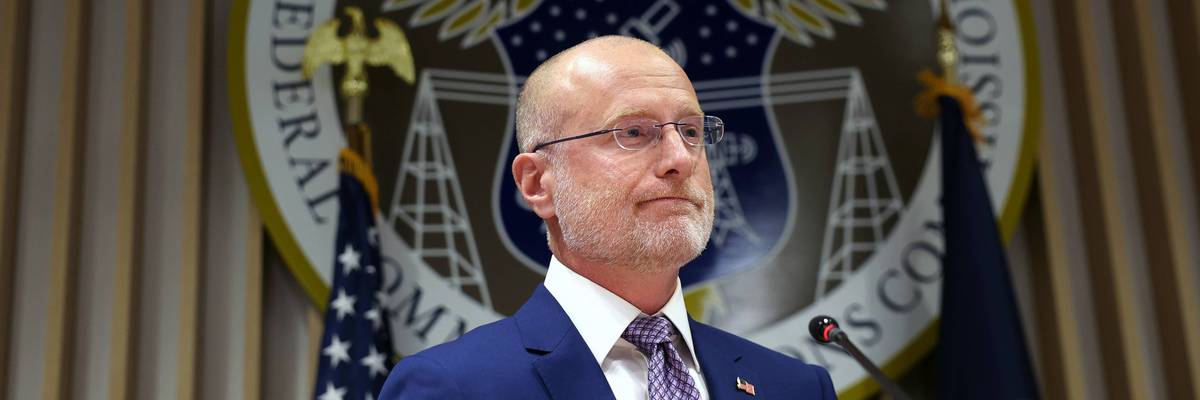
Chairman of the Federal Communications Commission Brendan Carr speaks at a news conference on February 18, 2026 in Washington, DC.
(Photo by Kevin Dietsch/Getty Images)

Brad Reed
May 07, 2026
C0MMON DREAMS

A group of Senate Democrats on Thursday told Federal Communications Chairman Brendan Carr to back off his threats to strip Disney-owned TV network ABC of its broadcast licenses.

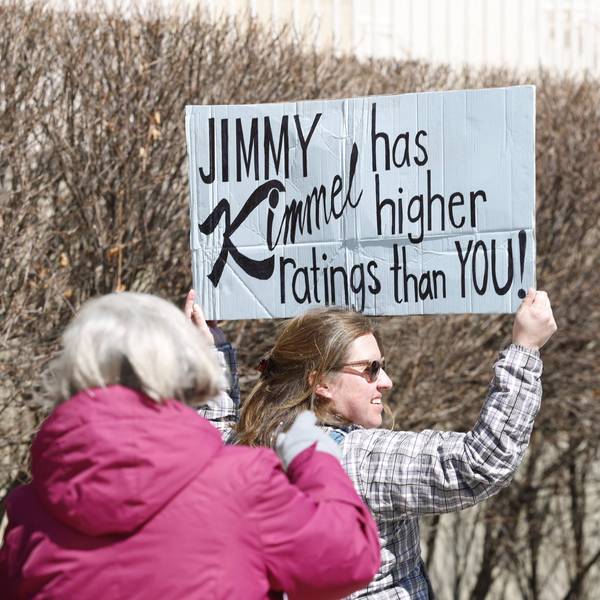
In a letter addressed to Carr, the Democrats took Carr to task for ordering Disney to file early license renewals for eight ABC stations shortly after President Donald Trump demanded that the network fire late-night host Jimmy Kimmel.


FCC Moves to Yank Disney Broadcast Licenses as Trumps Demand ABC Fire Kimmel

Kimmel earned Trump’s ire when he jokingly likened first lady Melania Trump to an “expectant widow” days before a gunman stormed into the White House Correspondents’ Dinner in an alleged attempt to assassinate the president.

The senators called Carr’s order an “extraordinary abuse of power” and “the latest and most extreme step in your use of the FCC’s licensing authority as a cudgel against broadcasters whose editorial choices displease the president.”

The Democrats charged that the order “appears to penalize Disney for refusing to capitulate to Trump’s demands to fire Kimmel and to send a message to other broadcasters: Modify your speech to favor Trump or face the FCC’s wrath,” while noting that the order was the first time in over 50 years that the commission had called on a broadcaster to apply for early renewal.

The day before the order to Disney, the FCC sent a similar order to a small station license holder called Bridge News.

Carr’s order to Disney was also part of a broad pattern of Trump administration assaults on the free press, including calls to fire Kimmel last year after the comedian said Trump and his political allies were trying “to score political points” after the assassination of right-wing activist Charlie Kirk.

“Although the FCC has the authority to ensure broadcasters operate in the public interest,” they wrote, “it cannot serve as President Trump’s roving censor, threatening to revoke licenses against broadcasters whose editorial content—including a comedian’s jokes—displeases the president.”

The Democrats concluded their letter by asking Carr to provide information about the timing and process by which the FCC decided to send Disney its early renewal order, including whether any FCC staff had communicated with the White House about the order before it was issued.

The letter was signed by Sens. Ed Markey (D-Mass.), Chuck Schumer (D-NY), Maria Cantwell (D-NM), Ben Ray Lujan (D-NM), John Hickenlooper (D-Colo.), Mazie Hirono (D-Hawaii), Jacky Rosen (D-Nev.), Bernie Sanders (I-Vt.), Brian Schatz (D-Hawaii), Adam Schiff (D-Calif.), Chris Van Hollen (D-Md.), and Elizabethe Warren (D-Mass.).


‘Are Readers Meant to Take This Seriously?’: Economist Refutes Latest Attack on Wealth Tax by Bezos’ Washington Post

“Local hospitals and emergency rooms could shut their doors forever because billionaires insist on paying less than the rest of us,” said Emmanuel Saez, the French economist who designed California’s wealth tax proposal.


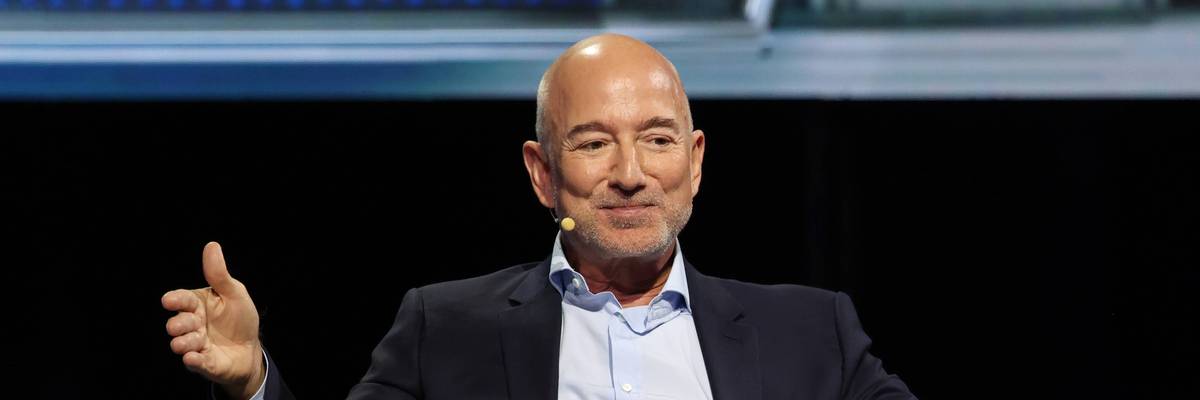
Jeff Bezos, founder and executive chairman of Amazon, speaks onstage during day 2 of the America Business Forum at Kaseya Center on November 6, 2025, in Miami.
(Photo by Alexander Tamargo/Getty Images for America Business Forum)

Stephen Prager
May 07, 2026
COMMON DREAMS


The architect of California’s wealth tax proposal called out The Washington Post and its multibillionaire owner, Amazon founder Jeff Bezos, on Thursday for peddling what he said is “misinformation” to readers.

Emmanuel Saez, a French economist and professor at the University of California, Berkeley, who was tapped by California’s largest union to design the tax proposal, singled out an opinion piece by the Washington Post editorial board from earlier this week that argues the proposal would backfire and cost California billions of dollars in tax revenue each year.

Saez said the article contains glaring falsehoods and omits key information about the proposal, which aims to create a one-time tax of 5% on the total assets of California’s roughly 200 billionaire residents in order to recoup about $100 billion in revenue for healthcare, food assistance, and education stripped from the state by last year’s Republican federal budget legislation, which will hand $1 trillion in tax breaks to the wealthiest 1% of Americans over the next 10 years.


The piece, published on Monday with the headline “California already losing with billionaire tax referendum,” argues that even if California voters don’t ultimately approve the measure, “the specter of such a wealth tax has already cost the state more in lost future revenue from income taxes than it would raise” due to an exodus of wealthy people from the state—an oft-used but weakly substantiated talking point by opponents of the measure.

The Post cited a paper by Jared Walczak, a visiting fellow at the California Tax Foundation, which it said demonstrates that billionaire flight “will cost California’s state government somewhere between $3.5 billion and $4.5 billion every year in other tax collections, and up to $19 billion in lost [gross domestic product].”

But Saez argued that his study makes a “basic mistake” by “modeling a mobility response of billionaires to a permanent annual and recurrent 5% wealth tax.” In reality, though, the tax would be imposed only once and would apply to any billionaires who resided in the state after January 1, 2026, which has already passed, so it no longer creates an incentive to move.

Saez argued that in any case, “Walczak’s estimation of the California income tax paid by billionaires who have threatened to leave is also wildly exaggerated.”

Walczak’s figure for lost tax revenue, he said, hinges on the idea that the three richest men who’ve threatened to leave the state, Google co-founders Sergey Brin and Larry Page, and Meta CEO Mark Zuckerberg, pay $1.7 billion in California income taxes each year.

“If only they paid so much!” Saez quipped.

“In reality, using Securities and Exchange Commission data on stock sales, stock donations, dividends, and executive compensation, we can directly estimate that they paid only [$269 million] in California income tax in 2025, 6.3 times less than Walczak’s assumption,” he said, citing a paper he co-wrote in March responding to a similar argument by a conservative think tank.

He cited tax data showing that the tech tycoons—who own a combined $810 billion according to Forbes—only collectively paid about [$22 million] per year on average between 2019-25, with Brin and Page paying no taxes on their wealth from stock in Google’s parent company Alphabet during three of those years because they didn’t sell stock, get dividends, or receive executive compensation. This is despite 90% of their wealth coming from those holdings.

“The one-time wealth tax finally makes them contribute in proportion to their enormous wealth gains,” Saez said.

The Post also claimed that the Service Employees International Union (SEIU) United Healthcare Workers West, the union leading the charge in support of the referendum, is “pretend[ing] that the tax is needed to save California’s health system from ‘collapse’” and is instead dishonestly using that framing to covertly pursue the “redistribution of wealth.”

But Saez said that the federal cuts of roughly $20 billion annually are already having devastating effects on Californians that could be alleviated with more tax revenue.

As a result of the cuts, “more than 400 California hospitals have already laid off more than 3,400 healthcare workers as of mid-March, with a second wave of layoffs expected as funding cuts tied to recent federal policy changes are phased in over the next several years,” he said. “Statewide, projections show the cuts could result in the loss of up to 145,000 healthcare jobs, impacting hospitals, clinics, and home care providers alike.”

Eighty-three more hospitals in California may be at risk of closing due to the federal funding cuts, according to a recent nationwide analysis by Public Citizen. But Saez said the billionaire’s tax would go a long way toward closing the gap.

“Right now, California’s billionaires pay much lower tax rates than what working families pay out of every paycheck,” Saez said.

Despite claims otherwise by the Post editorial board—which last month ran another piece arguing that due to progressive taxation, “the rich already pay more than their fair share”—according to the Institute on Taxation and Economic Policy, at all levels of government from 2018-20, billionaires paid just 24% of their total income in taxes, while the US-wide average was 30%. This disparity arises largely due to loopholes that allow the rich to avoid taxes on business and investment gains that are not sold.

“Local hospitals and emergency rooms could shut their doors forever because billionaires insist on paying less than the rest of us,” Saez said.

Debru Carthan, the executive vice president of SEIU-United Healthcare Workers West, said it was not surprising that the Post “completely ignores that the billionaire tax would keep hospitals from closing and healthcare costs from skyrocketing for millions of Californians” because it is “a crisis that comes as a direct result of the tax breaks handed out to Jeff Bezos and his buddies.”


Since the return of Donald Trump to the presidency, the Amazon founder has taken a much heavier hand over the content of his flagship paper, including its opinion section, which he last year mandated to exclusively publish pieces on economics that promote “personal liberties and free markets,” leading to the resignation of opinion editor David Shipley.

But Saez marveled at how blatant Bezos’ thumb on the scale has appeared in his paper’s coverage of California’s billionaire wealth tax and similar proposals, which it has denounced on several other occasions.

“Are readers meant to take this seriously?” Saez asked. “'Board of billionaire-owned paper comes out against tax on billionaires’? Everyone knows this board makes political decisions at the behest of Jeff Bezos, but this one is the most transparent of them all.”

A billionaire just accidentally delivered the most compelling argument for a wealth tax


By James Duncan Davidson/O'Reilly Media, Inc. - BY 2.0, 

May 06, 2026
ALTERNET

Google co-founder Sergey Brin, one of the three or four wealthiest people in the world, with a net worth hovering around $260 billion to $277 billion, is devoting some of his wealth to fighting California’s wealth tax on billionaires.

So far, he’s spent $57 million trying to defeat the measure.

Brin’s actions — along with Elon Musk’s $250 million “investment” in getting Trump reelected in 2024 — should be Exhibits A and B in why America needs a wealth tax.


First, let’s stipulate that there is nothing inherently wrong about being a billionaire, a multibillionaire, or even, as Musk is likely to become, a trillionaire.

Wealth isn’t a “zero-sum” game in which these vast accumulations at the top depend on the rest of us losing an equal amount. In fact, the super-wealthy may help the rest of us do somewhat better than we were doing before.


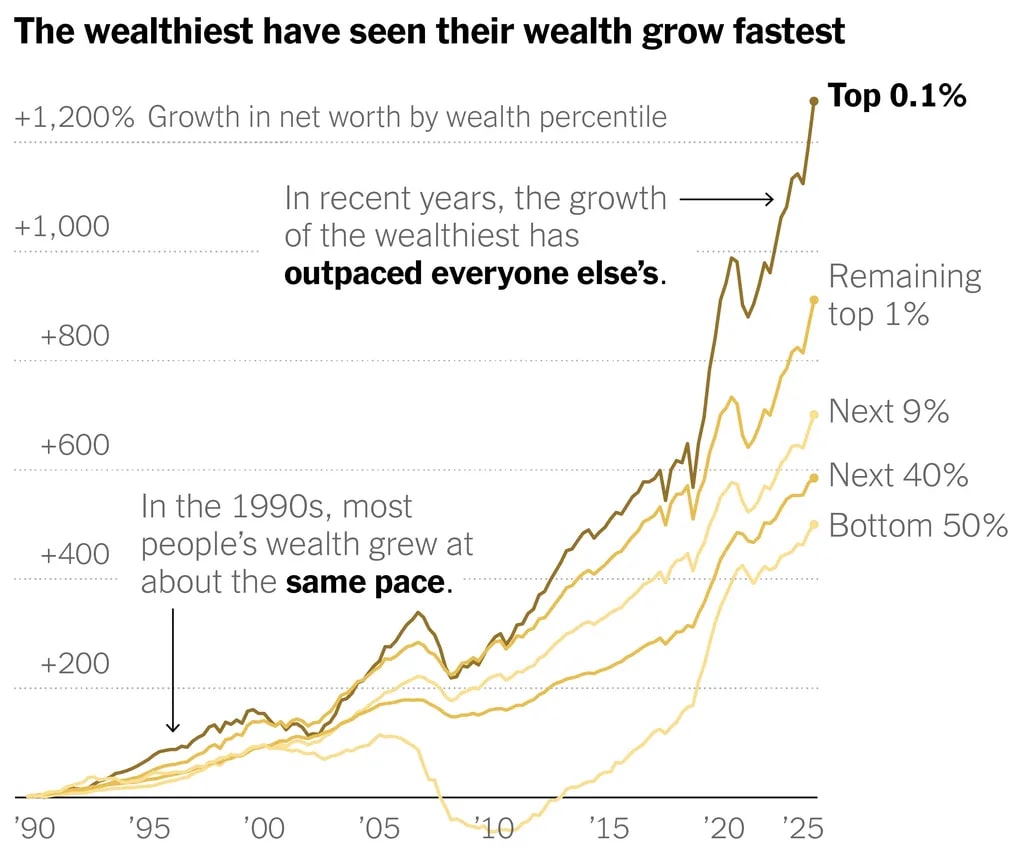
Even though the wealth of the top 0.1 percent has soared in recent years, the bottom 50 percent are doing somewhat better than before. (See chart here.)

But wait.

The problem is that political power is a zero-sum game. The more political power is concentrated in a few hands, the less political power in everyone else’s hands.


It’s almost impossible to separate wealth from power, because the wealthy turn their fortunes into campaign contributions to politicians who will change laws to their liking and stop laws they’d detest — such as higher taxes on the super-wealthy. The wealthy also finance public relations campaigns and think-tanks to persuade the public of the wisdom of their positions.

Billionaire spending on presidential elections has soared even faster than billionaire wealth. And if you believe they’re donating because they want people with great integrity and excellent character to be elected president, consider that most billionaire political spending in 2024 went to Trump.

They’re donating because they want to protect and enlarge their fortunes and don’t want politicians elected who support higher taxes on them.


Nor do they want politicians elected who support stricter anti-monopoly legislation or who would make it easier to form labor unions or stop climate change (all of which might reduce the profits of, say, Google).

Take Sergey Brin and his $57 million against California’s tax on billionaires — which, not incidentally, was proposed because California must now pay more for Medicaid for lower-income Californians, because Trump and his Republican lackeys enacted a giant federal tax cut whose benefits have gone mostly to the wealthy.

Brin has become a major Republican donor. Last May, he donated nearly half a million dollars to the Republican National Committee.

Why? Because the Republican Party is more dedicated to protecting and enlarging the wealth of the super-wealthy than is the Democratic Party.


By spending his fortune trying to stop California from taxing billionaires, Brin is illustrating why we need to tax billionaires. He’s making the argument for a billionaire wealth tax more clearly and articulately than anyone else possibly could.

Thank you, Serge.

Robert Reich is a professor of public policy at Berkeley and former secretary of labor. His writings can be found at https://robertreich.substack.com/.


Trump Tariffs Ruled Illegal—Again—as Data Shows Promised Manufacturing Boom Is Nonexistent

“The average household has already had nearly $2,000 stolen from them by this administration, and they should not have to pay a penny more,” said one House Democrat.


US President Donald Trump delivers remarks on tariffs during an event at the White House on April 2, 2025.
(Photo by Brendan Smialowski/AFP via Getty Images)

Jake Johnson
May 08, 2026
COMMON DREAMS


A panel of federal judges ruled Thursday that US President Donald Trump’s sweeping 10% tariffs on most imports are unlawful, another major legal blow to the centerpiece of the Republican president’s economic agenda—which has failed to produce the manufacturing boom he repeatedly promised on the campaign trail.

The Court of International Trade (CIT) found in a 2-to-1 ruling that Trump violated the law when he unilaterally enacted the 10% import taxes following a February decision by the US Supreme Court, which struck down tariffs the president imposed using emergency powers. But the CIT’s ruling, which the Trump administration is expected to appeal, only barred collection of the tariffs from some of the plaintiffs in the case—including a pair of businesses and Washington state—limiting the ruling’s immediate impact.

Rep. John Larson (D-Conn.), a member of the House Trade Subcommittee, applauded the new ruling in a statement, saying that “Trump must comply with the law by ending his illegal tax on the American people and getting families and small businesses the refunds they are owed.”

“The Supreme Court already rebuked the president’s costly tariffs, but Donald Trump sees our Constitution as a mere suggestion to follow, and not the law of the land,” said Larson. “As families are squeezed by sky-high grocery bills and gas prices, his latest round of tariffs is only pouring salt in the wound. The average household has already had nearly $2,000 stolen from them by this administration, and they should not have to pay a penny more.”

The decision came as a new analysis of trade and manufacturing data from the first quarter of 2026 found that the president’s “actions on trade have not delivered on his promises to quickly balance trade and revitalize US manufacturing.” Since Trump’s return to the White House last year, US manufacturing employment has declined by 82,000 jobs, according to the Rethink Trade program at the American Economic Liberties Project.

Additionally, the nation’s trade deficit was higher during the first three months of this year compared to the same period in 2024, Rethink Trade found.

“The first-quarter 2026 data show President Trump’s promises to prioritize speedily cutting the trade deficit and create more American manufacturing jobs are getting undermined by his chaotic and often mistargeted use of tariffs and squandering of leverage to demand other countries gut their Big Tech anti-monopoly and other policies instead of mercantilist abuses fueling the trade deficit,” said Lori Wallach, Rethink Trade’s director.
‘Spain Does Not Look the Other Way’: Sánchez Calls on EU to Block Israel-US Sanctions on ICC

“Sanctioning those who defend international justice puts the entire human rights system at risk,” said the Spanish prime minister.


Spanish Prime Minister Pedro Sánchez is seen delivering a speech as he takes part in a rally on May 1, 2026.
(Photo by Jesus Merida/SOPA Images/LightRocket via Getty Images)

Stephen Prager
May 06, 2026
COMMON DREAMS

Spanish Prime Minister Pedro Sánchez asked the European Commission on Wednesday to block compliance with US sanctions against the International Criminal Court over its arrest warrants against Israeli leaders accused of war crimes and crimes against humanity in Gaza.

Last February, US President Donald Trump signed an executive order sanctioning the ICC, citing its warrants in November 2024 for the arrest of Israeli Prime Minister Benjamin Netanyahu and his former defense minister, Yoav Gallant.

The ICC said at the time that the sanctions were meant to “harm its independent and impartial judicial work,” potentially restricting officials’ access to US-linked property, services, travel, banking, and financial transactions, as they investigate widespread human rights violations and accusations of genocide during the more than two-year military campaign, which has resulted in the deaths of at least 72,000 Palestinians according to official estimates.

In a letter to European Commission President Ursula von der Leyen on Wednesday, Sánchez called for the immediate activation of the European Union’s Blocking Statute, which is designed to protect European citizens from the effects of foreign sanctions.

Spain does not look the other way,” Sánchez said in a post to social media. “Sanctioning those who defend international justice puts the entire human rights system at risk.”

“The EU cannot remain idle in the face of this persecution,” he continued. “That is why, today, we ask the commission to activate the Blocking Statute, to protect the independence of the International Criminal Court and the United Nations, and their actions to end the genocide in Gaza.”

In addition to the ICC, Sánchez said that the commission should also shield Francesca Albanese, the United Nations special rapporteur for the Palestinian territories, whom the Trump administration also sanctioned in July, claiming that her stark criticisms of Israel’s actions in Gaza helped to “prompt” the ICC investigation.

Following the announcement, Albanese issued a message of thanks to Sánchez over social media.

“Gracias, Presidente Sánchez,” she wrote. “For your words, for your principled stance, and for trying to steer Europe away from the abyss.”
House Democrats Urge US State Dept to End Silence About Israel’s Nuclear Weapons


“Washington’s silence on the program is indefensible amid the war in Iran and the acute threat of military escalation, they argue. And they are right,” said one arms control expert.

Jake Johnson
May 05, 2026
COMMON DREAMS

More than two dozen Democratic lawmakers in the US House of Representatives are urging the Trump administration to break its official silence on Israel’s nuclear weapons program, whose existence is almost universally acknowledged even as its origins and status remain shrouded in secrecy.

In a letter to US Secretary of State Marco Rubio on Monday, the group of House Democrats led by Rep. Joaquin Castro of Texas wrote that “Congress has a constitutional responsibility to be fully informed about the nuclear balance in the Middle East, the risk of escalation by any party to this conflict, and the administration’s planning and contingencies for such scenarios,” particularly as it wages war on Iran in partnership with the Israeli government.

“The risks of miscalculation, escalation, and nuclear use in this environment are not theoretical,” the lawmakers wrote. “A policy of official ambiguity about the nuclear capabilities of one party to this conflict makes coherent nonproliferation policy in the Middle East impossible, for Iran, for Saudi Arabia, and for every other state in the region making decisions based on their perceptions of the capabilities of their neighbors.”

The House Democrats pressed Rubio to provide detailed information the US possesses about Israel’s nuclear weapons program, including the country’s current fissile material capability, nuclear doctrine, and “any indications of Israel planning to use or deploy nuclear weapons during the recent Iran conflict or during other conflicts.”

Israeli leaders have for decades maintained a posture of deliberate ambiguity regarding their country’s nuclear weapons capacity, even as some officials have at times tacitly acknowledged the nation’s nukes—including by suggesting they could be dropped on Gaza—and falsely claimed that Iran was on the verge of creating a nuclear weapon.

Israel is believed to have begun producing nuclear weapons in the 1960s, helped in part by uranium that US intelligence agencies suspected was obtained from a factory in the United States.

Analysts estimate that Israel currently has between 90 and 300 nuclear warheads, according to the Stockholm International Peace Research Institute (SIPRI).

“The United States’ indulgence of Israeli nuclear weapons has not escaped international attention, and the evident hypocrisy has undermined US nonproliferation policy,” Victor Gilinsky, a former commissioner of the US Nuclear Regulatory Commission, and Leonard Weiss, a visiting scholar at Stanford University’s Center for International Security and Cooperation, wrote in a March op-ed for the Bulletin of the Atomic Scientists.

“The US government’s public position continues to be that it does not know anything about Israeli nuclear weapons, and this will apparently continue until Israel releases the United States’ gag,” Gilinsky and Weiss continued. “This policy is allegedly enforced by a secret federal bulletin that threatens disciplinary actions for any US official who publicly acknowledges Israel’s nuclear weapons.”

Experts and anti-war campaigners applauded the group of House Democrats for demanding an end to the US government’s official silence on Israel’s nuclear weapons program.

“Washington’s silence on the program is indefensible amid the war in Iran and the acute threat of military escalation, they argue. And they are right,” said Daryl Kimball, director of the Arms Control Association.

The advocacy group Win Without War thanked Castro and his colleagues for “breaking DC’s ‘taboo’ over the Israeli government’s nuclear weapons—especially concerning as US and Israeli leaders wage a disastrous war of choice in the Middle East.”
Fuel Prices Have Spiked More in ‘Energy Independent’ US Than in Nations That Have Moved Away From Oil and Gas

“The only real energy independence from the Middle East is renewables,” said one policy expert.


Solar panels are seen in the city port in Barcelona, Spain on March 27, 2026.
(Photo by Davide Bonaldo/SOPA Images/LightRocket via Getty Images)

Stephen Prager
May 05, 2026
COMMON DREAMS

Average gas prices in the United States are quickly climbing toward $5 per gallon this week as US President Donald Trump’s war with Iran shows little sign of resolution.

Where average prices were about $2.98 the day before the war’s launch, they had shot up to $4.48 as of Tuesday, according to AAA’s gas price tracker, as Iran’s restriction of ships traveling through the Strait of Hormuz has squeezed global oil shipping and the shipping of other fuel sources like liquefied natural gas (LNG), causing global price hikes.

And while Trump has touted America’s supposed “energy independence” as an ace in the hole, achieved by ratcheting up fossil fuel production while canceling solar and wind power projects, data shows that the US has been hit harder by the price shocks than any other major economy in the world, with those that have embraced renewable energy being especially resilient.


Although the US leads the world in oil production by a large margin, data from JP Morgan Commodities research, analyzed Friday by MarketWatch, showed that between February 23 and April 27, the US experienced about a 42% increase in gas prices, the fifth-highest in the world.

“The spike in US gasoline prices over the past two months has outpaced everywhere except Southeast Asia, the region most dependent on oil from the Persian Gulf,” explained Yahoo Finance geopolitics reporter Jake Conley.

Rebecca Babin, senior energy trader and managing director at CIBC Private Wealth, explained to MarketWatch last week that while increased fuel production gives the US a “buffer,” oil is a global market and “it doesn’t operate in a vacuum.” She said, “Global tightness and domestic bottlenecks still show up in gasoline prices.”

Meanwhile, some of the countries that have best survived the price hikes include France and Spain, which derive large shares of their power from nuclear energy and renewables, respectively.

Craig Hanson and Jessica Isaacs, a pair of researchers at the World Resources Institute, explained last month that while a mix of factors is at play, countries less reliant on fossil fuels generally “find themselves in a better position to withstand the current crisis.”

“Every country has homegrown access to at least two clean energy resources—the sun shines, and the wind blows just about everywhere at some point,” they said. “The same cannot be said of oil and gas, where production is concentrated in a small number of countries and exposed to geopolitical disruption.”

“Renewable resources like wind, solar, and geothermal have zero fuel costs, and the fuel cost of nuclear power is quite low. Again, the same cannot be said of fossil fuels, which have costs set by volatile global markets,” they added. “These two advantages are why some of the world’s clean energy frontrunners are faring better than other countries amidst the Iranian energy crisis.”

As Reuters reported in late April, the contrast between Europe’s biggest gas guzzlers and green energy adopters is particularly stark.

While Albania has kept energy prices in check and even lowered them compared to last year by using its large system of hydroelectric dams, which supply much of its power, countries like Germany and Italy, which still rely heavily on gas, have seen electricity prices spike.

Hanson and Isaacs noted that while clean energy investments have helped soften the blow of global price shocks, the effects are not the same across the board. While price hikes for the electricity used to power factories, homes, and cars have been blunted by the availability of alternative energy sources, others, like heat—which are more reliant on natural gas—have still been affected.

Still, though, they said the crisis has shown that in addition to environmental sustainability, “clean energy systems’ greatest benefits today might actually be price stability and domestic energy resilience.”

While Trump has continued his efforts to choke off any federal investment in renewable energy and double down on oil and gas production, other nations have taken the war’s price hikes as a sign to further accelerate their transition away from fossil fuels.

Germany and several other European Union members, for example, have announced expedited timelines to expand offshore wind and solar investments, explicitly citing the volatility in oil markets caused by the war.

Stephen Wertheim, a senior fellow in the American Statecraft Program at the Carnegie Endowment for International Peace, said the energy price shocks showed that “the only real energy independence from the Middle East is renewables.”