It’s possible that I shall make an ass of myself. But in that case one can always get out of it with a little dialectic. I have, of course, so worded my proposition as to be right either way (K.Marx, Letter to F.Engels on the Indian Mutiny)
Friday, March 20, 2026
Trump burned all his bridges — and now no one will help him
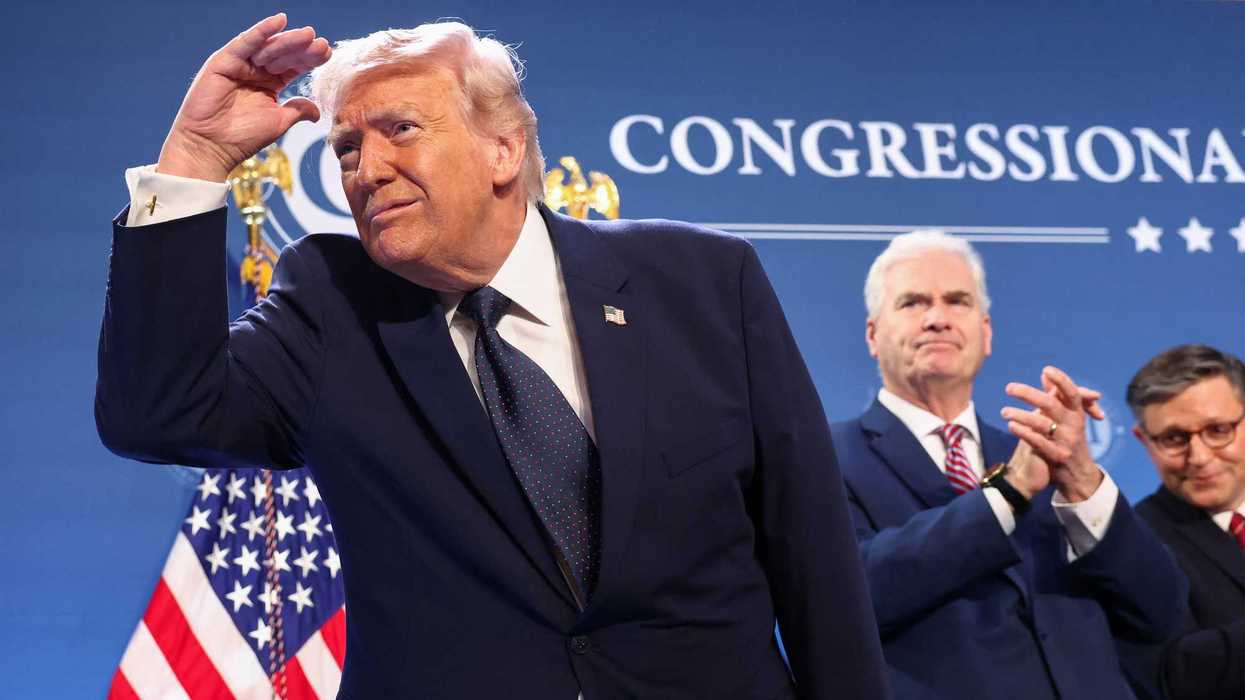
U.S. President Donald Trump looks from the stage after delivering remarks to members of the Republican Party, at Trump National Doral Miami in Miami, Florida, U.S., March 9, 2026. REUTERS/Kevin Lamarque
Donald Trump for three days now has been chiding NATO allies, as well as China and other countries, saying they should send forces to open the Strait of Hormuz (even as he paradoxically says we don’t need their help), which Iran has basically held hostage in the wake of the U.S. attack on the country 18 days ago in a war with no endgame.
The entire world economy is rocked. Hundreds of oil tankers are stuck, while the few that have tried to move through have been attacked—17 in total—or are given the green light by Iran, which allowed a Pakistani ship to pass yesterday. Iran’s own ships are sailing through, bringing oil to China.
Iran is in total control of the strait.
Trump is making veiled threats to allies, saying it would be a “mistake” for NATO if they don’t help. Nonetheless, no one is coming to his aid.
French President Emmanuel Macron put out a firm statement: “We are not party to the conflict, and therefore France will never take part in operations to open or liberate the Strait of Hormuz in the current context.”
Germany’s chancellor Friedrich Merz made it clear as well: “It is not NATO’s war. NATO is an alliance to defend the alliance area. The United States did not consult us before this war, and so we believe this is not a matter for NATO or the German government.”
Most of the other allies have made similar statements or said nothing at all. Merz is, of course, right. Why on earth would leaders who weren’t consulted on the war before it began join the U.S. after it surprised the world, putting many other countries in danger? And why would any leader get behind the authoritarian Benjamin Netanyahu of Israel and the more deranged-by-the-day Trump, putting their own service members in harm’s way?
It’s not a shock that Trump doesn’t understand why these countries are reticent, because he thinks he’s a genius. And of course, his having vilified them over the past year and his having even tried to take Greenland a few months ago (something he may still try to do) probably isn’t something he even thinks about in terms of creating bad blood.
Nor are the horrendous tariffs he put in place and the economic turmoil he caused in Europe and most of the rest of the world something in the front of his mind now that he wants their help. He’s a selfish, self-centered individual. Trump doesn’t get that if you treat people like s----, you’ll get the same in return.
But even for Trump, it is stunning that he thinks that these countries’ leaders could do something even if they wanted. His tariffs, his threats of land grabs, and his throwing Ukraine under the bus while bowing to Putin several times have created enormous anti-American sentiment among the voting public in those countries—even among conservative voters.
In Canada there are people walking around with t-shirts that ask, “Is he dead yet?” The anger Trump unleashed in calling Canada the 51st state and slapping tariffs on it caused the Liberal Party candidate Mark Carney to mount a stunning comeback last year and become prime minister after conservatives were earlier predicted to win in a landslide. The anger among people across Europe is also palpable over Greenland and Ukraine.
It’s quite clear that if leaders actually supported Trump’s war by sending ships to the strait they’d be engaging in political suicide. It’s jarring that Trump doesn’t at least see that. And anything he does now to retaliate—throwing more tariffs on them or pulling support for Ukraine or NATO—would only help these leaders with their electorates.
And that really underscores the most dangerous aspect of Trump’s actions in Iran. He doesn’t care what the American public thinks—he never made a case for the war to the American people—and this is the first war in modern history which the majority are against from the outset. He doesn’t even care about his own MAGA base as it fractures over the war.
Trump said at a press conference that British Prime Minister Starmer told him I need to “meet with my team” before making any decision on sending help.
“You don’t need to meet with your team. You’re the prime minister. You don’t have to meet with your team” Trump said he told Starmer.
That is the essence of a dictator. Don’t consult anyone—neither advisers nor the people. That’s how he got us into this mess, and it’s a mess that will only grow, as the those inside the White House worry and as Trump contemplates sending in ground troops.
Trump wants to upend voting to fix a 'virtually nonexistant' problem
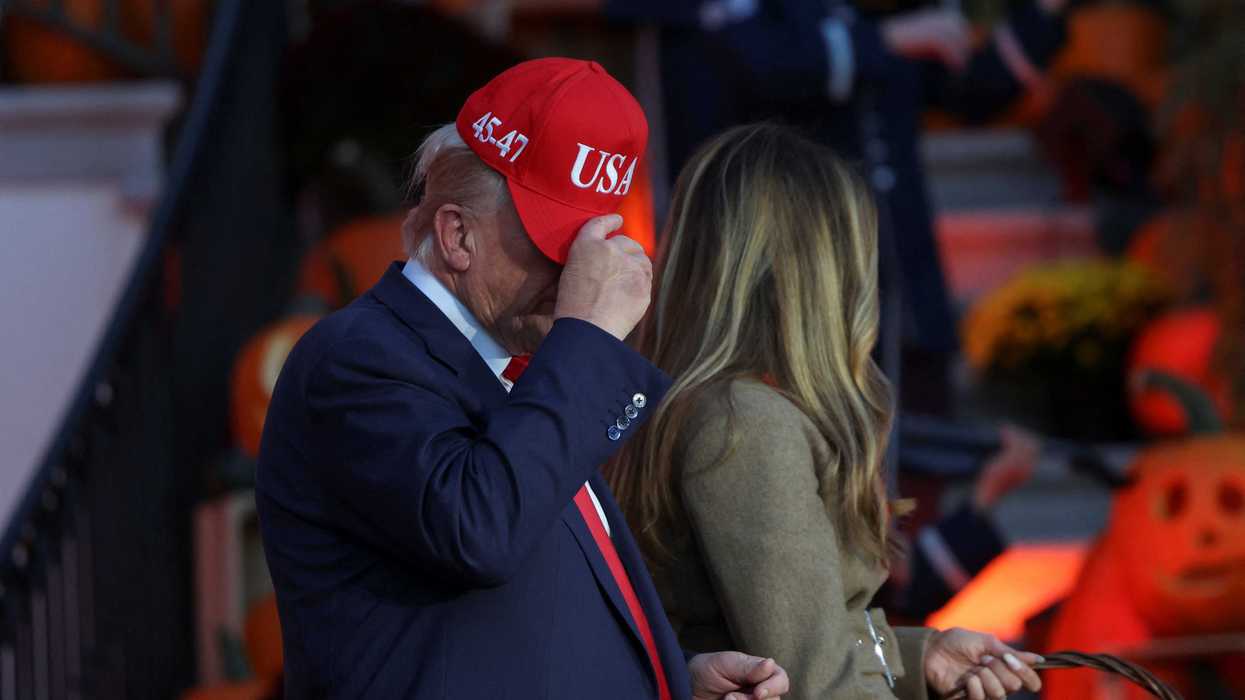
President Donald Trump during a Halloween event at the White House in Washington, D.C., October 30, 2025. REUTERS/Kylie Cooper
President Donald Trump has demanded that Congress treat the SAVE America Act as its "no. 1 priority," but according to a new analysis from the New York Times, the bill would upend the voting process for millions to fix a problem that is "virtually nonexistent."
In a piece published Wednesday, political commentator Jamelle Bouie broke down why the bill would impose "a broad set of new voting restrictions" for no good reason. Trump has claimed that the new rules — requiring proof of citizenship when registering to vote and a photo ID at polling places — will address widespread voter fraud, both from non-citizens voting and from people pretending to be others at polling locations. As Bouie explained, these are two issues that are so rare as to be negligible.
"Both noncitizen voting and in-person voter fraud are virtually nonexistent — they simply do not happen," Bouie explained. "Election officials aren’t flying blind either; every state that requires voter registration requires some identification to register, and 36 states have explicit voter ID laws. No matter where you vote in the United States, you must at some point prove your residence and identity."
The SAVE Act would, then, impose new barriers to voting that are both redundant and, for many, a considerable inconvenience. As Bouie explained further, while supporters of the bill have argued that the requirements around proving citizenship are reasonable, in practice, they require documentation — like birth certificates or passports – that many Americans lack easy access to.
"To register to vote, you would have to prove that you were an American citizen," Bouie wrote. "And the only acceptable documents under the law are a passport, a REAL ID that verifies citizenship, a valid military or tribal ID or a birth certificate. You do not need a sharp mind to see the problems here. Roughly half of Americans do not have a passport and millions of people, especially older Americans, lack easy access to their birth certificates. Overall, according to the Brennan Center for Justice, an estimated 9 percent of eligible voters, or 21.3 million Americans, do not have ready access to documents that could prove their citizenship."
The obstacles do not stop there. Acquiring a passport can cost a minimum of $165, which many low-income Americans simply do not have to spare. New birth certificate copies also carry fees, leading many critics to brand the SAVE Act as a new form of discriminatory "poll taxes." The bill would also require all voter registration to be done in-person, which Bouie explained would be "a serious obstacle for the tens of millions of Americans who are infirm, disabled, rely on public transportation or live in rural areas, far from a government office."
White House appears to have ‘plagiarized’ war justifications from Israel
Since President Donald Trump launched the war against Iran, the conflict has spiraled out of control, resulting in attacks throughout the Middle East, growing numbers of military and civilian casualties, and an energy crisis that threatens to upend the entire global economy. Two weeks ago, Trump was saying the war was “very complete,” but as of today, it is being reported that the Strait of Hormuz could remain closed for months and that the U.S. is sending thousands of troops to the region — not exactly signs that the situation is drawing down.
Early on, these attempts included the release of a document listing Iranian attacks against Americans, in which it was claimed that Trump’s war is an endeavor to “eliminate the threat once and for all.” But after digging by independent journalist Stephen McIntyre, it appears that list was “plagiarized” directly from a 2025 document published by an Israeli think tank on the eve of the U.S. bombing of Iran last June.
The White House document lists 992 American deaths spanning 44 incidents while providing no source for the information. But a side-by-side comparison with a list prepared by former AIPAC employee Tzvi Kahn and published by the Foundation for the Defense of Democracies (FDD) — the mission statement of which says it was founded to "provide education to enhance Israel's image in North America” — reveals that the two documents are “virtually identical,” with slight changes seemingly made with the intention of “ratcheting up the underlying allegation.”
For example, while the dates, assertions, and often wording included are nearly identical between the two documents, the White House version will sometimes attempt to emphasize Iran’s involvement by inserting the phrase “Iran-backed” into attacks committed by proxies like Hamas or Hezbollah.
Arguably the biggest difference between the two documents involved 9/11 and the subsequent war in Iraq. In the FDD version, one point attempts to draw unsubstantiated parallels between the 9/11 hijackers and Iran. While the White House list removed this entry, it added one attributing some 603 military deaths in Iraq to “Iran-backed militias,” “the largest single item (by far) in the entire list, accounting for 60% of the total attributed deaths.” And as McIntyre points out, that attribution was never reported by the State Department and has been “vigorously disputed” by experts. What’s more, in both documents, only a single death was directly attributed to Iran rather than its proxies, and some of the deaths listed were never officially attributed to any attacker at all.
The White House document may be intended to provide hard facts to justify the war, but as McIntyre concluded, “the reporting didn't come from an intelligence assessment,” but from Israeli assets.
'Out of the closet': Former Republican has a theory about white Christian nationalism
Former Republican US Rep. Joe Walsh said his old part is unquestionably outing itself as a white Christian nationalist party now.
“Man, they're out of the closet. They're loud and proud,” said Walsh on his Friday podcast. “Speaker of the House Mike Johnson talks about this. Republican members of Congress talk about this. Republican and MAGA thought leaders talk about the fact that America needs to be a Christian country. It needs to be officially designated as a Christian country.”
Walsh pulled a scenario of Secretary of Defense Pete Hegseth ending a press conference “by looking the American people in the eye [and saying] I want every American, every American adult and child to get down on bended knee and pray for our troops in the name of Allah.”
“Imagine the reaction to that. I think the Fox News … corporate headquarters would explode,” said Walsh. “… Can you imagine how upset and p—— off so many Americans would be?”
Hegseth’s actual line before reporters, like many similar lines that preceded it, was “… to the American people, please pray for them every day on bended knee with your family in your schools in your churches in the name of Jesus Christ.”
“He knows that not every American worships Jesus Christ,” Walsh said. “So what's he doing? Here's what he's doing. Pete Hegseth is a white Christian nationalist. Pete Hegseth, the Secretary of Defense, is a white Christian nationalist. He wants America to be a white Christian nation.”
“Our founders were very enlightened,” continued Walsh, explaining that many were both Christian and believers, but they understood the importance of separating religion from state.
“We do not have an official state religion,” said Walsh. “The very thought of that, the very notion of that is antithetical to what America is. … Christian nationalism is utterly un-American … as un-American as Islamism is. … Islamism is a radical concept that everybody's got to be Islam. Christian nationalism, same thing. Everybody's got to be Christian. Both are utterly un-American.”
“And I guess what I'm saying right now is, as I close on this, this Un-American, and by the way, un-Christian belief, has overtaken the Republican Party. And we need everybody to wake up to it. Fast. and help all of us, help everyone defeat it.”
Trump's 100% approval among MAGAs exposes who actually suffers from derangement: expert
President Donald Trump provokes TDS in a camp you may not expect.
The people with so-called Trump Derangement Syndrome are not who you may believe them to be, states Michael Tomasky, writing in The New Republic.
One look at recent polling provides a clue, the piece claims.
“Nate Silver found Trump’s approval slipping into uncharted territory, and approval of the war generally polls in the 30s—but at the same time, an NBC News poll discovered that among self-identified MAGAs, Trump’s approval stood literally at 100 percent to zero.”
So who earns TDS honors? “I’d say that we shouldn’t even accept the presumption that Trump Derangement Syndrome applies to people like us,” Tomasky writes. “It does not. The people who suffer from TDS in this country are the ones who support him.”
He adds, “Awareness is a far heavier burden than derangement.”
Case in point on that argument was Trump’s recent quip during his press availability with Japanese Prime Minister Sanae Takaichi. A Japanese reporter asked him why he didn’t inform U.S. allies before starting the Iran war. Trump’s response included this gem:“Who knows better about surprise than Japan? Why didn’t you tell me about Pearl Harbor?”
Uproar predictably ensued in the U.S. and Japan, “a combination of outrage and resignation that the president of the United States is both an idiot and a moral eunuch, from whom such simultaneously tedious and offensive bilge is expected.”
Perhaps the worst part, Tomasky writes, “is that Trump likened the U.S. attack on Iran to the Japanese attack on Hawaii. Trump was saying it was a good thing that the United States emulated the actions of a fascist regime that had killed millions and raped infants in China. Still, the details of history mean nothing to Trump. History is only about great men, and whether they win or lose.”
That attitude is reflected in the current Iran quagmire. Trump was somehow convinced that he could beat Iran “by sheer dint of his will.”
“That’s precisely the kind of thing you come to believe when you’ve cheated your way through life,” Tomasky writes. “Am I overstating things? Do I suffer—gasp—from Trump Derangement Syndrome?”
Tomasky underlines his final point on that by citing an essay from Simon Lazarus, who warns liberals not to become obsessed with Trump, but to focus on his supporters.
“He’s right about that,” Tomasky concludes.
Trump's last resort: Inside his four-part plan to topple American democracy
Many of you are justifiably worried that Trump will interfere in the midterm elections. He’s worried he’ll lose Congress: His polls continue to plummet. The economy is worse than ever. Prices are rising. Few new jobs are being created. And his war in Iran is going badly.
We also know he has no qualms about trying to overturn elections. He’s tried before. In February, he stated he would only respect the results of the 2026 midterms “if the elections are honest” — echoing his dangerous threat from 2020. He’s also kicked off a redistricting war and called for elections to be “nationalized.”
He continues to make the baseless claim that noncitizens are voting in our elections, but multiple investigations and fact-checks by election officials from both parties have repeatedly confirmed it is exceedingly rare.
Hence, it’s important now — eight months before the midterms — to “harden” our election systems and be vigilant against what he’s likely to do.
So today I’d like your thoughts on what he’s most likely to do and where the biggest threats lie.
I’m most concerned about Trump interfering in one of these ways:
1. Enacting a federal law requiring proof of citizenship (birth certificate or passport) and an exactly matching current photo ID, in person, to vote.
These requirements are in the SAVE America Act, which the House passed last month and is now under consideration in the Senate. It would disqualify an estimated 21 million people from voting, most of them Democrats, because they can’t afford the cost or hassle of finding their birth certificates — including married women who have changed their names.
The act also threatens election officials with imprisonment if they fail to uphold the bill’s strict voter documentation requirements, and it makes it harder to cast mail-in ballots (throwing into chaos eight states where vote-by-mail is currently the primary method of voting).
The act is a risk, to be sure, but Trump can’t get this measure through the Senate, because Democrats are sure to filibuster it. The only way it has a prayer is if almost every Senate Republican voted to abolish the filibuster. But this is doubtful because some Senate Republicans fear that without the filibuster, Democrats would be able to pass laws that Republicans abhor when Dems are next in the majority.
2. Stationing ICE and Border Patrol agents at polling places.
Some worry that Immigration and Customs Enforcement and Border Patrol agents will be deployed at polling locations during the midterm elections. The intent would obviously be to intimidate voters, especially in immigrant communities and communities of color, and create fear at the ballot box.
This is also a risk, but (for what it’s worth) the Department of Homeland Security says it won’t happen. Heather Honey, who serves as deputy assistant secretary for election integrity at DHS, told a group of secretaries of state that “any suggestion that ICE will be present at any polling location is simply not true.”
Meanwhile, measures to restrict federal agents from operating at or near election-related locations have been introduced in more than half a dozen states. Plus, a federal law dating to the end of the Civil War already bans sending the military or other “armed men” to polling places, except to repel armed enemies of the United States. Finally, the U.S. Constitution also gives states — not the president or federal government — the responsibility for running elections.
3. Seizing ballots and voting machines.
Tulsi Gabbard, director of national intelligence, has been working for months on an investigation into foreign election interference in U.S. voting machines, which could become a pretext for the regime’s seizing them to protect “national security.” Gabbard and the FBI induced Puerto Rico to turn over some of its voting machines and software images for analysis last year.
Gabbard was also on hand on January 28 in Fulton County, Georgia, when the FBI — acting on a search warrant that relied on debunked claims about the 2020 race — seized hundreds of boxes of ballots from a government warehouse. And the Department of Justice has issued lawsuits against dozens of states for copies of their voter rolls that include sensitive personal information.
It’s not hard to imagine the FBI or Justice Department trying to seize ballots while the 2026 midterm votes are being counted. Trump demanded as much in 2020, although his then attorney general rejected that as unlawful. Pam Bondi, the current attorney general, has shown herself willing to do whatever Trump asks, regardless of what the law says.
But the federal courts are unlikely to allow this. A president doesn’t have the authority to regulate elections, which the Constitution assigns to the states.
4. Getting pro-Trump forces to take over state and local voting systems.
Pro-Trump forces in swing states are trying to change election rules and take over local voting systems.
In recent months, Republicans in Michigan, Arizona, and North Carolina have sought changes in election rules that would hobble likely Democratic voters. They want to alter the places and times of voting to disadvantage Democrats, require high levels of proof of citizenship, and challenge the certifications of Democratic winners. Republicans in more than half of state legislatures have introduced legislation to restrict mail-in ballots.
But many of these initiatives have already been struck down by state and federal courts, and voting rights lawyers tell me that others will be challenged on First and 14th Amendment grounds.
Few state proposals to restrict mail-in ballots are under active consideration, presumably because Republicans worry that the restriction may hurt them as much if not more than Democrats. (Ditto for a bill now before Congress to ban mail-in ballots.)
Hence, today’s Office Hours question: Which is Trump’s most likely threat to the integrity of the midterm elections? Robert Reich is a professor of public policy at Berkeley and former secretary of labor. His writings can be found at https://robertreich.substack.com/.
'Nightmare scenario' that could mean the end of US democracy: report
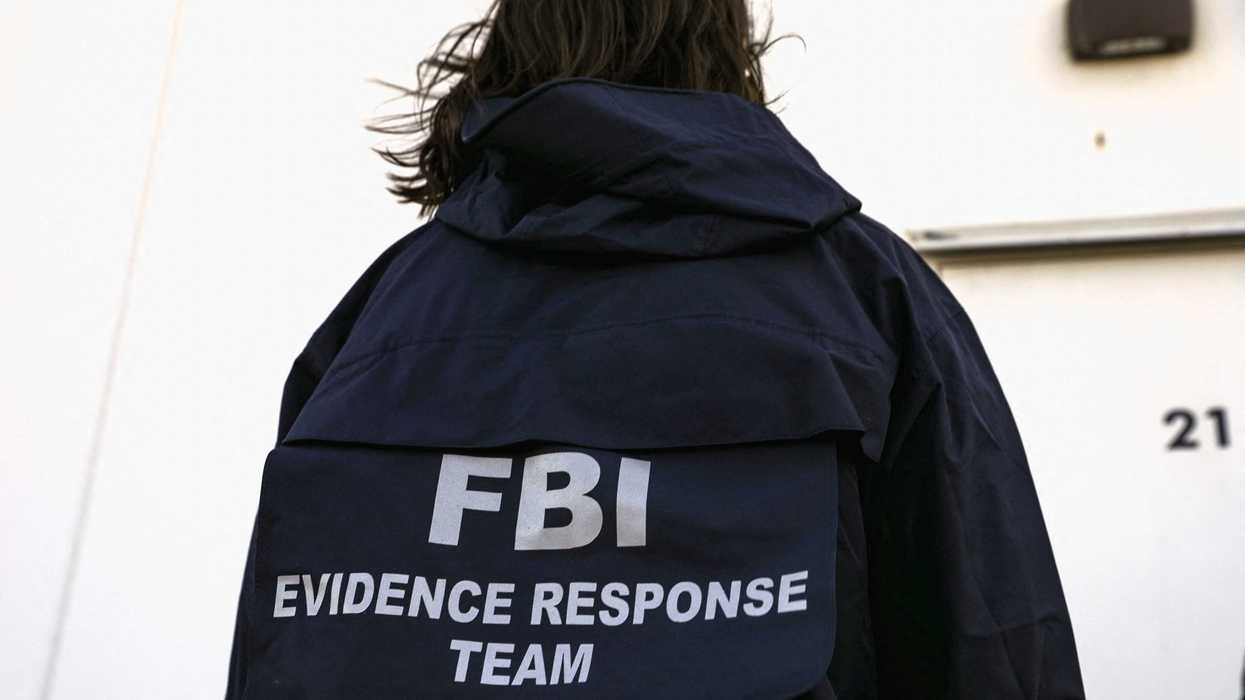
A member of the Federal Bureau of Investigation (FBI) Evidence Response Team prepares to enter the Fulton County Election Hub and Operation Center after the FBI executed a search warrant there in relation to the 2020 election, according to a law enforcement official familiar with the matter, in Union City, Georgia, U.S. January 28, 2026. REUTERS/Alyssa Pointer
President Trump is trying to steal the 2026 midterm elections in real time, experts say. But his opponents have the power to stop him.
In a recent report for Vox, Eric Levitz broke down the various methods that Trump may use to rig the results in his favor. These include ordering the military to seize voting machines and ballots in key districts before they have been counted, then altering the results so that the House Republicans can reject enough Democrats on the grounds of their “qualifications” to retain control of that chamber.
Levitz also pointed to Trump’s recent baseless raid on Fulton County, Georgia voting machines, with Director of National Intelligence Tulsi Gabbard present, as proof that Trump is considering doing this while claiming to protect national security. Finally Levitz observed that Trump has talked about stationing ICE at polling stations, which could chill voter turnout.
"For anybody who doubted that this administration is laying the foundation to interfere in elections, the deluge of activity over the last two weeks should lay those doubts to rest,” Wendy Weiser, Vice President of Democracy at the Brennan Center for Justice, told Vox. Weiser’s perspective was echoed by Derek Clinger, Senior Counsel at the State Democracy Research Initiative, University of Wisconsin Law School.
"The nightmare scenario used to be that Trump would invoke the Insurrection Act and have the military seize ballots and machines from a swing state on election night,” Clinger said. “But Fulton County suggests a much more plausible scenario: one where the seizure of ballots is conducted with the appearance of a legal process. I think that approach is both more likely to happen and also harder to challenge in real time."
Yet Levitz argues that Trump’s attempts could fail. Although Justin Levitt, a former Justice Department Official and professor at Loyola Law School, told Vox he believes Trump will do things like misuse ICE to deter people from voting, he does not think Trump’s attempts to directly meddle with voting will be upheld by courts.
"I think every magistrate judge in the country would understand the difference between a search warrant to seize materials for an election that happened five years ago and a search warrant to seize election materials from an election in progress,” Levitt told Vox. Referring to the courts upholding Trump’s Fulton County raid, Levitt said that “I understand why people are worried. But it's not remotely the same."
Levitz further added that any military seizure order would face judicial, political and potentially military resistance, with even some of Trump's own party members rebuking his election takeover remarks. Additionally, ICE does not have enough people to blanket large areas, and their presence at voting stations may inspire heavy turnout rather than intimidate voters into not showing up. Indeed, this is exactly what happened in a Minnesota special election following ICE operations.
As a result of Trump’s recent election meddling efforts, such as assigning an FBI Election Executive, House Minority Leader Hakeem Jeffries warned that “what Donald Trump wants to do is try to nationalize the election. Translation: steal it. And we're not going to let it happen.” Elie Mystal of The Nation condemned people who downplay the threat of Trump stealing the elections, arguing “to ignore the threat posed by Trump, to pretend like everything is going to be okay, to assume that upstanding members of the courts will rise to prevent the theft of the election is to stick your head in the sand.”
He added, “Trump and the Republicans have no intention of letting the upcoming midterms (in which Republicans are predicted to lose control of the House) proceed fairly.”
Although Trump claims the 2020 election was stolen from him, the president has a long history of making baseless claims of theft whenever he loses. When “The Apprentice” was snubbed for Emmys, he accused the process of being rigged. After losing the 2016 GOP Iowa caucuses, he claimed Texas Senator Ted Cruz had stolen them. Before the 2016 presidential election against Hillary Clinton, he declared he'd only accept results "if I win." Then, despite winning in the Electoral College against Clinton, Trump falsely alleged millions voted illegally to explain his vote loss in the popular vote. When he lost in both the Electoral College and popular vote to former President Joe Biden in the 2020 presidential election (despite trying to throttle mail-in votes by jamming up the Post Office), he filed dozens of lawsuits — losing 59 cases out of 60 cases that were rejected by over 90 judges, including many of his own appointees. Even Trump's then-Attorney General, William Barr, found no evidence Trump lost through fraud.
'Hate, hate, hate': Data guru has bad news for Trump
CNN anchor Boris Sanchez says “history shows that when fuel prices rise, a president's popularity can drop,” and polling appeared to verify his claim.
CNN analyst Harry Enten had no good news for President Donald Trump regarding his recent impact on gas prices and how this was sinking the future of his Republican Party.
“Not good. Not good, Boris Sanchez. “Not good,” said Enten. “I mean, look at what we're talking about here. … Net approval of Trump on gas prices overall: Whoo! -39 points. My goodness gracious. You think that's low. Look at Independence! Even lower: -53 points.”
“He is underwater, swimming in the deep blue sea,” said Enten. “And even amongst those who voted for him in 2024, he's getting just 56 approval there. The bottom line is this: Americans, Independence: They hate, hate, hate the way that Trump is handling gas prices at this point.”
Enten pointed out that Trump was more trusted on handling the cost of living than Kamala Harris in Oct. 2024 by more than 3 points. In fact, inflation was the key reason why Trump was reelected to a second term. It sank the Biden presidency and derailed Harris' chances of winning.
But today Enten points out that Trump is -41 points on the cost of living.
“And I was digging deeper into that poll, Boris, and I saw that his net approval rating among Independents was -60. Minus 60 points! Among Independents [he has] a near universal dislike of trust on the cost of living,” Enten added. “This is now a record low for Donald Trump on the cost of living, including either his first term or his second term. And with gas prices going up, that means the cost of living is going up as well.”
Where this puts Trump and Republicans just a few months ahead of midterms is an even more dismal prediction, said Enten.
“Trump is below 50 percent. And with the president's party average House midterm seat shift … they lose 35 seats on average in the House of Representatives when the president … at the beginning of the spring, before the midterm election, his approval rating is under 50 percent — and Donald Trump is way under 50 percent.
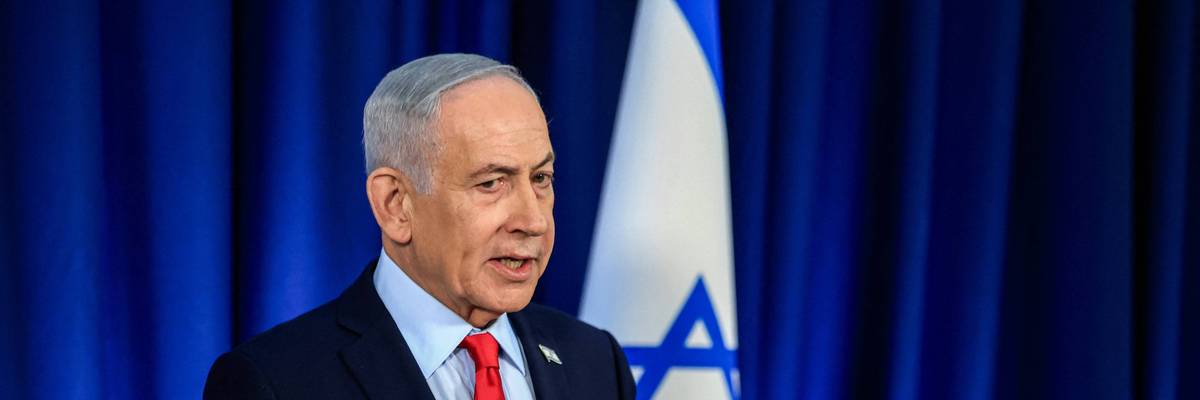
Israeli Prime Minister Benjamin Netanyahu said Thursday that “there has to be a ground component” to the war on Iran as a new survey of US voters showed just 7% support for a large-scale invasion involving American forces.
“It is often said that you can’t win, you can’t do revolutions from the air. That is true,” Netanyahu told reporters during a press conference in Jerusalem. “You can do a lot of things from the air... but there has to be a ground component, as well. There are many possibilities for this ground component. And I take the liberty of not sharing with you all of those possibilities.”
Netanyahu’s insistence on the necessity of ground operations in Iran came as US President Donald Trumpdeclared to reporters in the White House on Thursday, “I’m not putting troops anywhere.”
“If I were,” he added, “I certainly wouldn’t tell you.”
A Reuters/Ipsos poll released Thursday found that just 7% of US voters support the idea of a large-scale ground invasion of Iran—but 65% of Americans believe that Trump will order such an operation anyway.
Just 34% of US voters would support “deploying a small number of special forces troops” to Iran, the survey found, while 55% said they would oppose the use of any ground troops.
The survey came days after Reuters reported that the Trump administration is “considering deploying thousands of US troops to reinforce its operation in the Middle East, as the US military prepares for possible next steps in its campaign against Iran.”
The Pentagon’s push for $200 billion in supplemental funding from the US Congress, which did not authorize the Iran war, amplified concerns that the Trump administration is gearing up for a prolonged conflict that could involve American troops on the ground, despite Trump’s repeated public insistence that the war will be over “very soon.”
Both US and Israeli intelligence agencies have reportedly assessed that Iran’s regime is not on the verge of collapse after nearly three weeks of relentless bombing.
“Western officials and analysts who study Iran said they see little near-term prospect of a ‘regime change’ end to the 47-year-old Islamic republic or the rise of a more democratic government,” The Washington Postreported earlier this week. “The latter is a goal cited by Israeli Prime Minister Benjamin Netanyahu and sometimes by President Donald Trump, who has said he’ll know the war is over ‘when I feel it in my bones.’”
Raed Jarrar, advocacy director at the pro-democracy group DAWN, said Thursday that “the United States and Israel are not fighting the same war,” pointing to recent Israeli strikes on Iranian energy infrastructure. The strikes drew a public rebuke from Trump, who is facing soaring gas prices at home due to the illegal war he launched in partnership with Netanyahu.
“Trump wants a quick exit. Netanyahu wants to permanently destroy Iran as a regional power,” said Shakir. “There is an exit. Trump doesn’t need Israel’s permission to end this war. He’s done it before in Yemen. The longer he waits, the more Americans pay.”
Trita Parsi, executive vice president of the Quincy Institute for Responsible Statecraft, warned Thursday that Trump may be running out of time to “convincingly declare victory and provide himself a face-saving exit.”
“Israel will do all it can to sabotage any such off-ramp, including killing Iranian’s negotiators,” Parsi wrote. “But it will become increasingly clear—if it hasn’t already—to Trump that all his escalatory options only deepen the lose-lose situation he has put himself in.”
“That’s why Trump should never have listened to Netanyahu in the first place,” he added.
FCC Approval of Latest Megamerger Accelerates ‘Creation of State Media’ Under Trump, Critics Warn
One analyst said the Nexstar-Tegna merger was “yet another threat to our democracy, with fewer media companies controlling what gets reported on and how.” The Nexstar Media Group logo appears on a smartphone screen in this illustration photo in Reno, United States, on December 26, 2024. (Photo by Jaque Silva/NurPhoto via Getty Images)
Free press advocates warned Thursday that the Federal Communications Commission’s decision to greenlight Nexstar’s takeover of Tegna further imperils US democracy by accelerating the consolidation of broadcast media and extending the reach of right-wing propaganda.
According to The New York Times, the $6.2 billion deal will form a conglomerate that will “oversee 265 television stations in 44 states and Washington, reaching about 80% of US households,” making it by far the largest owner of local TV news in the country. Nexstar is headed by megamillionaire Perry Sook.
Commissioner Anna Gomez, the lone Democrat currently serving on the FCC, accused her colleagues of rushing approval of the Nexstar-Tegna merger while keeping the general public completely in the dark.
“This merger was approved behind closed doors with no open process, no full commission vote, and no transparency for the consumers and communities who will bear the consequences,” said Gomez, who added that the entire process was “meant to avoid public scrutiny.”
Several critics echoed Gomez’s concerns in denouncing approval of the merger.
Matt Wood, general counsel and vice president of policy at Free Press, accused the FCC of ignoring its own rules limiting broadcast TV station ownership to create a right-wing propaganda machine aimed at pushing the agenda of President Donald Trump and his allies.
“This deal would create a massive broadcast conglomerate willing to put the political agenda of Donald Trump over the needs of the communities local television serves,” said Wood. “[FCC Chairman Brendan] Carr and his allies in Nexstar’s executive suites have put up a smokescreen of rhetoric designed to dupe people into believing that these national conglomerates are truly local stations.”
John Bergmayer, legal director at Public Knowledge, described the FCC’s merger approval as “a betrayal of the agency’s legal obligations and the public it is supposed to serve.” He predicted the deal would have a devastating impact on the quality of local TV news.
“In every market where Nexstar already operates multiple stations, it has consolidated news operations, merged newsrooms, and cut staff,” Bergmayer said. “Nexstar’s CEO told investors the company analyzed the overlap markets ‘line by line, person by person’ to determine where to make cuts. Fewer owners means fewer reporters, fewer editorial voices, and fewer checks on local power.”
Bergmayer added that the merger is “yet another threat to our democracy, with fewer media companies controlling what gets reported on and how.”
Jeff Jarvis, professor emeritus at the CUNY Graduate School of Journalism, warned that the merger is part of “the creation of state media” under the Trump administration, and described it as “even more dangerous than Ellison Inc.,” a reference to the proposed megamerger between Paramount Skydance—a company controlled by the son of billionaire Trump donor Larry Ellison—and Warner Bros. Discovery.
Even with FCC approval, Nexstar’s acquisition of Tegna is not yet a done deal, as eight state attorneys general this week filed an antitrust lawsuit to block the merger.
California Attorney General Rob Bonta, one of the state AGs involved in the lawsuit, described the Nexstar-Tegna deal as “illegal, plain and simple.”
“When broadcast media is owned by a handful of companies, we get fewer voices, less competition,” said Bonta, “and communities lose the critical check on power that local journalism delivers.”
Americans Agree: The Government Shouldn’t Use AI Tech to Spy on Us
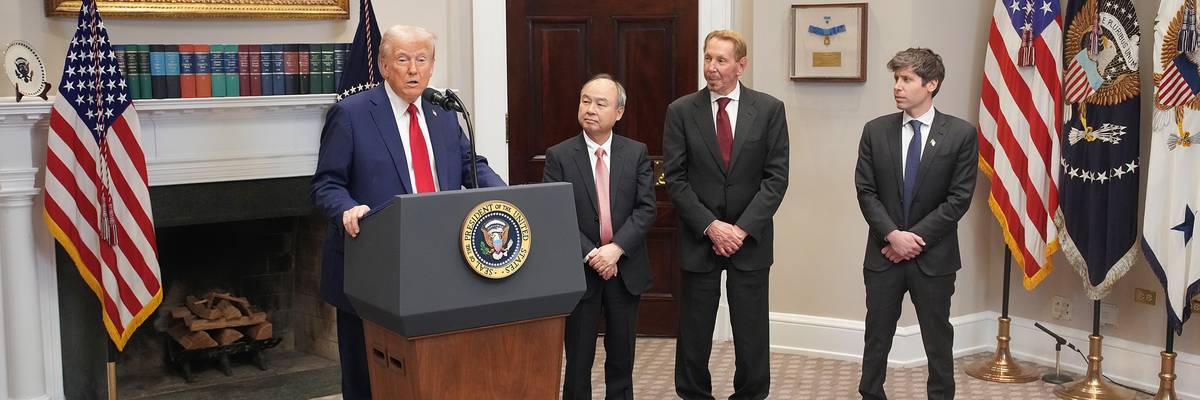
What is lacking is any action by Congress to protect our rights. Do we want to live in a country where our fundamental rights depend on the terms of service of powerful technology companies? U.S. President Donald Trump speaks in the Roosevelt Room of the White House while SoftBank CEO Masayoshi Son, Oracle CTO Larry Ellison, and OpenAI CEO Sam Altman look on on January 21, 2025 in Washington, DC. (Photo by Andrew Harnik/Getty Images)
Americans, it turns out, have a clearer view of the AI surveillance debate than most of Washington. A new poll from Americans for Responsible Innovation finds that 76% of Americans oppose allowing the government to force AI companies to hand over unrestricted access to their technology for surveilling citizens. The public, in other words, increasingly understands that our Fourth Amendment protections are under threat.
What is lacking is any action by Congress to protect our rights. Do we want to live in a country where our fundamental rights depend on the terms of service of powerful technology companies? The fight over whether the Pentagon should be able to use frontier AI for mass domestic surveillance and autonomous weapons has clarified the challenges we all face, especially under an administration with scant regard for the law.
It’s commendable that Anthropic took a principled stance and said no to the Department of Defense (DOD). But it is an outlier, for now. Others, like OpenAI, are eager to profit from the billions in government contracts and swooped in to replace Anthropic.
Frontier AI model companies are also only one part of enabling even more domestic surveillance of US citizens. Other companies, such as Microsoft and Amazon, provide critical infrastructure for AI models. For example, every query the Pentagon runs through GPT, every bulk data analysis, every AI-assisted profile of an American citizen that touches OpenAI’s models runs on Microsoft’s Azure cloud.
American citizens and consumers understand what is at stake here, and that is why an overwhelming majority oppose giving the government unchecked surveillance power.
OpenAI and Microsoft jointly confirmed on February 27 that Azure remains the exclusive cloud provider for OpenAI’s APIs, and that any collaboration between OpenAI and a third party, including for government use, is hosted on Azure. Microsoft is the infrastructure. And infrastructure is where surveillance lives. Other companies like Palantir use these models to build surveillance tools. Palantir reportedly has signed a billion-dollar contract with the Department of Homeland Security.
These companies hide behind terms of service, which they claim will stop the government from surveilling US citizens. But these are empty worlds.
OpenAI agreed to DOD terms when Anthropic wouldn’t, and then scrambled to dress up the deal with reassuring language after the backlash nearly buried it. Sam Altman himself admitted the whole thing was “rushed” and that “the optics don’t look good,” which is one way to describe handing the Pentagon sweeping AI capabilities while your competitor gets blacklisted for insisting on civil liberties protections.
When The Guardian reported in February that Immigration and Customs Enforcement (ICE) had more than tripled the data it stores on Azure in just six months, from 400 terabytes to nearly 1,400 terabytes, while deploying Microsoft’s own AI tools to search and analyze images and video, Microsoft responded with a one-liner: Its policies and terms of service “do not allow our technology to be used for the mass surveillance of civilians,” and the company does “not believe ICE is engaged in such activity.” That’s it. That is the entirety of Microsoft’s public position on AI-powered government surveillance in 2026: a terms-of-service claim and a profession of ignorance about what its own customer is doing with its own platform.
This is in contrast to the position Microsoft took in Israel, where last September Microsoft terminated access to Azure for an Israeli military intelligence unit after reporting confirmed the platform was being used for mass surveillance of Palestinians. The company’s president, Brad Smith, then declared that Microsoft prohibits its technology from being used for mass surveillance of civilians “in every country around the world”...except the US it seems.
These companies’ positions are strategically convenient and profitable for them, but untenable for all of us. Legal experts have spent weeks explaining why OpenAI’s revised contract language is insufficient to prevent surveillance, because the operative standard is “consistent with applicable law,” and the US government has historically interpreted that standard to accommodate sweeping surveillance programs.
The same applies to the terms of service of cloud service providers like Microsoft and Amazon. Have these changed substantially since the Snowden revelations that the National Security Agency was conducting mass digital surveillance? Instead of backing down, Amazon, for example, is extending this digital surveillance network into the real world via its Ring service. Dario Amodei is right, what’s at stake now is much larger—“a true panopticon on a scale that we don’t see today, even with the CCP.”
American citizens and consumers understand what is at stake here, and that is why an overwhelming majority oppose giving the government unchecked surveillance power. That kind of consensus is rare in American politics, and it cuts across partisan lines. Congress should act, and companies like Microsoft, Amazon, and the frontier AI companies should be on notice.
Our work is licensed under Creative Commons (CC BY-NC-ND 3.0). Feel free to republish and share widely.
Sumit Sharma Sumit Sharma is the executive director of NextGen Competition, and an independent economist, advocate, and policy expert in regulatory, competition and sectoral policies. Full Bio >
Trump AI Framework Would Deliver ‘Big Tech’s Top Policy Priority’: A Ban on State Regulations
“Written by Big Tech, for Big Tech,” said Rep. Yvette Clarke of the Trump administration proposal.
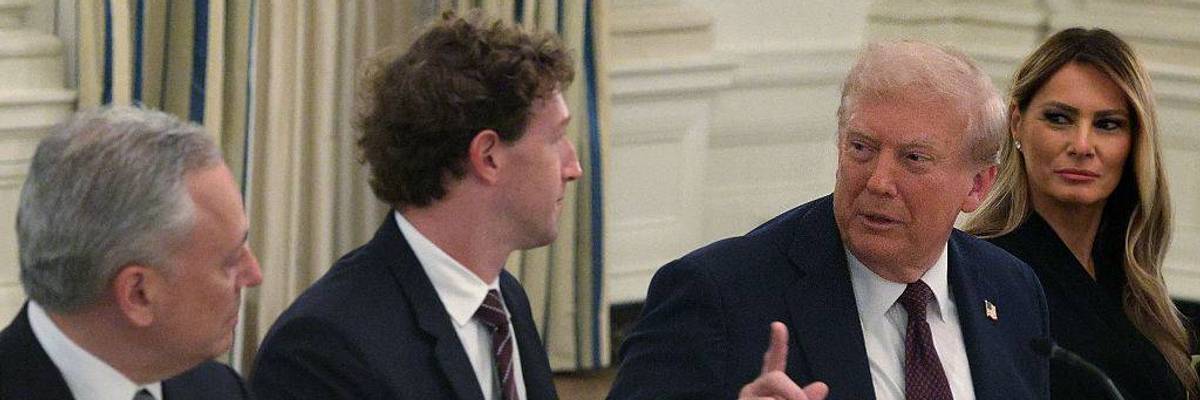
White House ‘AI and Crypto Czar’ David Scahs, Meta CEO Mark Zuckerberg, US President Donald Trump and first lady Melania Trump share a moment at the White House on September 4, 2025 in Washington, DC. (Photo by Alex Wong/Getty Images)
Specifically, Big Tech critics pointed to the framework’s recommendation that the federal government preempt state laws regulating AI that could otherwise “act contrary to the United States’ national strategy to achieve global AI dominance.”
“States should not be permitted to regulate AI development,” the framework stated, “because it is an inherently interstate phenomenon with key foreign policy and national security implications.”
The Trump administration’s paper also argued that states “should not unduly burden Americans’ use of AI for activity that would be lawful if performed without AI” and “should not be permitted to penalize AI developers for a third party’s unlawful conduct involving their models.”
Robert Weissman, co-president of Public Citizen, slammed the AI policy framework, which he said appeared designed “to protect Big Tech at the expense of everyday Americans.”
“Trump’s AI framework is a hollow document with only one tough and meaningfully binding provision, delivering Big Tech’s top policy priority: It aims to preempt all state laws and rules dealing with AI,” said Weissman. “Preemption would effectively mean no US regulation of AI at all, with the narrow exception of rules to deal with nonconsensual intimate deepfakes, because there are no national rules in place—and this framework would impose no additional standards of consequence.”
Weissman added that while states’ actions to regulate AI are inadequate, they are at least “trying to meet the novel and enormous challenges of the moment,” which “is exactly why Big Tech wants to shut down their efforts.”
Brad Carson, president of Americans for Responsible Innovation, called the White House’s preemption of state AI laws a mistake, predicting that it would lead to even worse problems than the ones created by unregulated social media over the past two decades.
“I think it’s like this: if you think the current state of play in social media guardrails are A-OK, then you’ll be fine with the framework,” he wrote. “If—like most—you believe we made catastrophic mistakes re social media, then you should fervently oppose this vacuous ‘framework.’”
Rep. Don Beyer (D-Va.) singled out the proposed ban on state AI regulations as a particularly troubling aspect of the framework.
“The White House National AI Policy Framework reinforces the Trump administration’s commitment to preempting state-level AI laws without the establishment of clear, enforceable federal guardrails to address the urgent risks posed by AI systems,” he wrote. “It even seeks to limit congressional regulatory action. But until federal action ensures safe and responsible AI development, deployment, and use, states must retain the ability to implement policies to protect the American public.”
Matt Stoller, an antitrust researcher and author of the BIG newsletter, argued that the Trump AI framework should be one of the first things a future Democratic president throws in the garbage after taking office.
Rep. Yvette Clarke (D-NY) delivered a pithy analysis of the White House framework, describing it as being “written by Big Tech, for Big Tech.”