What is lacking is any action by Congress to protect our rights. Do we want to live in a country where our fundamental rights depend on the terms of service of powerful technology companies?
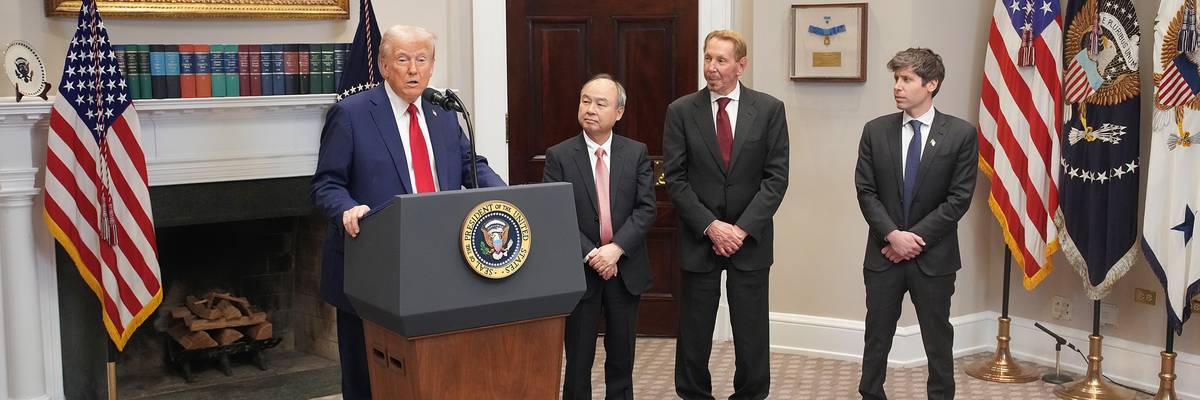
U.S. President Donald Trump speaks in the Roosevelt Room of the White House while SoftBank CEO Masayoshi Son, Oracle CTO Larry Ellison, and OpenAI CEO Sam Altman look on on January 21, 2025 in Washington, DC.
(Photo by Andrew Harnik/Getty Images)
Sumit Sharma
Mar 20, 2026
Common Dreams
Americans, it turns out, have a clearer view of the AI surveillance debate than most of Washington. A new poll from Americans for Responsible Innovation finds that 76% of Americans oppose allowing the government to force AI companies to hand over unrestricted access to their technology for surveilling citizens. The public, in other words, increasingly understands that our Fourth Amendment protections are under threat.
What is lacking is any action by Congress to protect our rights. Do we want to live in a country where our fundamental rights depend on the terms of service of powerful technology companies? The fight over whether the Pentagon should be able to use frontier AI for mass domestic surveillance and autonomous weapons has clarified the challenges we all face, especially under an administration with scant regard for the law.

Rights and Tech Coalition Calls On Congress to End Warrantless Mass Surveillance

Bucking ‘Huge Consensus’ at India Summit, Trump Admin Opposes Global AI Guardrails
It’s commendable that Anthropic took a principled stance and said no to the Department of Defense (DOD). But it is an outlier, for now. Others, like OpenAI, are eager to profit from the billions in government contracts and swooped in to replace Anthropic.
Frontier AI model companies are also only one part of enabling even more domestic surveillance of US citizens. Other companies, such as Microsoft and Amazon, provide critical infrastructure for AI models. For example, every query the Pentagon runs through GPT, every bulk data analysis, every AI-assisted profile of an American citizen that touches OpenAI’s models runs on Microsoft’s Azure cloud.
American citizens and consumers understand what is at stake here, and that is why an overwhelming majority oppose giving the government unchecked surveillance power.
OpenAI and Microsoft jointly confirmed on February 27 that Azure remains the exclusive cloud provider for OpenAI’s APIs, and that any collaboration between OpenAI and a third party, including for government use, is hosted on Azure. Microsoft is the infrastructure. And infrastructure is where surveillance lives. Other companies like Palantir use these models to build surveillance tools. Palantir reportedly has signed a billion-dollar contract with the Department of Homeland Security.
These companies hide behind terms of service, which they claim will stop the government from surveilling US citizens. But these are empty worlds.
OpenAI agreed to DOD terms when Anthropic wouldn’t, and then scrambled to dress up the deal with reassuring language after the backlash nearly buried it. Sam Altman himself admitted the whole thing was “rushed” and that “the optics don’t look good,” which is one way to describe handing the Pentagon sweeping AI capabilities while your competitor gets blacklisted for insisting on civil liberties protections.
When The Guardian reported in February that Immigration and Customs Enforcement (ICE) had more than tripled the data it stores on Azure in just six months, from 400 terabytes to nearly 1,400 terabytes, while deploying Microsoft’s own AI tools to search and analyze images and video, Microsoft responded with a one-liner: Its policies and terms of service “do not allow our technology to be used for the mass surveillance of civilians,” and the company does “not believe ICE is engaged in such activity.” That’s it. That is the entirety of Microsoft’s public position on AI-powered government surveillance in 2026: a terms-of-service claim and a profession of ignorance about what its own customer is doing with its own platform.
This is in contrast to the position Microsoft took in Israel, where last September Microsoft terminated access to Azure for an Israeli military intelligence unit after reporting confirmed the platform was being used for mass surveillance of Palestinians. The company’s president, Brad Smith, then declared that Microsoft prohibits its technology from being used for mass surveillance of civilians “in every country around the world”...except the US it seems.
These companies’ positions are strategically convenient and profitable for them, but untenable for all of us. Legal experts have spent weeks explaining why OpenAI’s revised contract language is insufficient to prevent surveillance, because the operative standard is “consistent with applicable law,” and the US government has historically interpreted that standard to accommodate sweeping surveillance programs.
The same applies to the terms of service of cloud service providers like Microsoft and Amazon. Have these changed substantially since the Snowden revelations that the National Security Agency was conducting mass digital surveillance? Instead of backing down, Amazon, for example, is extending this digital surveillance network into the real world via its Ring service. Dario Amodei is right, what’s at stake now is much larger—“a true panopticon on a scale that we don’t see today, even with the CCP.”
American citizens and consumers understand what is at stake here, and that is why an overwhelming majority oppose giving the government unchecked surveillance power. That kind of consensus is rare in American politics, and it cuts across partisan lines. Congress should act, and companies like Microsoft, Amazon, and the frontier AI companies should be on notice.
Our work is licensed under Creative Commons (CC BY-NC-ND 3.0). Feel free to republish and share widely.
Sumit Sharma
Sumit Sharma is the executive director of NextGen Competition, and an independent economist, advocate, and policy expert in regulatory, competition and sectoral policies.
Full Bio >
Americans, it turns out, have a clearer view of the AI surveillance debate than most of Washington. A new poll from Americans for Responsible Innovation finds that 76% of Americans oppose allowing the government to force AI companies to hand over unrestricted access to their technology for surveilling citizens. The public, in other words, increasingly understands that our Fourth Amendment protections are under threat.
What is lacking is any action by Congress to protect our rights. Do we want to live in a country where our fundamental rights depend on the terms of service of powerful technology companies? The fight over whether the Pentagon should be able to use frontier AI for mass domestic surveillance and autonomous weapons has clarified the challenges we all face, especially under an administration with scant regard for the law.
Rights and Tech Coalition Calls On Congress to End Warrantless Mass Surveillance
Bucking ‘Huge Consensus’ at India Summit, Trump Admin Opposes Global AI Guardrails
It’s commendable that Anthropic took a principled stance and said no to the Department of Defense (DOD). But it is an outlier, for now. Others, like OpenAI, are eager to profit from the billions in government contracts and swooped in to replace Anthropic.
Frontier AI model companies are also only one part of enabling even more domestic surveillance of US citizens. Other companies, such as Microsoft and Amazon, provide critical infrastructure for AI models. For example, every query the Pentagon runs through GPT, every bulk data analysis, every AI-assisted profile of an American citizen that touches OpenAI’s models runs on Microsoft’s Azure cloud.
American citizens and consumers understand what is at stake here, and that is why an overwhelming majority oppose giving the government unchecked surveillance power.
OpenAI and Microsoft jointly confirmed on February 27 that Azure remains the exclusive cloud provider for OpenAI’s APIs, and that any collaboration between OpenAI and a third party, including for government use, is hosted on Azure. Microsoft is the infrastructure. And infrastructure is where surveillance lives. Other companies like Palantir use these models to build surveillance tools. Palantir reportedly has signed a billion-dollar contract with the Department of Homeland Security.
These companies hide behind terms of service, which they claim will stop the government from surveilling US citizens. But these are empty worlds.
OpenAI agreed to DOD terms when Anthropic wouldn’t, and then scrambled to dress up the deal with reassuring language after the backlash nearly buried it. Sam Altman himself admitted the whole thing was “rushed” and that “the optics don’t look good,” which is one way to describe handing the Pentagon sweeping AI capabilities while your competitor gets blacklisted for insisting on civil liberties protections.
When The Guardian reported in February that Immigration and Customs Enforcement (ICE) had more than tripled the data it stores on Azure in just six months, from 400 terabytes to nearly 1,400 terabytes, while deploying Microsoft’s own AI tools to search and analyze images and video, Microsoft responded with a one-liner: Its policies and terms of service “do not allow our technology to be used for the mass surveillance of civilians,” and the company does “not believe ICE is engaged in such activity.” That’s it. That is the entirety of Microsoft’s public position on AI-powered government surveillance in 2026: a terms-of-service claim and a profession of ignorance about what its own customer is doing with its own platform.
This is in contrast to the position Microsoft took in Israel, where last September Microsoft terminated access to Azure for an Israeli military intelligence unit after reporting confirmed the platform was being used for mass surveillance of Palestinians. The company’s president, Brad Smith, then declared that Microsoft prohibits its technology from being used for mass surveillance of civilians “in every country around the world”...except the US it seems.
These companies’ positions are strategically convenient and profitable for them, but untenable for all of us. Legal experts have spent weeks explaining why OpenAI’s revised contract language is insufficient to prevent surveillance, because the operative standard is “consistent with applicable law,” and the US government has historically interpreted that standard to accommodate sweeping surveillance programs.
The same applies to the terms of service of cloud service providers like Microsoft and Amazon. Have these changed substantially since the Snowden revelations that the National Security Agency was conducting mass digital surveillance? Instead of backing down, Amazon, for example, is extending this digital surveillance network into the real world via its Ring service. Dario Amodei is right, what’s at stake now is much larger—“a true panopticon on a scale that we don’t see today, even with the CCP.”
American citizens and consumers understand what is at stake here, and that is why an overwhelming majority oppose giving the government unchecked surveillance power. That kind of consensus is rare in American politics, and it cuts across partisan lines. Congress should act, and companies like Microsoft, Amazon, and the frontier AI companies should be on notice.
Our work is licensed under Creative Commons (CC BY-NC-ND 3.0). Feel free to republish and share widely.
Sumit Sharma
Sumit Sharma is the executive director of NextGen Competition, and an independent economist, advocate, and policy expert in regulatory, competition and sectoral policies.
Full Bio >
Trump AI Framework Would Deliver ‘Big Tech’s Top Policy Priority’: A Ban on State Regulations
“Written by Big Tech, for Big Tech,” said Rep. Yvette Clarke of the Trump administration proposal.

White House ‘AI and Crypto Czar’ David Scahs, Meta CEO Mark Zuckerberg, US President Donald Trump and first lady Melania Trump share a moment at the White House on September 4, 2025 in Washington, DC.
(Photo by Alex Wong/Getty Images)
Brad Reed
Mar 20, 2026
COMMON DREAMS
The Trump administration on Friday released its national policy framework for regulating artificial intelligence, and critics said it gave Silicon Valley a massive gift by coming out in favor of barring state regulation of the technology.
Specifically, Big Tech critics pointed to the framework’s recommendation that the federal government preempt state laws regulating AI that could otherwise “act contrary to the United States’ national strategy to achieve global AI dominance.”

Trump’s Big Tech Pledge Won’t Do: Advocates Make Case for Nationwide Moratorium on Data Centers
“States should not be permitted to regulate AI development,” the framework stated, “because it is an inherently interstate phenomenon with key foreign policy and national security implications.”
The Trump administration’s paper also argued that states “should not unduly burden Americans’ use of AI for activity that would be lawful if performed without AI” and “should not be permitted to penalize AI developers for a third party’s unlawful conduct involving their models.”
Robert Weissman, co-president of Public Citizen, slammed the AI policy framework, which he said appeared designed “to protect Big Tech at the expense of everyday Americans.”
“Trump’s AI framework is a hollow document with only one tough and meaningfully binding provision, delivering Big Tech’s top policy priority: It aims to preempt all state laws and rules dealing with AI,” said Weissman. “Preemption would effectively mean no US regulation of AI at all, with the narrow exception of rules to deal with nonconsensual intimate deepfakes, because there are no national rules in place—and this framework would impose no additional standards of consequence.”
Weissman added that while states’ actions to regulate AI are inadequate, they are at least “trying to meet the novel and enormous challenges of the moment,” which “is exactly why Big Tech wants to shut down their efforts.”
Brad Carson, president of Americans for Responsible Innovation, called the White House’s preemption of state AI laws a mistake, predicting that it would lead to even worse problems than the ones created by unregulated social media over the past two decades.
“I think it’s like this: if you think the current state of play in social media guardrails are A-OK, then you’ll be fine with the framework,” he wrote. “If—like most—you believe we made catastrophic mistakes re social media, then you should fervently oppose this vacuous ‘framework.’”
Rep. Don Beyer (D-Va.) singled out the proposed ban on state AI regulations as a particularly troubling aspect of the framework.
“The White House National AI Policy Framework reinforces the Trump administration’s commitment to preempting state-level AI laws without the establishment of clear, enforceable federal guardrails to address the urgent risks posed by AI systems,” he wrote. “It even seeks to limit congressional regulatory action. But until federal action ensures safe and responsible AI development, deployment, and use, states must retain the ability to implement policies to protect the American public.”
Matt Stoller, an antitrust researcher and author of the BIG newsletter, argued that the Trump AI framework should be one of the first things a future Democratic president throws in the garbage after taking office.
Rep. Yvette Clarke (D-NY) delivered a pithy analysis of the White House framework, describing it as being “written by Big Tech, for Big Tech.”
“Written by Big Tech, for Big Tech,” said Rep. Yvette Clarke of the Trump administration proposal.
White House ‘AI and Crypto Czar’ David Scahs, Meta CEO Mark Zuckerberg, US President Donald Trump and first lady Melania Trump share a moment at the White House on September 4, 2025 in Washington, DC.
(Photo by Alex Wong/Getty Images)
Brad Reed
Mar 20, 2026
COMMON DREAMS
The Trump administration on Friday released its national policy framework for regulating artificial intelligence, and critics said it gave Silicon Valley a massive gift by coming out in favor of barring state regulation of the technology.
Specifically, Big Tech critics pointed to the framework’s recommendation that the federal government preempt state laws regulating AI that could otherwise “act contrary to the United States’ national strategy to achieve global AI dominance.”
Trump’s Big Tech Pledge Won’t Do: Advocates Make Case for Nationwide Moratorium on Data Centers
“States should not be permitted to regulate AI development,” the framework stated, “because it is an inherently interstate phenomenon with key foreign policy and national security implications.”
The Trump administration’s paper also argued that states “should not unduly burden Americans’ use of AI for activity that would be lawful if performed without AI” and “should not be permitted to penalize AI developers for a third party’s unlawful conduct involving their models.”
Robert Weissman, co-president of Public Citizen, slammed the AI policy framework, which he said appeared designed “to protect Big Tech at the expense of everyday Americans.”
“Trump’s AI framework is a hollow document with only one tough and meaningfully binding provision, delivering Big Tech’s top policy priority: It aims to preempt all state laws and rules dealing with AI,” said Weissman. “Preemption would effectively mean no US regulation of AI at all, with the narrow exception of rules to deal with nonconsensual intimate deepfakes, because there are no national rules in place—and this framework would impose no additional standards of consequence.”
Weissman added that while states’ actions to regulate AI are inadequate, they are at least “trying to meet the novel and enormous challenges of the moment,” which “is exactly why Big Tech wants to shut down their efforts.”
Brad Carson, president of Americans for Responsible Innovation, called the White House’s preemption of state AI laws a mistake, predicting that it would lead to even worse problems than the ones created by unregulated social media over the past two decades.
“I think it’s like this: if you think the current state of play in social media guardrails are A-OK, then you’ll be fine with the framework,” he wrote. “If—like most—you believe we made catastrophic mistakes re social media, then you should fervently oppose this vacuous ‘framework.’”
Rep. Don Beyer (D-Va.) singled out the proposed ban on state AI regulations as a particularly troubling aspect of the framework.
“The White House National AI Policy Framework reinforces the Trump administration’s commitment to preempting state-level AI laws without the establishment of clear, enforceable federal guardrails to address the urgent risks posed by AI systems,” he wrote. “It even seeks to limit congressional regulatory action. But until federal action ensures safe and responsible AI development, deployment, and use, states must retain the ability to implement policies to protect the American public.”
Matt Stoller, an antitrust researcher and author of the BIG newsletter, argued that the Trump AI framework should be one of the first things a future Democratic president throws in the garbage after taking office.
Rep. Yvette Clarke (D-NY) delivered a pithy analysis of the White House framework, describing it as being “written by Big Tech, for Big Tech.”

No comments:
Post a Comment