Sunday, March 22, 2026


Iran War Aftermath: War Reparations Claim – OpEd
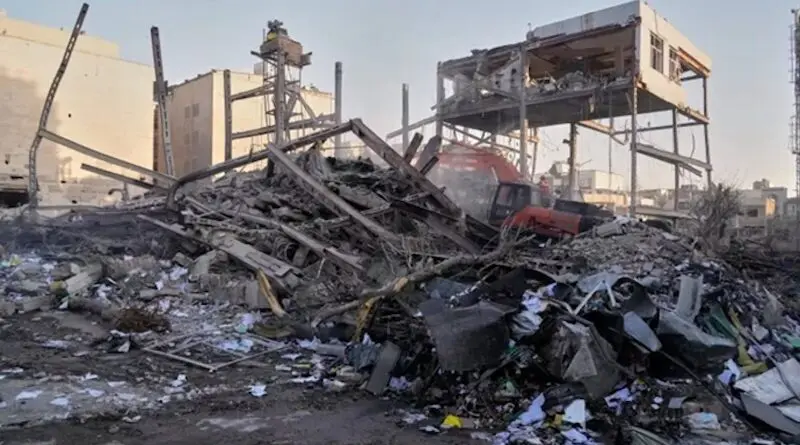

Aftermath of airstrikes in Tehran, Iran. Photo Credit: PMOI

March 22, 2026 

By Lim Teck Ghee


The law of reparations for war damage dictates that a State responsible for an internationally wrongful act – such as illegal warfare – must make full reparation for injury caused — Ref: Articles 1, 31, 34, and 35 on Responsibility of States for Internationally Wrongful Acts (ARSIWA), International Law Commission (ILC), 2001.

When asked by a reporter during Japan’s prime minister Sanei Takaichi visit, “Why didn’t you tell US allies in Europe and Asia and Japan about the war before attacking Iran”, Trump responded: “One thing you don’t want to signal too much, you know, when we go in, we went in very hard and we didn’t tell anybody about it because we wanted surprise. Who knows better about surprise than Japan? Why didn’t you tell me about Pearl Harbor?”

The surprise Japanese strike on the US naval base in Pearl Harbor, Hawaii, on 7 December 1941 killed 2,390 Americans and the US declared war on Japan the next day. Then president Franklin Delano Roosevelt called it “a date which will live in infamy”.

Supporting Trump, his son Eric posted on the X social media platform: “One of the great responses to a reporter in history”.

Trump failed to emphasise that not only was the strike an act of war but that it was initiated whilst Iran and the U.S. were in negotiations aimed at addressing American concerns about Iran’s nuclear capability.

War Reparations

Historical precedent, international law on war reparations which allows the victim of a “surprise” military strike such as that launched by Japan and Germany during the 2nd WW to claim reparations, and Iran’s ultimate position on the issue will likely be an important aftermath of the war.

As of March 2026, Iranian President Masoud Pezeshkian has demanded that the U.S. and Israel pay reparations and provide guarantees against future aggression as core conditions to end the war. Foreign Minister Abbas Araghchi has reinforced this, asserting that “reparations will be paid” and demanding a permanent end to attacks, not just a temporary ceasefire.

Iran has also demanded compensation from Bahrain and the United Arab Emirates, charging that their territory was used for US-Israeli strikes, which violated international law and constitutes “material and moral damages”.

​Estimated War Damage and Casualty Metrics (Mid March 2026)

​Under international law, reparations typically cover restitution, monetary compensation, and guarantees of non-repetition.

​While a final fully accounted total by Iran awaits the end of the war, the following data points, including those by US and Israel official sources providing daily assessments of the impact of their bombing strikes, gives some indication of the scale of reparations that Iran can claim.

Direct Civilian Damage and Human Casualties

This category covers the physical destruction of property and the human cost of the conflict, which are central to any war reparations claim. Reports indicate highly significant damage, though the exact numbers vary by source.
Category of Damage Reported Estimate And Source

1.Civilian Structures Damaged
42,914 buildings Iranian Red Crescent Society .
22,000 buildings UN International Organization for Migration (IOM) .

2.Breakdown of Damaged Structures 36,489 residential units
6,179 commercial facilities Official data from the Iranian Red Crescent Society
10,000 damaged homes in Tehran alone Anadolu Ajansı .

3.Civilian Casualties Over 1,245 killed; over 12,000 injured. Reported by the U.S.-based Human Rights Activists News Agency (HRANA) and Amnesty International. Under precedent, such as the United Nations Compensation Commission (UNCC) for Kuwait*, the compensation for “serious personal injury or death” is a primary category for liability.

4.Attacks on Civilian InfrastructureSchools, hospitals, cultural heritage sites, and critical infrastructure. A specific attack on a girls’ school in Minab killed at least 168 people .

5. ​Infrastructure & Military Assets The strikes have targeted nuclear facilities, missile production sites, and air defense systems across 9,000 targets in Iran. Historical comparisons suggest that rebuilding modern military and nuclear infrastructure involves costs in the tens of billions of dollars.

6. Economic & Energy Damages Iran’s Foreign Ministry has characterized strikes on fuel depots in Tehran as “ecocide,” citing long-term health and environmental damage. Damage to energy infrastructure (like Kharg Island) is often calculated not just by repair costs, but by lost revenue—which can reach hundreds of millions of dollars per day during outages. The war has also undoubtedly disrupted all normal economic activity within Iran, from manufacturing and agriculture to services and trade. The cost of this internal economic paralysis would form a major part of any reparations calculation.
​Historical Precedents for Calculation

​If Iran were to pursue these claims through a mechanism like the International Court of Justice (ICJ) or a specialized compensation commission, the “amount” would likely be built on these benchmarks.

The final liability amount would likely be a “global” figure—combining direct physical repairs, environmental cleanup for “ecocide,” and massive payouts for civilian loss of life—potentially exceeding several hundred billion US$ based on the scale of modern infrastructure destruction.


For now Iran has argued that U.S. “maximum pressure” campaigns constitute economic warfare and some Iranian officials have frequently cited damages exceeding $1 trillion in lost oil revenue, industrial stagnation, and social and economic crises (health, education, utilities shortages).

Although the U.S. and Israel currently maintain that their strikes are legally justified as “preemptive self-defense” or “maximum pressure”, international law experts contest this, labeling the February 2026 strikes as a violation of Article 2(4) of the UN Charter.

Trump’s assertion of a surprise military strike on Iran in the fashion of Japan’s Pearl Harbour attack leaves no doubt as to who started the war and is the belligerent. How much this surprise attack and continuing war will cost the US may come back to haunt Trump, his administration and the American public in more ways than just the moral and ethical concerns.

*The United Nations Compensation Commission (UNCC) was established in 1991 to process claims and pay compensation for damages resulting from Iraq’s 1990–1991 invasion and occupation of Kuwait. The UNCC awarded approx. US$3 billion for environmental remediation, including groundwater treatment and desert restoration. By 2022, the UNCC paid over $50 billion in total reparations to individuals, corporations, and governments, with the final payment made in early 2022, effectively concluding the compensation process.

  

War will deepen Iran’s water crisis

War will deepen Iran’s water crisis
Iran’s deepening water crisis, driven by drought, climate change and decades of mismanagement, is straining supplies for millions and exposing the vulnerability of the country’s ageing water infrastructure. / bne IntelliNews
By Ben Aris in Berlin March 21, 2026

An Israeli missile fell a few hundred metres from the Bushehr nuclear power plant during the South Pars missile strike on March 18, threatening not only a nuclear disaster on the order of Chernobyl but cutting off the entire region from its fresh drinking water supplies. However, even if Bushehr is not hit, the war with Israel and the US is going to make Iran’s dire lack of water problem a lot worse.

The Iranian authorities warned the International Atomic Energy Agency (IAEA) on March 18 that the Bushehr NPP may be included as a possible Israeli target as Israel seeks to collapse the Iranian economy by destroying its source of income and its energy sector.

Built on the shores of the Gulf, the danger is that nuclear fuel, or even just the reactor’s cooling fluid, would spill into the Persian Gulf and contaminate it. The Gulf countries have little fresh water and are heavily dependent on approximately a hundred desalination plants along the coast. The production of dozens of these plants would be threatened and they would have been closed, causing a major humanitarian crisis that could force millions to leave the region.

So far Bushehr has been untouched, but the war itself is making Iran’s already dire water problem a lot worse. The lack of drinking water could play a decisive factor in the war if hostilities drag on.

As bne IntelliNews reported, Tehran was already facing the possibility of water rationing in December due to a record drought last year. By the end of January the crisis was becoming acute after fourteen dams across Iran's most densely populated provinces saw reserves fall below 10% capacity. The authorities warned that if “day zero” arrived, the capital might have to be evacuated.

Decades of overbuilding and mismanagement of some 600 dams have left Iran with silted, leaky reservoirs and critically low storage levels. Global warming and extreme temperatures as the Climate Crisis accelerates faster than scientists predicted is exacerbating the problem. Work to counter these problems is now impossible after the beginning of Operation Epic Fury has drained away all resources and decapitated the government.

In the summer of 2025, Tehran, along with several other large cities, had to reduce its water consumption as the dams that feed the city completely dried up. This summer the situation will be a lot worse as the region is on track for more record breaking heatwaves. The last three years have already been the hottest in recorded history.

Tehran is a city of about 9mn people and in the frontline for a potential water crisis. In November, President Masoud Pezeshkian took the unusual step of releasing a video warning residents evacuation of the capital could become necessary if rainfall did not arrive soon.

Iran has been enduring its worst drought since 2020 and years with very little rainfall are now ten-times more likely than they were before industrialisation, according to World Weather Attribution, which studies the role of greenhouse gas emissions in extreme weather.

Climate change has compounded the long standing structural problems with Iran’s water system, due to decades of poor water management, misallocation of resources, an inappropriate agriculture policy and corruption.

Iran is the fourteenth most water-stressed country in the world and more than four-fifths of its 93mn population faces extremely high water stress, Bloomberg reports.

And now its infrastructure is under threat from the war. The US took the radical decision and struck Iran’s desalination plant on the island of Qeshm in Strait of Hormuz March 7. Iran struck back, hitting a water facility in Bahrain, and raising the nightmare scenario of Iranian retaliatory strike on all the desalination plants in the region that would make the Gulf effectively uninhabitable. The US denied Tehran’s accusation that it was responsible for the Qeshm incident.

The Middle East hosts more than 40% of the world’s desalination capacity, yet Iran relies on it far less than its neighbours. Only about 3% of the country’s drinking water comes from desalination plants, compared with more than half in Saudi Arabia and around 90% in Kuwait. Iran’s water problem is not caused by its lack of naturally occurring water, but the shoddy state of its infrastructure.

The development of the infrastructure was shaped by political patronage rather than long-term planning. Contracts were handed out to allies of the state and military – a network widely referred to inside Iran as the “water mafia”, a term used by Donald Trump in May in a speech in Riyadh.

Poor agricultural policy has added to the strain on the system -- agriculture accounts for roughly 90% of water use - by promoting water-intensive crops and attempting to be self-sufficient in food production, when it would make more sense to use the water for other means and import goods from more verdant neighbours.

The heavy use of water in agriculture was exacerbated by expanding farming into some of Iran’s driest regions which accelerated groundwater depletion and drained aquifers.

Iran’s short lived rainy season is already over and the intense heat of summer is on its way. Authorities fear a repeat of 2023 when Iran declared a two-day holiday in August after temperatures topped a record 50°C – one of the hottest summers on record. As the disaster season gets underway, this year could be at least as bad, or possibly worse. Climate models from bodies such as the World Meteorological Organization (WMO) and Copernicus predict a high probability (around 80–90%) that one of the next few years will set a new all-time global temperature record.

Iran Can Escalate The Energy War In The Gulf To Water – Analysis


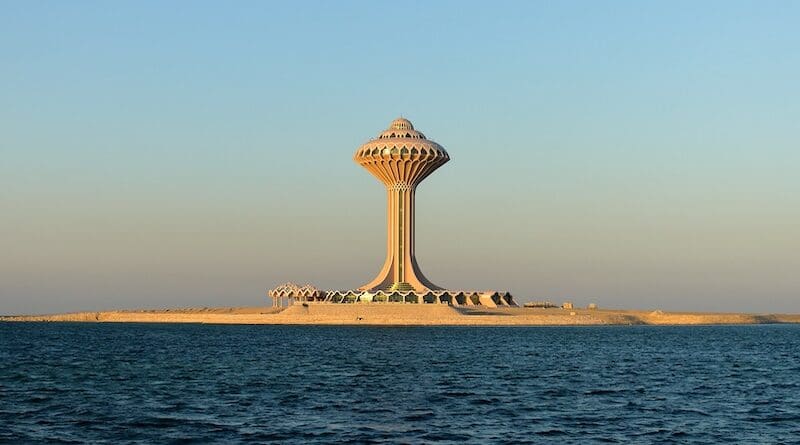
Al Khobar Water Tower located in Al Khobar Corniche, Saudi Arabia.

 Photo Credit: Francisco Anzola, Wikipedia Commons

March 21, 2026 
By Hudson Institute
By Can Kasapoğlu

Energy Warfare and The Expansion of the Gulf Battlespace

On March 18, the Israel Defense Forces struck upstream energy production facilities at Iran’s South Pars gas field. South Pars is not a peripheral asset—it sits at the core of Iran’s energy system and is the world’s largest natural gas field. It underpins roughly three-quarters of Iran’s domestic output.

Damage on this scale directly affects electricity generation and industrial output. It also undermines regime stability. In Iran, energy shortages are not technical issues; they are leverage points. In effect, the Epic Fury–Roaring Lion campaign is introducing a new dimension of political warfare. The focus is no longer solely on degrading the Islamic Revolutionary Guards Corps’ (IRGC) military capabilities. Instead, the campaign is now shifting toward shaping internal conditions within Iran—applying sustained pressure on the regime’s ability to provide services, govern, and uphold its already weakened social contract with a population under immense strain. Over the past twenty days without internet, for example, Iranian society has experienced Orwellian isolation from the rest of the world.

Tehran’s response expanded the scope of the conflict. Iranian drones and missiles struck energy infrastructure across the Gulf, including facilities connected to Qatar’s North Field—the geological twin of South Pars and a key global liquid natural gas (LNG) hub. The conflict escalated beyond bilateral exchanges. Iranian retaliation has grimly introduced systemic risk into an already unstable Middle East threat environment.

In the meantime, the United States Central Command conducted strikes against hardened Iranian anti-ship missile positions along the Strait of Hormuz. These strikes can either reflect the American effort to reopen the critical chokepoint for good or, in a low-probability and high-impact scenario, the prelude of an amphibious assault on the Kharg Island, particularly given recent American strikes on the military targets on the island. Kharg looms large as the nerve center of Iran’s economy and a hub of almost 90 percent of the country’s oil exports.

Energy markets responded swiftly to the chain of escalatory trends. Prices increased as upstream production and LNG infrastructure came under pressure. However, a more significant development underpins market volatility: water may shape the next phase of the conflict.

Marking the Hydro-Strategic Threat in the Gulf

When the political and military elite of the Islamic Republic assessed their strategic options after the United States and Israel began Operations Epic Fury and Roaring Lion, they calculated what few analysts anticipated: that the path to fracturing the coalition arrayed against Tehran ran not through Israel but through the Gulf Arab states. The IRGC, the regime’s praetorian deterrent, know they cannot defeat the American-led coalition militarily. Instead, they seek to raise the economic and diplomatic costs of the war sufficiently to break President Donald Trump’s will to continue waging it.

Iran has aimed almost half its long-range strikes at the United Arab Emirates. It hopes to weaken the resilience of America’s Gulf Arab allies. The Islamic Republic’s military strategy is designed to make a sustained US war effort politically unsustainable in Washington.

To achieve this, Iranian missile and drone forces might target a resource that is scarce and crucial in the Gulf Arab region: water. Iran has tried to close the Strait of Hormuz and struck oil and gas sites throughout the area. Oil markets dominate the strategic picture for now. Yet the vulnerability of desalination infrastructure is a different category of risk. Energy disruptions primarily trigger economic consequences by raising prices and constraining supply. Water disruption, by contrast, directly threatens daily survival in some of the world’s most water-scarce states.

Desalination is the Gulf Arab nations’ primary way of providing drinkable water to their people. About 90 percent of Kuwait’s drinking water comes from desalination, as does 86 percent of Oman’s and around 70 percent of Saudi Arabia’s. As a result, any postwar settlement that ignores Iran’s ability to threaten the desalination infrastructure that allows the Gulf Arab nations to function leaves the region exposed to continued Iranian blackmail. From the Guards’ perspective, this asymmetry makes water infrastructure an attractive coercive lever even if oil remains the region’s most globally visible strategic commodity.

US intelligence agencies raised a red flag on this danger long before the current war began. A declassified Central Intelligence Agency assessment, approved for release in 2010, concluded that potable water had already become a strategic commodity across the Gulf Arab states. The region’s leaders view this resource as more vital to national survival than oil. The CIA report identified Iran as the greatest threat to the region’s desalination infrastructure and cautioned that more than 90 percent of the region’s drinkable water production depended on just 56 plants. Damaging these facilities could trigger consequences more severe than the loss of any other industry. Today’s battlefield shows the CIA’s warnings come to fruition. Thus far, Iran has already struck a desalination plant in Bahrain, marking a dangerous path ahead. The Islamic Republic, moreover, has threatened to continue widespread strikes against the Gulf’s water resources.

When it comes to water, geography makes the region even more vulnerable. This exposure cannot be engineered away. Desalination needs direct seawater intake, so plants are built along coastlines. That means nations must put critical infrastructure on narrow, low-lying coastal strips with little defensive depth. The Islamic Republic sees these strips as sitting ducks.


Militarily, desalination plants are classic soft-skin targets. They are sprawling facilities, not hardened structures. Moderate physical damage to pumps and intake systems can disable plants for long periods. Repairing complex, specialized equipment can take time. Oil supply fluctuations can be managed with reserves or price changes, but water scarcity cannot. When water is disrupted, the situation can quickly turn into a public health crisis.

Damaging desalination plants fits Iran’s likely operational playbook in any future conflict. The regime can rebuild its missile arsenal with support from China, North Korea, and Russia. Hardline elements supporting new Supreme Leader Mojtaba Khamenei will likely stay in power. The Islamic Republic may become a new North Korea of sorts: a military dictatorship with both the capability and will to threaten neighbors—especially their water facilities.

While Epic Fury aims to dismantle Iran’s drone and missile programs, the Revolutionary Guards’ economic blackmail can hold Gulf water supplies hostage. Washington must make clear that threats to Gulf Arab water are intolerable and will incur overwhelming consequences.

Previous diplomatic frameworks for dealing with Iran have focused almost exclusively on Tehran’s nuclear program, as the nuclear deal inked during the Obama presidency. In seeking to resolve the current conflict, Washington and its partners should realize that Iran does not need nuclear weapons to threaten the region’s military balance.

About the author:
 Can Kasapoğlu is a nonresident senior fellow at Hudson Institute. His work at Hudson focuses on political-military affairs in the Middle East, North Africa, and former Soviet regions. He specializes in open-source defense intelligence, geopolitical assessments, international weapons market trends, as well as emerging defense technologies and related concepts of operations.


Source: This article was published by the Hudson Institute

 Iranian protesters fled ‘hell’ at home, watch war from exile


By AFP
March 16, 2026


Copyright AFP Ozan KOSE


Fulya OZERKAN

Iranian activist Farhad Sheikhi fights back tears as he recalls the crack of gunfire and his fellow protesters falling under a hail of bullets. Now, having fled to Iraq, he watches from afar as American and Israeli strikes pound his country.

“I literally saw hell,” said the 34-year-old Iranian Kurd in Sulaimaniyah, Iraqi Kurdistan’s second city, as he showed AFP photos he took during recent anti-government protests of bodies lying on the bloodied ground.

But his biggest worry today is for the safety of his family back home.

With the internet under a blackout in Iran, Sheikhi said he relies on a friend who only occasionally manages to get online.

“He calls my father and tells me how they are. That is the only way I get news of them,” he said.

Returning to Iran is no longer an option, according to Sheikhi, whose only remaining dream is to travel to Germany to finish his studies in law.

As the war enters its third week, Sheikhi said people are now more cautious and struggling with worsening living conditions.

“They are also still mourning the heavy price they have already paid” during the recent protests, he said, referring to the government crackdown that rights groups say killed thousands.

He said he can’t lose hope that “one day a social revolution will allow me to go back, but for now the risk is too great”.

After the crackdown in January, Sheikhi fled to the autonomous Kurdistan region in Iraq, fearing arrest and torture back home, where the moustached, bespectacled man had been no stranger to anti-government protests.

In 2022, he joined the vast crowds that poured onto the streets to denounce the death in detention of young Mahsa Amini after she was arrested for wearing her hijab improperly.

Back then, he was jailed three times and subjected to torture that left him with hearing loss. Even so, he once again joined the anti-government protests in December and January.

“The crackdown on the people, the slaughter, it was massive. I saw it myself,” he said.


– ‘If I die’-


Aresto Pasbar was also taking part in the 2022 protests when shotgun pellets peppered his body, leaving him blind in his left eye.

“I have undergone five surgeries,” Pasbar, 38, told AFP in Sulaimaniyah.

Fearing for his life, he fled Iran for Turkey. There, he was caught at sea while attempting to reach Europe illegally by boat, and a Munich-based human rights organisation helped him obtain asylum in Germany in 2023.

But Pasbar has followed events in Iran closely, his heart aching as he watched the recent crackdown on protests until he couldn’t bear it any longer.

When the war broke out, he left Germany to join the ranks of Iranian Kurdish rebels in Iraqi Kurdistan who have increasingly been the target of cross-border strikes from Iran since the start of the conflict.

“In my heart, I couldn’t remain in that comfort and simply watch my people be oppressed,” he said in a steady, determined voice.

Now, he wears the coarse grey traditional Kurdish fatigues, fully aware, he said, that he may never see his wife and two daughters again.

Before he left, he recounted telling his family: “Even if I die, please stand for your rights. Stand for who you are”.


– ‘Revenge’-


In 2005, when Amina Kadri’s husband, Ikbal, fled Iran to escape political persecution, his family hoped Iraqi Kurdistan would be a safe haven.

But 15 years later, Ikbal — then 57 and a member of an exiled Iranian Kurdish armed group — was killed near the Iraqi-Iranian border.

The assailants shot him, dumped his body in a river and escaped toward Iran on a motorcycle, Kadri quoted witnesses to the killing as saying. She accused Iran of being behind it.

Kadri’s ordeal did not stop there — 53 days later, her eldest son, who had remained in Iran, was executed at age 30 for murder. Kadri claims it was a set-up.

“I no longer care about what happens to me,” Kadri said over the phone from a border town that Kurdistan’s security forces barred AFP from entering, citing security reasons.

“My life is no more valuable than my son’s or my husband’s,” she added.

Today, the 61-year-old homemaker only wishes to see the Islamic republic fall, so she can have “revenge for the blood of all those who have been executed”.


Dubai faces expat exodus as war shatters safe-haven reputation

Dubai faces expat exodus as war shatters safe-haven reputation
Dubai faces expat exodus as war shatters safe-haven reputation. / bne IntelliNews
By bne IntelliNews March 19, 2026

Dubai is experiencing its largest outflow of foreign residents in decades as the Iran war enters its third week, threatening the emirate's carefully built reputation as a global hub for wealthy expatriates, finance and tourism.

This latest Emirates exodus has drawn comparisons to Hong Kong's pandemic-era talent drain, when strict Covid restrictions in 2022 triggered a mass departure of bankers, lawyers and professionals that took years to reverse. During those years, many in the UAE ended up locking themselves away in their apartments; however, that threat wasn't so apparent. 

More than 37,000 flights have been cancelled since the conflict began on February 28, according to previous data from Emering Travel. Dubai International Airport is operating at roughly 70% of capacity. Private jet departures reached $250,000 in the first days of the war, with some evacuees leaving pets and belongings behind. Local veterinarians reported being overwhelmed by abandoned animals.

Flight schedules tell a clear picture: "Emirates, Etihad Airways and Qatar Airways have all been forced into reduced or limited schedules since the conflict began on 28 February, when joint US-Israeli strikes on Iran triggered retaliatory missile and drone barrages across the Persian Gulf," Emerging Travel reported on March 19.

Major Western financial institutions have pulled staff from Dubai. Goldman Sachs, Citi, Standard Chartered and other firms ordered employees to work from home or relocate after Iran threatened to target banks and technology companies with US connections. The Dubai International Financial Centre's landmark ICD Brookfield tower, home to BlackRock, Bank of America, JPMorgan and BNP Paribas, stands largely empty. The rot is spreading; the Dubai stock exchange has fallen roughly 17% since the war began, while unemployment among expatriates rose to 12% in February, according to KPMG. Several UAE-based companies are now offering several roles on websites, including Linkedin, where the list continues to grow as people choose not to return. 

In a bid to stem the blood loss, the UAE is now even considering relaxing tax residency rules for expatriates who left during the conflict, with authorities expected to assess applications on a case-by-case basis, the report said. Under current rules, residents must spend at least 183 days per year in the country to maintain their tax status. Dubai is home to 237 centimillionaires and at least 20 billionaires. Around 9,800 millionaires relocated to the emirate in 2025, bringing an estimated $63bn in wealth. If they pull their cash out of local NBD or other banks. 

"Dubai has already seen its safety and security selling point damaged. It is really important for its economy and image to retain these expats," tax partner Elsa Littlewood of BDO told the Financial Times. British nationals face a particular dilemma due to the hurdles of hoops they have to jump through. Returning to the UK risks triggering tax residency, potentially exposing worldwide income to British taxation. Tax advisers have urged departing expats to consider third countries rather than going home. HMRC said it would assist those returning, but many are considering other options, including Georgia's capital, Tbilisi. 

However, for those who remain, the atmosphere is one of unease rather than outright panic.

One Dubai resident who asked not to be named, speaking with IntelliNews, said the past few weeks had been difficult with colleagues with children already departing for countries including Australia and Britain, while many have said they will stick through it, hoping the situation returns to some sort of normal in the next few hours. Residents describe a city that functions but under visible strain, with evacuation alerts interrupting social occasions and the sound of air defence interceptions audible at night.

"One of the things I loved most about my time in Dubai was the lifestyle. The city has an incredible food scene—fresh salads, grilled meats, colourful fruit platters, and so many international dishes that eating out never gets boring," said one resident speaking with IntelliNews.

"During my time in Dubai, one thing that really stood out was how active the lifestyle is. Early in the mornings and again in the evenings, you see people everywhere walking, jogging, and cycling along the city’s paths and waterfront areas. It feels like fitness is simply part of everyday life here," they added, whilst asking not to use their names due to the restrictive rules of spreading information.

Hotels have slashed prices. Beach clubs and tourist areas along Jumeirah sit largely empty at the height of peak season. Low-paid migrant workers from India, Pakistan and Bangladesh are being sent home or put on forced leave with no guarantee of return. According to searches on several hotel booking price-comparison websites, historically low prices are currently available at a raft of popular branded hotels, according to Kayak.com, Booking.com and Skyscanner. 

The UAE has intercepted 314 ballistic missiles, 15 cruise missiles and 1,672 drones from Iran since the war began. Eight people have been killed and 157 wounded. Strikes have hit the Fairmont hotel on Palm Jumeirah, caused fire damage at the Burj Al Arab, struck Dubai airport three times and hit the vicinity of the US consulate.

Authorities have arrested more than 100 people, including one British tourist, for sharing images of strikes or interceptions on social media under the UAE's cybercrime laws.

Dubai’s thriving global financial hub faces wartime stress test

In the space of just three decades, Dubai has built itself into one of the world’s major financial hubs – a magnet for global banks, investors and wealthy expatriates. But the war in the Middle East is testing that success, raising questions about whether the flows of capital, trade and tourism that fuel its economy can hold if the conflict spreads.


Issued on: 22/03/2026 - RFI

The Burj Khalifa (left), the world’s tallest skyscraper, and the Burj Al Arab hotel rise above Dubai’s skyline, pictured on 11 March, 2026. AFP - FADEL SENNA


The emirate is not only a symbol of luxury and spectacle, it has also become a key centre for finance and international commerce in the Gulf, attracting companies and wealthy individuals from around the world.

Dubai’s economic model is unusual in the region. Unlike several of its neighbours, its prosperity is not built mainly on oil. Instead, Dubai has focused on services, tourism, global trade and financial activity, strengthening its position as the main financial hub serving the Middle East, Africa and South Asia.

At the heart of that strategy is the Dubai International Financial Centre, which opened in 2004 and now hosts more than 8,800 companies including international banks, investment funds, law firms and wealth management firms.

Stability at risk

Dubai’s rapid rise as a financial centre has rested on two main pillars: favourable taxation and business-friendly regulations that attract foreign companies, and the stability the emirate has long projected in a region often marked by geopolitical tensions.

That sense of security is now under strain as the war threatens the flows of trade, tourism and investment that Dubai depends on.

The city itself has begun to feel the impact of the conflict. Drones and missiles have struck infrastructure in Dubai, including its airport, where a nearby drone strike sparked a fire at a fuel tank facility and disrupted flights.

The United Arab Emirates briefly closed its airspace early on Tuesday as a precaution on the back of missile and drone threats. Meanwhile debris from intercepted drones reportedly struck buildings in Dubai’s financial district.

Beyond the immediate damage, such incidents risk weakening the confidence that underpins international finance.

“It’s hard to overstate the peril for Dubai’s economic model,” Jim Krane, a fellow at Rice University’s Baker Institute for Public Policy, told Reuters.

The longer the conflict continues, he warned, the greater the risk that investors will begin looking for alternatives.


No exodus yet

So far, however, there has been no large-scale departure of capital or financial workers. Expatriates employed in the finance sector have not left in significant numbers.

Some companies have taken precautionary steps, including bringing employees home or allowing staff to work remotely. But no widespread panic has taken hold so far.

If the conflict drags on, however, the situation could change.

Dubai’s difficulties could create opportunities for other financial centres in the region. Saudi Arabia, for example, is trying to position Riyadh as an alternative economic hub. However, with most Gulf countries affected by regional tensions, this reduces their relative appeal.

Wealth managers in Singapore told Reuters that several Dubai-based clients had begun exploring transfers of assets to the city-state as geopolitical tensions rise.

For now, however, advisers say many investors are following developments closely and taking what one wealth manager described as a “wait and watch approach”.

With reporting by newswires and partially adapted from this story in French.

 UN maritime body kicks off emergency talks on Mideast shipping


By AFP
March 18, 2026


The Indian vessel 'Nanda Devi' carrying liquefied petroleum gas docked in Gujarat on March 17 after Iran allowed it to pass through the Strait of Hormuz - Copyright AFP STR


Joe JACKSON

The head of the UN’s maritime body Wednesday urged “practical measures” to protect trade ships threatened by the Middle East war, as he opened an emergency meeting amid fears for thousands of stranded ships and seafarers.

The International Maritime Organisation — responsible for regulating international shipping safety — will discuss efforts to ease the shipping crisis during the two-day gathering at its London headquarters.

The IMO’s 40-member council could vote Thursday on several proposed resolutions, including one to “establish a safe maritime corridor to allow the safe evacuation of seafarers and ships stranded in the Persian Gulf”.

However, if passed, resolutions remain non-binding.

The meeting — open to all 176 member states as well as dozens of NGOs and maritime industry bodies — comes as Iran’s retaliation to Israeli-US strikes cripples commercial shipping in or near the Strait of Hormuz.

That has left around 20,000 seafarers stranded on approximately 3,200 vessels west of the key maritime chokepoint, according to the latest information from the IMO.

“This situation is unacceptable and unsustainable,” IMO Secretary-General Arsenio Dominguez said as the gathering got underway, urging members to focus on “practical measures” to resolve it.

“Shipping has demonstrated time and again how resilient it is but geopolitics are testing the sector to the limit and every time that shipping is used as collateral damage in these conflicts, the whole world is negatively affected.”


– ‘Unjustifiable’ attacks –


Gulf states hit out at Iran in their opening statements.

“The United Arab Emirates expresses its rejection and condemnation in the strongest terms of… Iran’s unprovoked, unjustifiable, indiscriminate and wholly unlawful attacks,” the country’s IMO delegate said.

He said they “constitute a serious breach of our sovereignty, territorial integrity” and were “a flagrant violation of fundamental rules and principles of international law”.

An effective Iranian blockade of the Strait of Hormuz — through which a fifth of global crude and liquified natural gas normally transits — has dramatically spiked oil prices and spooked markets.

Meanwhile at least 21 ships have been hit, targeted or reported attacks since the start of the conflict, according to the UK Maritime Trade Operations (UKMTO), a naval monitor.

Britain, France, Germany and a host of other countries including Gulf states have urged the IMO’s council to adopt a declaration to “strongly condemn the egregious attacks” by Iran on its neighbours.

Noting Iran had “threatened and attacked commercial vessels and seafarers, as well as civilian maritime infrastructure”, their proposal said the attacks were “unjustifiable and must cease”.

They also urged similar condemnation of the “purported closure of the Strait of Hormuz” by Tehran.


– ‘Safe evacuation’ –


In its submission Iran, which is an IMO member but does not sit on its council, blamed the “current deterioration of the maritime security environment” on the attacks by Israel and the US.

“The adverse maritime repercussions currently affecting shipping and seafarers are a direct and inevitable consequence of these unlawful actions and cannot be viewed in isolation from their underlying cause,” it stated.

Separately, Japan, Panama, Singapore and the United Arab Emirates have urged the IMO to help “establish a framework to allow the safe evacuation of seafarers and ships stranded in the Gulf”.

It would “facilitate the safe evacuation of merchant ships from the high-risk and affected areas to a safe place… avoiding military attacks and protecting and securing the maritime domain”.

Meanwhile, maritime industry bodies have tabled a demand for a “coordinated international approach to security” while urging that “seafarer welfare must be taken into account”.

They want measures to ensure their “communications with home can be maintained, crew changes and disembarkation can be facilitated, and the stores and provisions are adequate for the needs of seafarers”.

 Key Middle East energy sites under fire


By AFP
March 19, 2026


Energy facilities across the Gulf have come under fire in the US-Israel war with Iran - Copyright AFP -

Qatar’s main gas facility has suffered extensive damage after several rounds of Iranian strikes, causing new energy supply fears as the Middle East war grinds on.

Here is a look at some of the key energy facilities that have been targeted in the US-Israel war with Iran.


– Ras Laffan –


Ras Laffan in Qatar is the world’s largest liquefied natural gas (LNG) hub.

It has been repeatedly targeted by Iranian strikes since the war began, and has now suffered “extensive damage” after back-to-back waves of hits, state-run QatarEnergy said.

Early Thursday, QatarEnergy reported “sizeable fires” and significant damage at several LNG facilities at the hub.

That came after an earlier attack on the Ras Laffan Industrial City on Wednesday had already caused extensive damage to a gas-to-liquids facility.

Qatar shares the world’s largest natural gas reservoir with Iran.

QatarEnergy estimates the Gulf state’s portion of the reservoir, the North Field, holds about 10 percent of the world’s known natural gas reserves.

In recent years, Qatar has inked a series of long-term LNG deals with France’s Total, Britain’s Shell, India’s Petronet, China’s Sinopec and Italy’s Eni, among others.

Earlier in March, Iranian attacks forced QatarEnergy to halt LNG production and declare force majeure.


– South Pars –


Iran’s strikes on Ras Laffan come after its South Pars/North Dome field was hit on Wednesday.

The South Pars mega-field is the largest known gas reserve in the world, and supplies around 70 percent of Iran’s domestic natural gas.

The strikes on the field, which it shares with Qatar, caused a fire, Iranian state television said.

The strike was condemned by some of Iran’s Gulf neighbours, including Qatar and the United Arab Emirates, who have seen energy facilities in their countries come under repeated Iranian attack.

US President Donald Trump said Thursday that Israel had carried out the attack and Washington “knew nothing” about it.

But he warned that if Iran continued attacks against Qatar, US forces would “massively blow up the entirety” of the South Pars field.


– Kharg –


Kharg island, around 30 kilometres off Iran’s mainland, is a hub for roughly 90 percent of the country’s crude oil exports.

It was hit in US strikes on Saturday, but Iranian officials said afterwards that exports were continuing normally and there had been no casualties.

Trump had threatened to target the island’s oil infrastructure if Iran continues to block the Strait of Hormuz, a crucial passage for energy and other exports from the region.

Iran has pledged to block export of all oil through the strait, and has targeted vessels attempting to transit the narrow chokepoint, wreaking havoc on exports reliant on the passage.


– Ruwais refinery –


The Ruwais oil refinery, in the emirate of Abu Dhabi, is the world’s fourth largest single-site refinery, according to state-owned operator Adnoc.

Operations there were halted earlier this month as a “precaution” after a drone attack on the industrial complex housing the facility, a source told AFP.

The source did not say whether the refinery had been hit. Adnoc did not make an official announcement.


– Ras Tanura –


The Ras Tanura facility along Saudi Arabia’s eastern Gulf coast is home to one of the largest refineries in the entire Middle East and a cornerstone of the kingdom’s energy sector.

The complex has a capacity of 550,000 barrels per day.

It has been repeatedly targeted in Iranian strikes, including a drone attack early in the conflict that caused a fire and forced a partial shutdown of the refinery.

Bloomberg reported Wednesday, citing an unnamed source, that operations had now resumed at the facility.

Gulf countries’ output of oil and oil products has plunged from 30 million barrels per day last year, excluding Oman, to 20 million currently, according to the International Energy Agency.

The president of Aramco, which operates the refinery, has warned the war could have “catastrophic consequences” on oil markets.

On Thursday, oil surged more than five percent, with Brent spiking to a peak of over $112 a barrel.

 Weakened WTO set for high-level meet under cloud of Mideast war


By AFP
March 19, 2026


World Trade Organization representatives will meet in Cameroon against the backdrop of the war raging in the Middle East and the WTO's forecasts of dramatically slowing global trade growth - Copyright AFP Fabrice COFFRINI


Agnès PEDRERO

A weakened World Trade Organization will gather ministers in Yaounde next week as it seeks a road to reform, amid surging global trade tensions, US tariffs and disruptions caused by the Middle East war.

The WTO ministerial conference, its supreme decision-making body, is usually held every other year.

The stakes at the March 26-29 meeting in the Cameroonian capital will be particularly high, coming against the backdrop of the war raging in the Middle East and the WTO’s forecasts of dramatically slowing global trade growth.

The difficult geopolitical situation should provide a “wakeup call”, showing “we need to maintain the system… to improve the system”, Director-General Ngozi Okonjo-Iweala said Thursday.

“We really need to be that island of stability.”

Two years after the WTO’s last ministerial conference in Abu Dhabi failed to make meaningful progress on key issues like fisheries and agriculture, the organisation’s 166 members will be facing even stauncher challenges in Yaounde.

Their main task will be to develop a plan towards reforming a WTO that has proven to be powerless in the face of rising protectionism and largely incapable of negotiating new agreements.

“The situation is likely to be more tense than at previous ministerial conferences,” warned Petros Mavroidis, a Columbia Law School professor focused on WTO law.

Success in Yaounde would be surprising, he said, adding that the conference would be more about “limiting the damage”.

The WTO, which regulates large swathes of global trade, has been facing increasing pressure to overhaul rules considered by many as outdated and unable to keep pace with a rapidly changing world.


– ‘Existential juncture’ –


“I don’t think the status quo is an option,” Okonjo-Iweala recently said, insisting the Yaounde meeting should mark “a turning point”.

The European Union also warned in a recent submission that the organisation was “at a critical and, in fact, an existential juncture”, while Britain cautioned that “without reform, it will slide into irrelevance”.

Swiss ambassador to the WTO Erwin Bollinger agreed, warning that a loss of relevance by the WTO could “lead to more fragmentation of the trading system”.

Yaounde will mark the WTO’s first ministerial conference since Donald Trump returned to the White House last year, unleashing a barrage of attacks on multilateralism and WTO rules with sweeping tariffs and bilateral trade deals.

“The Americans have effectively withdrawn from the WTO,” Pascal Lamy, who headed the organisation from 2005 to 2013, told AFP.

“They are not respecting any of the rules they agreed to.”


– Washington has ‘serious concerns’ –


Washington has not held back in its criticism of the WTO.

“The United States has serious concerns with the trading system embodied by the WTO, given that the system has overseen and contributed to a world of severe and sustained imbalances,” Washington said in a submission to the organisation.

US ambassador to the WTO Joseph Barloon said last week that his country rejects the current WTO reform proposal.

Washington is particularly critical of the WTO’s “most-favoured nation” (MFN) principle, which aims to extend any trade advantage granted to one trading partner to all others, in a bid to avoid discrimination.

The United States told the WTO last December that it considers the principle “unsuitable for this era”.

The EU has also said it would be appropriate to reflect “on the role of the MFN principle in today’s context”.

But China, like other developing countries, said it wants this rule to “remain the bedrock of the WTO”.


– ‘Tremendous pressure’ –


The organisation faced structural and geopolitical obstacles and calls for reform long before Trump returned to power.

It has long been handicapped by a rule requiring full consensus among members, meaning decisions are few and far between.

Its dispute settlement system has also been crippled since 2019 by the United States blocking the appointment of new judges, even as Trump’s aggressive trade policy has increasingly blurred the line between trade and national security concerns.

“WTO is under tremendous pressure,” a Western diplomat told AFP, asking not to be named.

“We’ve never seen the system being challenged as it is right now.”

Hamid Mamdouh, a former high-level WTO official, agreed.

“With the Trump Administration’s actions and all the uncertainties they caused to international trade, there is a much higher sense of crisis now within the international trade community and, of course, in the WTO,” he told AFP.
IMF raises concern over global inflation, output over Iran war


By AFP
March 19, 2026


The IMF's spokesperson warned that food price inflation could be 'substantial' if fertilizer prices remain elevated for a long period due to the war - Copyright AFP Elodie CLEMENT


Asad HASHIM

The International Monetary Fund said on Thursday it was monitoring the impacts of the war in Iran on global inflation and output, but that no countries had so far approached it for emergency assistance related to the conflict.

“If prolonged, higher energy prices will lead to higher headline inflation,” said IMF chief spokesperson Julie Kozack at a press briefing.

Kozack said that if oil prices remained above $100 for a year or more, the estimated impact on global inflation could be a rise of up to two percentage-points, with output dropping one percentage-point, according to “a broad rule of thumb.”

She also confirmed that the IMF had “not received any formal requests for emergency financing” in the wake of the US-Israel war on Iran.

The US and Israel launched strikes on Iran on February 28, sparking a war that has engulfed the Middle East and seen Tehran virtually blockade the key Strait of Hormuz waterway.

About 20 percent of the world’s oil and natural gas passes through the strait, and the crisis has sent energy prices spiralling, with potential knock-on effects on inflation worldwide.

On Thursday, international benchmark Brent crude was trading at around $110 a barrel — up 52 percent from before the war.

Kozack said the world’s most economically vulnerable states would be first in line to feel the fallout.

“They have limited policy space, limited buffers and this in a world where financing conditions may be becoming more challenging for them,” she said.

Kozack highlighted that the Fund was monitoring developments on commodity prices, inflation and global financial conditions in the wake of the war.

She stressed that countries would feel the effects in a variety of ways, particularly when it comes to commodity prices, depending on the structure of their economy.

Food prices were another area of concern.

“Fertilizer shipment has been disrupted (due to the conflict), and this, along with transportation disruptions, raise risks that we could see increases in food prices, and those could be substantial, again, depending on the duration and intensity,” she said.

   Why Iranian drones are hard to stop


By AFP
March 16, 2026


An Iranian-designed drone seen over the Ukrainian capital in December 2025
 - Copyright AFP/File Sergei SUPINSKY


Ali BEKHTAOUI

Cheap and deadly, Iranian-designed Shahed drones have inflicted major damage in the Middle East war, and have anti-jamming and other capabilities that make them difficult to stop.


– Offline navigation –


Designed to explode on impact, Shahed drones connect to GPS to register their location shortly before or after takeoff, then typically turn off their receivers, said Thomas Withington, a researcher at Britain’s Royal United Services Institute (RUSI).

The drones then travel long distances towards their target using gyroscopes that measure their speed, direction and position — known as an “inertial navigation system”.

“GPS is going to get jammed by whatever is protecting the target,” Withington told AFP.

“If you look at a map of GPS jamming at the moment in the Middle East, you see that there’s a lot of jamming… By not using the GPS, you avoid that.”

The drones can then return to GPS just before impact for a more precise strike, or remain offline.

“It’s not always necessarily very accurate, but it’s as accurate as it needs to be,” said Withington.


– Anti-jamming mechanisms –


Russia has been making Shahed-style drones to use in its war in Ukraine.

The US-based Institute for Science and International Security found in 2023 that those drones used “state-of-art antenna interference suppression” to remove enemy jamming signals while preserving the desired GPS signal.

Anti-jamming mechanisms were found in the wreckage of an Iranian-made drone that struck Cyprus in the opening days of the Middle East war, a European industry source told AFP.

“They have put (the Shahed) together using off-the-shelf parts, but it has… many of the capabilities that US military GPS equipment has,” Todd Humphreys, a professor of aerospace engineering at the University of Texas at Austin, told AFP.

Defending against them now requires sophisticated electronic warfare equipment.

“The Shaheds have been upgraded,” said Ukrainian air force spokesman Yuriy Ignat.


– Stealth materials –


The Shahed is built from “lightweight radar-absorbing materials”, such as plastic and fibreglass, a 2023 RUSI paper said.

Their small size and low altitude allow them to slip through aerial defence systems.


– Other positioning systems? –


Some experts think Iran is using multiple positioning systems, making it easier for its drones to dodge jamming.

Serhii Beskrestnov, a technology adviser to the Ukrainian defence ministry, said Iran is using the BeiDou system, a Chinese rival to the US-developed GPS.

And the Russia-made version of Shaheds uses both BeiDou and the Russian equivalent, GLONASS, he said.

Others suspect Iran may be using LORAN, a radio navigation system developed during World War II.

LORAN, which does not require satellites, largely fell out of use when GPS emerged.

But Iran said in 2016 it was reviving the technology, which requires a network of large ground-based transmitters, though experts have not confirmed it is active today.


– Counter-strategies –


Militaries have mainly defended against Shaheds by shooting them down with cannon fire, missiles and interceptor drones, with the United States and Israel also developing lasers.

But jamming can work, as Ukraine has shown, as can “spoofing”, which involves hacking into the drone’s navigation system to change its destination.

Ukraine used electronic warfare to neutralise 4,652 attack drones from mid-May to mid-July 2025 — not far off the number it shot down in the same period, 6,041, according to AFP analysis of Ukrainian military data.

Its experts insist that electronic and conventional defences are often used in tandem against the drones.


Rise of drone warfare sharpens focus on laser defense


By AFP
March 16, 2026


A laser-based system from Israeli defense group Rafael at a London arms fair in September 2025 - Copyright AFP Adrian DENNIS


Thomas URBAIN

The surge of drone use in conflicts worldwide, seen most vividly in the Ukraine and Middle East wars, will accelerate the race to develop high-power laser systems that could down the devices far more cheaply than traditional defensive weapons.

It is a critical issue for governments threatened by low-cost, easily obtainable drones that can wreak outsize destruction, and are usually shot down only by the most advanced — and expensive — missile technologies.

Currently, so-called directed energy weapons (DEWs) mounted to ships or armored vehicles can fire a concentrated electromagnetic beam at targets up to 20 kilometers (12 miles) away.

“Those systems have made a lot of progress in the last 10 to 15 years,” said Iain Boyd, director of the Center for National Security Initiatives at the University of Colorado.

Russia is using several versions against drones from Ukraine, which is testing its own system, while Israel has deployed the Iron Beam technology from Rafael against drones fired by Lebanon’s Iran-backed militant group Hezbollah.

However, the Israeli Army confirmed to The Jerusalem Post last week that Iron Beam was not being deployed in its current war with Iran, saying it was not ready for regular use.

China presented its LY-1 system last September, Britain and France are developing their own versions, and the United States has started equipping warships in particular, with Helios from Lockheed-Martin or the LWSD from Northrop Grumman.

“We have shown this technology has broad applicability including military operations and for homeland defense,” Northrop told AFP in a statement.

– Pennies per shot? –

US President Donald Trump said recently that “the laser technology that we have now is incredible,” and would soon replace the Patriot interceptor missile for taking out drones.

That would be music to the ears of military planners who are using the pricey Patriot and similar systems, where a single missile can cost millions of dollars, to down drones worth just several thousand dollars.

A top official in Britain’s DragonFire program has estimated its per-fire cost at around 10 pounds ($13).

“The cost of firing one laser or microwave is really the cost of electricity,” an expert in DEW systems design told AFP on condition of anonymity.

After the initial investment is made, “it’s going to be pennies per shot,” the designer said.

At that price, not even Iran’s notorious Shahed drones, estimated to cost as low as $20,000 each, or drone interceptors developed by Ukraine, whose costs start at around $700, can compete.

Other advantages include no launching device, the ability to modulate the beam’s intensity, and unlimited “ammunition.”

Billions of dollars have been invested in the technology, and in 2018 the US Navy ordered two DEW prototypes for around $75 million each.

– Limitations –

But the challenges for making lasers more widespread in the fight against drones are daunting.

“One is just the pointing, the ability to point — you really need to maintain the laser spot on the same area to create an effect,” said Boyd of the University of Colorado.

“If it’s sort of moving all over a drone or something, it’s not going to do anything.”

Laser systems are also less effective in cloudy weather, and can also be a risk for other aircraft in the area.

In February, the FAA aviation authority shut down airspace near El Paso, Texas after the US military mistakenly shot down a government drone with a laser near the Mexican border.

According to The New York Times, the FAA had not approved the use of the laser.