Friday, April 17, 2026


Source: The Lever

In an easy-to-miss two-line order in its shadow docket, the US Supreme Court just vacated the corruption conviction of a local official, raising a question: Will the kind of influence peddling that’s now ubiquitous in politics eventually end up being explicitly deemed unprosecutable simply because it’s so ubiquitous?

Cincinnati Democratic councilperson P. G. Sittenfeld had been convicted of allegedly accepting tens of thousands of dollars’ worth of campaign contributions in exchange for his support for a local development project. Law enforcement had Sittenfeld on tape promising an undercover FBI agent, “I can deliver the votes,” and Sittenfeld was charged by a Trump-appointed career prosecutor, David DeVillers, who was also prosecuting top Republicans in Ohio and cast such cases as important deterrents against corruption:

I hope that these investigations and prosecutions coming to light really kind of help the next generation of politicians and public servants. And that, you know, the idea that you can accept money with a “wink, wink, nudge, nudge” promise to do something that in your capacity as a politician or as a public servant for money — whether it’s going into pockets or whether it’s going into your campaign fund — if you’re making that promise in return for it, that’s a federal crime, always has been. I think that that culture of people coming into service thinking, “Oh, this is the way it’s supposed to be,” hopefully now realize that it’s not.

But after Sittenfeld was convicted, President Donald Trump ignored DeVillers’s deterrent argument and pardoned Sittenfeld in a deal that reportedly circumvented the normal pardon process and that was opposed by the Biden-appointed US attorney who oversaw much of the case.

The pardon, though, wasn’t enough for Sittenfeld. He still wanted his conviction formally expunged. And so last year, he appealed his conviction to the Roberts Court, which has been overturning bribery convictions in a string of jurisprudence that the Lever detailed in Master Plan and that has effectively legalized corruption in America.

The Supreme Court has now vacated the conviction and is telling lower courts to consider the Trump administration’s request to dismiss the entire case.

So what does it all mean? On one hand, you can view this as one weird, isolated, and ambiguous ruling — a politician caught in a tough situation trying to raise campaign money and inadvertently stepping over the line, and a court order merely agreeing with the administration’s request to let lower courts provide the “full relief” that Trump’s pardon supposedly promised.

In other words: you can conclude that this is just an anomalous spat with no far-reaching implications, especially since the Trump administration is opposing a similar outcome in the other major Ohio corruption case at the court right now.

Then again, you can instead view the court’s ruling as part of a long string of Supreme Court interventions in corruption cases and thus conclude the appeal is far more than an isolated local conflict.

There are certainly signs the conservative movement sees it that way: Trump opted to intervene in a local case to pardon a Democrat, conservative groups filed a flood of amicus briefs, a Trump-connected law firm reportedly provided pro bono legal support for Sittenfeld’s appeal, and the Roberts Court opted to intervene when it could have just done nothing.

There are also signs others see something bigger at play too: a lawyer representing a defendant in a similar public corruption case said the Sittenfeld decision “shows to me at least that the government does not want these cases to go to the Supreme Court.”

I’d like to believe what happened this week is the former: a small shadow docket blip and nothing more. But it’s hard to ignore all the context, all the history, and all the signs that the master planners see this case as having big stakes that could reverberate far beyond Cincinnati.

“Jurors Hostile to Money in Politics”

For those of us who believe money in politics is a big problem, what’s notable is that the high court has sided with the particular legal argument made by Sittenfeld’s lawyer, a former Trump official now at one of America’s most Trumpy law firms.

In Sittenfeld’s petition, his legal team cast politicians soliciting money from big donors doing government business as the same as politicians asking for support from grassroots donors who support their broader agenda. From there flowed their argument that juries fed up with corruption cannot be allowed to convict politicians who accept large sums of money in exchange for government favors:

Every day, American citizens participate in our democracy by contributing to political candidates precisely because of the policies the candidates have supported, the actions they have taken in office, or the actions they pledge to pursue if elected. Candidates thus routinely raise money based on pledges of official action: “Donate to me and I will vote to repeal the law my opponent supported!” “Send me a campaign check and I will cut your taxes — I can’t do it without you!”

Such campaign solicitations are the lifeblood of our representative democracy, and they lie at the heart of the First Amendment’s protection. But ambitious prosecutors can easily paint the same donations as corrupt agreements — a picture that many jurors hostile to money in politics will eagerly accept.

Sittenfeld’s Supreme Court petition also cited Trump reportedly asking oil executives for $1 billion in campaign cash in exchange for government favors as the kind of thing that could be prosecutable if Sittenfeld’s conviction is allowed to stand.

“An aggressive prosecutor could doubtless present this meeting alone as at least ambiguous evidence of a quid pro quo,” they wrote, adding that if Sittenfeld isn’t exonerated, “Politicians are open to prosecution if they say anything during these often informal, unscripted conversations that can be read to even hint at a possible quid pro quo.”

It’s hardly a stretch to intuit that the Supreme Court seems to have now validated the petition’s tautology: the corrupting influence of money in politics is no longer necessarily prosecutable in part because the corrupting influence of money is now so pervasive. By this logic, the problem that needs fixing is not the corruption and influence but the pesky jurors who are too angry about the corrosive effects of money in politics.

Celebrating the decision, Sittenfeld’s lawyer, former Trump Solicitor General Noel Francisco, wrote: “Elected officials accept campaign contributions from supporters every day, and prosecuting them for engaging in this type of routine political activity based on an ‘implicit bribery’ theory is a dangerous step toward the criminalization of politics.”

In other words, the argument is: Donor influence is so routine that it is now what politics just is — and so implicit exchanges of money for government policy cannot be criminalized.

Sure, the high court may still uphold the occasional corruption conviction in the most cartoonishly flagrant episodes. But when it comes to the more mundane and common forms of corruption, justices have now validated a legal argument for future defendants, who can now stride into court and confidently say, “Hey, I was just doing what everyone else in politics does, so it’s all good.”

The Shadow Docket Offers No Clarity

Of course, Sittenfeld challenged the entire notion that his accepting money was an explicit “quid pro quo” — but when a federal appeals court reviewed that claim, judges rejected it.

Now the Supreme Court rejected the rejection in a two-line order that is notable for what it doesn’t say: It doesn’t bother to carefully arbitrate that core dispute over quid pro quo, it doesn’t specify that the court is only ruling on the idiosyncrasies of one particular dispute, and it doesn’t make clear whether it is validating Sittenfeld’s larger ideological argument, the government’s narrow process argument, or both.

It’s certainly good that the justices didn’t use the case to explicitly invalidate what remains of anti-bribery precedents or formally create new precedents, which conservative amicus filers may have been hoping for. But the ruling doesn’t offer legislators or prosecutors any guidance or insight about how they might approach and apply existing anti-corruption laws and how they should understand what is — and what is not — illegal pay-to-play corruption.

This is the problem with the shadow docket. Rulings that don’t offer a rationale leave everyone guessing. By throwing out this case via the shadow docket without any explanation, the justices are leaving it to our imagination exactly what they are trying to say about corruption prosecutions.

And so, without a precise explanation, the order could easily be interpreted downstream in the legal system as a high-and-tight brushback pitch at prosecutors considering bringing public corruption cases now and in the future.

You might argue that such a message is necessary these days because, in the Trump era of political retribution, you can imagine partisan prosecutors selectively weaponizing anti-bribery laws against their political opponents in an attempt to criminalize political opposition.

But as Trump guts the Justice Department’s anti-corruption unit and as public corruption prosecutions have declined over decades, ask yourself: Is the problem in America overly aggressive prosecution of corruption? Or is the problem that corruption is so widespread that it has now been normalized?

If you think it is the latter, then you probably believe the Supreme Court’s decision could end up making that problem worse.

“The Lifeblood of Our Representative Democracy”

But then, Sittenfeld’s lawyers — and perhaps the Supreme Court — don’t seem to see money’s influence on politics as a problem. They seem to see transactions between donors and politicians as an integral part of democracy. Indeed, Sittenfeld’s petition insisted that “campaign solicitations are the lifeblood of our representative democracy.”

Read that over and over again and you realize how problematic that argument is. The process of politicians begging for cash from donors undermines representative democracy by encouraging them to disproportionately represent the interests of a handful of donors rather than their whole constituencies. And yet we’re told that the process is the “lifeblood of our representative democracy.” It’s Orwellian.

But it’s also a reminder that it is long past time to construct a system that does not force politicians who can’t self-finance their election campaigns to rely on cash from donors seeking favors. If Sittenfeld is really a victim here, as his legal team claims, then he’s a victim of an entire system that forces politicians to raise the election campaign money they need from private donors seeking favors. That’s why he was in that fateful donor negotiation in the first place.

If — as critics of Sittenfeld’s prosecution suggest — the existing campaign finance laws and court rulings now make it impossible for a good-faith politician to discern what is and what is not an impermissible campaign contribution, then that’s not a sign that all the money has to be legalized and all donations should be deemed unprosecutable. It’s a sign that the whole rotted system needs to be overhauled.

The best overhaul would be publicly financed campaigns — which may seem like a pie-in-the-sky idea, but it’s not. Versions of such public financing systems — which the Supreme Court’s Citizens United decision leaves intact — already exist in some states and cities. And in the not-so-distant past, popular anger at corruption almost forced government leaders to make that kind of system the national standard.

That anger at endemic corruption is once again simmering. So the answer to the Sittenfeld case and the legalization of corruption shouldn’t be despair — it should prompt a renewed focus on much bigger changes to the entire campaign finance system.

Source: Originally published by Z. Feel free to share widely.

On Sunday, April 12, Zohran Mamdani delivered a speech reflecting on his first one hundred days as New York City’s mayor. His remarks are reprinted here.


It is a Sunday night in New York City. And while some prepare for the week ahead, for many, the workday has only just begun.

Tonight, in the northern reaches of the Bronx, an MTA train operator is guiding a 2 train out of Wakefield. Before that train reaches its final stop in Flatbush, it will drop off New York City Health and Hospitals nurses at 135th Street, NYCHA (New York City Housing Authority) maintenance workers at 96th Street, CUNY staff at Franklin Avenue–Medgar Evers College. From the Power Control Center at 53rd Street, engineers will manage its path through a vast network of signals. And at every stop, at every hour of the night, the people of New York City will get off the subway and go to work.

This city does not run by accident. New York City is the greatest city in the world because of the millions of people who labor tirelessly each and every day to make it so. What an immense honor it is to be your mayor. To not simply lead you, but to learn from you.

One hundred two days ago, we stood together on the steps of city hall, bracing ourselves against the bitter cold. One hundred two days ago, we stood together at the dawn of a new era. The world watched, wondering if change could really come. Across the five boroughs, New Yorkers waited to see if a city hall powered by the people could truly govern for the people.

There were cynics then, just as there are cynics now. Some said that once the hard work began, we would forget the movement of working people that rewrote what was possible in this city. Others warned that the Left could debate but could never deliver. Socialists might be able to win a campaign, they said, but we could never advance an agenda.

Far more wanted to believe but didn’t know how. Because for too long, city hall had not just failed to meet expectations, it had lowered them. After years of broken promises, no one in this city could be blamed for doubting that government held either the ability or the ambition to upend the status quo.

Yet as I said on that freezing January afternoon to more than eight and a half million New Yorkers, we will make no apology for what we believe. I was elected as a democratic socialist and I will govern as a democratic socialist.

One Hundred Days In

Tonight I want to talk about what we’ve done. Not to congratulate ourselves but as a reminder of what is possible. With what we’ve accomplished in fourteen weeks, imagine what we can do together in four years.

We began with a promise, universal childcare, and by day eight, we delivered it. Thanks to the historic $1.2 billion partnership with Governor Kathy Hochul and the organizing of more than a hundred thousand New Yorkers during the campaign, we will not only make 3-K truly universal, we will deliver free child care for two-year-olds for the first time in New York City history. We will begin with 2,000 children this fall, 12,000 next year, and cover every single two-year-old by the end of four years. Tens of thousands of families will no longer have to choose between having a child and affording to live in our city. That is the change government can deliver.

When young parents save more than $20,000 per year per child, that is the change government can deliver. When children get a better start, when parents can keep their jobs, when billions of dollars in workforce productivity return to our economy, that is the change government can deliver.

And we didn’t stop there. We’re taking on the biggest driver of the affordability crisis in our city: housing. We are going after the bad landlords who violate our laws and mistreat their tenants. Since January 1, we have won more than $34 million in settlements, judgments, and repairs for tenants, delivered improvements to 6,070 apartments so far and issued 195,829 violations.

New York City will no longer tolerate exploitation as a business model. We have held Rental Ripoff Hearings across the five boroughs and heard from more than 1,600 New Yorkers. Because the same tenants who have been overlooked by our politics will now be at the heart of our policies.

As we protect the tenants of today, we must also build for tomorrow. That is why we have cut red tape and accelerated the construction of thousands of new units of housing: homes that are not only affordable enough to rent, but many that will be affordable enough to buy as well.

I know there are many New Yorkers who care about the work of the Rent Guidelines Board. I am one of them. Rents are too high across New York City, and government can do more to address that. I am proud of the six new members I appointed to that independent board, and I look forward to the decision they will come to in just a few short months.

No longer will city government be afraid of its own shadow. If anyone should be afraid, it is those who take advantage of working people. Over these past 102 days, as we launched a sweeping worker and consumer protection agenda, we have made clear that solidarity is not just a slogan. It is a practice. When NYSNA (New York State Nurses Association) nurses went on strike, I was proud to join them on the picket line. And those nurses didn’t back down until they won the better wages and safe working conditions they deserved.

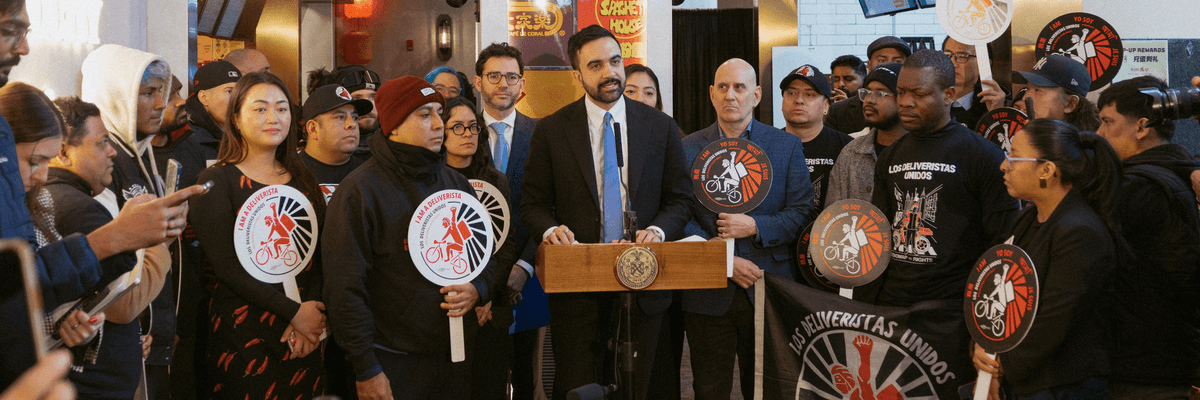
We will stand with workers who have so often stood alone. We have returned more than $9.3 million to workers, consumers, and small businesses — nearly $100,000 every single day we’ve been in office. We’ve expanded protected time off for more than four million workers, reinstated nearly 10,000 wrongly deactivated delivery workers and issued nearly 60,000 compliance warnings across our city. And throughout it all, we have taken on the junk fees and subscription traps that afflict far too many New Yorkers. No longer can someone charge you a hidden fee for the hotel you book or make it impossible to cancel a gym membership.

As we set the global standard for protecting consumers, we will also ensure that New York City remains the global center of business. We want to build the strongest economy that our five boroughs have ever seen. And we are on our way. New York City continues to lead office recovery nationwide. Venture capital investment in our city reached 11.1 billion in the first quarter of this year, the strongest quarter in five years. Labor force participation is at an all-time high.New York City will no longer tolerate exploitation as a business model.

And yet we know that if we want our city to continue to grow, we must deliver the conditions for exactly that. Public safety is at the top of the list. Make no mistake, our approach to public safety is working. Since we took office, murders have hit record lows. There has not been a murder on Staten Island in more than 180 days. Crime in our city is down. The NYPD has taken more than one thousand guns off of our streets since January 1. Together with the crisis management system, we are on pace to deliver the lowest levels of shootings in our city’s recorded history.

There is always more to be done. Our administration will approach public safety with a whole-of-government approach. That is why on day 78, we were proud to announce the creation of New York City’s first ever Office of Community Safety. It will devise new approaches to the gun violence and mental health crises that stretch across our city.

This commitment to safety extends to making our city safer and smoother for the New Yorkers who navigate our streets. On the third day of our administration, we announced that we would install protected bike lanes along the entirety of McGuinness Boulevard, one of the most dangerous roads in New York City, protecting the thousands of New Yorkers who use it every single day. We took action to lower speed limits across thousands of school zones citywide. Four hundred thirty-eight children have been killed in traffic crashes in our city since 2000 — we will not accept this as normal. And as we prepare for the World Cup, we are delivering major street upgrades, including a redesign of 9th Avenue and expanded bike lanes and pedestrian spaces across Downtown Manhattan.

Throughout every day of this work, we have contended with a historic budget deficit larger than even that of the Great Recession. Unlike those who came before us, we will budget with transparency and accountability. As we have responded to this crisis, I have thought often of the Margaret Thatcher quote, “The problem with socialism is that you eventually run out of other people’s money.” If anything, it seems that you eventually need a socialist to clean up the mess.

On January 1, I told New Yorkers that city hall would hold a singular purpose: to make this city belong to more of its people than it did the day before. For 102 days, we have endeavored to do exactly that, delivering both public goods and public excellence. Buses will run faster on Fordham Road. Children play in a new recreation center in East Flatbush, honoring the legacy of Shirley Chisholm. Childcare centers are opening in Western Queens and Staten Island and the South Bronx.

That is the change that government can deliver, and it is the change that democratic socialism can deliver.

I know there are many who use “socialist” as a dirty word, something to be ashamed of. They can try all they want, but we will not be ashamed of using government to fight for the many, not simply the few. We will not be ashamed of adding more heat pumps to NYCHA buildings in the Rockaways or building more supportive housing in Harlem or standing steadfast alongside our trans neighbors. We will not be ashamed of investing in youth mental health clinics or working to close Rikers or fighting for immigrants targeted by ICE (Immigration and Customs Enforcement).

To any New Yorker, whether you’re under attack from the federal government’s cruelty or suffocating under the affordability crisis, we will stand beside you. Because government is a series of choices. And socialism is the choice to fight for every New Yorker — to extend democracy from the ballot box to the rest of our lives.

Sewer Socialism and Pothole Politics

We are hardly the first socialists to embrace good governance. One hundred ten years ago, the city of Milwaukee elected a mayor named Daniel Webster Hoan. Hoan was considered young for the job, only thirty-five years old when he took office. Crazy, right?

More important, Hoan made no apologies for being a socialist. Mayor Hoan knew then what we know now. The worth of an ideology can only be judged by its delivery. As Emil Seidel, the socialist mayor who came before Hoan once said, their “entire governing philosophy was simple. Go after it and get it.”

Under Mayor Hoan, Milwaukee built the greatest public park system in the nation and weathered the Great Depression better than almost any other American city. Under Mayor Hoan, Milwaukee purged corruption and graft, built the first municipally sponsored public housing development in the nation, and transformed the city’s sewage disposal system. He believed, just as we do, that to deliver this great society, we should tax the rich.I know there are many who use ‘socialist’ as a dirty word, something to be ashamed of. We will not be ashamed of using government to fight for the many, not simply the few.

Today we know these leaders as the sewer socialists. But for years, Milwaukeeans knew them simply as leaders who delivered. It’s time we bring that to New York City.

There is no problem too big, no task too small. Universal childcare was a problem deemed too big to take on. Standing up for workers against corporations was a problem too big to take on. Building more homes, lowering crime to historic levels, and defending tenants against bad landlords — these were problems too big to take on.

But here’s the truth: nothing is too big for New York City to take on. And over the past fourteen weeks, we have proved that there is no task too small either. Because if government can’t do the small things, how could you ever trust it to do the big ones? How can we promise to transform our city if we can’t pave your street?

That’s why, since January 1, New York City has filled more than 102,000 potholes, including 22,800 in just three days alone. From Pelham to Tompkinsville, Bay Ridge to Inwood, city workers have fixed roads at a rate not seen in more than a decade. They filled them as the sun came up. They filled them at midnight. They filled them at all hours of the day.

That’s not all. By the end of this fiscal year, the Department of Transportation will repave 1,150 miles of our streets — enough to stretch from New York City to Miami.

This is pothole politics, our 2026 answer to sewer socialism, where government is not too busy, not too self-important, not too mired in paperwork to fix the problems of this city, no matter their size.

On day six, when we paved the bump at the base of the Williamsburg Bridge, that was pothole politics. On day sixty-five, when we rolled out our plan to take down thousands of feet of scaffolding that have darkened city streets for years, that was pothole politics. On day ninety, when we announced more than $100 million to replace and modernize more than 6,700 catch basins, that, too, was pothole politics. Honestly, that one might have been sewer socialism.

And when our city was blanketed by winter storms, when mountains of snow piled up on our streets, we brought pothole politics to emergency response. Sanitation workers melted 783 million pounds of snow, spread one billion pounds of salt, and cleared 135,000 crosswalks, 34,000 bus stops, and 29,000 fire hydrants.

We will lower costs, repave the road, shovel snow from the street, and return dignity to working people’s lives. And to the cynics, you know what? We’re going to fill your potholes too. Because when socialists make promises, we go after it and get it.

Proving Government Worthy

So, let us look forward to the next promises we will keep. This evening, I am proud to make three transformative announcements.

First, we’re going to make it easier for New Yorkers to put food on the table. Since the pandemic, grocery prices have gone up, and they haven’t come back down. We feel it every single time we go to the store. Between 2013 and 2023, grocery prices increased in New York City by nearly 66 percent, significantly higher than the national average.

During our campaign, we promised New Yorkers that we would create a network of five city-owned grocery stores, one in each borough. Today we make good on that promise. I am proud to announce that we will open every single one of these stores by the end of our first term. And the first one will open next year. Stores where prices are fair, where workers are treated with dignity, and where New Yorkers can actually afford to shop. At our stores, eggs will be cheaper, bread will be cheaper. Grocery shopping will no longer be an unsolvable equation.

One of those stores will be at La Marqueta in El Barrio, the same market that Fiorello La Guardia opened in 1936, so working people then could save money on fruits and vegetables. We will continue his legacy. We are building a brand-new store on city-owned land currently sitting empty in East Harlem, a neighborhood where nearly 40 percent of households received public assistance or SNAP in the past year.

Now, some will insist that city-owned businesses do not work, that government cannot keep up with corporations. My answer to them is simple. I look forward to the competition. May the most affordable grocery store win.

When I think of the change that government can deliver, I think, too, of the leadership of Mayor Bernie Sanders of Burlington, Vermont. Bernie’s eight years as mayor were defined by a tireless commitment to improving his city. He fixed a crumbling downtown. He delivered city services equally, not just to the wealthier areas. And he used a budget surplus to repair streets.

The sewer socialists used government to build a better Milwaukee. Bernie Sanders used government to build a better Burlington. We will use government to build a better New York City.

That, my friends, is pothole politics. And we will pursue it as we tackle one of the most persistent challenges that faces our city — one that affects every New Yorker, no matter where they live. The same word that many correctly use to describe my jump shot: trash.

Trash bags clutter our streets and our sidewalks; rats and vermin never have to look far for their next meal. In the wealthiest city, in the wealthiest nation in the history of the world, no one should have to live surrounded by garbage.

And for a brief moment, it seemed like we wouldn’t. In 2024, voters overwhelmingly supported moving forward with trash containerization. Empire Bins were rolled out in Harlem. They were promised in Brooklyn.

And then, as so many New Yorkers have come to expect from government, the momentum stalled. No date was given by which it would be completed. No funds set aside to make it real. The promise was empty. The only thing that should be empty in New York City are our sidewalks of trash.

So we are going to put a lid on it. Tonight I am proud to announce that we are launching an ambitious campaign of trash containerization across the five boroughs. We will containerize all trash at all residential properties. There will be at least one fully containerized community district in each burrow by the end of next year. We will begin aggressively rolling out new containers to store that trash and new trucks to pick it up, and we will accomplish full citywide containerization by the end of 2031.

New Yorkers deserve a government that does not shy away from the daily challenges we face, one that tackles the issues before us. That commitment to delivering change is what guides the third and final announcement I am so proud to make tonight: we will speed up buses for more than one million New Yorkers across New York City.We will lower costs, repave the road, shovel snow from the street, and return dignity to working people’s lives.

Already over these first 102 days, we have delivered for hundreds of thousands of bus riders. We kicked off street redesign projects on Madison Avenue in Manhattan, on Flatbush Avenue in Brooklyn, and we improved crosstown bus service in the Bronx — because, yes, even Yankees fans deserve better public transit.

But in a city where every minute counts, where time is money, it is unacceptable that some buses run as slow as five miles an hour. That is why on the campaign I promised to make buses faster. And it’s why tonight I am so excited to share that we will cut down commutes by up to six minutes each way. Six minutes is a lot of time. It’s enough to spend a little longer at breakfast with your family, take a shower before work, or listen to the seminal classic “4 Minutes” by Madonna featuring Justin Timberlake and Timbaland one and a half times.

Together with Governor Hochul, we will speed up buses by up to 20 percent along forty-five priority corridors. We will significantly increase the number of bus stops that are fully accessible. We will construct new, world-class rapid bus routes for a hundred thousand New Yorkers who live more than a half mile away from a subway or rail stop.

When we talk about who rides the bus, we are talking about New Yorkers who have too often been overlooked in our politics: disproportionately working-class, black, brown, outer-borough riders. The very New Yorkers who have been told to make do riding the slowest buses in America. No longer.

This will be led by a partnership between the Department of Transportation and the MTA, the first of its kind in a decade. Government will work together to work better for New Yorkers. We made a promise to New Yorkers to make buses fast and free. Tonight, we’re delivering the fast, and we’re excited to keep working with Albany to deliver the free.

When I began speaking tonight, a 2 train had just set out on a three-borough journey from Wakefield 241st Street. It rattled through the Bronx, racing the setting sun. Beneath the steel tracks, street vendors sold birria and fuchka. Students did homework on their stoop, and taxi drivers picked up passengers.

That train went underground beneath the Harlem River. Overhead, city workers piloted ferries and tugboats riding the waves. It sped below churches where the sound of neighbors singing in a single voice had echoed only a few hours prior.

Now, as we stand together, it is arriving at 125th Street. The New Yorkers on that train are thinking not of the many worlds they just rode through or the miracle that is New York City. They are thinking about whether they will make rent by the first of the month, whether they’ll have enough to ever buy a home, whether they can raise a family in the city that they love. And they’re thinking about whether their train will arrive on time, whether government will provide the services it has promised.

For too long, as New Yorkers have asked these questions, city hall has not raised its hand to help. The people of our city have been left to fend for themselves. We hold a mighty responsibility not just to govern with honesty and integrity, not just to deliver relentless improvement. We have the responsibility of proving that government is worthy of the people it serves.

Our best days lie before us. New York, the work is there to be done together. Let’s go after it and get it.


‘There Is Only One Majority in This Country, That’s the Working Class,’ Says Mamdani


“It’s time we have a politics that puts them at the heart of what it is that we’re pursuing and not as part of the appendix.”


New York City Mayor Zohran Mamdani stands with delivery app drivers in Queens on January 30, 2026.
(Photo: Mayor Zohran Kwame Mamdani/X)

Brett Wilkins
Apr 16, 2026
COMMON DREAMS


As he has done numerous times before, New York City Mayor Zohran Mamdani on Thursday rejected the notion that democratic socialism has limited appeal outside of progressive urban centers by asserting that his worker-centered policies are aimed at uplifting the nation’s biggest demographic cohort—working people and their families.

Mamdani appeared on “CBS Mornings” and was asked what grade he’d give himself after 100 days leading the world’s most important city.


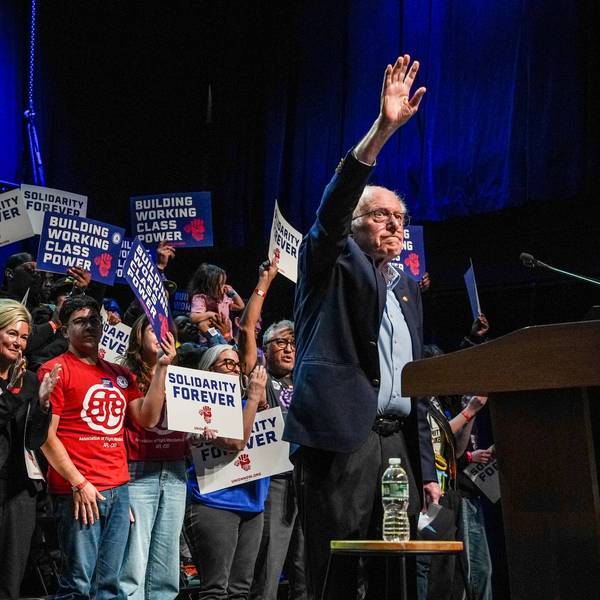
Sanders Leads Launch of ‘Worker Power’ Movement to Fight ‘Status Quo Economics’

“You know, I’ll always leave it to New Yorkers to give me the grade but I will say that I’m proud of what the team has accomplished over the 100 days,” Mamdani told “CBS Mornings” hosts Gayle King and Vladimir Duthiers. “I mean, we saw $1.2 billion secured in a partnership with Gov. [Kathy] Hochul to deliver universal childcare in our city.”

“We held bad landlords accountable for $32 millon, fixed 6,070 apartments,” he added. “We filled 102,000 potholes and we did all of this while also returning $9.3 million back to workers and small businesses that have been ripped off by megacorporations.”


Duthiers asked whether “a democratic socialist platform can translate into something that’s electorally viable in a statewide election or a national election given that, according to Gallup, many older and rural voters still have issues with the term, with the label, socialist.”

Mamdani replied: “You know, what I find is that New Yorkers ask me less about how I describe my politics and more about whether my politics includes them, and I think what we can see is that a democratic socialist politics is one that should be judged on its delivery, like any ideology. And what we’re showing in this city is we can we can pursue the big things like universal childcare and do the pothole politics at the same time.”

“I think that this is a politics that can flourish anywhere,” he added, “because frankly there is only one majority in this country that’s the working class and it’s time we have a politics that puts them at the heart of what it is that we’re pursuing and not as part of the appendix.”

Turning to the illegal US-Israeli war of choice against Iran, Mamdani lamented that “we’re talking about spending close to $30 billion to kill thousands of people an ocean away while we’re told that we don’t have even an ounce of that money to help working-class Americans across this country.”

According to a Marist poll published earlier this month, 48% of New Yorkers approved of Mamdani’s overall performance, while 30% disapproved and 23% are unsure. A majority of respondents—55%—“have either a very favorable or somewhat favorable view of the mayor, and 33% have either a somewhat unfavorable or very unfavorable opinion.”

A majority of respondents also said the city is heading in the right direction under Mamdani, while nearly three-quarters believe the mayor is “working hard,” and 58% “have a great deal or a good amount of trust in Mayor Mamdani to make decisions that are in the best interest of New York City.”

Previous polling has also shown that Mamdani’s economic policies are popular across the country.

Responding to Mamdani’s “CBS Mornings” appearance, the Center for Economic and Policy Research (CEPR) shared its newly publishedMajority Agenda,” a “roadmap” to passing policies that most Americans see as major priorities to improve their lives.

“The Majority Agenda is a collection of policy briefs on important issues where Americans generally have broad agreement across the political landscape,” CEPR explained. “The project organizes these reports into three main areas: good jobs, strong infrastructure, and fair play.”

“We’re not as divided as some media and politicians want us to believe,” CEPR contended.