The Settler’s Grin: How One Italian Magazine Cover Exposed the Monstrosity of Greater Israel
April 17, 2026
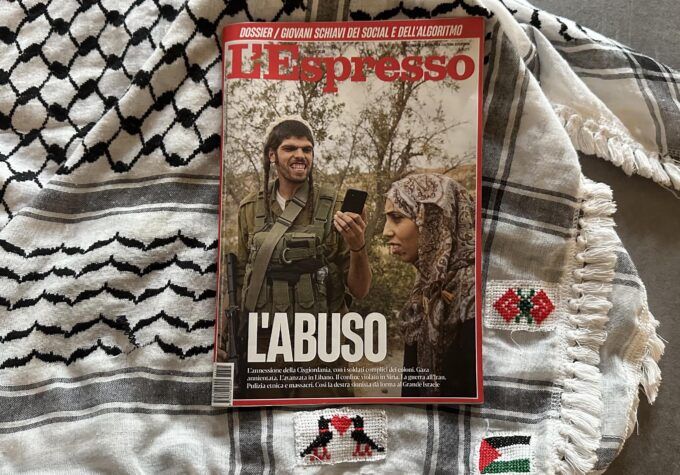
Photograph by Michael Leonardi
On April 10th 2026, the Italian weekly L’Espresso hit newsstands with a cover that has sent the Zionist apparatus into full meltdown. Titled “L’Abuso” (“The Abuse”), the image shows an armed Israeli settler — dressed in military fatigues, kippah on his head, peyot curls dangling — sneering with sadistic delight as he films a visibly distressed Palestinian woman with his phone. She stands among olive trees on what remains of her ancestral land, her face a mask of pain and exhaustion during the annual olive harvest.
The photograph, taken by Italian photojournalist Pietro Masturzo near the village of Idhna, west of Hebron, in October 2025, is not staged, not manipulated, and certainly not AI-generated. When pro-Israel accounts flooded social media claiming it was fake, Masturzo and L’Espresso released the full video footage. It shows exactly what the still image captures: a group of armed settlers, some in army uniforms, descending on Palestinian families trying to harvest their olives. The settler in the photo mocks the woman by imitating the sound a shepherd makes to herd animals — treating Palestinians like livestock on land that Zionist ideology claims as divinely ordained for Jews only.
Israel’s ambassador to Italy, Jonathan Peled, immediately denounced the cover as “manipulative” and distorting reality. Zionist networks across social media launched a coordinated campaign of harassment, denial, and smears. Yet the more they raged, the more the image spread — because it does what powerful images sometimes do: it cuts through the propaganda and shows the raw, everyday face of settler-colonial violence.
This single photograph has become a symbol of the Zionist Greater Israel project in its most unfiltered form. It is not an aberration. It is the logic of expansion made visible: armed civilians, backed by the state and its military, systematically terrorizing indigenous Palestinians to steal their land, destroy their livelihoods, and drive them out. Olive trees — ancient symbols of Palestinian rootedness and resilience — are regularly uprooted, burned, or blocked by settlers. The harvest, once a time of community and sustenance, has become a season of fear, confrontation, and ethnic cleansing in slow motion, especially in areas like Masafer Yatta and the South Hebron Hills.
The frenzy the cover provoked reveals something deeper than mere public relations damage control. It exposes the fragility of the Zionist narrative. When confronted with the unvarnished reality — the smirk of the occupier, the quiet suffering of the occupied — the default response is denial, deflection, and cries of “antisemitism.” The ambassador and his allies would prefer Italians and the world never see this face of the occupation. They want sanitized images of “self-defense” and “security,” not the daily humiliation and dispossession that sustain the dream of a Greater Israel stretching from the river to the sea, emptied of its Palestinian inhabitants.
L’Espresso’s reporting accompanying the cover goes further, documenting how the most extreme elements of the Zionist right are actively shaping Israeli policy: expanding illegal settlements, accelerating land grabs in the West Bank, and normalizing what amounts to a slow-motion ethnic cleansing operation. The settler in the photo is not a lone fanatic. He is the foot soldier of a state-backed project that enjoys full impunity — protected by Israeli law, financed by American taxpayers, and shielded diplomatically by governments in Europe and the United States, including Italy’s own Meloni administration.
Yet even in Meloni’s Italy, the tides are beginning to shift. This week, under mounting pressure from the streets and the so-called “Gaza Generation” — the young Italians radicalized by the live-streamed horrors in Gaza and the growing grassroots movement demanding an end to complicity — the Meloni government announced the suspension of its memorandum of cooperation with Israel. It is a limited but significant first step: a crack in the wall of unconditional alignment that has long defined Italian policy toward the Zionist regime. For the first time in years, economic and military ties are being questioned from within the halls of power, not just from the piazzas. The “movement from below” — sustained protests, port blockades, strikes at arms manufacturers like Leonardo, and relentless public mobilization — has forced even this far-right government to blink.
This development is no gift from above. It is the direct result of organized, unrelenting pressure from Italian civil society, particularly its youth, who refuse to let their country remain a willing accomplice in genocide and land theft. While the suspension is partial and reversible, it signals that the monopoly of Zionist influence in Italian politics is no longer absolute. The settler’s grin on the cover of L’Espresso has become a mirror that even Rome can no longer fully ignore.
In an era when Western governments continue to arm Israel, veto ceasefire calls, and criminalize solidarity with Palestine, L’Espresso’s courage in publishing this cover matters. The real scandal is not the photograph. The real scandal is the decades-long project it so powerfully illustrates: the methodical dispossession of an entire people, carried out with rifles, cameras, and the smug certainty of the colonizer.
The image will eventually fade from headlines, but the olive trees remain — stubborn witnesses to a crime that refuses to stay hidden. As long as Palestinians continue to harvest what is theirs, despite the colonizers and the soldiers, the truth will keep forcing its way onto the front page.
The abuse continues. So must the exposure.
Michael Leonardi lives in Italy and can be reached at michaeleleonardi@gmail.com
West Bank settler attacks on Palestinians are “rather sophisticated, organized, and funded systematic actions,” with the goal of “cleansing” the entire region, said journalist Ron Ben-Yishai.
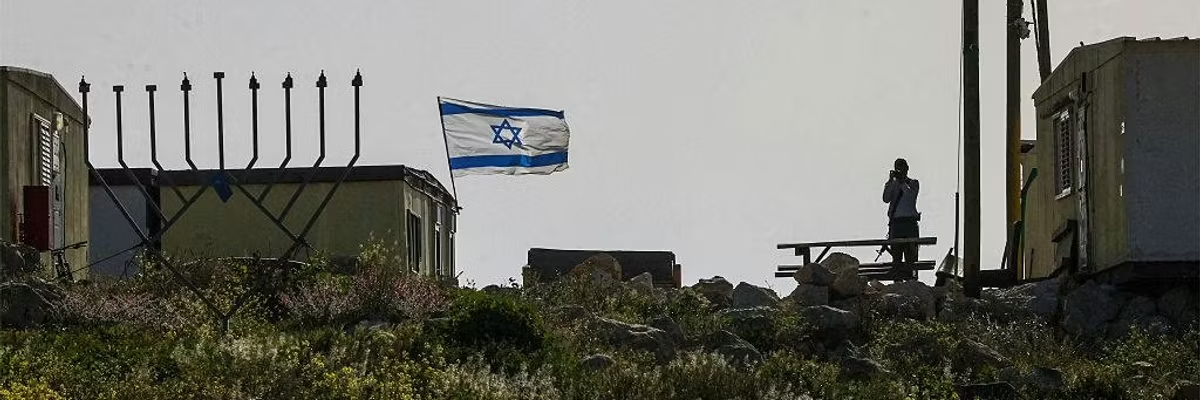
An Israeli settler from the new outpost of Karmel records movements in the Palestinian village of Um el-Kheir on April 14, 2026.
(Photo by Hazem Bader / AFP via Getty Images)
Brad Reed
Apr 16, 2026
COMMON DREAMS
An Israeli war correspondent who has been described as having deep ties to the Israel Defense Forces said that intensifying settler violence in the occupied West Bank appears to be “ethnic cleansing.”
In an column published by Ynet titled “This looks like blue and white ethnic cleansing,” journalist Ron Ben-Yishai wrote that, during a recent tour of the West Bank, he observed “a disturbing reality” of Israeli teenagers “who go on ‘intimidation tours’” in Palestinian villages, attacking Palestinians while members of the Israeli military frequently either stand by or actively join in the attacks.
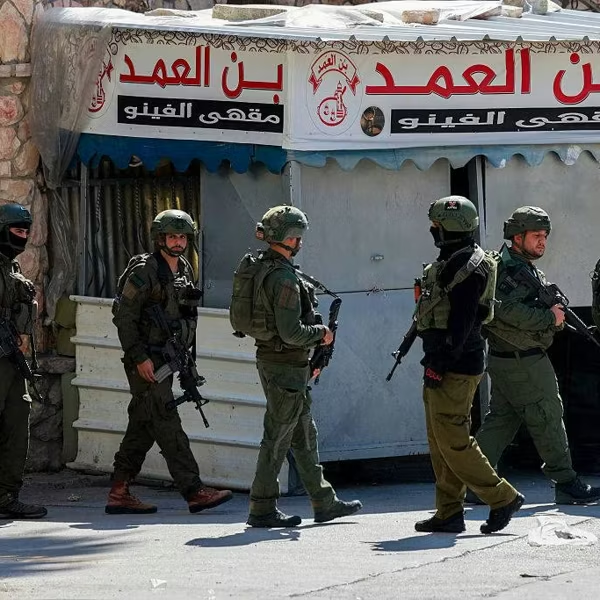
Assault on Journalists Shows How Israeli Military Acts ‘In Service of The Settler Movement’: CNN Reporter
“In some cases, these are reservists who also identify ideologically with the rioters, and therefore stand by and do not prevent them from going wild—and sometimes even help them,” explained Ben-Yishai. “Even in the regular IDF units stationed in the territories, there have been quite a few cases in which commanders and fighters have deviated from the norms and the IDF’s code of ethics for religious-nationalist reasons.”
In conversations with Israeli settlers, Ben-Yishai often found that they believed they were entitled by God to take all land where Palestinians reside.
“The confident reliance on God’s command as the answer to all moral and practical questions and concerns,” he wrote, “gave me a disturbing feeling that this was a type of Jewish terrorism motivated by religious and nationalist motives.”
Ben-Yishai also described ways in which Israeli settlers surround Palestinian communities “in order to prevent them from moving freely and strangle them economically.”
Taken as a whole, Ben-Yishai concluded that the Israel settler attacks on Palestinians are a “rather sophisticated, organized, and funded systematic actions—with the long-term strategic goal being to ‘cleanse’ most of” the West Bank and Gaza of Palestinian presence.
In a social media post, geopolitical analyst Shaiel Ben-Ephraim explained how significant it was for someone like Ben-Yishai, whom he said has “the deepest ties to the IDF of any reporter,” to describe West Bank settlers’ actions as ethnic cleansing.
“Observers have been saying for years that what is happening in the West Bank is ethnic cleansing,” he wrote. “But now voices from the heart of the Israeli consensus are admitting it as well.”

No comments:
Post a Comment