Protest is Not Terrorism, No Matter What the DOJ Tries to Tell You
April 17, 2026
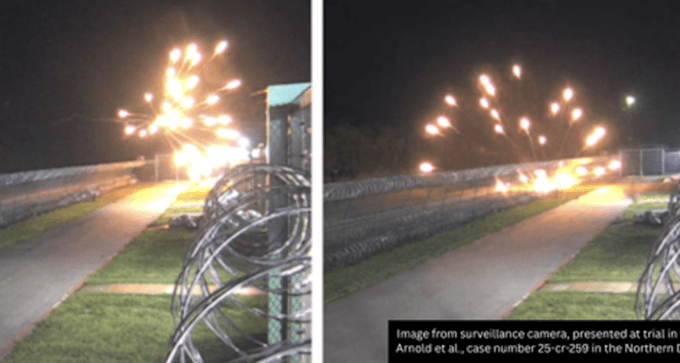
Image Source: Department of Justice – Public Domain
I recently helped organize a talk by Dr. Tom Alter, who was fired from his job at Texas State University in the Fall of 2025, supposedly for a statement he made as a private citizen at an online socialism conference earlier that year. The firing was illegal and a lawsuit against those responsible for the action is currently underway. Tom Alter has been on the road on and off since then, discussing his case, the current repression against those against Trumpism, the US-Israeli genocide in Palestine, and ICE. A key element of his talk is his insistence that, not only should this repression be opposed in every possible forum, but that opposition should not be afraid to include individuals and groups of a more radical bent in its literature and actions. Among such groups are the Prairieland defendants, seven of whom were recently convicted on federal charges of providing material support for terrorism, rioting, and conspiracy to use explosives (fireworks). Another member was convicted of attempted murder of a federal officer, and yet another was convicted of conspiracy to conceal documents and covering up records. On the face of it, these charges make it sound like the individuals were involved in a major act of terrorism when in fact the actual incident involved considerably less.
According to a website put together by the DFW Support Committee to garner support for the defendants and to keep their supporters informed, this is what happened:
On July 4th, around a dozen people gathered to make a display of noise and fireworks to express solidarity with immigrants and ICE detainees who face threat of deportation under Trump’s sweeping anti-immigration crackdown. The state’s narrative about what happened that night is dubious and full of inconsistencies. After the demonstration, police claim that two people exchanged gunfire with correctional officers and one Alvarado patrol officer on a nearby street. Subsequently, police arrested everyone in the area and the state and feds have charged these 10 people with terrorism and attempted murder, respectively. Two days later, an 11th person was arrested after receiving a phone call from a loved one in the jail. He was arrested by FBI in Denton, Texas with a box of zines in their car. FBI have turned him over to ICE in order to jeopardize his green card status.
In an email, Bruce, a member of the DFW Support Committee clarified the situation a bit further:
There was no coordination around the fireworks, there was no coordination around the vandalism. Basically all the fireworks went into the air and the couple that were pointed at the fence didn’t do any damage (it was raining). Not everyone was wearing black, some were wearing blue jeans and no masks. All but two of the people there stayed on public property. People actually left when they were asked. The cop who arrived pulled his gun first on unarmed people running away. The shots that were fired that likely hurt the officer seem to have been fired into the dirt (not at the cop) and the bullet that seems to have struck him was mangled like it ricocheted.
In other words, a group of people angry at the US policy regarding immigrants and Palestine (Palestinian protester Leqaa Kordia was imprisoned at the facility at the time) held what is currently known as a noise demo at an ICE detention camp, the cops and ICE agents at the protest freaked out and attacked the group, with some of the law enforcement personnel discharging their weapons. In the days and weeks that followed, the US Department of “Justice” drew up warrants, raided homes using lethal weapons and discharging flash-bang grenades, and threatened the arrestees’ family members. All told, nineteen people have been arrested in the case, including some folks who were not at the protest and have not even set foot in the town of Alvarado where the detention camp is located. The prosecutions themselves appear to be one of the first undertaken under presidential executive order NPSM-7 (National Security Presidential Memorandum #7), which directs federal law-enforcement agencies to investigate progressive activist organizations as domestic terrorists. The order’s definition of political beliefs that are considered indicators of domestic terrorism include anti-capitalism, anti-Christianity, so-called extremism on migration, race, and gender, and opposition to what the order calls traditional American views on family, religion, and morality.
For anyone who has ever attended a protest (especially in recent years), it should be quite clear that the reaction of law enforcement and the bureaucrats in the DOJ was (and is) over the top. Indeed, the charges brought against the defendants and the aggressive prosecution reveal the true intent of the case; it is part of a federal government attack on the first amendment’s guarantees of free speech, freedom of association and freedom to assemble. The fact that the defendants oppose fascism fits neatly into the Trumpist attempt to ignore facts and portray anti-fascist organizers and protesters, sometimes called antifa, as a centralized conspiracy of domestic terrorists. By defining protesters as such, the US government hopes to instill fear in the ordinary US resident watching the news on TV. Of course, as anyone who takes a moment to consider it, this portrayal is nonsense. Antifa is a word, not an organization. The attempts by the authorities to paint it as something else is both evidence of their far-right political ideology—an ideology that lumps neoliberal political figures like Hillary Clinton and Barack Obama together with social democrats, socialists, communists and anarchists—and their intention to stifle any political speech that is not in agreement with their authoritarian designs.
The federal convictions of the Prairieland defendants are reminiscent of the prosecutions of the Holy Land 5, The LA 8, The Chicago 8(7), Los Siete, decades of McCarran Act prosecutions and dozens of other political prosecutions over the last seventy years in the United States. These prosecutions share elements with the arrests and prosecutions of the Prairieland defendants, especially as regards these cases’ political nature. A prime example is that of the defendant convicted of conspiracy to conceal documents and covering up records, Daniel Sanchez Estrada, faces prison time because he had anarchist and anti-ICE leaflets and other such literature in his vehicle. Let me state that even more clearly: he was charged because he had political materials on his person and was trying to prevent the cops from taking them. One has to wonder how is that even an offense, much less a prosecutable one? The audacious interpretation of the statutes involved is surpassed only by the fact the jury voted to convict him.
According to Support Committee member Bruce, motions have been filed to overturn the trial but are unlikely to succeed. Sentencing is scheduled to take place in June after which appeals will be pursued. There are still three defendants facing state-only charges including Dario Sanchez who’s charged with hindering the prosecution of terrorism for allegedly removing someone a group chat. His trial is currently set for April 20th. It remains uncertain what will happen with state charges filed against other defendants.
Fundraising efforts for appeals lawyers are ongoing and can be supported best by going here: https://www.givesendgo.com/supportdfwprotestors/ Folks can also host letter writing events or info sessions to spread the word and the Support Committee encourages people to continue organizing to oppose the rising authoritarianism by holding noise demonstrations or other actions and to call out the connections between their actions and the case.
Bruce ended his email with these words from the Support Committee:
We believe our friends will come home as heroes of a movement for liberation!
American Prisons Restrict Free Speech
.jpg)
April 17, 2026
Over the span of a single week at the end of March, a Michigan prisoner was found dead inside his cell in what authorities are investigating as a homicide, two inmates died inside New York City’s infamous Rikers Island jail complex, and an inmate was killed inside a California jail.
The violence and abuse that is commonplace in American prisons is beginning to draw national attention. That same week, The Marshall Project released its investigation into systemic sexual abuse inside a Texas womens prison, a civil rights lawsuit was filed accusing an Oregon corrections deputy of raping an inmate inside her cell, and the state of California paid $1.9 million to settle a lawsuit against jail staff accused of excessive use of force. The American prison system is in a crisis of accountability. Until state legislatures take measures to protect the speech rights of prison inmates, incarceration will become an unspoken death sentence for more American citizens.
Last year, filmmakers Andrew Jarecki and Charlotte Kaufman brought us into the heart of this crisis. Their documentary, The Alabama Solution, uses smuggled cell phones to document abuses inside Alabama state prisons. The documentary-style investigation found over 1300 deaths inside Alabama prisons since 2019, less than half of which were of natural causes. One family, whose son was beaten to death by prison guards, was allegedly told that if they contacted reporters, his body would not be returned to them. Another family received their son’s body from prison officials with his heart missing after the family commissioned a private autopsy.
As of 2025, 45% of Americans have an immediate family member who at some point was incarcerated, most of them will never be featured in an award-winning documentary. In order to prevent, investigate, and prosecute prison abuses, we need to know about them in the first place. While a trio of 20th century Supreme Court decisions grant prison officials discretion in barring media access behind bars, inmates still retain the right to free speech, so long as it doesn’t legitimately jeopardize prison security. Doubling down on free speech behind bars will make America’s jails and prisons safer.
In many cases of prison abuse, it is the victims who are punished instead of the perpetrators. In its investigation into sexual misconduct in Texas prisons, The Marshall Project notes how inmates and staff who spoke out were threatened, one of the victims was even moved to a more restrictive facility after reporting her sexual abuse. Likewise, when the initial media buzz surrounding The Alabama Solution quieted, three inmates most critical to the film were placed into solitary confinement. Filmmaker Charlotte Kaufman explains, “What’s so disturbing is that [state prison officials] don’t have to give a ‘why.’ They can… take away all of their belongings, cut them off from their family members, cut them off from the outside world.”
This can even be done to well-resourced inmates. Last year, billion-dollar crypto fraudster Sam Bankman-Fried was placed in solitary confinement after conducting an “un-authorized” interview. You don’t even need to be convicted of a crime to find yourself in solitary. In 2021, D.C. jail officials decided that all accused January 6th Capitol rioters would be housed in solitary. Forced to eat off the floor, they were locked in their cells 23-hours a day, given one hour daily to shower, exercise, and meet with their attorneys.
Fortunately for those inmates, reporters latched on to their stories. The Alabama Solution filmmakers launched a website for viewers to sign an open letter, call Alabama correctional facilities, and donate directly to inmates. Sam Bankman-Fried is now in a low-security California prison, and all accused January 6th rioters were pardoned by President Donald Trump. Transparency, in those cases, led to action.
But not everyone has a film crew, million-dollar legal funds, or the president of the United States to advocate for them. Thankfully, state legislatures can take practical legal action to defend prisoners’ speech rights behind bars. This begins with making jailhouse phone calls free of charge. The Prison Policy Initiative notes that a 15-minute phone call costs anywhere from 93 cents in New Jersey to $5.47 in Minnesota. A significant price for inmates making less than $1 per hour at their prison jobs.
Facilities should also allow some inmates to have cell phones and social media accounts of their own. It is reasonable for many non-violent offenders to communicate freely with the outside world. Social media is a particularly effective way to do this, yet in most cases is strictly forbidden. For example, the South Carolina Department of Corrections considers inmates “creating and/or assisting with a social networking site” a Level 1 offense — putting it in the same category as murder, rape, and hostage-taking.
In our 21st-century media ecosystem, there is no reason for prisons to be information black holes. What happened last week, can happen next week, which is why we need transparency today. Doubling down on prisoners’ First Amendment rights is the best way to do it.

No comments:
Post a Comment