Victory Disease in Iran
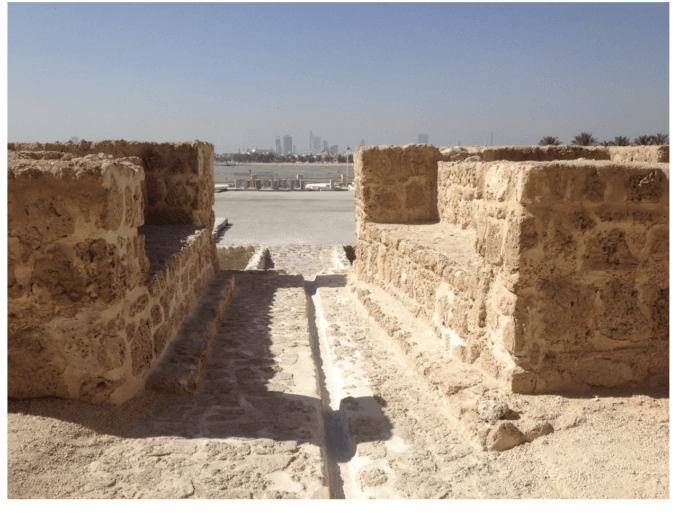
Old fortification in Oman. Photo by Matthew Stevenson.
Before the United States decides to stump up another half a trillion dollars for Pete Hegseth’s Excellent Adventures, it might want to answer the question why the country has only won a handful wars in the last hundred years?
Victory disease is defined as “dangerous overconfidence, arrogance, and complacency that arises within a leadership or military force following a string of decisive victories,” and most imperial powers in decline, including now the U.S., suffer from it chronically.
On paper, measured by budget appropriations, the U.S. army is the greatest show on turf—with endless gadgets, cruise missiles, and stealth bombers.
Since World War II, however, the United States has fought to the occasional draw—as happened in Korea—but in most of its splendid little wars it has been defeated.
The United States has lost wars in Cuba, Vietnam, Cambodia, Iraq, Iran (1979), and Afghanistan, and smaller engagements in places like Syria, Libya, and Lebanon.
The 1991 Gulf War did end with the Iraqis out of Kuwait and its malls, but that fighting ended at intermission, with the issues in Iraq and the Middle East still unresolved.
+++
The three most glaring defeats—Vietnam, Iraq, and Afghanistan—are examples of undeclared wars that involved the combined arms of the army, navy, and air forces, which at war’s end departed in rooftop helicopters with the American flag stuffed into a garbage bag or whatever.
In Vietnam, the United States tried everything in its “arsenal of democracy” (except maybe nuclear weapons or democracy itself), but got nowhere.
The Vietnam War cost the lives of some 58,000 soldiers, but really the death toll—when you add in the suicides of returning veterans—was in the hundreds of thousands (not counting the deaths of Vietnamese soldiers and civilians,
As Professor Christian Appy writes in his excellent book, American Reckoning: “We didn’t know who we were till we got here. We thought we were something else.”
The 9/11 Forever Wars in Afghanistan and Iraq largely followed the template of the defeat in Vietnam.
At the wars’ beginnings (maybe as now in Iran?), the United States won the sound-and-light shows—with spectacular D-Day air campaigns that destroyed power grids, airports, and rail networks—only for American forces to become bogged down in unwinnable guerrilla wars. For the moment Iran is following this libretto.
+++
Was it the politicians (with confused war aims) or the generals (fighting the last war) that cost the United States victories in so many wars?
In Vietnam, Lyndon Johnson’s orders to his generals were beyond the capabilities of the army in the field, roughly 500,000 men.
The senior army commanders approached Vietnam as if each hamlet was Bastogne and as if the war was a rerun of the Battle of the Bulge—not combat-in-the-round against a largely invisible army. In a country larger than California, eight combat divisions don’t cover much ground.
Attrition as a strategy might have worked for Ulysses S. Grant at the Wilderness (on the march to Appomattox) but it was unsuited to Vietnam—a labyrinthine country of mountains, rivers, and jungles—although senior army commanders never adapted.
Now in Iran Trump is saber rattling with 2,500 marines and few minesweepers.
+++
In many ways, Iraq and Afghanistan were reruns of Vietnam, in that the George W. Bush and Obama administrations assigned impossible missions to an unprepared army (which thought that it could go home once the Saddam Hussein monument had come down in Baghdad).
Instead, in both wars, it took more than ten years to figure out that neither the American government or the army was up to its assigned tasks. Nor did it help in Vietnam, Iraq, and Afghanistan that the U.S. government justified these wars through a series of lies told to the American people—something those defeats have in common with Trump’s “little excursion” in Iran.
+++
The only person to declare war on Iran was Donald Trump, who approached the campaign as if playing with ships in one of Jeffrey Epstein’s hot tubs.
Trump went to war in Iran without a clear reason, without a declaration from Congress, without any allies (except for Israel’s remittance men using war to stay out of jail), without troops at the ready (those marines sailing toward Kharg Island had to be sent from Okinawa), and without knowing how victory would be defined.
Even worse—from the perspective of Napoleon who often spoke of deluded generals “painting pictures”—Trump’s war plans in Iran are an invention of the president’s addled brain.
+++
Knowing nothing about geography, history, or religion, Trump chose to imagine war in the Middle East as a variation on new TV game show, in which the key is to get other people’s money to backstop your paper empire.
For Trump attacking Iran was always just “a deal”: to get rid of Ayatollah Khamenei; to curry favor with Jewish voters in the mid-term elections; to make voters forget about his Epstein rape allegations; to weasel more money out of the Saudis and the Gulf States for his son’s private-equity schemes; and to play soldier in the bunkers at Mar-a-Lago. Hence, the casus belli changes with each Fox talk show beamed into his echo chamber.
In less than two months, the war to liberate Iran’s street demonstrators became a war to deny Iran the use of enriched uranium, which became a war to destroy Iran’s power grids and then a battle to control the Strait of Hormuz—war as a Netflix serial not unlike Succession.
+++
Few, if any, Americans knew why we were “in Vietnam,” just as the only geopolitical justification for the Iraq War was W’s utterance about Saddam Hussein: “We’re taking that fucker out.”
Likewise, few Americans—even those supporting the blitz—have a clue why the United States is at war with Iran (unless, of course, Trump wants “to impress Jody Foster”).
Even on his good days, which are few and far between, Trump sounds more like Peter Sellers’ Chauncey Gardiner (“I like to watch…”) than either the Austrian Foreign Metternich or the British Viscount Castlereagh.
Through endless nights, Trump drones on about Iranian oil “paying for the war” or going into business with the ayatollah to collect tolls in the Strait of Hormuz. Then he reverts to the mean and calls all Iranians “scumbags” or “crazy bastards,” debased language that suggests more than a little desperation in the demented and wandering Trump.
How can he figure out the Middle East if he needs posted signs to find his way around the White House?
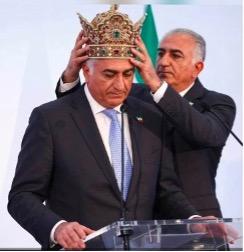
Reza Pahlavi speaks of a “revolution”, but what kind?
Wednesday 15 April 2026, by Houshang Sepehr
In Iran, the streets, morgues and cemeteries are now littered with corpses. Predictably, the Islamic Republic is carrying out summary executions of protesters with extreme brutality. It was a deliberate massacre aimed not only at stifling mobilizations, but also at deterring any dissent.
In this context, Reza Pahlavi was accused of having sent the population to their deaths by calling for demonstrations. But the first problem concerning him is the very nature of the political project he embodies. The second is the real political function that the son of the former Shah wants to assign to himself: he aspires to lead, but without assuming a real role as a revolutionary leader. This position conceals a fundamental contradiction: wanting to frame a movement while avoiding the revolutionary dynamic that could result from it.
Pahlavi’s orientation draws on both Gene Sharp’s theories of “colour revolutions” and approaches that advocate limited and controlled confrontation. In both cases, the emphasis is of course not on the self-organization of the masses, but on preconceived scenarios aimed at channelling, indeed containing, popular mobilization.
However, the Iranian experience has already shown the limits of these approaches. Mass mobilizations can only succeed when the regime in place is already deeply weakened. Conversely, dispersed forms of confrontation must face the cohesion of the repressive apparatus. In both cases, the absence of an autonomous organization of the masses constitutes a decisive weakness. However, without organization, there is no social transformation possible.
The reality of the uprisings: the centrality of the popular classes
The social reality resulting from the recent uprisings, especially since 2017, contradicts the schemas of the monarchists. The popular classes, confronted with permanent structural violence, have developed their own forms of struggle. These do not correspond to the models developed to analyse mobilizations mainly affecting the “middle classes”.
Moreover, a part of these “middle classes”, deprived of political representation since the collapse of the “reformist” clans of the regime, has turned to a form of nostalgia for the past. The “Pahlavi Organization” has been able to capture and organize this nostalgia, positioning itself as a new pole of representation. Thanks to extremely rich media relays, part of the diaspora and various networks of influence, the “Pahlavi Organization” has gradually extended its influence, including in certain segments of the popular classes.
However, this strategy is based on a major contradiction. On the one hand, it recognizes the need to mobilize social anger; on the other, it seeks to limit its scope, in order to avoid any transformation into an autonomous revolutionary dynamic. This double movement — encouraging mobilization while preventing its deepening — constitutes the heart of the project of Reza Pahlavi and his entourage.
What they know, but keep silent, is that no revolution triumphs through mere mass demonstrations or dispersed violent actions. A revolution is a long process, based on the progressive organization of the dominated: neighbourhood committees, strike structures, forms of self-organization capable of concretely contesting the existing regime.
It is precisely this prospect that is feared by the monarchists. Such a dynamic would open the way to autonomous forces, beyond their control. Recent history has shown that movements capable of anchoring themselves in social structures can permanently transform the balance of forces — even when counterrevolutionary forces seek to capture them for their own benefit.
A strategy that exposes the population without protecting it
From then on, a central question arises: what “revolution” is Pahlavi talking about? For him, it is a “national revolution” of a particular type: a strategy consisting of exposing the unarmed masses to massive repression, so that the human cost becomes a lever in international negotiations. This logic cannot be imposed without foreign intervention.
But such a prospect is a dead end. It is based on an instrumentalization of popular mobilizations, without offering any perspective of real emancipation. Meanwhile, the most precarious classes—those who do not even have the means to resort to the weapon of strikes—continue to pay the highest price.
An alternative that needs organization
The Islamic Republic, for its part, has demonstrated that it will not back down from an escalation of violence. Under these conditions, the repetition of unstructured mobilizations can only lead to a reproduction of the cycle of repression-sacrifice.
Breaking this deadlock requires breaking with these illusions: neither imported scenarios of “peaceful transition” nor strategies of dispersed confrontation can, on their own, open a path to real transformation. Only the autonomous organization of the oppressed and exploited masses can constitute a real alternative.
Until such a perspective is implemented, the situation is likely to remain unchanged — and streets, morgues and cemeteries will continue to bear the brunt of this impasse.
But in reality, the question is not whether Pahlavi and his entourage could move towards the creation of mass organizations, or whether they are afraid of them and will therefore fail to overthrow the Islamic Republic. Rather, it is a matter of noting that this “national revolution,” whose real name is “neo-fascist counterrevolution,” is based on street mobilization, control of the media, and implicit recourse to U.S.-Israeli military intervention.
Even if, where necessary, it could attempt to set up mass institutions, these would be of the fascist type and intended to consolidate its control, and not to emancipate the popular masses.
Basically, this whole discussion shows a simple and disturbing reality: Reza Pahlavi has de facto taken the lead of the "counter-revolution”. The question is not whether this “counter-revolution” – or “royalist revolution” – can triumph, as the Islamic “counter-revolution” did in 1979. Above all, it is a question of becoming aware of this fact and remembering the great lesson of 1979: popular uprisings, however powerful, can be co-opted or betrayed when they are not based on an autonomous organization of the masses.
This lucidity is essential to understand that the real transformation will come neither from Pahlavi nor from any foreign intervention, but only from the ability of the oppressed and exploited to organize and defend their own interests.
10 April 2026
Houshang Sepehr
Houshang Sepehr is an exiled Iranian revolutionary Marxist militant. He is an organizer of Solidarité avec les Travailleurs en Iran (“Solidarity with the Workers in Iran” - 266 avenue Daumesnil, 75012 Paris) and a member of the Fourth International.
.png)

No comments:
Post a Comment