Thursday, May 07, 2026

Platner, El-Sayed Embrace Warning That They Are ‘Direct Threat to the US-Israel Relationship’

“I’m Abdul El-Sayed and I endorse this message,” said the US Senate candidate in Michigan.
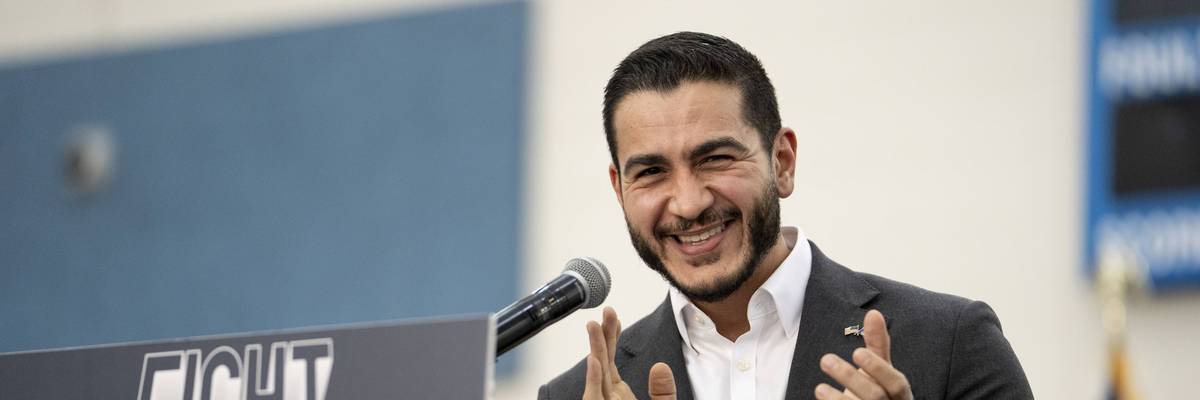


Abdul El-Sayed, candidate for US Senate in Michigan, speaks at a rally at Mumford High School on May 3, 2026 in Detroit.
(Photo by Sarah Rice/Getty Images)

Julia Conley
May 06, 2026
COMMON DREAMS


Two Democratic US Senate candidates in closely watched primary races found themselves in rare agreement with a powerful pro-Israel lobby group on Tuesday evening after it warned the two progressives posed “a direct threat to the US-Israel relationship.”

“I’m Abdul El-Sayed and I endorse this message,” said the physician and public health advocate running in a three-way race in Michigan, where he recently emphasized at a rally that the American Israel Public Affairs Committee (AIPAC)—the group that issued the warning to voters—has endangered Jewish Americans by promoting the idea that criticizing the Israeli government is antisemitic.

In Maine, combat veteran and oyster farmer Graham Platner, the presumed winner of the June 9 primary following Gov. Janet Mills’ decision to suspend her campaign, said he was also “proud to appear” in AIPAC’s fundraising email, “and many AIPAC fundraising emails to come.”


In its email to supporters, AIPAC said El-Sayed and Platner are the chosen candidates of a “coordinated, well-funded effort to punish anyone who stands with Israel”—one that’s being “driven by the far-left fringe of American politics.”

The group added that the movement is being “pushed” by Sen. Bernie Sanders (I-Vt.)—one of the nation’s most prominent Jewish political leaders and consistently ranked as the most popular member of the US Senate—and “amplified by voices like Hasan Piker,” a Twitch streamer and commentator who has campaigned with El-Sayed.

Piker’s involvement in El-Sayed’s campaign sparked a weekslong controversy, with the other two Michigan Democrats in the race, AIPAC-backed Rep. Haley Stevens and state Sen. Mallory McMorrow, accusing El-Sayed of associating with someone who’s promoted antisemitism and comparing Piker to white nationalist influencer Nick Fuentes. Both El-Sayed and Piker have condemned antisemitism, expressed vehement support for Palestinian rights, and denounced Israel’s US-backed attacks on the occupied Palestinian territories.

In its email, AIPAC doubled down on its claims that El-Sayed and Platner are part of an extremist movement that occupies the fringes of American public life, warning that they’ve embraced “extreme rhetoric, pushed false accusations of genocide, and openly support cutting off aid” to Israel.

But numerous polls in recent months have suggested that Israel’s actions since it began attacking Gaza in October 2023 with US military funding—killing more than 72,000 Palestinians, creating the largest child amputee population in the world, and imposing an intentional starvation policy—have resulted in plummeting approval ratings for the country and its right-wing government, without any help from Sanders, Platner, El-Sayed, or Piker.

Months into Israel’s war on Gaza, cracks in Israel’s popularity among US voters were already beginning to show. In May 2024, a poll by Data for Progress found that 56% of Democratic voters believed Israel was committing genocide in Gaza, and 54% said they supported suspending all US arms sales to Israel until it stopped blocking humanitarian aid.

Public disapproval has only grown more pronounced since then. A Gallup poll showed in February that for the first time, a larger share of Americans sympathized with the Palestinians than with Israel in the Middle East conflict. In March, a survey by Hart Research Associates and Public Opinion Strategies found that just 32% of US voters viewed Israel positively, down from 47% in 2023.

Just before the US helped broker a ceasefire between Israel and Hamas last October—a deal Israel has repeatedly violated, killing hundreds of Palestinians since it was reached—a Washington Post poll found that 61% of Jewish Americans believed Israel had committed war crimes in Gaza and 40% said Israel was guilty of genocide.

At a rally held by Platner and Sanders in September, the political newcomer garnered loud applause when he called for an end to US funding for the Israeli military.

On Tuesday, despite the mounting evidence to the contrary, AIPAC replied to El-Sayed’s “endorsement” of its attack by insisting that many voters want to vote for a candidate “who backs a partnership that delivers for Michigan—more jobs, a stronger auto industry, thriving agriculture, and better healthcare.”


The Medicare for All advocate retorted that he plans to be “a senator who keeps Michigan tax dollars in Michigan to fund schools, healthcare, and roads... in Michigan.”

Recent polls have shown a close race in the state. The most recent survey by the Glengariff Group found Stevens ahead of El-Sayed by just two points, with McMorrow behind six points. A poll by Emerson College, also taken in mid-April, found El-Sayed and McMorrow tied with 24% of the vote, despite the attacks on El-Sayed over his campaigning with Piker.

The Michigan primary is scheduled for August 4.
Billionaire Compares ‘Tax the Rich’ Calls to Hate Speech as Study Finds Barely Half of Americans Earn Living Wage

Vornado CEO Steven Roth was particularly upset by New York City Mayor Zohran Mamdani’s proposed tax on second homes in the city that are valued at $5 million or more.


Sen. Bernie Sanders (I-V.) holds a ‘Tax the Rich’ rally at Lehman College in the Bronx, New York City, on March 29, 2026.
(Photo by Selcuk Acar/Anadolu via Getty Images)

Brad Reed
May 06, 2026
COMMON DREAMS

A real estate investment tycoon on Tuesday said that calls to raise taxes on the wealthiest Americans were akin to “racial slurs.”

As reported by The New York Times, Vornado Realty Trust CEO Steven Roth took time during his company’s latest earnings call to decry calls from politicians such as New York City Mayor Zohran Mamdani to fund public programs by taxing the rich.

“I must say that I consider the phrase ‘tax the rich’... when spit out with anger and contempt by politicians both here and across the country, to be just as hateful as some disgusting racial slurs,” said Roth.

Roth took aim at Mamdani for celebrating a proposed pied-à-terre tax on luxury properties worth more than $5 million whose owners have other primary homes, and was particularly upset that the mayor filmed a video announcing the tax outside a $238 million penthouse owned by Ken Griffin, the CEO of the hedge fund Citadel. He called the announcement “dangerous” and an “ugly, unnecessary video stunt.”

The Vornado CEO went on to say that America’s wealthiest individuals deserve the nation’s gratitude, not their scorn.

“The rich, whom the politicians are targeting... are the epitome of the American dream,” he said. “They are at the top of the great American economic pyramid for a reason. They should be praised and thanked.”

Roth’s remarks drew criticism from Douglas Farrar, former director of the Office of Public Affairs at the Federal Trade Commission under President Joe Biden.

“A billionaire real estate CEO compared being asked to pay taxes to a racial slur, then said the top 1% should be ‘praised and thanked,’” Farrar wrote in a social media post. “There was a time when the wealthy had the good sense to be quiet about it. Now they demand gratitude on earnings calls.”

Activist and healthcare advocate Melanie D’Arrigo noted that Roth build developments in the city after intentionally allowing properties to sit in a state of blight for years, which “gutted Black and brown neighborhoods in exchange for billions in tax breaks.”

Roth’s lamentations about the treatment of the wealthy in the US came as human resources and software services company Dayforce teamed with the Living Wage Institute to release a new study showing that the percentage of Americans earning a living wage has significantly declined over the last five years, from 55.8% in 2021 to 50.7% in 2025.

The report notes that “job growth has recently slowed, and millions of workers haven’t seen a meaningful improvement in their financial situation,” even as “the costs of housing, food, childcare, and other essentials are elevated, energy prices have spiked, and affordability continues to be a major issue for a significant share of the workforce.”

The data in the report all came from 2025, before President Donald Trump launched his illegal war with Iran that has sent gas prices soaring above $4.50 per gallon and is threatening to unleash a global food crisis.

US consumer sentiment as measured by the University of Michigan hit a record low last month, and the university found that the effects of the Iran war were the primary drivers of Americans’ economic pessimism.
​Bessent confronted by airline exec over damage Trump is inflicting on industry: WSJ

Tom Boggioni
May 7, 2026 
RAW STORY


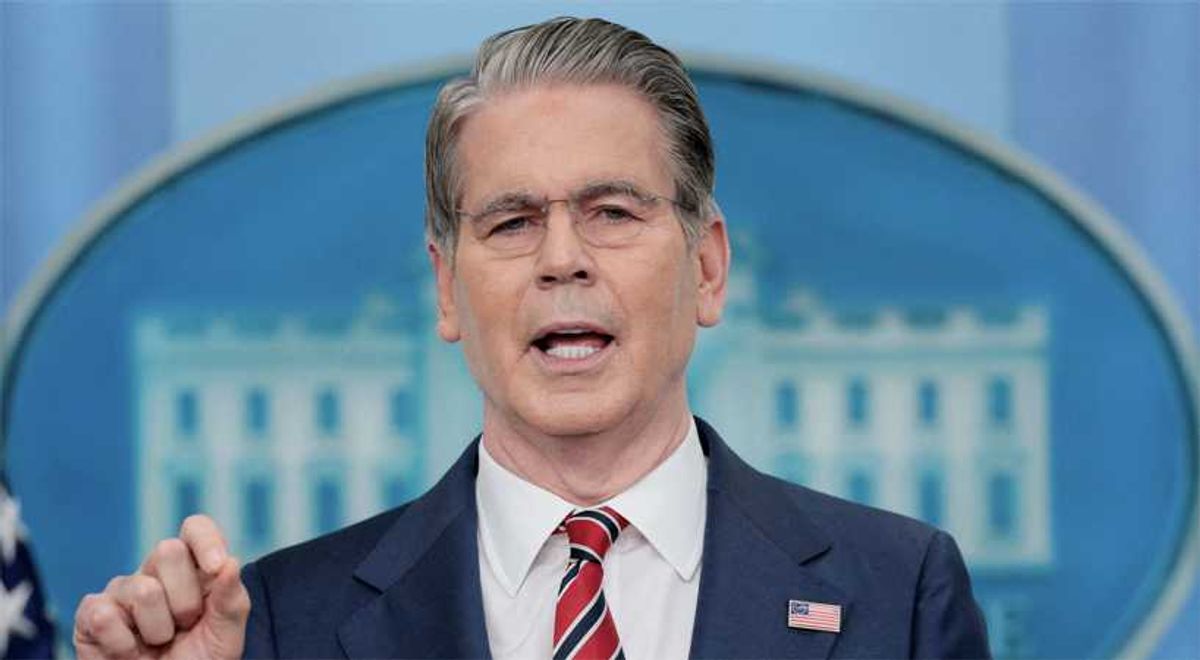
U.S. Treasury Secretary Scott Bessent speaks during a press briefing in the James S. Brady Press Briefing Room at the White House in Washington, D.C., U.S., April 15, 2026. REUTERS/Evan Vucci/File Photo

Treasury Secretary Scott Bessent, who has been making the rounds reassuring the public that the economic hardships from Donald Trump's Iran war will eventually subside, received a sobering reality check from the airline industry — one of the sectors being hit hardest by skyrocketing fuel costs.

According to reporting from the Wall Street Journal, former New Hampshire Gov. Chris Sununu, now president of Airlines for America, delivered a stark warning to the Trump administration that jet-fuel costs have become unsustainable.

According to the Journal's Brian Schwartz and Alison Sider, Sununu "delivered a warning to Treasury Secretary Scott Bessent during a recent visit to Washington."

Sununu has spent weeks sounding the alarm to Trump administration officials about the economic fallout from elevated fuel prices, arguing that the war must end soon or conditions will deteriorate further. His message appears to be landing.

Privately, Trump's advisers are said to be growing concerned that Republicans will pay a significant political price for the rising fuel costs ahead of November's midterm elections. Many administration officials are now eager to end the conflict in hopes that prices will moderate before voters head to the polls, the Journal is reporting.

"They get it…and I think that's why they're trying to get through the war as fast as they can," Sununu told the Journal.

Since Trump's initial U.S.-Israeli attack on Iran in late February, Sununu has met in Washington with National Economic Council Director Kevin Hassett, representatives from the Transportation Department, and senior White House officials. A White House official confirmed that Hassett and Sununu have discussed the impact of increased fuel prices on the airline industry and how the sector can blunt the cost for consumers.

However, Sununu cautioned that recovery will be slow. Even after the Strait of Hormuz is fully reopened, ticket prices won't drop immediately. "You're looking at elevated ticket prices through the summer and fall because it takes a while for the prices to go down," Sununu warned.


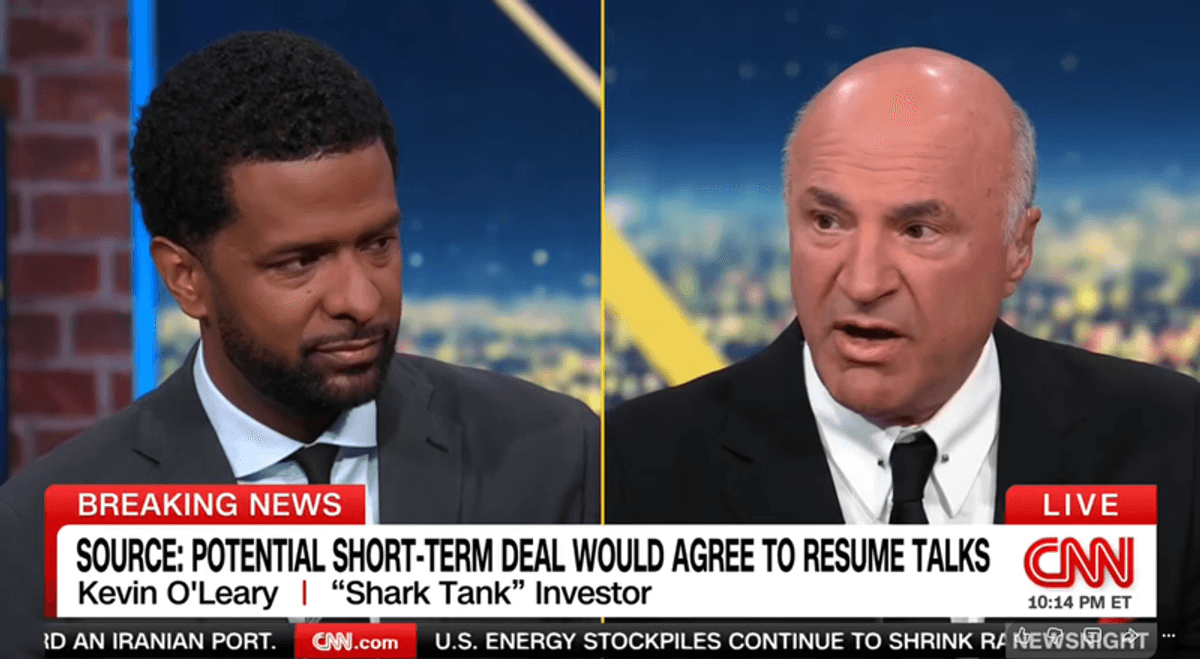
'You just said a bunch of nothing!' Kevin O'Leary sparks uproar on CNN over war costs

O'LEARY IS A FAUX CANUCK
HE LIVES HERE JUST FOR THE UNIVERSAL HEALTHCARE 

Robert Davis
May 6, 2026 
RAW STORY


CNN screenshot


Canadian businessman and star of CNBC's "Shark Tank," Kevin O'Leary, sparked an uproar on CNN on Wednesday after he defended the costs of President Donald Trump's war in Iran.


O'Leary argued during a segment on CNN's "NewsNight" with host Abby Phillip that waging the war in Iran is worth the associated costs because it will allow American businesses to sell products in an emerging region, and that the Strait of Hormuz will be policed by another nation in the region. O'Leary added that the short-term rise in oil and fertilizer prices is just part of the deal for Americans.

"I guarantee you two things before this has worked out: the Strait will be open and probably policed by people around that region because it's in their best interest, and secondly, there are no friends in the world left for Iran," O'Leary said.

Bakari Sellers, a political analyst, sharply rebuked the "Shark Tank" star's comments.

"You just said a bunch of nothing!" Sellers said. "Explain to me, right now, somebody who lives in South Carolina, Nebraska, or Ohio, what is good right now for the American public going into a war where you do not understand that they're going to close the Strait of Hormuz. Explain to somebody watching right now where they're from."

"It's been 78 days ..." O'Leary began.

"So you don't have an answer?" Sellers shot back.


As Trump Drives Up Gas Prices and Trashes Economy, US Auto Debt Hits Record High

“Reckless actions on the economy and the expensive fallout from the war in Iran has made it harder for working families to purchase a car and has left millions more feeling major pocket pain at the pump,” one researcher said.


Used cars are for sale in Inglewood, California on February 18, 2026.

(Photo by Michael Yanow/NurPhoto via Getty Images)

Jessica Corbett
May 06, 2026
COMMON DREAMS

As Americans on Wednesday continued to face the economic fallout of President Donald Trump’s war on Iran, a gallon of gasoline cost $4.536, the average transaction price for a new vehicle was $49,275, and a pair of progressive groups published a report detailing “how surging auto loan debt is hurting households.”

“The costs of purchasing and financing a car have been going up for years,” noted Protect Borrowers senior fellow Tara Mikkilineni, who co-authored the report, “When The Wheels Come Off,” with other experts from her organization and The Century Foundation.

“Unfortunately, the Trump administration’s reckless actions on the economy and the expensive fallout from the war in Iran has made it harder for working families to purchase a car and has left millions more feeling major pocket pain at the pump,” Mikkilineni said. “For millions of working families, a car is not a luxury, it is an essential economic lifeline. Working families deserve relief and they deserve to have a government that is watching out for them, not allowing lenders and auto dealers to rake in record profits at their expense.”

Mikkilineni’s team found that “in recent years, aggregate total auto debt has reached $1.68 trillion, a 37% jump since early 2018, and now comprises the largest volume of outstanding loan debt ever recorded. At the end of 2025, nearly 86 million Americans—roughly 28% of consumers—have outstanding auto loan or lease debt. Residents in states where driving is most necessary, such as Texas, Alaska, Louisiana, and Florida, are struggling with the highest levels of auto debt.”

“Borrowers carrying auto loans see significantly higher and faster credit card balance growth—regardless of income level—suggesting that auto debt cascades into broader financial pressure,” according to the report. Specifically, “between early 2018 and late 2025, credit card balances for middle-income borrowers with auto debt surged by 31%, while those without auto loans saw a notably lower growth of 17%. Borrowers with extended-length auto loans are carrying monthly balances on their credit cards that are 190% of (that is, nearly twice) their monthly income.”

“At the end of 2025, the average origination balance for an auto loan reached $33,519, an amount $10,000 higher than the average in 2018, due to massive increases in the price of even the most basic cars and a shortage of ‘affordable’ car models,” the publication explains. “Borrowers are also facing higher interest rates. Today, the average annual percentage rate (APR) for auto loans is nearly 10%, up from 7.5% in 2018.”

Financially vulnerable borrowers are being hit particularly hard by current conditions. The researchers found that for those with the most limited access to credit, “the average APR is up to 18.7%, which means a six-year loan on a $30,000 car will cost $20,000 in interest alone. Furthermore, Black, Hispanic, and American Indian and Alaska Native borrowers face higher interest rates than their white and Asian counterparts.”


Affordable vehicles are also harder to find these days. Sean Tucker, a managing editor at Kelley Blue Book, told CNBC that “in 2017, [automakers] built 36 models priced at $25,000 or under... Today? Four.”

Tucker said that a “record” share of new cars—over 43%—are now bought by households with incomes of at least $150,000. According to him, “Automakers are serving that market.”

Angela Hanks, another report co-author and chief of policy programs at The Century Foundation, stressed that “for the overwhelming majority of working families, a car is a necessity—yet purchasing a car has become a financial trap, eating up more of people’s paychecks than ever before.”

With so many US communities lacking quality public transit, some US families in need of a vehicle turn to loans with longer terms. The report points out that “for these borrowers, even after taking on these riskier products with additional lifetime costs, auto loan payments are still nearly 20% of their monthly income, meaning nearly $1 out of every $5 they earn will go toward car payments over the seven years of their loan.”

Hanks highlighted that “while families drown” from costly, extended-term loans, “the Trump administration is refunding big businesses for the tariffs that consumers paid, with interest.”

The Trump administration last month launched a portal designed to facilitate refunds for around $166 billion in tariffs that the US Supreme Court struck down as unconstitutional, but only businesses that directly paid the import taxes are eligible, even though companies largely passed on the cost hikes to consumers.

Meanwhile, the president responded to the high court’s decision by imposing temporary import taxes, and his administration is pursuing “plan B,” holding hearings required to impose tariffs under Section 301 of the Trade Act of 1974, a different legal authority than the one Trump used last year.

The new report concludes by calling on US policymakers to act: “Amidst the growing affordability crisis, Americans deserve urgent action to bring down costs and rein in profiteering from the dealers and lenders who have been allowed to get away with nickel-and-diming working families for far too long.”


Internet stumped over Trump official's bizarre boast

Nicole Charky-Chami
May 6, 2026 
RAW STORY


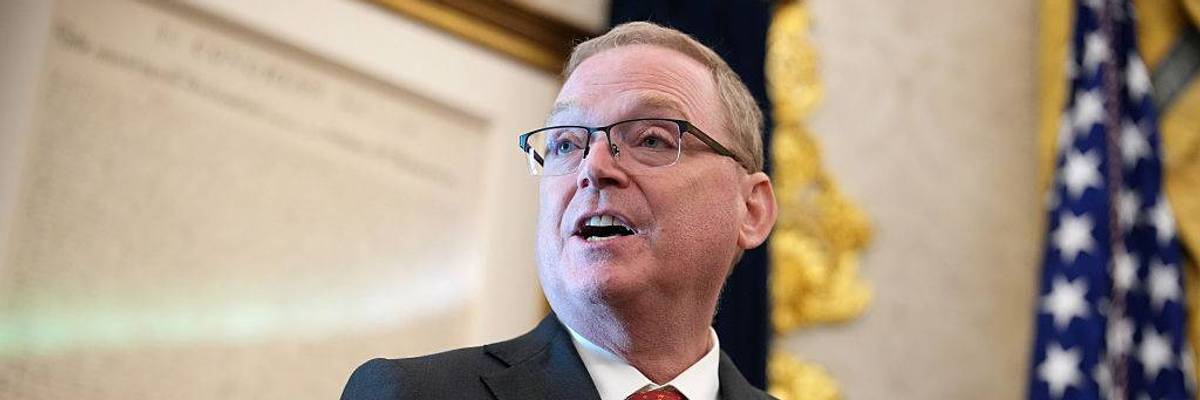
Kevin Hassett, director of the National Economic Council, participates in the Semafor World Economy conference in Washington, D.C., on April 14, 2026. REUTERS/Elizabeth Frantz

The internet was stunned by White House economic adviser Kevin Hassett's comments on Wednesday as he bragged about how credit card spending on higher-priced gasoline was "through the roof."

Hassett made the remarks in an interview with Fox Business on Wednesday morning where he discussed the ongoing Iran war, the continued closure of the Strait of Hormuz and the American economy.

Media experts and political voices were shocked by the comments.

"Is this supposed to be a brag?" Rep. Mark Pocan (D-WI) wrote on X.

"We must consider the possibility that Kevin Hassett is secretly working for the Democrats," Jon Favreau, co-founder of Crooked Media and co-host of Pod Save America, wrote on X.


"Trump’s chief economic advisor is bragging that people are surviving on credit cards right now," MeidasTouch editor-in-chief Ron Filipkowski wrote on X.


"?" New York Times White House correspondent Katie Rogers wrote on X.

"Make this guy the spokesperson for the entire Republican party," House Majority PAC, a Democratic Super PAC, wrote on X.

"Do they understand that this is not a good thing?" Nobel Prize nominee Andrew Gebo wrote on X.


Trump Economic Adviser Boasts That US Consumers Are ‘Spending More on Gasoline’ and ‘Everything Else’

“Is this supposed to be a brag?” said Democratic US Rep. Mark Pocan.


National Economic Council Director Kevin Hassett speaks in the Oval Office of the White House on April 30, 2026 in Washington, DC.
(Photo by Andrew Harnik/Getty Images)

Brad Reed
May 06, 2026
COMMON DREAMS

National Economic Council Director Kevin Hassett on Wednesday tried to put a rosy spin on President Donald Trump’s economy by highlighting the large credit card bills being racked up by US consumers.

During an interview on Fox Business, Hassett cited credit card spending as a purported sign of strength in the economy as a whole.

“I had the head of one of the Big Five banks in my office yesterday, going through credit card data,” he said. “Credit card spending is through the roof! They’re spending more on gasoline, but they’re spending more on everything else too.”


The price of oil has been surging since Trump launched an illegal war with Iran in late February, and on Wednesday the average price for a gallon of gasoline in the US topped $4.50, a high not seen since 2022 in the wake of Russia’s invasion of Ukraine.

As the Iran crisis persists, economists project that the price of energy will be reflected in increases in other consumer goods, most notably food.

Given this, many critics were astonished that Hassett decided to brag about consumer credit card spending as a way to reassure Americans concerned about the economy.

“Working-class Americans are maxing out their credit cards to pay for groceries and gas,” wrote House Minority Leader Hakeem Jeffries (D-NY). “The Trump Cartel thinks this is something to celebrate. Shameful.”

Hassett’s claims about credit card spending also earned a swift rebuke from Warren Gunnels, staff director for Sen. Bernie Sanders (I-Vt.).

“Americans are putting more stuff on credit cards because they don’t have enough money to pay for the skyrocketing cost of virtually everything,” Gunnels wrote. “Trump promised to put a 10% cap on credit card interest rates. Instead, the average credit card interest rate today is 22%. Obscene.”

Fred Wellman, a Democratic candidate for the US House of Representatives in Missouri, could not hide his disgust at Hassett’s performance.

“He’s smiling,” Wellman observed. “He’s celebrating that we are all maxing out our credit cards because they have torched the economy. He’s not smiling for working people. He’s happy for the corporations and billionaires. It’s good for them. We can all die poor. This is why I’m running for Congress.”

Rep. Mark Pocan (D-Wis.) expressed bewilderment at Hassett’s argument.

“Is this supposed to be a brag?” Pocan asked.

Jon Favreau, former speechwriter for President Barack Obama and current co-host of Pod Save America, found Hassett’s messaging so tone-deaf that “we must consider the possibility that Kevin Hassett is secretly working for the Democrats.”

The Democratic House Majority Political Action Committee had a response similar to Favreau’s, recommending that the GOP make Hassett “the spokesperson for the entire Republican Party.”


‘Epic Insider Trading’: Nearly $1 Billion in Crude Oil Shorts Taken Just Before Report of US-Iran Peace Deal

“Only a select few in the top tax bracket are benefiting from this, and the majority of you ain’t in it,” said former Rep. Marjorie Taylor Greene.


Fuel storage tanks are seen at a petroleum depot in Ambes, near Bordeaux, southwestern France, as global oil supply chains face acute disruption, on May 5, 2026.
(Photo by Philippe Lopez/AFP via Getty Images)

Stephen Prager
May 06, 2026
COMMON DREAMS

Observers are once again raising concerns about insider trading on Wednesday after a trader took a colossal crude oil short position just over an hour before a US-Iran peace deal was reported to be on the horizon, causing prices to fall.

The Kobeissi Letter, a financial newsletter, reported on X that at 3:40 am on Wednesday, “nearly 10,000 contracts worth of crude oil shorts were taken without any major news.”

This was equivalent to $920 million in notional value, which the letter described as “an unusually large trade” so early in the morning. But it would soon pay off.

At 4:50 am, just 70 minutes later, Axios published an exclusive scoop by Middle East reporter Barak Ravid that the White House believed the US and Iran were on the verge of agreeing to a one-page “memorandum of understanding” to end the war, which included more nuclear negotiations, one of the key sticking points for US President Donald Trump.

By 7:00 am, just over two hours after Axios dropped its report, oil prices had fallen by 12%, allowing the savvy investor to make $125 million in a matter of hours, which led to accusations that it was yet another example of “epic insider trading” by those in the know about Trump’s plans.

Prices have since rebounded by about 8% after Iran announced the creation of the new “Persian Gulf Strait Authority,” to mediate the passage of ships through the Strait of Hormuz on its terms.


The Trump administration has already been deluged with accusations that its members are using insider information to take advantage of financial markets and prediction market apps.

Last month, an active-duty US special forces soldier was indicted by the Department of Justice after he made about $400,000 betting on Polymarket that Venezuelan President Nicolás Maduro would be removed from power, a bet he allegedly placed using classified information about an operation he himself was involved with.

More bettors collected around $1 million in profits from bets on the specific timing of Trump’s war with Iran in late February. The Financial Times also reported a surge of more than $580 million in oil futures trading right before Trump announced a pause in strikes on Iran’s energy facilities in March.

Of course, Wednesday’s bet theoretically could have been made without the aid of insider information.

The new peace framework is the latest in what has seemed to be an endless pattern over the past several weeks in which US officials tell media outlets that a peace agreement is on the horizon, causing oil prices to dip, only for it to collapse later in the week, often with Trump issuing hostile threats or making new demands.

It has become such a familiar story that some have speculated that the announcement of productive ceasefire talks is deliberately choreographed to calm oil markets and bring down prices, which have become a growing problem for Trump among voters.

But as The Economic Times explained, the bet placed Wednesday morning likely “is not a routine hedge” or “a portfolio rebalancing move.”

“At that hour, in that size,” it said, “a crude oil short of that magnitude is a deliberate, high-conviction directional bet.”

Former Rep. Marjorie Taylor Greene (R-Ga.), a one-time Trump cheerleader who’s become one of his leading critics, suggested Trump’s erratic approach to negotiating an end to the war was just a tool used by him and his allies to profit.

“When is everyone going to start realizing that the on-again, off-again war/peace rhetoric is really just insider trading? And sprinkle in some murder,” Greene wrote on social media. “Only a select few in the top tax bracket are benefiting from this, and the majority of you ain’t in it.”

Democrats in Congress have urged the Securities and Exchange Commission (SEC) to investigate what Sen. Chris Murphy (D-Conn.) suggested could be “mind-blowing corruption” by the White House, not only related to Trump’s wars, but also to his tariff regime, which has caused similar market chaos that bettors have been able to capitalize on with fortuitously timed wagers.

But critics have described profiting from the machinations of a war that has killed more than 1,700 civilians as particularly grotesque.

“This has to stop,” said Fox News commentator Jessica Tarlov. “Lives on the line so they can insider trade!”
Why the US Tax Code Isn’t Truly Progressive

The rich pay more because they have more. But they don’t pay more at levels sufficient to counterbalance their outsized gains.


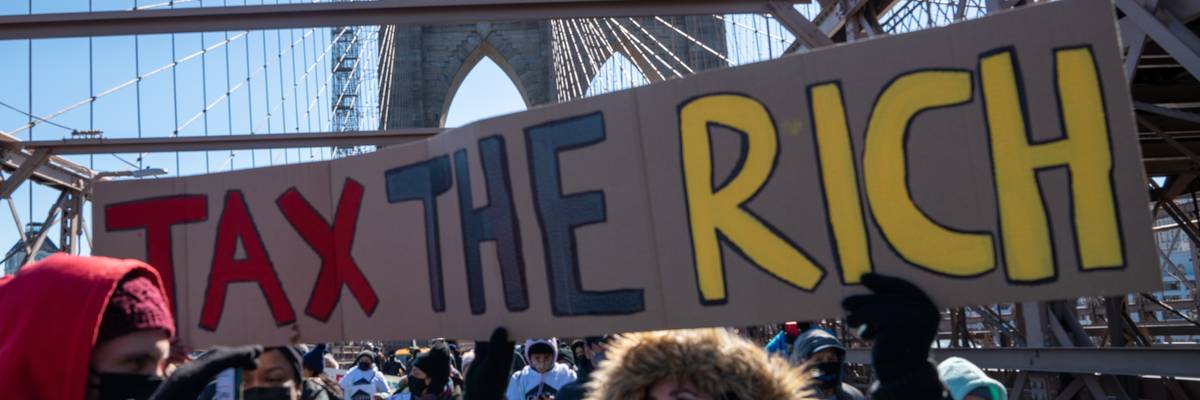
Protesters march across the Brooklyn Bridge holding a sign to “tax the rich” to demand funding for excluded workers in the New York State budget on March 5, 2021 in New York City.
(Photo by David Dee Delgado/Getty Images)

Reyanna James
May 07, 2026
Inequality.org

A recent analysis from the Tax Foundation argues that the US federal income tax system remains solidly progressive. Citing new Internal Revenue Service data for tax year 2023, the group is emphasizing that high-income taxpayers pay the highest average tax rates and account for a large share of total income taxes paid. On its face, that claim sounds reassuring—a sign that our tax code must surely be doing its job.

But this framing leaves out a critical part of the story. Yes, the wealthy pay more in taxes than everyone else. The real question: whether they’re paying enough, their fair share relative to their rapidly growing share of our nation’s income and wealth. By that measure, the answer must be a clear no. The US tax system, the underlying data show, remains far less progressive than it once was—and far less effective at counteracting inequality than it needs to be.


On Tax Day, Socially Conscious Millionaires Say Make Us Pay More!


‘Taxing Billionaires Is Not Radical’: Mamdani Joins Top Economists to Denounce ‘Rigged’ US Tax System

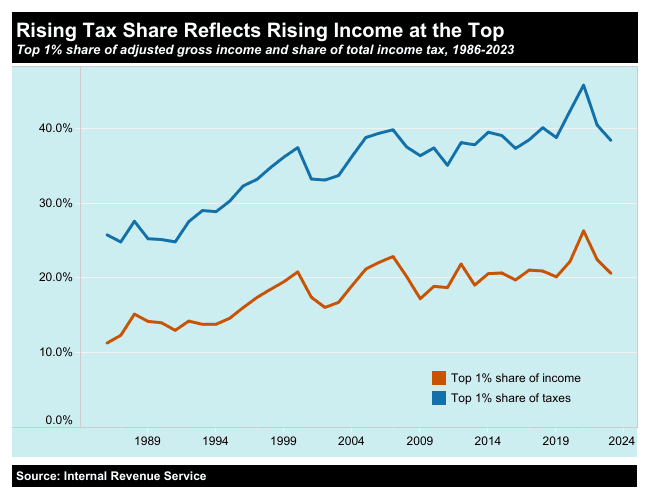
The Tax Foundation is claiming that the top 1%'s share of the nation’s adjusted gross income, AGI, “fluctuates with the business cycle” while the share of the taxes these rich pay has been “generally increasing.” But, in fact, these two indicators track each other rather closely over time. By placing income share and tax share on separate graphs, the Tax Foundation obscures how close this tracking has been.


Graphed together, the obvious correspondence of these two measures becomes unmistakably clear: As the top 1%'s share of income rises, so does the top 1%'s share of taxes. In other words, the increase in the tax dollars these rich are paying largely reflects the larger slice of total national income these rich are pocketing, not that the tax system has somehow become meaningfully more progressive. The top 1% tax share is rising because the top 1% income share is rising, not because our most affluent are facing a heavier tax burden on their gains.

A truly progressive system should meaningfully reduce inequality by redistributing income and wealth and curbing the concentration of economic power at the top. By that standard, the US tax system falls short.

By characterizing the top 1%'s income share as “fluctuating with the business cycle” while characterizing its tax share as “generally increasing”—and separating the graphic presentation of these two trends—the Tax Foundation is playing fast and loose with our core tax reality.


The time frame of the Tax Foundation’s analysis further muddies the waters. By starting in 2001, the Tax Foundation misses the longer arc of rising inequality in the United States. Looking back to the 1980s, the trend is unmistakable: The top 1%'s share of income has climbed substantially, from 11.3% in 1986 to 20.6% in 2023. The tax share of these rich has risen as well, from 25.8% in 1986 to 38.4% in 2023. Meanwhile their average effective tax rate has actually declined over the same period, from 33.1% to 26.3%, according to IRS data.

Even more importantly, focusing solely on income ignores the explosion of wealth at the top. Adjusted gross income (AGI) itself is a limited and often misleading measure—an arbitrary definition used for tax purposes that fails to capture total economic income, and completely misses the scale of wealth accumulation. Over the past several decades, our nation’s richest households have accumulated an outsized share of the nation’s wealth, with that wealth share far outpacing the top 1%'s growing share of national income. Yet the tax system does relatively little to address this imbalance.

Wealth remains lightly taxed compared to income, and many forms of capital income, to make matters worse, enjoy low preferential tax rates or taxes that can be deferred indefinitely. The end result: The overall tax burden on America’s richest is failing to keep pace with their expanding economic power.

The distortions become even clearer when we look beyond the top 1% to the tippy top of our wealth distribution, the top 0.01%. These ultra-wealthy households have seen extraordinary gains in both income and wealth over time. But their tax contributions have not kept up proportionally.


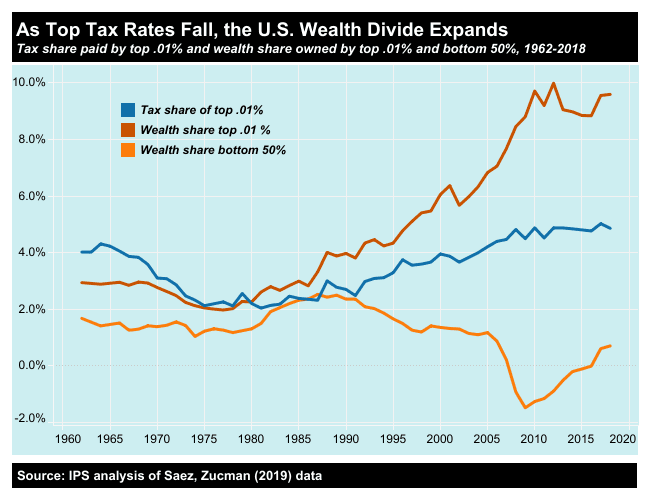
An Institute for Policy Studies analysis of data collected by economists Emmanuel Saez and Gabriel Zucman shows that our top 0.01% more than tripled their share of the nation’s wealth between 1962 and 2018. Yet their share of US taxes paid in 2018 hovered only slightly higher than their share of taxes paid in 1962.

All of this raises a fundamental question: What makes a tax system “progressive”? Just somewhat higher tax rates on higher earners? No. A truly progressive system should meaningfully reduce inequality by redistributing income and wealth and curbing the concentration of economic power at the top. By that standard, the US tax system falls short.

Our current tax system largely mirrors our nation’s underlying distribution of income rather than reshaping that distribution. The rich pay more because they have more. But they don’t pay more at levels sufficient to counterbalance their outsized gains. In 2023, the top 1% captured about 20.6% of pre-tax income and still held roughly 17.7% after federal income taxes, only a modest reduction. That after-tax share is still higher than their 17.4% share of pre-tax income in 2001, underscoring how little the tax system has done to curb the growing concentration of income at the top.

Reversing these trends will require more than modest tweaks to the tax code. It will take a more ambitious approach, one that directly addresses both income and wealth concentration at the very top. Until then, claims that the tax system is adequately progressive risk obscuring a deeper reality: Inequality continues to widen, and the tax code is doing too little to stop it.


This work is licensed under a Creative Commons Attribution-Share Alike 3.0 License.


Reyanna James
Reyanna James is an inequality research associate at the Institute for Policy Studies.
The Climate Reckoning That the Nuclear Arms Control Can’t Ignore

Climate change and nuclear weapons reinforce one another in dangerous ways: Environmental stress increases the risk of conflict, while nuclear conflict would produce environmental consequences on a planetary scale.


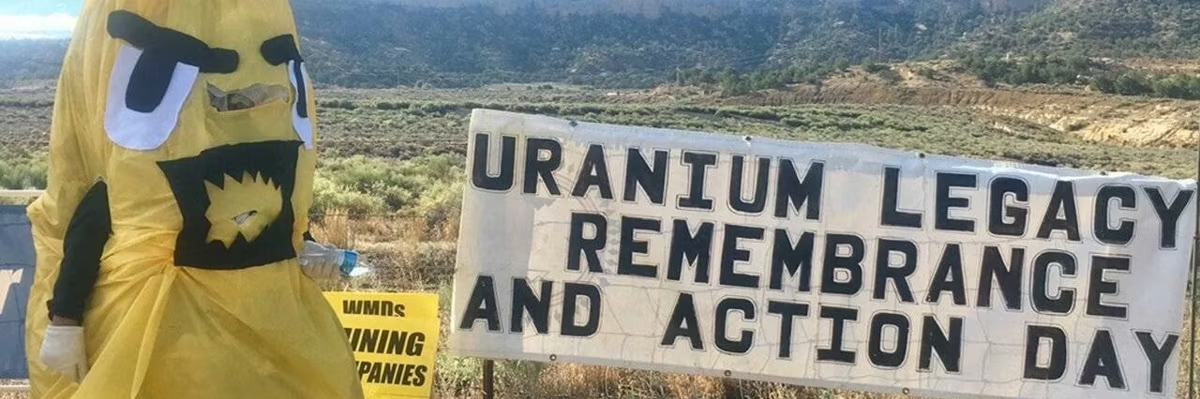
A community member commemorates a uranium tailings spill in Red Water Pond, New Mexico.
(Photo by Myrriah Gómez)

Paul Aversa
May 07, 2026
Common Dreams

At 8:15 AM on August 6, 1945, a 9,000-pound atomic bomb detonated 1,900 feet above Hiroshima, instantly killing 70,000 people. Three days later, a second bomb exploded over Nagasaki, killing another 40,000.

The sheer scale of destruction—that humans could annihilate each other by means as violent as a nuclear blast—ensured that Hiroshima and Nagasaki would become the defining images of nuclear weapons in the American imagination. According to a 2025 Pew Research survey, 83% of Americans reported knowing at least something about the use of nuclear weapons in Japan. However, increasingly large numbers of younger Americans don’t know enough about nuclear weapons today to give an opinion on their role in national security.

What is often remembered as the only detonation of nuclear weapons in history remains the sole use of nuclear weapons in warfare. While Americans looked overseas at the devastation in Japan, fewer recognized that nuclear weapons were also transforming the American environment at home.

For decades after World War II, nuclear weapons reshaped landscapes and communities across the United States. Between 1945 and 1992, the United States conducted 1,030 nuclear tests, while producing tens of thousands of warheads during the Cold War. At its height, the US nuclear stockpile comprised 31,255 warheads, with the last fully functional nuclear weapon being produced in 1989. The environmental and human consequences of this effort extended far beyond test sites and production facilities. Yet, the US government kept the public in the dark, leaving a generation born in the 21st century to bear the consequences of its obfuscated proliferation campaign.
The Nuclear Transformation of Marginalized America

Consider that the plutonium used in the first nuclear test in New Mexico and in the Nagasaki bomb was produced at the Hanford Site in Washington State. Between 1945 and 1970, Hanford’s reactors discharged roughly 444 billion gallons of radioactive wastewater into the Columbia River basin, a watershed that today supports over 8 million residents.

Other sites tell similar stories. In South Carolina and Georgia, rural communities were displaced to make way for the Savannah River Site nuclear weapons facility, where millions of gallons of radioactive waste were stored in underground tanks.

Make no mistake, the United States federal government was calculated in its targeting of marginalized communities to isolate radioactive material from the general population. These facilities were often located in rural or economically disadvantaged areas, where political resistance was limited and land was cheaper.

Nuclear weapons represent one of the most profound environmental risks humanity has ever created.

Currently the only permanent waste site for nuclear material in the United States, the Waste Isolation Pilot Plant (WIPP) in Carlsbad, New Mexico, collects plutonium-contaminated waste to be buried over 2,000 feet underground a salt flat formation. Framed as a barren wasteland far from major population centers, WIPP is in Eddy County, New Mexico—home to a population of over 61,000 people, of which 64% identify as people of color. Many communities face contaminated water supplies and elevated rates of respiratory illness, kidney disease, and cancer: a pattern sometimes described as “radioactive colonialism.”

Despite the government’s efforts to isolate nuclear activities and waste disposal, radioactive contamination did not respect geographic boundaries. Research released in 2023 found that nuclear tests conducted between 1945 and 1962 distributed radioactive fallout across 46 of the lower 48 contiguous states in the United States, as well as parts of Canada and Mexico. As a result of nuclear tests conducted by both the United States and other nuclear-armed powers, radioactive isotopes released into the atmosphere spread throughout the world in communities far from test sites. By the 1960s, “there was no place on Earth where the signature of atmospheric nuclear testing could not be found in soil, water, and even polar ice.” Radioactive isotopes entered the food chain through plants and animals, creating pathways of exposure far from any test site.

For most people living far from testing areas, these exposures were small. But they illustrate a fundamental reality of nuclear weapons: Even carefully controlled programs produce global environmental consequences. Even when the government attempted to isolate radioactivity and testing in supposedly remote communities, contamination from weapons production, testing, and disposal still spread far beyond those sites, affecting environments across the world.
The Renewed Nuclear Arms Race

While the United States has not conducted a full-scale nuclear test since 1992, nuclear competition is accelerating again.

China is rapidly expanding its nuclear arsenal, with estimates suggesting that its stockpile could exceed 1,000 warheads by the early 2030s. At the same time, arms control agreements that once constrained the world’s largest nuclear powers are eroding. The expiration of the New START treaty in February 2026 removed the last formal limits on US and Russian strategic nuclear forces.

Even if informal limits remain in place, the collapse of binding agreements signals a shift toward a less regulated nuclear environment. Some policymakers have suggested that renewed nuclear testing may be necessary in response to foreign advances, which would risk repeating many of the mistakes of the Cold War.

Consider that for the first time in history, the new nuclear proliferation environment includes a three-way standoff between three major armed powers: the United States, China, and Russia.
Mutually Assured Climate Destruction

A global nuclear war alone would be enough to trigger catastrophic climatic effects. Even a limited nuclear exchange could inject vast quantities of smoke and soot into the upper atmosphere, blocking sunlight and lowering global temperatures. The use of a mere 2% of the world’s current arsenal could trigger severe cooling and agricultural disruption, leaving 2 billion people at risk of starvation in just the following two years. If nuclear winter renders any use of nuclear weapons as unsurvivable, then deterrence may be an inadequate strategy, since the consequences of a miscalculation or accidental launch would increase dramatically.


This erosion of international nonproliferation channels comes as climate change fuels geopolitical instability by intensifying resource competition, migration pressures, and regional conflicts, increasing the risk of confrontation among nuclear-armed states. Climate change and nuclear weapons therefore reinforce one another in dangerous ways: Environmental stress increases the risk of conflict, while nuclear conflict would produce environmental consequences on a planetary scale.
Bridging the Gap: Building the Next Generation of Advocates

Despite these connections, environmental and social justice concerns remain peripheral in most nuclear policy debates. Discussions of deterrence and arms control typically focus on military balance and strategic stability, while the environmental legacy of nuclear weapons receives far less attention.

This gap may help explain why nuclear policy often struggles to engage younger generations.

Surveys consistently show that climate change is one of the defining concerns of younger voters. Roughly 70% of young people report deep anxiety about environmental degradation and say they are likely to support candidates who prioritize climate policy. Nuclear weapons policy rarely speaks to these concerns directly. Yet nuclear weapons represent one of the most profound environmental risks humanity has ever created.

Reframing nuclear policy to include environmental and social justice considerations would not only reflect historical reality, but also make nuclear policy more relevant to the challenges of the 21st century.


Our work is licensed under Creative Commons (CC BY-NC-ND 3.0). Feel free to republish and share widely.


Paul Aversa
Paul Aversa currently serves as the program assistant on nuclear disarmament and pentagon spending issues at Friends Committee on National Legislation (FCNL). He graduated from Georgetown University with a BS in Science, Technology, and International Affairs, and has accumulated years of experience working on environmental, foreign policy, and agriculture issues in DC.
Full Bio >

The GOP Wants to Put Workers Under AI’s Thumb: A Shorter Work Week Is a Better Answer


Just because Donald Trump and Republicans in Congress have no grasp of economics doesn’t mean the rest of us shouldn’t.


“We don’t need to run around like chickens with our heads cut off” if AI leads to higher productivity, writes Baker. “Because productivity growth is in fact a very very old phenomenon. We have long known how to deal with it; we shorten work hours.”
(Photo: Getty Images)


Dean Baker
May 07, 2026
Beat the Press

Productivity growth is an old concept; we’ve been seeing it at a substantial pace for more than 200 years. Nonetheless, many elite intellectual types like to claim they know nothing about it when they talk about AI.

It’s far from clear how much of a productivity boom we will see with AI. For people who are lost with my reference to productivity growth, the story that AI will take all the jobs is a story of a massive productivity boom. If that happens, it will mean that the people who are still working will be hugely more productive, since we will be producing the same or more goods and services as we do at present, with many fewer people working.


FWIW, virtually no major forecaster or forecasting agency is projecting anything like this productivity boom. For example, the Congressional Budget Office (CBO) projects that productivity growth will average 1.5 percent over the next decade.

That’s a healthy rate of productivity growth, but nothing extraordinary. It’s a bit better than the 1.3 percent rate from 2005 to 2025, but less than the 2.0 percent rate we saw in the 1990s and much less than the 2.4 percent pace the country had from 1947 to 1973. There is no story of AI creating mass unemployment here.

CBO is not God, but they are pretty much in the center of professional forecasters by design. They try to make sure that their forecasts do not vary hugely from what other public and private sector forecasters are projecting.

It is also worth noting that if CBO is seriously wrong on the low side, then some other things logically follow. Most importantly, if productivity growth proves to be far more rapid than what they have projected, GDP growth will also be far more rapid than projected. This would mean, among other things, that the debt-to-GDP ratios will be much lower in the future than is currently projected.

In other words, the people yelling about unsustainable debts and deficits need to STFU. You can’t both be expecting a massive AI productivity boom and think the US has a huge debt problem. That is not a matter of opinion; it is a matter of logic.

But let’s assume for a moment that we do get a huge productivity boom from AI. We don’t need to run around like chickens with our heads cut off when we ask what to do about it. Because productivity growth is in fact a very very old phenomenon. We have long known how to deal with it; we shorten work hours.

Workers in Germany, France, and other wealthy countries work on average 20-25 percent fewer hours a year than Americans.

That is why we got the 40-hour work week with the Fair Labor Standards Act (FLSA) in 1937. The Act doesn’t actually prohibit employers from having longer work weeks; it simply requires them to pay a 50 percent premium for overtime hours. This was supposed to encourage them to hire more workers instead of working their existing workforce more hours. (Contrary to the way it is discussed in the media, the decision to put in overtime is almost always the employer’s, not the worker’s. Unless a union contract specifies otherwise, an employer has the option to fire a worker who refuses overtime.)

This is why it was truly incredible that Trump eliminated the income tax on the overtime premium. This is effectively encouraging employers to have longer workweeks, 180 degrees opposite of the intention of the FLSA.

But just because Donald Trump and Republicans in Congress have no grasp of economics doesn’t mean the rest of us shouldn’t. If we really are seeing an AI-driven productivity boom, the most obvious way to deal with it is to shorten the workweek and work year. The United States is an outlier here. While we were originally a leader in implementing a 40-hour workweek, we have done little to reduce work time in the 90 years since then.

As a result, workers in Germany, France, and other wealthy countries work on average 20-25 percent fewer hours a year than Americans. As a crude approximation, if workers put in 20 percent fewer hours on average, it will mean 20 percent more jobs. Things in the real world are never quite that simple, but the basic logic that shorter work years means more jobs does hold.

It’s also not rocket science to get to shorter work years. We can amend the FLSA so that the overtime wage premium kicks in at 34 or 36 hours. Also, instead of removing taxes on the premium (having taxpayers subsidize long workweeks), we can raise the premium from 50 percent to 75 percent, as the Congressional Progressive Caucus recently proposed. We can also mandate 2 weeks or more vacation, along with paid sick days and family leave, as many states have already done. All this is old-fashioned stuff that other wealthy countries have been doing for decades, and we have done in the United States nationally in the distant past and more recently at the state level.

The immediate prompt for this diatribe was a New York Times article that asked how we will deal with a collapse of employment from AI. In fairness, the piece does note that an AI-driven productivity boom is far from certain, but it then suggests that if it does happen, a universal basic income, or a universal high income might be ways to deal with it. The piece notes that Elon Musk is supposedly an advocate of the latter.

While any pro-worker legislation will face an enormous uphill battle in the current political environment, a variation of policies that people have seen for a century might have a better shot than something that seems completely new.

While these proposals are, in principle, fine, they ignore the reality of US politics. Just four years ago, when the Democrats had a trifecta, they could not get a modest increase in the child tax credit approved in the Senate. Get out your yard stick and try to measure the distance between a modest boost to the child tax credit and a universal basic income, much less a universal high-income.

It’s probably also worth mentioning that Elon Musk has done everything he can to keep his workers at Tesla from forming a union, where they would be better able to secure their share of the company’s profits. That may lead reasonable people to question his commitment to workers’ well-being in an era of AI-driven mass unemployment.

While any pro-worker legislation will face an enormous uphill battle in the current political environment, a variation of policies that people have seen for a century might have a better shot than something that seems completely new. It is also worth pointing out that the tools for dealing with a surge in productivity growth are well-known and tested. Whether or not a universal basic income is a better way to go, our toolbox is already far from empty when it comes to dealing with this situation. This is not a new story, and it is wrong to portray it as one.


This work is licensed under a Creative Commons Attribution 4.0 International License


Dean Baker
Dean Baker is the co-founder and the senior economist of the Center for Economic and Policy Research (CEPR). He is the author of several books, including "Getting Back to Full Employment: A Better bargain for Working People," "The End of Loser Liberalism: Making Markets Progressive," "The United States Since 1980," "Social Security: The Phony Crisis" (with Mark Weisbrot), and "The Conservative Nanny State: How the Wealthy Use the Government to Stay Rich and Get Richer." He also has a blog, "Beat the Press," where he discusses the media's coverage of economic issues.
Full Bio >


Bargaining to Save Our Jobs from Artificial Intelligence

There is broad and deep recognition that AI technology will reshape the future of work, and unions have decided to roll up their sleeves (and dust off their picket signs) to bargain how AI will be implemented, to do what, and to what effect.


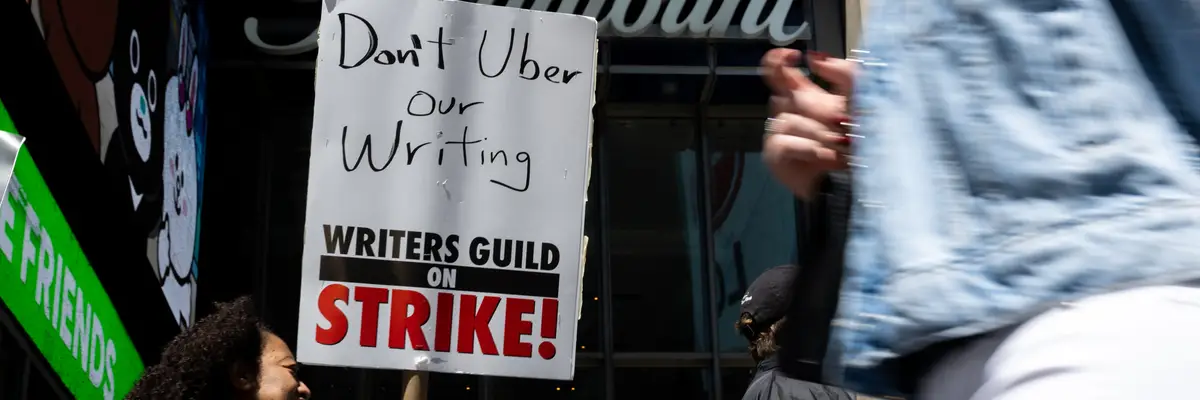
Writers Guild of America (WGA) East members walk a picket line at the Paramount+ Summit outside the Paramount Building in Times Square on May 17, 2023 in New York City.
(Photo by Alexi Rosenfeld/Getty Images)

Lowell Peterson
May 07, 2026
Common Dreams

For many pundits and policymakers, there is little doubt that Artificial Intelligence will devour the jobs of millions of people, including professionals formerly presumed immune to technological replacement. The only question is how many jobs will be lost, how quickly. In fact, there is nothing inevitable about AI—not its development, its deployment, or its impact. Massive job losses are not inherent in the algorithm, preordained by the laws of nature and physics. Rather than remaining struck by awe, we can reassert human agency over this technology. We can not only save jobs, but perhaps even make them better.

AI is not an abstract force that operates solely at the macroeconomic level. AI systems and agents are developed and implemented in ways specific to each sector, each workplace, each type of job. Although employers might focus myopically on cutting their wage bill, their employees know firsthand how the work actually gets done. They know what disclosures to request about how the technology would be used. They know how AI might affect the content and flow of their work, what training would be most helpful, and which implementations would be most likely to devalue their labor versus those most likely to enhance it. Thus, the most effective way to ensure that AI makes work life better and not worse is to empower workers to bargain about it.

By “workers” I mean people who rely on their own labor to earn a living—which is to say, most of us, whether we write reports, treat patients, teach kids, manufacture products, or stock warehouses. AI is not something that’s going to happen only to other people; it will affect all of us.


Workers need the authority and the power to bargain about the implementation of AI in the workplace, not just the effects. “Effects bargaining” is the traditional approach: After a technology has wiped out jobs, people negotiate a little severance pay to tide them over, and maybe some training for completely different jobs, if any such jobs exist. By contrast, our goal should be to make sure workers can negotiate for technology that makes their jobs better, more productive, more valuable. To avoid the car crash in the first place, if you will, and not just to apportion damages afterward.

AI will not destroy or devalue our jobs by itself, unless we let it.

One can imagine some objections to this approach. Some people might insist that AI is in irresistible force, that large-scale job destruction is inevitable, and that our task is to figure out other things for people to do to earn a living—or, if that’s not possible, to pay them a small stipend so they don’t starve. This defeatism is a short step away from the more nihilistic vision of the pure doomers, who think it might already be too late to save humanity from machine-led destruction. I love science fiction myself—but it is fiction, not history.

Another objection might be that placing restraints of any kind on AI companies in the United States will keep the industry from winning the global race for dominance. This is the Trump administration’s view. This logic is inverted. Nations should be governed for the benefit of their people, not just their Big Tech companies. Both the Republican and Democratic parties proclaim themselves to be the champions of the American worker. If so, the real triumph for the nation would be to ensure that technology enhances work and makes working people’s lives better, not to create havoc and economic devastation across the labor market.

Some might object that it is unrealistic to think that working people have the interest or ability to intervene effectively, to exercise their right to bargain about AI technology. But that is exactly what has been happening in the entertainment industry. One of the central issues in the 2023 strike by the Writers Guild of America against the Hollywood studios and producers was the use of AI in writers’ workplaces. The Guild represents the professionals who create scripts for TV and streaming series and for feature films. In late 2022 Open AI revealed that ChatGPT could write—coherently and at some length. Although the union did not conclude that robots had suddenly become capable of crafting award-winning scripts, Guild members recognized that their employers could use AI to do just enough to degrade and devalue their work.

During contract talks in 2023 the Guild proposed—and won, after a five-month strike—language that puts meaningful guardrails on the use of AI. These guardrails reflect the process writers and studios actually use to create characters and stories and full-length projects. They ensure that AI cannot be used to deprive writers of the opportunity to do the full range of writing work, and they deprive employers of the economic incentive to replace professional writers with algorithms. Guild members knew how to defend their careers, and they fought for meaningful protections.

The Guild members’ willingness to take on the AI issue, rather than passively accept that the technology would hollow out their careers, resonated with working people everywhere. The actors’ union (SAG AFTRA) also struck and won contract protections on AI, and the following year the other entertainment industry unions did the same. The entire labor movement has made workplace AI a top priority. There is broad and deep recognition that AI technology will reshape the future of work, and unions have decided to roll up their sleeves (and dust off their picket signs) to bargain how AI will be implemented, to do what, to what effect.

AI systems do not develop themselves; AI companies do. AI does not implement itself in the workplace; employers do. AI will not destroy or devalue our jobs by itself, unless we let it. Working people can and must protect their livelihoods by bargaining over AI implementation. Nothing less than the future of work is at stake.

Our work is licensed under Creative Commons (CC BY-NC-ND 3.0). Feel free to republish and share widely.


Lowell Peterson
Lowell Peterson was the executive director of the Writers Guild of America East from 2008 to 2023. Cornell University Press is publishing his book, Building Power: Organizing for the Future, with Lessons from the Writers’ Strike Against Hollywood, later this year.
Full Bio >


\