Sunday, June 07, 2026

GOP insider shocks by debunking Republican conspiracy theory: 'What kind of sorcery?'

David McAfee
June 6, 2026
RAW STORY


A California Republican operative went viral this week for doing something unusual in her party: publicly fact-checking a right-wing election conspiracy theory — and refusing to back down when Rasmussen Reports pushed back.

Elizabeth Barcohana, who works with the Los Angeles GOP, stepped in after Rasmussen posted a claim that a single ballot drop in the LA mayor's race had contained zero votes for Republican candidate Spencer Pratt — the reality TV personality from The Hills running for LA mayor — while every other candidate gained thousands. "Virtually every candidate received votes except for Spencer Pratt," Rasmussen wrote. "Impossible."

Barcohana called it false. "No, it did not happen," she posted, sharing a batch composition chart showing Pratt's orange bar appearing consistently across every single ballot drop. "This is fake news." She further noted that Rasmussen was recycling an NBC screenshot taken before the network's graphics team had corrected an error — meaning the "evidence" of fraud was a screenshot of a mistake that had already been fixed.

Rasmussen didn't fold. Instead, the polling firm told Barcohana to "wake up," name-dropped someone it claimed was a federal investigator, and accused her of not understanding "what is going on in national election integrity."

Barcohana's response to an anonymous user cut to the heart of the problem: "THIS is why you don't see Republicans fighting back against all of this. No one believes us no matter what we say when we push back on things that aren't true which demoralize our voters, so they would rather just keep quiet and not hit a hornet's nest of angry voters."

The exchange drew notice across the aisle. "How does one deal with a company that exists to poll elections but then casts doubt on the actual results with loony conspiracy theories?" asked Garrett Archer, a data journalist at ABC15 in Arizona. Damin Toell, a conservative activist, was more pointed, calling Rasmussen "the zombie husk of Rasmussen Reports, which just grifts off garbage conspiracy theories without any concern for how it suppresses Republicans from voting."

Drew Savicki, a political analyst, called it "fascinating watching a California Republican struggling to push back against the online conspiracy theories being promoted by so many in her party."

Republican strategist Mike Madrid kept it simple: "Wait...is this a Republican standing up for math, facts and evidence? What kind of sorcery is this?"

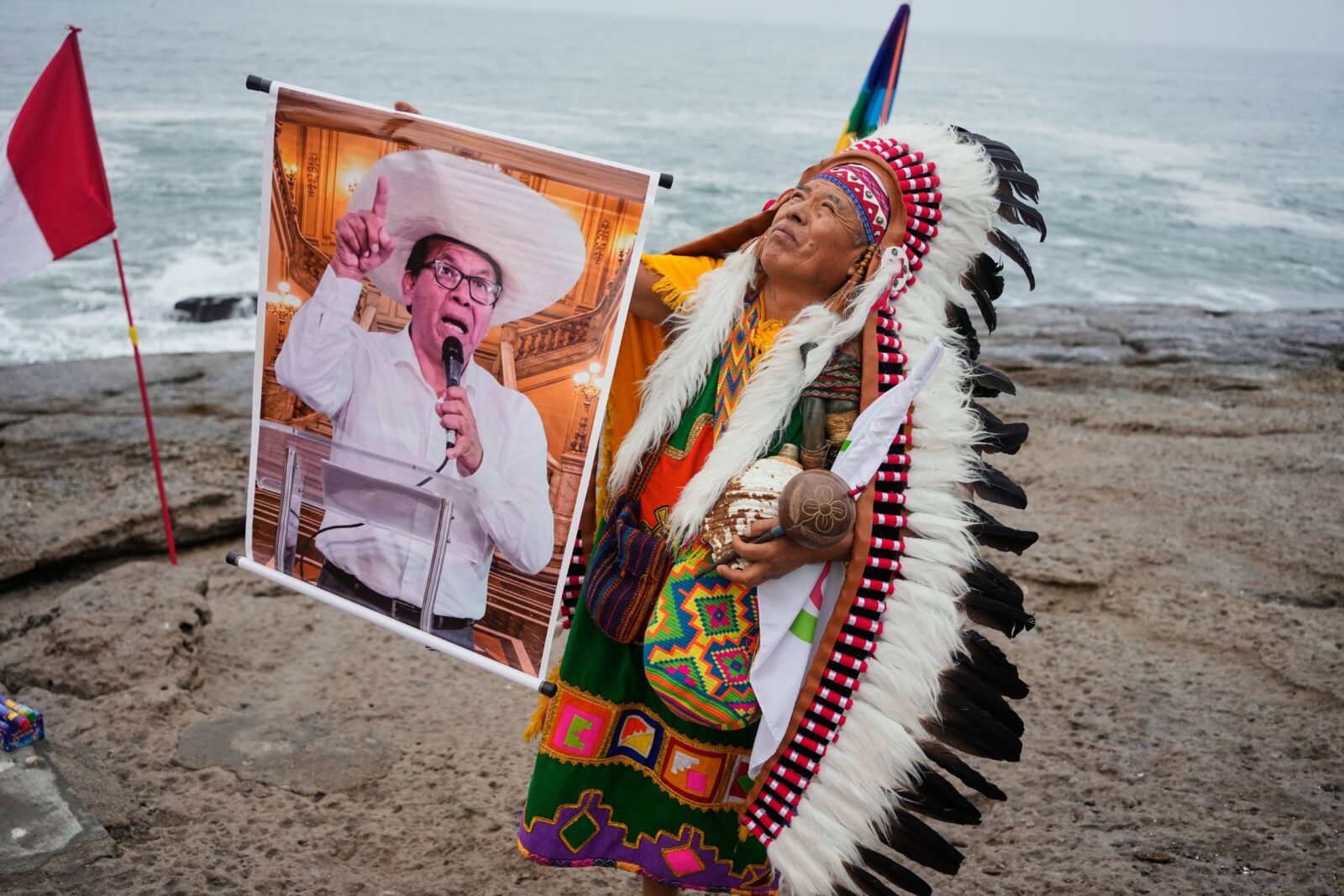

Peruvian shamans perform a blessing ritual ahead of a presidential runoff

LIMA, Peru (AP) — The shamans gathered by the sea on Herradura Beach in the Chorrillos district in Lima, Peru's capital, holding up posters of the two candidates.


Mauricio MuÑoz
June 3, 2026
AP


LIMA, Peru (AP) — Peruvian shamans gathered on Monday for a blessing ritual for the two candidates in the country’s presidential runoff next weekend, a decisive vote for the South American country that has seen a revolving door of presidents kicked out of office over corruption scandals.

The ritual is a tradition at the start of every year and before elections.

The shamans gathered by the sea on Herradura Beach in the Chorrillos district in Lima, Peru’s capital, holding up posters of the two candidates.

The two — Keiko Fujimori, the conservative daughter of disgraced former President Alberto Fujimori, and Roberto Sánchez, a nationalist congressman and former minister — are neck and neck in the polls and will face off on Sunday.

Fujimori garnered just over 17% of the votes while Sánchez got about 12% in a crowded field of candidates in the first round of voting in April. That round was mired in logistical problems that left thousands in Peru and abroad unable to cast ballots. It then took weeks for the country’s electoral body to finalize the two contenders for the runoff.

In the blessing ritual, the shamans used flower petals, fruit, coca leaves and fragrant pieces of palo santo — or “holy wood” in Spanish — as well as black tobacco, swords and dolls. They also lit colorful flares and banged drums.

“The ritual we perform is primarily intended to ensure that the best candidate is the one who represents our Peru,” said shaman Andrés de los Santos, who had traveled to Lima from the north of the country.

Although the shamans made no forecasts this time, they have previously predicted the future. At the end of 2025, they predicted Venezuela’s then-President Nicolás Maduro, now facing drug trafficking charges in the United States, would no longer be in office by the end of 2026.

The winner of the runoff will become Peru’s ninth president in just 10 years, replacing José María Balcázar, who was elected interim president in February. Balcázar replaced another interim leader, José Jerí, who was ousted over corruption allegations just four months into his term.

Peru’s next president will be sworn in on July 28 for a five-year term.

___

Follow AP’s Latin America coverage at https://apnews.com/hub/latin-america
Why soccer fandom in Latin America feels almost sacred

MEXICO CITY (AP) — Among fans passion is nurtured through a sense of community. The singing of anthems, tears shed after victories or defeats, and the embrace of strangers inside a stadium are experiences that can mirror forms of collective devotion.
AP


MEXICO CITY (AP) — The chain that hung from Santiago García’s neck carried no crosses or saint medals, yet it felt sacred nonetheless.

When García’s grandmother fell sick years ago and he visited her in intensive care, the Argentine soccer fan took off his beloved Boca Juniors necklace and placed it around her neck.

“Boca will save you,” García murmured to his grandmother. “And it did. So now it’s hers.”


García’s faith in his club mirrors that of millions across Latin America as the region prepares for the 2026 World Cup. From Argentina to Mexico, devotion to the game often spills into everyday life, inspiring rituals and beliefs tied to the sport.

“There has been an emotional connection between the public and their soccer teams for a long time,” said Mexican analyst Erick Fernández. “It fosters identity and bonds that make us feel part of a sporting process that represents us.”

In Argentina, the home country of Lionel Messi, sports passion is often inherited within families and loyalty to clubs strengthens over time. Pope Francis himself — born in Argentina and lifelong supporter of club San Lorenzo — said he agreed with those describing soccer as the world’s most beautiful game.

García’s love for Boca Juniors came from his father. He said his mother used to support another team, but after the couple met, she became a Boca fan too.

“You usually support your mother’s or father’s club,” García said. “Soccer is the backbone of it all, but you develop a sense of belonging to a team and carry it with you everywhere.”

He may have let go of his Boca necklace and the energy he believed it carried, but the club’s imprint was already etched into his skin.


At age 17, García tattooed a phrase from the club’s anthem on his torso. Fourteen years later, those words remain as meaningful as they were when the ink was fresh.

“It belongs to a song that is like a chant of war for us,” he said. “It’s like saying: ‘No matter the storm, no matter what happens, we will always be there for you.’”

The power of belonging

Pope Francis once told a crowd that soccer is a team sport whose beauty comes from its collective spirit.

Among fans, too, passion is nurtured through a sense of community. The singing of anthems, tears shed after victories or defeats, and the embrace of strangers inside a stadium are experiences that can mirror forms of collective devotion.

“Each person can support a team, but the sense of togetherness that generates ‘communitas’ — a word associated with religion — is only possible when people gather,” said Argentine anthropologist Eloísa Martín.

Both negative and positive reactions can emerge from that sense of collective identity. A fan who feels a member of his sporting community has been attacked by a rival may react violently in ways he otherwise never would. But the same dynamic can strengthen solidarity, leading fans to help strangers because they support the same club.


“Soccer creates a community even for those who lack one,” Martín said.

On a recent night, among a sea of fans heading towards Maracanã stadium in Rio de Janeiro was Adilvania Santos. Dressed in the maroon and green colors of Fluminense, the 27-year-old said that supporting the club had helped her through a difficult time in her life.

“I get emotional talking about Fluminense,” said Santos, who described the passion for her club as the most important aspect of her life, apart from her family. “Some people come together to go to church. For us, accompanying Fluminense is also sacred.”

Santos tries to attend every game despite living nearly 100 kilometers (about 60 miles) from Rio. When she follows matches from home, she stays alone in her bedroom to avoid interruptions from family members who may not support her team.

“Soccer deeply moves Brazilians because it creates a sense of belonging, identity and hope,” said Jeferson Mengali, a Catholic priest in the Bragança Paulista diocese and a lifelong fan of Corinthians. “People suffer, work hard and face difficulties, and soccer becomes a space for collective joy.”

Rituals for victory

Mengali supported Corinthians as a chaplain for years. He celebrated Masses with the team and was present during training sessions and matches.

“I have always liked praying before important games,” he said. “Asking more for serenity than victory.”


While not all soccer fans pray, many cling to rituals they believe can influence the outcome of a game. In Argentina these practices are known as “cábalas.” According to Martín, they became widespread during the 1990s.

Cábalas vary widely. Fans may drink from the same cup, sit in the exact same spot or wear the same underwear during every match. Others insist on watching games with certain people, while some avoid watching altogether after concluding they bring bad luck to their team.

Rituals are repeated if the team wins and abandoned if it loses. For some supporters, avoiding a match can even feel like a sacrifice made in hopes of securing victory.

At García’s home, his father sits in a specific chair whenever Boca is playing well. If the rival team scores, he changes seats. His mother cleans the house instead of watching the game, stopping every so often to ask about the score.

García’s current cábala includes wearing the same jersey throughout the season and carrying a small image of Diego Maradona everywhere he goes.

“After he died, he was rapidly sanctified by the people,” García said. “He became a figure bigger than sports.”


NEW: Bring more puzzles and play to your week with RNS Games

Saints of the stadium

Argentines rarely call him Maradona. He’s simply “El Diego,” as one would refer to a family member or an old friend from the neighborhood.

“Maradona is the player, while ‘El Diego’ is the one people turn to like a family member when they need help,” Martín said. “Sacredness only works when there’s a community behind it.”

Legends like “El Diego” or Brazil’s “The King” Pelé are recognized across the world. But other soccer fans in Latin America revere personal idols of their own.

In Chile, Héctor Hermosilla keeps a black-and-white portrait of Colo Colo club founder David Arellano at his home.

“He founded Colo Colo in 1925 and before every match I always say goodbye to him and ask him to watch over us,” Hermosilla said.

He still remembers attending his first match in 1986 and falling under the spell of the atmosphere inside the arena. From then on, he faithfully began to follow his team, traveling from Chile’s far north to Puerto Montt, considered the gateway to Patagonia.


To finance his trips, he and his wife typed out the iconic anthems of Colo Colo and sold photocopies to fans, earning him the nickname “Nano Fotocopia.”

“There were around 20 songs and I would make photocopies and sell them for 100 pesos,” he said.

Typewriters and photocopies became obsolete over time. Hermosilla now sells necklaces, bracelets and other accessories to finance the trips he now does with his wife and teenage son.

When in Chile, Hermosilla still attends matches every Sunday and performs a ritual he has followed since the 1980s. Beneath Arellano’s portrait, he asks for the club founder’s blessing, packs his products for sale and heads to a roast chicken restaurant where fans gather.

“He is like our God,” Hermosilla said. “He is the one who guides us.”

___

Batschke reported from Santiago, Chile, and Hughes from Rio de Janeiro.

___

Associated Press religion coverage receives support through the AP’s collaboration with The Conversation US, with funding from Lilly Endowment Inc. The AP is solely responsible for this content.

Pepper-sprayed yet undeterred: Faith leaders keep ministering at Delaney Hall

(RNS) — ‘We are called by our faith to put our bodies on the line if that’s the call,’ said the Rev. Robin Tanner, a Unitarian Universalist minister.


Jack Jenkins
June 4, 2026 
RNS


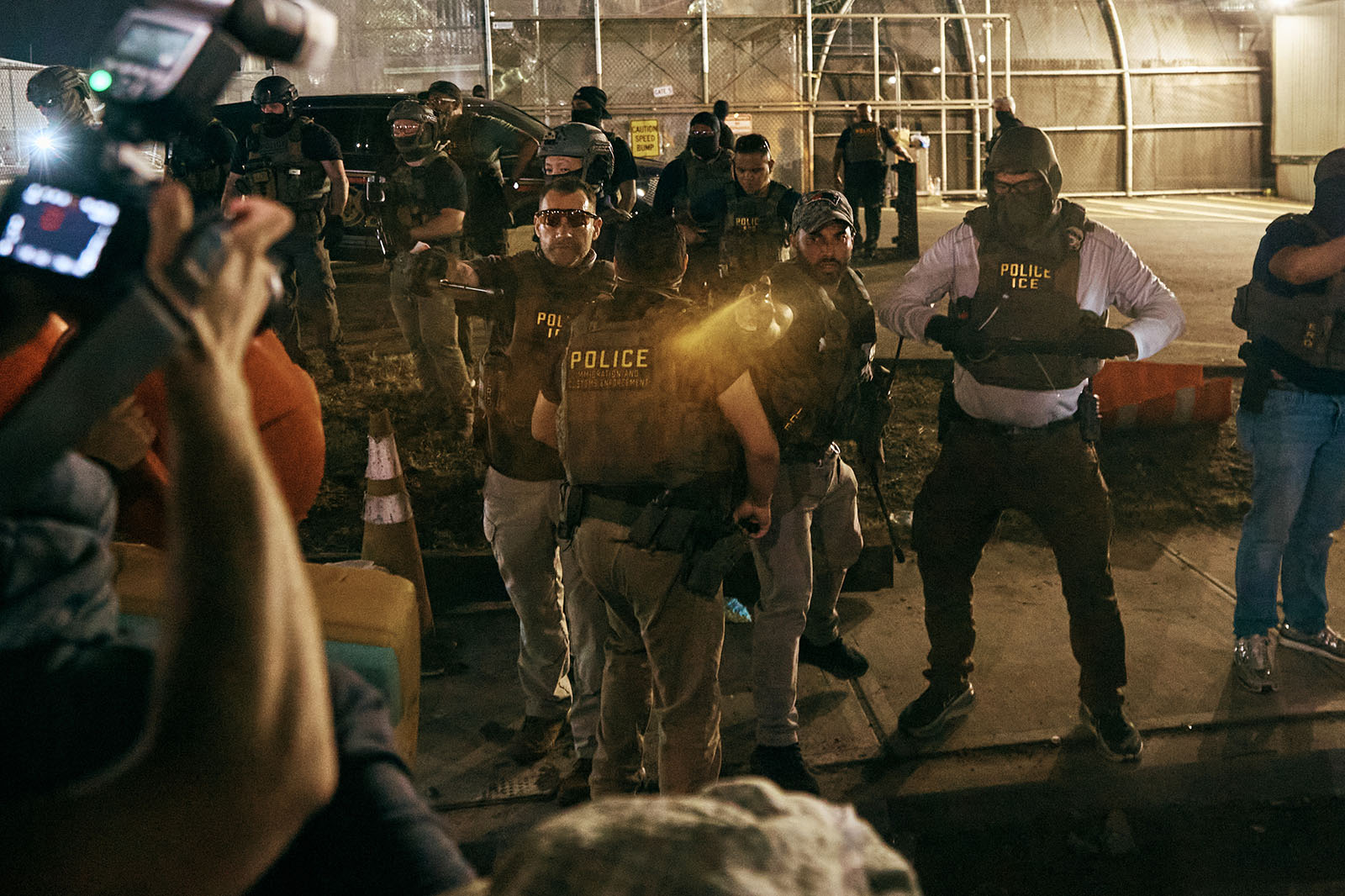
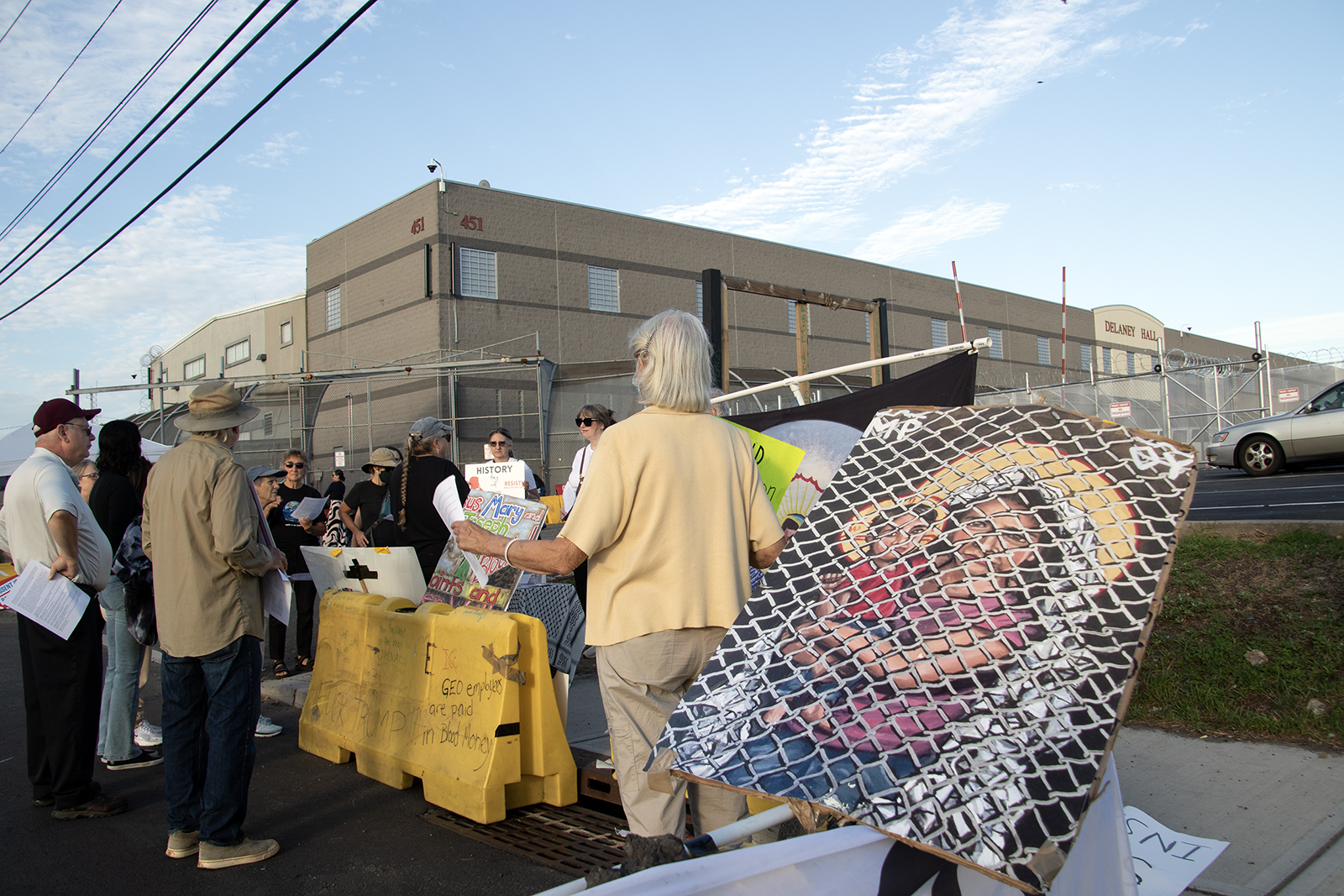
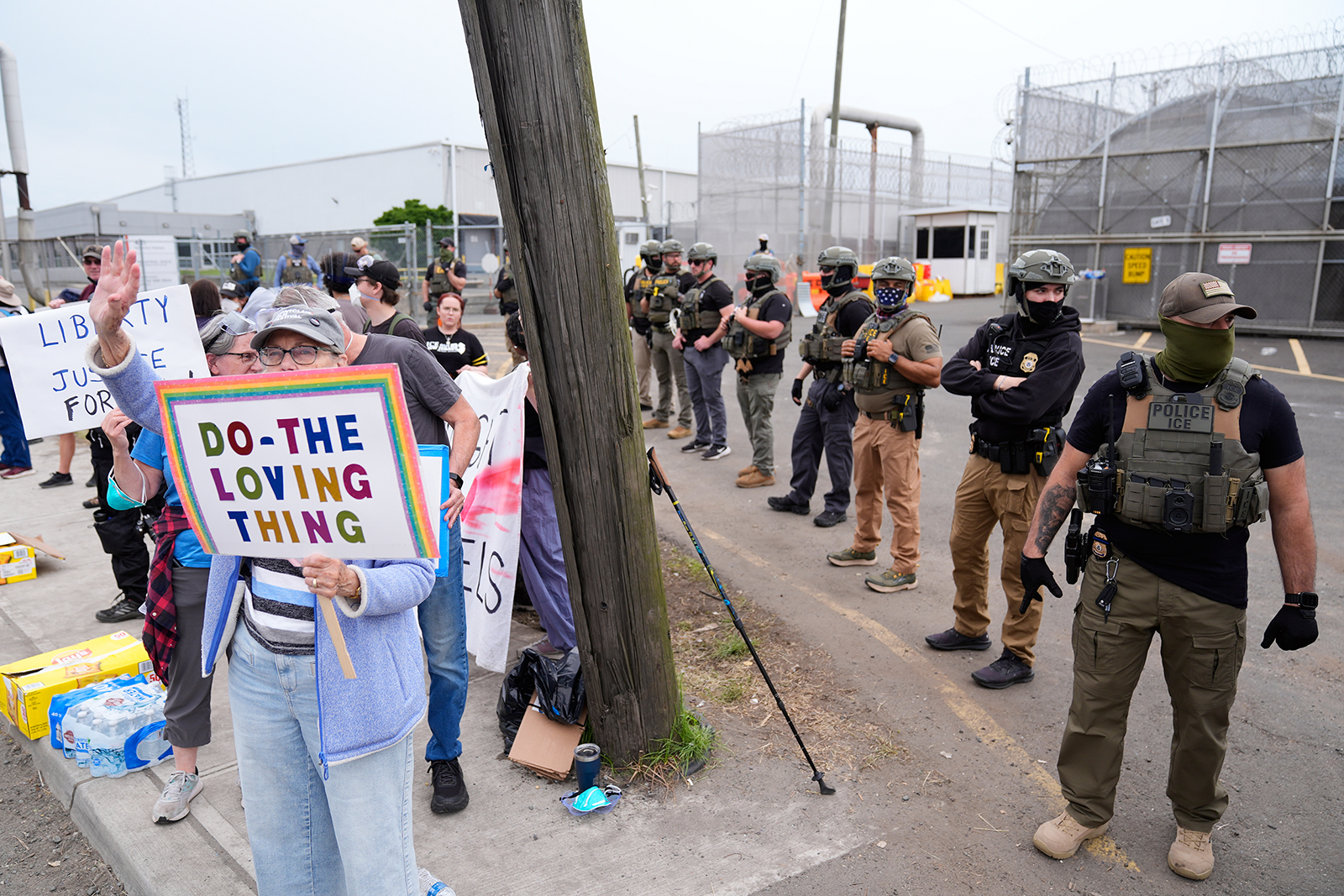
(RNS) — Moments before Department of Homeland Security agents fired a hail of pepper balls at the feet of demonstrators outside the Delaney Hall detention center in Newark, New Jersey, last Monday (May 25), faith leaders say they were frantically working to calm things down.

Kathy O’Leary, coordinator of the Catholic group Pax Christi New Jersey, said she was helping to push the crowd back. Rabbi Rachel Kahn-Troster, executive vice president of the Interfaith Center on Corporate Responsibility, said she and a Christian pastor had placed themselves between agents and demonstrators, raising their hands aloft. And the Rev. Robin Tanner, a Unitarian Universalist minister in Summit, New Jersey, said she was conversing with DHS agents as she stood beside U.S. Sen. Andy Kim, who had come to visit Delaney amid reports of a hunger and labor strike staged by detainees alleging inhumane conditions inside.

Then, unexpectedly, DHS agents unleashed the volley of pepper balls. All three faith leaders — along with Kim — were exposed, some left coughing and sputtering as bystanders rushed to help.


“We got hit with the same pepper spray,” said Tanner. “(Kim) got his in his eyes, and I got mine up my nose.”

A DHS spokesperson said in a statement to RNS that the agents used the “minimum amount of force necessary” against “rioters” who “obstructed law enforcement from exiting the ICE facility,” but demonstrators allege the incident is one of many cases of law enforcement using unnecessary force outside Delaney Hall in the last two weeks. During that period, one religious organizer interviewed estimated that at least a dozen clergy and other faith leaders have been hit with nonlethal projectiles or exposed to pepper balls, pepper spray and other crowd-control measures deployed by DHS agents and state police outside the facility. RNS was unable to independently verify that number but spoke with four faith-led advocates who said they have experienced such measures in that time frame.

Yet the faith leaders who spoke to RNS were almost matter-of-fact about the violent encounters, with all expressing greater concern about the people they are advocating for: immigrant detainees inside Delaney Hall, as well as their families.


U.S. Immigration and Customs Enforcement agents pepper-spray protesters and media outside the Delaney Hall detention center during demonstrations near the entrance gates, May 27, 2026, in Newark, N.J. (AP Photo/Andres Kudacki) TOP PHOTO: Masked federal agents stand outside the Delaney Hall detention center during a protest against the transfer of detainees, May 27, 2026, in Newark, N.J. (AP Photo/Seth Wenig)

Charlene Walker, who leads the multifaith advocacy group Faith in New Jersey, noted that clergy and other religious leaders have been present both outside and inside Delaney Hall long before the recent surge in demonstrations, with many protesting or advocating for immigrants at the site for roughly a year. Her group, she said, pushed for legislation designed to discontinue the use of places such as Delaney Hall as immigrant detention centers in 2021, so when news broke last spring that it was being reopened to house immigrant detainees, Faith in New Jersey quickly organized protests. In May 2025, dozens of faith leaders associated with the group were arrested outside Delaney Hall, where they had linked arms and physically blocked all of the building’s entrances for several hours.

Walker, a Unitarian, said she was dragged, “pushed and prodded by ICE and the police” during her arrest.


Also around the same time, Pax Christi’s O’Leary said she and a friend began showing up at Delaney Hall, handing out flyers to prospective workers about the “basic teachings from every major religion on welcoming people who were migrating.” Once the facility began operating fully that month, O’Leary noticed families coming to visit loved ones who were being detained inside.

“We started talking to them and finding out what kind of hurdles they were having” when visiting the facility, she said. “We started advocating for them with the guards at the gate.”

The facility’s strict dress code was a frequent issue. O’Leary said one woman traveled from Boston to visit her father who was being detained inside, only to be denied entry because she was wearing ripped jeans. A staffer with the Episcopal Diocese of New York, who was volunteering with O’Leary that day, offered to swap pants with the woman, and the two quickly changed in a nearby minivan.


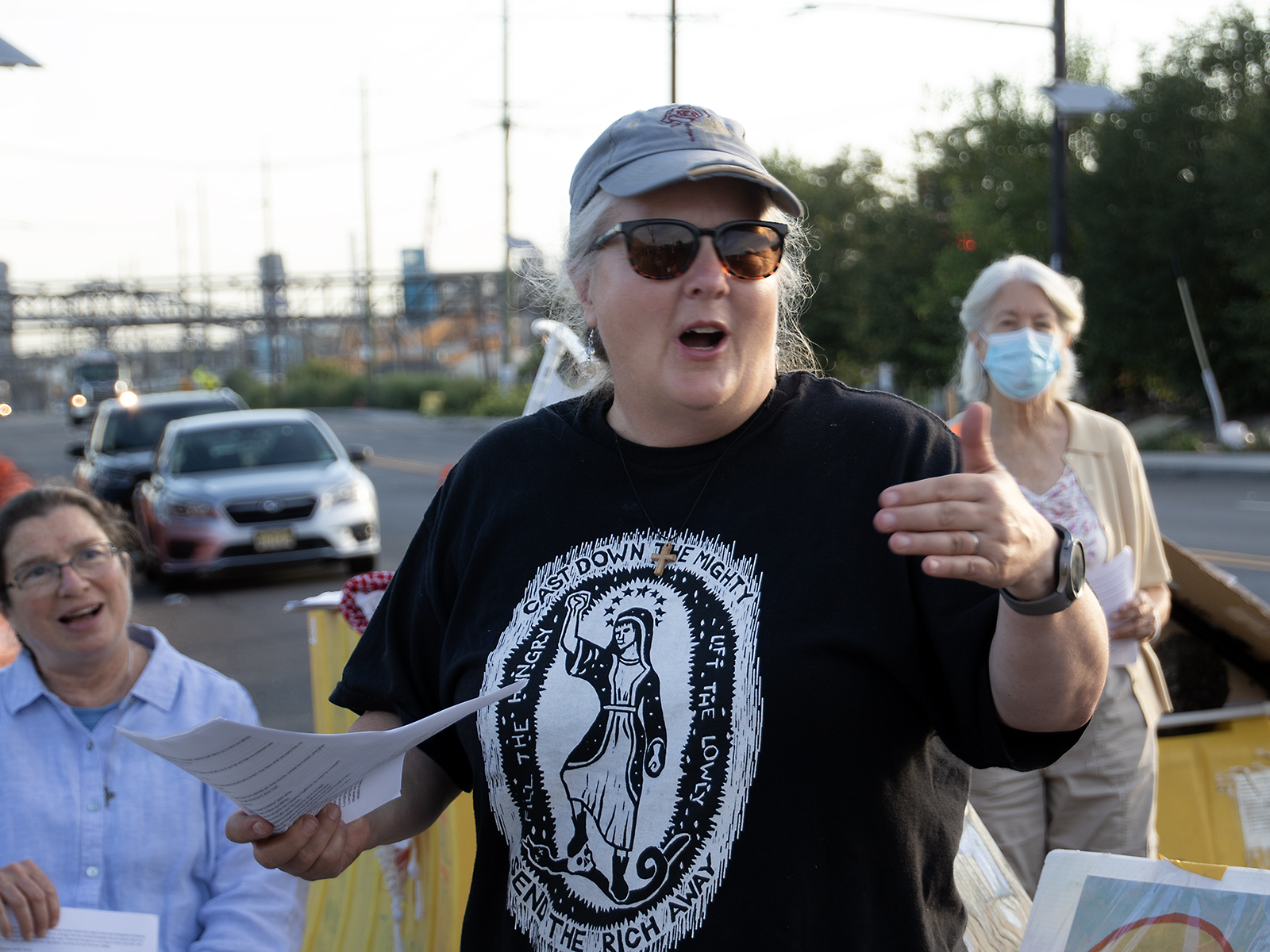
Kathy O’Leary speaks during a prayer service outside the Delaney Hall detention center, Aug. 24, 2025, in Newark, N.J. (RNS photo/Fiona Murphy)

The staffer, O’Leary said, still has the woman’s pants.

“She calls them the ‘holy jeans,’” O’Leary said.

That incident spurred volunteers to begin bringing more clothes for other visitors, which eventually resulted in the pitching of several tents — stocked with water, food, snacks and diapers — outside Delaney Hall. The tents were staffed with a wide variety of volunteers, but many were affiliated with faith groups, including Catholic nuns. Propped against the walls were an array of religious signs and symbols, including many commonly associated with Catholicism.

“We called that the radical hospitality zone,” O’Leary said.

Faith leaders say they that as early as last summer, they began to hear unsettling reports of deteriorating conditions inside Delaney Hall. Last June, four men escaped the facility amid internal unrest after what Kim, the New Jersey senator, and others alleged were instances of infrequent meals and overcrowding. In February, more than two dozen detainees managed to sign and release a letter that, among other things, reportedly complained of flu being “a constant problem among the detainees,” as well as “stress, fever, and general body aches which could lead to an outbreak of illness or an epidemic.”


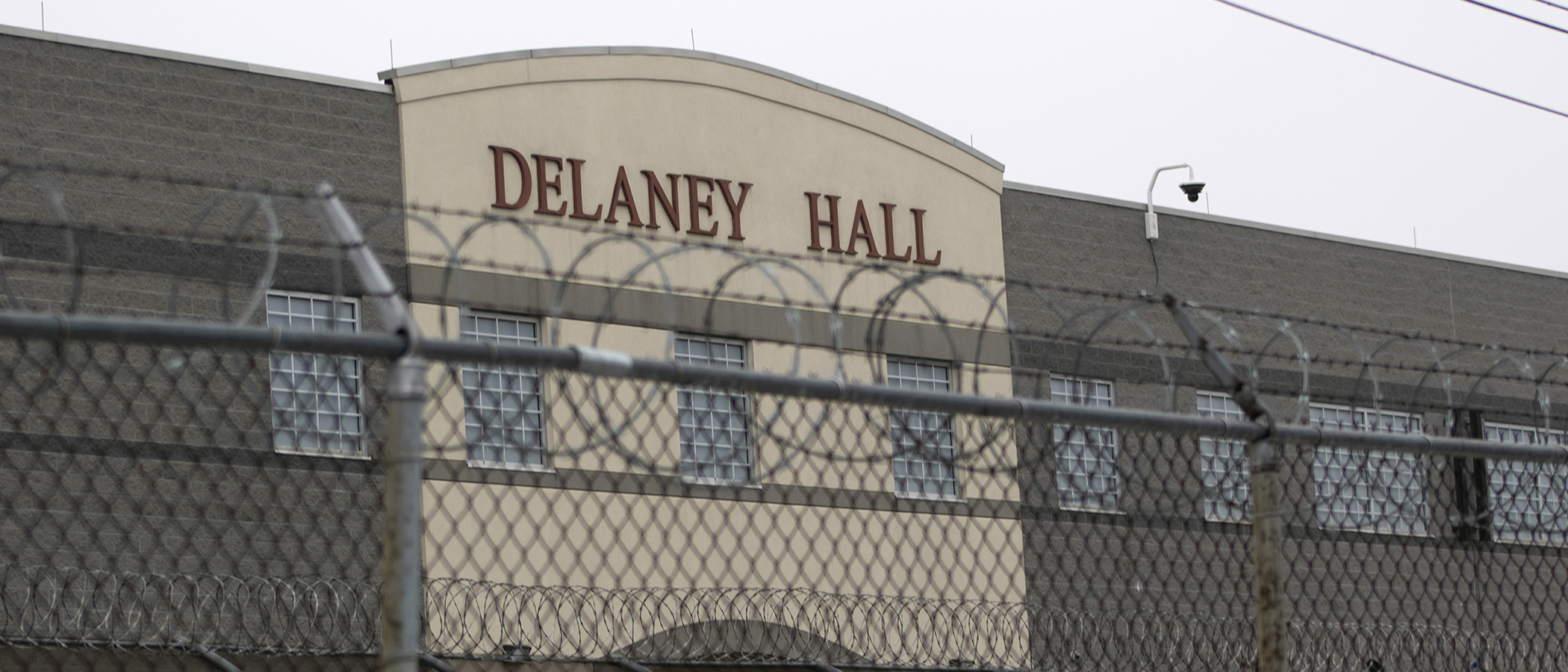
Delaney Hall Immigration and Customs Enforcement detention facility on Feb. 18, 2026, in Newark, N.J. (RNS photo/Fiona Murphy)

In addition, a lawsuit filed this week by the New Jersey attorney general listed allegations that the facility is beset by “overcrowding and lack of ventilation; lack of or inadequate medical care or hygiene practices; unsanitary food and drink preparation and storage; and the unchecked spread of communicable diseases like COVID-19 and Influenza.” The suit also alleges that inspectors who toured the facility last month were barred from accessing the “medical unit; toileting and shower facilities; ventilation; HVAC; and sleeping areas.”

DHS has publicly derided many of the allegations as “smears” forwarded by “sanctuary politicians.”

But Tanner, the Unitarian Universalist minister, said she has seen evidence of issues inside the facility. Accompanying some families into Delaney Hall during visits, she said, she has witnessed detainees growing physically weaker over time. “I saw it with my own eyes,” she said, describing detainees losing weight over the course of a few weeks. “They reported not getting enough food or water. Medical care, if it came, took several weeks.”


The situation escalated last month, when the New Jersey Monitor reported that roughly 300 Delaney Hall detainees had launched a hunger and labor strike. DHS Secretary Markwayne Mullin has dismissed the situation as a dispute over “ethnic food,” but the news spurred a surge of protests outside the facility.

Walker said Faith in New Jersey has been offering pastoral care and sometimes even first aid amid confrontations between law enforcement and protesters. She recalled a recent instance when a protester walked over to clergy and asked for help dressing her wounded arm, only for the group to realize the arm was broken. Walker also noted that a faith leader with her group was the person who helped Kim wash out his eyes after being exposed to pepper balls.

For her part, O’Leary stressed the “radical hospitality” tent is not meant to be a protest space, but rather a center for assisting visiting families. Even so, the space appears to have become a target: This past weekend, Pax Christi New Jersey posted a video claiming the tents had been “trashed,” showing supplies strewn about the ground inside. The images showed many religious signs and symbols, such as images of the Virgin Mary, thrown to the ground, including one that read “The Empire can kidnap Joseph and jail Mary but Baby Jesus is still coming back.”

Photographs taken by Reuters on Sunday appeared to show FBI and Homeland Security investigations agents inside the tent. DHS did not respond to direct questions about whether federal agents raided the tent, and why they would do so. But O’Leary said that conservative-leaning media outlets have suggested the tent is a hub for the protests — a claim she called “absolutely not true” — and that the New York Post described it as a place where “rioters enjoy puzzles and games.”

“The puzzles and games are for the children,” she said.

Since last week, state police have become a regular presence at Delaney Hall, distancing demonstrators from DHS agents and often using force as well, particularly in the evening. Tanner said one of her clergy colleagues was also struck with a nonlethal projectile during a protest that took place in the past few days.


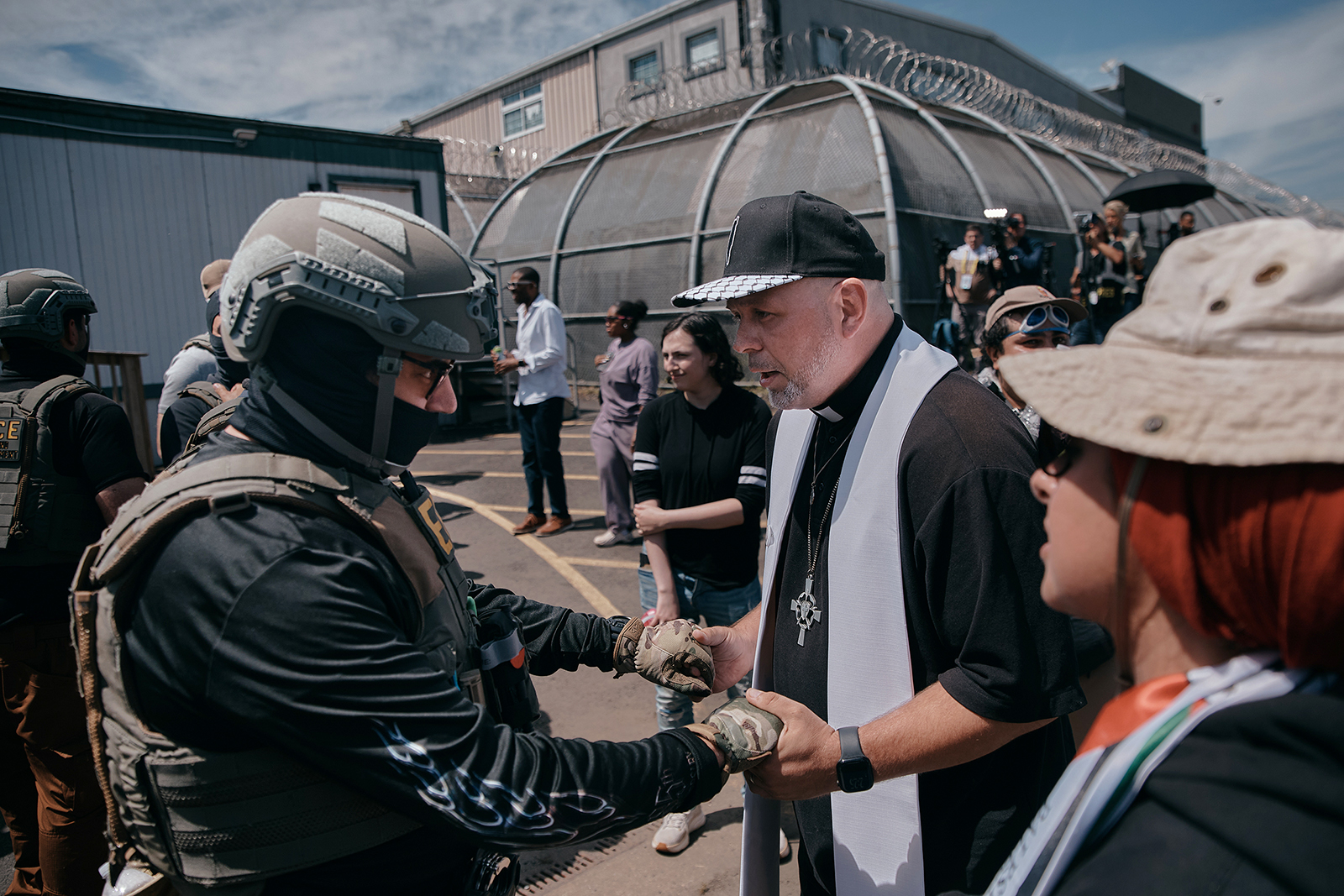
The Rev. Erich Kussman, from St. Bartholomew Lutheran Church, center, prays with a U.S. Immigration and Customs Enforcement agent outside Delaney Hall detention during a protest against the transfer of detainees, on May 26, 2026, in Newark, N.J. (AP Photo/Andres Kudacki)

Still, all of the religious leaders RNS spoke to said they were undeterred. Walker recently returned to the site for another evening of protests. O’Leary has already begun cleanup at the radical hospitality tent.

“I have been thinking about this call from the Holy One to redeem the captives,” said Kahn-Troster, the rabbi who stood between demonstrators and DHS agents when pepper balls were fired. “It’s not just a good deed, but a commandment — a guiding force to free those who are unjustly held and reunite with their families.”

Tanner agreed. She pointed to the symbol used by Unitarian Universalists — a chalice with a flame. It’s an image with a specific history: During World War II, she said, it became associated with efforts to aid those attempting to flee parts of Europe occupied by the Nazi regime.

“Literally the core symbol of our faith, the essential ritual that we begin every Sunday with, comes from that assertion that every single person has worth and dignity, and we are called by our faith to put our bodies on the line if that’s the call,” she said. “I could not just be silent and ignore what’s happening at Delaney Hall.”

Tanner added: “It would be immoral, according to my faith, for me to do so.”


People gather for a prayer service outside the Delaney Hall detention center, Aug. 24, 2025, in Newark, N.J. (RNS photo/Fiona Murphy)
One Eye Squinted

Why evangelicals should oppose the new farm bill's Save Our Bacon Act

(RNS) — Evangelicals have largely forgotten past generations of evangelicals who not only fought against the slave trade and inhumane working conditions but also against animal cruelty.


(Photo by Mark Stebnicki/Pexels/Creative Commons)


Karen Swallow Prior
June 4, 2026 
RNS


(RNS) — Christians should care about cruelty to animals, even, perhaps especially, the animals we eat.

The Bible is filled with principles that govern the ways in which animals are to be cared for, slaughtered, eaten and sacrificed. Laws and regulations in our own government today that eliminate or reduce unnecessarily cruel and inhumane conditions for animals simply reflect biblical wisdom regarding the good stewardship of God’s creation.

Christians should know, then, that the 2026 Farm Bill, which was passed by the U.S. House of Representatives in April and is expected to go before the Senate this month, departs from this biblical wisdom. The bill contains a provision, referred to as the Save Our Bacon Act, directed at overriding some state laws against animal cruelty. The act specifically targets legislation in California and Massachusetts (passed by voter approval) requiring “that hogs, calves and chickens that are on confined farms or sold in the states are raised with adequate room to turn around, lie down and extend their limbs.”

To be very clear: The proposed change will nullify the basic requirement that living, breathing, sentient creatures created by God have room to move and rest throughout the short duration of their lives. Requiring such minimum comfort “hardly seems an unreasonable request for a modern, enlightened society,” as Kathleen Parker recently mused. Indeed, such cruelty directly counters Scriptures in both the Old and New Testaments that command us not to muzzle an ox while it is threshing.

As some critics point out, the provision not only removes animal welfare protections, but will also hurt small-scale farmers. Moreover, a report from Harvard Law School finds that the act could have unintended effects on hundreds of local and state laws and regulations “related to livestock production and livestock products that are intended to protect public health, farmers, and consumers, such as vaccination and food safety requirements.”

Ultimately, while it may feel impossible to untangle all the layers of competing needs and interests entailed in the bill, Christians have an ethical, God-ordained duty to care well for all of creation by supporting practices that are humane and healthy for both people and animals. Opposing cruelty is foundational to any system of Christian ethics, but it is also essential to our mere humanity.


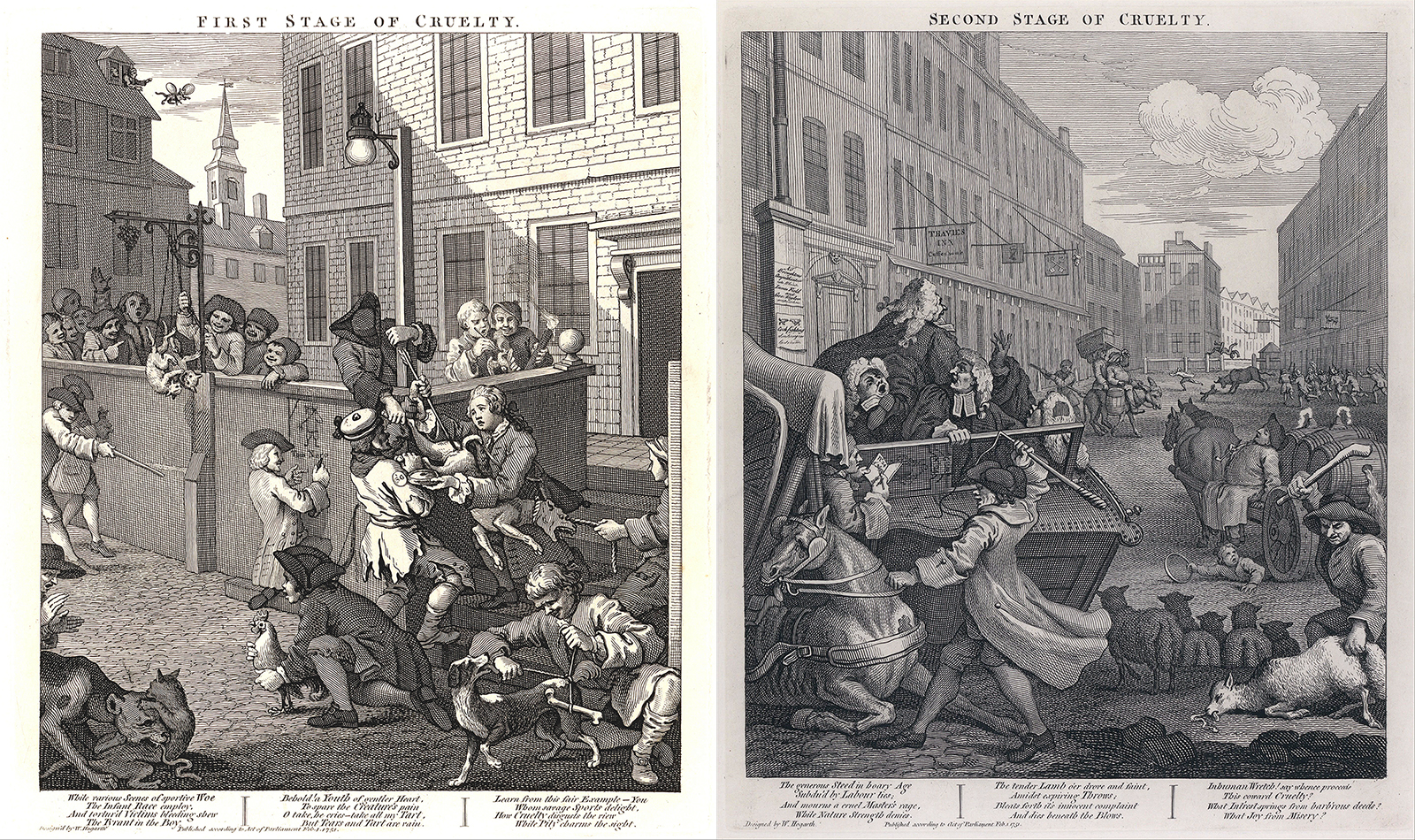
William Hogarth’s “The First Stage of Cruelty: Children Torturing Animals,” left, and “The Second Stage of Cruelty: Coachman Beating a Fallen Horse.” (Images courtesy of Wikimedia/Creative Commons)

This is not a new idea, of course, but it is one that gained new currency in the early modern period when urbanization and industrialization severed old ties between humans and the natural world. It was in the midst of this great shift that the English painter William Hogarth produced a series of prints titled “The Four Stages of Cruelty“ (1751), which vividly portrays the natural course of cruelty for the one who practices it.

The series depicts a character, aptly named Tom Nero, over the course of a life characterized by acts of heartless cruelty — first acts committed by him, but ultimately upon him. The first print shows Tom sadistically torturing a dog on a city street with another boy while others commit abuses on other animals nearby. Only one boy seems to be pleading for them to stop.

The second print depicts Tom grown and working as a coachman. His horse has collapsed from exhaustion, and Tom is wielding the stick with which he has mercilessly beaten the horse, surrounded by other men heaping abuses on other creatures on the city street.

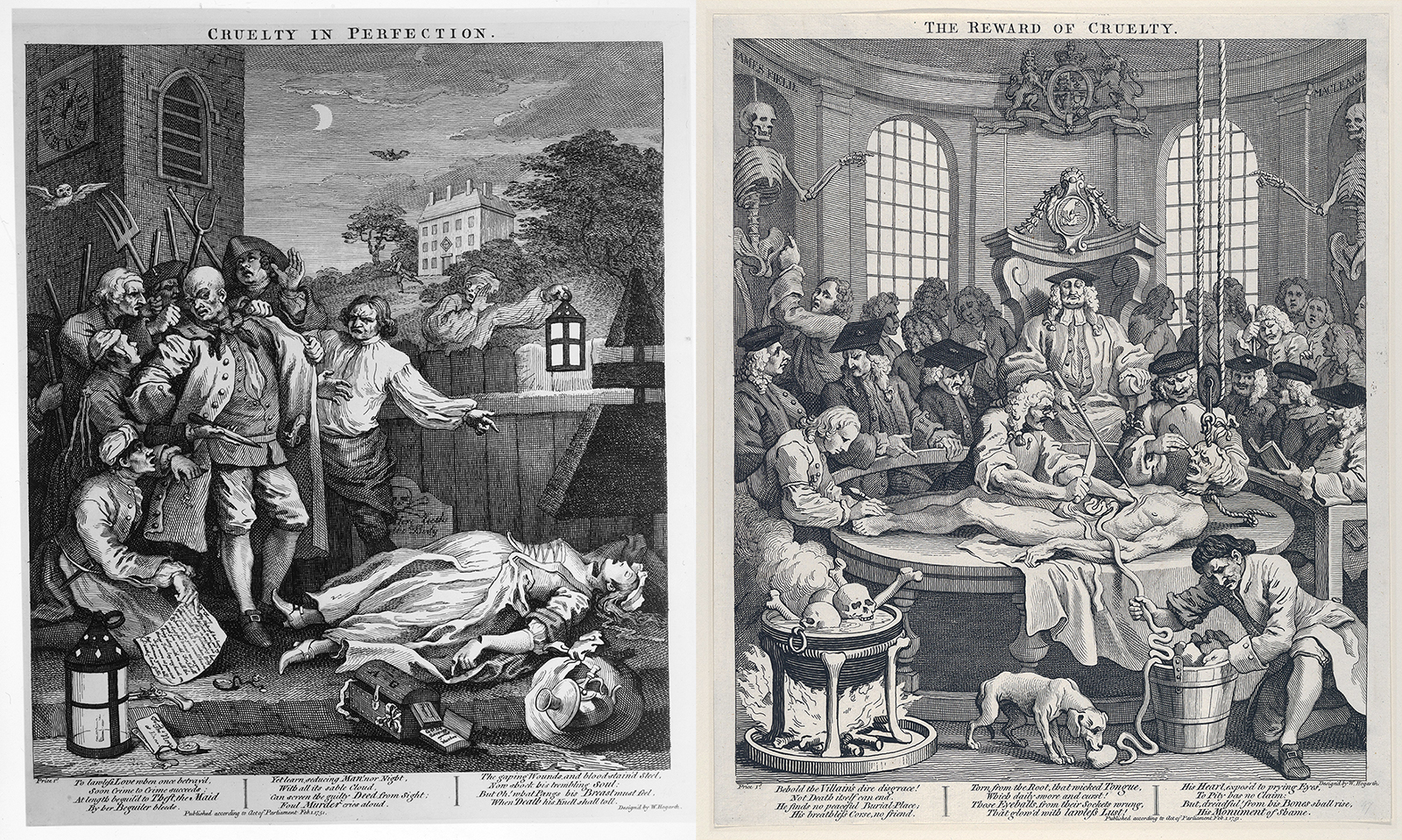
In the third print, we see Tom in the moments after he has murdered his pregnant lover, details of the event described in a letter written by his lover, included in the scene. Tom’s pockets are full of stolen goods and weaponry.


William Hogarth’s “The Third Stage of Cruelty: Cruelty in Perfection,” left, and “The Fourth Stage of Cruelty: The Reward of Cruelty.” (Images courtesy of Wikimedia/Creative Commons)

The fourth and final in the series conveys the moral lesson with the inevitable consequences for such a life: Tom has been executed by hanging, his body is being dissected by heartless operators and bears signs and symbols that reflect all the cruelties he has committed over the course of his life.

Hogarth’s series brings starkly to life the truth that cruelty begets cruelty and ultimately consumes the one who is cruel. This is a truth that was embraced by the earliest evangelical reformers, whose broad reforms during the 18th and 19th centuries changed the world in ways we take for granted today.

Hogarth’s work was produced during the decades when evangelicalism was growing as a movement in England and the Colonies. Within a few decades of this series, a generation of evangelical leaders would rise up who would see with new eyes the various forms of cruelty that were all around in everyday life and challenge them: slavery, the inhumane working conditions of the poor, the injustice of the system of criminal law and animal cruelty.

These evangelicals — including John Newton, William Wilberforce and Hannah More — successfully advocated for reforms in all of these areas. While they were fighting to abolish the slave trade — fueled by the virtue of benevolence and in recognition of the demoralizing and coarsening effects all forms of cruelty have on all those who participate in it — these evangelicals also advocated for animal welfare. In fact, in 1824 Wilberforce helped found the Society for the Prevention of Cruelty to Animals. This is a legacy that, sadly, has been largely forgotten by evangelicals today. But it is a legacy worth remembering and keeping today.

Industrialization and bureaucracy bring greater distances between us and the animals we eat, and it’s easy to feel removed from the practices by which living, breathing, sentient animals become the products we consume — because we are so greatly removed.

But that distance does not remove our ethical and moral responsibility to fulfill the stewardship mandate God gave us in a way that reflects the nature of his goodness and care. It is good and right to care well for the lives of the creatures who aid and sustain human life.


Pope Leo makes clear Iran is not a 'just war,' as he travels to Madrid for week in Spain

ABOARD THE PAPAL PLANE (RNS) — The pope touched on ‘just war’ theory, the war in Ukraine, the soccer World Cup and even Bad Bunny during the papal flight taking him to Madrid.


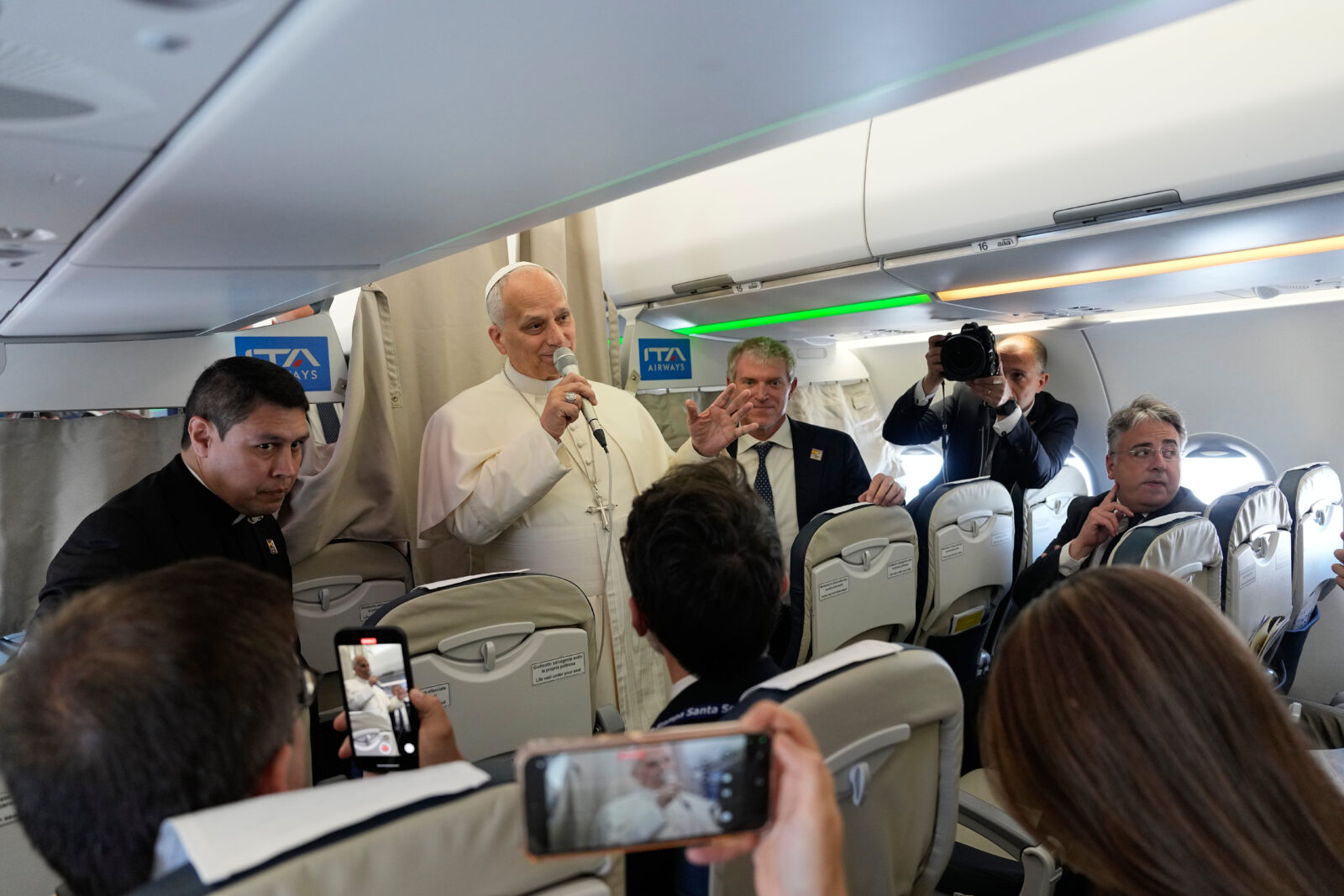
Pope Leo XIV talks to journalists aboard the papal flight from Rome to Madrid, Saturday, June 6, 2026, on the occasion of his apostolic journey to Spain. (AP Photo/Alessandra Tarantino, Pool)


Claire Giangravè
June 6, 2026  
RNS


ABOARD THE PAPAL PLANE (RNS) — Pope Leo XIV said the war in Iran does not qualify as a “just war” according to Catholic teaching, while answering questions by journalists aboard the papal plane for his six-day visit to Spain.

“I believe it has been already declared clearly,” Leo said answering a question by Italian journalist Franca Giansoldati, of Il Messaggero, on Saturday (June 6). “There is no just war there,” he said, referencing the conflict in Iran.

The question referred to U.S. Vice President JD Vance’s remarks in April, where he used just war theory to justify the war in Iran. On that occasion, Vance said the pope should “be careful” when talking about theology.

“When the pope says that God is never on the side of people who wield the sword, there is more than 1,000-year tradition of just war theory,” he said. President Donald Trump later said Leo was “weak” on war in a post on Truth Social.

Leo pointed to his most recent encyclical, “Magnifica Humanitas” (Magnificent Humanity), which says that just war theory has “too often been used to justify any kind of war” and is “now outdated.”

“The problem is that the just war theory comes from centuries past when we couldn’t imagine the weapons, human beings’ ability for destruction,” Leo said.

The document urges alternative ways to overcome conflict — “dialogue, diplomacy and forgiveness” — condemning the use of force which disproportionately harms civilians.

The pope made “overcoming the theory of the ‘just war'” one of the themes of the first summit of cardinals he convened at the Vatican June 26-27, called a consistory.

Aboard the plane, Leo also weighed in on the war in Ukraine, especially after Russian President Vladimir Putin recently refused to meet with Ukrainian President Volodymyr Zelenskyy. “I am worried for Ukraine,” Leo said. “We must really push to reach an end to the conflict and the war and find a solution,” he added, calling for continued negotiations.

“Already, four years and a half have passed. We must reach a solution,” he said, recognizing the United States’ efforts to mediate a peace.

The pope also said he is in contact with religious leaders in Lebanon, whom he met when he visited the country in November. “The situation is very complex,” he said, as Israel continues its offensive in the southern part of the country.

Regarding clerical sexual abuse, which he will likely address during his visit to Spain when he meets with abuse victims, Leo said “abuse remains an open wound.”

Finally, Leo said he will support the United States in the soccer World Cup, though he does not know how many games he will be able to watch. He also said that while “the pope is for all teams, Prevost is for Madrid!,” using his former last name.

He addressed the rise in religiosity among some young people in many European countries and parts of the United States. “Young people that are looking for something more, having grown up in many cases that, if you will, spiritual dimension in their lives, they realize there’s an emptiness and a lack of a sense of meaning,” he said, adding that he hopes his visit to Spain will encourage the young who have drawn closer to the church there.

Leo also commented on the Puerto Rican singer Bad Bunny, who is doing 10 concerts in Madrid this month, amid rumors of a possible virtual meeting between the two. “If (young people) are confronted with the question ‘do they want to see the Bad Bunny or do they want to see the pope?,’ I think many will see Bad Bunny. But I think there will also be a few here to see the pope. And that says something, you know?”
Opinion

The status quo at Jerusalem’s Al-Aqsa Mosque is deteriorating

(RNS) — The long-standing practice has been to preserve the site for Muslim worship and allow visitors of other faiths.


Worshippers enter the Al-Aqsa Mosque compound in Jerusalem’s Old City, April 9, 2026, after a ceasefire reached by Iran, Israel and the United States. (AP Photo/Mahmoud Illean)


Daoud Kuttab
June 4, 2026 
RNS

(RNS) — At first, last week’s investigative report by Middle East Eye journalists, revealing a secret U.S.-Israel plan to end Jordanian custodianship of Jerusalem’s most contentious holy site, seemed far-fetched. The plan purports to replace Jordan’s administrative body with an Israeli-appointed one that would reframe the Muslim site, allowing public access to a “multifaith center.”

When questioned, U.S. Secretary of State Marco Rubio appeared surprised. “I’m not even aware of those reports. … I’ve never heard that,” he said in a congressional hearing about the matter. Rubio then stressed the “great” partnership between the U.S. and Jordan.

But those on the ground were not surprised by the report. The long-standing status quo, dating back to 19th-century Ottoman rule and reinforced by international resolutions and the 2014 U.S.-Israel-Jordan agreement, has been to preserve the site for Muslim worship and allow visitors of other faiths. But in practice, that agreement has been eroding for decades, increasingly so since the war in Gaza in late 2023.

The 14-hectare compound, which includes Al-Aqsa Mosque and the Dome of the Rock, holds deep significance for Islam; Muslims believe that the Prophet Muhammad ascended to heaven from there to receive divine revelations. Together, the two structures that make up Haram al-Sharif/Al-Aqsa Mosque are a UNESCO World Heritage site and are considered the third-holiest site in Islam.

Israeli police have restricted mosque entry from Palestinians during holidays, citing security concerns. And Israeli police have increasingly allowed Jews, who believe that the Temple Mount beneath Al-Aqsa is the location of the ancient First and Second Temples, to perform rituals and prayers inside the complex, despite the 2014 meeting in Amman where Israeli Prime Minister Benjamin Netanyahu and Jordan’s King Abdullah II, in the presence of U.S. Secretary of State John Kerry, affirmed that “Al-Aqsa is for Muslims to pray and for all others to visit.”


Israeli police escort Jewish visitors marking the holiday of Passover to the Al-Aqsa Mosque compound, known to Muslims as the Noble Sanctuary and to Jews as the Temple Mount, in the Old City of Jerusalem during the Muslim holy month of Ramadan, April 9, 2023. (AP Photo/Mahmoud Illean)

Since Ariel Sharon’s provocative breach of the mosque in 2000 and the removal of Jordan’s waqf guards from the Mughrabi Gate, Jewish extremists have entered the mosque without permission from Jordanian waqf authorities. Jewish settler visits, accompanied by armed Israeli forces, have surged by more than 18,000% since 2003, according to statistics released by the Jordanian authorities, from 289 to over 53,000 in 2024.

Researchers have warned that, under the rhetoric of religious and historical ties, Israel is steadily expanding its influence at the site. What began as a police revision permitting greater Jewish prayer has become a broader precedent.

Israeli media reports in early 2026 indicated that Netanyahu supported a decision by Israel’s national security minister, Itamar Ben-Gvir, allowing Jewish prayer at Al-Aqsa. Israeli media coverage also notes that the prime minister said the policy changes were coordinated with him and that he dismissed warnings that such moves breached decades‑old arrangements.

On May 14, Ben-Gvir personally led a Jewish extremist group into the Al-Aqsa compound and raised an Israeli flag, danced, sang and declared that “the Temple Mount is in our hands.” The incident underscored the high-stakes nature of policy shifts and the urgency of careful stewardship and inclusive dialogue to prevent escalation.

Concurrently, a draft bill advanced by a right-leaning Israeli ministerial committee seeks to regulate the call to prayer by requiring mosques to obtain prior authorization to use loudspeakers, with security forces empowered to intervene more readily. Penalties would include steep fines and confiscation of equipment, effectively creating a regime where permission is the default and prohibition the exception, potentially suspending a core element of Islamic worship at moments deemed to violate the permit. The proposed fines — around $17,300 for operating loudspeakers without a permit and about $3,500 for noncompliance — underscore the seriousness of the shift.


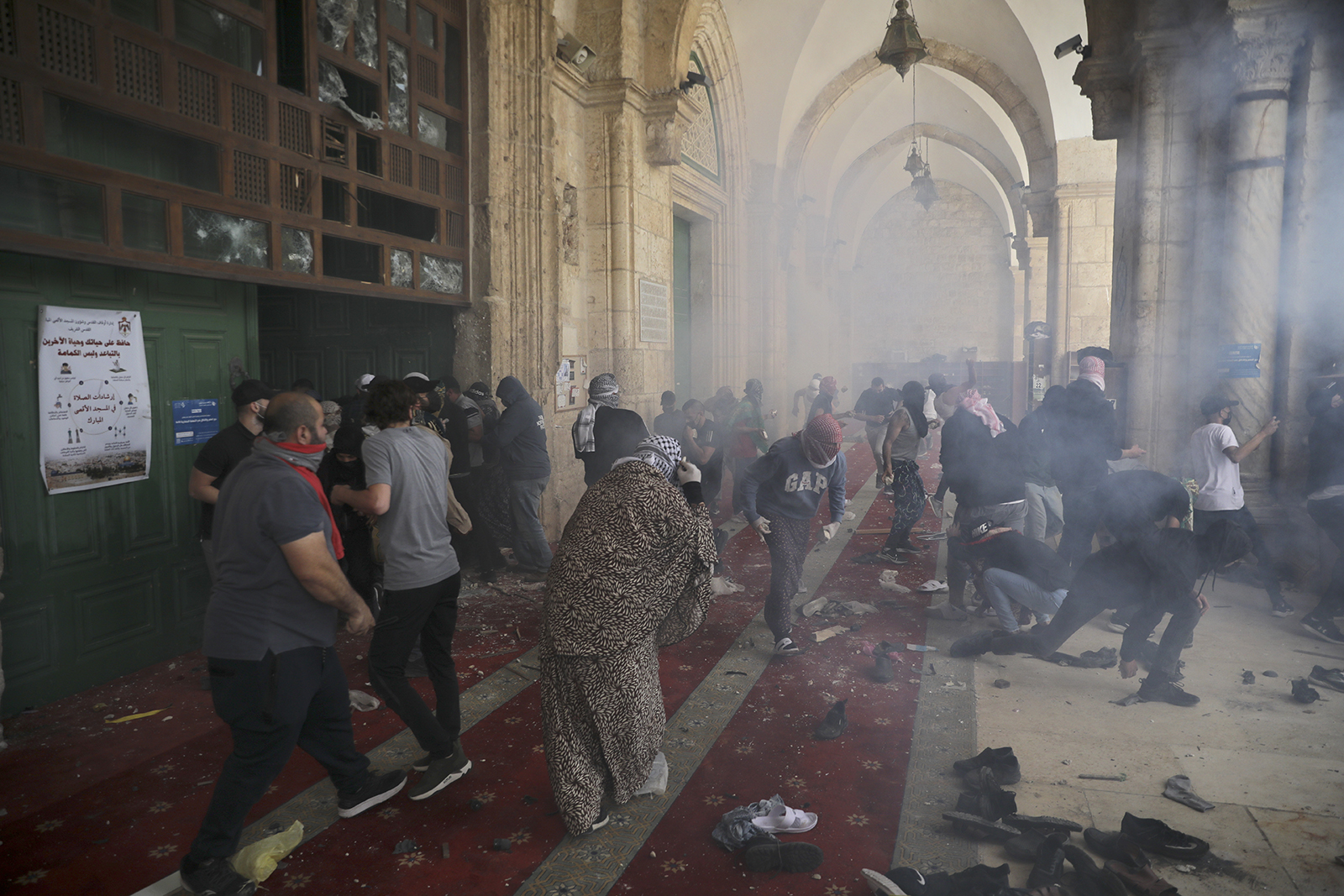
Palestinians clash with Israeli security forces on May 10, 2021, at the Al-Aqsa Mosque compound in Jerusalem’s Old City. (AP Photo/Mahmoud Illean)

The Islamic-Christian Commission for Supporting Jerusalem and Holy Sites has expressed profound concern over escalating Israeli measures targeting Al-Aqsa Mosque.

“Obstructing restoration, maintenance, and preservation work, hindering repairs to facilities and gates, and delaying vegetation removal and hazard mitigation reflects a deliberate policy to paralyze the waqf administration and strip it of its authority,” the commission said in a June 2 statement.

The long-standing agreement scaffolding the site’s governance was carefully formed on the basis of religious legitimacy, historical memory and a web of legal instruments intended to prevent flare-ups in a city that can ignite regional and even global tensions.


RELATED: Israel’s defense for closing Holy Week sites in Jerusalem takes a new twist

Religious legitimacy for the Hashemite custodianship derives from the Hashemite lineage’s ties to the Prophet Muhammad and from the widely understood duty to guard Al-Aqsa as a sacred obligation. Consolidated in 1924, the custodianship has endured despite shifting sovereignty, linking Jordan’s national identity to the city and its governance. Legally, it is reflected in international and bilateral instruments recognizing shared stewardship of Jerusalem’s holy places, a framework invoked in diplomacy to avert crises.

The Hashemite custodianship of the holy sites is a responsibility upheld by King Abdullah II and is firmly recognized and documented in international treaties and agreements, including Article 9 of the Jordan-Israel Peace Treaty. Jordan has also stressed that Israel, as an occupying power, has no authority under international law or United Nations Security Council resolutions to alter the historic and legal status quo of Jerusalem.

Al-Aqsa Mosque remains a focal point where faith, history and geopolitics intersect, and changes to its custodianship, access rules or administration carry implications far beyond a single site, affecting regional stability and international diplomacy.

A sustained commitment to the 19th‑century status quo, the trilateral understandings of 2014 and ongoing diplomatic efforts is essential to prevent escalation and to preserve a framework that accommodates worship, history and peace for all who revere Jerusalem’s sacred places.

(Daoud Kuttab is the senior communications officer of the World Evangelical Alliance. The views expressed in this commentary do not necessarily reflect those of Religion News Service.)

INDIA

Uttarakhand: Muslims at Receiving End, Another Mosque Sealed Amid Protests


S.M.A. Kazmi |


An old mosque in Thano area, in existence since 1978, was sealed by the MDDA authorities for being ‘illegal’ after persistent demand by Hindutva groups.

Dehradun: With Assembly elections fast approaching in Uttarakhand, the minority Muslim community which has been at the receiving end of wrath of the ruling BJP/RSS dispensation for the past nearly nine years, are being cornered and targeted in every possible way by the Hindutva brigade having the patronage of the State administrative machinery and police.

An old mosque at Thano village area of Dehradun, which has been existence since 1978, was sealed by the authorities of Mussoorie Dehradun Development Authority (MDDA) for being ‘illegal’ on the persistent demand of the Hindutva groups owing allegiance to the ruling party.

This is the fifth mosque in and around Dehradun which has been shut down by the administration of Uttarakhand Chief Minister Pushkar Singh Dhami, who is seen as the rising young star of Hindutva forces in the country and is leaving no stone unturned in emulating his counterpart neighbour, Uttar Pradesh Chief Minister Yogi Adityanath, in anti-Muslim rhetoric.

The mosque was sealed on the ground that the map for its construction was not sanctioned. Members of the Bajrang Dal had been agitating for some time against the mosque, questioning a mosque could come up in a rural area. The local Muslims claim that the mosque was functioning since 1978 and even a room was of the mosque had been constructed by the minorities’ welfare department of the state government.

Regarding the issue of sanctioning of map, the local Muslims claim that none of the buildings in the said village has got maps sanctioned by MDDA, which itself came into being in the 1980s. However, acting under pressure from Hindutva groups, the mosque was sealed.

Nayeem Quraishy, President of Muslim Sewa Sangathan, who along with other members staged a dharna in front of the MDDA office, charged the authorities of bias against Muslims.

“It is blatant use of arbitrary powers to seal the mosque and clear infringment of Article 25 of the Constitution. Has anyone asked for the maps and documents of Hindu religious places which are coming up at public and forest land? But Muslims are targeted,” he lamented.

The Muslim Sewa Sangathan said it plans to knock the doors of High Court to seek justice. Hafiz Shah Nazar, a spokesperson of Jamait-E-Ulema-Hind, a body of clerics said they would also be taking up the issue with appropriate authorities. They propose to approach the National Human Rights Commission (NHRC) and the Minorities Commission both at the national and state level on the issue.

Earlier, the functioning mosques at MDDA colony, opposite Raipur police station, Asharodi and Dakrani, were sealed for alleged failure to get official permission. On the other hand, it is near impossible to get sanction for a new mosque from the administration and even more difficult to get an old mosque repaired due to objections from Hindutva groups.  

 It was under Dhami’s leadership that anti-Muslim campaigns of ‘Love Jehad’, ‘Land Jehad’, ‘Thook Jehad’, ‘Nakal Jehad’ and demographic change were coined to vilify the minority community in the past nearly six years of his rule. Nothing concrete on the ground has come out of these wild allegations but has helped BJP/RSS in a poisonous narrative against Muslims on social media in a Hindu majority state.

The narrative of these ‘Jehads’ spread by the ruling party and its affiliates hinting a “large scale” planned conspiracy by the Muslims could not be proved on the ground and in the court of law. The oft-repeated allegations of demographic change by the Chief Minister and his resolve to check it with an aim to preserve and conserve the Hindu culture of ‘Devbhoomi’ (land of Gods) fell flat as none from Muslim community was found buying land in the hills, as documented by the Migration Commission employed by the BJP government.

Interestingly, the lands have been bought and sold by the members of the majority Hindu community. However, a miniscule Muslim community, which had been doing odds jobs and businesses in the small towns of hills of Uttarakhand, has been targeted and hounded out by Hindutva groups in the past nine years.

The Banphoolpura riots in Haldwani town two years ago, which resulted in the death of six Muslims in police firing and subsequent police repression following the demolition of a mosque and later alleged police brutalities in the wake of the ‘I love Mohammed’ procession at Kashipur, speaks volumes about the attitude of the police and administration toward Muslims in Uttarakhand.

Apart from being the targets of administration and police, the Hindutva groups unleashed, allegedly by the ruling dispensation, have made the life of common Muslims difficult. These groups are moving with impunity, threatening, attacking and vilifying Muslims and all those who try to stand with the minority community.

The case of ‘Mohammed’ Deepak of Kotdwar who stood up to save an old Muslim shopkeeper and has become a target of the Hindutva forces, is one such example. Even Hindus who have rented out their shops and houses to Muslims are being pressured to get their properties vacated from ‘infidels’. Only a few have dared to stand up to the Hindutva groups.

The Hindutva groups are roaming freely and even scrounging hotels, rest houses and resorts in and around Dehradun and Rishikesh to target any young Muslim staying there. In the past few months, many Muslims youngsters have been beaten up by these groups for staying in the hotels with Hindu girls or women. They were charged with indulging in ‘Love Jehad’. Interestingly, there is no such stigma if the girl happens to be a Muslim with a Hindu boy. Such cases are encouraged and eulogised as ‘home-coming’.

 A Muslim youngster named, Samir, had to die for eloping with a Hindu girl from Gandhi gram area of Dehradun in April. Son of a poor labourer, he eloped with a girl on April 20 and the police along with Bajrang Dal members mounted pressure on his family to produce him. Their house was attacked and ransacked allegedly by Bajrang Dal members as the location of the eloped duo was traced to Tyuni in Uttarakashi district. As per the police version, the girl was recovered but the boy escaped and jumped into the river. The family was informed after a week to identify a dead body found from the river. The family members were too scared after the trauma that they refused to even write a complaint letter seeking an enquiry into the circumstances leading to his death.  

Recently, a footwear showroom was raided by one such group and the word ‘jehadi’ was written with a pen on the nameplates of Muslim employees on the charge that Hindus working there were being harassed. The owners of the footwear chain are Muslims.

These groups and ‘Dals’ have become so powerful that a fortnight ago they took out a rally in Dehradun and in their anti-Muslim zeal, harassed a Hindu girl on her two-wheeler for covering her face with a ‘dupatta’ to save herself from scorching heat. She was asked not to cover herself as a Muslim. Interestingly, this phenomenon was seen in Gujarat, the Hindutva laboratory of harassing girls for covering their faces during harsh summers but it has now reached the hills.

The modus operandi of these groups and individuals has been to magnify their ‘deeds’ by using the social media platforms backed by ruling party networks. They target Muslims and record it to be uploaded on various social media platforms to garner lakhs of views and appreciation for their ‘good’ work from their supporters. They openly call for economic and social boycott of Muslims and even calling for violence against them.

On the other hand, the administration and police look the other way when and where such groups attack. The complaints are mainly ignored or booked against unknown people despite the fact that their ‘deeds’ are recorded and uploaded on social media. The most glaring example is Mohammed Deepak’s case who was threatened by a large group with known faces but the case was been lodged against “unknown” people.

In a game of one upmanship, Chief Minister Dhami on the lines of UP Chief Minister Adityanath, who had announced not to allow Eid Namaz on the roads, announced that Eid prayers would not be allowed at Flat Grounds in Nainital. Eid prayers had been taking place at this ground for the past one century with peace and harmony, but Dhami wanted to surpass Yogi. However, much to his disappointment, the Nainital High Court ruled that Eid Namaz would be held at Flat Grounds and ordered police and administration to make arrangements for peaceful conduct of the prayers.

The double standards of the ruling BJP stood exposed on Eid-Ul-Zuha (May 28) when during the maiden visit of BJP national president Nitin Nabeen to Dehradun, the road outside the BJP state headquarters on Balbir Road was blocked for hours to hold a function to honour him, causing inconvenience to commuters. This is BJP, a party with a difference but indifferent to people’s concern. 

The writer is a senior freelance journalist based in Dehradun, Uttarakhand. The views are personal.

Republic at Risk: Slow Erosion of Trust in India’s Diverse Democracy


Shabir Ahmad Ganaie |


The biggest challenge is whether the social trust necessary to sustain diversity is gradually weakening.


India’s greatest strength has never been uniformity. It has always been its ability to accommodate difference.

From ancient kingdoms to the modern republic, the subcontinent evolved not as a single cultural bloc but as a layered civilisation shaped by multiple faiths, languages, ethnicities, and traditions coexisting within the same political space. Pluralism in India is, therefore, not a fashionable constitutional slogan. It is a historical necessity.

The inscriptions of Emperor Ashoka urged respect for all sects and warned against glorifying one faith by condemning another. Centuries later, Mughal emperor Akbar attempted to institutionalise coexistence through sulh i kul, or “peace with all,” as a governing principle for a deeply diverse empire.

In the 20th century, leaders of the freedom movement reinterpreted this civilisational inheritance within a democratic framework. India’s first Prime Minister, Jawaharlal Nehru, repeatedly argued that secularism was not merely a moral preference but a structural requirement for the survival of a nation as diverse as India.

That warning appears increasingly relevant today.

The central challenge before modern India is no longer whether diversity exists. The challenge is whether the social trust necessary to sustain diversity is gradually weakening.

Over the past decade, recurring incidents of mob violence, communal polarisation, hate speech, and identity-based hostility have generated growing anxiety about the health of India’s democratic culture.

According to recent findings by the Pew Research Center, a significant proportion of Indians across communities continue to value religious diversity, yet many simultaneously prefer strong social separation between religious groups in matters such as marriage and neighborhood life. The coexistence of diversity alongside deepening social distance presents a serious democratic contradiction.

Similarly, the Sweden based V Dem Institute has repeatedly raised concerns regarding increasing polarisation, pressures on civil liberties, and democratic backsliding in India in its annual democracy reports. Regardless of political interpretation, such assessments indicate growing international concern regarding the condition of democratic institutions and civic trust.

One of the most widely discussed cases was the 2019 lynching of Tabrez Ansari in Jharkhand after allegations of theft. Videos of the assault circulated nationally and intensified debate over mob violence, religious polarisation, and delayed institutional response.

Another controversial case concerns the death of Tauseef Raza Mazhari from Kishanganj. Police described the incident as an accidental railway death, while family members alleged assault and foul play. The investigation remains ongoing. Yet the broader issue extends beyond the facts of a single case. In polarised societies, conflicting narratives themselves become sources of instability. Suspicion deepens rapidly when communities lose confidence in impartial institutional processes.

There have also been documented reports of harassment and intimidation targeting Kashmiri students and traders in different parts of India during periods of heightened political tension following developments in Jammu and Kashmir. Civil society groups and independent observers have recorded incidents involving threats, verbal abuse, and social exclusion.

These incidents do not by themselves define India. Nor do they erase the country’s still significant institutional resilience and democratic diversity. However, together they point toward a disturbing transformation in public culture, where religious identity increasingly shapes perceptions of loyalty, belonging, and security.

The danger extends beyond isolated acts of violence.

Democracies rarely collapse only through coups or constitutional breakdowns. More often, they weaken gradually when equal citizenship begins to feel uncertain for sections of society.

When citizens begin believing that justice depends upon identity, democratic trust starts eroding from within.

This erosion carries long term consequences.

Polarisation weakens public faith in institutions. It deepens social fragmentation. It reduces political disagreements into civilisational conflicts. It normalises suspicion between communities that must continue sharing the same society long after elections and headlines fade away.

Recent monitoring by organisations such as India Hate Lab has documented rising instances of hate speech at public events in recent years, particularly during politically charged periods. Such developments matter because rhetoric often shapes social behaviour long before violence becomes visible on the streets.

Comparative experiences from South Asia offer particularly important warnings.

In Pakistan, the Ahmadiyya community has faced decades of legal and social exclusion following the constitutional amendment of 1974 and Ordinance XX of 1984, which prohibited Ahmadis from publicly identifying as Muslims or openly practicing central aspects of their faith.

Human rights organisations, including Human Rights Watch, have repeatedly documented discrimination, blasphemy related prosecutions, attacks on places of worship, and systematic marginalisation targeting the community.

One of the deadliest incidents occurred in Lahore in May 2010, when coordinated attacks on Ahmadi mosques killed nearly ninety worshippers during Friday prayers.

Pakistan demonstrates how exclusion, once normalised legally and politically, can slowly harden into a wider culture of social hostility.

Bangladesh presents a different but equally relevant warning. Human rights organisations have documented repeated attacks on Hindu minorities during periods of political unrest and communal tension. Such episodes demonstrate how quickly minorities become vulnerable when institutions appear weakened, inconsistent, or politically polarised.

These examples are not presented as simplistic equivalence. India’s constitutional structure remains substantially stronger and more democratic than either comparison. Yet constitutional strength alone cannot guarantee social stability.

A common counterargument is that communal tensions and identity conflicts have always existed in India, and that present concerns are therefore exaggerated. History certainly shows that India has witnessed communal violence before. However, the normalisation of polarisation through digital media ecosystems, continuous political mobilization around identity, and the speed at which misinformation now spreads create a far more volatile environment than earlier decades. The scale of amplification has changed dramatically.

Institutions survive not merely through laws, but through public confidence in their neutrality.

That confidence weakens when hate speech becomes normalised in political discourse.

It weakens when communities are portrayed as permanent adversaries rather than equal citizens.

It weakens when mob violence becomes routine enough to stop shocking society.

It weakens when television debates reward outrage more than verification.

Sections of India’s television media ecosystem increasingly operate through confrontation driven formats where sensationalism generates greater commercial value than factual nuance. In such environments, communal tensions are often amplified instead of responsibly contextualised.

Popular culture and cinema also influence social imagination in subtle but lasting ways. Repeated stereotypes and simplified portrayals of religious communities gradually shape perceptions of threat, patriotism, and belonging within public consciousness.

The deeper danger, therefore, is not only communal conflict. The deeper danger is the slow corrosion of democratic trust itself.

No diverse nation can remain stable if large sections of its population begin feeling politically disposable, socially unwelcome, or institutionally unprotected.

Addressing these concerns requires responsibility across institutions.

The state and law enforcement agencies must ensure consistent and impartial enforcement of law in cases involving communal violence, hate speech, and intimidation.

Political leadership must exercise restraint in rhetoric that risks reducing citizens into permanent religious camps for electoral mobilisation.

The judiciary must ensure timely accountability so that impunity does not become normalised.

Media institutions must prioritise verification over sensational amplification, especially during sensitive communal incidents.

Educational institutions, civil society groups, and religious organisations must actively reinforce constitutional ethics, inter community understanding, and habits of coexistence in everyday life.

Ultimately, however, responsibility also belongs to society itself. Democracies depend not only upon constitutions and courts, but upon ordinary civic choices made daily by citizens, whether to reject rumours, resist collective blame, and preserve empathy during moments of tension.

India’s diversity is not under threat because diversity exists. It comes under threat when trust disappears between communities expected to live together within the same democratic framework.

Nations rarely fracture in a single dramatic moment. More often, they weaken slowly through accumulated suspicion, normalised hostility, and unresolved tensions.

What is ultimately at stake is not merely the absence of conflict, but the preservation of trust itself.

And once trust erodes, rebuilding it becomes far more difficult than preserving it ever was.

Shabir Ahmad Ganaie is a researcher in South Asian history, specialsing in socio-political dynamics, minority experiences, and marginalised voices. Shabeerhistory18@gmail.com. The views are personal.