Showing posts sorted by relevance for query ANTI-PAPISTS. Sort by date Show all posts

Saturday, September 27, 2025

 UK

Cardinal Vincent Nichols Condemns Words And Symbols ‘Co-Opting Christianity’


The statement comes after a recent “Unite the Kingdom” rally in England, organized by anti-immigration activist Tommy Robinson


ANTI IMMIGRANT PROTESTANTS ARE ANTI PAPISTS

The flag of England flying alongside the flag of the United Kingdom. Photo Credit, Thor, Wikipedia Commons

By 

By Madalaine Elhabbal


Cardinal Vincent Nichols, the president of the Bishops’ Conference of England and Wales, has joined other church leaders in England to express concern that protesters were “co-opting Christianity” at the recent “Unite the Kingdom” rally in London.

“As leaders of Christian churches in this country, we wish to express our deep concern that in the recent rally ‘Unite the Kingdom’ and in other places, use has been made, by some, of the symbols and words of the Christian faith to support views and attitudes actually opposed” to the Christian message, the presidents of Churches Together in England (CTE) said in a Sept. 23 statement

“In contrast, we wish to state clearly some of the key messages of our shared faith that are a crucial contribution to the well-being of all people in our lands,” they wrote. 

The statement comes after a recent “Unite the Kingdom” rally in England, organized by anti-immigration activist Tommy Robinsonreportedly drew an estimated 110,000 to 150,000 people, according to Reuters, and featured a video appearance by billionaire Elon Musk. 

Robinson, whose real name is Stephen Yaxley-Lennon, organized the rally in response to record-breaking levels of asylum-seeking migrants in Britain and the rising levels of crimes they are allegedly committing.


Robinson said during an address at the rally where protesters carried Britain’s Union Jack flag, as well as flags bearing the red-and-white St. George’s Cross of England: “Today is the spark of a cultural revolution in Great Britain, this is our moment,” and praised those gathered for the demonstration for representing “a tidal wave of patriotism.”

At the smaller “Stand Up to Racism” counterprotest of about 5,000 people, which took place alongside Robinson’s demonstration, a speaker identified as Ben Hetchin said that “the idea of hate is dividing us and I think the more that we welcome people the stronger we are as a country,” according to Reuters.

The Christian leaders’ statement similarly countered the tone of the rally, condemning its use of the Cross of St. George to protest against immigration.

“The cross of Christ reveals God’s overwhelming and unconditional love for every single human being,” the statement said. ”The cross and the Gospel of Christ must never be co-opted to support the messages that breed hostility towards others. Its message never legitimizes rejection, hatred, or superiority towards people of other cultures.”

“As Christians, we wish all policy to be grounded in solid and compassionate values. So, we pray for a generous and just spirit, which does not demonize the other simply for being other. We pray that we can have mercy on those in need who legitimately come seeking our aid. We pray for a true Christian revival where people of all creeds and none, of all ethnicities and ways of life, can feel secure and appreciated for the gifts they bring.”

Nichols was joined by Bishop Tedroy Powell, CTE Pentecostal and Charismatic president and national bishop of the Church of God of Prophecy UK; Rev. Dr. Tessa Henry-Robinson, moderator of the Free Churches Group; Bishop Paulina Hławiczka-Trotman, CTE president for the Fourth Presidency Group and head of the Lutheran Church in Great Britain; and His Eminence Archbishop Nikitas, CTE president for the Orthodox Churches and archbishop of the Oecumenical Patriarchate (Diocese of Thyateira and Great Britain).


CNA

The Catholic News Agency (CNA) has been, since 2004, one of the fastest growing Catholic news providers to the English speaking world. The Catholic News Agency takes much of its mission from its sister agency, ACI Prensa, which was founded in Lima, Peru, in 1980 by Fr. Adalbert Marie Mohm (†1986).

Tuesday, November 18, 2025

PROTESTANT ANTI-PAPISTS

'Sickens me!' MAGA hosts lose it on pope after perceived 'woke' snub of Mel Gibson


David Edwards
November 17, 2025 
RAW STORY


Real America's Voice/screen grab

Hosts of the pro-MAGA Real America's Voice network accused Pope Leo XIV of a "woke turn" after a meeting with Hollywood stars did not include conservatives like Mel Gibson.

"It's time to stay awake, not woke," host Terrence Bates noted on Monday. "That is where Pope Leo the 14th just hosted a private meeting with Hollywood A-listers, Spike Lee, Kate Blanchett, Judd Apatow, all there. But noticeably not there: Conservatives like Mel Gibson, Clint Eastwood, Jon Voight, and James Woods."

"I grew up in Catholic churches," co-host Gina Loudon explained. "My heart just breaks for the good people I know who are Catholics who have had to endure now two popes in a row, I've lost count, is it three popes in a row? All the popes since Pope John Paul essentially have been just— not what the average Catholic that I know believes, right?"

"What in the heck is this guy doing?" she asked. "What a mockery of God's faithful in the Catholic Church to be worried about getting to rub elbows with Hollywood elite? It sickens me, to be honest."

"A hundred percent, I agree with everything you said," co-host David Brody agreed. "Why, just because he's the pope, I mean, all of a sudden there has to be this reverence because he's the pope?"

According to Brody, the pope was "doing stuff that's just not biblical in many ways."

"We can go down the list if you want to talk about the LGBT aspect of it, or how about blessing a block of ice?" he continued. "I feel bad for the Catholics that are just like, you know, would like to see a pope actually speak out on the traditional biblical values that are not only time-honored and cherished but are actually factual and accurate and biblical."

"Don't put him on a pedestal," Bates added.


Thursday, August 06, 2020

Trailing in election polls, Trump says rival Biden opposes God and guns 

AKA WHITE MALE EVANGELICAL PROTESTANTS
THESE HOME GROWN PROTESTANTS ARE VEHEMENTLY ANTI PAPISTS

Lisa Lambert


WASHINGTON (Reuters) - U.S. Republican President Donald Trump asserted on Thursday that his Democratic opponent in November’s election, Joe Biden, is “against God,” even though Biden frequently discusses how his Catholic faith has guided his actions as a public official.

With Trump trailing Biden in four recent polls in Ohio, the president is fighting to win voters in the traditional swing state as the coronavirus pandemic threatens his chances of a second term. After addressing a small crowd at a Cleveland airport on Thursday, Trump went on to deliver a campaign-style speech at a Whirlpool plant in Clyde, Ohio.

“He’s following the radical-left agenda: take away your guns, destroy your Second Amendment, no religion, no anything, hurt the Bible, hurt God,” Trump said about Biden in his Cleveland speech. “He’s against God.”


The Second Amendment of the U.S. Constitution gives Americans the right to keep and bear arms.

Trump did not explain what he meant. His accusation, though, could solidify support from his party’s sizable conservative Christian bloc and also damage voters’ view of Biden, the first Catholic Vice President in U.S. history.

John Kennedy was the first and only Catholic elected President when he won in 1960.

In a statement on Thursday night, Biden said Trump’s attack was “shameful” and that faith had been the bedrock foundation of his life.

“President Trump’s comments reveal more about him than they do about anyone else. They show us a man willing to stoop to any low for political gain, and someone whose actions are completely at odds with the values and teachings that he professes to believe in,” Biden said.

More than three-fourths of Americans practice Christianity or another religion, according to the Pew Research Center. Trump has been hurt politically by his response to the coronavirus pandemic that has recently killed on average more than 1,000 Americans each day.


While he speaks very little about his own Presbyterian faith and rarely attends church, Trump works closely with evangelical Christians and puts their causes of restricting abortion and preserving gun ownership at the top of his policy agenda.


After a school shooting in Newtown, Connecticut, killed 20 children in 2012, Biden pushed for some restrictions on gun ownership, but he has not called for confiscating firearms.

He has said he would seek to ban assault weapons and high-capacity ammunition magazines, let people who own assault weapons sell them back voluntarily, and expand background checks.


Reporting by Lisa Lambert; Additional reporting by Trevor Hunnicutt in New York; Editing by Lisa
Trump makes pitch on Catholic TV: ‘Catholics like their Second Amendment so I saved the Second Amendment’

FOR TRUMP THERE IS BUT ONE AMENDMENT #2

HE HAS CONFUSED PAPISTS
PRO LIFE ANTI DEATH PENALTY ANTI WAR
WITH PROTESTANTS 
PRO LIFE PRO GUN ALL WHITE PRO DEATH PENALTY PRO WAR

 August 5, 2020 By David Edwards

President Donald Trump this week made a pitch to Catholic voters based on his assertion that he “saved the Second Amendment.”

In a Tuesday interview with the Catholic TV network EWTV, correspondent Tracy Sabol asked Trump if he had a message for Catholic voters.

“Well, I think anybody having to do with, frankly, religion, but certainly the Catholic Church, you have to be with President Trump when it comes to pro-life, when it comes to all of the things, these people are going to take all of your rights away, including Second Amendment,” the president said, “because, you know, Catholics like their Second Amendment. So I saved the Second Amendment.”

“If I wasn’t here, you wouldn’t have a Second Amendment,” Trump continued. “And pro-life is your big thing and you won’t be on that side of the issue, I guarantee, if the radical left, because they’re going to take over, they’re going to push [Joe Biden] around like he was nothing.”


The president also repeated the false claim that children are “virtually” immune to COVID-19.

“First of all, children are unbelievably strong, right? Their immune system,” he said. “So children just are, I guess I heard one doctor say, virtually they’re immune from it. They have a strong, they have a very strong something, and they are not affected.”

“And we have to open our schools,” he added. “And they’re also finding it’s wonderful to use computers, but it’s not a great way of learning.”

Watch the video below from EWTN.

Friday, January 02, 2026

Zohran Mamdani’s 2026 Mayoral Inauguration Block Party in New York City


By Markos Papadatos
MUSIC EDITOR
DIGITAL JOURNAL
January 2, 2026


Zohran Mamdani was born in Uganda to a family of Indian origin before moving to the United States at age seven - Copyright AFP TIMOTHY A.CLARY

On January 1, 2026, NYC Mayor Zohran Mamdani hosted a massive Block Party and Inaugural event near New York’s City Hall.

He arrived there with his wife, Rama Duwaji, in a yellow taxicab.

On the night prior, Mamdani took his oath of office on the Quaran, which was administered by New York Attorney General Letitia “Tish” James in a defunct old City Hall subway station, as his wife looked on.

Mamdani was sworn in as the 112th mayor of New York City, and he is the first-ever Muslim and Asian American mayor to hold this position.

Mamdani is a member of the Democratic Socialist party, and he previously served as a New York State Assemble member, where he represented Astoria.

At 34 years old, Mamdani is New York City’s youngest mayor in generations (since Hugh J. Grant was inaugurated at age 30 on January 1st, 1889).

Despite the freezing temperatures, this inauguration block party was well-attended with New York Governor Kathy Hochul, Rep. Alexandria Ocasio Cortez (AOC), Senator Chuck Schumer, Senator Bernie Sanders, New York Attorney General Letitia James.

Due to the heavy cold, most of these politicians were bundled up in gloves, coats, and navy-blue airline-style blankets.

Former New York City Mayors Bill de Blasio and Eric Adams were also in the crowd, along with Former Republican mayoral candidate Curtis Sliwa.

Alexandria Ocasio-Cortez made the opening remarks, while Bernie Sanders conducted the ceremonial swearing in. “Thank you to the man whose leadership I seek most to emulate, who I am so grateful to be sworn in by today, Senator Bernie Sanders,” Mamdani said.

“My fellow New Yorkers, today begins a new era,” Mamdani said in his inauguration speech. “I stand before you moved by the privilege of taking this sacred oath, humbled by the faith that you have placed in me, and honored to serve as Mayor of New York City, but I do not stand alone,” the leftist mayor explained.

“I stand alongside you, the tens of thousands gathered here in Lower Manhattan, warmed against the January chill by the resurgent flame of hope,” he said.

“I promise you this: If you are a New Yorker, I am your mayor. Regardless of whether we agree, I will protect you, celebrate with you, mourn alongside you, and never for a second, hide from you,” Mamdani elaborated.

Mamdani went on to thank his parents, “Mama and Baba” for raising him, as well as for teaching him how to be in this world and for bringing him to this city.
New Yorkers have taken note of Mamdani’s enthusiastic support of his wife, Rama Duwaji.— © AFP

“Thank you to my family, from Kampala to Delhi, and thank you to my wife, Rama, for being my best friend, and for always showing me the beauty in everyday things,” Mamdani acknowledged.

“Most of all, thank you to the people of New York,” Mamdani underscored.

“Beginning today, we will govern expansively and audaciously,” he noted. “We may not always succeed but never will we be accused of lacking the courage to try.”

Mamdani reiterated several of the promises he made during his mayoral campaign sch as freezing the rent for rent-stabilized apartments and vowed to make “buses fast and free.”

Following his inaugural address speech, confetti drizzled and fell over City Hall.

Besides the cold temperatures, only downside was that there was no access to public restrooms or food concession stands or music as supporters of Mamdani gathered in the barricade pens to celebrate this historic moment.

Please Note: This journalist attended the 2026 Zohran Mamdani NYC Inauguration Block Party in-person.


Written ByMarkos Papadatos
Markos Papadatos is Digital Journal's Editor-at-Large for Music News. Papadatos is a Greek-American journalist and educator that has authored over 24,000 original articles over the past 19 years. He has interviewed some of the biggest names in music, entertainment, lifestyle, magic, and sports. He is an 18-time "Best of Long Island" winner, where for three consecutive years (2020, 2021, and 2022), he was honored as the "Best Long Island Personality" in Arts & Entertainment, an honor that has gone to Billy Joel six times.


Zohran Mamdani and the Long Muslim Thread in the American Story

America is not a Christian nation, nor a nation for whites, nor a nation for the rich alone. It is a nation built on principles shared by all who live in it, and Islam has always been part of that inheritance.


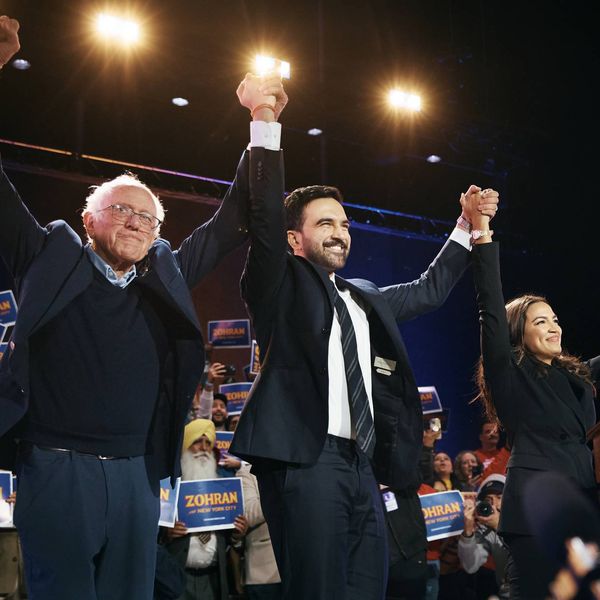
Sen. Bernie Sanders (I-Vt.) swears in Zohran Mamdani as New York City mayor as Mamdani’s wife Rama Duwaji looks on at City Hall on Thursday January 1, 2026 in New York, New York.
(Photo by Spencer Platt/Getty Images)
Common Dreams


“If there is no struggle, there is no progress.” —Frederick Douglass


America’s story has always been a story of struggle—for liberty, for justice, for recognition. On a cold January afternoon outside City Hall, Zohran Mamdani stepped into that struggle. Raising his right hand, he took the oath of office as mayor of New York City—the first Muslim ever to hold the city’s highest office—embodying Douglass’ truth: Progress demands courage, perseverance, and the relentless pursuit of inclusion.


‘Welcome to a New Era for NYC’: Zohran Mamdani Sworn In as New York City Mayor


The headlines captured the surface: a 25-minute inaugural address, roughly 4,000 spectators, a private swearing in just after midnight at the Old City Hall subway station, appearances by Rep. Alexandria Ocasio-Cortez (D-N.Y.) and Sen. Bernie Sanders (I-Vt.). But the moment ran far deeper. Mamdani’s inauguration was not only a municipal milestone; it was the latest chapter in a debate as old as the republic itself: where Muslims belong in the American story—and whether they ever truly have.

That question stretches back to July 30, 1788, when North Carolina ratified the Constitution. Anti-federalist William Lancaster warned that by rejecting religious tests for office, the new nation might allow Muslims to govern. “Papists may occupy that chair,” he cautioned, “and Mahometans may take it. I see nothing against it.” A warning, then. A prophecy, now.

When Mamdani declared, “New York belongs to all who live in it,” he answered a question first posed in fear in 1788, tested in war, dramatized by Muhammad Ali, and deferred for generations.

There were no Muslim candidates in 1788. But there were Muslims in America—thousands of enslaved Africans whose presence exposed the republic’s deepest contradiction. Between 5 and 20% of enslaved Africans were Muslim, many literate in Arabic, bearing names like Fatima, Ali, Hassan, and Said. Their faith was violently suppressed, yet fragments endured—in memory, language, and resistance.

Even the founding generation reflected this tension. Thomas Jefferson studied the Quran and treated Islam as a serious intellectual tradition, even as he owned enslaved Muslims. Islam existed in theory, in human reality, and yet was denied civic recognition.

That tension carried forward into the nation’s greatest moral reckoning: the Civil War.

Muslims fought for the Union. Mohammed Kahn enlisted in the 43rd New York Infantry. Nicholas Said—born Mohammed Ali ben Said in Nigeria, raised Muslim, later converted to Christianity—served as a sergeant in the 55th Massachusetts Colored Regiment and as a Union clerk. Captain Moses Osman held a high-ranking post in the 104th Illinois Infantry. Union rosters show names like Ali, Hassan, and Said, hinting at a wider Muslim presence than history often acknowledges.

Yet rifles were not the only weapons. Islam entered the moral imagination through words and witness. Sen. Charles Sumner, nearly beaten on the Senate floor, quoted the Quran to condemn slavery. Ayuba Suleiman Diallo—Job ben Solomon—had already unsettled transatlantic assumptions through literacy, eloquence, and dignity. His story endured into the Civil War, republished in 1864 to reinforce the war’s moral purpose. Overseas, Hussein Pasha of Tunisia urged the US to abolish slavery “in the name of humanity,” showing Muslim advocacy was part of a global ethical conversation.

Muslims remained largely invisible in America’s public self-understanding—until the 20th century produced a figure too large to ignore.

Muhammad Ali, still the most recognizable man on Earth decades after his gold medal at the 1960 Rome Olympics, transformed boxing and American consciousness alike. He was named “Athlete of the Century” by Sports Illustrated, GQ, and the BBC; “Kentuckian of the Century” by his home state; and became a global icon through speed, grace, and audacious charm.

Ali’s significance extended far beyond the ring. By insisting on the name Muhammad Ali instead of Cassius Clay, he forced America to confront the legacy of slavery embedded in naming itself. His embrace of Islam was unapologetic and public. His refusal to be drafted into the Vietnam War cost him his title and livelihood, yet anticipated the anti-war movement. His fights in Kinshasa, Manila, and Kuala Lumpur shifted attention from superpower dominance toward global conscience.

Ali’s humanitarian work was relentless: delivering over 232 million meals, medical supplies to children in Jakarta, orphans in Liberia, street children in Morocco. At home, he visited soup kitchens, hospitals, advocated for children’s protections, and taught tolerance in schools through his book Healing. For this, he was honored as a United Nations Messenger of Peace, cited by Amnesty International, and recognized by President Jimmy Carter as “Mr. International Friendship.”

Ali showed the nation something fundamental: that Islam is American. That Muslims have always belonged to the moral and civic fabric of this country. That a nation built on life, liberty, and the pursuit of happiness, on religious tolerance, on care for the poor, is naturally aligned with Islam. Mamdani is American not in spite of his faith, but because Islam is American.

It is against this long arc—from slavery to abolition, civil rights, global conscience, and the moral courage of Muhammad Ali—that Zohran Mamdani’s inauguration comes into focus.

Mamdani’s life traces modern routes of migration and belonging. Born in Kampala, Uganda to parents with roots in South Asia, he was raised in New York City. Yet his rise fulfills an older constitutional promise. In his inaugural address, he thanked his parents—“Mama and Baba”—acknowledged family “from Kampala to Delhi,” and recalled taking his oath of American citizenship on Pearl Street.

When Mamdani declared, “New York belongs to all who live in it,” he answered a question first posed in fear in 1788, tested in war, dramatized by Muhammad Ali, and deferred for generations. He named mosques alongside churches, synagogues, temples, gurdwaras, and mandirs, making visible what history had long rendered partial. When he spoke of halal cart vendors, Palestinian New Yorkers, Black homeowners, and immigrant families bound together by labor and hope, he articulated a civic vision rooted in lived American reality.

Notably, Mamdani did not frame his Muslim identity as something to defend. It simply existed. “Where else,” he asked, “could a Muslim kid like me grow up eating bagels and lox every Sunday?” Hybridity was not an exception. It was inheritance.

Yet it is equally important to recognize that Mamdani’s historic victory does not make him infallible, nor should it. The fact that he is the first Muslim mayor of New York City is not a personal achievement alone—it reflects the barriers that Muslims, like many others, have historically faced in participating fully in American democracy. Discrimination, racial and religious bias, and systemic obstacles made this moment possible only now, not because of any failing on his part. He will, like all mayors before him, make mistakes. He will face limits, criticism, and flaws—because he is human. To hold him to an impossible standard would be to misunderstand both history and democracy.

There is, too, something unmistakably American about Mamdani’s politics. By invoking La Guardia, Dinkins, and de Blasio; by embracing democratic socialism without apology; by grounding his agenda in labor, affordability, and collective responsibility, he situates himself firmly in an American tradition—one that echoes the abolitionists, the New Deal, and the moral courage of Ali.

And as Malcolm X reminds us, this is the guiding principle for American civic life: “I believe in the brotherhood of man, all men, but I don’t believe in forcing anyone to accept it.”

This is what makes the moment historic. Not that a Muslim has finally entered American politics, but that an old constitutional anxiety—once voiced as a warning—has become an ordinary fact of civic life. Islam, Mamdani, and the ideals of this nation converge in a single, undeniable truth: America is not a Christian nation, nor a nation for whites, nor a nation for the rich alone. It is a nation built on principles shared by all who live in it, and Islam has always been part of that inheritance.

The work, as Mamdani said, has only just begun. But the story his inauguration tells—that Muslims were enslaved at the nation’s birth, debated at its founding, fought in its wars, shaped its abolitionist conscience, transformed its civil rights culture, and now govern its greatest city—is no longer hypothetical.

It stands, unmistakably, on the steps of City Hall.

‘We Will Govern Expansively and Audaciously’: Zohran Mamdani’s Inaugural Address

To those who insist that the era of big government is over, hear me when I say this—no longer will City Hall hesitate to use its power to improve New Yorkers’ lives.


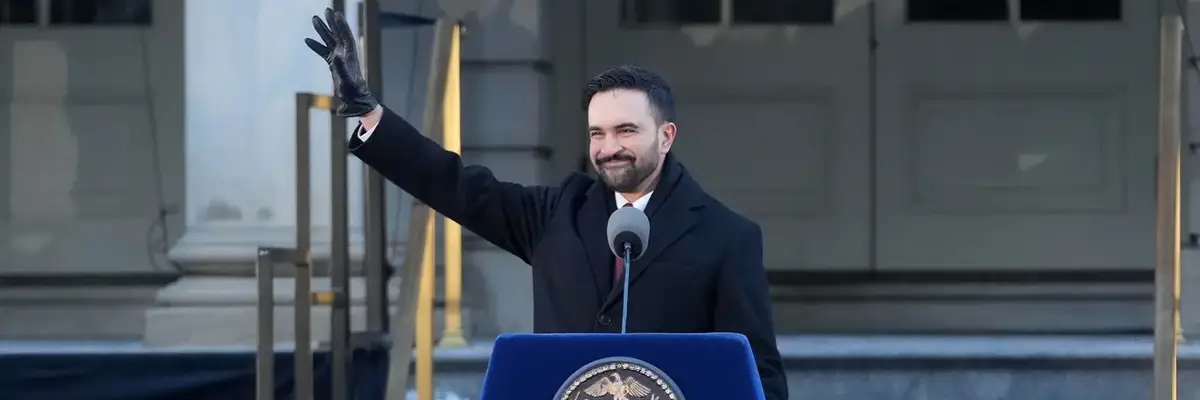
Zohran Mamdani addresses New Yorkers as he is inaugurated on January 1, 2026.
(Photo via NYC.gov)

Zohran Mamdani
Jan 02, 2026
Common Dreams


New York City Mayor Zohran Mamdani prepared these remarks to deliver at his inauguration on January 1, 2026.


My fellow New Yorkers—today begins a new era.


I stand before you moved by the privilege of taking this sacred oath, humbled by the faith that you have placed in me, and honored to serve as either your 111th or 112th Mayor of New York City. But I do not stand alone.

I stand alongside you, the tens of thousands gathered here in Lower Manhattan, warmed against the January chill by the resurgent flame of hope.

Seldom do we hold such an opportunity to transform and reinvent. Rarer still is it the people themselves whose hands are the ones upon the levers of change.

I stand alongside countless more New Yorkers watching from cramped kitchens in Flushing and barbershops in East New York, from cell phones propped against the dashboards of parked taxi cabs at LaGuardia, from hospitals in Mott Haven and libraries in El Barrio that have too long known only neglect.

I stand alongside construction workers in steel-toed boots and halal cart vendors whose knees ache from working all day.

I stand alongside neighbors who carry a plate of food to the elderly couple down the hall, those in a rush who still lift strangers’ strollers up subway stairs, and every person who makes the choice day after day, even when it feels impossible, to call our city home.

I stand alongside over 1 million New Yorkers who voted for this day nearly two months ago—and I stand just as resolutely alongside those who did not. I know there are some who view this administration with distrust or disdain, or who see politics as permanently broken. And while only action can change minds, I promise you this: If you are a New Yorker, I am your Mayor. Regardless of whether we agree, I will protect you, celebrate with you, mourn alongside you, and never, not for a second, hide from you.

I thank the labor and movement leaders here today, the activists and elected officials who will return to fighting for New Yorkers the second this ceremony concludes, and the performers who have gifted us with their talent.

Thank you to Governor Hochul for joining us. And thank you to Mayor Adams—Dorothy’s son, a son of Brownsville who rose from washing dishes to the highest position in our city—for being here as well. He and I have had our share of disagreements, but I will always be touched that he chose me as the mayoral candidate that he would most want to be trapped with on an elevator.

Thank you to the two titans who, as an Assemblymember, I’ve had the privilege of being represented by in Congress—Nydia Velázquez and our incredible opening speaker Alexandria Ocasio-Cortez. You have paved the way for this moment.

Thank you to the man whose leadership I seek most to emulate, who I am so grateful to be sworn in by today—Senator Bernie Sanders.

Thank you to my teams—from the Assembly, to the campaign, to the transition and now, the team I am so excited to lead from City Hall.

In so doing, we will provide our own answer to that age-old question—who does New York belong to? Well, my friends, we can look to Madiba and the South African Freedom Charter: New York “belongs to all who live in it.”

Thank you to my parents, Mama and Baba, for raising me, for teaching me how to be in this world, and for having brought me to this city. Thank you to my family—from Kampala to Delhi. And thank you to my wife Rama for being my best friend, and for always showing me the beauty in everyday things.

Most of all—thank you to the people of New York.

A moment like this comes rarely. Seldom do we hold such an opportunity to transform and reinvent. Rarer still is it the people themselves whose hands are the ones upon the levers of change.

And yet we know that too often in our past, moments of great possibility have been promptly surrendered to small imagination and smaller ambition. What was promised was never pursued, what could have changed remained the same. For the New Yorkers most eager to see our city remade, the weight has only grown heavier, the wait has only grown longer.

In writing this address, I have been told that this is the occasion to reset expectations, that I should use this opportunity to encourage the people of New York to ask for little and expect even less. I will do no such thing. The only expectation I seek to reset is that of small expectations.

Beginning today, we will govern expansively and audaciously. We may not always succeed. But never will we be accused of lacking the courage to try.

To those who insist that the era of big government is over, hear me when I say this—no longer will City Hall hesitate to use its power to improve New Yorkers’ lives.

For too long, we have turned to the private sector for greatness, while accepting mediocrity from those who serve the public. I cannot blame anyone who has come to question the role of government, whose faith in democracy has been eroded by decades of apathy. We will restore that trust by walking a different path—one where government is no longer solely the final recourse for those struggling, one where excellence is no longer the exception.

We expect greatness from the cooks wielding a thousand spices, from those who stride out onto Broadway stages, from our starting point guard at Madison Square Garden. Let us demand the same from those who work in government. In a city where the mere names of our streets are associated with the innovation of the industries that call them home, we will make the words “City Hall” synonymous with both resolve and results.

As we embark upon this work, let us advance a new answer to the question asked of every generation: Who does New York belong to?

For much of our history, the response from City Hall has been simple: It belongs only to the wealthy and well-connected, those who never strain to capture the attention of those in power.

Here, where the language of the New Deal was born, we will return the vast resources of this city to the workers who call it home.

Working people have reckoned with the consequences. Crowded classrooms and public housing developments where the elevators sit out of order; roads littered with potholes and buses that arrive half an hour late, if at all; wages that do not rise and corporations that rip off consumers and employees alike.

And still—there have been brief, fleeting moments where the equation changed.

Twelve years ago, Bill de Blasio stood where I stand now as he promised to “put an end to economic and social inequalities” that divided our city into two.

In 1990, David Dinkins swore the same oath I swore today, vowing to celebrate the “gorgeous mosaic” that is New York, where every one of us is deserving of a decent life.

And nearly six decades before him, Fiorella La Guardia took office with the goal of building a city that was “far greater and more beautiful” for the hungry and the poor.

Some of these Mayors achieved more success than others. But they were unified by a shared belief that New York could belong to more than just a privileged few. It could belong to those who operate our subways and rake our parks, those who feed us biryani and beef patties, picanha and pastrami on rye. And they knew that this belief could be made true if only government dared to work hardest for those who work hardest.

Over the years to come, my administration will resurrect that legacy. City Hall will deliver an agenda of safety, affordability, and abundance—where government looks and lives like the people it represents, never flinches in the fight against corporate greed, and refuses to cower before challenges that others have deemed too complicated.

In so doing, we will provide our own answer to that age-old question—who does New York belong to? Well, my friends, we can look to Madiba and the South African Freedom Charter: New York “belongs to all who live in it.”

Together, we will tell a new story of our city.

This will not be a tale of one city, governed only by the 1%. Nor will it be a tale of two cities, the rich versus the poor.

It will be a tale of 8 and a half million cities, each of them a New Yorker with hopes and fears, each a universe, each of them woven together.

The authors of this story will speak Pashto and Mandarin, Yiddish and Creole. They will pray in mosques, at shul, at church, at Gurdwaras and Mandirs and temples—and many will not pray at all.

They will be Russian Jewish immigrants in Brighton Beach, Italians in Rossville, and Irish families in Woodhaven—many of whom came here with nothing but a dream of a better life, a dream which has withered away. They will be young people in cramped Marble Hill apartments where the walls shake when the subway passes. They will be Black homeowners in St. Albans whose homes represent a physical testament to triumph over decades of lesser-paid labor and redlining. They will be Palestinian New Yorkers in Bay Ridge, who will no longer have to contend with a politics that speaks of universalism and then makes them the exception.

From today onwards, we will understand victory very simply: something with the power to transform lives, and something that demands effort from each of us, every single day.

Few of these 8 and a half million will fit into neat and easy boxes. Some will be voters from Hillside Avenue or Fordham Road who supported President Trump a year before they voted for me, tired of being failed by their party’s establishment. The majority will not use the language that we often expect from those who wield influence. I welcome the change. For too long, those fluent in the good grammar of civility have deployed decorum to mask agendas of cruelty.

Many of these people have been betrayed by the established order. But in our administration, their needs will be met. Their hopes and dreams and interests will be reflected transparently in government. They will shape our future.

And if for too long these communities have existed as distinct from one another, we will draw this city closer together. We will replace the frigidity of rugged individualism with the warmth of collectivism. If our campaign demonstrated that the people of New York yearn for solidarity, then let this government foster it. Because no matter what you eat, what language you speak, how you pray, or where you come from—the words that most define us are the two we all share: New Yorkers.

And it will be New Yorkers who reform a long-broken property tax system. New Yorkers who will create a new Department of Community Safety that will tackle the mental health crisis and let the police focus on the job they signed up to do. New Yorkers who will take on the bad landlords who mistreat their tenants and free small business owners from the shackles of bloated bureaucracy. And I am proud to be one of those New Yorkers.

When we won the primary last June, there were many who said that these aspirations and those who held them had come out of nowhere. Yet one man’s nowhere is another man’s somewhere. This movement came out of 8 and a half million somewheres—taxi cab depots and Amazon warehouses, DSA meetings and curbside domino games. The powers that be had looked away from these places for quite some time—if they’d known about them at all—so they dismissed them as nowhere. But in our city, where every corner of these five boroughs holds power, there is no nowhere and there is no no one. There is only New York, and there are only New Yorkers.

8 and a half million New Yorkers will speak this new era into existence. It will be loud. It will be different. It will feel like the New York we love.

No matter how long you have called this city home, that love has shaped your life. I know that it has shaped mine.

This is the city where I set landspeed records on my razor scooter at the age of 12. Quickest four blocks of my life.

The city where I ate powdered donuts at halftime during AYSO soccer games and realized I probably wouldn’t be going pro, devoured too-big slices at Koronet Pizza, played cricket with my friends at Ferry Point Park, and took the 1 train to the BX10 only to still show up late to Bronx Science.

The city where I have gone on hunger strike just outside these gates, sat claustrophobic on a stalled N train just after Atlantic Avenue, and waited in quiet terror for my father to emerge from 26 Federal Plaza.

The city where I took a beautiful woman named Rama to McCarren Park on our first date and swore a different oath to become an American citizen on Pearl Street.

So, standing together with the wind of purpose at our backs, we will do something that New Yorkers do better than anyone else: We will set an example for the world.

To live in New York, to love New York, is to know that we are the stewards of something without equal in our world. Where else can you hear the sound of the steelpan, savor the smell of sancocho, and pay $9 for coffee on the same block? Where else could a Muslim kid like me grow up eating bagels and lox every Sunday?

That love will be our guide as we pursue our agenda. Here, where the language of the New Deal was born, we will return the vast resources of this city to the workers who call it home. Not only will we make it possible for every New Yorker to afford a life they love once again—we will overcome the isolation that too many feel, and connect the people of this city to one another.

The cost of childcare will no longer discourage young adults from starting a family—because we will deliver universal childcare for the many by taxing the wealthiest few.

Those in rent-stabilized homes will no longer dread the latest rent hike—because we will freeze the rent.

Getting on a bus without worrying about a fare hike or whether you’ll be late to your destination will no longer be deemed a small miracle—because we will make buses fast and free.

These policies are not simply about the costs we make free, but the lives we fill with freedom. For too long in our city, freedom has belonged only to those who can afford to buy it. Our City Hall will change that.

These promises carried our movement to City Hall, and they will carry us from the rallying cries of a campaign to the realities of a new era in politics.

Two Sundays ago, as snow softly fell, I spent 12 hours at the Museum of the Moving Image in Astoria, listening to New Yorkers from every borough as they told me about the city that is theirs.

We discussed construction hours on the Van Wyck Expressway and EBT eligibility, affordable housing for artists and ICE raids. I spoke to a man named TJ who said that one day a few years ago, his heart broke as he realized he would never get ahead here, no matter how hard he worked. I spoke to a Pakistani Auntie named Samina, who told me that this movement had fostered something too rare: softness in people’s hearts. As she said in Urdu: logon ke dil badalgyehe.

142 New Yorkers out of 8 and a half million. And yet—if anything united each person sitting across from me, it was the shared recognition that this moment demands a new politics, and a new approach to power.

We will deliver nothing less as we work each day to make this city belong to more of its people than it did the day before.

Here is what I want you to expect from the administration that this morning moved into the building behind me.

We will transform the culture of City Hall from one of “no” to one of “how?”

We will answer to all New Yorkers, not to any billionaire or oligarch who thinks they can buy our democracy.

We will govern without shame and insecurity, making no apology for what we believe. I was elected as a democratic socialist and I will govern as a democratic socialist. I will not abandon my principles for fear of being deemed radical. As the great senator from Vermont once said: “What’s radical is a system which gives so much to so few and denies so many people the basic necessities of life.”

We will strive each day to ensure that no New Yorker is priced out of any one of those basic necessities.

And throughout it all we will, in the words of Jason Terrance Phillips, better known as Jadakiss or J to the Muah, be “outside”—because this is a government of New York, by New York, and for New York.

Before I end, I want to ask you, if you are able, whether you are here today or anywhere watching, to stand.

I ask you to stand with us now, and every day that follows. City Hall will not be able to deliver on our own. And while we will encourage New Yorkers to demand more from those with the great privilege of serving them, we will encourage you to demand more of yourselves as well.

The movement we began over a year ago did not end with our victory on Election Night. It will not end this afternoon. It lives on with every battle we will fight, together; every blizzard and flood we withstand, together; every moment of fiscal challenge we overcome with ambition, not austerity, together; every way we pursue change in working peoples’ interests, rather than at their expense, together.

No longer will we treat victory as an invitation to turn off the news. From today onwards, we will understand victory very simply: something with the power to transform lives, and something that demands effort from each of us, every single day.

What we achieve together will reach across the five boroughs and it will resonate far beyond. There are many who will be watching. They want to know if the left can govern. They want to know if the struggles that afflict them can be solved. They want to know if it is right to hope again.

So, standing together with the wind of purpose at our backs, we will do something that New Yorkers do better than anyone else: We will set an example for the world. If what Sinatra said is true, let us prove that anyone can make it in New York—and anywhere else too. Let us prove that when a city belongs to the people, there is no need too small to be met, no person too sick to be made healthy, no one too alone to feel like New York is their home.

The work continues, the work endures, the work, my friends, has only just begun.


Tuesday, May 10, 2022


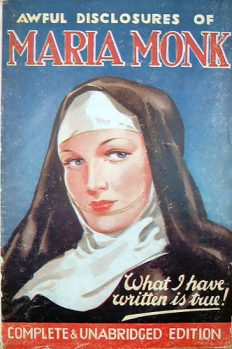
In 1836, Maria Monk exposed an alleged account of sexual abuse of Catholic nuns and the killing on infants by the clergy in Montreal, Canada. 

However, the book was dismissed by scholars as an anti-Catholic hoax.

Maria Monk - Wikipedia

https://en.wikipedia.org/wiki/Maria_Monk
Maria Monk (June 27, 1816 – summer of 1849) was a Canadian woman whose book Awful Disclosures of Maria Monk, or, The Hidden Secrets of a Nun’s Life in a Convent Exposed (1836) claimed to expose systematic sexual abuse of nuns and infanticide of the resulting children

Awful Disclosures of Maria Monk (1836)

Awful disclosures of Maria Monk, as exhibited in a narrative of her sufferings during a residence of five years as a novice, and two years as a black nun, in the Hôtel Dieu nunnery at Montreal. By Maria Monk; in London.

In the prevailing anti-Catholic atmosphere of early-nineteenth-century America, and fresh after the Ursuline Convent riots of August 1834 in Massachusetts (in which a convent of the Roman Catholic Ursuline nuns burned down by the hands of a Protestant mob), the publication of Maria Monk's revelations of her time at the Hôtel-Dieu convent in Montreal became a sensation. With nuns forced to engage in sexual acts with priests and being locked in the cellar as a punishment for disobeying, the story had similarities to the popular Gothic novels of the eighteenth and early nineteenth centuries. Maria also tells of how any babies that were born as a result of these liaisons were immediately baptized, strangled, and buried under the convent. It was from this fate that she wanted to save her unborn child which led her to escape and consequently publish her exposé.

Although the preface claims the events and persons described to be real, after the initial sensation died down some began to question the veracity of Maria's tale. American journalist William L. Stone traveled to Montreal and visited the convent, later writing that the descriptions found in Maria's book bore no resemblance to the actual building. Tales of Maria's past seem to suggest that she had been confined by her mother in a house for fallen women from which she was expelled in 1835 due to her pregnancy. In October of the same year, a New York newspaper announced Maria's forthcoming book which was then published in January 1836. It is believed that the book was not written by Maria herself but either written down or indeed fabricated by one or more of the various clergymen that surrounded her during this time of publicity, such as Reverend William K. Hoyt and Reverend John Jay Slocum, in an attempt to make money through the sensational narrative. When or how she had come to meet these men and how much influence they had over her is unknown, as is the truth of the narrative found in her book or indeed anywhere else regarding Maria's life or character.

For a great list of various editions of the book and related material - including Maria's "sequel" and an affidavit from Maria's mother) - see this great page from the University of Penn Library.

TRICK OR TREAT? THE AWFUL DISCLOSURES OF MARIA MONK (1836)


by Tasha Jones | Oct 16, 2018 | Articles, Books, Montreal 

|

“Mr Bloom turned over idly pages of The Awful Disclosures of Maria Monk, then of Aristotle’s Masterpiece. Crooked botched print. Plates: infants cuddled in a ball in bloodred wombs like livers of slaughtered cows. Lots of them like that at this moment all over the world. All butting with their skulls to get out of it. Child born every minute somewhere. Mrs Purefoy.” (Ulysses)

When it was first published in 1836, The Awful Disclosures of Maria Monk caused a literary and religious storm in Montreal, and abroad. Why? Because the book was purported to be a real account of a young woman’s trials as an ‘inmate’ of Montreal’s Hôtel Dieu nunnery.

In the book, Maria claims that she and the other nuns (‘black nuns’ as she calls them) were systematically raped by the Catholic priests who lived next door to the nunnery. Any child born of these rapes was immediately baptized, strangled, and then buried in the cellar of the nunnery and covered with lime.

Maria also confesses to participating in the murder of a young nun who refused to kill a newborn baby. As a punishment for her disobedience, the nun was forced to lie down, and a mattress was placed on top of her. Priests and the ‘black nuns’ jumped on the mattress until the young nun was crushed to death, and her body was buried in the cellar.

But is the story real, or a publishing hoax?

And who was Maria Monk?

According to her Wikipedia entry, Maria Monk was a Canadian woman born on June 27, 1816. It’s possible that Maria suffered a head injury as a child, and she may have spent some time living in an asylum. A fellow patient in the asylum, with whom Maria may have been friends with, was supposedly a nun. Did Maria receive her ‘source material’ from her?

It’s also claimed in the entry that Maria spent seven years living in a Magdalene asylum. Did she use that experience as a reference for her text? Or was she used by her publisher who hired a ghost writer to pen the book?

Maybe Maria is the book’s author and she was an ‘inmate’ of the nunnery?

As it turns out, Maria’s story was debunked and the book is now considered a hoax. Perhaps this is one of the earlier examples of fake news?

Of course, I read the book because of its appearance in Ulysses. Leopold Bloom gets it for his wife Molly, but she wasn’t too impressed with it, unable to even remember the title:

“should we tell them even if its the truth they dont believe you then tucked up in bed like those babies in the Aristocrats Masterpiece he bought me another time as if we hadnt enough of that in real life without some old Aristocrat or whatever his name is disgusting you more with those rotten pictures children with two heads and no legs thats the kind of villainy theyre always dreaming about” (Ulysses)

The Awful Disclosures is not a page-turner by modern standards, but it has its charms. Although it’s hardly salacious, and lacks any detail about the sex crimes, it was still interesting to read about the tediousness of life in a nunnery. Go figure. The most shocking thing to me was that anyone would willingly sign up for a life of unremitting drudgery, constant supervision, and endless prayer and fastidiousness to religious patriarchy.

Upon taking the veil, Maria dies a symbolic death by lying down in a coffin, and from that moment on she has vowed complete obedience to the nunnery, and the male-dominated Catholic church.

Her reward? To be gang raped later that night by three priests. This, with the approval of the Mother Superior.

If you’re interested in browsing through the book yourself, it is available for free at Project Gutenberg, and despite its faults, the content is still relevant and spooky, especially during this time of year.


MARIA MONK.

Boston Pilot (1836-1837), Volume 2, Number 33, 13 August 1836 IIIF Collection Link

We would direct the attention of our readers to the following extracts from those liberal, talented, and spirited papers, the New York Transcript and New Hampshire Patriot, in reference to the gross and groundless falsehoods parroted forth, from the instructions of her clerical keepers , by that modern Messalina, Maria Monk. The testimony of several respectable Protestant Clergymen, who have lately visited the Convent at Montreal, and who are about publishing the results of their observations and enquiries, will certainly fasten disgrace and dishonour on the clerical fanatics who enjoyed the criminal and libidenous favours of that infamous creature. p. Maria Monk’s Awful Disclosures. We perceive by the Montreal papers, that the inspection of the Hotel Dieu Nunnery in that city, proves that the Disclosures are a tissue of falsehoods, as far as regards the localities of that religious house, and that it is quite certain that this woman could never have been an inmate of it. It is disclosed, moreover, that she had resided at one time in a sort of Magdalen Asylum in Montreal, for penitent prostitutes, and that the names of the pretended nuns introduced by her into her work, were actually those of certain of the frail sisterhood who were in the asylum at the very period she inhabited it. The “ Refutation” will appear forthwith, and when it sees the light, we will give an analysis of it to our readers. Since writing the above we have been favoured with an inspection of the manuscript copy of the “Refutation,” and the pieces justifcatives appended thereto in the form of a mass of affidavits, the most important of which are those of the gentlemen who visited the interior of the Hotel Dieu nunnery, to compare it with the description given by Maria Monk. Among those were the Rev. Mr. Curry, Corresponding Secretary of the Home Missionary Society ; the Rev. G. W. Perkins, Pastor of the American Presbyterian Church; the Rev. Henry Esson, Pastor of the Scotch Presbyterian Church; Benjamin Holmes, Esq., Cashier of the Montreal Bank, Justice of the Peace ; John Ostell, Esq., Architect and Surveyor; and John Jones, Esq., Editor of the Ami du Peuple Newspaper. — All these gentlemen declare that there is not the slightest resemblance between Maria Monk’s description, and the buildings and vaults; and that had any alteration been made since the publication of the book, it would have been necessary to alter it from summit to foundation. Nothing can be more complete than the sworn evidence of these gentlemen, who are among the most respectable in the British Provinces. There are also affidavits of James Ray, so frequently mentioned in the “Disclosures;” Maria

Howard, Miss Reed, and Jane McCoy, who were repentant prostitutes in the Magdalen Asylum at the time Maria Monk was there; andjalso of various persons with whom Maria Monk" lived during the period she states that she was an inmate of the nunnery. The work will be ready in a fortnight, and will be issued by, one of our respectable publishers. We, therefore, consider this most impudent humbug as being most satisfactorily exposed. A little time was necessary for this conclusion ; anti that time has been so employed as toj bring’ conviction to the minds 'of the most bigoted and credulous. [N. Y. Transcript. Maria Monk’s “Awful Disclosurf.s.’’ A further examination of the affidavits about this woman’s impostures, discovers the fact, that the account she gives of the interior of the nunnery act.oids with the localities of the female penitentiary in Montreal, superintended by Mrs. McDonnell ; ‘that the conventual discipline she relates, is in some degree copied from that which prevails in that institution ; and that Louis Malo a constable of the Court of King’s Bench, is the real father of her child. Is it not an extraordinary instance of the credulity of the public mind, that upwards of 25,000 copies of such ridiculous trash as Mr. Theodore Dwight’s rifacimento of a strumpet’s lies, should have been sold, and that a feeling of indignation and abhorrence should have been so excited against a religious society so excellent, exemplary, and universally respected as the Sceurs de Charite of the Hotel Diet] hospital foi the sick and infirm ? [N. Y. Transcript. From the New Hampshire Patriot. Maria Monk:—again. As the editors of the different religious papers in this State (we regret to say without a solitary exception to our knowledge,) have avowed their belief in the monstrous and abominable legend published to the world as the narrative of this abandoned woman, but, in reality invented by an artful and designing cabal at New York, and written by Mr. Theodore Dwight, the public cannot fail to be interested in whatever is calculated to establish or impeach the veracity of the “Awful Disclosures,” since it will equally serve to strengthen or diminish their confidence in the candour, Christian charity, sound judgment, and unerring discretion of the religious'press. They will accordingly be pleased to learn that measures have been instituted by the ecclesiastical authorities of the Roman church, such as are calculated to satisfy all of the truth or falsity of the pretended revelations of horrors and abominations. The Bishop of Montreal has named a committee to examine and report upon the alleged disorders of the Hotel Dieu Nunnery, the pretended scene of Maria’s imprisonment and suffering; with whom a Protestant clergyman is joined in order to remove the slightest opportunity for questioning the fairness and impartiality of the investigation. In announcing this arrangement, the N. Y. Transcript enumerates the following reasons why its editor—by the way, one of the most talented, best informed, and most unprejudiced in that city—entertains no doubt of the issue: “ In the first place, to every unprejudiced and reasoning mind, the book itself was its completest refutation, and the character of the authoress, as given by herself, was sufficient to destroy her reputation for truth. VVe happen to be well acquainted with the localities, and with most of the gentlemen whose names were introduced ; and from what we know of them, from the position of some, and the peculiar circumstances of others, we were morally sure, that the affair was a fabrication. In the next place, we had many conversations with respectable Protestants from Montreal, who expressed their utter disbelief of the entire story, and who informed us of sundry events in the life of the authoress, quite sufficient to shake the belief of the most enthusiastic in the horrors of her tale ; the ignorance of the female whose recital was embodied by another, was also a suspicious circumstance, as the art of book making is now pretty well understood, and this publication was immediately followed by another of a more revolting character still, from the pious press of Leavitt, Lord & Cos.; and lastly, from the fact that she was disavowed by her mother and brother, who declared the whole story a fiction, and the relator a disgrace and a misfortune to them. When she came out with her charges against the Catholic clergy of Canada, she must have made up her mind, that her own character would be scrutinized, and ‘ her pedigree looked into for on the good character of a witness depends his or her credibility. This test has not redounded at all to the advantage of the good fame of the person on whose credibility depends the stability of the ingenious legend named ‘Awful Disclosures,’ which title might more appropriately be affixed to the developments recently made in Montreal respecting her. It appears to have been ascertained that a constable of the Court of King’s Bench there, (whose name we have) has discovered that she was at one time an inmate of a licentious house in the suburbs, and that on one occasion she figured at the criminal bar for pilfering. The Catholics. The last Monitor contains an excellent article on the course which certain religious bigots are pursuing towards the Catholics in this country. The spirit and sentiments it contains are such as will commend it to every liberal, enlightened Christian and patriot, and should put to the blush the bigotry and knavery which stoops to the grossest falsehoods, knowingly and wilfully, in order to prostrate a sect who manifest in their lives as many of the Christian virtues, and as much perfection, as any other in the land. We shall transcribe the article to our columns. [New Hampshire Patriot. Patriotism. The Presbyterians and their associates from some of the other churches, sent no invitation—or, in other words, would not permit the children of Unitarians and others, to walk in the Sunday School procession, at Louisville, on the fourth of July. We have not heard, for some time, of a meaner exhibition of sectarian animosity. On the national anniversary of our liberty, when every heart should be grateful—when the sight of our country’s flag, associated as it is with such proud recollections, should have gladdened the bosom of every patriot in the land to see a line of distinction drawn upon that day, between the children of our citizens, was indeed a pitiful proceeding. What a bright example was this for the rising offspring of our country, what an effectual method to fill their hearts with love for one another, from which, when grown into manhood, they would not depart! Had Catholics been guilty of such conduct, what a cry would be raised throughout the land—what appeals to patriotism, what love of country would be professed, what a horror for the Pope, Prince Metternich, and the emperor of Austria! Whenever Catholics have been proved guilty of such conduct as this, then, indeed, let( them be denounced ns traitors. [Catholic Telegraph.]

 ITDR. JOHN S. BARTLETT, No. II Atkinson Street.


“Awful Disclosures”
— But No Longer Unbelievable
Maria Monk Reconsidered


In the light of modern revelations and nunsploitation movies, 19th Century tales of immorality and crimes in Roman Catholic convents appear far less fantastic.

IN 1836, a controversial book exploded upon the scene like an artillery shell, written by a woman who had supposedly fled the revered Hotel Dieu nunnery in Montreal, Canada. It bore the title, Awful Disclosures of Maria Monk, or, The Hidden Secrets of a Nun’s Life in a Convent Exposed! The book immediately touched off an acrimonious firestorm of wild polemics with its sensational allegations. And no wonder — for the author, “Maria Monk”, claimed that in the many years that she had been enclosed there in the cloister of the “Black Nuns,” as the sable-clad Sisters of Charity were called, she had witnessed or been subjected to a number of horrific crimes and abuses.


The nun’s tale


Priests, Monk claimed, under the pretext that such godly men could not sin, regularly used nuns for sex in a private room reserved for “holy retreats.” On the very day she took her solemn vows, she said that she herself had been forced to have intercourse with three priests, and once again with the first for good measure. More on that later.

Monk said she had personally witnessed an offspring from such a union being immediately baptized after birth, nonchalantly suffocated, and tossed into a pit of lime in the basement (where there were presumably others), with acid later added to dissolve the tiny corpse. A ledger she found in the Superior’s office listed many more.

At the mere whim of a superior, disobedient or recalcitrant nuns were severely disciplined with punishments that ranged from petty annoyances up to Inquisition-like torture. In dark cells in the cellar near the pit, several sisters were imprisoned for unknown sins apparently for life. Nuns would disappear in the night for no known reason never to be spoken of again; Monk firmly believed some had been murdered. Suicides were also not unrumored.

All of this took place in a forbidding atmosphere of medieval despotism, where the only thing expected of a nun was silent, unquestioning obedience. Superstition ruled supreme — hair and nail clippings of an elderly nun thought to be holy were prized as relics, for instance. Bizarre penances, such as drinking the Superior’s foot-bath, were often imposed and strange rituals were frequent. Nuns, for example, would be placed in their coffins upon taking their vows to show they had died to the world, and then propped sitting up in church after they died to show they now lived in Heaven.

Meanwhile in this hell on Earth, the sisters were expected to constantly spy on each other and inform the Mother Superior of any defects, disobedience, or independence in themselves or others. Yet lying to outsiders was encouraged insofar as it would further the faith — especially if it brought in wealthy new recruits.

The aftermath


According to her own account, having become pregnant, she escaped, and told her story to a Protestant minister at a hospital for the poor in New York. He persuaded her to tell her story to the world.

At any time, such outrageous charges would have sparked an outcry; in the jostling pandemonium of pre-Civil War America, they touched off an immediate conflagration of bombastic claims and counter-claims. For this was the era of the “Know Nothings,” stridently anti-immigrant and anti-Catholic nativists. Even before the Potato Famine brought starving hordes of Irish over, these men feared the influx of Roman Catholics as a sneaky invasion of papists determined to subvert the liberties of free, white Protestants and take over the country. Catholic apologists instantly saw that Monk was a tool being used by Protestant nativist agitators and fought back vigorously in kind.

It was quickly realized that proof of Monk’s story hinged on the existance of certain secret entrances and passages built into the nunnery. She had described these in detail, showing how a priest could gain entrance to the cloister unobserved at any time, day or night, with secret signals so he did not have to mention his name or even speak a word. Like the much later controversy surrounding the McMartin Preschool, a Col. William Leete Stone found no signs of such secret passages in the Hotel Dieu during a brief inspection and after interviewing her, was convinced she had never even been there. This finding, along with the story that she was a actually a prostitute, had been in an asylum, and died in prison as a pickpocket, was loudly trumpeted throughout the press, and Catholic propagandists triumphantly labelled her an imposter and hoaxer to this day.

But was she? She was not the only former nun to break silence at that time; shortly before Monk, a woman named Rebecca Reed came out with similarly horrid tales that led a mob to burn her former convent in South Carolina. Famous ex-priest Charles Chiniquy, himself a French Canadian, spoke out about many clerical abuses in Montreal several decades later. Maria Monk herself countered the claims of Stone in the back of her book with statements of nearby residents attesting to unexplained building supplies for interior alterations at the Hotel Dieu that happened shortly after she first spoke out in the newspapers.

In the Preface she implored,

Permit me to go through the Hotel Dieu Nunnery at Montreal, with some impartial ladies and gentlemen, that they may compare my account with the interior parts of the building, into which no persons but the Roman Bishop and Priests are ever admitted: and if they do not find my description true, then discard me as an imposter. Bring me before a court of justice — there I am willing to meet [her detractors] and their wicked companions, with the Superior, and any of the nuns, and a thousand men.

This, needless to say, never happened and Maria Monk is nowadays remembered only with derision. Despite the fame, or rather notoriety, her life ended tragically. She lost credibility by running off again, falsely claiming she had been abducted by a gang of priests. She may have been married briefly, but in any case had another child, was arrested for pickpocketing, and died in poverty in an almshouse in 1839 (although some sources say 1849).

Her testimony


But for someone out to boldly defame the Catholic Church, she went about it in an odd manner. The tone of the book is anything but lurid or sensationalistic; she knew the gravity of what she was claiming, and related her story quite calmly and rationally throughout. It is certainly not titillating. While using florid Victorian language about her feelings concerning the “debased characters” of the priests who had access to the convent and its inhabitants, Monk showed great circumspection in discussing the actual abuse.

This, for instance, is all she had to say about what happened after she took her vows:

Nothing important occurred till late in the afternoon, when, as I was sitting in the community-room, Father Dufresne called me out, saying, he wished to speak to me. I feared what was his intention; but I dared not disobey. In a private apartment, he treated me in a brutal manner; and, from two other priests, I afterwards received similar usage that evening. Father Dufresne afterwards appeared again; and I was compelled to remain in company with him until morning. [Emphasis added.]

I am assured that the conduct of priests in our Convent had never been exposed, and it is not imagined by the people of the United States. This induces me to say what I do, notwithstanding the strong reasons I have to let it remain unknown. Still I cannot force myself to speak on such subjects except in the most brief manner.

And indeed, she was true to her word. Far more space in her book was devoted to the daily life of the nuns. More space is even allotted to the antics of “mad Jane Ray M’Coy”, who helped her survive, than all the discussion of the wicked doings of the priests and her superiors.

In an age so famously reticent to speak of sex this was natural perhaps; surely quite different from the explicitly detailed confessions gloried in today. For many survivors of such cult-like abuse, however, often the only way it can be talked about is in such an unemotional, matter-of-fact manner as Monk. It is too painful otherwise.

The wrath of God’s wives

It is indeed strange that many people who are willing to ascribe any degree of wickedness to male clergy have a strong denial about female religious. Among victims and survivors that I have talked to those who had been molested by nuns seemed to bear a special burden, perhaps because of this. Yet, as every veteran of parochial schools has at least one story about mean or crazy sisters, a certain recognition of it exists in popular culture.

Undeniably, the best reason to reconsider Maria Monk’s claims is based on modern revelations of victims and survivors of clergy sexual abuse. Reports in recent years have detailed extensive and global abuse of nuns by priests, which the Vatican has vigorously denied. Nuns, especially in Africa, have been even more vulnerable than before as they are deemed to be safe from AIDS.

It may be significant that Canada has unfortuntely been one of the major epicenters of these scandals. Since the late 1980s, there has been one grim exposure after another of abuse and neglect of children in Church-run institutions on a massive, institutional scale, beginning with the Mount Cashel Orphanage run by the Christian Brothers in St. John’s, Newfoundland, and extending through one institution after another across the entire country.

Thousands of children over decades at Mt. Cashel and in similar facilities were subjected to foul food, severely beaten with belts and fists on a regular basis, and occasionally sodomized. A film, The Boys of St. Vincent’s, effectively dramatized the situation, but was banned in Canada after its first showing.

Then there are the so-called “Duplessis orphans”, some 3,000 children who were condemned to be treated as retarded simply for the higher rates the government would pay for their care. Indian children were treated even worse, if that’s possible, in Church-run residential schools. Two nuns, for instance, members of the Sisters of Charity, have been charged with assault at a residential school in Ontario. However, this abuse occured not just in Catholic schools, but also those run by Anglicans, Presbyterians, and the United Church of Canada as well. The recompense due to the Native population from this legacy of abuse may soon lead to the bankruptcy of the entire Anglican Church of Canada.

All of these innocents were victimized by an unholy bargain between the Church and the Canadian state, where the Church took charge of orphans and the underprivileged with the blessing of government grants and virtually no oversight — a situation already begun in Maria Monk’s day. (To which I say, thank God for the Masonic Founders of the US and the separation of church and state!)

The Sisters of Charity also figure in scandals in Ireland and in Australia. In Ireland, a Sr. Dominic of the Sisters of Mercy not only molested a 10-year-old girl, but also held her down to allow “a smelly vagabond” rape the child. Such cases are not common, but they do exist.

In Australia, war orphans sent from England were subjected to such abuses by the nuns as being burnt with a red-hot poker during an exorcism, locked in underground cells, scalded in boiling water, and so on in some of the worst atrocities ever said to be described there. “Madness, ruthless and sadistic madness, on the part of at least some of the nuns, and a depthless depravity on the part of some of the men who inhabited the place, are the defining characteristics of some of those who ran the orphanage,” Professor Bruce Grundy, the author of a report for the government, exclaimed. “There was no limit to the sexual deviance that could be engaged in with those unlucky enough to find themselves singled out as ‘the chosen ones’.”

He began his investigation, by the way, after police failed to find evidence that stillborn babies and children who died from disease were buried in unmarked graves. One can only wonder how these stories get started.

But, knowing the depravity that human nature is capable of, can anyone today claim in good conscience that Maria Monk‘s story could not be true? I doubt it.


The first victim


Illustrations from an Anti-catholic tract.
Top: "A Nun Stabbing a Priest," Middle: "Death-Pit — Trap Door — Cell," Bottom: "The Smothering of the Nun."


It is time, I believe, for her name to be rehabilitated and her courage recognized and honored. Whether crazy or an imposter, Maria Monk was the first voice to speak out for North American victims of clergy sexual abuse, and paid the price for it. She was roundly reviled for her efforts. Even if she became a madwoman, pickpocket and a prostitute with several illegitimate children, it does not indicate her story is not true but more likely the opposite, for many victims of abuse come to unfortunate ends, especially if scorned and disbelieved. Certainly her verbal maltreatment by the mouthpieces of the Church after she spoke out is similar if even more severe than what many later survivors have faced.

With such factual horrors having been proven by government commissions and courts of law, the claims of rampant abuse and crime by Maria Monk do not sound so wildly extravagant anymore. Even the charges of infanticide which moderns find most revolting might look entirely different to those women who lived in medieval gloom before the invention of contraception.

After all, the Roman Catholic Church opposes such measures as abortion partially because it believes the soul of the infant, if unbaptized, will not be allowed into Heaven due to Original Sin. At least, the nuns might say in their deluded self-justification, their babies, being brought to term and baptized, were guaranteed an eternity of happiness, unlike today’s aborted fetuses forever doomed to Limbo, whatever that means. Their sins, they would claim, were thereby the lesser.

In any case, Maria Monk never claimed all nunneries were corrupt, but only spoke of her own experiences. But hers was not the only one so debased, and conditions have not necessarily changed for the better. A decade ago I listened in pity and horror along with several hundred other people at a conference as an elderly woman softly told her story. She had, at her quite advanced years, recently quit Regina Laudis, a wealthy convent, related somehow to the Benedictines and Sisters of Mercy, based on an island off the East Coast. Among other things, she claimed that the order stole land, duped recruits and supporters, and led by several shady confessors, advocated Eucharistic meditations for the sisters that were overtly autoerotic fantasies. Her complaints to the ecclesiastical authorities brought no relief but only harsh discipline for herself, and so she was forced to leave in protest.

Whether either her tale or that of Maria Monk is true or not, how can any of us on the outside ever know for sure? The lives of those women behind the cloister’s forbidding walls remain as insulated from the world today as if they were in a Dark Age harem.

Empty convents


Ironically, Maria Monk’s ultimate revenge lays not so much in reform but in extinction. It is not generally realized that many more nuns than priests have quit since the Second Vatican Council. Roman Catholic orders of female religious are withering away as their members grow old and are no longer replaced. Figures show that in the US there are only half as many in 1994 as there were in 1965, and the average age of a nun is now over 65.

The reason for this mass exodus may not be that the modern outside world is so glamorous. Perhaps it’s because the cloister is not that mysterious but cozy refuge portrayed in those old Bing Crosby and Ingrid Bergman movies any more than the priesthood is.

In reality, a convent is more like a prison, the uncomplaining inmates of which the Church has ruthlessly and thanklessly exploited throughout two millennia. Only those women who have actually been there can say if any of these disturbing tales are true, if a nun’s life is indeed worth such sacrifice. It should be noted that once Vatican II threw open the doors, many of these inmates have spoken, silently but eloquently, with their feet.

And so the cloisters’ silence deepens. The halls do not echo much anymore with the nuns’ whispered secrets or their footsteps hurrying on unknowable errands, but the mystery remains.
Links


The Nuns' Stories: Vatican Condemned for Abuse of Nuns by Priests

Awful Disclosures — the entire text in .gif and .pdf format

Imposters — from the 1910 Catholic Encyclopedia