Showing posts sorted by relevance for query ORANGUTAN. Sort by date Show all posts

Thursday, July 06, 2023

BAN PALM OIL

Migrant orangutans learn which foods are good to eat by watching the locals


Migrants male orangutans ‘peer’ at role models to learn about new foods, especially those hard to process or rarely eaten


Peer-Reviewed Publication

FRONTIERS

Peering 

IMAGE: AN UNFLANGED MIGRANT ORANGUTAN MALE (ON THE LEFT SIDE) AND AN ADOLESCENT LOCAL ORANGUTAN FEMALE (ON THE RIGHT SIDE) ARE PEERING AT EACH OTHER. ORANGUTAN SPECIES: PONGO ABELII view more 

CREDIT: CAROLINE SCHUPPLI, SUAQ PROJECT, WWW.SUAQ.ORG


Orangutans are dependent on their mothers longer than any other non-human animal, nursing until they are at least six years old and living with her for up to three years more, learning how to find, choose, and process the exceedingly varied range of foods they eat. But how do orangutans that have left their mothers and now live far from their natal ranges, where the available foods may be very different, decide what to eat and figure out how to eat it? Now, an international team of authors has shown that in such cases, migrants follow the rule ‘observe, and do as the locals do’. The results are published in Frontiers in Ecology and Evolution.

“Here we show evidence that migrant orangutan males use observational social learning to learn new ecological knowledge from local individuals after dispersing to a new area,” said Julia Mörchen, a doctoral student at the Max Planck Institute for Evolutionary Anthropology and the University of Leipzig, in Germany, and the study’s lead author. “Our results suggest that migrant males not only learn where to find food and what to feed on from locals, but also continue to learn how to process these new foods.”

Mörchen and colleagues showed that migrant males learn this information through a behavior called ‘peering’: intensely observing for at least five seconds and from within two meters at a role model. Typically, peering orangutans faced the role model and showed signs of following his or her actions with head movements, indicating attentive interest.

Male orangutans migrate to another area after becoming independent, while females tend to settle close to their natal home range.

“What we don’t yet know is how far orangutan males disperse, or where they disperse to. But it’s possible to make informed guesses: genetic data and observations of orangutans crossing physical barriers such as rivers and mountains suggest long-distance dispersal, likely over tens of kilometers,” said Mörchen.

“This implies that during migration, males likely come across several habitat types and thus experience a variety of faunistic compositions, especially when crossing through habitats of different altitudes. Over evolutionary time, being able to quickly adapt to novel environments by attending to crucial information from locals, likely provided individuals with a survival advantage. As a result, this ability is likely ancestral in our hominin lineage, reaching back at least between 12 and 14 million years to the last common ancestor we share with orangutans.”

The authors analyzed 30 years of observations, collected by 157 trained observers, on 77 migrant adult males of the highly sociable Sumatran orangutan Pongo abelii at the Suaq Balimbing research station in Southwest Aceh, and 75 adult migrant males of the less sociable Bornean orangutan Pongo pygmaeus wurmbii at the Tuanan station in Central Kalimantan. They focused on every observation of peering behavior during 4,009 occasionswhen these males were within 50 meters of one or more neighbors, who could be adult females, juveniles, or adult males.

Peering by males was observed 534 times, occurring in 207 (5.2%) of these associations. In Suaq Balimbing, males most frequently peered at local females followed by at local juveniles, and least at adult males. In the less sociable population of Tuanan, the opposite held: males most frequently peered at adult males followed by immature orangutans, and least at adult females. Migrant males at Tuanan may lack opportunities to peer at local females, as females are known to avoid long associations with them in this population.

Migrant males then interacted more frequently with the peered-at food afterwards, putting into practice what they learned through peering.

“Our detailed analyses further showed that the migrant orangutan males in our study peered most frequently at food items that are difficult to process, or which are only rarely eaten by the locals: including foods that were only ever recorded to be eaten for a couple of minutes, throughout the whole study time,” said Dr Anja Widdig, a professor at the University of Leipzig and co-senior author of the study.  

“Interestingly, the peering rates of migrant males decreased after a couple of months in the new area, which implies that this is how long it takes them to learn about new foods,” added Dr Caroline Schuppli, a group leader at the Max Planck Institute of Animal Behavior in Konstanz, and co-senior author.

The authors cautioned that it’s still unknown how many times adult orangutans need to peer at a particular behavior to learn to master it. Observations suggest that depending on the complexity or novelty of the learned skill, adults may still use explorative behaviors on certain food items they first learned about through peering – possibly to figure out more details, strengthen and memorize the new information, or to compare the latter with previous knowledge.

An unflanged migrant orangutan male feeding on leaves from a tree fern, Akar Pakis Sarang Burung (Drynaria sparsisora). Orangutan species: Pongo abelii

CREDIT

Julia Mörchen, SUAQ Project, www.suaq.org

A flanged migrant orangutan male feeding on Rotan Tikus leaves (Flagellaria indica), Orangutan species: Pongo abelii

CREDIT

Guilhem Duvot, SUAQ Project, www.suaq.org

An unflanged migrant orangutan male feeding on Rotan Tikus leaves (Flagellaria indica) Orangutan species: Pongo abelii

CREDIT

Natascha Bartolotta, SUAQ Project, www.suaq.orgJOURNAL

Tuesday, December 08, 2020


Sumatran orangutan born at Belgium's Pairi Daiza animal park

By Jack Guy, CNN 8 hrs ago
© Pairi Daiza Mathaï was born on November 28.Sumatran orangutan born at Belgium's Pairi Daiza animal park


An animal park in Belgium has welcomed the arrival of a critically endangered Sumatran orangutan.

The male orangutan, named Mathaï, was born on November 28 at Pairi Daiza animal park, spokesman Mathieu Goedefroy told CNN in a statement Tuesday.

He was conceived and born naturally, joining his father Ujian, mother Sari and brother Berani.

Berani is the only other orangutan born at the park. The sibling is four years older and is "showing great and positive interest in the new baby," said Goedefroy.

The brothers can expect to live up to 45 years and Mathaï will live with his family until around the age of 10, when he reaches adulthood and will have to find a female partner, Goedefroy said.

At that point experts from the European Endangered Species Program will study Mathaï's DNA and that of available female orangutans from around the world to find the best match.

"That way, we ensure a healthy offspring with the best possible genetic qualities, and thus maximizing the odds of survival for the species," said Goedefroy.

Two other adult orangutans at the park, named Gempa and Sinta, are expecting their first child in 2021, according to Goedefroy, who said the park's orangutan program "is going extremely well."

Pairi Daiza is home to a growing group of Sumatran orangutans, and Goedefroy said the park also funds reforestation projects in their main natural habitat.

Orangutans are critically endangered, facing deforestation of their rainforest habitat on the islands of Sumatra and Borneo, in Indonesia.

In the last three decades around 80% of irreplaceable orangutan habitat has been lost, according to wildlife charity Born Free, which reports that there are around 14,000 Sumatran orangutans left.

Pairi Daiza said it funds a reforestation program in Indonesia which planted more than 11,000 trees last year.

Sumatran orangutans are one of three identified species of orangutan. An estimated 45,000-69,000 Bornean orangutans are left, according to Born Free, and fewer than 800 Tapanuli orangutans.

This makes the Tapanuli orangutan, which was only identified in 2017, the rarest great ape in the world, Born Free adds.
 
© Benoit Bouchez/Pairi Daiza Mathaï will live with his family until reaching adulthood around the age of 10.

Sunday, February 09, 2020

Orangutan in Borneo offers its hand to 'rescue' a man from snake-infested water

MUTUAL AID KROPOTKIN

The natural world never fails to surprise us, and this moving encounter between an orangutan and a man in Borneo has melted hearts all over the world.
© Anil Prabhakar/SWNS The orangutan held out its hand to the man, who was clearing snakes from a river as part of efforts to protect the endangered apes.

Amateur photographer Anil Prabhakar captured the fleeting moment, in which one of the Indonesian island's critically endangered apes stretched out its hand to help a man out of snake-infested water.

Prabhakar was on a safari with friends at a conservation forest run by the Borneo Orangutan Survival Foundation(BOS) when he witnessed the scene.

He told CNN: "There was a report of snakes in that area so the warden came over and he's clearing snakes.

"I saw an orangutan come very close to him and just offer him his hand."

Prabhakar said it was difficult for the guard to move in the muddy, flowing water. It seemed as if the orangutan was saying "May I help you"? to the man, he said.

"I really wasn't able to click," he said. "I never expected something like that.

"I just grabbed that moment. It was really emotional."

Venomous snakes are predators of Borneo's orangutans, which are under threat from forest fires, habitat loss and hunting.

"You could say snakes are their biggest enemy," said Prabhakar, a geologist from Kerala in India.

The guard then moved away from the ape and climbed out of the water. When Prabhakar asked why he moved away, "He said, 'they're completely wild, we don't know how they'll react.'"

Prabhakar said the entire encounter lasted just three or four minutes. "I'm so happy that moment happened to me," he said.
© Anil Prabhakar/SWNS The great ape appeared to be trying to help the warden, who was standing in a muddy, flowing river.

His photo of the moment has been liked 15,000 times on Instagram.

The orangutan is Asia's only great ape and is found mostly in Borneo and Sumatra in Indonesia, with the remaining 10% found in Sabah and Sarawak in Malaysia, according to the BOS foundation. It is estimated that the Bornean orangutan population has decreased by more than 80% within the past three generations.

The apes are brought to the conservation forest if they are injured, at risk from hunters or facing destruction of their habitats. Once they are healthy, they are returned to the wild.

They also reproduce very slowly, according to BOS. A female will only give birth every six to eight years in the wild.

© Anil Prabhakar/SWNS The conservation forest is maintained by Borneo Orangutan Survival Foundation, which protects the critically endangered species from hunters and habitat destruction until they can be returned to the wild.

Tuesday, September 28, 2021

Zoo Miami: Orangutan dies following dental surgery

Zoo Miami: Orangutan dies following dental surgery
This photo provided by Zoo Miami shows orangutan Kumang. Kumang, a 44-year-old 
Bornean orangutan, died Thursday, Sept. 23, 2021, during recovery from anesthesia. 
Credit: Ron Magill/Zoo Miami via AP

An orangutan has died at Zoo Miami following a dental surgery, officials said.

Kumang, a 44-year-old Bornean , died Thursday during recovery from anesthesia, according to a statement from the South Florida zoo.

"We at Zoo Miami are heartbroken over this terrible loss and our deepest condolences go out to the staff that provided Kumang with such great care over the years," the statement said.

The  had been anesthetized for the removal of two teeth, which were damaged and causing an infection in her gums, official's said. The anesthesia, examination and  went as planned. Kumang was closely monitored by veterinarians, veterinary technicians and a human cardiologist. Her vitals remained stable,  said.

After the procedure, Kumang was returned to her enclosure, where she began to recover. Zoo workers said she was able to sit up and climb to her platform bed. But then for unknown reasons, she lied down and stopped breathing, officials said. Efforts to resuscitate Kumang, including CPR, were unsuccessful. Officials said a thorough necropsy will be performed to determine the cause of death.

Zoo Miami: Orangutan dies following dental surgery
This photo provided by Zoo Miami shows orangutan Kumang, left. Kumang, a 44-year-old
 Bornean orangutan, died Thursday, Sept. 23, 2021, during recovery from anesthesia. 
Credit: Ron Magill/Zoo Miami via AP

Kumang leaves behind an 8-year-old daughter named Bella, who continues to reside at Zoo Miami.

Bornean orangutans are considered endangered, with a global population of just over 100,000. They can be found in the wild in Malaysia and Indonesia on the Asian island of Borneo.

Testing times: Borneo orangutans get COVID swabs

© 2021 The Associated Press. All rights reserved. This material may not be published, broadcast, rewritten or redistributed without permission.

Thursday, April 07, 2022

How Orangutans Changed Their Behavior After Devastating Fires

Primatologists found the disaster’s effects lingered years after the smoke cleared from Borneo’s forests.

BY BRIDGET ALEX
APRIL 5, 2022


A female orangutan and her three-year-old offspring from Central Kalimantan, Borneo; primatologists found the primates reduced social interaction in the wake of destructive fires. 
ANUP SHAH/GETTY IMAGES

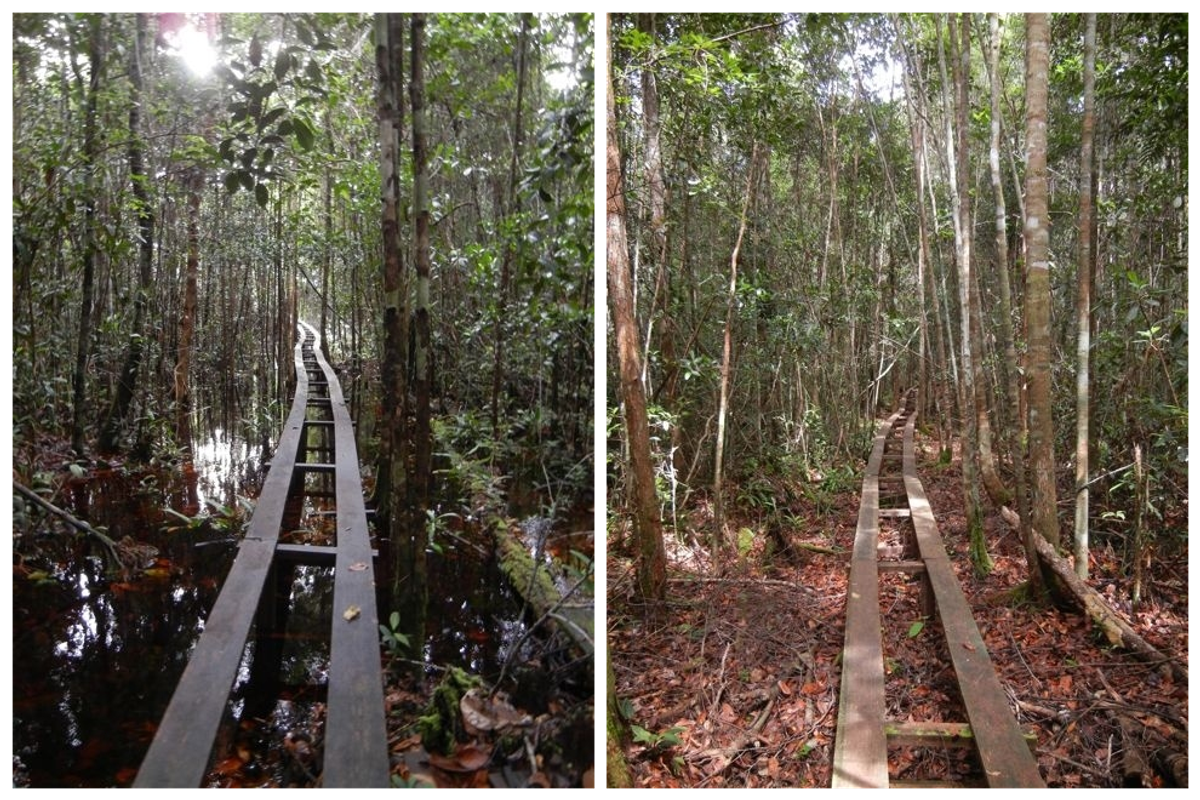
IT’S AROUND 4 A.M. on the island of Borneo, and a few researchers have already left camp. In darkness, they creep along boardwalk trails: lines of single planks of wood that offer solid footing in the swamp forest. Where the planks end, the scientists step gingerly into knee-deep muck and toe along tree roots.

The team hopes to reach a slumbering orangutan before she wakes and urinates. They’ll try to catch the stream in a baggie on a stick, as the animal pees from her leafy nest in the trees. Then, they’ll follow her, logging her activity every two minutes until nightfall. The morning urine sample, and more baggies filled throughout the day, will eventually be analyzed in the lab.

Stalking orangutans in a tropical swamp forest of Southeast Asia isn’t easy. “If you think you’re standing on solid ground at any point, that’s an illusion,” says Wendy Erb, a primatologist who has studied the animals in Borneo for the past decade. One slip from a root and the researchers will be fully soaked. Erb and colleagues refer to especially sodden parts of the forest as “the swamps of sadness.”

Researchers use narrow boardwalks in the forests around Borneo’s Tuanan Orangutan Research Station in both the swampy wet season (left) and the fire-prone dry season (right). 
TUANAN ORANGUTAN RESEARCH PROJECT/COURTESY MARIA VAN NOORDWIJK

During the dry season, roughly March through October, the ground hardens and trekking becomes relatively easy. But then the researchers—and the animals they study—face a more serious risk than mud. The swamps are made of peat, slowly decaying dead stuff that is highly combustible. The slightest spark can set the forest ablaze.

That’s what happened in 2015, an extra-dry year due to El Niño. Hundreds of fires raged across Borneo. Orangutans and other forest-dwellers fled from flames, but could not escape the noxious, bleary smoke that smothered their habitat for months. “It’s like this yellowy orange haze. It’s something like a dream world,” Erb says.

Even after the smoke cleared, it continued to cause problems. The haze had starved trees of fresh air and sunlight, and fruit—the preferred food of orangutans—became scarce. Stuck in a less-bountiful forest, ape relations frayed. Adults avoided each other, scuffled more often, and cast off their own kids. A recent paper in the International Journal of Primatology documents these behavioral changes and shows, says study author and University of Zurich primatologist Maria van Noordwijk, “These fires really have a long-term effect.”
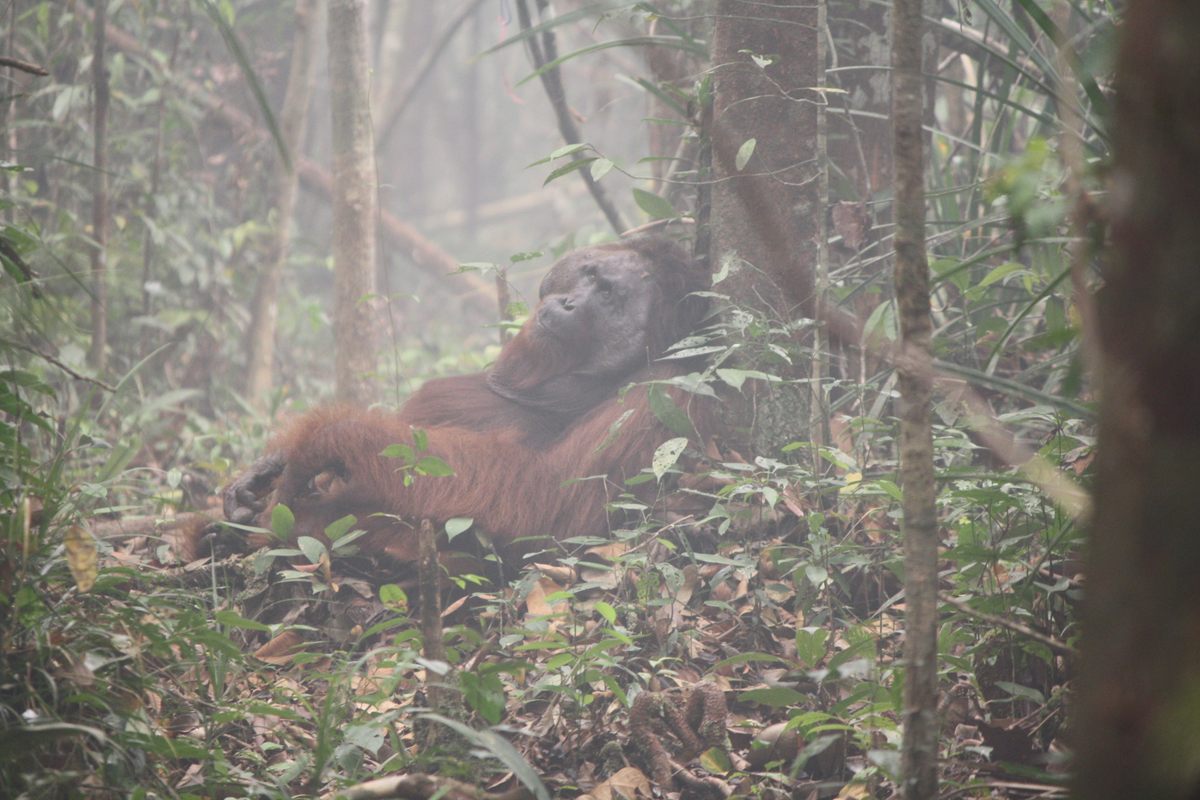
An adult male orangutan, photographed through the wildfire-fueled haze that descended across Borneo in 2015. 
TUANAN ORANGUTAN RESEARCH PROJECT/COURTESY MARIA VAN NOORDWIJK

After chimpanzees and gorillas, orangutans are our next closest kin in the great ape family. In the wild, the critically endangered primates can only be found on the Southeast Asian islands of Borneo and Sumatra, where they spend most of their time resting, munching, or moving between tree branches. Some 2,500 wild orangutans dwell in the Mawas Reserve, about 1,000 square miles of swamp forest in Kalimantan, the Indonesian portion of the island of Borneo. On a small patch of this forest, in the early 2000s, van Noordwijk and colleagues built a few tin-roofed huts and opened the Tuanan Orangutan Research Station. Since then, thanks to more than 60,000 hours of observation, the team has documented over 70 different orangutans, most of which are habituated to the scientists’ presence.

“There’s nothing more magical in the world than being completely ignored by a wild orangutan, and just having them go about their day, and go about their activities,” says Alison Ashbury, a coauthor based at the University of Konstanz.

Socially, orangutans are “the introverts of the forest,” says Ashbury. At Tuanan, promiscuous males roam widely, mating with various females and then absconding. Females mostly keep to their own territories of about a square mile; offspring stay with their mothers for about eight years.

Despite their solitary proclivities, adult females do meet up for at least one reason: to let their kids romp together. Primatologists suspect these playdates are crucial for development. “Young orangutans learn so much socially, the same way that human kids do. They don’t have the innate instincts of other animals, where they can just figure it out on their own. They learn from their moms and their peers,” Ashbury says. And there’s much to learn: what to eat, how to climb and build nests from leafy branches, the dos and don’ts of orangutan society.

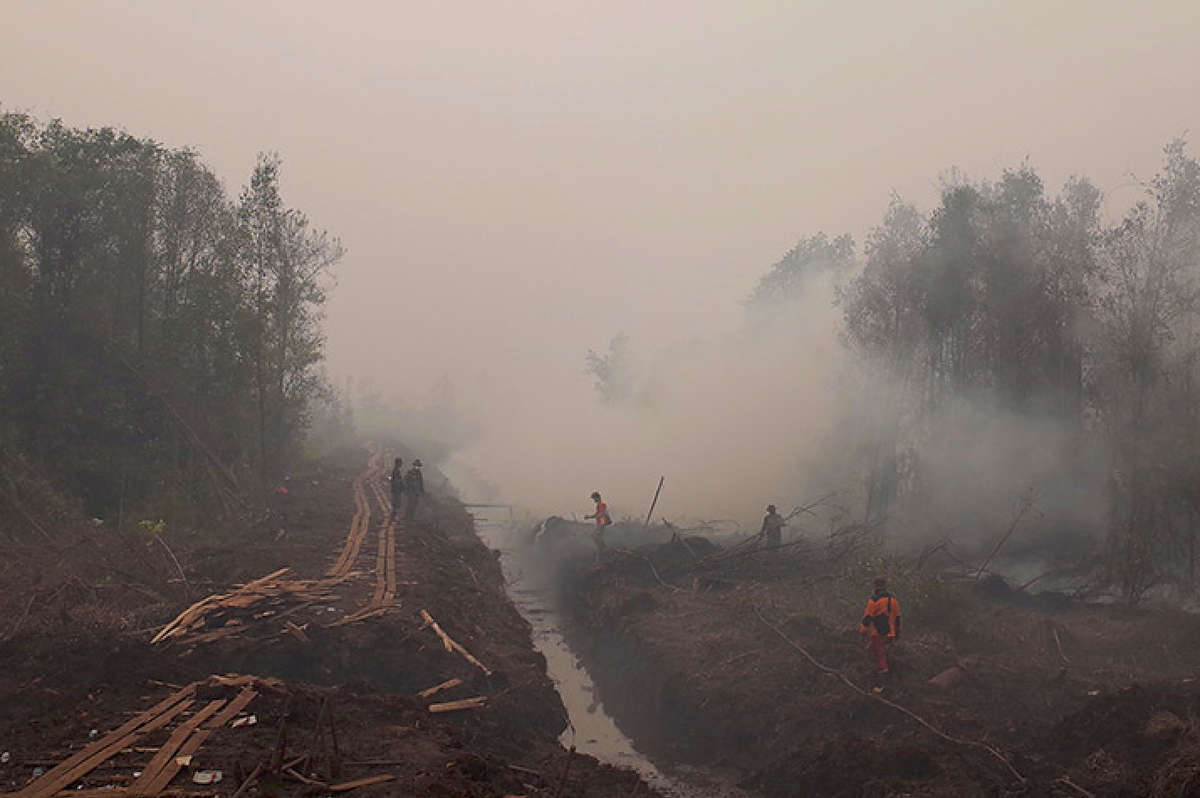
First responders attempt to put out a peat fire near a drainage canal in Indonesia in 2015; the canals lower the water table and make the peatlands more prone to catching fire in the dry season. 
MARTIN WOOSTER, CC BY 2.0/NASA EARTH OBSERVATORY

During the unprecedented 2015 fires, when more than 10,000 square miles of Indonesia burned, smoke particles in the air near the study site exceeded safe levels by up to 12 times. Because the swamps are peat, the fires can burn underground, travel along roots, and then pop up anywhere. About 10 percent of the Tuanan habitat burned, as the rest choked in smoke.

Researchers witnessed the orangutans coughing and physiologically stressed. “During the smoke time, they rest more. They travel less. They feed less… trying to save their energy,” says Sri Suci Utami Atmoko, a primatologist based at Jakarta’s Universitas Nasional. When males tried to make long calls—booming shouts to announce their presence—it sounded like they were choking, she says.

Ashbury, Atmoko, and colleagues analyzed recorded observations for 13 adult females over an eight-year period, from 2010 to 2018, that revealed changes in the apes’ lives before, during, and after the fires. During the fires and a subsequent three-year fruit “depression” with fewer resources, the animals ate lower-quality foods, including bark and leaves. They also rested more and roamed less—what Ashbury calls an “extreme energy saving strategy.” But most interesting to the scientists, the orangutans’ already low-key social lives took a hit.

“At first you had the impression that moms were just cranky,” says van Noordwijk. But the analysis showed more serious changes. Mothers spent less time with unrelated adults, which meant fewer playdates for their kids. The moms also pushed their older offspring away at a younger age than they did before the fires.
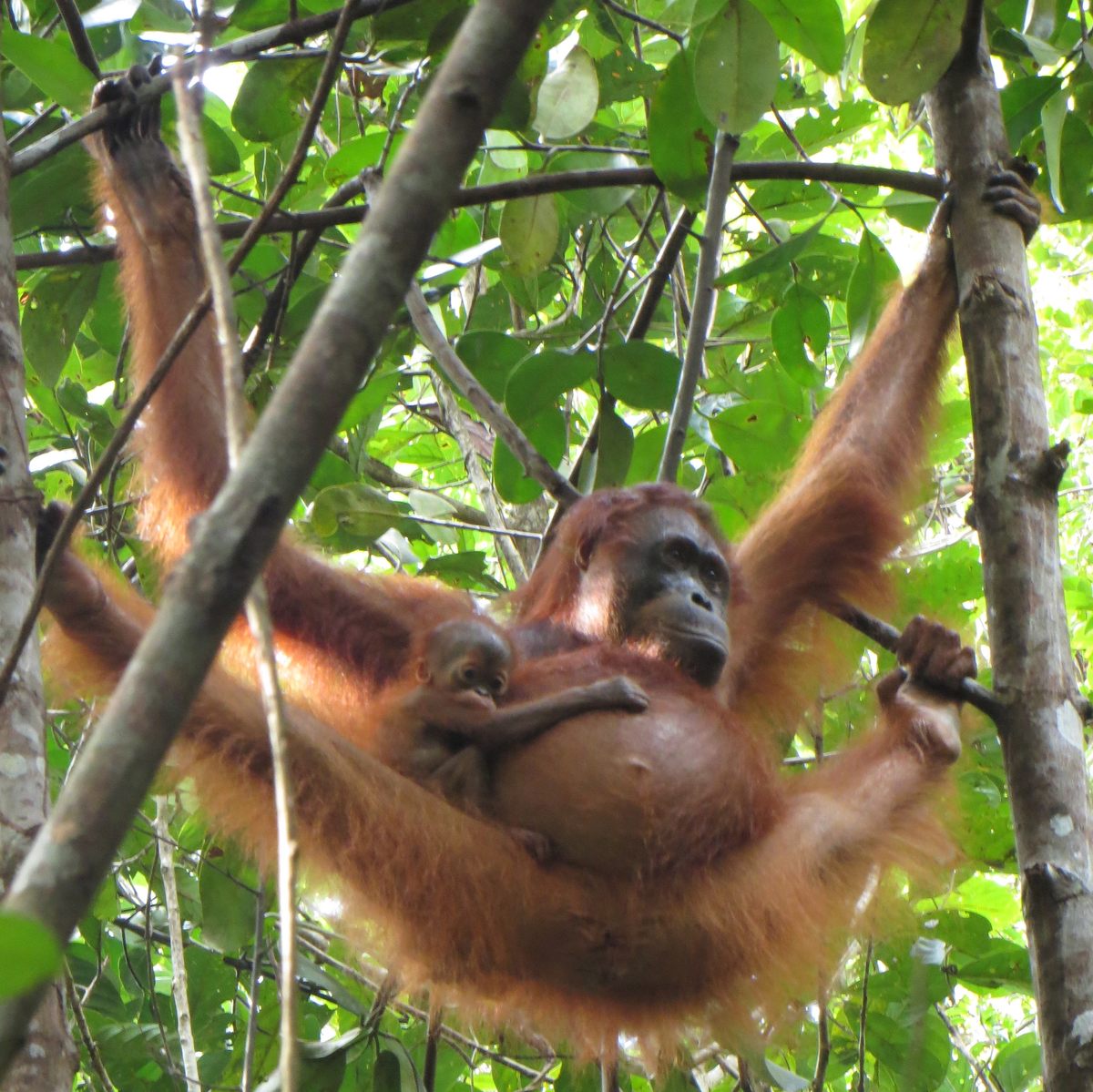
A female orangutan and her offspring moving through the thick forest of Central Borneo.
 TUANAN ORANGUTAN RESEARCH PROJECT/COURTESY MARIA VAN NOORDWIJK

Erb, who was not an author on the study, wonders “about the long-term consequences to these baby orangutans in terms of their social development and their ecological competency.”

Beyond orangutans, the new research is “really fascinating,” says University of Denver anthropologist Nicole Herzog, who was not involved in the study but researches primate responses to fires in other habitats. “Ecological change,” she says, “does lead to social reorganization.”

Though the scientists focused on orangutans in the paper, the forest holds many other rare species including leopards, slow lorises, the world’s smallest bears, and its biggest bats. Understanding unexpected long-term impacts on the ecosystem is important as climate change fuels more frequent forest fires—and potentially more changes to animal behavior that may linger long after the smoke clears.

Tuesday, September 28, 2021

Great ape's consonant and vowel-like sounds travel over distance without losing meaning

Great ape’s consonant and vowel-like sounds travel over distance without losing meaning
An Orangutan. Credit: Madeleine E. Hardus

Scientists have shown that orangutan call signals believed to be closest to the precursors to human language, travel through forest over long distances without losing their meaning. This throws into question the accepted mathematical model on the evolution of human speech according to researchers from the University of Warwick.

The currently accepted , developed by mathematicians, predicts that  strung sounds together in their calls in order to increase their chances of carrying a signal's content to a recipient over distance. Because  degrades over larger distances, it is proposed that human ancestors started linking sounds together to effectively convey a package of information even if it is distorted.

Researchers from the University of Warwick's Department of Psychology set out to collect empirical data to investigate the model. They selected a range of sounds from previously collected audio recordings of orangutan communications. Specific consonant-like and vowel-like signals were played out and re-recorded across the rainforest at set distances of 25, 50, 75 and 100 meters. The quality and content of the signals received were analyzed. The results are revealed in the study "Orangutan information broadcast via consonant-like and vowel-like calls breaches mathematical models of linguistic evolution" published today in Biology Letters.

The team found that although the quality of the signal may have degraded, the content of the signal was still intact—even at long distance. In fact the informational characteristics of calls remained uncompromised until the signal became inaudible. This calls into question the existing and accepted theory of  development.

Dr. Adriano Lameira, an evolutionary psychologist from the University of Warwick, led the study. He said:

"We used our bank of audio data recordings from our studies of orangutan in Indonesia. We selected the clear vowel-like and consonant-like signals and played them out and re-recorded them over measured distances in a rainforest setting. The purpose of this study was to look at the signals themselves and understand how they behaved as a package of information. This study is neat because it is only across distance that you can hope to assess this error limit theory—it disregards other aspects of communication like gestures, postures, mannerisms and .

"The results show that these signals seem to be impervious to distance when it comes to encoding information.

"It calls into question the existing thinking based on the model set out 20 years ago by Harvard scientists. Their work assumes that the signals that our ancestors were using were reaching an error limit—a moment when a signal is received but stops being meaningful. They concluded that our ancestors linked sounds together to increase the chance of content traveling over .

"We know sound degrades the further away from the source you are. We have all experienced this effect when shouting for your relative or your friend. They don't hear all the words you say—but they recognize you are talking to them and that it is your voice. By using actual great ape communication sounds, which are the closest to those used by our hominid ancestors, we have shown that although the sound package is being distorted and pushed apart, the content remains unaltered. It's a call to the scientific community to start thinking again about how language evolved."

Dr. Adriano Lameira and his team used orangutan calls because they were the first species to diverge from the great ape lineage but are the only great ape which uses the vowel and consonant like sounds in a complex way—giving a parallel with human speech.

His research team is now moving on to deciphering the meaning of their calls. The research involves pulling together all the ways orangutan combine calls, putting the consonant and vowel sounds together to get meaning.

He said: "We still don't know what they are referring to, but right now what is completely clear is that the building blocks of language are present. Although other animal sounds and signals are complex, they are not using the same building blocks. We are focussed here on the building of language—exactly the component the great apes use. It gives us the parallel to .

"The Harvard model has been the accepted theory for years and if you ask a mathematician if language origins were still a puzzle they'd say no—but evolutionary psychologists are still working on it. But we haven't solved the puzzle either—if anything we have just gone deeper down the rabbit hole.

"We are proposing that mathematical models be applied to the real life data to see what we can come up with together."Voice control in orangutan gives clues to early human speech

More information: Orangutan information broadcast via consonant-like and vowel-like calls breaches mathematical models of linguistic evolution, Biology Letters, royalsocietypublishing.org/doi … .1098/rsbl.2021.0302
Journal information: Biology Letters 
Provided by University of Warwick 

Friday, August 29, 2025


Treetop Tutorials: Orangutans learn how to build their beds by peering at others and a lot of practice!


Observational social learning of “know-how” and “know-what” in wild orangutans: evidence from nest-building skill acquisition


University of Warwick

Example of a young orangutan peering at nest building 

video: 

Peering at another individual building a nest 

view more 

Credit: Permana, A.L., Permana, J.J., Nellissen, L. et al. Commun Biol 8, 890 (2025).


Warwick primatologists, in collaboration with the Max Planck Institute, have shown that young orangutans develop their nighttime nest building skills via observational social learning - by closely watching others and then practicing these complex constructions.

Nest-building is an often-overlooked behaviour in great apes, but for arboreal species, a well-built nest is essential to survival. Nests are responsible for keeping apes safe from predators, helping them stay warm, providing a secure place to sleep when up high and have even been shown to have anti-mosquito properties. But how orangutans learn this complex ability has remained largely unclear.

Now, University of Warwick researchers have reported in Nature Communications Biology that immature Sumatran orangutans learn how to build these complex feats of engineering through carefully ‘peering’ at the workmanship of their mothers and others and practicing the steps they’ve paid careful attention to.

Dr. Ani Permana, Department of Psychology, University of Warwick, lead author of the paper said: “Nest-building is critical to survival in orangutans but is surprisingly not the focus of a lot of research. We previously reported that it takes multiple years for immature orangutans to learn to nest-build, but based on 17 years of observational data, this paper shows that this learning process is highly dependent on young animals carefully watching the nest-building of others.

“Orangutan nest-building tendency may have some innate basis, but the details and method must be socially learned starting from a very young age by watching and practicing, learning from mistakes as they grow and this paper is the first time this has been shown in wild apes.”

In the wild, Sumatran orangutans build two types of nests. Day nests tend to be basic practical frames, but the night nests are intricate sleeping platforms often built as high as 20 meters in the tree canopy and including comfort elements such as pillows, blankets, mattresses (linings) and roofs to protect from adverse weather.

By observing orangutans for long durations over many years, the research group managed to show that young orangutans peered at (deliberately watched) their mothers making nests to learn how to do it. When peering was observed, the immature orangutan was more likely to follow up by practicing nest-building themselves. If the immature orangutans were nearby when mum built a nest but didn’t watch for example because they were distracted, they generally didn’t go on to practice themselves – meaning active watching is likely crucial to developing the skill, strongly supporting the idea that this is observational social learning.

Immature orangutans were also shown to pay special attention to the more complicated parts of nest construction—like adding comfort elements or building across multiple trees—and practiced more after watching these actions.

As the orangutans grew older, they began watching and learning from other individuals beyond their mothers, choosing new role models who can help diversify their knowledge of which trees to use, suggesting that both how to build, and what to build with, are learned socially.

Dr. Caroline Schuppli, Max Planck Institute of Animal Behavior, senior author of the study said: “Aside from learning ‘how to’ build a nest, immature orangutans also appear to learn the ‘know-what’ of which materials to use. The choice of tree species is important, and infants—who primarily peer at their mothers—are more likely to select the same species their mothers use."

“Just like human teenagers finding their own path, maturing orangutans increasingly peer at the nest-building of others and begin experimenting with the tree species those individuals use."

“Ultimately, adult orangutans tend to revert to the nest materials used by their mothers, perhaps recognizing that the most effective methods had already been established. This consistent variation in nest materials across generations indicates that wild orangutan populations possess cultural elements that could be lost without the conservation of the species and their habitats.”

While social learning has been documented for behaviours such as tool use (using a frayed stick for termite fishing), this discovery of observational social learning in nest-building is important with new implications because:

  • Nests are crucial for survival – suggesting a fundamental role for social learning in orangutan development.
  • Nest building is a complex multi-stage process – that social learning is powerful in orangutans, and they can learn complex processes through watching and practicing
  • Nest building is an evolutionarily old behaviour (existing in ape ancestors millions of years ago) – suggests an older origin for social learning in apes.

ENDS

Notes to Editors

The research paper “Observational social learning of “know-how” and “know-what” in wild orangutans: evidence from nest-building skill acquisition” is published in Nature Communications Biology. DOI: 10.1038/s42003-025-08217-2


About the University of Warwick

Founded in 1965, the University of Warwick is a world-leading institution known for its commitment to era-defining innovation across research and education. A connected ecosystem of staff, students and alumni, the University fosters transformative learning, interdisciplinary collaboration and bold industry partnerships across state-of-the-art facilities in the UK and global satellite hubs. Here, spirited thinkers push boundaries, experiment and challenge conventions to create a better world.

Example of young orangutan observing and then practicing nest building [VIDEO] |


Mother and Immature Orangutan exploring together. Credit: Guilhem Duvot @ SUAQ Project

Immature Orangutan Looking Down through the branches. Credit: Natasha Bartolotta @ SUAQ Project

Immature Orangutan in a Nest. Credit: Natasha Bartolotta @ SUAQ Project

Friday, September 19, 2025

How did an Indian zoo get the world’s most endangered great ape?

“Trying to breed orangutans outside Indonesia with some kind of long-term hope that they are going to contribute to the population is just pure nonsense.”

By AFP
September 18, 2025


Vantara says it has 150,00 animals at its sprawling facility in India 
- Copyright AFP Idrees MOHAMMED

Sara HUSSEIN

Tapanuli orangutans are the world’s most endangered great ape. Fewer than 800 remain, all previously thought to be in their native Indonesia. But now an Indian zoo says it has one.

An Indian court cleared the 3,500-acre wildlife facility known as Vantara on Monday of allegations including unlawful acquisition of animals and financial wrongdoing.

But the decision is unlikely to quiet questions about how Vantara, which describes itself as a wildlife rehabilitation and conservation centre, has stocked its enclosures.

Vantara, run by Anant Ambani, the son of Asia’s richest man, says it houses 150,000 animals of 2,000 species, far exceeding populations at well-known zoos in New York, London or Berlin.

AFP spoke to seven experts on conservation and the wildlife trade to understand concerns about Vantara.

Several declined to speak on the record, citing Vantara’s previous legal actions against critics.

They called Vantara’s collection unprecedented.

“We’ve never seen anything on this scale,” said one longtime conservation expert from a wildlife protection group.

“It’s hoovering up animals from all over the world.”

Some of those acquisitions are more noteworthy than others, such as the single tapanuli that arrived in Vantara between 2023 and 2024, according to the facility’s submissions to India’s Central Zoo Authority.

Only officially described in 2017, tapanulis are incredibly rare, said Serge Wich, an orangutan specialist at Liverpool John Moores University.

They are confined to a small range in Indonesia and are in “dire straits” because of threats including mining and deforestation, he told AFP.


– ‘Surprised and shocked’ –


Trade in the world’s most endangered species is prohibited by the Convention on International Trade in Endangered Species of Wild Fauna and Flora (CITES).

But there are exceptions, including for “captive-bred” animals — individuals born in captivity to captive parents.

There is only one CITES record of a tapanuli orangutan ever being transferred internationally.

It left Indonesia in 2023, bound for the United Arab Emirates, where Vantara says its tapanuli came from.

The transfer record describes the animal as “captive-bred”.

However, multiple experts said that description was implausible.

“There are no captive breeding programmes for orangutans in Indonesia,” said Panut Hadisiswoyo, founder and chairman of the Orangutan Information Centre in Indonesia.

Only a handful are known to be in captivity at all, at rehabilitation facilities in Indonesia, he said.

A conservationist for more than two decades, Panut said he was “surprised and shocked” to learn from AFP about Vantara’s tapanuli orangutan.

“We do everything to protect them,” he said. “So it’s really, really distressing information.”

There is no information on where in Indonesia the animal originated. The country’s CITES authorities did not respond to a request for comment.

Experts said it was possible the orangutan is not a tapanuli at all. They look similar enough to Bornean and Sumatran orangutans that DNA testing would be needed for confirmation.

It could also be a mix of tapanuli and another species, perhaps discovered by a zoo in its collection — although experts questioned why a facility would hand off such a rare animal.

But if the animal is a tapanuli, “it’s almost inevitable that it would have to be illegal”, said orangutan conservation expert Erik Meijaard.

“It would be super sad.”


– ‘Pure nonsense’ –


Vantara did not respond to AFP’s request for comment on the orangutan and how it acquires animals.

The tapanuli is not the first highly endangered animal to arrive at Vantara.

Spix’s macaws, a vibrant blue species native to Brazil, were extinct in the wild until recently.

Brazil has sought to prevent all trade and transfer of the birds.

It allowed a breeding facility in Germany to acquire some on condition they would not be sold or moved without Brazilian permission, according to documents submitted to CITES.

Yet in 2023, 26 Spix’s macaws from the German facility arrived in Vantara.

Vantara says it is working “to ensure that the calls of these rare birds are never lost from their native habitats”.

The case has rankled Brazil, which raised it repeatedly at CITES meetings.

Asked about Vantara’s tapanuli, the CITES secretariat told AFP “this matter is under review”, adding it was “not in a position to provide information”.

In public documents, CITES has acknowledged receiving “multiple reports” about imports of endangered animals into India.

India has said it will invite CITES officials for a visit but has yet to provide “detailed information on the matter”, the secretariat noted.

If Vantara does own a single tapanuli orangutan, its conservation value would be limited, said Panut, who urged the animal’s return to Indonesia.

For Meijaard, conservation in their natural habitat in Indonesia provides “the only chance for this species’ survival”.

“Trying to breed orangutans outside Indonesia with some kind of long-term hope that they are going to contribute to the population is just pure nonsense.”