Showing posts sorted by relevance for query TransAlta. Sort by date Show all posts

Saturday, March 06, 2021


Varcoe: Once among the country's largest emitters, TransAlta joins journey to carbon neutrality

Chris Varcoe, Calgary Herald 


It wasn’t that long ago that TransAlta Corp. was among the largest emitters of greenhouse gases in Canada, largely because of its fleet of coal-fired power plants
© Provided by Calgary Herald The TransAlta Utilities Sundance Generating Plant near Wabamun Lake on August 13, 2019.

Earlier this week, the Calgary-based company announced its intention to be carbon neutral by 2050, joining a growing group of Canadian energy companies on a similar journey.

As part of its pledge, it will lower company greenhouse gas emissions by 60 per cent by the end of the decade, a sharp drop from 2015 levels.

It will discontinue coal-fired power generation in the country by the end of this year, as it converts existing facilities in Alberta to use natural gas.

The company is also expanding the development of wind and solar projects.

If you’re looking for a Canadian example of how the tide is turning in the energy transition debate — with companies setting tough targets as government policies and economics change — TransAlta is a good place to start.

© Jeff McIntosh/The Canadian Press A TransAlta wind turbine is shown at a wind farm near Pincher Creek, Alta., Wednesday, March 9, 2016.

TransAlta CEO Dawn Farrell, who is retiring at the end of this month, has been working on carbon policy since the late 1980s, before the Rio de Janeiro Earth Summit.

She recalls being put in charge of a $15-million fund back in 1990 to buy carbon offsets for TransAlta’s coal-fired power plants, part of the company’s long journey that led to today’s point.

“Back then, we saw the technology was taking a long time to come to market. We invested in wind in 2000 and even through 2000 to 2015, we saw wind farms and solar being very, very expensive,” Farrell said in an interview.

“I don’t think anybody could have ever foreseen the acceleration of the technological development.”

Costs for developing renewable energy projects have plunged in the past decade.

Could Farrell have imagined in those days seeing a line of sight to TransAlta becoming carbon neutral?

“Absolutely not,” she added.

“But absolutely what we all missed was just how quickly, with the way information moves around, you can just accelerate technological development — and that’s what has changed the game here.”
© Larry MacDougal/The Canadian Press TransAlta Corp. CEO Dawn Farrell speaks during at the company’s annual general meeting in Calgary on Tuesday, April 29, 2014.

It was only a decade ago that TransAlta’s Sundance generating plant was the largest-single source of greenhouse gas emissions in Canada, according to a report at the time by the Pembina Institute.

This week’s declaration by the company earned praise from some environmental groups. They noted the power generator’s announcement contained something that’s often lacking in corporate net-zero plans: interim steps and an idea of how to get there.

“It shows how far you can go,” said Binnu Jeyakumar, the Pembina Institute’s director of clean energy.

“This is a sign of how change can happen if they’re pushed there by a combination of regulations and economics,” added Keith Stewart, a senior energy strategist for Greenpeace Canada.

Alberta has the highest emissions in the country and coal-fired power generation has been a key part of the decarbonization discussion for years.

In late 2015, the former NDP government announced emissions from all coal-fired power generation had to be eliminated by 2030.

Since then, companies such as TransAlta and Edmonton-based Capital Power have been aggressively converting their plants to use natural gas, which generates significantly fewer emissions than coal.

Armed with their new corporate strategies, all coal-fired generation will be phased out by 2023.

With the federal government’s commitment for Canada to reach net-zero emissions by 2050 and plans to increase the national carbon price to $170 per tonne by decade’s end, there are mounting monetary and political reasons for companies to chart such a course forward.

According to TransAlta, it has already lowered its total annual emission by 61 per cent in the past 15 years.

TransAlta’s chief operating officer John Kousinioris noted carbon neutrality is an aspirational goal, but stressed the company doesn’t need technical solutions “that are just a twinkle in someone’s eyes” to get there, he said on an earnings call.

Kousinioris, who will become TransAlta’s next CEO, said switching to natural gas will cut emissions per megawatt by almost half.

By 2022, TransAlta’s total emissions will drop to about 10 megatonnes, down from about 41 megatonnes in 2005.

Looking towards the end of the decade, emissions will be “significantly more modest,” although he noted natural gas is still needed and there will likely be more plants built.

But he’s confident in the target

.
© TransAlta.com TransAlta COO, and future CEO, John Kousinioris.

“There comes a tipping point where you can either stand on the sidelines or embrace it. Dawn was a real champion for us in saying this is something we need to embrace,” Kousinioris said in an interview.

Other companies are also setting their sights on such ambitions.

Capital Power has adopted a target of being carbon neutral within three decades. Canadian Natural Resources and Cenovus Energy and pipeline giant Enbridge have already announced plans to be net-zero by 2050.

Canadian Natural said Thursday it has lowered its emissions per barrel by 18 per cent since 2016.

The company is using carbon capture and storage in Alberta, and is running a pilot project that uses solvents in thermal oilsands projects that will cut emissions intensity by up to 50 per cent, said president Tim McKay.

For companies such as TransAlta and Canadian Natural, the push is on.

With the election of U.S. President Joe Biden and his pledge to have an emissions-free electricity sector by 2035, momentum is growing for power companies to embrace net-zero goals, said Sara Hastings-Simon, a research fellow at the University of Calgary’s School of Public Policy.

The key for companies is to have a strategy going forward, which includes measuring emissions, setting targets and tying executive compensation to the goal.

“It is really important when companies put forward these goals, they are not just saying we are going to do this, but they have all the pieces in place that make it real,” she added.

“You are seeing a recognition from leaders in these companies that this is where the world is going — and this is what investors and customers are looking for.”

Chris Varcoe is a Calgary Herald columnist.

Thursday, November 05, 2020

Hundreds of coal mining jobs to end as power company switches to natural gas


CALGARY — Alberta power producer TransAlta Corp. says it will end operations at its Highvale thermal coal mine west of Edmonton by the end of 2021 as it switches to natural gas at all of its operated coal-fired plants in Canada four years earlier than previously planned.
© Provided by The Canadian Press

The announcement will result in hundreds of mine job losses as employment drops to 40 to 50 people involved in reclamation work, expected to take about 20 years, from a peak workforce of around 1,500, said CEO Dawn Farrell on a conference call on Wednesday.

TransAlta confirmed last week it had closed a $400-million second tranche of a $750-million investment by an affiliate of Brookfield Asset Management, with the proceeds to be used to advance its coal-to-gas conversion program and other corporate purposes.

But on the call, Farrell said Brookfield's purchase of convertible securities wasn't responsible for the board's decision to accelerate its coal-to-gas conversions.

"It's really related to, overall, the economics of producing power in Alberta on coal with the carbon tax," she said on the call.

"We've currently got a $30 (per tonne) carbon tax, it'll be $40 by next year, $50 the year after. Coal plants get less economic and they're less flexible in a merchant market."

The percentage of power in Alberta generated from coal has fallen from more than 80 per cent in the 1980s to less than one-third now, in part due to rising provincial government prices on carbon that began in 2007. The electricity market was deregulated in 1996, which means prices are set through competition.

"It's good news for GHG reduction and the health of Albertans to have coal being phased out earlier," said Binnu Jeyakumar, director of clean energy for the environmental Pembina Institute, adding coal power profitability is becoming less attractive as the costs of renewable power fall.

She cautioned, however, that converted coal plants are unlikely to be as efficient as new natural gas powered plants and added that fugitive gas emissions from production and transportation of gas also present an ongoing GHG risk.

TransAlta said it will stop burning coal in its Keephills Unit 1 and Sundance Unit 4 plants, which will operate at lower capacity with natural gas, while it evaluates full conversion projects.

A conversion project at Sundance Unit 6 is to be complete in a few weeks and the conversions of Keephills Unit 2 and Unit 3 are to be wrapped up in 2021.

The company announced it will proceed with the full $800-million conversion of Sundance Unit 5 to allow it to produce about 730 megawatts when it comes online in Q4 2023.

"Our greenhouse gas emissions will be under 11.5 million tonnes by the end of 2022, down almost 70 per cent from 2005," said Farrell, who said it has cut 32 million tonnes per year across its worldwide operations since 2005 and 21 million in Canada.

"TransAlta has more than met it's fair share of the Paris agreement. To date, we alone have delivered 10 per cent of Canada's goal of a 220-million-tonne reduction for Canadians by 2030."

She said TransAlta should be a "sought after investment" for clean energy investors.

The company will still produce power from coal at its Centralia facility in Washington State, which has a transition agreement allowing it to burn coal until its end of life in 2025, Farrell said on the call.

TransAlta also owns a 50 per cent stake in the Sheerness power plant in western Alberta, which is operated by American firm Heartland Generation Ltd., and continues to burn coal although it has some dual-fuel capabilities.

TransAlta reported a loss attributable to common shareholders of $136 million for the quarter ended Sept. 30 compared with a profit of $51 million in the same quarter a year earlier.

Revenue was $514 million, down from $593 million in the same quarter last year.

This report by The Canadian Press was first published Nov. 4, 2020.

Companies in this story: (TSX:TA, TSX:BAM)

Dan Healing, The Canadian Press

TransAlta to end coal mining operations at Highvale in 2021, stop using coal in Canada

Lisa Johnson 

TransAlta Corp. says it will stop mining coal at its Highvale mine by the end of 2021 and will no longer use coal to generate power in Canada effective Jan. 1, 2022.
© Provided by Edmonton Journal 
A giant drag line works in the Highvale Coal Mine to feed the nearby Sundance Power Plant near Wabamun on Friday, Mar. 21, 2014.

In a Wednesday report of its third-quarter financial results, TransAlta said it was closing the mine, which is located south of Lake Wabamun, about 70 kilometres west of Edmonton, four years ahead of schedule in an effort to accelerate its environmental, social, and corporate governance goals.

The Highvale mine, which has been in operation since 1970, is one of three TransAlta-owned surface coal mines and Canada’s largest surface strip coal mine, covering more than 12,600 hectares, according to the Calgary-based company’s website.


TransAlta CEO Dawn Farrell said in a conference call that the company is on track to reduce its greenhouse gas emissions by almost 70 per cent from 2005 levels by the end of 2022.

“TransAlta has more than met its fair share of the Paris Agreement,” said Farrell.

Under the agreement, Canada committed to reducing its emissions by 30 per cent below 2005 levels by 2030.

At TransAlta’s coal power generating stations, Keephills Unit 1 and Sundance Unit 4 will stop firing with coal and will only operate on gas, reducing their maximum capability to 70 MW and 113 MW, respectively.

“It’s really related to overall the economics of producing power in Alberta on coal with the carbo
n tax. If you look at Alberta, we’ve currently got a $30 (per tonne) carbon tax, it’s be $40 by next year, $50 the year after. Coal plants get less economic and they’re less flexible in a merchant market,” said Farrell.

TransAlta reported a net loss attributable to shareholders of $136 million for the quarter ending Sept. 30, compared with a profit of $51 million in the same quarter last year. The difference means a loss of 50 cents per diluted share this quarter, compared with a gain of 18 cents in the same quarter of 2019.

The company said the decrease was largely due to lower revenues, a write-down of its coal inventory, higher depreciation, and an increase in asset impairments and power purchase agreement termination payments, which were partially offset by foreign exchange gains and income tax recoveries.

Its revenue for the quarter was down to $514 million from $593 million in the same quarter last year.

TransAlta operates more than 70 power plants in Canada, the United States and Australia.

Monday, March 21, 2005

Alberta Fleeced by Enron

Well you know the good ship of state in Alberta is teetering towards toppling and leaking like a sieve when its main propagandist gives it a good backhand slap.

Edmonton Sun columnist Neil Waugh the apologist for all things Klein and Tory has thrown up his hands in disgust over the cover up by the government of the fleecing it got from Enron when it deregulated the energy market. See his Edmonton Sun columns: March 10, 2005 Powerful question where he asks:

When first confronted with the Project Stanley allegations, Market Surveillance Administrator Martin Merritt - a watchdog without a government leash - reviewed the Snohomish/California allegations and declared them old news. Then he turned his guns on the media, accusing us of "mischaracterizing the allegations."

Just 20 days later - on the first day the legislature gets down to business - Merritt suddenly changed his tune. There's going to be an investigation after all.

"The MSA has requested and obtained materials filed in proceedings before FERC," Merritt gulped. The Cantwell tapes. But instead of an Alberta-based probe, he turned it over to the feds' weak sister Competition Bureau. Then he took another shot at published "articles and commentary."

Short hours later, the Tory butt-covering started in the legislature. Surely a coincidence. And the premier quickly ducked and let the B-Team take over.

"Albertans have not been impacted in any financial way," blustered Energy Minister Greg Melchin. But how does he know? Especially after Justice Minister Ron Stevens - when asked if his notorious Gang that Couldn't Shoot Straight has launched an investigation - blurted "at this point in time there is no intention to proceed with anything."

Yesterday, Opposition Leader Kevin Taft met the same brick wall.

"I don't get involved in the mechanics of an investigation," the premier snapped.

Melchin blathered on about "legislated hedges."

Even the man who should be on the case, Auditor General Fred Dunn, is handcuffed. The Market Surveillance Administrator has been conveniently tucked away out of his jurisdiction.

"Why do the people of Alberta have to rely on the County of Snohomish to protect their rights?" wondered Taft. Why indeed?

and in his March 17, 2005 column, How serious are we? Alberta talks tough on crime, but ignores power allegations he continues the spanking:

In a week when a New York court declared Edmonton's own Bernie Ebbers guilty in the massive WorldCom securities fraud, Alberta Solicitor General Harvey Cenaiko summoned the province's police chiefs to his office.

He vowed to crack down on criminal conspiracies.

"Gangs are a breeding ground for organized crime," stormed our Harv. "Organized crime crosses all boundaries and affects everyone."

He joined Justice Minister Ron (Get Tuff) Stevens in his law-and-order manifesto. Our Harv and Tuff mean business. Or at least they say they do.

"We are targeting crime bosses through co-ordinated efforts," Cenaiko blustered on. He talked about "aggressive action already taken."

It all sounds so wonderful, until yet another Enron horror story shows up, this time from deep in the heart of Texas. And you realize just how pathetic the Alberta Tories are these days.

Especially with the Enron bigwigs Ken Lay and Jeff Skilling about to be the next alleged corporate fraudsters to undergo the tough love concept of the United States Department of Justice and President George Bush's Corporate Fraud Task Force.

OUCH that must hurt, could hear that ring throughout the marble halls of the Legislature.

The privatization and deregulation of energy in Alberta has been its billion dollar boondoggle, the equivalent of the Ferderal Gun Registry. No one wanted it, not the public sector or the private sector, and certainly not the public. It was driven by ideology (See my article Wild West Buy Out, Steve West aka Prince of Darkness, Kleins drinking buddy and his promoter of the privatization of everything) and it has been a failure in reducing costs but a success in making huge profits for the utility companies.

And now it has been revealed that Enron set up a price fixing fraud in Alberta using the deregulated market to set up a sting it would later use in Texas and Califronia. The gutting of the public purse by Enron first happened in Alberta, thanks to the ill informed, poor planning and oversight of the Klein team.It has taken an American court case to reveal the fact and the Klein gang now has egg on their face.

And now they are covering their asses, claiming this fraud is no big deal. After all it wasn't their fault it was the, wait for it, the Federal Governments fault. Yep fleece us with deregualtion, get fleeced by Enron pass the buck to the Feds.

The Official Opposition Liberals have taken them to task over Enron in the house last week. The NDP have made energy deregulation their cause popular, and now both opposition parties have a literal smoking gun. Will this kevlar government feel the pain, well when its allies like Waugh give it a good smack down, you know they are in trouble. Big Trouble, with a capital T and its spelled ENRON.

Waugh continues his attack in the Edmonton Sun where he writes about TransAlta the private utility corporation which pushed deregualtion because it had a license to market electricity into and out of the U.S. Along with it being private it is a holding company for ex government politicians, it was that way under the Socreds and remains so under the Tories.

TransAlta was the power behind West, in the push to privatize electrical marketing in Alberta. They hoped to be able to trade blended electricity into Canadian and American markets, since they were the only Canadian utility licensed to do so. Ron Sothern of ATCO the other private utility company as well as EPCOR and ENMAX the City of Edmonton and Calgary publicly owned utilites opposed the deregulation.

And while Transalta and the public utilities have made oddles of profit on the deregulated market it is us as taxpayers and consumers who have borne the brunt of the burdern with massive cost increases in electricty as well as having to shell out infrastructure costs for expanding the electrical generation base in the province. After all we were told that deregulation would be good for consumers.


Yeah, consumers like Enron.


Sun, March 20, 2005
Power struggle
TransAlta gets no help from Tories in shaking off taint of Enron scandal
By Neil Waugh -- For the Edmonton Sun

With friends like these, who needs enemies? TransAlta Utilities and the Alberta Tories have this relationship going. They're not exactly attached at the hip. But a lot of prominent PCs are on its board.

Former provincial treasurer - and reported heir apparent for the premier's job - Jim Dinning was an executive vice-president until he curiously resigned Jan. 1 to head up a small bank based out of High River.

Last week TransAlta's name came up in the legislature. This is not a good thing. Especially when it's linked with former Enron Canada president Rob Milnthorp and ex-Enron general counsel Mark Haedicke.

Haedicke, among other things, is suffering the wrath of ex-Enron workers who lost their jobs and pensions after he got a $750,000 bonus, days before the big power marketer went bankrupt. Enron is now facing charges that it rigged the California power market in 2000.

The Alberta Liberals went on the attack after they found what they claimed was a damning e-mail in the mountains of Enron files and transcripts recently released by the United States Federal Energy Regulatory Commission.

The document was called "Project Stanley" - the code name Enron execs invented to allegedly manipulate energy markets in California and Texas. And, if you believe the attorney general of California Bill Lockyer, honed their illegal craft, fixing the Alberta market in the early days of Ralph Klein's botched energy-deregulation regime.

'Low profile'

It talked about keeping a "relatively low profile until we settle Project Stanley." And the 2000 memo referred to "recent meetings" with the Alberta government and TransAlta. That sent the Liberals off on a fishing trip for what Grit Leader Kevin Taft says are 5,600 pages of Enron documents in the government's possession.

Instead of giving them up, the Tories naturally stonewalled. Unlucky TransAlta got caught in the crossfire. "The intent is to try and slander," yelped Alberta Energy Minister Greg Melchin. "We still are looking for evidence."

He sure has a funny way of going about it.

"Until a month ago I'd never heard of Project Stanley," said TransAlta legal affairs director Sterling Koch. (Although TransAlta was involved in litigation with Enron at the time.) But he sure has heard of Bill Lockyer. Probably too much.

On May 30, 2002, the crusading attorney general, on behalf of the "people of the state of California," launched a massive suit against TransAlta Energy Marketing Inc., owned by TransAlta but registered in Delaware.

In it he talked about the "skyrocketing electricity prices, widespread blackouts, utility bankruptcy and massive economic upheaval" that hammered his state in 2000. It alleged that the TransAlta spin-off "through unjust, unreasonable and illegal overcharges and price-gouging, received unprecedented profits at the expense of consumers, ratepayers, businesses and the state of California."

As you can see, Bill doesn't pussyfoot around.

In his latest quarterly report - after all the happy news came out - TransAlta president Steve Snyder gave his shareholders the latest Golden State update. The claims were dismissed. An appeal was denied last October.

A parallel investigation by FERC in June 2003 ordered TransAlta to "justify certain trading activities in California." A document filed with the regulator specifically asked TransAlta if it participated in Enron market-fixing scams like "Death Star, Load Shift, Get Shorty and Fat Boy."

TransAlta denied it.

Overcharge claim

"TransAlta does not participate in and has nothing to gain by doing these types of trades," Snyder said at the time. But the company is still arguing over $46 million that California power authorities claim TransAlta overcharged them.

"The courts have dismissed their claim," said Koch. But he might have spoken too fast.

"We're just trying to get our money back," California attorney general spokesman Tom Dresslar snapped last week.

The battle continues. With no help from the Alberta Tories.

Sunday, January 02, 2022

ALBERTA

TransAlta completes conversion from coal to natural gas power in Canada


CALGARY – A major Canadian electricity producer is successfully off coal power in this country, nine years ahead of a government deadline.

Calgary-based Trans-Alta Corp. announced Wednesday it has finished its planned transition from coal to natural gas in its Canadian power generation.

The company said the recently completed conversion of the Keephills Unit 3 power plant west of Edmonton was the last of three coal-to-gas conversions at its Alberta thermal power generation facilities.

In a news release, TransAlta president and chief executive John Kousinioris said the company has achieved a significant milestone well ahead of the federal mandate that will require the full phaseout of coal-fired electricity generation in Canada by 2030.

“We are pleased to have completed this important step, nine years ahead of the government target,” Kousinioris said. “Our coal transition is among the most meaningful carbon emissions reduction achievements in Canadian history.”

Since 2019, TransAlta says it has invested $295 million into its coal-to-gas program, which also included the conversion of Sundance Unit 6 and Keephills Unit 2 near Wabuman, Alta., and Sheerness Units 1 and 2 near Hanna, Alta., plus the construction of new high-volume gas delivery infrastructure.

Converting to natural gas from coal maintains the company’s current generation capacity while at the same time reducing carbon dioxide emissions by almost 50 per cent, the company said.

As of Friday, TransAlta will also close its Highvale thermal coal mine, which is the largest in Canada and has been in operation on the south shore of Wabamun Lake west of Edmonton, since 1970.

TransAlta’s move away from coal is a major milestone in Alberta, which has been working to reduce its reliance on coal for power generation.

In 2014, 55 per cent of Alberta’s electricity was produced from coal. The province, under then-premier Rachel Notley, announced in 2015 — three years ahead of the federal government’s own coal mandate — that it would eliminate emissions from coal-powered generation by 2030.

In addition to TransAlta, other Alberta-based companies have also made major utility conversion commitments. Edmonton-based Capital Power Corp. has said it will spend nearly $1 billion to switch two coal-fired power units west of Edmonton to natural gas, and will stop using coal entirely by 2023.

TransAlta said that overall, it has retired 3,794 megawatts of coal-fired generation since 2018. The company still operates the Centralia coal-fired power plant in Washington State, which is set to shut down at the end of 2025.

TransAlta said that it is on track to reduce its annual greenhouse gas emissions by 60 per cent, or 19.7 million tonnes, by 2030 over 2015 levels and achieve net-zero emissions by 2050.


 Calgary·Opinion

Alberta steps closer to ending coal power, faster than many expected. But then comes the hard part

Blake Shaffer on how to get to zero emissions from power

sector while keeping lights on (and costs down)

TransAlta has finished converting the last of its three coal power generating plants to natural gas, a transition at the Keephills plant west of Edmonton. The Calgary-based company says the switch cuts almost in half the emissions intensity of the power at the Keephills unit. (Sam Martin/CBC)

This opinion piece is by Dr. Blake Shaffer, an assistant professor of economics and public policy at the University of Calgary. He was formerly the head trader for western power and gas at TransAlta. 


Another year, another step closer to the end of coal power in Alberta.

As we turn our calendars to 2022, only three coal-fired power plants will remain in Alberta. With TransAlta's Keephills 1 coal power plant shuttering Dec. 31, and Keephills 3 and Sundance 4 switching from burning coal to natural gas, the Genesee 1, 2, and 3 facilities at Warburg are now the last of what was, only a few years ago, Alberta's most-used source of electricity.

The end of coal power in Alberta is happening faster than many expected, and well ahead of regulations set first by Ottawa in 2012 and updated in Alberta in 2015. Only a decade after Alberta commissioned its last coal plant, the regulatory phase-out scheduled for 2030 is a moot point, with the remaining Genesee plants set to convert to natural gas by the end of 2023. Coal, once responsible for over 80 per cent of Alberta's electric generation, and roughly half only five years ago, will be gone. 

This chart shows coal power's share of Alberta's annual electricity demand, as it shrinks over the years from a high of 81 per cent in 2001 to 20 per cent in 2021 and an expected zero per cent by 2023. (Blake Shaffer)

This will be the biggest greenhouse gas reduction in Alberta's history. A true climate success story. But we're not done yet. Converting to natural gas was the easy part. The road ahead to meet the federal government's goal of eliminating all emissions from the power sector by 2035 will be the hard part.

Our recent cold snap, with temperatures plunging to –30, and lower, across the province offers a glimpse of the challenge ahead. While renewables now account for one quarter of Alberta's generating capacity (that alone is a pretty amazing stat), they produced less than five per cent of the energy during the cold days at the end of 2021. A dearth of wind coinciding with the coldest conditions, something unfortunately all too common for Alberta wind in winter, meant the lion's share of Alberta's power came from natural gas.

This line graph shows how wind power generation in Alberta dropped during a cold snap in late December. A dearth of wind coinciding with the coldest conditions, something all too common for Alberta wind in winter, meant the lion's share of the province's power came from natural gas. (Blake Shaffer)

This isn't intended as a knock on renewables. It's simply a reminder that they are what they are, and that is raw, or intermittent, energy. And that's OK so long as that's what we expect and what we're paying for. When wind and solar were expensive, as in Ontario a decade ago, people had a reason to question their merit. But now that they're cheap — and they really are cheap — it can be worth accepting their intermittency. (As I like to tell my electricity students, even I will drink cheap red wine sometimes, so long as it's cheap!)

The key is knowing what to expect, being honest about what they provide (and paying accordingly), and finding ways to integrate these abundant and cheap resources into our power mix using other flexible, or "firm," resources. Renewables can and likely will produce the bulk of Alberta's electric energy in the future, but other resources will be needed to couple with them to ensure reliable capacity, or "on-demand" availability.

Firming up Alberta's power supply

With that in mind, how can Alberta get to zero while keeping the lights on (and costs down)? 

First, we need to better engage demand. While not for everyone, encouraging those with some flexibility (hello, EV chargers!) to shift when they pull from the grid can limit the strain on the system. More supply variability from renewables, and cheaper automated ways to flexibly control demand, make this an increasingly valuable and feasible low-cost option. Regulators and electricity providers need to innovate to encourage this type of behaviour.

Second, while unabated natural gas has a limited role in a zero emission future, natural gas plants equipped with carbon capture offer a way to take advantage of Alberta's plentiful natural gas reserves. Capital Power is planning to go down this route with their Genesee facility. Another option is to convert these plants to clean-burning hydrogen. As hydrogen production gets cheaper, this starts to become an attractive option. "Green" hydrogen, produced through electrolysis, also offers a way to store hydrogen by soaking up periods of excess wind and solar power.

While unabated natural gas has a limited role in a zero emission future, natural gas plants equipped with carbon capture offer a way to take advantage of Alberta's plentiful natural gas reserves, Blake Shaffer writes. Capital Power is planning to go down this route with their Genesee Generation Station, located 70 kilometres southwest of Edmonton. (Supplied by Capital Power)

Third, nuclear reactors, of the small modular variety, are a potential game-changer. Though they have to clear some pretty steep technical and economic hurdles to be viable, it's worth remembering that wind and solar were also once deemed infeasibly expensive 10 years ago, until they weren't. 2035, however, is a tight deadline for nuclear to get its technical, economic, and regulatory ducks in a row. Geothermal is another firm supply option, one similarly plagued with cost questions, but also one that can leverage the oil and gas skill set in this province.

Fourth, storage offers a way to take advantage of Alberta's abundance of cheap wind and solar, shifting the energy from periods of plenty to when it's needed. Batteries can offer short duration storage, while pumped hydro and even compressed air can offer longer duration opportunities. As renewables get cheaper, storage becomes increasingly attractive. And believe me, Alberta will be building a lot more renewables in the years to come.

Fifth, bigger transmission connections between Alberta and B.C. ought to be part of the mix. Comparative advantages exist on both sides of the border (B.C. has the peaking capacity; Alberta has the cheap variable energy). Rather than one-way flow like pipelines, transmission lines mean exporting when the wind is fierce, and importing hydro power when it's not. This exchange won't come free, but it's cheaper than many of the alternatives.

So what's needed to make these resources a reality?

For starters, those saying "it can't be done" need to be reminded that many also said phasing out coal by 2030, let alone 2023, wouldn't be possible, that coal-to-gas conversions were hard, and that wind would never be procured for less than $80 per megawatt-hour, let alone the mid-$30s observed recently.

Nonetheless, some clarity on where we are headed is needed. Uncertainty is anathema for investors. If Alberta is truly headed for zero emission power by 2035, planning and investment needs to start now. To the extent governments can de-risk policy uncertainty by providing clear and durable guidance on future carbon prices and emissions regulations, this will better enable the new resources that are needed to be built.

Also, and perhaps a topic for a deep dive on another day, Alberta's market design may have to evolve to ensure reliability as we transition. We went down this road five years ago, with Alberta's system operator recommending, and the NDP accepting, the introduction of a capacity market — essentially paying for steel in ground, i.e., the ability to produce, not just energy generated. This was rescinded in 2019 under the UCP, but the need for some form of instrument to ensure sufficient resources in the longer run never went away.

To date, Alberta's short run energy market has attracted sufficient long run investment. Will that be the case as we transition? And, importantly, what will prices do along the way? Texas, whose power market is the closest thing in North America to Alberta's, is grappling with this same question in the aftermath of brutal power outages last February. They, too, are currently considering enhancing their market with some form of reliability mechanism. Alberta ought to take note and take this issue on proactively.

What are we the consumers to do?

Finally, what does this mean for you and I? 

Those that follow me on Twitter won't be surprised to hear me say: get on a fixed rate plan. While the market will be volatile, there's no reason those bumps need to flow through to consumers' pocketbooks. There remain five-year fixed rate plans today that are well below where the market is currently indicating prices will be over that period. And if things change, most of these plans give you the flexibility to exit. I've done it, and I'd encourage others to consider it as well.

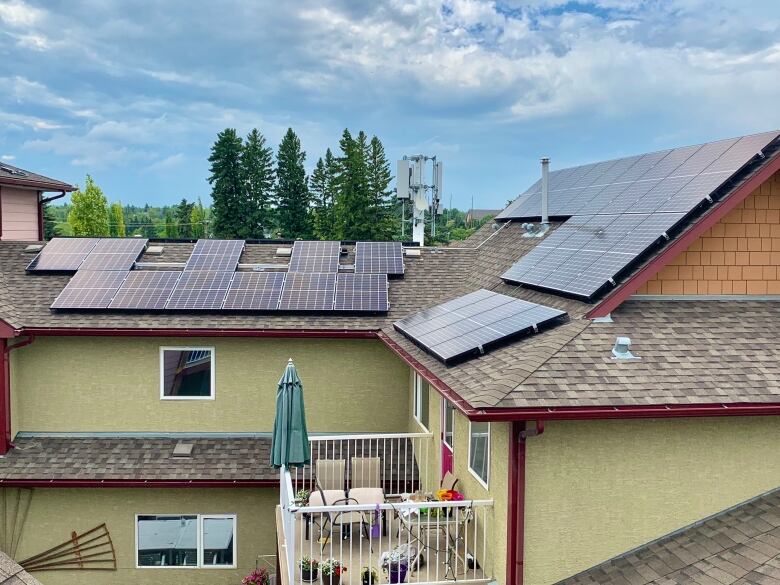
Installing solar panels is one way consumers can insulate themselves against rising power prices, Blake Shaffer writes. Here, solar panels can be seen on the roofs at the Prairie Sky Cohousing Co-operative in northeast Calgary, which has got all its energy from solar since 2020. (Submitted by Lise Rajewicz)

Another option to consider to protect yourself against rising prices is to add solar panels. It won't take you off the grid — you'll still be paying those pesky fixed charges, and for power when you're using more than you generate — but the amount you produce will reduce your exposure to energy prices, even allowing you to receive a credit when you're surplus. What was once a luxury for the ultra-green or techno-curious is now in the realm of economically reasonable with panel costs falling and the federal government handing out $5,000 retrofit cheques. And with the cities of Calgary and Edmonton now offering low-cost financing by spreading the cost over many years on your property tax bill, it's more accessible to more people.

The bottom line is that Alberta's power system is changing. And though the emissions reductions are a good thing, with change will come some turbulence. Getting to zero by 2035 will be no easy feat with many bumps in the road. It's time to ensure our markets, policies, and plans are ready to get us there.

ABOUT THE AUTHOR

Blake Shaffer is an assistant professor of economics and public policy at the University of Calgary. Prior to academia, he had a 15-year career in energy trading.

Tuesday, November 21, 2023

TransAlta going greener as it maps out $3.5B in spending, mainly on renewables

 TAKE THAT ANTI RENEWABLES DANIELLE SMITH 

TRANSALTA CORP (TA:CT)

10.90 0.67 (5.75%)
As of: 11/21/23 3:35:50 pm
REAL-TIME QUOTE. Prices update every five seconds for TSX-listed stocks
Jan '23Apr '23Jul '23Oct '239101112131415
Chart Type - 1year
See Full Stock Page »

One of Alberta's largest power generators says more than two-thirds of its profits will come from renewable electricity production by 2028 — a major transformation for a company that once was one of the largest emitters of greenhouse gases in the country.

TransAlta Corp. announced an updated capital growth plan at its investor day on Tuesday which will see the company invest $3.5 billion, focused mainly on clean electricity generating and storage capacity by the end of 2028.

The Calgary-based company, which has brought online more than 800 megawatts of wind and solar power since 2021 alone, said it will add an additional 1,750 MW of clean power within the next five years.

Most of that new generation will be organic growth — developing wind and solar projects from scratch — though the company is also open to growth through mergers and acquisitions if the right opportunity comes along, said TransAlta CEO John Kousinioris in an interview.

"What's interesting about it is just the impact it will have on our company," Kousinioris said of the new growth projections.

"It will end up pushing us pretty firmly into a more contracted and greener generation company. By 2028 and frankly, even earlier, somewhere in the range of 70 per cent of our EBITDA (earnings before interest, taxes, depreciation and amortization) will come from renewables."

Currently, approximately 40 per cent of TransAlta's EBITDA is attributable to renewable energy. The company is one of the largest producers of wind power in Canada, having grown its total renewable energy capacity from approximately 900 MW in 2000 to more than 2,900 MW in 2022.

But just a decade ago, the company's bread-and-butter was its large fleet of coal-fired power plants. TransAlta's move to convert those coal-fired plants to natural gas, at a cost of close to $300 million, was completed in late 2021 and has been widely hailed as a significant environmental accomplishment.

Shifting away from coal has reduced TransAlta's greenhouse gas emissions by 32 million tonnes annually — or 76 per cent — from what they were in 2005.

TransAlta is not turning its back on natural gas. The company recently announced a $658-million acquisition of Heartland Generation, a deal that adds 1,844 MW of gas-fired electricity production — mostly in Alberta — to the company's portfolio.

Kousinioris said natural gas-fired plants that can serve as a backup to renewables during periods of peak demand will still be necessary going forward, adding the company is looking at a handful of opportunities to "round out" its natural gas fleet.

But renewables are the future, he said, adding the "overwhelming majority" of TransAlta's growth in the coming years will be in the clean electricity space.

"We think that governments, investors, people are going to want a greener grid over time. We believe that the cost of carbon is going to continue to increase over time," Kousinioris said.

"We think that demand for renewables and storage will continue to increase and there'll be, over time, more and more policy supports for renewables."

In recent months, higher interest rates, inflation, and supply chain issues have dogged renewable companies, taking some of the shine off the sector for investors. The S&P/TSX renewable energy and clean technology index, for example, is down nearly 23 per cent from the start of the year.

There is also growing global debate over the pace and cost of the energy transition. TransAlta's home province of Alberta, for example, is pushing back against Ottawa's proposed clean electricity regulations, saying a 2030 net-zero target for the sector is unachievable.

Alberta has also imposed a temporary moratorium on renewable energy development over concerns about impacts to agricultural land, system reliability and reclamation.

But Kousinioris said TransAlta remains bullish on the long-term outlook for renewable electricity.

"At the end of the day, it's all about our convictions. And when we think about our convictions, we don't look at any short-term turbulence," he said.

"We try to take a really long-term view."

This report by The Canadian Press was first published Nov. 21, 2023.