Showing posts sorted by relevance for query YIPPIE!. Sort by date Show all posts

Friday, April 29, 2022


JAMES RETHERFORD: BOOKS | Judy Gumbo’s ‘Yippie Girl’

Combating authoritarian repression with absurdist political theatre.

By James Retherford | The Rag Blog |April 29, 2022


Listen to Thorne Dreyer‘s interview with ‘Yippie Girl’ Judy Gumbo on Rag Radio, here.


As Kris Kristofferson sorta said, “[S]he’s a walkin’ contradiction, partly truth and partly fiction.” Such is noted Sixties troublemaker Judy Gumbo’s part myth/part romance/part BildungsromanYippie Girl: Exploits in Protest and Defeating the FBI, where “Yippie is a state of mind.”

As all good Marxists know, to call something a contradiction is not a criticism but a description of historical process, and free-form myth-making was a central feature of the Yippie creative strategy for combating authoritarian repression in the mid-Sixties/early Seventies. The Yippies can trace their taste for absurdist political theatre at least back to the Zurich dadaists of 1916. Our Marxism comes with an abundant measure of Grouchoism.

I am at least partly responsible for injecting myth into the cannons of Yippie literature. My 1970 work-for-hire bio-fable, Do It!: Scenarios of the Revolution, portrayed Jerry Rubin as the parabolic “child of America.” The opening line, “The New Left sprang, a predestined pissed-off child, from Elvis’ gyrating pelvis,” even alludes to the birth of the original Olympian wild child of myth and ritual … Dionysus, the patron saint of the Yippies.

So I am not surprised when Judy seeks to air out the musky closets of male-dominated myth-making with a fresh female look at the old tropes. In fact, I would expect nothing less from a woman of her fearlessness, intelligence, and character.


Judy Clavir was born June 25, 1943, in Toronto, the oldest daughter of immigrant Eastern European Jews. Her parents, Leo and Harriet, were dedicated, but secret, members of the Canadian Communist Party, and her father, who distributed Russian films throughout North America, frequently visited the Soviet Union. Her mother, Judy writes, lost her dedication to Stalinism and replaced it with booze, cigarettes, and anger.

Along with Anita and Abbie Hoffman, Nancy Kurshan and Jerry Rubin, Paul Krassner, Phil Ochs, Ed Sanders, Robin Morgan, Jonah Raskin, Stew Albert, and more, Judy was an original member of the Yippies, aka the Youth International Party.

Gumbo arrived in Berkeley in the fall of 1967 and shortly thereafter met a “blue-eyed blonde with curly hair” named Stew Albert, who would soon become her on-again, off-again, but mainly on-again co-conspirator, partner, and husband until his death in 2006.

Stew was also besties with Black Panther Party minister of information Eldridge Cleaver and Jerry Rubin, which gave Judy an intimate opportunity to watch the history of the Black Power movement and cultural revolution unfold. It also gave her the up-close and personal opportunity to learn how women, even movement women, are disregarded and marginalized into roles no different than that of the dominant white male-dominated capitalist society.

Judy received her Yippie surname from Cleaver, who liked to call Judy “Mrs. Stew.” When Judy objected, Eldridge said, “Alright then, I’ll call you Gumbo,” because to Cleaver, born in Arkansas, “Gumbo was a spicy Stew.”

Gumbo navigated the ebbs and flows of Bay Area activism—as a trusted Black Panther ally, underground journalist, and later People’s Park insurgent—and then moved on, with Stew, to New York City, where she became part of the two-ring circus called Yippie!

And then, of course, Yippie! went to Czechago in August 1968, nominated a pig to run for president of the United States, was attacked and beaten by Mayor Richard Daly’s bigger and meaner pigs, and then put on trial for conspiracy to cross state lines to desecrate the nation’s political hog wallow.

During this time, our shameless lifestyles and anti-social ideas were the subject of perverse interest to federal authorities operating under the relaxed surveillance directives of J. Edgar Hoover’s COINTELPRO. Headed by FBI deputy director Mark Felt—later to be revealed as Watergate informant Deep Throat—the feds engaged in a long dirty laundry list of extralegal and outright illegal actions against people believed to have contact with the Weather Underground, who recently had successfully detonated explosive devices in the U.S. Capitol and the NYC police commissioner’s office, or to be working on the 1971 Mayday demonstrations in Washington, D.C.

The FBI moved my neighbor out of his roach-infested apartment into a nice hotel in order to station agents and listen through the wall as I painted my fireplace with acrylics, wrote bad poetry, and had absolutely no sex.

Even as I watched through my front-door peephole as men wearing London Fog overcoats came and went from the grungy sixth-floor walkup … Even as I returned home to find papers on my work space in disarray … Even as I summoned the nerve to creep out on the fire escape and peek through the next-door apartment window where glowing LED lights illuminated banks of reel-to-reel recording machines in the semi-darkness …

Even then I had trouble believing that I was being spied on by the United States government. Such was the nature of movement paranoia in those days.

About the same time, the feds had been caught red-handed placing a tracking device on Judy’s car. Not once but twice! Her home was broken into, and a listening device was installed there. Gumbo described the mind-dulling, evidence-denying effects of fear and paranoia with such clarity that I revisited those times and rediscovered that paranoia vanishes when light is shined into the dank holes where repressive plots are planned and waged by ruthless autocrats. One on the sources of that light was the underground press.

Quotes from Gumbo’s FBI files are sprinkled throughout Yippie Girl like an off-key Greek chorus. Their voices often lend an element of farce to the narrative, kind of like the phone call to the Keystone Kops that triggers all of the frolicking slapstick. I was reminded that while the government operative’s power to intimidate and repress was extensive, their stupidity and incompetence were indeed epic.

The result of this prolonged government farce was the nationwide Guy Goodwin grand juries of 1971, beginning after the FBI “kidnapped” Leslie Bacon from her bed at the Washington Mayday organizing collective, secretly transported her by auto across country to Seattle, and put her in front of a grand jury without legal counsel.

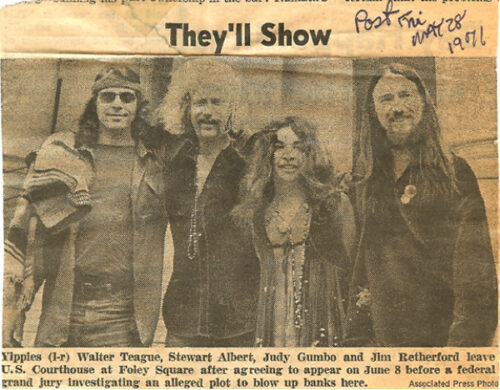
In NYC five movement activists were subpoenaed—myself, Sandra Wardwell (a Santa Barbara activist previously arrested after the burning of a Bank of America branch), veteran New York anti-Vietnam War organizer Walter Teague, and Judy and Stew. (A sixth individual, Chicago-born heiress Ellen Ruth Stone, was also subpoenaed, but after her billionaire father intervened, Stone’s subpoena was quietly quashed.)
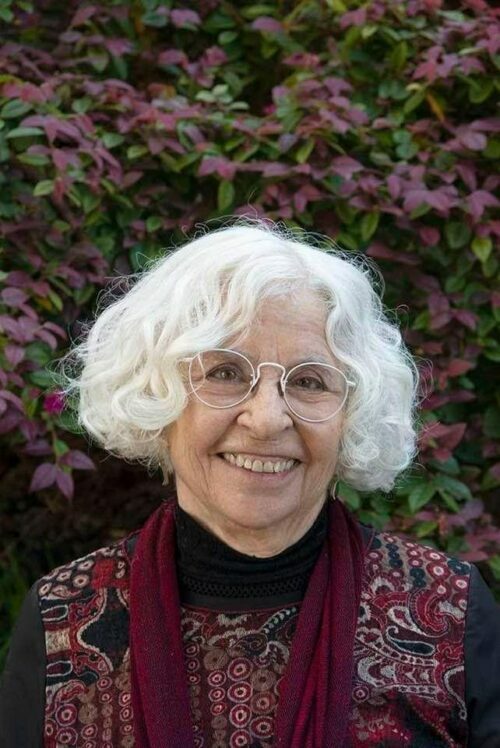

Judy Gumbo.

Myth-making is successful when the myth is far more compelling than the real story. What actually transpired in and around the federal courthouse at Foley Square on June 8, 1971, as the five subpoenaees arrived to face Guy Goodwin’s grand jury was the stuff of collective Yippie legend.

What I participated in, under the towering granite and marble foyer outside the grand jury chambers, was a quintessentially Yippie counteroffensive against the Nixon administration’s war on dissent. It was two-thumbs-up Theatre of the Absurd.

The subpoenaed witnesses came to the courthouse dressed up in crazy-ass costumes and dared Goodwin to call us before his geriatric grand jurors. We oozed ridicule for the whole rotten system.

To call attention to the government’s witch-hunt, Judy and Sandy were dressed as witches in black cloaks and black pointed hats. I came dressed in a head-to-toe gorilla costume wearing a t-shirt that said “King Cong,” because the feds were looking for urban gorillas . (I rode a subway from the Upper West Side in the attire.) Walter was vintage Teague—your everyday working-class commie in blue work shirt festooned with National Liberation Front support buttons. Stew stole the show, showing up, as I wrote in a 2006 Counterpunch tribute, “as a cross-dressing female terrorist bombshell, glamming to the nines in an utterly f-a-b-u-u-u-u-l-o-u-s rainbow-striped minidress with the name ‘Bernardine’ stitched in sequins across the bodice.” (Note: Gumbo quoted my description in Yippie Girl, but attributed my words to a nameless “journalist friend.”)

Sadly Judy’s version of the story completely missed the joyful message of collaboration and resistance. She eschewed the story of shooting our collective finger in the face of government intimidation in order to frame a story celebrating her own heroic smackdown of authority. In doing so, she embraced the male model of shameless self-promotion that she rails against throughout the book.

According to Yippie Girl mythos, Judy says she was the only one of us five to called into the hearing chamber and tells a very anti-climactic (and untrue) story of the experience. As I recollect, Walter, the only one of us who didn’t look like he just stepped out of a cartoon or the funny farm, was the only person summoned to the jury. (A federal marshal informed me that I would have to remove my gorilla suit when I was called. “Okay,“ I said, adding that it was a very hot day and “I wasn’t wearing anything underneath.”)

We all had been well-prepared by our crack legal team headed by Bill Schaap and Lennie Weinglass, and Walter’s appearance lasted less than five minutes. Guy Goodwin opted not to call in the rest of the crazies—it seems a lot of at-risk old people with weak hearts volunteer for grand juries, and he didn’t want to risk an EMS call.

Thus the New York grand jury inquisition came to a fizzling climax, and we Yippies and fellow travelers provided a template for our sisters and brothers facing the same government overreach in other jurisdictions across the country. Authoritarian repression was lampooned to death on its own doorstep.

Judy missed the opportunity to mythologize to our collaborative victory, and this, I think, is the low point of the book.
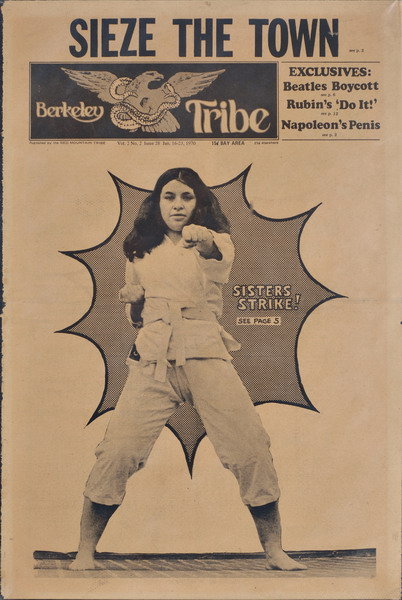

Judy Gumbo on the cover of the Berkeley Tribe

Before I go further, I cannot ignore the fact that I was born with standard male genitalia and use male pronouns and now am attempting to critique—some of you may say, mansplain—a woman’s story about her struggle to be heard above the din of male voices. I will do my best.

Starting at home in Toronto, Gumbo witnessed the effects of patriarchy as her father confidently promoted public relations for the Soviet regime and her mother angrily disappeared into a bottle. Judy didn’t suspect marital infidelity by her father, but fucking around quickly became a factor in her own life after she opened her bedroom door and found her first husband with another woman.

As she became acquainted with the female half of some of the Sixties most prominent “movement power couples,” Kathleen and Eldridge Cleaver, Anita and Abbie Hoffman, Nancy Kurshan and Jerry Rubin—and herself became half of one such power pairing with Stew Albert—she began to discover how poisonous gender inequality can cause distrust among women and cause them to doubt their own minds.

On getting a cold shoulder in her first meeting with Anita Hoffman, Judy writes that she later “understood that Anita’s unfriendliness was not about me—Anita was suspicious of any stranger who happened to be a woman… She faced the traditional, patriarchal bind of a woman married to a charismatic man.”

“Only after the rise of the women’s movement,” Gumbo adds, “did Anita and I become friends.”


To borrow Greek mythology again, Tiresias was the ancient Theban seer who spent seven years as a woman so they could settle an argument between Zeus and Hera about whether men or women enjoyed sex more.

I am no Tiresias, and I am a much older and more testosterone-challenged human than when I waged dada-inspired mindfuck warfare alongside Judy and Stew and the entire Yippie gang in NYC. Call my next remarks mansplaining for men if you will, but I now am gonna tell the brothers why Yippie Girl, in spite of its blemishes, is an important book to read.

If I have learned one thing during a lifetime struggle to both cause change and then embrace it, even when it becomes a little uncomfortable, it is that avoidance of the conversation only breeds hostility and is anathema to change.

For men to become mindful partners in the struggle for social and economic justice, we must open our minds and begin to understand that male privilege, like white privilege and class privilege, is the ravager of egalitarian society.

While Judy Gumbo presents her quest for gender equality as a work in progress, relatively free of what many men misperceive as feminism’s automatic guilty verdict against manhood, she aims to steer her story away from negativity and reproach—except for the drunken Revolutionary Union (RU) cretin [my description] who tried to rape her in Berkeley. She also calls herself out when needed.

Judy’s journey is one of searching for her own better self amidst the detritus of patriarchal leadership norms, and when she succeeds and when she falls short—and I suggest instances of both in my remarks above—her successes and failures have much to offer as men—and women—grapple with the corpulent burden of culture. Men are afflicted with always being right, even when we’re wrong. Women struggle to create a narrative of inclusivity but are sometimes unwittingly lured into easy answers about right and wrong. We as a species are a work in progress.

As the archetypal Yippie Girl, Judy Gumbo still grapples up toward the mountaintop where the boy gods meet and make the rules.


[James Retherford is an Austin-based writer, graphic designer, and political activist, and an occasional contributor to The Rag Blog. Jim, who was active in SDS, the Yippies, and political guerrilla theater, was a founder and editor of underground newspaper The Spectator in Bloomington, Indiana, in 1966, and was the ghost writer for Jerry Rubin’s iconic book, Do It!]

Sunday, January 26, 2020

Yippie! Pop 
Abbie Hoffman Andy Warhol and Sixties Media Politics

DAVID JOSELIT

In his 1968 manifesto,Revolution for the Hell of lt,  Abbie Hoffman wrote:

Did you ever hear Andy Warhol talk? ...Well,I would like to combine his style and that of Castro's. Warhol understands modern media. Castro has the passion for social change.It's not easy. One's a fag and the other is the epitome of virility. If I were forced to make the choice I would choose Castro,but right now in this period of change in the country the styles of the two can be blended. It's not guerrilla warfare but,well maybe a good term is monkey warfare. If the country becomes more repressive we must become Castros. If it becomes more tolerant we must become Warhols. 1

Castro and Warhol:what strange bedfellows And indeed Hoffman hints at a queer union-why else would he explicitly label Warhol a"fag"?But for Hoffman,the yippie! activist who built a movement by capturing free publicity on TV,the nature of this fantasy is genealogical not erotic.2 In their combination of radical politics and a  ruthless understanding of media culture, yippie!s are indeed the legitimate progeny of Castro and Warhol. 


What is puzzling and exhilarating in Hoffman's pairing is the political distinction he draws between his two progenitors:"If the country becomes more repressive we must become Castro s. If it becomes more tolerant we must become Warhols."The first half of this prescription is ordinary enough. When times are bad,activists use force. But the second part is mystifying.Warhol-the paragon of indifference and passivity,the celebrity groupie and ambitious art world operator- is held up as a model of politics appropriate for "tolerant times." In this essay I will reflect on this surprising assertion. I will try to understand Hoffman's declaration by sketching out what a Warholian politics might be and why it is particularly well-suited to"tolerant times."Before I turn to Warhol,I need to establish Hoffman's under-standing of media politics. And for this there is no better source than Hoffman himself. Yippie! actions were premised on soliciting and addressing the media through what Daniel Boorstin famously called pseudo-events. 

Tuesday, January 01, 2008

Forty Years Ago

Happy New Year

2008 is the Fortieth Anniversary of the 1968 Revolution.

And once again the Amerikan Empire is in the throes of a foreign war and a Presidential Election. While a new activist movement has arisen in opposition to Imperialism, Globalization and Capitalism. What goes around comes around....Of course some folks dread that.

Tet Offensive

http://www.vietnamwar.com/tetoffensive.jpg

The Tet Offensive (Tet Mau Than) or Tong Cong Kich/Tong Khoi Nghia (General Offensive, General Uprising) was a three-phase military campaign launched between 30 January and 23 September 1968, by the combined forces of the National Front for the Liberation of South Vietnam (NLF, or derogatively, Viet Cong) and the People's Army of Vietnam (PAVN) during the Vietnam War (1955-1975). The purpose of the operations, which were unprecedented in their magnitude and ferocity, was to strike military and civilian command and control centers throughout the Republic of Vietnam (South Vietnam) and to spark a general uprising among the population that would then topple the Saigon government, thus ending the war in a single blow.

The image “http://www.dmko.info/image2.jpeg” cannot be displayed, because it contains errors.


http://history.sandiego.edu/gen/USPics5/71757a.jpg

http://www.history.army.mil/books/Vietnam/Comm-El/Photos/Map5.jpg


Paris

Constraints imposed on pleasure incite the pleasure of living without constraints.

The more I make love, the more I want to make revolution.
The more I make revolution, the more I want to make love.


Communiqué


Comrades,

Considering that the Sud-Aviation factory at Nantes has been occupied for two days by the workers and students of that city,

and that today the movement is spreading to several factories (Nouvelles Messageries de la Presse Parisienne in Paris, Renault in Cléon, etc.),

THE SORBONNE OCCUPATION COMMITTEE calls for

the immediate occupation of all the factories in France and the formation of Workers Councils.

Comrades, spread and reproduce this appeal as quickly as possible.


Sorbonne, 16 May 1968, 3:30 pm


The image “http://www.tu-cottbus.de/BTU/Fak2/TheoArch/wolke/eng/Subjects/991/McQuillan/11.jpg” cannot be displayed, because it contains errors.
" The only safeguard against authority and rigidity setting-in is a playful attitude."
Raoul Vaneigem.

http://flag.blackened.net/revolt/graphics/pdf/paris68.gif


Chicago


Chicago: demonstrators gather at grant park (Aug. 1968).
photo: Fred W. McDarrah


Theatre of fear: one on the aisle
A view from the Chicago Democratic Convention riots by Richard Goldstein

"You afraid?" I asked a kid from California. He zipped his army jacket up to his neck, and filled his palm with a wad of Vaseline. "I dunno," he answered. "My toes feel cold, but my ears are burning."

We were standing together in Lincoln Park, not long after curfew on Tuesday night, watching an unbroken line of police. Around us were 1000 insurgents: hippies, Marxists, tourists, reporters, Panthers, Angels, and a phalanx of concerned ministers, gathered around a 12-foot cross. Occasionally a cluster of kids would break away from the rally to watch the formation in the distance. They spoke quietly, rubbing cream on their faces, and knotting dampened undershirts around their mouths. Not all their accoutrements were defensive. I saw saps and smoke bombs, steel-tipped boots and fistfuls of tacks. My friend pulled out a small canister from his pocket. "Liquid pepper," he explained.

Watching these kids gather sticks and stones, I realized how far we have come from that mythical summer when everyone dropped acid, sat under a tree, and communed. If there were any flower children left in America, they had heeded the underground press, and stayed home. Those who came fully anticipated confrontation. There were few virgins to violence in the crowd tonight. Most had seen—if not shed—blood, and that baptism had given them a determination of sorts. The spirit of Lincoln Park was to make revolution the way you make love—ambivalently, perhaps but for real.

The cops advanced at 12:40 a.m., behind two massive floodlight-trucks. They also had the fear; you could see it in their eyes (wide and wet) and their mouths. All week, you watched them cruise the city—never alone and never unarmed. At night, you heard their sirens in the streets, and all day, their helicopters in the sky. On duty, the average Chicago cop was a walking arsenal—with a shotgun in one hand, a riot baton (long and heavy with steel tips) in the other, and an assortment of pistols, nightsticks, and ominous canisters in his belt. At first, all that equipment seemed flattering. But then you saw under the helmets, and the phallic weaponry, and you felt the fear again. Immigrant to stranger, cop to civilian, old man to kid. The fear that brought the people of Chicago out into the streets during Martin Luther King's open housing march, now reflected in the fists of these cops. The fear that made the people of Gage Park spit at priests, and throw stones at nuns, now authorized to kill. And you realized that the cops weren't putting on that display for you; no—a cop's gun is his security blanket, just as Vaseline was yours.

Then the lights shone brilliant orange and the tear gas guns exploded putt-putt-puttutt, and the ministers dipped their cross into a halo of smothering fog. The gas hit like a great wall of pepper and you ran coughing into the streets, where you knew there would be rocks to throw and windows to smash and something to feel besides fear.

The soldiers stood on all the bridges, sealing off Grant Park from the city streets. The kids couldn't be gassed anymore, because the wind was blowing fumes across the guarded bridges and into every open pore of the Conrad Hilton, and the hotel was filled with good people who had tears in their eyes. So the soldiers just stood with their empty guns poised against the tide. And they were frowning at the kids who shouted "put down your guns; join us." A few hid flowers in their uniforms, and some smiled, but mostly, they stood posing for their own death masks.

"Wouldn't you rather hold a girl than a gun?" asked one kid with his arm around two willing chicks.

"You don't understand," the soldier stammered, moving his tongue across his lips. "It's orders. We have to be here."

That was Wednesday—nomination day—and the city was braced for escalation. At the afternoon rally, an American flag was hauled down, and the police responded by wading into the center of the crowd, with clubs flying. The kids built barricades of vacated benches, pelted the police with branches, and tossed plastic bags of cow's blood over their heads. . . .

With every semblance of press identification I owned pinned to my shirt, I set out across the mall. But most of the crowd had the same idea. Across on Michigan Avenue, I could hear the shouts of demonstrators who were re-grouping at the Hilton. I stopped to wet my undershirt in a fountain and ran down the street. My hands were shaking with anticipation and I could no longer close my eyes without seeing helmets and hearing chants. So my body was committed, but my head remained aloof.
http://peacecorpsonline.org/messages/imagefolder/knifedchicago.jpg


Czechoslovakia


The Soviet Invasion
of Czechoslovakia: August 1968

Materials from
the Labadie Collection
of Social Protest Material

Soviet tank in front of the Czechoslovak Radio building, photo: CTKSoviet tank in front of the Czechoslovak Radio building, photo: CTK

In the morning hours of August 21, 1968, the Soviet army invaded Czechoslovakia along with troops from four other Warsaw Pact countries. The occupation was the beginning of the end for the Czechoslovak reform movement known as the Prague Spring.

This web site contains material from the days immediately following the invasion, and they reflect the atmosphere in Czechoslovakia at the time: tense, chaotic, uncertain, full of pathos, fear, and expectation...


SDS: Anarchist Libertarian Alliance


The image “http://www.antiauthoritarian.net/sds_wuo/thumbnail/sds_organizer_guide.jpg” cannot be displayed, because it contains errors.
  • SDS Bulletin - July, 1964 (Vol 2, Nr 10)
  • New Left Notes - May 13, 1968 (Vol 3, Nr 17)
  • New Left Notes - March 8, 1969 (Vol 4, Nr 9)


  • First-phase SDSers hadn’t talked much about values. But as anti-war activity heated up during the second phase, SDSers were looking for new worldviews, indulging in new tastes and lifestyles. Pardun, for whom LSD was practically religion, took the hippie lifestyle as a facet of the movement.

    But neither critique nor lifestyle, without political gains, were enough by late 1967, when second-phase leaders began to worry about the realism of their project. Pardun puts its succinctly: "Protesting the war," he writes, "assumed that it was a mistake and that if we could convince the war makers of that then the war would end."

    Escalations in ground forces and bombing–his book recounts them, brigade by brigade, ton by ton–told SDS that the war wasn’t simply a "mistake" and that hawks would not be persuaded–until and unless doves could take power away from them.

    Several prairie leaders, notably Carl Oglesby, Greg Calvert, and Carl Davidson, began to concoct theories to deal with the task. Three elements were common to their formulations: the notion of a "New Working Class," of "resistance," and of youth as a powerful and independent force. The "New Working Class" was a highly technical, white-collar proletariat, whose members, proponents of the theory insisted, were going to replace the blue-collar industrial workforce. "Resistance" was a vaguer idea, which took practical form in a campaign to sabotage and derail the military draft. Youth were "revolutionary" because they weren’t sworn to doctrines about racial supremacy and My Country, Right or Wrong. They also smoked pot.


    Consciousness and Social Life - Google Books Result

    by David H. DeGrood - 1976 - Philosophy - 112 pages
    Now Karl Marx was being referred to, help! theory!45 By the Summer of 1967 ... the Spring of 1968 opportunists such as Carl Oglesby were urging SDS to drop ...

    Building a New Libertarian Movement

    [The following, which I co-authored with the late Samuel Edward Konkin III, originally appeared in slightly different form under the title “Smashing the State for Fun & Profit!” in Tactics of the Movement of the Libertarian Left (Vol. 5, No. 1), May Day 2001. I offer it here as a clarification of “Libertarian Leftism,” an illuminating piece of political revisionist history, and a contribution to Tom Knapp’s ongoing Symposium on Building a New Libertarian Movement. I apologize for its length.]
    What was the New Left in 1965 was conducive to an alliance with Libertarians. Indeed, the New Left and the nascent Libertarian Movement reached out for each other to battle the common enemy, Corporate Liberal Imperial Leviathan. Libertarian Movement founder Murray N. Rothbard traded votes with Maoists at New York Peace & Freedom Party conventions. Rothbard and historian Leonard Liggio started
    Left and Right: A Journal of Libertarian Thought to help forge a Libertarian alliance with the New Left. Carl Oglesby, 1965 president of Students for a Democratic Society (SDS), wrote an analysis of the U.S. Empire, Containment and Change, in which his prescription for defeating the Empire called explicitly for a coalition with the Libertarian “Old Right” as led by Rothbard and Liggio. And Karl Hess, speechwriter for the Goldwater presidential campaign in 1964, determined by 1968 that he had more in common with the New Left than Buckley’s Right and penned his stirring “Death of Politics” Libertarian manifesto for Playboy magazine.

    But those “Old Left” commune-statists were not, to use that familiar Trotskyist phrase, “decisively defeated on the proletarian terrain.” By the time of its 1969 convention, SDS expelled its anarchists and split between Maoists and WeatherMaoists. After a brief exhibition of street violence, the “vanguard” collapsed underground with an occasional eruption over the years. Also in 1969, Libertarian Rightists, inspired by Rothbard and led by Hess, walked out of the Young Americans for Freedom (YAF) convention to join the New Left. And unfortunately, even the first Libertarian Con that year in New York, which brought together disenfranchised SDS decentralists and YAF free-marketeers, also split — not on Left-Right lines but on revolutionary rage vs. quite academic movement-building lines.

    YIPPIE!

    The image “http://upload.wikimedia.org/wikipedia/en/e/e4/Us-yip.gif” cannot be displayed, because it contains errors.

    The Youth International Party (whose adherents were known as Yippies, a variant on "Hippies") was a highly theatrical political party established in the United States in 1967. An offshoot of the free speech and anti-war movements of the 1960s, the Yippies presented a more radically youth-oriented and countercultural alternative to those movements. They employed theatrical gestures—such as advancing a pig ("Pigasus the Immortal") as a candidate for President in 1968—to mock the social status quo.They have been described as a highly theatrical youth movement of “symbolic politics.”


    It was during the conventions in 1968 that the Yippies really made a national splash.


    At the turbulent Democratic gathering in Chicago, Yippie founders Abbie Hoffman and Jerry Rubin presented their candidate for president – "Pigasus the Immortal," a real pig.

    But the scene at the convention turned ugly as Chicago police, and then the National Guard, clashed with antiwar protesters. In the aftermath, Hoffman and Rubin were among seven protesters arrested and charged with conspiring to incite violence.

    During the trial of the so-called "Chicago Seven," Hoffman and Rubin continued to play to the media, one day showing up for court in judicial robes. Ultimately, the charges against the defendants were dismissed.

    Paul Krassner, who was among the founding members of the Yippies with Hoffman and Rubin, said the party came about because "the whole antiwar effort seemed dreary. .. We wanted to add some color and fun to the demonstrations."

    Abbie Hoffman.


    Yippie Workshop Speech by Abbie Hoffman (1968)

    Cops are like Yippies-you can never find the leaders... You just let 'em know that you're stronger psychically than they are. And you are, because you came here for nothin' and they're holdin' on to their fuckin' pig jobs 'cause of that little fuckin' paycheck and workin' themselves up, you know. Up to what? To a fuckin' ulcer. Sergeant. We got them by the balls. The whole thing about guerrilla theatre is gettin' them to believe it. Right.

    Theatre, guerrilla theatre, can be used as defense and as an offensive weapon. I mean, I think like people could survive naked, see. I think you could take all your fuckin' clothes off, a cop won't hit ya. You jump in Lake Michigan, he won't go after you, but people are too chickenshit to do that. It can be used as an offensive and defensive weapon, like blood. We had a demonstration in New York. We had seven gallons of blood in little plastic bags. You know, if you convince 'em you're crazy enough, they won't hurt ya. With the blood thing, cop goes to hit you, right, you have a bag of blood in your hand. He lifts h is stick up, you take your bag of blood and go whack over your own head. All this blood pours out, see. Fuckin' cop standin'. Now that says a whole lot more than a picket sign that says end the war in wherever the fuck it is you know. I mean in that demonstration, there was a fuckin' war there. People came down and looked and said holy shit I don't know what it is, blood all over the fuckin' place, smokebombs goin' off, flares, you know, tape recorders with the sounds of machine guns, cops on horses tramplin' Christmas shoppers. It was a fuckin' war. And they say, right, I know what the fuck you're talkin' about. You're talkin' about war. What the fuck has a picket line got to do with war? But people that are into a very literal bag, like that heavy word scene, you know, don't understand the use of communication in this country and the use of media. I mean, if they give a ten-page speech against imperialism, everybody listens and understands and says yeah. But you throw fuckin' money out on the Stock Exchange, and people get that right away. And they say, right, I understand what that's about. And if they don't know what you're doin', fuck 'em. Who cares? Take this, see, you use blank space as information. You carry a sign that says END THE. You don't need the next word, you just carry a sign that says END, you know. That's enough. I mean the Yippie symbol is Y. So you say, why, man, why, why? Join the Y, bring your sneakers, bring your helmet, right, bring your thing, whatever you got. Y, you say to the Democrats, baby, Y that's not a V it's a Y. You can do a whole lotta shit. Steal it, steal the V, it's a Y. It's up the revolution like that. Keeping your cool and having good wits is your strongest defense.

    If you don't want it on TV, write the work "FUCK" on your head, see, and that won't get on TV, right? But that's where theatre is at, it's TV. I mean our thing's for TV. We don't want to get on Meet the Press. What's that shit? We want Ed Sullivan, Johnny Carson show, we want the shit where people are lookin' at it and diggin' it. They're talking about reachin' the troops in Viet Nam so they write in The Guardian! [An independent radical newsweekly published in New York.] That's groovy. I've met a lot of soldiers who read The Guardian, you know. But we've had articles in Jaguar magazine, Cavalier, you know, National Enquirer interviews the Queen of the Yippies, someone nobody ever heard of and she runs a whole riff about the Yippies and Viet Nam or whatever her thing is and the soldiers get it and dig it and smoke a little grass and say yeah I can see where she's at. That's why the long hair. I mean shit, you know, long hair is just another prop. You go on TV and you can say anything you want but the people are lookin' at you and they're lookin' at the cat next to you like David Susskind or some guy like that and they're sayin' hey man there's a choice, I can see it loud and clear. But when they look at a guy from the Mobilization [against the War in Vietnam] and they look at David Susskind, they say well I don't know, they seem to be doing the same thing, can't understand what they're doin'. See, Madison Avenue people think like that. That's why a lot SDS's don't like what we're doin'. 'Cause they say we're like exploiting; we're usin' the tools of Madison Ave. But that's because Madison Ave. is effective in what it does. They know what the fuck they're doin'. Meet the Press, Face the Nation, Issues and Answers-all those bullshit shows, you know, where you get a Democrat and a Republican arguin' right back and forth, this and that, this and that, yeah yeah. But at the end of the show nobody changes their fuckin' mind, you see. But they're tryin' to push Brillo, you see, that's good, you ought to use Brillo, see, and 'bout every ten minutes on will come a three-minute thing of Brillo. Brillo is a revolution, man, Brillo is sex, Brillo is fun, Brillo is bl bl bl bl bl bl bl bl. At the end of the show people ain't fuckin' switchin' from Democrat to Republicans or Commies, you know, the right-wingers or any of that shit. They're buying Brillo! And the reason they have those boring shows is because they don't want to get out any information that'll interfere with Brillo. I mean, can you imagine if they had the Beatles goin' zing zing zing zing zing zing zing, all that jump and shout, you know, and all of a sudden they put on an ad where the guy comes on very straight: "You ought to buy Brillo because it's rationally the correct decision and it's part of the American political process and it's the right way to do things." You know, fuck, they'll buy the Beatles, they won't buy the Brillo.

    We taped a thing for the David Susskind Show. As he said the word hippie, a live duck came out with "HIPPIE" painted on it. The duck flew up in the air and shat on the floor and ran all around the room. The only hippie in the room, there he is. And David went crazy. 'Cause David, see, he's New York Times head, he's not Daily News freak. And he said the duck is out and blew it. We said, we'll see you David, goodnight. He say, oh no no. We'll leave the duck in. And we watched the show later when it came on, and the fuckin' duck was all gone. He done never existed. And I called up Susskind and went quack quack quack, you motherfucker, that was the best piece of information: that was a hippie. And everything we did, see, non-verbally, he cut out. Like he said, "How do you eat?" and we fed all the people, you know. But he cut that out. He wants to deal with the words. You know, let's play word games, let's analyze it. Soon as you analyze it, it's dead, it's over. You read a book and say well now I understand it, and go back to sleep.

    The media distorts. But it always works to our advantage. They say there's low numbers, right? 4000, 5000 people here. That's groovy. Think of it, 4000 people causin' all this trouble. If you asked me, red say there are four Yippies. I'd say we're bringin' another four on Wednesday. That's good, that freaks 'em out. They're lookin' around. Only four. I mean I saw that trip with the right wing and the Communist conspiracy. You know, you'd have 5000 people out there at the HUAC demonstrations eight years ago in San Francisco and they'd say there are five Communists in the crowd, you know. And they did it all. You say, man that's pretty cool. So you just play on their paranoia like that. Yeah, there're four guys out around there doin' a thing. So distortion's gonna backfire on them, 'cause all of a sudden Wednesday by magic there are gonna be 200,000 fuckin' people marchin' on that amphitheater. That's how many we're gonna have. And they'll say, "Wow. From 4000 up to 200,000. Those extra four Yippies did a hell of a good job." I dig that, see. I'm not interested in explainin' my way of life to straight people or people that aren't interested. They never gonna understand it anyway and I couldn't explain it anyway. All I know is, in terms of images and how words are used as images to shape your environment, the New York Times is death to us. That's the worst fuckin' paper as far as the Yippies are concerned. They say, "Members of the so-called Youth International Party held a demonstration today." That ain't nothin'. What fuckin' people read that? They fall asleep. 'Cause the New York Times has all the news that's fit to print, you know, so once they have all the news, what do the people have to do? They just read the New York Times and drink their coffee and go back to work, you know. But the Daily News, that's a TV set. Look at it, I mean look at the picture right up front and the way they blast those headlines. You know, "Yippies, sex-loving, dope-loving, commie, beatnik, hippie, freako, weirdos." That's groovy, man, that's a whole life style, that's a whole thing to be, man. I mean you want to get in on that.


    ABBIE HOFFMAN

    1936-1989

    This site is dedicated to the memory and spirit of Abbie Hoffman.

    "Revolution is not something fixed in ideology, nor is it something fashioned to a particular decade. It is a perpetual process embedded in the human spirit."

    Abbie Hoffman

    Soon to be a Major Motion Picture

    abbie hoffman
    by Alex Burns (alex@disinfo.com) - May 29, 2001

    Abbie Hoffman (1936-1989) was a complex and deeply paradoxical social activist and media celebrity, whose legendary culture-jamming exploits have come to characterise the period's para-political turmoil and counter-culture.

    His early 1950s experiences as a Brandeis student and sexual experienced aesthete marked Hoffman as a future American Rebel (Outsider). Under the tutelage of famous humanist psychologist Abraham Maslow, Hoffman conceived of political protest as a positive and life-affirming self-actualising process.

    During the early 1960s, Hoffman was involved with civil rights activism as an organiser in Mississipi for the Student Non-violent Co-ordinating Committee. In San Francisco's Haight-Ashbury district, Hoffman became involved with the Diggers (actors turned social activists), distributing free food and organising accomodation.

    He first came to national exposure with Jerry Rubin during the infamous 1967 New York Stock Exchange "money-burning" incident. Through his involvement with anti-Vietnam War protests and the Chicago Eight trial which resulted from 1968 Chicago Democratic convention riots, Hoffman became a counter-culture icon and the face of American radical dissidence.

    Hoffman mixed with many of the leading protesters, including John Lennon and Yoko Ono, Tom Hayden, Timothy Leary and G. Gordon Liddy, and was notable for fusing creativity with righteous fury and savage humour. He pioneered many tactics of guerilla survival and personal autonomy.

    Drifting into an outlaw life-style, Hoffman was implicated in a 1973 cocaine deal gone wrong, and busted by undercover agents. Fleeing, Hoffman lived underground for six years, working on environmental campaigns.

    Re-surfacing in 1980, Hoffman served a brief prison sentence, before returning to social activism. Hoffman battled many fronts, but his demons were largely personal, in an environment that had dramatically changed since the demise of the Counter-culture. Psychosis, substance abuse and relationship breakdowns created a messy personal life.

    The rise of the Moral Majority as a political force, increased on-campus student conservatism and a critical re-appraisal of New Left radicalism countered his many attempts to re-mobilise university campus and environmental progressive forces into raising hell.

    Hoffman also encountered a media backlash against his clown persona and culture-jamming legacy, as many critics claimed that he had betrayed his earlier ideals.

    But despite his deep flaws, Hoffman remained committed to progressive campaigning, and criticised the Reagan administration's War on Some Drugs.

    Hoffman's social revolution ideals were finally realised through the 1989 collapse of Eastern European 'puppet' Communist states, but plagued by manic depression, Hoffman had died by suicide.

    Sadly, he did not live to see the resurgence of his ideas and radicial dissidence in the 1990s by a variety of individuals and progressive foundations.

    Hoffman's legacy has been chronicled in several excellent biographies: Marty Jezer's American Rebel (1992); Damien Simon and Jack Hoffman's Run Run Run (1994); Jonah Raskin's For the Hell of It and Larry 'Ratso' Sloman's Steal This Dream (1998).


    Who is Jerry Rubin?

    the co-founder of the Yippies

    IPB Image

    Jerry C. Rubin was perhaps the most outlandish figure to ever defended American civil liberties. A revolutionary and anti-war activist, his voice and zany stunts were heard and seen throughout the world. Rubin was a master of media sensationalism, exposing American injustice through outrageous spectacles and whimsical press conferences. His outrageousness and free style made him a household name, and soon every politician's worst nightmare.

    During the 70's Rubin reflected about his past deeds and thoughts. In essays he would admit his wrongs, explaining how sexism, homophobia, racism, and drug abuse shaped his beliefs. Once believing homosexuality was a sick behavior, he now understood it as a valid sexual expression. He also thanked women for the role they played in creating his public image: women were the ones who typed his manuscripts, handled his clerical work, and labored behind the scenes. He abandoned his "Kill You Parents" mantra and encouraged people to accept the "Love Your Parents" wisdom.

    In the 80's Rubin slowly removed himself from the media spotlight, complaining, "To live inside a media image is like a prison. Living for your image means sacrificing your true self." He made a few guest appearances with Abbie Hoffman and appeared in the movies "Growing Up in America" (1987), "Rude Awakening" (1989), and "Panther" (released 1995).

    Rubin died on November 28, 1994 when he was struck by a car while jay walking in Los Angeles. He was buried at Hillside Memorial Park in Culver City, California.

    Anita Hoffman: 16 March, 1942 - December 27, 1998


    The Yippies didn't just want to sit around and smoke pot. They sought to pull Uncle Sam's pants down in public, to show that revolution could be conducted in a spirit of festive nonviolence.

    Dubbing her the "Queen of the Yippies," the U.K.'s Economist (not exactly a radical publication) had this to say of Anita Hoffman and her husband Abbie: "Perhaps the most famous song of the 1960s was Bob Dylan's 'The Times They Are A'Changin'', in which 'senators, congressmen' and others stuck in the past were warned of the 'battle outside raging.' No one fought the battle with more enthusiasm than the Hoffmans, Abbie and Anita."

    > The Hoffmans became the symbols of an era of resistance against racism, capitalism and war.


    Steal this millennium!

    Yippie Stew Albert sits down with R.U. Sirius to plan the revolution and remember Abbie Hoffman.

    - - - - - - - - - - - -
    By R.U. Sirius


    Stew Lives!

    Activist Stew Albert's quest for social and economic justice found its path in the Yippie movement of the late 1960s

    By Michael Simmons

    Photo by Judy Gumbo Albert

    HUNGRY FOR JUSTICE: Yippie Stew Albert, 1939-2006.

    "My politics have not changed."

    So read the simple blog entry by Stew Albert on Jan. 28. Two days later, he died in his sleep at his home in Portland, Ore., surrounded by his wife Judy Albert, daughter Jessica and friends. Suffering from cancer and unable to write at length, he was clearly determined to make a statement - a last stand - that blended the legendary Yippie's defiance and wit. As if his politics would ever change!

    For the Yippies - the Youth International Party - the word "party" meant both political group and outrageously good times. The Yippies merged leftwing activism and freak culture in the late 1960s. One of the "non-leaders" along with Abbie Hoffman, Jerry Rubin and Paul Krassner was another party animal - equally irresponsible for the chaos and comedy: Stew Albert, a fierce soldier for justice as well as a subversive prankster.


    Yippies on Wall Street (1)

    The image “http://sniggle.net/Images/yippie1.gif” cannot be displayed, because it contains errors.


    http://static.flickr.com/36/75282044_4dc36a22e1.jpg


    http://www.cafes.net/ditch/shards.jpg


    This guy was not a YIPPIE!

    http://www.lib.berkeley.edu/MRC/pacificaviet/kerry.jpg

    SEE

    Gay Old Communists

    The Summer of Love

    40 Years Later; The Society of the Spectacle

    Year of the Pig

    Black and Redmonton

    Paul Goodman

    Military Industrial Complex

    SOME REMARKS ON WAR SPIRIT


    Find blog posts, photos, events and more off-site about:
    , , , , , , , , , , , , , , ,
    , , ,, , , , , , ,
    , , , , , , , , , , , , ,, , , , , , , , , , , , , , , , , , ,, , Trotsky, , , , , , , , , , , , , , , , , , , , ,

    Friday, December 13, 2024

     REST IN POWER

    Tribute to Dariano, Anarchist and Mail Artist

    from International Union of Mail-Artists
    November 18, 2024

    "A Greeting with the Force of the Wind"
    A tribute to a dear friend and comrade, who after a lifelong militancy has left us, present in a thousand struggles, social, cultural and political initiatives, because he believed that society could be changed in a libertarian sense with personal commitment and mutual aid.

    Submit tribute mail art to:
    Circolo "Al Bafo" | Piazza Bolognini, 8 | 24068 Seriate BG, Italy
    required dimensions 148 x 105 mm | 5.8 x 4.1 in

    ---------------------------------

    A Compagno has Left Us. In Memory of Doriano Rota.
    From Umanità Nova
    September 8, 2024

    On Thursday, July 18, 2024, after about 2 months of illness and a hospital stay, comrade Doriano Rota died of cancer at the age of 69. He had only been able to obtain a modest pension for a few years after about 43 years of work, mostly as a craftsman tiler, but in reality essentially dependent on the subcontracts of the building contractors who allowed him to work. That's right, "allowed", because: after an initial youthful experience of working in a factory, of strikes, of struggles, of political choices that had led him to join Avanguardia Operaia, of alternative experiences that had led him to live in a youth commune in Verdello, in the 70s of the last century; for him, as for many others, the oppressive conformist Christian Democrat/Catholic/bigoted/authoritarian/exploitative society had catalogued him among the bad guys, creating serious difficulties for him in re-entering the working world, forcing him to make do, because our post-war society did not and does not forgive those who oppose it, those who want to experiment with a new social life of solidarity. We emphasize this aspect because the mass media tend to make anarchists appear almost only as artists or rich kids, while the reality is that the majority come from proletarian families of employed workers.

    These were therefore difficult experiences that had made him decide to change his surroundings and from Bergamo he then lived for a few years in Sardinia, returning to the Lombardy province towards the mid-80s, with his partner, with whom he would have two children, always maintaining a vivid and esteemed memory of the land and the Sardinian experience.

    It is precisely in this period that the meeting between us young anarchists of the “Freccia Nera” group of Bergamo and Doriano takes place, a frequentation that will immediately become assiduous and will never stop. With a character that is sometimes gruff, frank, of few words, rough, he did not fail to argue, discuss, to be reserved, but in essence, if the acquaintance continued and if concrete experiences of doing together materialized, his closeness and friendship was true, always ready, as soon as he could, to lend a hand to organize the various locations where the anarchist group wandered; organize concerts, parties, demonstrations and the most varied political, cultural, social, environmentalist, animalist activities, in which the libertarian spirit could be present and proposed.

    We remember, starting from the mid-90s, his constant commitment to spreading through the book stall - which he had taken over from other comrades of the group - anarchist, libertarian and alternative ideas to the capitalist/nationalist/authoritarian society; a practice that he carried on for about 35 years, with the additional annual commitment of the organization of the Bergamo Anarchist and Libertarian Publishing, which followed in various city spaces, for 24 years. It will be our commitment to organize the 25th edition in December of this year, in addition to remembering as always the assassination of Giuseppe Pinelli and the State Massacre of Piazza Fontana, also in his memory.

    Beyond the adversities of his life, we want to remember the respect he had for the land and the peasant work, his desire to know, to socialize, his artistic passion that he had expressed especially in mail art, participating, promoting and organizing various initiatives and exhibitions; a very recent one, on the genocide of the Palestinian people in Gaza in partnership with the ARCI "Al Bafo" Circle of Seriate. Lately he had then applied himself with interest to the creation of mosaics, in the realization of which he combined his creative and working skills.

    Working skills as a tiler that he made available to his comrades, for example, for the arrangement of the anarchist headquarters in Viale Monza, 255 in Milan and for the headquarters of the Germinal Anarchist Group in Trieste, works of which, speaking among ourselves, he was quietly proud.

    His, a life-long militancy, made of readings and many practical actions, because he believed that society could be changed in a libertarian sense with personal commitment and mutual support. The feeling of brotherhood and friendship that united us, will remain an indelible memory.

    Dean Tuckerman 1952-2024

    From Slingshot, Issue #141, Winter 2024
    October 10, 2024

    By dress wedding

    The world and our Bay Area anarchist community lost the feisty and wondrous Dean Tuckerman on May 30, 2024. Born in Philadelphia on March 28, 1952, his mother imparted to him that he should think highly of himself, despite his challenges with cerebral palsy, and not take shit from anyone. Dean moved to New York City in the early 1970’s to join the Yippie! (Youth International Party) at the infamous Bleecker Street household. He installed himself as the greeter, helping new comrades figure out how to help the cause or find their way around town. He was assigned to attaining permits for events, as his inimitable and persistent style left typical bureaucrats racing to find a way to get him out of their offices quickly. He helped organize many Yippie! marijuana smoke-ins on the White House lawn in Washington DC. According to his long-time friend Mitchell Halberstadt, Dean was one of most emotionally and spiritually strong people he ever knew.

    Dean provided decades of legal support, as a contact and a paralegal, whether he himself was in or out of jail. This applied both to political cases and to marijuana cases. He attended numerous National Lawyers Guild national conferences and was likely a member.

    When he first arrived on the West Coast in the early 80’s, Dean lived in a variety of SROs in the Tenderloin and the East Bay. After getting his own apartment near Ashby BART, Dean let numerous friends and comrades crash in his living room, some for months at a time. He was a fixture at the Long Haul and at every sort of anarchist and gay political action in the Bay Area.

    Around 2012, he moved to Bellingham to be near his close friend, “movement” attorney Larry Hildes and his wife Karen. Karen died of a brain tumor in 2019, and Larry died a year or two later of congestive heart failure. That left Dean fairly isolated in WA state, living in a studio apartment in a high-rise for seniors and disabled people.

    Dean came to the Bay Area last April for the Folsom Street Fair and the Anarchist Book Fair. Finding himself stumbling, he tried to get admitted to SF General Hospital but was turned away. After he fell and hurt himself, he was brought to UCSF in an ambulance and admitted with no real diagnosis and fairly comatose. After weeks of little improvement, the State of California shirked the costly medical expense by having him flown back to Seattle, where he remained in a hospital, away from his community and friends, until his death.

    Presente Dean Tuckerman

    What is Remembered Lives!

    Bergamo comrades of the Freccia Nera / Spazio Anarchico Underground anarchist group who have shared a good stretch of the journey with you. Ciao.