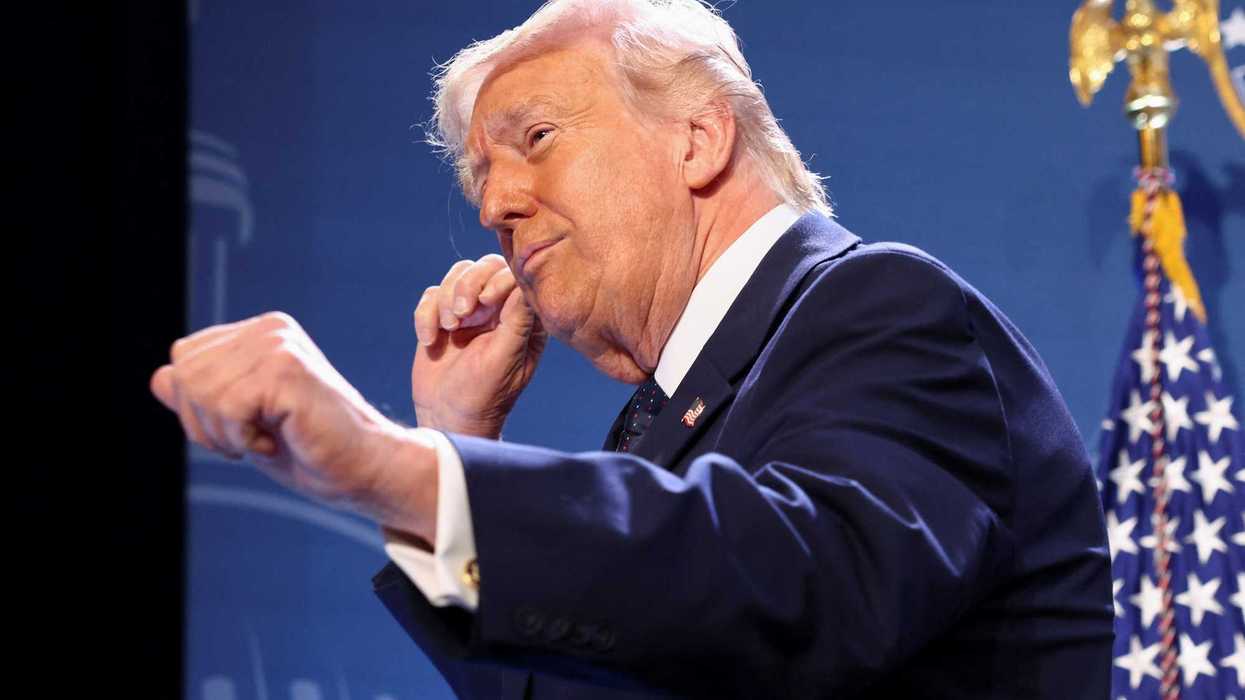
U.S. President Donald Trump dances after delivering remarks to members of the Republican Party, at Trump National Doral Miami in Miami, Florida, U.S., March 9, 2026. REUTERS/Kevin Lamarque
March 23, 2026
ALTERNET
President Donald Trump’s “recent adventurism” in Iran is likely to fail, warned a retired four-star general on Monday — and it is because he does not understand the magnitude of what he has done in Iran.
Speaking with David French of The New York Times, retired General Stanley A. McChrystal linked Trump’s invasion of Iran with his unilateral tariffs, economic confrontation with China and threats toward Canada and Denmark
“Now, there was no military action taken. But there was no cost to it,” McChrystal told French. “And then shooting at the drug boats in the Caribbean was a muscular way to do something. I don’t think it had any effect. But the Maduro raid, I think, crossed a point in which the president got seduced by one of the things I mentioned — the idea that you can do something on the cheap if you’re clever enough and you can pull it off.”
Yet even though Trump succeeded in Venezuela, that does not mean the same tactics will work elsewhere.
“The thing about Special Operations missions is they are high risk,” McChrystal told French. “We say, ‘Well, they’re high risk, but they always work.’ No, they don’t. That’s what makes them high risk.”
Despite this drawback, Trump “got emboldened” by his success in Venezuela, and that made him more susceptible to the arguments made by Israeli Prime Minister Benjamin Netanyahu for invading Iran.
“I think he got caught up in the current of it,” he concluded.
At another point in his conversation with French, McChrystal addressed the argument that the military today is more sophisticated than it was when McChrystal served, and that he therefore may be underestimating its ability to quickly win in Iran.
“I have to keep an open mind that it is possible that the dynamic has changed so much that we finally hit a tipping point where it will be decisive,” McChrystal acknowledged. “But I’m not seeing that, and I don’t feel that. The other part that I would bring out is we thought really early in Afghanistan that the people on the ground who we were targeting would be awed and intimidated by the bombing and that they would respect our capability. In many ways, what we found, particularly with the tribal members, is that they were disdainful of it.”
For his part, French argued earlier in March that Trump would need a “military miracle” to win in Iran quickly and permanently.
“Here is the present situation, in a nutshell: The United States and Israel have established absolute air dominance over the nation of Iran,” French opined. “In a few short days, our combined forces have destroyed Iran’s ability to protect its own airspace, have killed much of Iran’s senior military and civilian leadership, and have sunk much of Iran’s navy.”
Citing the Institute for the Study of War, French said America cannot afford to leave Iran without reopening the Strait of Hormuz, lest Iran view its shutdown as a tactical victory.
“That’s the logic that leads to a quagmire,” French explained. “If America declares victory now, when the Iranian regime is still in power and the strait is closed, then Iran perversely can claim that it won. It took a huge punch, absorbed the blow, and still forced America to climb down. It employed its ultimate weapon — closing the strait — and America had no effective answer.”
He added, “Commit to opening the strait (and keeping it open) by force, and the U.S. may well find itself in yet another open-ended, costly conflict with at least some American soldiers on Iranian soil. This would be war on our enemy’s terms and terrain, with the potential of slowly but surely inflicting casualties and costs on the American military until we grow tired of the conflict and leave.” Only a “military miracle” can stave off both, “a fast campaign with minimal casualties that can quickly reopen the strait, minimize harm to the international economy and leave Iran almost entirely toothless, unable to inflict military or economic damage on its foes.”
Brett McGurk, the Special Presidential Envoy for the Global Coalition to Counter the Islamic State of Iraq and the Levant under both President Barack Obama and Trump himself, told CNN’s Kasie Hunt on Monday that his various war gaming for the US-Iran war did not account for America killing most of Iran’s previous leadership.
“Kasie, I've war-gamed the Iran war plan a number of times across multiple administrations,” McGurk explained. “And I think what the administration said earlier — a 4-to-6-week military campaign — was about right. If you're going to degrade Iran's defense industrial base, the missiles, the drones, everything, it takes 4 to 6 weeks.”
Yet “the one thing that usually did not happen in those war games was that on Day One of the campaign, you took out the entire Iranian leadership,” McGurk added. “That brought this to a whole new level. And therefore the fact that Iran is turning everything on — I think that's not particularly surprising. But we're only about halfway through from where it was originally planned.”
President Donald Trump’s “recent adventurism” in Iran is likely to fail, warned a retired four-star general on Monday — and it is because he does not understand the magnitude of what he has done in Iran.
Speaking with David French of The New York Times, retired General Stanley A. McChrystal linked Trump’s invasion of Iran with his unilateral tariffs, economic confrontation with China and threats toward Canada and Denmark
“Now, there was no military action taken. But there was no cost to it,” McChrystal told French. “And then shooting at the drug boats in the Caribbean was a muscular way to do something. I don’t think it had any effect. But the Maduro raid, I think, crossed a point in which the president got seduced by one of the things I mentioned — the idea that you can do something on the cheap if you’re clever enough and you can pull it off.”
Yet even though Trump succeeded in Venezuela, that does not mean the same tactics will work elsewhere.
“The thing about Special Operations missions is they are high risk,” McChrystal told French. “We say, ‘Well, they’re high risk, but they always work.’ No, they don’t. That’s what makes them high risk.”
Despite this drawback, Trump “got emboldened” by his success in Venezuela, and that made him more susceptible to the arguments made by Israeli Prime Minister Benjamin Netanyahu for invading Iran.
“I think he got caught up in the current of it,” he concluded.
At another point in his conversation with French, McChrystal addressed the argument that the military today is more sophisticated than it was when McChrystal served, and that he therefore may be underestimating its ability to quickly win in Iran.
“I have to keep an open mind that it is possible that the dynamic has changed so much that we finally hit a tipping point where it will be decisive,” McChrystal acknowledged. “But I’m not seeing that, and I don’t feel that. The other part that I would bring out is we thought really early in Afghanistan that the people on the ground who we were targeting would be awed and intimidated by the bombing and that they would respect our capability. In many ways, what we found, particularly with the tribal members, is that they were disdainful of it.”
For his part, French argued earlier in March that Trump would need a “military miracle” to win in Iran quickly and permanently.
“Here is the present situation, in a nutshell: The United States and Israel have established absolute air dominance over the nation of Iran,” French opined. “In a few short days, our combined forces have destroyed Iran’s ability to protect its own airspace, have killed much of Iran’s senior military and civilian leadership, and have sunk much of Iran’s navy.”
Citing the Institute for the Study of War, French said America cannot afford to leave Iran without reopening the Strait of Hormuz, lest Iran view its shutdown as a tactical victory.
“That’s the logic that leads to a quagmire,” French explained. “If America declares victory now, when the Iranian regime is still in power and the strait is closed, then Iran perversely can claim that it won. It took a huge punch, absorbed the blow, and still forced America to climb down. It employed its ultimate weapon — closing the strait — and America had no effective answer.”
He added, “Commit to opening the strait (and keeping it open) by force, and the U.S. may well find itself in yet another open-ended, costly conflict with at least some American soldiers on Iranian soil. This would be war on our enemy’s terms and terrain, with the potential of slowly but surely inflicting casualties and costs on the American military until we grow tired of the conflict and leave.” Only a “military miracle” can stave off both, “a fast campaign with minimal casualties that can quickly reopen the strait, minimize harm to the international economy and leave Iran almost entirely toothless, unable to inflict military or economic damage on its foes.”
Brett McGurk, the Special Presidential Envoy for the Global Coalition to Counter the Islamic State of Iraq and the Levant under both President Barack Obama and Trump himself, told CNN’s Kasie Hunt on Monday that his various war gaming for the US-Iran war did not account for America killing most of Iran’s previous leadership.
“Kasie, I've war-gamed the Iran war plan a number of times across multiple administrations,” McGurk explained. “And I think what the administration said earlier — a 4-to-6-week military campaign — was about right. If you're going to degrade Iran's defense industrial base, the missiles, the drones, everything, it takes 4 to 6 weeks.”
Yet “the one thing that usually did not happen in those war games was that on Day One of the campaign, you took out the entire Iranian leadership,” McGurk added. “That brought this to a whole new level. And therefore the fact that Iran is turning everything on — I think that's not particularly surprising. But we're only about halfway through from where it was originally planned.”
War-gamer exposes Trump's fatal miscalculation in Iran
March 23, 2026
ALTERNET
President Donald Trump’s surprise war against Iran did not factor in the implications of an important consideration, and a foreign policy expert who “war gamed” this conflict is calling it out.
“Kasie, I've war-gamed the Iran war plan a number of times across multiple administrations,” Brett McGurk, the Special Presidential Envoy for the Global Coalition to Counter the Islamic State of Iraq and the Levant under both President Barack Obama and Trump himself, told CNN’s Kasie Hunt on Monday. “And I think what the administration said earlier — a 4-to-6-week military campaign — was about right. If you're going to degrade Iran's defense industrial base, the missiles, the drones, everything, it takes 4 to 6 weeks.”
Yet there is one variable that did not happen in those war games, and it makes a big difference.
“The one thing that usually did not happen in those war games was that on Day One of the campaign, you took out the entire Iranian leadership,” McGurk told Hunt. “That brought this to a whole new level. And therefore the fact that Iran is turning everything on — I think that's not particularly surprising. But we're only about halfway through from where it was originally planned.”
Earlier in his interview with Hunt, McGurk criticized Trump’s press conferences about the Iran war for their “stream of consciousness” quality and added that Trump is probably trying to buy time to resolve the ongoing crisis over Iran blocking the Strait of Hormuz.
“I think here, this is the president buying some time — calming the economic situation in markets and energy prices — because that buys you time,” McGurk told Hunt. “And that is the one tool the Iranians are playing. It's also buying some time to get forces into place. We still have forces moving as we try, over this five-day period, to see if diplomacy has a chance. I hope it does. I hope an Iranian can come forward and say, ‘I'm speaking now for what's left of our system, and we're prepared to sit down and do a deal.’”
Yet he added, “I'm just — I don't see that happening. So I suspect that by the end of this week, the military campaign is continuing. We're not hitting energy sites, but we're hitting everything else that was on the target list. That will continue through the week, and by the weekend, we might be kind of back to where we started — with Marine Expeditionary Units moving in and other things that give the president a number of options. So I don't see this ending anytime soon, Kasie. I'm just trying to analyze it as best I can in a neutral way.”
Hunt then asked Marc Short, who served as Trump's legislative affairs director from 2017 to 2018, about the president's mindset in approaching this war. He agreed with McGurk's analysis, adding that "he's giving himself five days to see if any negotiations happen."
Trump’s problems do not end with the chaos caused by assassinating Iran’s leadership. Phil Klay, a novelist and Marine Corps veteran from President George W. Bush’s Iraq war, explained in The New York Times earlier this month that the war’s prosecution has been inherently demoralizing.
“I have plenty of complaints about the war I served in two decades ago: the Iraq war was ill-conceived, hubristic and marred by poor leadership at the highest level,” Klay wrote. “But I did know why I was there. What exactly do our service members think we’re trying to do in Iran?”
Denouncing the Trump administration’s “stunningly incoherent” explanations for the war, Klay concluded that “in President Trump’s America, there may be only two genders, but our military adventures can identify however they please.” Noting that they seem to exult in “mixing images of death and destruction with footage from video games or sports highlights,” Klay described the president’s actions as “macho posturing.”
Similar to McGurk and Klay, former U.S. ambassador to Lebanon Jeffrey Feltman and Levant director for the Pentagon Mara Karlin wrote in The New York Times earlier in March that Trump’s “cavalier approach” in Iran is putting Americans and others in danger. In addition to leaving U.S. diplomats and their families on their own to evacuate the Middle East, they also pointed out that America is not accounting for the scale of the Iranian response, which has shut down travel across the region and increases the risk of retaliatory acts of terrorism.
President Donald Trump’s surprise war against Iran did not factor in the implications of an important consideration, and a foreign policy expert who “war gamed” this conflict is calling it out.
“Kasie, I've war-gamed the Iran war plan a number of times across multiple administrations,” Brett McGurk, the Special Presidential Envoy for the Global Coalition to Counter the Islamic State of Iraq and the Levant under both President Barack Obama and Trump himself, told CNN’s Kasie Hunt on Monday. “And I think what the administration said earlier — a 4-to-6-week military campaign — was about right. If you're going to degrade Iran's defense industrial base, the missiles, the drones, everything, it takes 4 to 6 weeks.”
Yet there is one variable that did not happen in those war games, and it makes a big difference.
“The one thing that usually did not happen in those war games was that on Day One of the campaign, you took out the entire Iranian leadership,” McGurk told Hunt. “That brought this to a whole new level. And therefore the fact that Iran is turning everything on — I think that's not particularly surprising. But we're only about halfway through from where it was originally planned.”
Earlier in his interview with Hunt, McGurk criticized Trump’s press conferences about the Iran war for their “stream of consciousness” quality and added that Trump is probably trying to buy time to resolve the ongoing crisis over Iran blocking the Strait of Hormuz.
“I think here, this is the president buying some time — calming the economic situation in markets and energy prices — because that buys you time,” McGurk told Hunt. “And that is the one tool the Iranians are playing. It's also buying some time to get forces into place. We still have forces moving as we try, over this five-day period, to see if diplomacy has a chance. I hope it does. I hope an Iranian can come forward and say, ‘I'm speaking now for what's left of our system, and we're prepared to sit down and do a deal.’”
Yet he added, “I'm just — I don't see that happening. So I suspect that by the end of this week, the military campaign is continuing. We're not hitting energy sites, but we're hitting everything else that was on the target list. That will continue through the week, and by the weekend, we might be kind of back to where we started — with Marine Expeditionary Units moving in and other things that give the president a number of options. So I don't see this ending anytime soon, Kasie. I'm just trying to analyze it as best I can in a neutral way.”
Hunt then asked Marc Short, who served as Trump's legislative affairs director from 2017 to 2018, about the president's mindset in approaching this war. He agreed with McGurk's analysis, adding that "he's giving himself five days to see if any negotiations happen."
Trump’s problems do not end with the chaos caused by assassinating Iran’s leadership. Phil Klay, a novelist and Marine Corps veteran from President George W. Bush’s Iraq war, explained in The New York Times earlier this month that the war’s prosecution has been inherently demoralizing.
“I have plenty of complaints about the war I served in two decades ago: the Iraq war was ill-conceived, hubristic and marred by poor leadership at the highest level,” Klay wrote. “But I did know why I was there. What exactly do our service members think we’re trying to do in Iran?”
Denouncing the Trump administration’s “stunningly incoherent” explanations for the war, Klay concluded that “in President Trump’s America, there may be only two genders, but our military adventures can identify however they please.” Noting that they seem to exult in “mixing images of death and destruction with footage from video games or sports highlights,” Klay described the president’s actions as “macho posturing.”
Similar to McGurk and Klay, former U.S. ambassador to Lebanon Jeffrey Feltman and Levant director for the Pentagon Mara Karlin wrote in The New York Times earlier in March that Trump’s “cavalier approach” in Iran is putting Americans and others in danger. In addition to leaving U.S. diplomats and their families on their own to evacuate the Middle East, they also pointed out that America is not accounting for the scale of the Iranian response, which has shut down travel across the region and increases the risk of retaliatory acts of terrorism.

No comments:
Post a Comment