Data centre to be built near planned Polish nuclear power plant
_72825.jpg)
Preparations for the project - named the Baltic Data Centre Campus - have taken several months, the company said, and included the development of the investment concept, the selection of an optimal location and the securing of suitable plot for the development. "The chosen site allows the project to scale flexibly across different technological configurations while ensuring access to sufficient power sources," it added.
WBS Power is now moving into the next phase of the project. The campus will be built in four phases, each with a planned capacity of 800 MW. Each phase will include: dedicated energy infrastructure for AI workloads; integration with renewable energy sources and battery energy storage systems; solutions meeting the highest ESG, energy efficiency and energy security standards; and platforms designed to support cooperation with global hyperscalers and cloud providers.
Preparatory work for all four phases is expected to be completed by the end of 2027, with the first data centre planned to become operational around 2028–2029.
The company said it has already secured grid connection conditions for the full 3.2 GW capacity.
"This will be the largest project of its kind in Poland and one of the largest in Europe," said WBS Power CEO Maciej Marcjanik. "The rapid development of AI is driving demand for hyperscale data centres supported by advanced infrastructure and reliable access to large volumes of power. The integration of renewable energy and energy storage with digital infrastructure will be a key pillar of competitiveness for next-generation hyperscale projects."
The company said power supplied to the Baltic Data Centre Campus "will come from conventional sources complemented by renewable energy and, in the longer term, also nuclear power".
In November 2022, the then Polish government selected Westinghouse AP1000 reactor technology for the construction of the country's first nuclear power plant at the Lubiatowo-Kopalino site in Choczewo municipality. The aim is for Poland's first AP1000 reactor to enter commercial operation in 2033.
"The digital revolution requires infrastructure on an entirely new scale," said WBS Power CFO Hubert Bojdo. "We selected the location for the Baltic Data Centre Campus very carefully, ensuring access to large power capacities, a diversified energy mix already in place today, and the long-term prospect of stable supply supported by future nuclear generation."
Nucleareurope releases action plan to stimulate EU nuclear investments
_33533.jpg)
"For more than 70 years, nuclear has delivered stable, clean power across Europe," Nucleareurope says. "Today, with electrification accelerating, data centres multiplying, industries racing to decarbonise and global pressures intensifying, its value is clearer than ever. In this context, nuclear brings concrete and measurable benefits to all EU countries, regardless of whether these countries have nuclear facilities or not. It provides firm, dispatchable clean power that stabilises the grid and complements renewables. It strengthens Europe's energy sovereignty by reducing dependence on imported fossil fuels. It supports industrial decarbonisation with decarbonised electricity, heat and hydrogen. And it anchors a world-leading European value chain that supports 900,000 skilled jobs."
In the latest Communication on the European Commission's eighth Nuclear Illustrative Programme (PINC), published in June last year, the European Commission assessed that lifetime extensions and new large-scale reactors planned by member states will need investment of EUR241 billion (USD279 billion) by 2050 - with more needed for small modular reactors and advanced modular reactors. It says that installed nuclear capacity is projected to increase from 98 GW in 2025 to 109 GW by 2050.
"Unleashing the power of nuclear will require a technology neutral, long-term policy framework," Nucleareurope says. "Furthermore, a series of concrete policy steps at EU level are needed to further support these investments, reduce time delays and cost overruns."
The trade body has now published an action plan aimed at creating the right policy environment to maximise the contribution of nuclear.
The plan centres around five main policy groupings: a long-term policy vision to stimulate net-zero with nuclear; an equitable financial framework to stimulate investments in nuclear; an accelerated regulatory framework to speed up nuclear deployment; investing in the entire fuel cycle to ensure security of supply; and a policy framework sustaining a supply chain based in Europe.
"We need to decarbonise our economy, secure our energy supplies, protect our industrial competitiveness and keep our energy affordable," said Xavier Ursat, Nucleareurope President. "As an industry we are committed to helping Europe overcome these challenges. Nuclear is key in this respect. It is a homegrown technology that will ensure energy sovereignty. Its low emissions make it the ideal partner in decarbonising our economy. It is also affordable and available 24/7."
"As highlighted under the latest Nuclear Illustrative Programme, significant investments will be required over the next two decades in order to ramp up the deployment of nuclear projects," added Nucleareurope Director General Emmanuel Brutin. "Our action plan outlines how EU policies can really help stimulate these investments, bringing significant benefits to the entire EU."
Uzbekistan and Russia mark SMR construction progress
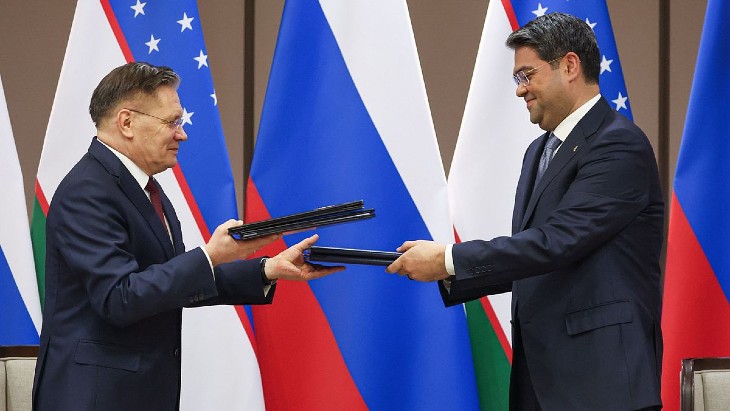
The roadmap, signed by Rosatom Director General Alexey Likhachev and Uzatom Director Azim Akhmedkhadzhaev, "covers all key areas of cooperation on the nuclear power plant construction project, including personnel training, public awareness of modern nuclear technologies, and the creation of a future 'nuclear city' at the plant".
A supplemental agreement to the contract for the new nuclear power plant covers the decision to change its contents to two gigawatt-scale VVER-1000 units and two 55 MWe RITM-200N small modular reactors (SMRs). The original plan had been for the plant to feature six of the SMRs - the new design will mean a capacity of more than 2,100 MWe, compared with the previous 330 MWe.
(Image: Rosatom)
The two countries' presidents spoke on the phone on Tuesday, noting the signing of the roadmap and the progress being made for the first SMR unit at the site, in the Jizzakh region.
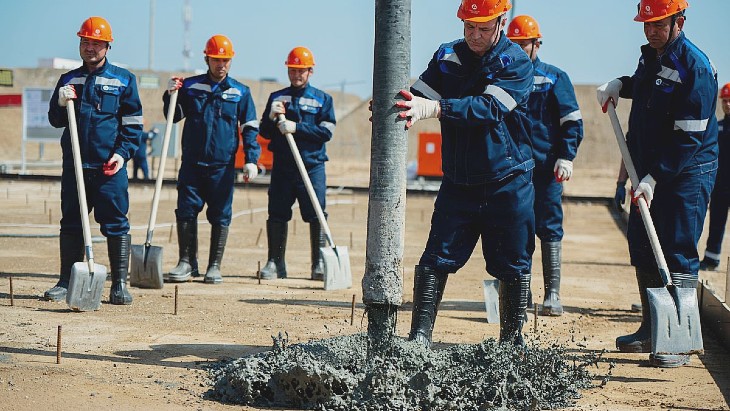
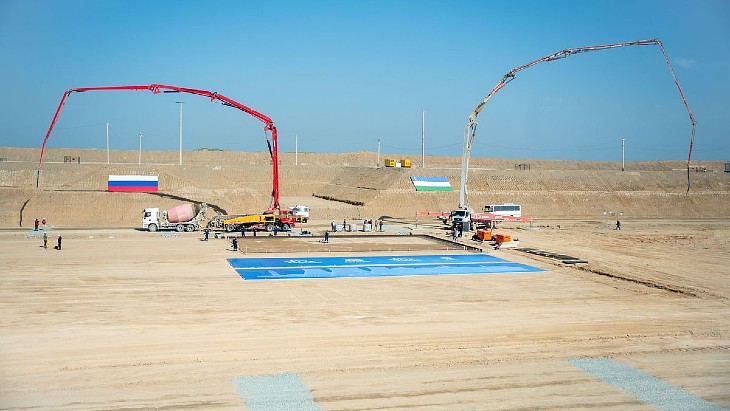
Rosatom said that, following the receipt of the necessary permissions to use the site for the two SMRs, concrete work had begun at the site, saying that "approximately 900 cubic metres will be poured during the concrete foundation work for the reactor building, due for completion in April". It said that this foundation will then be levelled and waterproofed before "the pouring of the first concrete for the reactor building's foundation slab".
(Image: Rosatom)
Alexey Likhachev, Rosatom Director General, said: "The signing of the roadmap and agreement for the construction of the integrated nuclear power plant, and the subsequent commencement of concrete work at the site, mark Uzbekistan's emergence as a leader in global nuclear energy. The country is launching a unique project that will contribute to socioeconomic growth and strengthen its technological sovereignty for decades to come."
Once it is fully operational, the plant will generate approximately 17.2 billion kWh per year, about 14% of Uzbekistan's total energy requirements.
Background
A contract signed in May 2024, during a visit to the country by Russian President Vladimir Putin, was for the construction of a 330 MW capacity nuclear power plant featuring six units of the RITM-200N water-cooled small modular reactor, which is adapted from nuclear-powered icebreakers' technology, with thermal power of 190 MW or 55 MWe and with an intended service life of 60 years. The first unit was scheduled to go critical in late 2029 with units commissioned one by one.
It was the first export order for Russia's SMR. The first land-based version is currently being built in Yakut in Russia, with the launch of the first unit scheduled to take place in 2027.
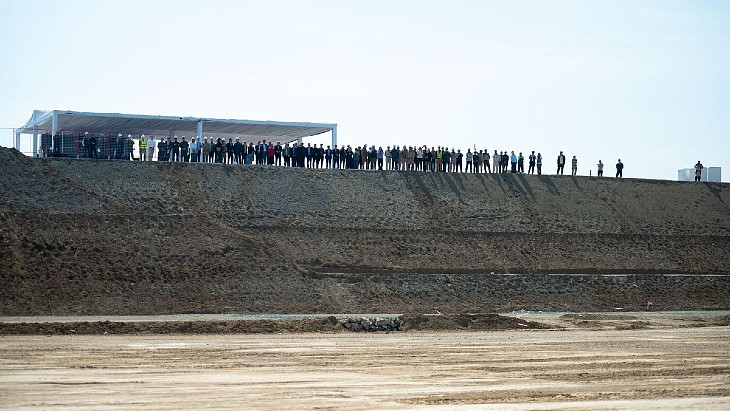
A ceremony was held at the site, where a giant pit has been prepared (Image: Rosatom)
An agreement signed at the end of September 2025 during World Atomic Week in Moscow multiplied the capacity of what had previously been proposed, with the plant plan switched to feature two large units - VVER-1000s with an output each of 1 GW - plus two 55 MW RITM-200N SMRs.
Excavation work began in October for the pit for the first of the SMRs at the site. About 1.5 million cubic metres of soil were excavated during the digging of a pit 13 metres deep for the RITM-200N, with engineering surveys and design and preparatory works also taking place.
Vietnam, Russia sign agreement on new nuclear plant
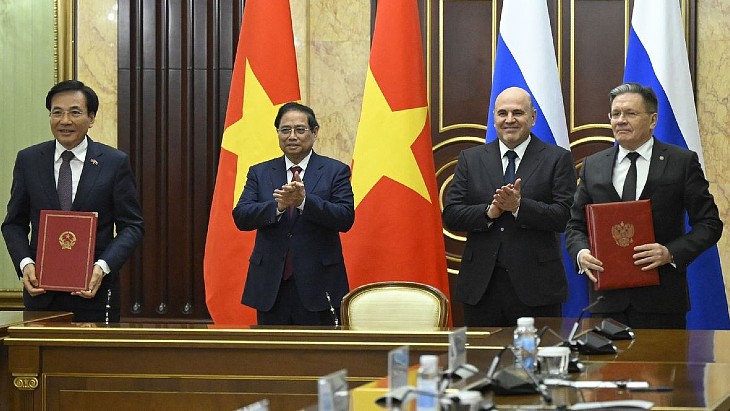
The signing of the agreement took place on Monday during the official visit of Vietnam's Prime Minister Pham Minh Chinh to Moscow. It was signed by Rosatom Director General Alexey Likhachev and Tran Van Son, Minister and Head of the Office of the Government of the Socialist Republic of Vietnam, in the presence of the Vietnamese Prime Minister and his Russian counterpart, Mikhail Mishustin.
Mishustin said that "creation of the nuclear plant will give a strong impetus to development of cooperation in adjacent areas - high technologies, fundamental and applied research".
Rosatom said the intergovernmental agreement "regulates the conditions and key areas of cooperation between the parties in implementing the project for the construction of the nuclear power plant ... Leningrad NPP‑2 (power units No 1 and No 2) has been selected as the reference project. The document establishes the necessary legal framework for the construction of the plant and will shape the direction of Russian‑Vietnamese cooperation in the nuclear field for decades to come".
Likhachev said: "For us, this is not merely an agreement to build two nuclear power units. We see it as the foundation for a long‑term industrial partnership that will strengthen Vietnam's energy independence and open up new opportunities for economic growth."
Background
A previous project, in the central province of Ninh Thuan, was approved in principle by the government in 2009 and was going to feature Russian VVER-1200 reactors - but project work was halted in 2016 because of "economic conditions". Considerable work was done at the site before the project's indefinite postponement, including relocating two villages with much upgrading of facilities and infrastructure.
The Vietnamese government has since revived its nuclear energy ambitions - citing energy security, development and net zero targets - and has been exploring the possibilities of small modular reactors. The National Assembly approved the government's proposal to restart the Ninh Thuan nuclear power project at its 8th working session in November 2024.
Vietnam's proposed Ninh Thuan nuclear power project consists of two plants, with each plant comprising two reactors. The Ninh Thuan 1 plant is located in Phuoc Dinh commune, Thuan Nam district. The Ninh Thuan 2 plant is located in Vinh Hai commune, Ninh Hai district.
In February last year, Vietnam's prime minister set a target to complete the construction of two nuclear power plants in Ninh Thuan province by the end of 2030.
Russia and Vietnam have existing nuclear technology links, notably with the development of plans for a Centre for Nuclear Science and Technology in Vietnam, which includes a Russian‑designed research reactor. The existing Dalat research reactor uses Russian‑supplied fuel and provides Vietnam with medical isotopes.
Upgraded turbine monitoring system at Temelin 2
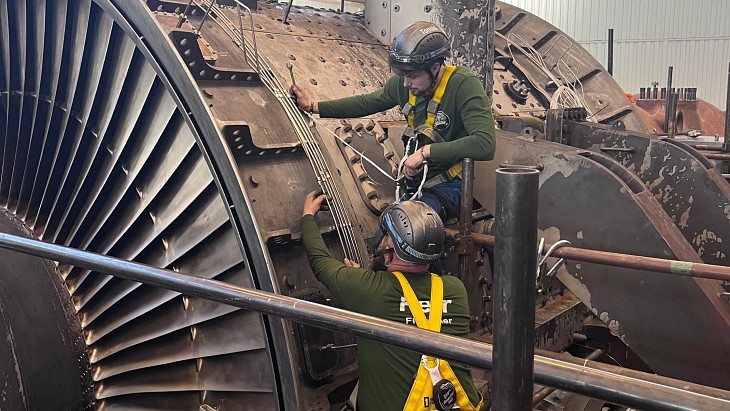
Petr Měšťan, Director of the Temelín Nuclear Power Plant, said it was a modernisation of the monitoring system which had been used for ten years: "Thanks to the special sensors, we can monitor whether the vibration of the blades of the last impellers is within the required limits even during operation."
Bohdan Zronek, member of the ČEZ board of directors and director of the nuclear energy division, said: "Although Temelín is a relatively young power plant, new technologies are always emerging. And if it makes sense for us from the point of view of efficiency and safety, we use them to the maximum extent. This applies to turbine diagnostics and a number of other devices."
ČEZ says the sensors measure the rotation time of each blade, which is over a metre long - acceleration or delay in the passage of the blade then signals its vibration. The work, costing "tens of millions" of Czech Koruna (CZK10 million is USD474,000), is taking place during the current, planned shutdown of the unit.
Investment projects at Temelin - which has two VVER-1000 units which came into operation in 2000 and 2002 - will reach CZK3.8 billion (USD182 million) this year and include continued modernisation of the control system and completion of the switch to a longer fuel cycle, the company said in an announcement in January. The plan is for the plant's units to operate for 60 or more years.
The Czech Republic gets about one-third of its electricity from nuclear generation - it also has four VVER-440 units at Dukovany, which began operating between 1985 and 1987. A CZK407 billion (USD18.6 billion) contract was signed with Korea Hydro & Nuclear Power last year for two of its APR1000 reactors near the existing Dukovany units. The aim is to start construction in 2029. There are also developing plans for small modular reactors in the country.
Application submitted for Swedish SMR plant
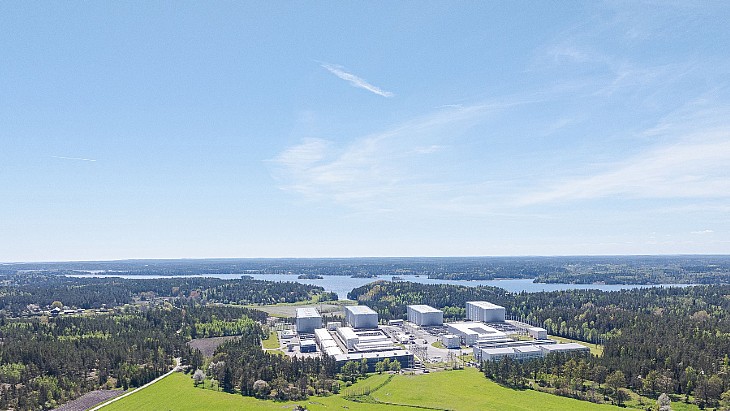
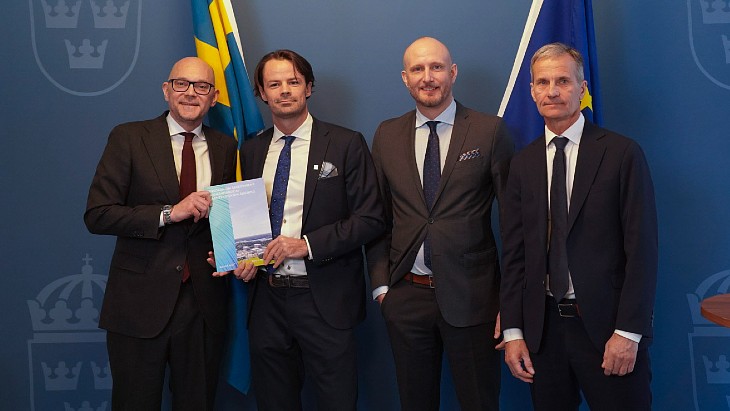
The application - submitted by project company ReFirm Målma AB - covers a planned small modular reactor (SMR) campus in Valdemarsvik, and was formally submitted to Johan Britz, Minister for Employment and acting Minister for Climate and the Environment.
The SMR campus in Valdemarsvik is initially planned to host between four and six small light water reactors, adding between 10-15 TWh of electricity generation per year. In February 2025, Kärnfull Next announced it had secured land rights for the Valdemarsvik project. The property includes areas that were identified as suitable for nuclear power in studies going back as far as the 1970s.
"This is a clear step from concept to formal permitting," said Kärnfull Next CEO Christian Sjölander. "Sweden needs new dispatchable, fossil-free power – particularly in the south – and this application shows that real projects are now moving forward."
The Valdemarsvik project would be part of Kärnfull Next's ReFirm South SMR programme, aiming to expand carbon-free and dispatchable energy production across southern Sweden.
(Image: Kärnfull Next)
The company has been conducting site selection and feasibility studies in several municipalities in Sweden since 2022. By establishing multiple SMR parks as part of the same programme, Kärnfull Next expects to achieve economies of scale in terms of technology selection, construction partners, power purchase agreements and financing partners.
Kärnfull Next said it plans to submit additional applications for other ReFirm sites later this year.
Last month, the Swedish government announced several proposed measures to make it easier to establish new nuclear power in the country. The new legislation introduces an early-stage government approval process designed to improve predictability and accelerate the deployment of new nuclear capacity.
In March 2022, Kärnfull Next signed a memorandum of understanding with GE Hitachi Nuclear Energy on the deployment of its BWRX-300 in Sweden. The company signed a memorandum of understanding with South Korean construction firm Samsung C&T in December 2024 to advance the deployment of SMRs in Sweden.
Earlier this month, Swedish nuclear technical services provider Studsvik announced its acquisition of Kärnfull Next, expanding its role from supporting the world's existing nuclear fleet to also developing new nuclear projects.
In October 2022, Sweden's incoming centre-right coalition government adopted a positive stance towards nuclear energy. In November 2023, it unveiled a roadmap which envisages the construction of new nuclear generating capacity equivalent to at least two large-scale reactors by 2035, with the equivalent capacity of up to 10 new large-scale reactors (which may include small modular reactors) coming online by 2045. A new act on state aid entered into force on 1 August 2025, since when interested companies have been able to apply for the aid.
The Swedish government received the first such application in December to support proposals for either five GE Vernova Hitachi BWRX-300 reactors or three Rolls-Royce SMRs to provide about 1,500 MW capacity at Ringhals on the Värö Peninsula. The application came from Videberg Kraft AB, a project company owned by Vattenfall AB and backed by a series of industrial firms via the Industrikraft i Sverige AB consortium.

No comments:
Post a Comment