Rights Groups Warn Countries to End Complicity in Trump’s High Seas Murder Spree
As the death toll rises, governments “cannot plausibly claim ignorance of the risks” of supporting the US military in the Caribbean and Pacific, said a coalition.
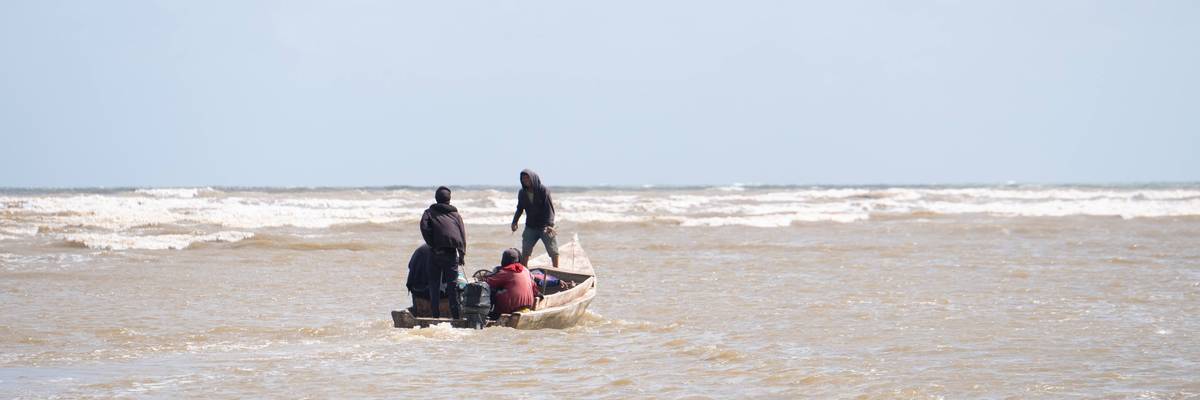
Wayuu fishermen in the coastal community of Cano Sagua, Venezuela on December 20, 2025 continue their daily work amid growing anxiety over the Trump administration’s deadly attacks on boats in the region.
(Photo by Oumala Epieyuu/Anadolu via Getty Images)
Julia Conley
Apr 24, 2026
COMMON DREAMS
With the death toll in the Trump administration’s bombings of boats in the Caribbean Sea and eastern Pacific Ocean hitting at least 180, a global coalition of rights and policy organizations is warning governments that they “cannot plausibly claim ignorance of the risks” of continuing to support the United States’ deadly policy in the region, and demanding that countries “stop facilitating extrajudicial killings” carried out by the US military.
The Center for Civilians in Conflict (CIVIC) spearheaded the statement now co-signed by at least 125 human rights groups, drug policy organizations, and veterans’ groups, warning that just as US military officials and personnel have risked potential criminal liability by taking part in at least 52 boat bombings since September, third countries that are aiding the US in the attacks may be taking similar risks.
“Third states can incur legal responsibility for aiding or assisting another state in their commission of internationally wrongful acts, including extrajudicial killings and crimes against humanity,” reads the statement, whose signatories include Amnesty International, Oxfam America, and the Friends Committee on National Legislation. “Forms of cooperation such as intelligence sharing, access to military bases, and the provision of logistical support may meet the threshold for aiding and assisting where they facilitate the identification, tracking, and targeting of vessels.”
Apr 24, 2026
COMMON DREAMS
With the death toll in the Trump administration’s bombings of boats in the Caribbean Sea and eastern Pacific Ocean hitting at least 180, a global coalition of rights and policy organizations is warning governments that they “cannot plausibly claim ignorance of the risks” of continuing to support the United States’ deadly policy in the region, and demanding that countries “stop facilitating extrajudicial killings” carried out by the US military.
The Center for Civilians in Conflict (CIVIC) spearheaded the statement now co-signed by at least 125 human rights groups, drug policy organizations, and veterans’ groups, warning that just as US military officials and personnel have risked potential criminal liability by taking part in at least 52 boat bombings since September, third countries that are aiding the US in the attacks may be taking similar risks.
“Third states can incur legal responsibility for aiding or assisting another state in their commission of internationally wrongful acts, including extrajudicial killings and crimes against humanity,” reads the statement, whose signatories include Amnesty International, Oxfam America, and the Friends Committee on National Legislation. “Forms of cooperation such as intelligence sharing, access to military bases, and the provision of logistical support may meet the threshold for aiding and assisting where they facilitate the identification, tracking, and targeting of vessels.”
As El País reported Thursday, a number of countries have confirmed they are cooperating with President Donald Trump’s targeting of boats in the Caribbean and Pacific, which the administration has claimed is aimed at stopping drug trafficking in the region.
The US military has not publicly released evidence that the people it’s killed were actually “narco-terrorists” as it’s repeatedly claimed; the family members of some of the victims have filed legal complaints, saying their loved ones were not involved in the drug trade.
A small number of victims were identified last year by The Associated Press, which found some were struggling fishermen or other workers who took low-level jobs helping drug traffickers to navigate the Caribbean. Adam Isacson of the Washington Office on Latin America has compared the killings, if they have targeted the drug trade at all, to “straight-up massacring 16-year-old drug dealers on US street corners.”
Despite the lack of evidence to back up the administration’s claims about the operation, the Dominican Republic has allowed the US to refuel military planes and transport equipment at one of its air bases and its Las Américas International Airport, and the prime minister of Trinidad and Tobago expressed support for the boat bombings when they began in September. The island nation has reportedly allowed the transit of military aircraft and the installation of a US radar system for surveillance.
Colombian President Gustavo Petro said in November that his government would no longer share intelligence on drug trafficking with the US, but he later walked back the threat, saying intelligence would be shared provided it “will be used for seizures without undermining human rights.”
Trump also convened a “Shield of the Americas” summit last month to announce the creation of a coalition of 17 countries in the region, including Argentina, Costa Rica, and Paraguay, which will focus on “bilateral and multilateral operations against cartels and terrorist organizations.”
Legal experts have warned that although Trump informed the US Congress last October that the administration views the US as being in an “armed conflict” with Latin American drug cartels, the military has clearly violated international law by targeting defenseless survivors of its boat bombings.
“The United States is not in an armed conflict with anyone in Latin America. That means the people on these boats are civilians. Civilians, including those suspected of smuggling drugs, are not lawful targets,” said the ACLU last month.
Experts have said the bombings meet the definition of extrajudicial killings—or simply murder—and one top US military lawyer warned before the operation began that US service members could face legal repercussions for carrying out the attacks at the direction of Trump and Defense Secretary Pete Hegseth.
Despite the alarm raised by legal experts, “we are witnessing a continuation and a truly worrying normalization of these attacks against vessels,” Annie Shiel, US director of CIVIC, told El País on Thursday. “The United States is committing extrajudicial killings or murders, plain and simple.”
The group and its fellow signatories warned states like the Dominican Republic and Trinidad and Tobago could also be held legally responsible if they provide aid or assistance to the US when it is committing acts that violate international law.
“All states must immediately cease or refrain from providing any assistance that could contribute to these unlawful killings,” reads the statement. “Failure to do so facilitates the continuation of this lawless campaign, undermines the rule of law, and risks incurring legal responsibility under international law.”
The groups emphasized that in addition to putting countries at risk for legal liability, governments that facilitate the boat killings are exacerbating harm to their own communities.
Despite the lack of evidence to back up the administration’s claims about the operation, the Dominican Republic has allowed the US to refuel military planes and transport equipment at one of its air bases and its Las Américas International Airport, and the prime minister of Trinidad and Tobago expressed support for the boat bombings when they began in September. The island nation has reportedly allowed the transit of military aircraft and the installation of a US radar system for surveillance.
Colombian President Gustavo Petro said in November that his government would no longer share intelligence on drug trafficking with the US, but he later walked back the threat, saying intelligence would be shared provided it “will be used for seizures without undermining human rights.”
Trump also convened a “Shield of the Americas” summit last month to announce the creation of a coalition of 17 countries in the region, including Argentina, Costa Rica, and Paraguay, which will focus on “bilateral and multilateral operations against cartels and terrorist organizations.”
Legal experts have warned that although Trump informed the US Congress last October that the administration views the US as being in an “armed conflict” with Latin American drug cartels, the military has clearly violated international law by targeting defenseless survivors of its boat bombings.
“The United States is not in an armed conflict with anyone in Latin America. That means the people on these boats are civilians. Civilians, including those suspected of smuggling drugs, are not lawful targets,” said the ACLU last month.
Experts have said the bombings meet the definition of extrajudicial killings—or simply murder—and one top US military lawyer warned before the operation began that US service members could face legal repercussions for carrying out the attacks at the direction of Trump and Defense Secretary Pete Hegseth.
Despite the alarm raised by legal experts, “we are witnessing a continuation and a truly worrying normalization of these attacks against vessels,” Annie Shiel, US director of CIVIC, told El País on Thursday. “The United States is committing extrajudicial killings or murders, plain and simple.”
The group and its fellow signatories warned states like the Dominican Republic and Trinidad and Tobago could also be held legally responsible if they provide aid or assistance to the US when it is committing acts that violate international law.
“All states must immediately cease or refrain from providing any assistance that could contribute to these unlawful killings,” reads the statement. “Failure to do so facilitates the continuation of this lawless campaign, undermines the rule of law, and risks incurring legal responsibility under international law.”
The groups emphasized that in addition to putting countries at risk for legal liability, governments that facilitate the boat killings are exacerbating harm to their own communities.
“Families awaiting the return of their loved ones may never know what happened to them and have no access to recourse,” they said. “Coastal communities have witnessed human remains washing up on shore and fear for their lives when they trade and fish, sowing psychological trauma and undermining livelihoods.”
From Boat Murders to Kidnapping Maduro, Trump Spending Billions on ‘Donroe Doctrine’ Militarism
“Across the country people are going bankrupt and dying prematurely because of lack of healthcare, but the US government has billions to spend on imperialist violence to enrich corporations,” said one researcher.
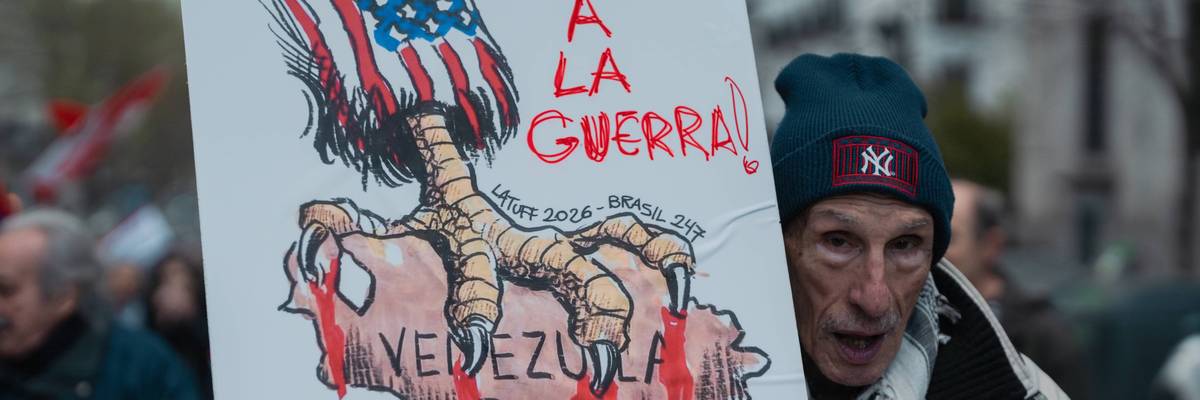
A protester holds a sign decrying US militarism against Venezuela, with the message “No to War,” during a March 14, 2026 demonstration in Madrid.
(Photo by Olmo Blanco/Getty Images)
Brett Wilkins
Apr 23, 2026
COMMON DREAMS
As the basic needs of millions of Americans are sacrificed upon the altar of waning US global domination, an analysis unveiled Thursday revealss that the Trump administration has spent billions of dollars on illegal military aggression against Venezuela and civilian boats alleged without evidence to be smuggling drugs off the coast of Latin America.
The Costs of War Project at Brown University’s Watson School of International and Public Affairs published an analysis by a pair of researchers who “found that spending on Operation Southern Spear and Operation Absolute Resolve in Venezuela, the Caribbean, and the Eastern Pacific cost at least $4.7 billion from August 1, 2025 to March 31, 2026.”
The researchers—Hanna Homestead of the Institute for Policy Studies’ National Priorities Project and Jennifer Kavanagh of the think tank Defense Priorities—also found that “costs will continue to mount as some naval assets and aircraft remain in the region and strikes continue.”
“This estimate is only partial due to lack of information, and does not include long-term budgetary costs such as veterans benefits,” an introduction to the analysis states.
In addition to the financial burden, the analysis notes the human costs of enforcing the so-called “Donroe Doctrine.”
“While not the topic of this paper, they are essential to note at the outset,” the publication states. “The raid and capture of Venezuelan President Nicolás Maduro during Operation Absolute Resolve resulted in approximately 75 known fatalities. These include 32 Cuban personnel killed, at least 23 Venezuelan security officers killed, and at least two civilian deaths.”
US strikes “against unarmed vessels in the Caribbean and Eastern Pacific between September 2, 2025 and March 31, 2026 have killed at least 163 people,” the authors added. “In addition, at least one American service member died while deployed to the Caribbean in February 2026 when two US ships collided.”
The toll from Trump’s boat-bombing spree has since risen to more than 180 following additional reported strikes. Survivors of somemi bombings allege they were tortured by their US captors. The US military and Trump administration have provided no solid evidence to support their claims that the boats were transporting illicit narcotics.
Homestead and Kavanagh noted in their analysis that “to date, Congress has not authorized the use of force in the Caribbean or Eastern Pacific and the Pentagon has not provided information about costs of Venezuela-related operations, even as they continue to mount.”
There have been more than 50 boat bombings since Trump launched his campaign last September. Relatives of people killed in or missing after the strikes insist their loved ones were fishers with no links to the drug trade, an assertion echoed by leaders in Venezuela, Colombia, and some Caribbean island nations.
Multiple war powers resolutions aimed at reining in Trump’s ability to wage war on Venezuela or bomb boats on the high seas without congressional authorization have been rejected by the Republican-controlled Congress.
In addition to the bombing and invasion of Venezuela and the boat strikes, the Trump administration has deployed troops to Ecuador as part of a joint campaign against alleged drug gangs dubbed Operation Total Extermination. Trump has also ordered the military to plan an invasion to seize the Panama Canal, threatened to “take” Cuba, possibly attack Mexico and Colombia, invade and annex Greenland, and somehow make Canada the “51st state.”
That’s just in the Western Hemisphere. Overall, Trump has bombed seven countries around the world since returning to the White House and 10 nations over the course of his two terms—including Iran, where he launched an illegal war with Israel.
The Costs of War Project rose to prominence by tracking the human and financial price of the so-called US War on Terror, which since September 2001 has resulted in over 940,000 direct deaths, including at least 432,000 civilians, in five studied countries, at a monetary cost of around $8 trillion.
Homestead and Kavanagh wrote in their analysis that the $4.7 billion figure “is a conservative estimate, and the greatest costs may yet be to come,” as “operations do not have a clear end date and are actively expanding.”
“They carry significant human, financial, and strategic costs and risk,” the researchers contended. “American taxpayers, who are increasingly unable to afford basic needs, have a right to know how their tax dollars are spent.”
Homestead told The Intercept on Thursday that “across the country people are going bankrupt and dying prematurely because of lack of healthcare, but the US government has billions to spend on imperialist violence to enrich corporations—from Venezuela to Iran—without any regard for human rights, life, or rule of law.”
“This situation illustrates why greater restraint on Pentagon spending—which primarily benefits private contractors—is so necessary,” she added.
This, as Trump seeks a record $1.5 trillion allocation for military spending in the next federal budget—despite the national debt approaching a staggering $40 trillion—while proposing billions of dollars in cuts to vital social programs.
“Across the country people are going bankrupt and dying prematurely because of lack of healthcare, but the US government has billions to spend on imperialist violence to enrich corporations,” said one researcher.
A protester holds a sign decrying US militarism against Venezuela, with the message “No to War,” during a March 14, 2026 demonstration in Madrid.
(Photo by Olmo Blanco/Getty Images)
Brett Wilkins
Apr 23, 2026
COMMON DREAMS
As the basic needs of millions of Americans are sacrificed upon the altar of waning US global domination, an analysis unveiled Thursday revealss that the Trump administration has spent billions of dollars on illegal military aggression against Venezuela and civilian boats alleged without evidence to be smuggling drugs off the coast of Latin America.
The Costs of War Project at Brown University’s Watson School of International and Public Affairs published an analysis by a pair of researchers who “found that spending on Operation Southern Spear and Operation Absolute Resolve in Venezuela, the Caribbean, and the Eastern Pacific cost at least $4.7 billion from August 1, 2025 to March 31, 2026.”
The researchers—Hanna Homestead of the Institute for Policy Studies’ National Priorities Project and Jennifer Kavanagh of the think tank Defense Priorities—also found that “costs will continue to mount as some naval assets and aircraft remain in the region and strikes continue.”
“This estimate is only partial due to lack of information, and does not include long-term budgetary costs such as veterans benefits,” an introduction to the analysis states.
In addition to the financial burden, the analysis notes the human costs of enforcing the so-called “Donroe Doctrine.”
“While not the topic of this paper, they are essential to note at the outset,” the publication states. “The raid and capture of Venezuelan President Nicolás Maduro during Operation Absolute Resolve resulted in approximately 75 known fatalities. These include 32 Cuban personnel killed, at least 23 Venezuelan security officers killed, and at least two civilian deaths.”
US strikes “against unarmed vessels in the Caribbean and Eastern Pacific between September 2, 2025 and March 31, 2026 have killed at least 163 people,” the authors added. “In addition, at least one American service member died while deployed to the Caribbean in February 2026 when two US ships collided.”
The toll from Trump’s boat-bombing spree has since risen to more than 180 following additional reported strikes. Survivors of somemi bombings allege they were tortured by their US captors. The US military and Trump administration have provided no solid evidence to support their claims that the boats were transporting illicit narcotics.
Homestead and Kavanagh noted in their analysis that “to date, Congress has not authorized the use of force in the Caribbean or Eastern Pacific and the Pentagon has not provided information about costs of Venezuela-related operations, even as they continue to mount.”
There have been more than 50 boat bombings since Trump launched his campaign last September. Relatives of people killed in or missing after the strikes insist their loved ones were fishers with no links to the drug trade, an assertion echoed by leaders in Venezuela, Colombia, and some Caribbean island nations.
Multiple war powers resolutions aimed at reining in Trump’s ability to wage war on Venezuela or bomb boats on the high seas without congressional authorization have been rejected by the Republican-controlled Congress.
In addition to the bombing and invasion of Venezuela and the boat strikes, the Trump administration has deployed troops to Ecuador as part of a joint campaign against alleged drug gangs dubbed Operation Total Extermination. Trump has also ordered the military to plan an invasion to seize the Panama Canal, threatened to “take” Cuba, possibly attack Mexico and Colombia, invade and annex Greenland, and somehow make Canada the “51st state.”
That’s just in the Western Hemisphere. Overall, Trump has bombed seven countries around the world since returning to the White House and 10 nations over the course of his two terms—including Iran, where he launched an illegal war with Israel.
The Costs of War Project rose to prominence by tracking the human and financial price of the so-called US War on Terror, which since September 2001 has resulted in over 940,000 direct deaths, including at least 432,000 civilians, in five studied countries, at a monetary cost of around $8 trillion.
Homestead and Kavanagh wrote in their analysis that the $4.7 billion figure “is a conservative estimate, and the greatest costs may yet be to come,” as “operations do not have a clear end date and are actively expanding.”
“They carry significant human, financial, and strategic costs and risk,” the researchers contended. “American taxpayers, who are increasingly unable to afford basic needs, have a right to know how their tax dollars are spent.”
Homestead told The Intercept on Thursday that “across the country people are going bankrupt and dying prematurely because of lack of healthcare, but the US government has billions to spend on imperialist violence to enrich corporations—from Venezuela to Iran—without any regard for human rights, life, or rule of law.”
“This situation illustrates why greater restraint on Pentagon spending—which primarily benefits private contractors—is so necessary,” she added.
This, as Trump seeks a record $1.5 trillion allocation for military spending in the next federal budget—despite the national debt approaching a staggering $40 trillion—while proposing billions of dollars in cuts to vital social programs.


No comments:
Post a Comment