Remembering Chornobyl
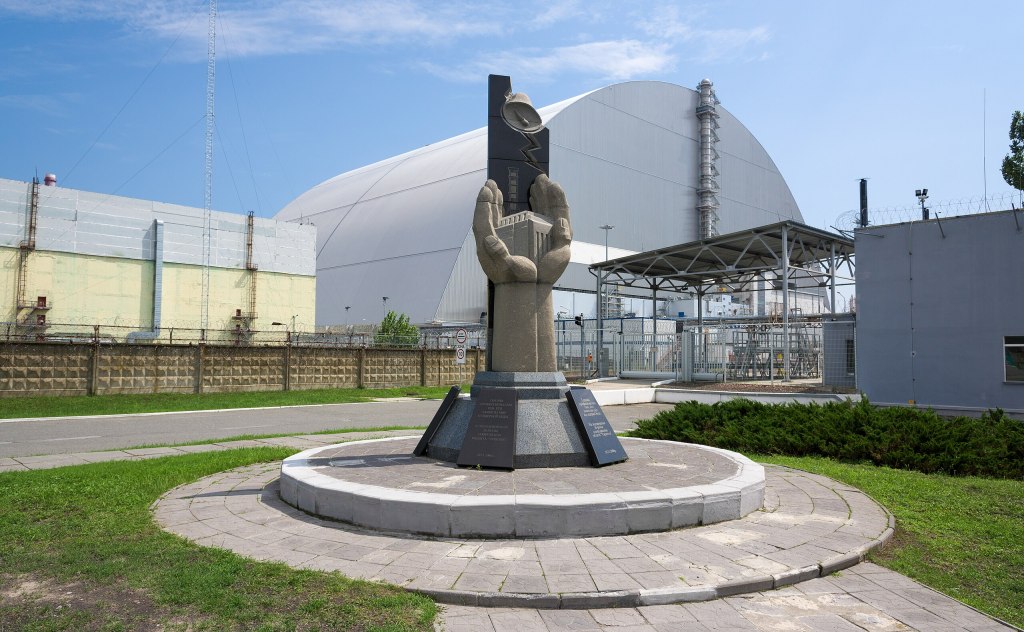
The Chornobyl Dome, now damaged by a Russian drone attack, and a memorial at the site. (Photo: Hnabel/Wikimedia Commons)
Probably the most heinous crime, other than the avoidable accident itself and its immediate coverup, is the way that the Chornobyl (Ukrainian equivalent spelling) nuclear power disaster in Ukraine, 40 years old this week, has been used to downplay and normalize the long-lasting health impacts caused by that April 26, 1986 explosion.
Still today, the myth is repeated that “no one died” — meaning no one in the public. Instead, we are told over and over that it was only a handful of liquidators, sent in to deal with the immediate crisis, who were killed by the massive release of radiation resulting from the reactor explosion.
And still today, in part because of that myth, now so firmly cemented in the public and media narratives around the Chornobyl disaster, the true health effects of even just routine reactor operation, or the exposures suffered by communities living around active or abandoned uranium mines, or by those working in uranium enrichment or fuel fabrication facilities, are discounted and dismissed.
Worse still, we are now facing a concerted effort by the Trump administration to emasculate already weak radiation protection standards, once again ignoring females who are most vulnerable to harm, and especially pregnant women, babies and children.
Through yet another executive order accelerating nuclear power expansion while sparing the industry the costs it should incur to guarantee safety (an impossibility anyway), the White House wants to abandon the long-held Linear No Threshold (LNT) model.
LNT holds that radiation damage increases with higher exposures, and that harm is posed by all radiation exposure no matter how small. But LNT itself is already unsatisfactory, since health studies continue to indicate that more — not less — protection is needed for non-cancer impacts, and for radionuclides taken internally, than is already provided by applying LNT.
This is what makes the perpetual focus on “who died” when it comes to major nuclear accidents, fundamentally the wrong question. We will likely never know who or how many died as a result of the Chornobyl disaster. Registries and statistics weren’t kept, people moved around, and, as is so often the case, illnesses were ascribed to other causes. Certainty is hard to achieve.
Nevertheless, perhaps one of the most important pieces of research on the health realities of the Chornobyl aftermath was done by historian Kate Brown in her book Manual For Survival. A Chernobyl Guide to the Future. It looks like a “hefty tome”, but it is anything but. Despite being nonfiction, it reads like a page-turning thriller and some of what she uncovers is eye-stretching. And, of course, by saying “uncovers,” we immediately understand that this was indeed a cover-up, first by the then Soviet Union, and then compliantly perpetuated by the United States and other western allies eager to avoid any shocking realization by the general public that nuclear power technology is phenomenally dangerous and human beings are liable to lose control of it, with disastrous results.
This returns us to the question about the protracted harm that can be caused if something goes very badly wrong at a nuclear power plant. And it returns us to dispensing with the wrong question, which is “how many people died?”
That wrong question, a favorite of headline writers and spin doctors, sets us on a  perpetual path to dispute. The health figures, especially fatalities, have become the most misrepresented statistic related to the Chornobyl disaster. But focusing only on fatalities also serves to diminish the disaster’s impact. Nuclear power plant accidents often do not kill people instantly and sometimes not at all. It can take years before fatal illnesses triggered by a nuclear accident take hold. This creates a challenge in calculating just who eventually died due to the accident and who suffered non-fatal consequences.
Exposure to ionizing radiation released by a nuclear power plant (and not just from accidents but every day) can cause serious non-fatal illnesses as well. These should not be discounted. Arguably, neither should post-accident psychological trauma. Nuclear power plant accidents can and should be prevented. The only sure way to do so is to close them all down. Otherwise we risk another Chornobyl, or Three Mile Island, or Fukushima.
In our Thunderbird newsletter of 2018, we examined some of the key myths around the impacts of the Chornobyl disaster now 40 years ago. Below, is a synopsis of some of the key points, as they bear repeating and remain perpetually true. The full document can be read here.
What happened?
On April 26, 1986, Unit 4 at the Chornobyl nuclear power plant exploded. That explosion and the resulting fire, lofted huge amounts of radioactivity into the atmosphere. Unit 4 was relatively new, having only been in service for just over two years. The accident occurred during what should have been a routine test to see how the plant would operate if it lost power. The test involved shutting down safety systems but a series of human errors, compounded by design flaws, instead set in motion a catastrophic chain of events.
After shutting down the turbine system that provided the cooling water to the reactor, the water began boiling and workers desperately tried to re-insert control rods to slow down the nuclear reaction. But the rods jammed and control of Unit 4 was irrevocably lost. The explosion and fire — which took five months to put out — dispersed at least 200 times more radioactivity than that produced by the Hiroshima and Nagasaki bombs. The fallout contaminated several million square kilometers of land in the former Soviet Union and in Europe and was also detected in the US.
Soviet authorities were slow to react. The accident was first detected by monitors in Sweden. The nearby city of Pripyat was not evacuated immediately. By the time they did so, radioactivity levels were 60,000 times higher than “normal”.
The financial cost of the accident, while difficult to calculate given the many unknowns, is estimated to be in the region of $700 billion and is expected to keep rising.
The Liquidators
The Chornobyl liquidators were dispatched to the stricken nuclear plant in the immediate aftermath, as well as for at least the subsequent two years, to manage and endeavor to “clean up” the disaster. They included military as well as civilian personnel such as firefighters, nuclear plant workers and other skilled professionals.
While estimates of the number of liquidators varies, the generally accepted figure is around 800,000. However, evaluating their fate has been difficult. Only a small portion of them were subject to medical examinations.
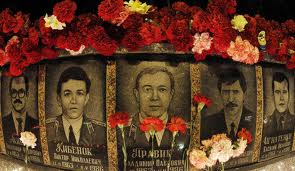
Yet, by 1992 it was estimated that 70,000 liquidators were invalids and 13,000 had died. These estimates rose to 50,000 then to 100,000 deaths among liquidators in 2006. By 2010, Yablokov et al. estimated a death toll of 112,000 to 125,000 liquidators.
Even the Russian authorities admit findings of liquidators aging prematurely, with a higher than average number having developed various forms of cancer, leukemia, somatic and neurological problems, psychiatric illnesses and cataracts.
The UN Office for the Coordination of Humanitarian Affairs found a statistically significant increase of leukemia among Russian liquidators who were in service at Chernobyl in 1986 and 1987.
General populations inside and outside the former Soviet Union
As with the liquidators, tracking the health of general populations exposed to the plume pathway of Chornobyl has been problematic. Within the Soviet Union, people moved away and neither they nor many living in other affected countries were tracked or monitored. While countless numbers may have died from their Chornobyl-related illnesses, equal or even greater numbers may have survived with debilitating or chronic physical as well as mental illnesses caused by the accident.
Establishing exact numbers may never be possible. Media reports often rely on the 2003-2005 Chernobyl Forum report produced by the nuclear promoting International Atomic Energy Agency. The agency ignored its own data that indicated there would be 9,000 future fatal future cancers in Belarus, Russia and Ukraine, claiming there would be no more than 4,000. Both numbers are gross underestimations. The report focused only on the most heavily exposed areas in making its predictions. It ignored the much larger populations in the affected countries as a whole, and in the rest of the world, who have been exposed to lower but chronic levels of radiation from Chornobyl.
In contrast, a comprehensive analysis by the late Soviet scientist, Alexey Yablokov and colleagues, examined more than 5,000 Russian studies. They concluded that almost a million premature deaths would result from Chornobyl. Meanwhile, the TORCH report (The Other Report on Chernobyl), by Dr. Ian Fairlie, predicts between 30,000 and 60,000 excess cancer deaths worldwide due to the accident.
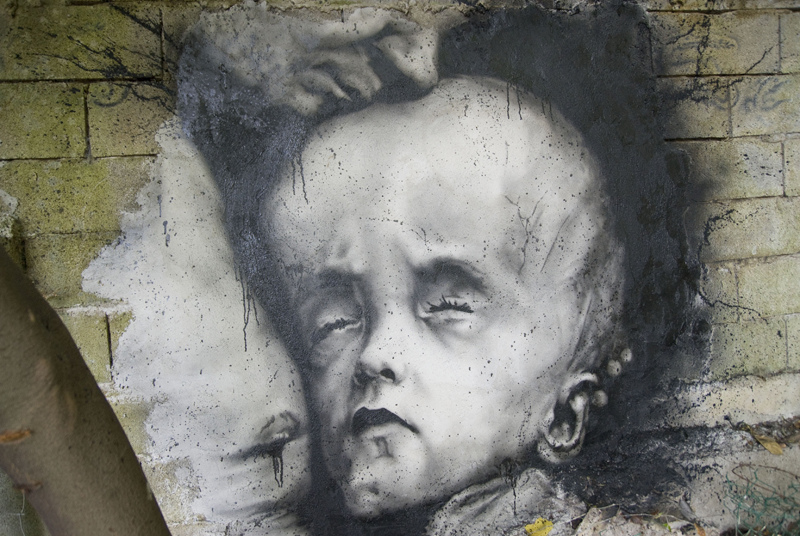
More than half the Chornobyl fallout landed outside of the Ukraine, Belarus and Russia — in Europe, Asia and North America. Fallout from Chornobyl contaminated about 40% of Europe’s surface. Immediately after the accident, thyroid cancer was particularly rampant in Belarus, Ukraine and Russia, where no prophylactic remedy in the form of potassium iodide pills was offered. Consequently, as Baverstock and Williams found in 2006, “by far, the most prominent health consequence of the accident is the increase in thyroid cancer among those exposed as children . . . particularly in children living close to the reactor.”
In contrast, Poland, where potassium iodide was distributed, experienced relatively low rates of thyroid cancers. While thyroid cancer is considered one of the more treatable kinds of cancers, this does not mean it should be viewed as an acceptable consequence of a nuclear power plant accident. Such diseases — especially among children — impact emotional, social, and physical wellbeing. In the former Soviet Union, those operated on bear a scare referred to grimly as the “Chornobyl necklace.”
Dr. Wladimir Wertelecki, a physician and geneticist, has conducted research, particularly focused on Polissia, Ukraine. There he found clear indications of altered child development patterns, or teratogenesis. Wertelecki noted birth defects and other health disturbances among not only those who were adults at the time of the Chornobyl disaster, but their children who were in utero at the time and, most disturbingly, their later offspring.
Important research has also been conducted on psychological effects. Pierre Flor-Henry and others examined some of the psychological disorders resulting from Chornobyl and found a clinical pathology related to radiation exposure. Flor-Henry found that schizophrenia and chronic fatigue syndrome among a high percentage of liquidators were accompanied by organic changes in the brain. This suggested that various neurological and psychological illnesses could be caused by exposure to radiation levels between 0.15 and 0.5 sieverts.
There are of course many other non-cancerous diseases caused by nuclear accidents that release radioactivity. A peak in Down Syndrome cases was observed in newborns born in 1987 in Belarus, one year after the Chornobyl nuclear accident. This phenomenon has been found around other nuclear sites. Abnormally high rates of Down Syndrome were found in the Dundalk, Ireland population possibly tied to the operation of the Sellafield nuclear waste reprocessing plant across the Irish Sea in Cumbria, England.
Read full Thunderbird: Chornobyl: The Facts.
This first appeared on Beyond Nuclear International.
By AFP
April 25, 2026

Nikolay Solovyov points to photograph depicting him in the control room in the nineties - Copyright Iranian Foreign Ministry/AFP -
Romain COLAS
Nikolay Solovyov was on shift the night of April 26, 1986 when the Chernobyl nuclear power plant exploded. Instead of fleeing, he chose to fight his “first war” against radiation.
Four decades later, a second war — Russia’s invasion of Ukraine — has taken his son.
Solovyov, 67, a hard rock fan, still wears his hair long, though it has turned grey.
On the night of the world’s worst nuclear accident, he was working as a turbine mechanic in unit number two, a few hundred metres from reactor number four, which exploded during a safety test.
“It felt like an earthquake. I didn’t hear the explosion — the turbines were still running, with a very loud noise,” he recalled, his voice quiet and gentle.
The alarms went off. As he rushed towards the exploded reactor, he saw one colleague badly irradiated and vomiting, another being carried out on a stretcher. The third one was slumped in his chair, head in his arms. All of them died soon after.
Only then did the full extent of the disaster become clear. Through the massive hole ripped open by the explosion, he could see “the sky.” In the corridors, torrents of water poured from broken pipes.
Firefighters quickly began hosing down the smoking reactor — “they didn’t let the fire spread,” Solovyov said. Almost all those firefighters later died from radiation exposure.
At dawn, he and his colleagues discussed how long they had left to live. “We’ll last two weeks,” said one of them.
After hearing this, Solovyov, who quit smoking five months earlier, lit up a cigarette. “Well, if I’m going to die, at least I’ll die young and handsome,” he recounted his thought in the moment.
– Seeking praise –
His night shift ended in the morning. The day team took over and the bus drove him back to Pripyat, the workers’ town three kilometres (two miles) from the plant.
It was all quiet and business as usual, except for the roaring trucks that were spraying foamy “detergent” on the pavement. Once home, he told his wife to seal the windows.
For days, Soviet authorities hid the catastrophe from the world — a disaster that further weakened the already crumbling USSR, which collapsed in 1991.
Solovyov stayed at the plant throughout the “liquidation” — a massive clean-up operation in the aftermath. He later helped build the first sarcophagus covering the reactor, as well as the second one, which was damaged by a Russian drone strike in 2025.
The plant continued producing electricity until 2000 and teams still work there to ensure its safety.
Among the reasons for his decision to stay, Solovyov lists good pay, “generous holidays” and an “interesting” nature of work.
The man, who later became an engineer, believes that the “dangerous” 1986 test was pushed ahead by the plant managers for the sake of winning praise from Soviet leadership.
Hundreds of thousands of people were involved in the massive liquidation operation, which saw hundreds of thousands more evacuated from neighbouring settlements. “Only the USSR” had the resources to carry out such an effort, Solovyov believes.
Dozens of his acquaintances later died of cancer. Of the 22 men on his night shift, only four are still alive.
A 2005 UN report put the number of confirmed and projected deaths at 4,000 in Russia, Belarus and Ukraine. Greenpeace in 2006 estimated that the disaster had caused close to 100,000 deaths.
– ‘The other war’ –
Solovyov, who received high doses of radiation and has undergone countless medical checks, attributes his longevity to good health, regular sport, a calm temperament and genetics.
“I have to thank God and my parents for giving me good genes,” he said.
He now lives in a country house near Slavutych, a town 120 kilometres (70 miles) north of Kyiv, built in 1986 to house people displaced by the disaster.
In the local Chernobyl museum, wreckage from downed Russian drones is displayed in the main hall. “That’s the other war,” Solovyov said quietly.
Standing on the windswept central square of Slavutych, he said that his first, “nuclear” war was against an invisible, odourless poison.
“When people here say ‘before the war’ or ‘after the war,’ they mean April 26, 1986,” he said. “And now, as people put it, this is already the second war of our generation.”
On the night of February 23-24, 2022, Solovyov set out for the plant as usual. But he never reached it: the two bridges leading there had been destroyed. Russian forces seized Chernobyl and occupied the site for a month.
His youngest son joined the Ukrainian army. In September 2023 he was reported missing in action.
Devastated, Solovyov could no longer find the strength to work and took early retirement.
By AFP

Slavutych was created to house people who lost their homes in the Chernobyl disaster, now it has become home as well for those displaced by Russia's invasion - Copyright AFP Genya SAVILOV
Romain COLAS
Slavutych was built as a Soviet paradise for refugees from the Chernobyl nuclear disaster but now it is being born again as a haven for people escaping Russia’s invasion of Ukraine.
With is massive theatre, stadium, schools, hospital and rows of identical concrete apartment blocks, Slavutych was the perfect example of the Soviet Union’s ideal of “friendship of the peoples”.
After the Chernobyl reactor exploded on April 26, 1986, workers and architects from the eight Soviet republics — Estonia, Lithuania, Latvia, Georgia, Armenia, Azerbaijan, Ukraine and Russia — took part in the construction carried out at breakneck speed.
Hundreds of thousands of people in Ukraine, Belarus and Russia had to leave their homes as Chernobyl’s radiation spread across Europe after the world’s worst nuclear accident.
The population of the town of Prypyat, the town near the Chernobyl reactor where most of its workers lived, was mainly sent to Slavutych.
“All the residents aged over 39 are internally displaced,” Slavutych mayor Yurii Fomichev told AFP.
But the collapse of the Soviet Union in 1991 and the final closure of Chernobyl in 2000 saw many of Slavutych residents lose their job, and hope. Most decided it was best to leave.
– Soviet welcome –
Now there are only about 20,000 people in a town designed to take 50,000. Some buildings in Slavutych were left to abandon, until Russia decided to invade in 2022.
Some 1,265 of the population moved to the town in northern Ukraine because of the war, according to Mykola Kalachnyk, the administration head of the Kyiv region that includes Slavutych. That, however, is just a fraction of the 3.7 million people that the United Nations says has been displaced by the Russian onslaught.
Russian forces even occupied Slavutych for a few days in March 2022 but left when Kyiv’s forces ousted them.
“Here the people have been through so much and they understand us,” said Olga, a 50-year-old who lives in the town with her elderly, handicapped mother.
Four years ago, Olga, who only gave her first name, was forced to flee the town of Enegodar that was home for workers of another Ukrainian nuclear power station at Zaporizhzhia. The Zaporizhzhia plant, Europe’s biggest civilian nuclear power complex, remains in Russian hands.
Olga and her mother spent 18 months living with another family in the town of Zaporizhzhia before arriving in Slavutych in 2024. She has been given a brand new apartment.
According to the UN refugee agency UNHCR representative in Ukraine, Bernadette Castel-Hollingsworth, every family in Ukraine has been “touched” in some way by the displacement of the war.
A children’s nursery and part of a hospital have been renovated, with help from the government and the United Nations, and turned into apartments for the displaced.
Kateryna Romanenko, 40, left the devastated city of Bakhmut, in the Donetsk region, just before it was captured by the Russians in 2023.
Romanenko is delighted by her Slavutych home which she called her “most positive” experience of the past four years. She pays no rent, just for power and services.
But Olena Tolstova, 74, said she is feeling the pain of the war turmoil.
“I want to go home,” said the retired pharmacist, who pines for her apartment in Energodar and small country dacha house in the countryside.
Tolstova, a widow, is living in hospital dormitory in Slavutych, after spending several months at the home of a friend who had worked at Chernobyl.
Despite wanting to leave Slavutych, she acknowledged that she had been helped under the Soviet principle of “friendship of the people”.
‘Nature has performed a factory reset’: Chernobyl has flourished into an unlikely wildlife refuge
On the 40th anniversary of the Chornobyl nuclear disaster, the site remains too dangerous for humans – but wildlife has moved back in.
On contaminated land that is too dangerous for human life, the world’s wildest horses roam free.
Across the Chernobyl exclusion zone, Przewalski’s horses – stocky, sand-coloured and almost toy-like in appearance – graze in a radioactive landscape larger than Luxembourg.
Forty years ago, on 26 April 1986, an explosion at the nuclear power plant in Ukraine sent radiation across Europe and forced the evacuation of entire towns, displacing tens of thousands. It was the worst nuclear disaster in history.
Four decades on, Chernobyl – which is transliterated as 'Chornobyl' in Ukraine – remains too dangerous for humans. But the wildlife has moved back in.
Wolves now prowl the vast no-man’s-land spanning Ukraine and Belarus, and brown bears have returned after more than a century. Populations of lynx, moose, red deer and even free-roaming packs of dogs have rebounded.

Przewalski’s horses: 'A remarkable example of successful reintroduction'
Przewalski’s horses, native to Mongolia and once on the brink of disappearing, were introduced here in 1998 as an experiment.
Known as 'takhi' in Mongolia ('spirit'), the horses are distinct from domestic breeds, with 33 pairs of chromosomes, compared with 32 in domesticated horses. The modern name comes from the Russian explorer who first formally identified them.
“The fact that Ukraine now has a free-ranging population is something of a small miracle,” says Denys Vyshnevskyi, the zone’s lead nature scientist.
With human pressure gone, parts of the exclusion zone now resemble European landscapes from centuries past, he says, adding: “Nature recovers relatively quickly and effectively.”
The transformation is visible everywhere. Trees pierce abandoned buildings, roads dissolve into forest, and weathered Soviet-era signs stand beside leaning wooden crosses in overgrown cemeteries.
Hidden cameras show the horses adapting in unexpected ways. They seek shelter in crumbling barns and deserted homes, using them to escape harsh weather and insects – even bedding down inside.
The horses live in small social groups – typically one stallion with several mares and their young – alongside separate bands of younger males. Many died after their introduction, but others adapted.
Declared extinct in the wild in 1969, Przewalski’s horses survived only through captive breeding before reintroduction efforts rebuilt a global population of about 3,000, according to Florian Drouard, an operations manager at a program for the horses at Cevennes National Park in southern France.
“This species is a remarkable example of successful reintroduction,” he says. “While it is still far from being fully secure, it has shown that with proper preparation, a species kept in captivity can regain the social and ecological behaviors needed to live freely.”
The horse, he says, has proved unexpectedly adaptable, adapted to open landscapes but now also thriving in Ukraine's partly forested environment.

Effects of radiation and forest fires on wildlife
Tracking the animals at Chernobyl takes time. Vyshnevskyi often drives alone for hours, setting motion-sensitive camera traps in camouflaged casings attached to trees.
Despite persistent radiation, scientists have not recorded widespread die-offs, though subtler effects are evident. Some frogs have developed darker skin, and birds in higher-radiation areas are more likely to develop cataracts.
However, new threats have emerged.
Russia’s 2022 invasion brought fighting through the exclusion zone as troops advanced toward Kyiv, digging defences into contaminated soil. Fires linked to military activity swept through forests.
Harsh wartime winters have also taken a toll. Damage to the power grid left surrounding managed areas without resources, and scientists report increases in fallen trees and dead animals – casualties of both extreme conditions and hastily built fortifications.
“Most forest fires are caused by downed drones,” says Oleksandr Polischuk, who leads a firefighting unit in the zone. “Sometimes we have to travel dozens of kilometres to reach them.”
Fires can send radioactive particles back into the air.
Today, the zone is no longer just an accidental refuge for wildlife. It has become a heavily monitored military corridor, marked by concrete barriers, barbed wire and minefields – a landscape of what some describe as grim beauty.
Personnel rotate in and out to limit radiation exposure. Chernobyl is likely to remain off-limits for generations – too dangerous for people, yet full of life.
“For those of us in conservation and ecology, it’s kind of a wonder,” Vyshnevskyi says. “This land was once heavily used – agriculture, cities, infrastructure. But nature has effectively performed a factory reset.”

No comments:
Post a Comment