The Pope Is Right – The US-Israeli War With Iran Violates Just-War Theory
On April 10th, Pope Leo XIV posted on Twitter/X, “God does not bless any conflict. Anyone who is a disciple of Christ, the Prince of Peace, is never on the side of those who once wielded the sword and today drop bombs. Military action will not create space for freedom or times of #Peace, which comes only from the patient promotion of coexistence and dialogue among peoples.”
The Pope’s condemnation of war drew the ire of the self-proclaimed “Peace President” and his allies. On TruthSocial, President Trump described the Pope as “Weak on Crime, Weak on Nuclear Weapons” and “terrible for Foreign Policy.” At a Turning Point USA event, Vice President J.D. Vance remarked, “When the pope says that God is never on the side of people who wield the sword, there is more than a 1,000-year tradition of just war theory.” Speaker of the House Mike Johnson was likewise “taken a little bit aback.” He told reporters, “It’s a very well-settled matter of Christian theology. There’s something called the just war doctrine.”
Yet just war is precisely the Pope’s point. As Bishop James Massa, the chairman of the US Conference of Catholic Bishops’ Committee on Doctrine, said in a statement:
“For over a thousand years, the Catholic Church has taught just war theory and it is that long tradition the Holy Father carefully references in his comments on war. A constant tenet of that thousand-year tradition is a nation can only legitimately take up the sword ‘in self-defense, once all peace efforts have failed’ (Catechism of the Catholic Church, no. 2308). That is, to be a just war it must be a defense against another who actively wages war, which is what the Holy Father actually said: ‘He does not listen to the prayers of those who wage war.’
Ultimately, this appeal to Just War Theory by Vance and Johnson is a desperate retort from a historically sinful administration. To date, Trump has authorized military strikes in 10 countries: Afghanistan, Iraq, Yemen, Pakistan, Somalia, Libya, Syria, Venezuela, Nigeria, and Iran. Currently, the Pentagon is reportedly preparing for military action against Cuba – a nation that Trump has repeatedly threatened to “take.” This invasion would come months after the Trump administration imposed a total oil blockade that is causing widespread suffering and starvation there. No interpretation of Just War Theory would ever justify such rampant and senseless violence.
Just War Theory
Modern versions of Just War Theory are split into three components: first, jus ad bellum, or the conditions under which a nation may justifiably wage war. This includes: (i) a just cause (e.g., self-defense, protecting the innocent), (ii) war must be a last resort, (iii) right intention (i.e., the war must be conducted for the sake of justice – not self-interest or personal gain), and (iv) declared by a proper authority.
The second component is: jus in bello, or how a just war is waged. This includes: (i) distinguishing between civilians and combatants and (ii) proportionality (i.e., deploying the minimum amount of violence necessary to achieve one’s goal – no matter how righteous the cause, excessive destruction is unjust).
Finally, the third component is: jus post bellum, or how nations ought to act once the fighting has stopped, including during a ceasefire. This includes: (i) not punishing civilians, (ii) respecting the rights and traditions of the defeated, (iii) not exploiting the defeated nation, and (iv) rehabilitating the aggressor to avoid future violence.
Trump’s wars consistently fail these criteria. Consider the US-Israeli war with Iran.
Jus Ad Bellum
Trump alleges that this war was necessary to stop Iran from developing nuclear weapons. However, he had previously alleged that Operation Midnight Hammer had “significantly degraded Iran’s nuclear program.” There is no evidence that Iran was developing a nuclear weapon, had ambitions to develop nuclear arms, or that they posed an immediate threat to the US. There is no just cause here.
This war was also not a last resort. Not only was Iran negotiating with the US, but they also made major concessions to the Trump administration regarding their nuclear program. Omani Foreign Minister Badr bin Hamad Al Busaidi, who was mediating these talks, said, “I have seen a lot of flexibility on both sides, and I believe it’s really a matter of just keeping at it, keeping negotiating to get that to that finishing line.” Trump, however, unilaterally decided to stop these productive talks based on a “feeling” – not necessity.
The Trump administration has provided several, often conflicting, reasons for this war. Notably, Israeli Prime Minister Benjamin Netanyahu expressed that he has “longed” for this war “for 40 years.” President Trump has repeatedly insisted that, “If it were up to me, I’d take the oil, I’d keep the oil, it would bring plenty of money.” This is, after all, what he did in Venezuela after kidnapping President Nicolás Maduro. As Trump put it, after (rightfully) not winning the Nobel Peace Prize, he “no longer feel[s] an obligation to think purely of Peace.” His actions in Iran, Venezuela and elsewhere reflect this. They are not guided by the pursuit of justice or peace, but rather personal and financial gain.
As for proper authority, the Constitution is clear: Congress alone has the power “to declare War.” No congressional approval means no just war.
Jus In Bello
On the very first day of the war, the US struck a girl’s elementary school killing more than 175 people. The International Federation of Red Cross and Red Crescent Societies reports that at least 1,900 people have been killed and 20,000 injured in Iran since the start of US-Israeli attacks. On March 9th, Iranian Deputy Health Minister Ali Jafarian reported that 52 health centers, 18 emergency service locations and 15 ambulances had been damaged or destroyed. US-Israeli strikes also “completely destroyed” a synagogue in Tehran and at least 30 universities have been impacted. Trump has even gone as far as to threaten that, “A whole civilization will die tonight, never to be brought back again.” Clearly, no distinction between civilians and combatants is being observed.
In clear violation of international law, Secretary of War Pete Hegseth pledges “no quarter, no mercy for our enemies.” On March 2nd, he remarked, “No stupid rules of engagement, no nation-building quagmire, no democracy building exercise, no politically correct wars. We fight to win, and we don’t waste time or lives.” There will be “no apologies, no hesitation” for “we are not defenders anymore. We are warriors, trained to kill the enemy and break their will.” By his own admission, Trump is likewise “not at all concerned about war crimes.” The point here is clear: excessive violence is this administration’s first resort.
Jus Post Bellum
At the time of this writing, the US and Iran have agreed to a ceasefire. After the first round of talks, Vance, who was heading the US delegation, said Iran chose “not to accept our terms.” He remarks, “The bad news is that we have not reached an agreement, and I think that’s bad news for Iran much more than it’s bad news for the United States of America.” Vance’s wording makes clear that the US is not negotiating with Iran as equals. This is unsurprising. Throughout this conflict, Trump has repeatedly referred to Iran’s leaders as “lunatics” and “crazy bastards.” Secretary of State Marco Rubio has described them as “lunatics,” “insane” and “religious zealots.” This lack of respect for the Iranian people will only serve to further tensions and make a lasting peace less possible.
Indeed, the US initially sought to escalate hostilities during this ceasefire by imposing its own blockade on the Strait of Hormuz. The purpose here was clear: by blocking their oil exports, the US was hoping to coerce Iran into submission. Because of sanctions, the Iranian economy is already fragile – a blockade could have major financial and humanitarian consequences. Even during a ceasefire, the Trump administration’s first instinct is to cause collective suffering.
Amid the Lebanon ceasefire, Iran has agreed to open the Strait; however, Trump has declared that the American blockade on Iranian ships and ports “will remain in full force.”
Ultimately, this is not a war of self-defense. It is not a preemptive war against a legitimate threat. It is a war of glory and conquest. It is a war of sin.
The violence and suffering that the US and Israel have caused can never be undone. Yet, we can and must hold the responsible parties accountable. Trump, Netanyahu and everyone in their administrations who enabled this war must be brought to justice. They have shown themselves time and time again to lack the moral character necessary to lead a nation. Justice likewise demands that reparations be made. While no compensation can ever make up for the loss of innocent life, Iran must be provided with the tools and resources necessary to rebuild their nation.
On April 16th, Pope Leo XIV remarked, “The world is being ravaged by a handful of tyrants, yet it is held together by a multitude of supportive brothers and sisters.” Once again, the Pope is right – we must never stop striving towards building a more peaceful and just world. A world where people are elevated, not buried under rubble; a world where children grow up safe and sound without fear of “Epstein’s Fury”; a world where love, compassion and respect for others trumps war, death and destruction.
Originally published at Common Dreams.
Jordan Liz is an Associate Professor of Philosophy at San José State University. He specializes in issues of race, immigration and the politics of belonging.
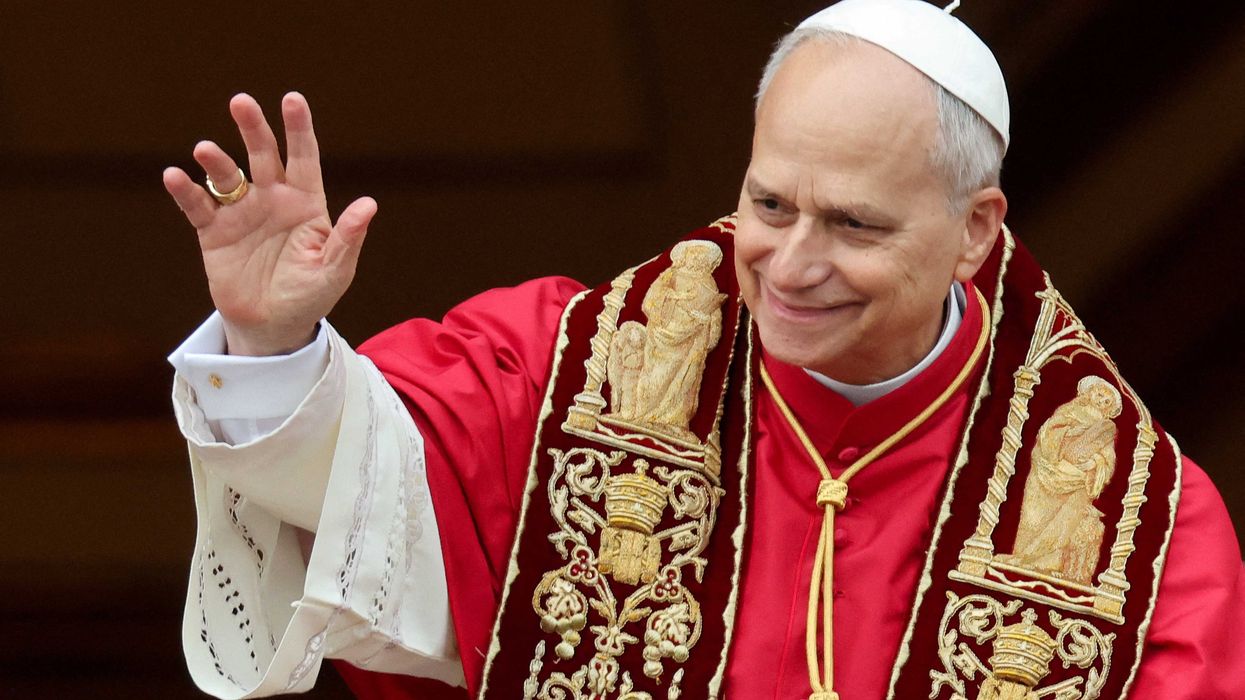
Pope Leo XIV gestures after delivering the traditional Christmas Day Urbi et Orbi speech to the city and the world from the main balcony of St. Peter's Basilica at the Vatican, December 25, 2025. REUTERS/Yara Nardi
One thing that the ongoing spat between President Donald Trump and Pope Leo XIV did was expose the hollow core of the Christian nationalism in his administration, one columnist argued on Thursday.
The New York Times' David French wrote that the spat between Trump and Pope Leo "may be the most important theological debate of my lifetime" for revealing how the administration's faith serves as a political prop but crumbles when confronted with actual Christian doctrine on war and morality.
Writing as the Pope finished up his packed 10-day trip across Africa, French explained that the one thing the new pontiff has exposed is that there is no real Christianity in Christian Nationalism.
His back and forth with Trump made it clear where he stands on war and peace, and his speeches across Africa on "global moral responsibility," aid for the poor, mentally ill, prisoners and others hammered the message home. He urged unity among all people, not just Catholics, calling on Christians in Algeria to strengthen ties with Muslims.
The result of Trump treating the pope "the way he would a freshman Republican congressman — trying to bully and bluster him into silence—" was outright failure, French said.
Trump brought the pope to the center of a national conversation about the war. A trip across Africa wouldn't normally have garnered much attention outside of religious publications and those who already follow it. But thanks to Trump, every word the pope said on the trip was reported, broke into the mainstream, and laid bare the "profound contrast between the two men."
"In this contest between a pope and a president, the president looks weak and erratic. He looks small. Between Trump and Pope Leo, there is only one man who is demonstrating strength and moral consistency on the world stage," French said.
The debate also made it clear that, despite its memes and public prayers, when the Christian part of "Christian nationalism" comes into conflict with the nationalist part, the latter prevails.
French cited Jesus’ words in Matthew 15: “These people honor me with their lips, but their hearts are far from me.”
Further, the columnist said, Pope Leo raised the level of debate about war beyond Catholics, with a public debate about philosophy and religion regarding the nuances of "just war theory."
French pointed to the Catechism of the Catholic Church, making the theory clear: “The strict conditions for legitimate defense by military force require rigorous consideration. The gravity of such a decision makes it subject to rigorous conditions of moral legitimacy.”
He then compared it to the Department of Defense's Law of War Manual, which describes the "just war doctrine" as part of a “philosophical foundation” of the law of war.
“The just war tradition remains relevant for decisions to employ U.S. military forces and in warfighting," the manual says.
French cited Edward Feser, a Catholic philosophy professor, who penned a piece not long after the war began, to explain how Trump's decision failed the just war test. Even if there was a "just" reason for the war as a preemptive strike to protect future people, the administration hasn't made that case.
"If you’re going to argue that you intend to liberate the Iranian people, you have to show how your intervention — no matter how well intentioned — won’t actually increase their suffering," said French.
While it might focus on Iran now, it goes beyond just war doctrine and international law because it can bind nations in a moral alliance if they agree to follow only that doctrine.
"It helps bind together alliances. It enhances the effectiveness of the armed forces. American history demonstrates that national unity in a conflict is almost directionally proportionate to the justice of the cause. Contrast, for example, the unambiguous virtue of defending ourselves from Imperial Japanese and Nazi aggression with the far hazier justifications for our extended war in Vietnam," wrote French.
He noted that if a just war can bring allies together, then an unjust war can certainly tear them apart. A good example is NATO's response to Trump's Iran war compared to NATO's willingness to help the U.S. after Sept. 11, 2001.
All of this draws a clear line between the rhetoric that the Trump administration uses about Christianity to justify "corrupt and lawless actions" and the realities of Christian theology.
"The administration wants all the benefits of religion and none of the burdens. It wants to be seen as godly while acting godlessly," French closed.
President Donald Trump and his administration talk a big game about their devotion to and support for religion, but in practice, their "high-octane condescension" exposes their "contempt toward Christianity," according to a new analysis from The Bulwark.
Mona Charen is a veteran writer and journalist who previously worked as a staffer for former President Ronald Reagan and as a speechwriter for First Lady Nancy Reagan. She is now an outspoken critic of Trump and his political agenda, writing for The Bulwark on Wednesday about the ways in which he has "revealed MAGA's anti-Christian nature."
"The past few days have featured the vice president of the United States lecturing the pope on morality and church doctrine; Sean Hannity making it official that he worships at the Church of Trump; Pete Hegseth quoting made-up verses from Pulp Fiction as if they were actual scripture; and Trump styling himself as Jesus Christ," Charen wrote. "A few years ago, one might have wondered how these acts of contempt toward Christianity would go down with the religious right, but after 10 years of cultishness, it would be foolish to expect many defections."
Speaking from her own background in the conservative movement, Charen called it "dizzying" to see "people who used to venerate religious leaders of all stripes" morph under Trump's influence into people who now "smack-talk the pope and commit what some have characterized as blasphemy." She took particular exception to Vance's "swipes at the vicar of Christ," in which he urged Pope Leo XIV "to stick to matters of morality," and "let the president of the United States stick to dictating American public policy," a set of assertions especially galling considering Vance's much publicized late-in-life conversion to Catholicism.
"You do Mass and baptisms and such and let us handle war and peace. That’s some high-octane condescension, but if he had stopped there, it would only have registered as normal MAGA insolence," Charen continued. "But no, Vance wasn’t finished. Speaking the next day at a Turning Point USA event, Vance rebuked the spiritual leader of 1.4 billion Christians (including himself: Vance converted to Catholicism in 2019) for his theology!"
While she herself is Jewish, Charen explained that she had always had an admiration for "serious Christians" and their commitment to doing good. In the face of Trump's contamination of right-wing religiosity, she called it "One of the sad revelations of our time" how MAGA has exposed "the shallowness of many Christians’ professed faith," becoming another in a long line of historical examples of faith being "perverted to enable cruelty and even atrocities."
"But the particular sacrilege that late stage Trumpism has adopted must be tearing at some hearts," Charen concluded. "From Trump’s declaration that unlike Erika Kirk, he doesn’t forgive his enemies, to his crude attacks on the pope as 'weak on crime,' to his insane AI rendering of himself as Jesus, he seems to be deliberately testing Christians’ forbearance. Above all, his threat to commit war crimes by deliberately targeting civilian infrastructure in Iran (bridges, power plants) and culminating in the maniacal vow to destroy Iranian civilization in one night ought to have produced a recoil in any nation with a conscience. Time to consider that he might be a false prophet—if people can distinguish truth from falsehood anymore."

No comments:
Post a Comment