Shallāl: On Water, Palestine, and the Grammar of the Unrelenting
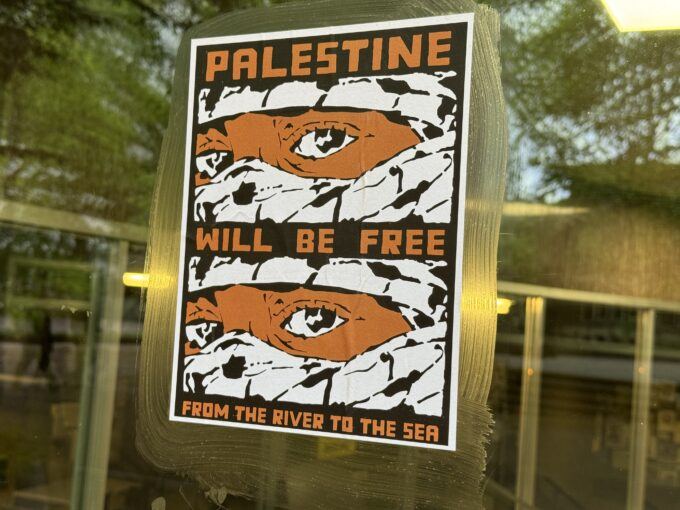
Photograph by Nathaniel St. Clair
I write this from Lenape land, Turtle Island, stolen and renamed New York. A land never ceded, never surrendered, never forgotten by the people it belongs to. I begin there because the day I’m writing this–March 30th–demands it.
This is the fiftieth anniversary of Palestinian Land Day. On March 30th, 1976, Palestinians took to the streets against mass land confiscations in the Galilee. Zionist security forces opened fire, killing six and wounding dozens. The land was taken anyway. Not a single professional body stood up to say a word.
Fifty years later: the demolitions in Silwan and Bustan continue. The West Bank is being annexed in real time. An eighteen-month-old child named Jawad Abu Nassar was detained on the first day of Eid, his legs burned with cigarettes, a nail driven through his leg, tortured in front of his father to force a confession. Last week, Francesca Albanese delivered her report to the Human Rights Council. She titled it simply: “Torture and Genocide.”
Empire is not hiding. It is governing.
I know many of you are reading this carrying an enormous weight. And I want to speak directly to that before I say anything else.
There are mornings when what I feel is not grief exactly. It is rage that has nowhere to go. A need to climb the highest mountain and scream, not words, not arguments, just sound, the kind of sound a human being makes when they have witnessed something that should not be possible and the world has not stopped. When the birds are still singing and the trains are still running and someone somewhere is complaining about the weather, and I am standing there holding what I have seen.
That feeling is not weakness. It is the correct response to what is happening. The problem is not that you feel it. The problem is that you feel it alone.
I want to offer you something. Not a reason to stop feeling what you feel. A frame for why our efforts are not wasted, and why your refusal to look away is a form of resistance.
The Arabic word for waterfall is shallāl, شَلّال. Arabic words are built from three-consonant roots that carry a core meaning, shaped by morphological patterns that determine how that meaning behaves. The pattern faʻal, with its doubled middle consonant, signals intensity, repetition, and continuity: an action that does not stop. The root sh-l-l relates to flowing and pouring. Placed in the faʻal pattern, it becomes shallāl: not water that fell, but water that keeps falling, relentlessly. The grammar forbids cessation.
A single drop of water evaporates in seconds, as though it never existed at all. But when streams find one another, when the current running through Jenin meets the current running through Minneapolis, when the water rising in Gaza reaches Beirut, Khartoum, Tehran, they become something the landscape cannot ignore. They carve through rock. They produce a sound so continuous it drowns out every voice that once claimed there was silence.
This is the physics of transnational solidarity. If the Empire’s adage is divide and conquer, transnational solidarity is to gather and prevail.
Empire knows this. That is why its first and most essential work is the fracturing of the human. What Frantz Fanon calls the zone of non-being is the fracture. Before the Empire draws a single border, it draws a line through being itself, teaching one side of humanity that its life constitutes life, and the other that its life does not. The very grammar of grievability, rights, and futurity does not apply to them.
From this fracture flows everything: the fragmentation of nations, the isolation of struggles, a structure designed to ensure each tributary believes it is alone. Palestine cannot find Sudan. Congo cannot reach Rwanda. Ferguson cannot hear Jenin. The fragmentation takes us away from the common denominator of all our struggles: necrocapitalism, coloniality of power, the structure that produces all of this death, all of this thirst.
The hiding is the point. Because if the water in Minneapolis recognized that the knee on George Floyd’s neck and the knee on Iyad al-Hallaq’s neck, a 32-year-old Palestinian man with autism, shot dead in Jerusalem five days later, are the same knee, the dam would not hold.
Consider the Mavi Marmara: a ship sailing toward Gaza in May 2010, carrying humanitarian aid and hundreds of activists from across the world. Empire boarded it in international waters and killed activists. And still the boats returned, because the faʻal forbids stopping. The sound they produced forced nations across Europe to respond, because the water had risen to a level that could no longer be ignored.
Transnational solidarity is the lived recognition that liberation is indivisible.
The gathering is real. The convergence is real. Every post you write that refuses the official silence, every conversation you refuse to drop, every moment you say the word genocide in a room that wants you not to: that is a stream finding another stream.
It may feel quiet now. As though the world has moved on. As though the current has stopped.
But this is winter. The shallāl does not stop. It gathers beneath the surface. It waits. And when spring comes, and spring always comes, it moves again with everything it has held.
Hope, here, is not optimism. It is not a claim that things are improving or that justice is imminent. It is not a claim that things are improving or that justice is imminent. Hope is structural. The faʻal does not wait for favorable conditions. It does not ask whether the rock will yield before it begins to fall. It falls. And in falling, it changes what it touches.
Empires can dam rivers. They cannot un-carve the canyon.
What you share registers. What you refuse to normalize accumulates. The Palestinian in exile and the Sudanese in exile recognize that their dispossession flows from the same source: that recognition is irreversible. It cannot be undispossessed.
The demolitions in Silwan are real. The annexation is real. The tortured child is real. The impunity is real. I do not diminish any of it by refusing to stop. I honor it by refusing to stop.
Palestinian Land Day has been observed for fifty years. The shallāl has been falling for fifty years, through siege, through exile, through every generation told it was the last one to hold this grief.
The morphology faʻal is not a promise. It is a description of what is already underway.
Do not give up.

No comments:
Post a Comment