The UK, Repackaged for US Culture Wars
Photograph Source: Shayan Barjesteh van Waalwijk van Doorn – CC BY-SA 4.0
Tiresome though it may be for some of us over here on Airstrip One, it seems domestic political argument in the United Kingdom is still being regularly repackaged for an American audience. As Motihari-born Eric Blair, later celebrated as George Orwell, once observed, “Political language… is designed to make lies sound truthful and murder respectable, and to give an appearance of solidity to pure wind.”
An odd patchwork of British figures—among them Liz Truss, Tommy Robinson, and Nigel Farage, continue, in varying forms, to present the United Kingdom to US audiences as a cautionary tale. Nor is this confined to the most recognisable names. When off-shoot figures such as Rupert Lowe appear on platforms with Tucker Carlson, the framing is much the same. The UK is cast as a scuttled country in sinking decline, awash with either liberal or technocratic elites, depending on the mood of the drowning that day. It is like watching all day long the radicalised in hot pursuit of the radicalised. One day the serpent will eat its tail and we will all be able to go home.
Truss, for instance, strutted into Dallas last week for the Conservative Political Action Conference, or CPAC, warning of “deep state” forces and advancing seriously contested claims about parallel legal systems in the UK. It seemed most unusual—when not in the US, she saunters around her neighbourhood here, close to where I am writing from, and always seems happy with her lot.
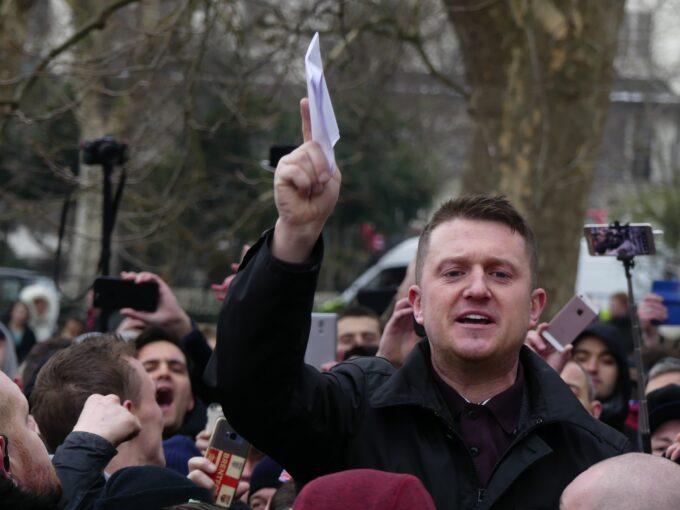
Robinson, meanwhile, has long gorged on the sprats of sympathetic US media ecosystems and donors, presenting the UK as best he can as an object lesson in the supposed dangers of immigration and the perils of restrictions on speech. Even when a complaint has a modicum of truth to it, why play so feverishly to a foreign gallery? It is as though our so-called lovers of country are unified only through a lack of love for said country when abroad. In fact, many reasonable people in the UK find the prominence afforded Robinson in the United States baffling, to say the least.
Farage has cultivated perhaps the most sustained transatlantic presence, from regular appearances on US cable news to campaigning alongside Donald Trump, though Trump was reportedly too busy to entertain him last trip. Farage’s interventions have often positioned a Brexit-era UK as part of a broader populist alignment, even if these also serve to bolster his domestic political profile.
Clocked from London, the overall impression is that parts of the American political ecosystem are not only flirting with insurgent-style movements in Europe, they are rhetorically in bed with them. During and after Brexit, slices of American conservatism openly cheered it as a model. Trump-era language around nationalism and “taking back control” pounded like migraine across many European debates.
More recently, protests and unrest in European countries have been amplified by US commentators, jumped on, even, as further evidence of liberal failure—a jack-booted kind of interpretation that can be so easily segued into moral encouragement for anti-establishment mobilisation, even when no formal coordination exists. Listen to Trump decrying not just Starmer but Macron as well. Hear the views of the present US administration on the likes of Orban. You would think they were terrified of the left. Frightened kittens. In recent days, Donald Trump has used Truth Social to cast the United Kingdom in unusually stark terms, folding it into the same narrative of civilisational decline he applies to domestic opponents. Watch the flowers of freedom wilt and slowly die. See the sky about to rain.
Trump’s rhetoric towards supposed allies, including the United Kingdom, maybe especially the United Kingdom, probably reflects a broader scepticism towards joining anything other than his own private club, rather than straightforward hostility. However, his repeated insistence that NATO partners are “not paying what they should,” alongside earlier criticisms of Theresa May’s handling of Brexit, signalled an unusual willingness by an American politician to intervene in domestic British politics, though Obama had earlier told Brits not to vote Brexit.
There is still little evidence of any truly coordinated US state effort to fund insurgent-style movements in Europe. However, there is a looser ecosystem of private donors, media platforms, and overbearing think tanks. Wealthy American backers, such as Robert and Rebekah Mercer, have supported transatlantic populist politics, while well-known figures like Steve Bannon have openly sought—albeit with limited success—to forge bonds between like-minded movements. More often, influence flows through amplification, through noise, not through direct financing. The din of discord, if you prefer. US media platforms and personalities grant visibility, legitimacy, and audiences that can be just as politically valuable as greenbacks.
By contrast, whatever people may think of the credentials of Keir Starmer as a politician, the UK prime minister adopts a very different vibe. Rather than engaging in tit-for-tat provocations, he has emphasised the legitimacy of institutions, as well as alliance cohesion. Where Trump seems to get off on kicking over tables, Starmer positions himself as a defender of process, stability, and good table manners. I suspect that some of us by now would far rather fall asleep listening to someone drone on, than have to watch our backs, check our pockets, and lock our doors the whole time. As an American—Thomas Jefferson—put it, though as an argument at the time for isolationism, “Peace, commerce and honest friendship with all nations; entangling alliances with none.”
At least this portrayal of the United Kingdom as a society in decline is far from uncontested within the UK. Albeit disputed as a number, half a million people gathered at the weekend in London for a rejection of the far right, though one or two groups in attendance were supporting continued violence in the Middle East. Political leaders across the spectrum, at different times, have rejected depictions of systemic collapse over here, while Sadiq Khan has repeatedly pushed back against claims in US media that London has become unsafe or ungovernable. UK institutions—from the Metropolitan Police Service to parliamentary voices—have often had to correct narratives that begin abroad. Commentators such as Rory Stewart warn that the UK risks becoming a kind of political theatre, its internal debates simplified and exported to serve ideological battles elsewhere. This may be the nub of the problem. We are being used and don’t even see it.
“The eye sees only what the mind is prepared to comprehend,” is a quote often attributed to Henry Bergson. In short, the American response to UK politics is loud, visible, and politically useful to actors on both sides of the Atlantic, particularly within media ecosystems that reward provocation and making things simpler. The noise, to be honest, is grinding. It may not be the whole story, nor a particularly intelligible transatlantic strategy. But it is a bugbear that increasingly shapes how the UK is perceived—and often misperceived—abroad.

No comments:
Post a Comment