From Gaza to Minab, the Same Story: Children Paying the Price of War
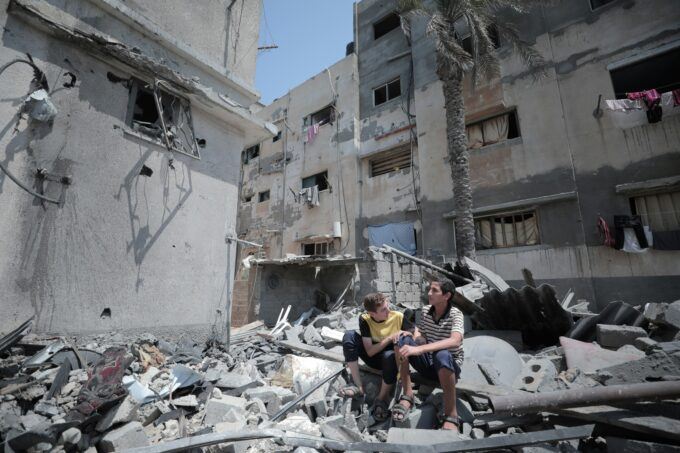
Image by Mohammed Ibrahim.
Those who had the misfortune of growing up in a war zone require no explanation. War is hell, it is true—but for children, it is something else entirely: a confusing, disorienting fate that defies comprehension.
There are children who live only briefly, experiencing whatever life manages to offer them: the love of parents, the camaraderie of siblings, the fragile joys and inevitable hardships of existence.
There are over 20,000 children in this category who have been killed in Gaza over the span of roughly two years, according to figures released by the Gaza Health Ministry and repeatedly cited by United Nations agencies. Some were born and killed within the same short timeframe.
Others remain buried beneath the rubble of the destroyed Strip. According to humanitarian and forensic experts cited by the United Nations Office for the Coordination of Humanitarian Affairs (OCHA), thousands of bodies are still missing under collapsed buildings, with recovery efforts hindered by the scale of destruction and lack of equipment. In some cases, extreme heat, fire, and the use of heavy explosive weaponry have rendered identification nearly impossible, meaning that many of these children may never be properly accounted for, let alone mourned at a grave.
These children will not have graves to be visited. And if they do, many will have no living parents left to pray for them. But we will always do.
And then, there are those who are wounded and maimed—tens of thousands of them. Visiting Amro, the wounded son of a relative who perished along with his entire family in Gaza, I witnessed one of the most heartbreaking sights one could possibly endure: the wounded and maimed children of Gaza in a Turkish hospital.
There were a few teenagers, many without limbs. Hospital staff had adorned them with the beloved Palestinian keffiyeh. Those who could flashed the victory sign, and those who had no arms raised what remained of their limbs, as if to tell every wandering visitor that they stand for something deep and unyielding, that their losses were not in vain.
But then there were the little ones, who experienced trauma without fully comprehending even the magnitude of their tragedy. They stared in confusion at everyone—the unfamiliar faces, the incomprehensible languages spoken around them, the empty walls.
My nephew kept speaking of his parents, who were meant to visit him any day. They were both gone, along with his only brother.
I was in kindergarten in a refugee camp in Gaza when I witnessed my first military raid. The target was our school. I still recall our teachers pushing back against soldiers as they forced their way into the building. I remember them being physically assaulted, screaming at us to run toward the orchard.
We began running while holding hands with one another. We were all wearing matching red outfits with stickers on our faces—none of us had any understanding of who these men were or why they were hurting the people who cared for us.
If the killing of children in Gaza, Lebanon, Syria, Iran, and across the Middle East is normalized, then it will become just another accepted feature of war. And since “war is hell,” we will all move on, accepting that our children—anywhere in the world—now stand on the front lines of victimhood whenever it suits the calculations of war.
I have thought about this often in recent years—during the devastation in Gaza, the wars across the region, and the killing of students at a school in the Iranian city of Minab.
Minab is not just an Iranian tragedy; it is our collective loss. Evidence from international investigations indicates that the strike on the Shajareh Tayyebeh school was not an accident, but the result of deliberate targeting within a broader military campaign.
Amnesty International concluded that the school building was directly struck with guided weapons. Investigations by major outlets, alongside US military sources, suggest the site had been placed on a target list despite being a functioning school. The result was devastating: children killed, families shattered, and yet another atrocity absorbed into the relentless rhythm of war.
The US administration may deny intent as often as it wishes. But we know that the killing of children is not incidental. It is evidenced in Gaza, where the scale alone defies any claim of accident. As UNICEF Executive Director Catherine Russell stated, “Gaza has become a graveyard for thousands of children.” That reality alone should end any debate.
I could pause here to tell you that all children are precious, that all lives are sacred, and that international law is unequivocal on this matter. I could invoke the Fourth Geneva Convention, which states that “protected persons (…) shall at all times be humanely treated,” and that violence against civilians is strictly prohibited.
Yes, I could do all of that. But I fear it would make little difference.
Everything we have said and done has failed Gaza, Lebanon, Syria, and much of our region. International law, once seen as a shield, has become little more than a point of departure for conversations about its ineffectiveness and hypocrisy.
Speaking to Palestinians about international law often generates not reassurance, but frustration and anger. So I will spare you that, too.
Instead, I want to make a call to the world.
A call on behalf of Amro, and the many others from our family who were killed, and the thousands more who perished; a call on behalf of the frightened children of the Flowers Kindergarten in my old refugee camp in Gaza: please, do not allow them to normalize the killing of children.
Do not settle for indifference, or mere concern, or even moral outrage that is never followed by action.
Trapped by His Own Image: Trump’s Iran War and the Politics of Ego

The judgment on the Trump administration’s war on Iran is already largely settled across mainstream media, public opinion, and much of the analytical sphere.
What remains supportive of the war is limited to two predictable camps: official government discourse and the president’s most loyal supporters, along with entrenched pro-Israel constituencies.
Beyond these circles, the war is widely understood as reckless, unjustified, and strategically incoherent.
Among the wider American public, this conclusion is not abstract. It is shaped by growing unease, economic anxiety, and a mounting sense that the war lacks both purpose and direction.
Since the outbreak of the war on February 28, 2026, polling has consistently pointed in one direction. A Pew Research poll in late March found that 61 percent of Americans disapprove of Trump’s handling of the conflict.
Another AP-NORC survey showed that six in ten Americans believe US military action against Iran has already “gone too far,” while even Fox News polling found 58 percent opposition.
These numbers confirm a broader trend that began early in the war and has only intensified. Reuters reported on March 19 that just 7 percent of Americans support a full-scale ground invasion.
In that same reporting, nearly two-thirds of respondents said they believe Trump is likely to pursue one anyway, highlighting a growing disconnect between policy and public will.
Days later, Reuters noted that Trump’s approval rating had dropped to 36 percent, with rising fuel prices and economic instability cited as key drivers.
The longer the war continues, the more its consequences are internalized by ordinary Americans, turning distant conflict into immediate economic pressure.
Among the American intelligentsia, opposition is no longer confined to traditional anti-war circles. It now spans ideological boundaries, including segments of Trump’s own political base.
Reporting from the 2026 Conservative Political Action Conference, The Guardian observed that many MAGA supporters warned the war risks becoming another “forever war.”
This convergence is significant, reflecting not a passing disagreement but a deeper structural shift in public perception.
Yet mainstream media—from CNN to Fox News—has largely avoided confronting what many Americans already recognize: that the war aligns closely with the agenda of Israeli Prime Minister Benjamin Netanyahu.
Within Washington itself, unease is also becoming more explicit. The Wall Street Journal reported in March that lawmakers from both parties are increasingly skeptical of the administration’s approach.
At the strategic level, the war’s foundational assumptions have already begun to unravel. Israel’s early calculations that escalation might trigger internal collapse in Iran have failed to materialize.
Iran’s political system remains intact, its leadership stable, and its military cohesion unbroken under Supreme Leader Ali Khamenei.
At the same time, Tehran has demonstrated its ability to retaliate across multiple fronts, targeting Israeli territory and US military assets in the region.
Its geographic leverage over the Strait of Hormuz continues to exert pressure on global energy markets, amplifying its strategic position despite sustained attacks.
The structural reality is therefore unavoidable. Regime change in Iran would require a massive ground invasion, a broad coalition, and a prolonged occupation.
Even under such conditions, success would remain uncertain, as the experience of Iraq has already demonstrated with devastating clarity.
This raises the central question: why continue a war whose strategic premises are already collapsing?
Part of the answer lies not in strategy, but in psychology. A substantial body of political psychology research, frequently cited in relevant 2026 analyses, describes Trump’s leadership style as deeply narcissistic. Traits such as grandiosity, hypersensitivity to criticism, and an overriding need to project dominance are not incidental—they actively shape decision-making.
Trump’s rhetoric has long relied on humiliation, domination, and spectacle, framing politics as a contest of strength rather than negotiation.
Within this framework, escalation becomes a psychological necessity. To retreat risks appearing weak, while compromise risks humiliation.
For a leader whose identity is built on projecting strength, such outcomes are politically and personally intolerable.
This dynamic is reinforced by the broader culture of the administration, where senior officials have repeatedly relied on language such as “obliteration” and “total destruction.”
Such rhetoric, however, has not been matched by evidence of a coherent long-term strategy, exposing a widening gap between performance and planning.
At the same time, the administration’s fixation on masculine power—on dominance, strength, and spectacle—has contributed to a profound underestimation of its adversary.
Iran is not a fragmented state waiting to collapse, but a regional power with decades of experience in asymmetric warfare and strategic resilience.
Yet Trump appears to have operated under the assumption that American power alone guarantees outcomes, an illusion reinforced by past displays of military force.
Reuters reported in late March that Trump is now increasingly pressured to “end the war” quickly, as the administration confronts what it described as “only hard choices.”
The same report cited officials acknowledging that there is no clear exit strategy, leaving the administration caught between escalation and political fallout.
One official told Reuters that there are “no easy solutions” left, underscoring the depth of the strategic impasse.
Another added that any withdrawal would have to be framed carefully to avoid appearing as a defeat, reflecting the administration’s concern with optics as much as outcomes.
This is where the psychological dimension becomes decisive. Trump has constructed a political identity rooted in strength, dominance, and victory.
A defeat in Iran would not simply be a policy failure; it would represent the collapse of that identity. For a leader driven by narcissistic imperatives, such a collapse is existential, threatening not only his political standing but his relationship with his own base.
This is why some analysts—and even figures within Trump’s own orbit—have begun to float a theatrical exit strategy. As Reuters reported on March 14, White House adviser David Sacks stated bluntly that the United States should “declare victory and get out” of the war on Iran, calling for disengagement despite the absence of a clear strategic outcome.
Such a move would allow Trump to claim success while disengaging from an increasingly untenable conflict, preserving the image of strength even in the face of strategic failure.
But this reveals the deeper truth of the war. The “victory” being pursued is not military—it is psychological.
The US-Israeli war on Iran is therefore not only a moral and legal crisis. It is also a geopolitical catastrophe shaped, in no small part, by the psychology of a leader unwilling to confront the consequences of his own disastrous decisions.


No comments:
Post a Comment