It’s possible that I shall make an ass of myself. But in that case one can always get out of it with a little dialectic. I have, of course, so worded my proposition as to be right either way (K.Marx, Letter to F.Engels on the Indian Mutiny)
Tuesday, April 07, 2026
Iran Continues Strikes on UAE Ports and Claims Hit on “Israeli Ship”
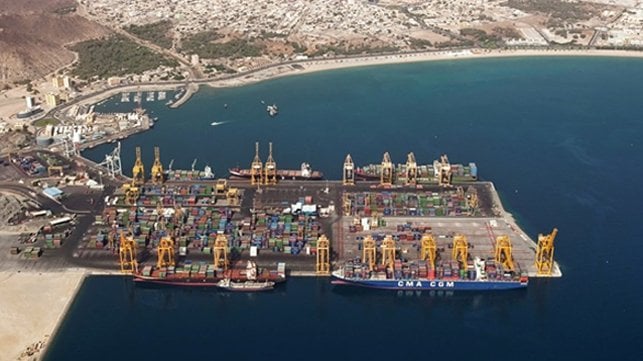
Four people were injured in Khor Fakkan and the master of a ship reported splashes no Sunday (Sharjah Customers)
Iran continues to strike out at ports in the UAE in what the Islamic Revolutionary Guard Corps (IRGC) is calling Operation Wave 97. Reports indicated a fire and damage at the Khor Fakkan Port, followed by claims that an “Israeli ship” was burning near the Jebel Ali port.
One of the official media outlets in the UAE, Sharjah Media, issued a series of reports on April 5 confirming the fire at Khor Fakkan on the western side of the UAE in the Emirate of Sharjah. It said the incident was due to debris from a missile intercept.
The official report said three individuals from Pakistan and one from Nepal were injured, with the Nepalese suffering a severe injury. The three Pakistanis were reported to have minor to moderate injuries. It resulted in a message of “deep concern” and new calls for de-escalation from Pakistan’s Prime Minister Shehbaz Sharif.
The report said the debris had caused a fire in the port. Later reports said the fire was contained and cooling operations were underway.
UK Maritime Trade Operations also reported that the master of a vessel alongside in the Khor Fakkan Port witnessed multiple splashes near the unnamed vessel. There were no reports of injuries or damage to the vessel.
The IRGC, however, in an unconfirmed report, that it had targeted an “Israeli ship” with a cruise missile near Jebel Ali. It claimed the ship, which they identified as “King Dao Star” (sic), was currently burning. Other reports said the ship was using an international identity to hide its association with Israel.
The likely vessel was the Qingdao Star (IMO: 9318163), commented Martin Kelly, Head of Advisory at EOS Risk Group. The 4,253 TEU vessel was built in 2006 and operated for Zim as the Zim Qingdao until 2023. The vessel (50,689 dwt) is now registered in the Marshall Islands and shows on Maersk’s schedule in the Gulf region.
Iran also claimed an attack on an MSC containership on Saturday near Bahrain. It also associated the company with Israel.
The attacks are part of the ongoing targeting of sites in the UAE with a total of nine ballistic missiles, one cruise missile, and 50 drones launched from Iran on Sunday and engaged by the UAE. On Friday, the UAE reported one person was killed, and four were injured by shrapnel at the Habshan gas facilities. Since the start of hostilities, the UAE reports it has intercepted over 500 ballistic missiles, 24 cruise missiles, and over 2,100 drones.
Traffic Through Strait of Hormuz Ticks Up, But Iran Retains Control
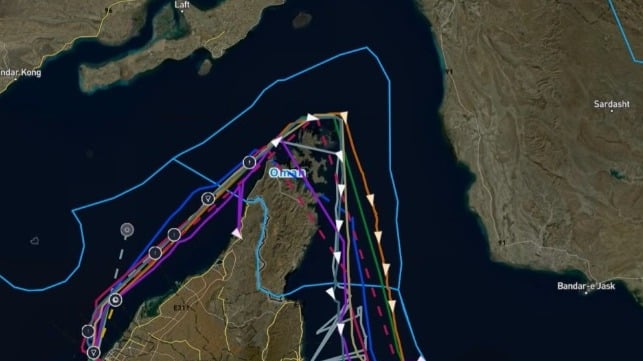
An Omani corridor takes shape: vessels transit close to Oman's waters in the new southern corridor (Windward Maritime AI Platform)
Transit volume through the Strait of Hormuz remains a fraction of what it was before the Iran conflict, but there are signs that outbound movement is picking up, according to maritime data consultancy Windward. In particular, a new trickle of transits through Omani waters appears to be holding steady at several vessels per day, suggesting that there may be a stable alternative to the "Tehran toll booth" at the north side of the waterway.
Windward's independent analysts counted 11 ships passing through the Strait on April 5. Fars News Agency - the outlet of the Islamic Revolutionary Guard Corps, which now controls traffic in the Strait - put the number somewhat higher at 15 vessels for the day.
Outbound transits continue to dominate traffic, according to Windward, suggesting that most IRGC transit permits are granted to allow ships trapped in the Arabian Gulf to leave. Much of the "tollbooth" tanker traffic is Iran's own energy commerce, as Iran continues to sell oil into global markets and profit from the tight supply environment.
The new Omani corridor is showing signs of life. Two to four vessels have used the route every day since April 2 - a meaningful change. The functional route appears to be a rare sign of diplomatic progress: an Iranian official claimed last week that Iran was coordinating with Muscat on a "monitoring" protocol for the strait, and the Omani foreign ministry confirmed Sunday that staff talks had been held with Iranian counterparts on "smooth passage through the Strait of Hormuz." Omani and Iranian technical staff "presented a number of visions and proposals" to each other for how to operate the strait, the ministry said.
However, traffic remains limited to a small fraction of normal amounts, says Sparta analyst Hoa Nguyen. "First, it is a drop in the ocean compared to pre-war levels. Second, lots of ships being included in the trackers are bulk carriers or containers. Third, the vast majority being outbound traffic with a tiny portion being inbound with links to Iran," he said in a research note Monday. "Only when inbound traffic [crosses] can we have any confidence in any normalization scenario."
For this reason, Iranian control is a strategic disadvantage for the GCC states, which have a high degree of economic dependence on the waterway. On Monday, top UAE diplomat Anwar Gargash told Reuters that "the Strait of Hormuz cannot be held hostage by any country," and he insisted that freedom of navigation must "be part and parcel of the settlement of any ?conflict" between Iran and the United States. The White House and Tehran continue to exchange threats and peace proposals; the most recent updated White House deadline for Iran to reopen the waterway expires at 2000 hours on Tuesday, at which point the U.S. and Iran may choose to escalate the conflict.
Multiple defense analysts predict that Iran will remain in control of the strait for an extended period, even in the event of escalation. For now, Tehran continues to demonstrate its de facto authority over navigation: it claimed Sunday that it has given permission for "brotherly Iraq" to use the strait unhindered; on the same day, Iranian authorities ordered two Qatari LNG carriers that were headed for the "toll booth" route to turn around and go back.
The traffic restriction has sent oil prices (and backwardation) soaring, specifically for deliverable barrels. Trading sources told Reuters Monday that traders are selling WTI Midland into Asia for July delivery at a premium of up to $30-40 over dated Brent, a sign of the tight market in the Gulf-dependent Far East.
Diesel prices have soared as heavier Arabian Gulf barrels exit the Asian refining mix and middle distillate output falls. In Singapore, diesel prices are running in the range of US$13 per gallon at the pump. In California, where energy prices are exposed to demand from the Asian market, retail diesel exceeded $7.50 per gallon statewide and breached the $8 mark in San Francisco - a national record.
Are Naval Forces Ready to Keep the Bab el Mandeb Open?
The Houthis' leaders have made their position clear. They stand alongside Iran and the Palestinians, and have demonstrated the Houthi ideological position by launching two drone and four missile attacks against Israel up until April 4, all successfully intercepted without causing any damage. The Houthis appear set on continuing these nuisance attacks designed to express solidarity, which in all likelihood will continue until the war against Iran comes to a conclusion. Alternatively, when the inevitable Israeli retaliation hits the Houthis, they may be tempted to try and increase the scale of their attacks.
In the meantime, the Houthis have advertised they are ready to resume attacks on shipping in the Red Sea and Gulf of Aden, at a time of the Houthi leadership’s own choosing, factoring in (but not determined by) appeals from Iran for support or by the clamor of popular sentiment.
If the Houthi leadership does decide to resume the attacks, then the impact on global energy supplies will be potentially even greater than the impact of the closure of the Strait of Hormuz – because the estimated five million barrels per day-plus of Saudi crude being shipped south from Yanbu through the Bab el Mandeb would cut into the bare minimum needed to keep critical services in Asia functioning.
So how would the world react to a resumption of Houthi attacks against shipping?
Unlike in the Strait of Hormuz, it has already been demonstrated that with a sufficiently strong naval presence, merchant shipping can get through the danger area, albeit admittedly with some casualties.
The threat, if it emerged, would no longer be one that Saudi Arabia could ignore, as it would compromise the Kingdom’s last open shipping route. This certainty would be one reason why the Houthis might not resume their attacks, because it would not only bring the Saudi Western Fleet into action, it would threaten the general ceasefire between the Houthis and Saudis which has been in place since March 2022. Since then, the Saudi Western Fleet has also been considerably strengthened with the addition of five Avante Class corvettes ordered by Royal Saudi Navy in 2018. These modern corvettes are each equipped with 64 Evolved Sea Sparrow Missile (ESSM) medium-range, surface-to-air missiles for engaging anti-ship cruise missiles and drones. Any Saudi involvement would also likely bring with it as well the Egyptian Navy, with whom the Saudis have had a very active bilateral naval support agreement since September 2025.
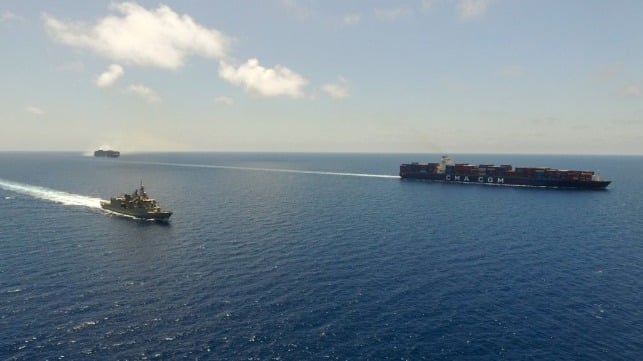
Already in place, patrolling the danger area from a base in Djibouti, are ships of the European Union’s Operation Aspides. Operation Aspides already has a mandate until February 2027 to intervene should there be a threat to civilian shipping, removing the lack-of-political-cover issue which often delays EU deployments. Currently the force is commanded by Rear Admiral Vasileios Gryparis from Greece, with tactical command afloat exercised by Italian Rear Admiral Milos Argenton from the Carlo Bergamini Class frigate Luigi Rizzo (F595).
As well as the Greek MECO 2000 Class frigate HS Hydra (F542), there are also probably two French vessels in the force, their identities as is normal not disclosed by the French, and the force is likely to also be able to call upon the Spanish Air Force CN-235 maritime patrol aircraft normally based in Djibouti. This experienced force could probably be quickly reinforced by the large numbers of European naval vessels defending the Republic of Cyprus, as only the British Sovereign Base Area in Cyprus has been threatened by Iran, rather than the Republic itself.
Asian navies might also be keen to join in, as a closure of the Bab el Mandeb would have direct and significant economic impact on Asian countries heavily dependent on Middle Eastern crude.
Although the United States Central Command would wish to assist in an operation to keep the Bab el Mandeb open, the mission to do so is formally allocated to Destroyer Squadron 50; DESRON 50 is heavily engaged elsewhere and might not have the resources to join in. Without DESRON 50 in the force, there would be a deficit both of tactical and overhead intelligence resources, but also of command and control capability.
Unlike for any potential operation in the Strait of Hormuz, there is a large enough potential naval force available to help keep the Red Sea and Gulf of Aden open to the merchant marine. The principal problem is that from a force command perspective, the Americans are unlikely to have the bandwidth to provide some key functionality. This deficit can probably be overcome, but only if someone is currently stepping up and working out how the leadership and coordination role is to be filled – because the requirement to act, in what would be a very complex air defense environment, could come soon and at very short notice.

No comments:
Post a Comment