
Venezuela: ‘In times of retreat, the priority should be preparing the counteroffensive’
First published in Spanish at Diario Red. Translation by LINKS International Journal of Socialist Renewal.
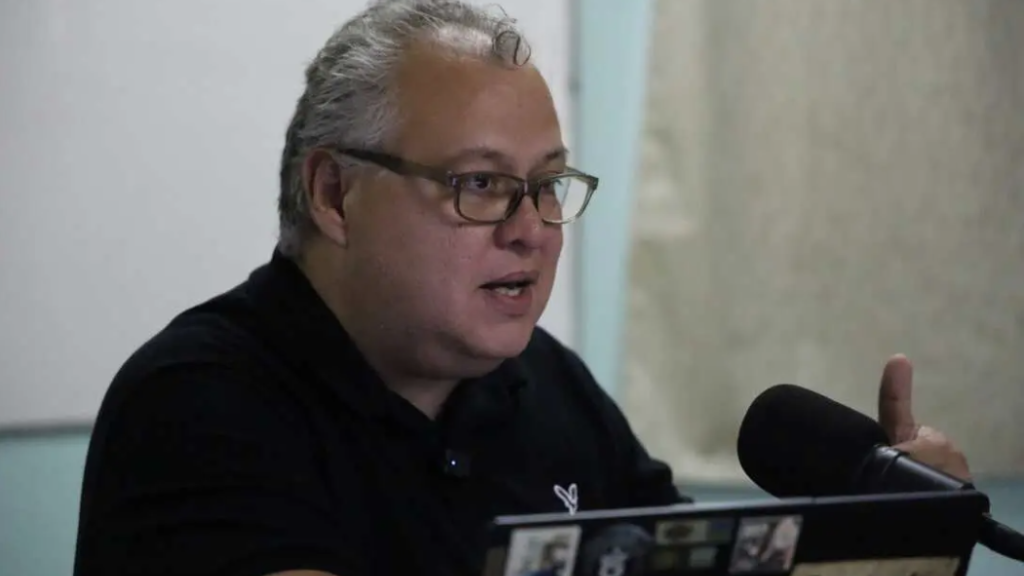
Reinaldo Iturriza is a Venezuelan sociologist, writer and political activist. In the early years of Nicolás Maduro’s presidency, he served as Minister of Communes between 2013–14 and then Minister of Culture until 2016. Since then, he has worked on grassroots intellectual and political education, creating the Centre for Studies for Socialist Democracy (CEDES) to support the complex and turbulent process of popular organisation in Venezuela.
Always insightful in discussing the trajectory of the Bolivarian Revolution, Iturriza does not shy from criticising a process that, he argues, has suffered over the past decade as “democratic life deteriorated and we saw a progressive weakening of the political class and its respective social bases.”
He describes the January 3 US aggression, which culminated in the kidnapping of Maduro and National Assembly deputy Cilia Flores, as an “invasion”. Iturriza also points out that it makes no sense to talk of “treason or loyalty” when it comes to acting president Delcy Rodríguez’s government and the conditions imposed on it by Washington. From his perspective, [the government] has carried out a “full-scale strategic retreat.”
Iturriza also develops his concept of “political disaffiliation” from Chavismo, and challenges the prevailing narrative about polarisation in his country. He also discusses the state of the communes and organisations of popular power.
Finally, Iturriza says “it is essential to create an effective narrative of the Bolivarian Revolution” that points out errors and limitations, but also “gives due credit” to its successes. “Our program was certainly suited to its time, consistent with our political culture, and successfully created a high-intensity democracy,” he argues.
While US aggression against Venezuela has been ongoing for decades, what happened on January 3 was unprecedented and disconcerting. This was due to the kidnapping of Maduro and his wife, but also because it was not a coup d'état in the traditional sense, at least not in terms of the usual White House script, which involves a change in government. How do you view what happened that day?
It was an invasion, plain and simple. A flagrant and criminal violation of our sovereignty, preceded by constant threats and provocations, as well as the murder of dozens of fisherfolk in the Caribbean Sea. More than 100 Venezuelan and Cuban internationalist military personnel in charge of protecting the president died in combat that morning.
Regarding a change in government, the first thing this exposes is the false claim that US aggression was motivated by anything even remotely concerned with democracy, just as the immediately preceding siege had nothing to do with the Venezuelan government’s alleged links to drug trafficking.
Clearly, the US government wanted to regain control of our strategic resources, starting with oil. Weighing up its options and considering possible scenarios, it concluded that the least traumatic way to achieve this objective was preserving the existing government.
How did we get to this situation?
Only someone with no political knowledge would dare state something like “we should thank the US for taking the first and decisive steps to free us from a tyranny that had been in power for 25 years, and which otherwise could have prevailed indefinitely.”
I mention this because Venezuelan society is not exactly known for being depoliticised. This is not only a self-serving version of events, but a very dangerous one, that seeks to defend the indefensible. It is a version of events trying to force its way in and aspires to become common sense. That is why it is essential to debunk it.
This requires emphasising that throughout the first decade of this century, and even the first half of the past decade, Venezuela was characterised by a high-intensity democracy in which the majority experienced remarkable progress in all aspects of their material and spiritual lives. We need to understand, then, what happened here during the past 10 years.
When did the turning point occur? What circumstances led to the loss of our high-intensity democracy?
[Italian Marxist] Antonio Gramsci provides invaluable analytical insights to start to understand this historic development. What we suffered was nothing more than what Gramsci called the “reciprocal destruction of the conflicting forces”, in which democratic life deteriorated and we saw a progressive weakening of the political class and its respective social bases.
This was the context in which, using Gramscian terminology, the “foreign sentinel” intervened on January 3. This foreign sentinel, it should be noted, played a leading role in the conflict by decisively supporting one side while working to undermine the national economy’s foundations [through the use of sanctions and other means].
As the weeks have gone by, it has become clear that Rodríguez’s government has largely accepted the conditions imposed by the US. Is this a “betrayal” or a temporary retreat with a view to sustaining the Bolivarian process in the long term?
Talking in terms of betrayal or loyalty to the cause contributes little or nothing to understanding the situation. Such opinions are part of what Gramsci himself, incidentally, called “petty, day-to-day political criticism.” Overusing historical analogies also does not help.
The government sought a rapprochement with certain factions of the capitalist class throughout 2016, and then implemented an orthodox monetarist program in 2018, which fundamentally sought to control hyperinflation but, among other things, meant unprecedented public spending cuts and wage freezes. I remember clearly how some colleagues at the time asked me, in good faith, whether this was similar to [Russian revolutionary Vladimir] Lenin’s New Economic Policy or, on the contrary, whether it represented the abandonment of the Bolivarian Revolution’s strategic programmatic banners.
I more or less responded that we needed an analysis of power relations and that, regardless of how it was described, the incontrovertible fact was that a recomposition of the ruling bloc was taking place. The working class, slowly but surely, was ceasing to be the backbone of that ruling bloc, as it undoubtedly was during the entire Chávez period and even during the first years of Maduro.
After January 3, the 1918 Treaty of Brest-Litovsk [signed by Soviet Russia with the Central Powers] was invoked to explain the peace agreement with the US government, in much the same way that [Russian dictator Josef] Stalin was previously invoked to justify anything because we were facing the far right and he defeated fascism.
Paradoxically, during the past 10 years we have been in similar situations to that faced by the Soviet Union in 1921, 1945, and 1918, yet today we can not say that, after each retreat, the Bolivarian process today finds itself in a better position to confront the future.
In retrospect, the facts point to a structural retreat or, more precisely, a full-blown strategic retreat.
A few days after January 3, you wrote that the popular reaction was one of “silence”. In that initial moment, there were no opposition celebrations, nor pro-government mobilisations; instead, the prevailing climate was one of “mourning for a humiliated homeland.” You also made an interesting point that “far from signifying consent with what had happened,” this marked a discontent that found no “no outlet for expression.” This is striking, considering the narrative of polarisation that has surrounded Venezuela for years, of an entire society divided between Chavistas and anti-Chavistas. Is there a vacuum of political representation?
Contrary to the usual narratives, Venezuelan society has become increasingly depolarised over the past 10 years, or we could say that polarisation has taken on new contours: the majority versus its political class.
I have argued that during this period no political phenomenon has been more significant, or had more far-reaching implications, than that of political disaffiliation. This is not a recent “discovery”; I first raised this in December 2015, in relation to parliamentary election results.
Analysed in depth, it was clear that the United Socialist Party of Venezuela (PSUV) defeat was due to an anti-government protest vote in electoral strongholds of Chavismo.
Significantly, despite historical differences and significant contextual variations, we did not see people celebrating in the streets after that defeat or January 3. That protest vote was a demand for the government to change course.
From the perspective of a significant portion of the social base that supports the Bolivarian Revolution, this course correction did not occur. On the contrary, it was precisely from that point on that the process of recomposing the bloc of forces intensified.
Why do you think this political disaffiliation occurred?
My working hypothesis is that mass disaffiliation from Chavismo, understood here as a political identity, is directly proportional to the gradual distancing of the governing political class from its working-class origins. In other words, to the extent that this political identity ceased to embody the interests of the popular majorities, these majorities ceased to feel represented by it.
This is what [Bolivian sociologist] René Zavaleta Mercado termed a political and ideological hollowing out of the popular classes. This hollowing out, though, should not be confused with depoliticisation. It refers to the fact that the main driving ideas that shape and give meaning to how they conceive of politics ceases to be associated with a specific identity.
This is very prevalent among youth: my generation (and even more so the generations before us) often lament the depoliticisation of youth. And yes, there is depoliticisation. But it is not uncommon to strike up a conversation with someone in their 20s from a working-class background and realise that several of the core ideas that historically defined Chavismo are still there; it is just that they lack political expression today.
This phenomenon is far from exclusive to youth. It describes the situation of the vast majority of Venezuelan society. This majority does not accept things like an invasion, but finds no way to express its profound discontent with the state of affairs.
You have been involved in the process of organising and building communes as Minister of Communes between 2013–14, but also as an activist and intellectual. This new form of popular organisation was an initiative of the Bolivarian Revolution and in particular Chávez. What are communes? What is their objective?
The communes, and before them the communal councils, can be understood as the political formula trialled by the Bolivarian leadership, and in particular Chávez, to organise that fraction of the working class that became the backbone of the movement: the subproletariat, understood as the poor who work, but whose labour does not guarantee them sufficient means to ensure their reproduction as a labour force.
I have elaborated this in more detail elsewhere, but briefly: the subproletariat was the subject of the popular rebellion of February 27, 1989 [known as the Caracazo]. During the neoliberalism of the 1990s, the subproletariat became the largest segment of the Venezuelan working class.
Excluded from the market, politics and citizenship, this sector became politicised under Chávez's leadership. It did everything possible to bring him to power. It defended democracy when it was threatened by the elites and led the huge street demonstrations that succeeded in reversing the 2002 coup. Months later, it was on the front line of resistance to the oil industry managers’ strike and sabotage, and the business owners’ lockout: the Bolivarian Revolution would not be defeated by hunger and unemployment.
In a country on the brink of economic ruin, this sector saw the recovery of the oil industry and experienced the effects of the first attempts at democratic redistribution of that income, an experience completely foreign to the subproletariat that has emerged in more recent times.
Citizenship and the market ceased to be forbidden territories: this sector progressively gained access to healthcare, education and food. Its neighbourhoods began to appear on official maps. Millions obtained identity cards for the first time. They achieved their most resounding political victory in the 2004 recall referendum, which decided whether Chávez would remain in power.
In 2005, the Bolivarian leadership faced the problem of how to organise a subproletariat that, by definition, did not work in factories, distrusted traditional forms of political intermediation, and demonstrated a huge vocation for political experimentation.
The answer, broadly speaking, was promoting popular self-government in the neighbourhoods. These self-governments were, among other things, to identify the productive potential of these territories and organise communities to develop it.
This was the context in which the first communal councils were created. Later, in 2008, when experiences of self-government began to show greater political potential, there was the first attempts to create communes.
The communes were conceived as having relative autonomy. This meant not being subordinate to any formal power, but also not functioning as small, self-sufficient communities, or tiny islands in the sea of capitalism.
In Chávez's words, they had to organise themselves in a network, “like a gigantic spider's web covering the territory with the new” but never outside the bounds of the strategic horizon of the Bolivarian Revolution. In this sense, they represented a kind of grassroots popular vanguard to implement the program of change.
What is the current state of community organising in Venezuela? How has this process been affected in recent years?
That is a good question, especially since it has become customary to appeal to the existence of the communes as a kind of political and even ethical reserve that could eventually counterbalance more authoritarian or conservative tendencies within Chavismo.
It is true that things are not going very well, and it is equally true that prospects are not encouraging, but on the positive side at least there are the communes.
However, it is important to emphasise that the past 10 years have been a time of recomposition of the ruling bloc, of huge political disaffiliation, and of an economic policy that has not prioritised the interests of the working class. These are times of managing the status quo, which means that the scope for political experiments has been reduced to historic lows.
To this we must add that after January 3, the US government essentially manages and decides how our income is spent. In other words, the problem is no longer even the scope of action of the communes, but the scope of sovereignty of the republic.
This question of the relative autonomy of the communes is now presented in a radically different context: it remains to be seen whether, beyond the possibility of managing very limited amounts of resources for the execution of very limited amounts of local projects, the communal leadership has the will and capacity to reaffirm its autonomy, not only in the face of state and party institutions, but predominately in the face of a foreign sentinel that intends to decide the nation's fate.
Donald Trump’s offensive in Latin America, in a global context of military escalation and the rise of the far right, presents a very complex scenario for leftist governments, movements and organisations. The aggression against Venezuela is compounded by the tightening of the blockade against Cuba and the pressure on progressive governments in the region. How do you see the future of Chavismo and the Bolivarian Revolution in this context?
Let me appeal once more to Gramsci: the analysis I have attempted here is not an end in itself. It is not intended to demonstrate lucidity, eloquence or anything of the sort. This analysis only makes sense if it aims to create the conditions for the political viability of “initiative of will.”
The onslaught of the far right on a global scale cannot be countered with wishful thinking or naïve pragmatism. There is no more effective incentive than this to develop the capacity to conduct the most rigorous and unflinching analyses possible of the balance of power. In moments of retreat, the priority must be preparing a counteroffensive. And this is impossible if we start from self-satisfied analyses or those that simply seek to reaffirm our victimhood.
In the battle of ideas, it is crucial to create an effective narrative about the Bolivarian Revolution. One that does not shy away from pointing out our errors or limits but, appealing to abundant historical evidence, gives due credit to our many successes, starting with the fact that we managed to outline a programmatic vision that was embraced by the popular majorities, who for the first time in a long time felt in control of their destiny.
The current state of affairs is not the inevitable consequence of an anachronistic program, alien to our ideas and customs, which carried within it the seeds of authoritarianism from its inception. On the contrary, our program was suited to its time, consistent with our political culture, and successfully created a high-intensity democracy. We need to account for the multiple and diverse causes that led to the interruption of this program.
The above will have to be done amid a profound crisis of political representation, so we have to be prepared to witness and even encourage the emergence of a new political identity that does not deny its national, popular and — why not — anti-capitalist character.
In the short term, what is essential is the convergence of all forces, regardless of their political leanings, to oppose the imposition of tutelage upon our nation. We are on the verge of new battles to recover our full sovereignty. This is just the start.
From blockade to tutelage: Sovereign funds, financial hegemony and economic subordination in Venezuela
“With ones’ eyes to the ground, the march resumes
until the next stumble, just a few steps away.
And history repeats itself…”
Subcomandante Marcos, Instructions for falling down and getting up
Six days after the United States military aggression against the Bolivarian Republic of Venezuela that occurred in the early morning of January 3, 2026, the White House published a presidential decree entitled Protecting Venezuela's oil revenues for the good of the American and Venezuelan people.1 The new executive order seeks to ensure that revenue derived from the sale of Venezuelan oil and diluents, which are being deposited in US Treasury Department accounts or funds on behalf of the Venezuelan government and its institutions, such as the Central Bank of Venezuela and PDVSA, cannot be seized or be subject to external legal proceedings by private creditors. The arguments used to justify this has focused on three points: first, any legal action would interfere with efforts to stabilise the country; second, to curb migration and drug trafficking; and finally, to minimise potential risks associated with the use of these funds by a number of foreign actors that the US labels as malign.
While the executive order states that the so-called Foreign Government Deposit Funds are the property of the Venezuelan government, they will be guarded and managed by a board of US establishment officials. The framework established by this decree envisions the special designation of these funds by the US Secretary of the Treasury, who must comply with the disbursement or transfer instructions issued by the US Secretary of State, who in turn must consult the US Attorney General and the US Secretary of Energy. In the real terms, Trump’s board of trustees is made up of Scott Bessent, Marco Rubio, Pam Bondi, and Chris Wright; who, paradoxically, must enforce sovereign immunity against any embargo, judgment, decree, lien, execution, withholding, or other legal process concerning the funds. The novel aspect of this executive order is that it is based on international comity as “deference to foreign government actors that is not required by international law but is incorporated in domestic law,”2 It is this deference that now marks the direction of this new stage in the relationship between the US and Venezuela’s national government.
One of the most problematic elements precisely concerns the illusion of sovereignty over these funds, as it ends up having merely declarative character while the actual exercise of sovereignty over Venezuela’s resources is subrogated. While prioritising the custodial nature of possession, the retention and administration of funds shall be held pending “sovereign disposition for public, governmental, or diplomatic purposes determined by the Secretary of State, on behalf of the Government of Venezuela.”3 This leaves Venezuela’s ability to use our resources subservient to the approval of a foreign power. By establishing that the US will maintain governmental authority, the Venezuelan state sees its power to regulate and exercise economic and financial administration of the income generated by the exploitation of its subsoil wealth and minerals diminished. This income contributes to real productive investment and social investment, as stipulated in Article 311 of the Constitution of the Bolivarian Republic of Venezuela.
The mechanism
Trump’s new executive order does not establish with precision the route that funds will take within the financial system; most of the details were provided by Marco Rubio during his testimony before the Senate. The mechanism consists of submitting a monthly budget that adheres to US-established parameters, which in turn would facilitate the issuance of licences by the Office of Foreign Assets Control (OFAC) for oil and blocked entities.4 This mechanism includes an auditing process paid for by the Venezuelan state, through which the US government can verify the proper use and destination of funds through several options, such as the Export-Import Bank (the official US export credit agency). Although only about $300 million had been disimbursed by the date of the hearing, via a temporary account in Qatar, Rubio assured that the funds would remain in Treasury-blocked accounts.5
The prohibition of any legal or judicial action against Venezuelan assets and property could be considered a positive development. Before this order, companies or creditors with judgments or claims against the Venezuelan state for past expropriations could seek to seize those funds through embargoes or lawsuits in US courts. The lifting of sanctions through OFAC-issued licences can also be viewed positively and as a sign of a possible “end of the blockade,” as general licences have recently been granted to Venezuelan oil companies and the government to purchase diluents from the US.6 But the situation is much more complex.
The US’ financial hegemony is not limited to its currency dominance in international trade; it is expressed as a coercive mechanism through the application of monetary policy, secondary sanctions, blockades, asset freezes and exclusion from the SWIFT system. Once funds are in blocked accounts, their availability is subject to US Treasury authorisation and administrative measures, adjusted to US interest rates and Federal Reserve dictates. Venezuela can not directly control how these resources are spent; this would be conditioned on economic policies that the US deems legitimate. As our loss of autonomy is made evident through Washington’s decisions, we also relegate our ability to dictate our own economic policy and use our strategic resources.
Some precedents
Executive Order No.14373 significantly shapes what, in recent months, has become known as the Donroe Doctrine. This stems from the new National Security Strategy of the United States of America. However, it is important to remember that on March 8, 2015, then-President Barack Obama issued Executive Order No.13692, which categorised Venezuela as “an unusual and extraordinary threat.”7 The Obama Decree, as it is colloquially known in Venezuela, was not the first regulatory instrument issued during his second presidential term; months earlier, US Congress sanctioned the Defense of Human Rights and Civil Society in Venezuela Act, with bipartisan support.8 The decrees, OFAC designations and other legislative instruments, as well as decisions by US courts, have been applied under the principle of extraterritoriality to economically, commercially and financially blockade our country, taking advantage of the predominance of its currency and the dependence on it of our banking system.
While we could point out that for decades numerous US decrees have frozen funds and financial assets of other countries, there is one particular precedent that shares many elements with the Executive Order issued on January 9. On May 22, 2003, two months after the invasion of Iraq, George W. Bush issued EO No.13303, Protecting the Development Fund for Iraq and Certain Other Property in Which Iraq Has an Interest. Through this, the fund created from Iraqi oil revenues after the invasion came under international administration, preventing those assets from being subject to lawsuits or seizures.9 As with the recent order on Venezuelan funds, the aim is to avoid litigation by private creditors, with a group of foreign officials having the power to take the necessary measures for its implementation.
One characteristic that these types of instruments generally share is their legal basis, mostly derived from the International Emergency Economic Powers Act (IEEPA) and the National Emergencies Act (NEA), which grant the US president the power to declare emergencies related to national security and foreign policy. Another parallel is that both decrees contemplate a redistribution of resources in circumstances where the US has intervened directly and a crisis management plan is underway: in the Iraqi case, reconstruction, and in our case stabilisation, economic recovery and democratic transition. As we have seen in Iraq’s case, the White House outlines a post-incursion plan that is part of a concatenated strategy: a new legal architecture that makes possible the formation of the supervised administration of the sovereign funds of a state that, in formal terms, is independent.
A new stage of domination
We could have focused on demystifying the pretexts used by the US to advance its foreign policy; we need only recall that we have endured more than 10 years of economic, financial and commercial blockade, which has worsened the material living conditions of the Venezuelan people, triggered an unprecedented emigration process, and resulted in unimaginable losses of national income. We could also compile a list of rights and principles violated by conditioning the use and disposal of resources that should be controlled by the Venezuelan state, according to domestic legislation and sovereign decisions. International law recognises that states and their property enjoy immunity from the jurisdiction and enforcement of courts of another state. What is concerning is that officials from other countries are assuming governmental authority over sovereign immunity, which constitutes one of the nation’s inalienable rights (see Article 1 of the Constitution of the Bolivarian Republic of Venezuela).
The Venezuelan people have the right to self-determination and the right to development, on the terms that we, the Venezuelan people, decide. Given the absence of voices challenging this new instrument of coercion, and considering that the decree of US executive orders was condemned for years due to the principle of extraterritoriality with which they implemented their designs, demonstrating US interference, it is necessary to analyse what is happening to us now. What is at stake now is sovereignty, not as an abstraction but as a real and concrete exercise that impacts our present and future.
During years of economic, financial and commercial blockade against Venezuela, US imperial policy and financial hegemony attempted to suppress the exercise of sovereignty over our hydrocarbons and resources; today, however, we are witnessing a more advanced stage. We are facing tutelage, that is, the administration of the nation’s strategic resources by a foreign power, within a new framework that erodes any genuine exercise of sovereignty. Venezuela is serving as a showcase to Latin America and the rest of the world of the consolidation of a model of domination that, under the rhetoric of advancing economic stabilisation and democratic transition in the hemisphere, has in fact become more voracious and expansive.
Ana Gabriela Salazar is a Venezuelan researcher focused on human rights and migration. As a political analyst, she is a frequent contributor to opinion outlets such as Aporrea.org, where she writes about issues of sovereignty, geopolitics, and the impact of international sanctions on Venezuela.
References
Dodge, W. S. (2015). International comity in American law. Columbia Law Review, 115(8). https://columbialawreview.org/content/international-comity-in-american-law/
Export-Import Bank of the United States. https://www.exim.gov/about
Face the Nation. (2026, January). Rubio defends Trump administration's actions in Venezuela at Senate hearing: Key moments [Video]. YouTube. https://www.reuters.com/business/energy/trump-signs-order-protect-venezuelan-oil-revenue-held-us-accounts-2026-01-10/https://www.reuters.com/business/energy/trump-signs-order-protect-venezuelan-oil-revenue-held-us-accounts-2026-01-10/n-oil-revenue-held-us-account
The White House. (2026, January). Fact Sheet: President Donald J. Trump safeguards Venezuelan oil revenue for the good of the American and Venezuelan people. https://www.whitehouse.gov/fact-sheets/2026/01/fact-sheet-president-donald-j-trump-safeguards-venezuelan-oil-revenue-for-the-good-of-the-american-and-venezuelan-people/
Official Gazette of the Bolivarian Republic of Venezuela. (2009, February 19). Constitution of the Bolivarian Republic of Venezuela, No. 5,908 Extraordinary, with Amendment No. 1 approved by the sovereign people. https://www.cgr.gob.ve/assets/pdf/leyes/Constitucion.pdf
Scheyder, E. (2026, January). Trump moves to block courts from seizing Venezuelan oil revenue in US accounts. Reuters. https://www.reuters.com/business/energy/trump-signs-order-protect-venezuelan-oil-revenue-held-us-accounts-2026-01-10/
- 1
Presidential Actions, Safeguarding Venezuelan Oil Revenue for the Good of the American and Venezuelan People: https://www.whitehouse.gov/presidential-actions/2026/01/safeguarding-venezuelan-oil-revenue-for-the-good-of-the-american-and-venezuelan-people/
- 2
Dodge. W. International Comity in American Law. Columbia Law Review. Vol. 115. December 2015.
- 3
Safeguarding Venezuelan Oil Revenue for the Good of the American and Venezuelan People.
- 4
Secretary of State Marco Rubio Before the Senate Committee on Foreign Relations on U.S. Policy Towards Venezuela, https://www.state.gov/press-releases/
- 5
The US has transferred the remaining $200 million from the oil sale to Venezuela, see: https://finanzasdigital.com/eeuu-200-millones-venezuela-venta-petrolera/
- 6
Office of Foreign Assets Control. Venezuela Sanctions Regulations. General License No. 47, Authorizing the Sale of U.S.-Origin Diluents to Venezuela, see: https://ofac.treasury.gov/media/934891/download?inline
- 7
Executive Order 13692 of March 8, 2015, Blocking Property and Suspending Entry of Certain Persons Contributing to the Situation in Venezuela: https://ofac.treasury.gov/media/5906/download?inline
- 8
Venezuela Defense of Human Rights and Civil Society Act of 2014 https://www.govinfo.gov/app/details/PLAW-113publ278/summary
- 9
The American Presidency Project. Executive Order 13303, Protecting the Development Fund for Iraq and Certain Other Property in Which Iraq Has an Interest, see: https://www.presidency.ucsb.edu/documents/executive-order-13303-protecting-the-development-fund-for-iraq-and-certain-other-property
U.S. Moves to Secure Venezuela’s Gold as Influence Deepens After Intervention
- The U.S. has brokered new gold deals with Venezuela as part of a broader push to reshape the country’s resource sector under its influence.
- Venezuela is opening its oil and mining industries to foreign investment to rebuild output after years of decline.
- Serious concerns remain over environmental destruction and human rights abuses linked to mining in the Orinoco region.
Since the United States intervention in Venezuela on January 3rd, which effectively brought an end to President Nicolás Maduro’s 13-year dictatorship, the Trump administration has had a heavy hand in Venezuelan politics. The U.S. has made it clear that any new political leader, who is currently interim President Delcy Rodriguez, must cooperate with Washington. The U.S. has also staked its claim to vast quantities of Venezuelan crude. However, oil is not the only resource that the U.S. has shown an interest in, as the Trump administration imports millions of dollars’ worth of gold from the South American country.
President Trump has had a strong hold in Venezuela’s oil industry since January and has been encouraging U.S. oil and gas executives to invest in Venezuela’s energy sector. Venezuela is thought to hold the largest crude oil reserves in the world, but years of underinvestment in the country’s energy industry have caused output to dwindle. To increase output, Venezuela must attract high levels of foreign investment to its oil and gas industry to rebuild it from the ground up.
President Trump has said that Venezuela’s oil resources were stolen from the U.S., in reference to the expropriation of assets from U.S. businesses in 2007, suggesting that the U.S. has the right to dominate the South American country’s oil business. However, international law guarantees that countries have permanent sovereignty over their own natural resources, which cannot be exploited by foreign powers without consent. Nevertheless, interim President Rodriguez has, so far, complied with Trump’s requests to hand over Venezuelan oil to the U.S. and open the country’s oil and mining sectors to foreign investment.
In early March, reports broke that the United States planned to broker a multimillion-dollar gold deal with Venezuela. It was reported that the global commodities trader Trafigura
planned to purchase between 650 and 1,000 kg of gold doré bars – a semi-refined bar with a gold content of around 98 percent – from Venezuela’s state-owned mining company, Minerven, to be refined in the United States.
During his two-day visit to Venezuela in March, U.S. Interior Secretary Doug Burgum discussed the potential for the future of the country’s mining industry with President Rodriguez, alongside representatives from around 20 U.S. mineral companies. Burgum stressed that the Venezuelan government provided security guarantees to mining companies interested in investing in the mineral-rich south of the country, where guerrillas, criminal gangs, and other illegal groups continue to operate.
The Trump administration authorised a limited licence for the export of Venezuelan gold in March, announcing the move on the U.S. Department of the Treasury’s website. The license allows Minerven to export, transport, and sell Venezuelan gold to the U.S. within specific parameters. However, it forbids the sale or exchange of Venezuelan gold to Cuba, North Korea, Iran, or Russia.
On March 25th, the U.S. Interior Secretary, Doug Burgum, said that the U.S. had recently brought back $100 million of gold from Venezuela. “There hadn’t been a shipment of precious metals between Venezuela and America in over 20 years,” Burgum stated during a CERAWeek conference in Houston. Burgum said that U.S. refiners would use the gold for commercial and consumer purposes.
This marks the third extraction contract overseen by the Trump administration since the U.S. intervention in Venezuela in January, and a significant shift away from its previous policy of sanctions on the South American country’s energy and resources. Minerven and other state-owned industries previously faced strict U.S. sanctions on trade under both former President Hugo Chavez and Maduro. The move forms part of a broader effort to stabilise and reconstruct Venezuela’s economy under U.S. influence.
The Trump administration has shown great interest in Venezuela’s natural resources, including its vast coal reserves that contain critical minerals, as well as its rare earth metals reserves, including coltan and thorium. Burgum said that Venezuelan mining presented a major opportunity and that it is “an industry that’s been in complete collapse in Venezuela, and they know that. It’s down to just artisanal miners controlled by gangs, [with] probably some of the worst environmental practices in the world.” Burgum added, “They (the government) want a clean environment, they want to have modern investment, they want to see growth in their country.”
While the purchase of Venezuela's gold could provide a much-needed boost for the country’s economy after years of stagnation, there are significant concerns around Venezuela’s existing mining operations. In 2016, then-President Maduro signed a decree creating the Orinoco Mining Arc, a 112,000 km2 area rich in gold and other minerals. However, the region has since become a hub for crime, political and military corruption, and smuggling. In addition, mining activities in the Arc have been devastating to the environment, with activities expanding into the protected natural areas of the states of Bolívar and Amazonas.
UN reports on the Orinoco Mining Arc have warned of serious human rights violations, including slavery and trafficking, and suggest that purchasing gold from the region can be equated to buying “blood gold”. It also said that license 51, granted by the Office of Foreign Assets Control to Minerven, “perpetuates ecocide and launders criminal wealth”. To develop legitimate mining operations in Venezuela will likely, therefore, be a gruelling task with several hurdles to overcome along the way.
By Felicity Bradstock for Oilprice.com

No comments:
Post a Comment