New Worlds Still to Conquer: Caesar Storms Berlin
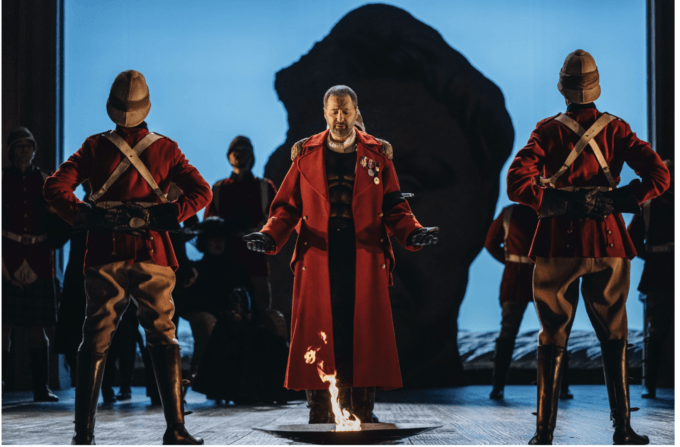
Christoph Dumaux as Caesar in Handel’s Giulio Cesare at the Deutsche Oper Berlin. Photo Nancy Jesse.
He came, he saw, he conquered. Then he went—first to the New World, before returning to the Old.
His victories began in England: this invincible hero of the operatic stage—Handel’s Giulio Cesare as staged by David McVicar. The director was subsequently knighted by Queen Elizabeth, not least for his breakthrough at Glyndebourne Opera in the summer of 2005. The production is said to be the most successful in the history of that famous festival. Over the next years, McVicar’s Giulio Cesare invaded the Lyric Opera of Chicago, the Metropolitan Opera in New York, and last week stormed the Deutsche Oper in Berlin.
McVicar’s initial triumph took place in 2005—that’s 2,060 years after the Roman general and his legions had landed on Britannia’s south coast, not far from the Glyndebourne opera house.
In contrast to Alexander the Great, who supposedly wept because there were no more worlds to conquer—and to whom the power- and fame-hungry Roman was compared in Plutarch’s Parallel Lives—Handel’s Giulio Cesare, as reimagined by McVicar, still has plenty of operatic territory to subdue. Beijing glimmers across the waters; the Moon shines above. Or Giulio could even be tempted to launch an off-world conquest of the planet whose color matches the coats of the pith-helmeted Brits that McVicar marches into Egypt, in a transposition of imperial expansion from Rome to Great Britain. Square-rigged ships of the line cut through the blue Mediterranean waves that roll at the back of the raked, perspectival Baroque stage lined by square columns.
Right after the curtain rises, the libretto has a chorus of Egyptians hymn Caesar’s victory (in Italian, of course—the language of Handel’s operas):
Long live our Alcides! [i.e., Hercules]
Let the Nile rejoice today!
Every shore smiles for him,
Every grief has vanished.
In polished boots, Caesar strides down the center of the stage, lined by his troops, a rolled-up campaign map in his gloved hands. He then sits down, is brought a glass of Scotch, and proceeds to knock off a killer aria—vocal prowess as a weapon of conquest: “Let the land of Egypt now / offer its palms to the victor!” After flexing his musical muscles and geopolitical might, he declaims his most famous line, as ever in his own account of his epoch-making deeds, in the third person: “Cesare venne, e vide e vinse”—Caesar came, he saw, he conquered.
Back in 2005, the United Kingdom was two years into the Iraq War, having joined a former junior partner now ascended to CEO of the shared enterprise of trying to keep the sun from ever setting on the English-speaking empire.
Still to be marveled at on video through Glyndebourne’s streaming service, the color and cleverness feast the eyes, dazzle the ears, and shake up and play on the emotions. Dubbed “legendary” by the company’s own PR machine, these four-plus hours of opera fly by, especially for well-heeled Brits in their afternoon tuxedos and gowns in the English countryside, laughing along with Caesar as a kind of Lord Nelson who slashes and smooches his way to colonial glory, singing a song of seduction and nation-building in a Middle Eastern country as he goes.
Unlike Handel, McVicar plays this enterprise for laughs, with fey servants, a cross-dressing villain, and bathing beauties playing peekaboo with the audience. But he also leans into the depravity, as when the widow of the murdered Pompey—Caesar’s fellow Roman and adversary—is presented with his head on a silver plate in an early scene. McVicar also fills the piece with delightful Orientalist dancing, choreographed by Andrew George, and fabulous costumes that mix golden breastplates and jodhpurs, fezzes and laurel wreaths, black-sequined cocktail dresses of the Roaring Twenties, and silver lamé hoop skirts of an updated eighteenth century. The upstage naval vessels of Robert Jones’s fabulous set design likewise draw freely on transhistorical and transcultural markers, as when, instead of frigates, dreadnoughts are seen ruling the waves after Caesar has pulled himself from those same waters, from the depths of defeat, and made his late-in-the-show comeback. Finally, a cutout of the Queen Mary arrives to take the royal pair of Caesar and Cleopatra on a tour of their shared realms. The promiscuous play of British-Roman signs is glib, never risking irony. The romanticizing of imperialism makes the whole show as effervescent as the expensive bottles of champagne those well-heeled opera-goers uncork during their Glyndebourne picnics.
Now in the midst of a run at the Deutsche Oper, McVicar’s battle-tested staging remains unbeatable. Its original success had not only to do with McVicar’s genius for melding and morphing cultural and political signifiers, but also with his ability to draw on the unique talents of his tremendous cast, from gymnastics to whistling—and, of course, brilliant and beautiful singing. French countertenor Christophe Dumaux was a member of that original cast as Tolomeo, the bad brother of Cleopatra and adversary of Caesar. Back in 2005, Dumaux flexed, flipped, strutted, and sang the angular, haughty music that profiled the character’s treachery, arrogance, and childishness. Two decades later, the lithe Dumaux has a bit of added heft and a few gray hairs in a stubbled beard and closely shaven hair, but his voice is as sharp and agile as it ever was, though also more textured. He never falters in Handel’s sheets of coloratura, the dramatic leaps, or the flamboyant trills. The sometimes blinding tempos set by the otherwise generous conductor Quarta never faze the singer; yet Dumaux has a magnificent way of sometimes riding just behind the beat without ever giving the impression of difficulty. With these metrical subtleties, he demonstrates who is really in command: interpretation and technique contribute to his convincing and complex portrayal of a man who is not so much torn between love and duty as certain he can have it all—glory on the battlefield and in the bedchamber.
In the second of the opera’s three acts, Caesar begins to rush from the stage to meet Cleopatra (though at that point he still thinks she is actually a servant called Lydia), but then he hears a bird sing. He takes the birdsong as a challenge and spends eight pastoral minutes in a delightful duel with the musically virtuosic creature. The avian musician is voiced not by a flute but by a violin, played on stage with natural purity and untroubled charm by Paul Kropfitsch, wearing a waiter’s tuxedo, tie, and vest, and a black fez—“Se in fiorito ameno prato”:
If in a pleasant, flowery meadow
a songbird conceals itself
among the leaves and flowers,
its song sounds all the sweeter
to the ear.
Caesar sits down on the stage floor, like those he’s conquered, and is brought tea. He settles in for a long contest during which he comes to recognize and respect the talents of his interlocutor. The challenger becomes a colleague. In Berlin (as in England back in 2005), the aria closes with an anything-you-can-do-I-can-do-better cadenza that even flies free from instruments and language into birdlike whistled exchanges. The joyful interspecies banter conveys a moving message about communication and play: music becomes an antidote to violent conflict.
As during the Glyndebourne campaign of 2005, the Americans are in another war, though this time the British aren’t joining in. The “Special Relationship” is showing serious signs of strain.
As redcoats strode the stage in Berlin, King Charles (whose ancestor King George I had been a great opera fan and patron and heard the original London production of Giulio Cesare in 1724) was in America, singing for his supper. Trump rewarded his country by lifting the tariff on whisky like the kind drunk by McVicar’s Caesar from Glyndebourne to Berlin.
Far from the Berlin stage and the farce in the American capital, the humongous American aircraft carrier USS Gerald Ford headed home from its deployment in the Red Sea after a non-combat fire broke out last month. I’m for converting the behemoth into a carrier not of military conquest but of operatic forces headed for port theaters of the world, to be led by Dumaux’s Giulio Cesare. On its flight deck, with Handel, war will be sung of but never made.

No comments:
Post a Comment